
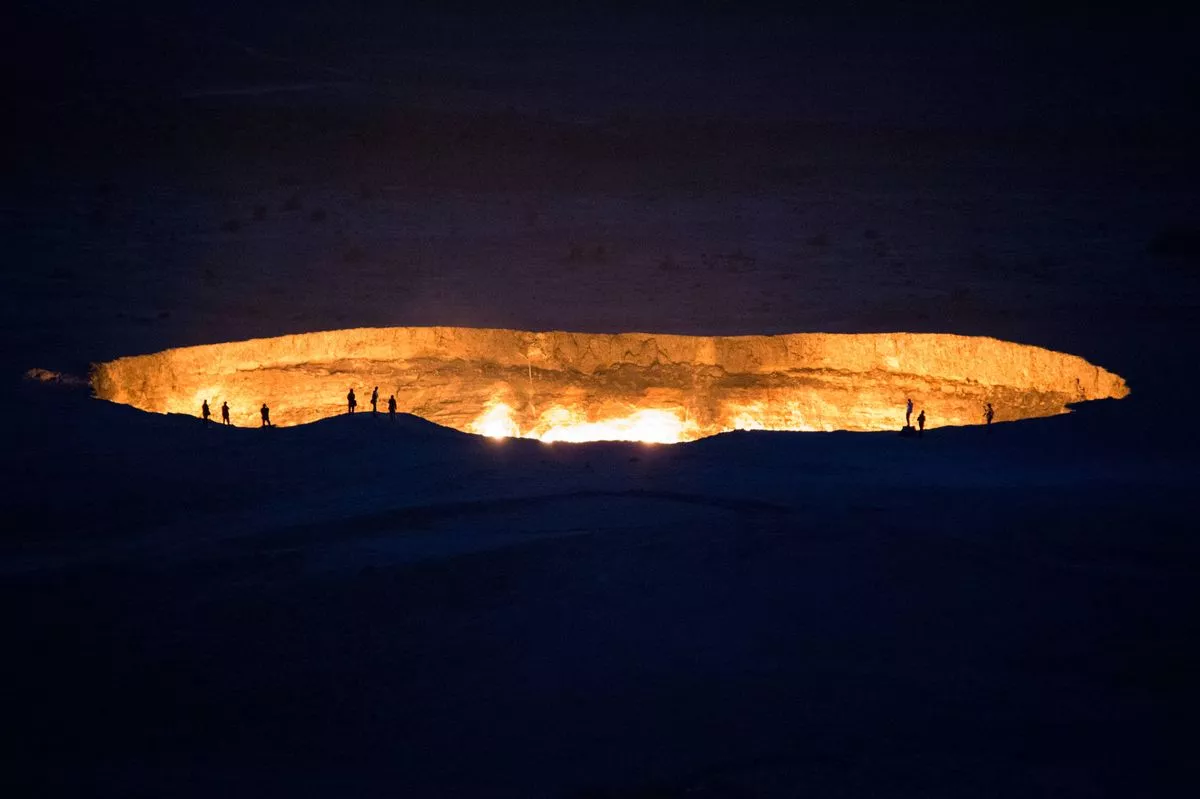
The apocalyptic site, dubbed a ‘doorway to hell’, exists right here on Earth and has been burning since 1971 — only one person is known to have ever descended inside.

Straight out of a dystopian thriller, a fiery ‘Gate to Hell’ exists right here on Earth.
This ominous sight, located in Turkmenistan, has been aptly named the ‘Doorway to Hell’, having first been set alight back in 1971. Over half a century later, it’s still burning. The Darvaza Gas Crater, locally known as the Shining of Karakum, is a blazing sinkhole that’s been spewing out natural gas since 1971.
Legend has it that Soviet geologists accidentally collapsed a natural gas chamber while drilling and subsequently set it on fire in an attempt to contain the lethal gases and prevent them from spreading. What the engineers anticipated would be a flame extinguishing itself within a few weeks has now been burning for over 50 years (hardly surprising given that the country ranks fourth globally in natural gas reserves).
Interestingly, Turkmenistan holds no official records of the incident as relevant documentation is either classified, inaccessible, or missing from the archives – consistent with the country’s policy of secrecy. This ‘Gate to Hell’ can be found ablaze near the village of Darvaza, nestled in the heart of the Karakum Desert, and measures approximately 60-70 meters wide and 98ft deep.
The hellish pit can be seen from miles around and has become a major tourist attraction for Turkmenistan, reports the Daily Star. Despite the seemingly inhospitable conditions of this blazing chasm, visitor accounts suggest that, astonishingly, there may be some signs of life within the crater.
The only known human descent into the crater was undertaken by Canadian explorer George Kourounis. In November 2013, Kourounis ventured to the bottom of the Darvaza Gas Crater with National Geographic, aiming to gather soil samples for the Extreme Microbiome Project to investigate potential signs of life in the crater’s harsh environment. Equipped with a specialised heat-resistant suit, Kourounis managed to spend roughly 17 minutes inside the fiery abyss.
During the thrilling exploration episode, Kourounis described their mission as “looking for alien life right here on Earth”, given that the crater’s hostile, methane-rich environment mirrors that of certain planets found beyond our solar system. And indeed, they discovered signs of life. Kourounis’ expedition unearthed several types of bacteria in the soil from the crater floor.
Recounting his experience of the apocalyptic ‘Door to Hell’, Kourounis said: “It is burning with a tremendous amount of flame like there is a lot of fire down there. Day or night, it is clearly burning. You can hear the roar of the fire if you stand at the edge. The heat, if you are downwind of it, is unbearable. There are thousands of little flames all around the edges and towards the centre. It’s a very volatile place.”
Now, in a dramatic twist, after blazing fiercely for more than 50 years, it appears the flames in this ‘Gateway to Hell’ are at last dying down, though gradually. During a press briefing in June this year, Irina Luryeva, a director at Turkmenistan’s state-owned energy firm Turkmengaz, revealed to the world that the crater was finally burning out, stating: “The reduction [in fires] is nearly threefold. Whereas before a huge glow from the blaze was visible from several kilometres away, hence the name ‘Gateway to Hell’, today only a faint source of combustion remains.”