Angie Martinez hid her explosive Tupac interview for 30 years. Why did she decide to finally press play?
There are few voices in New York hip-hop radio more recognizable than Angie Martinez. For over 30 years, the sound of her magnetic Brooklyn swagger and love for hip-hop transmitted through her microphone on Hot 97 FM and Power 105.1 FM, cementing her title as “The Voice of New York.” But on a recent fall evening in L.A., the hip-hop radio legend is dealing with the pain of losing a part of her that’s much less admired than her radio voice — her appendix.
“I’m really struggling right now, I’m gonna try not to laugh, cry or sneeze,” she tells The Times during an interview with a warm smirk on her face. Her hair is slicked back into a braided ponytail as she slowly sips hot lemon ginger tea and picks at cubes of Monterey Jack cheese and thin marbled slices of prosciutto on a charcuterie board.
Even sitting down in the tranquil, low-lit ambience inside the lobby of the 1 Hotel in West Hollywood, Martinez is trying to avoid agitating the slowly healing stitches on her abdomen underneath her thick gray hoodie. Though having the vestigial organ surgically removed at age 55 isn’t totally unheard of, its timing coincides with her extracting a piece of her history in hip-hop that she’s finally ready to share with the world.

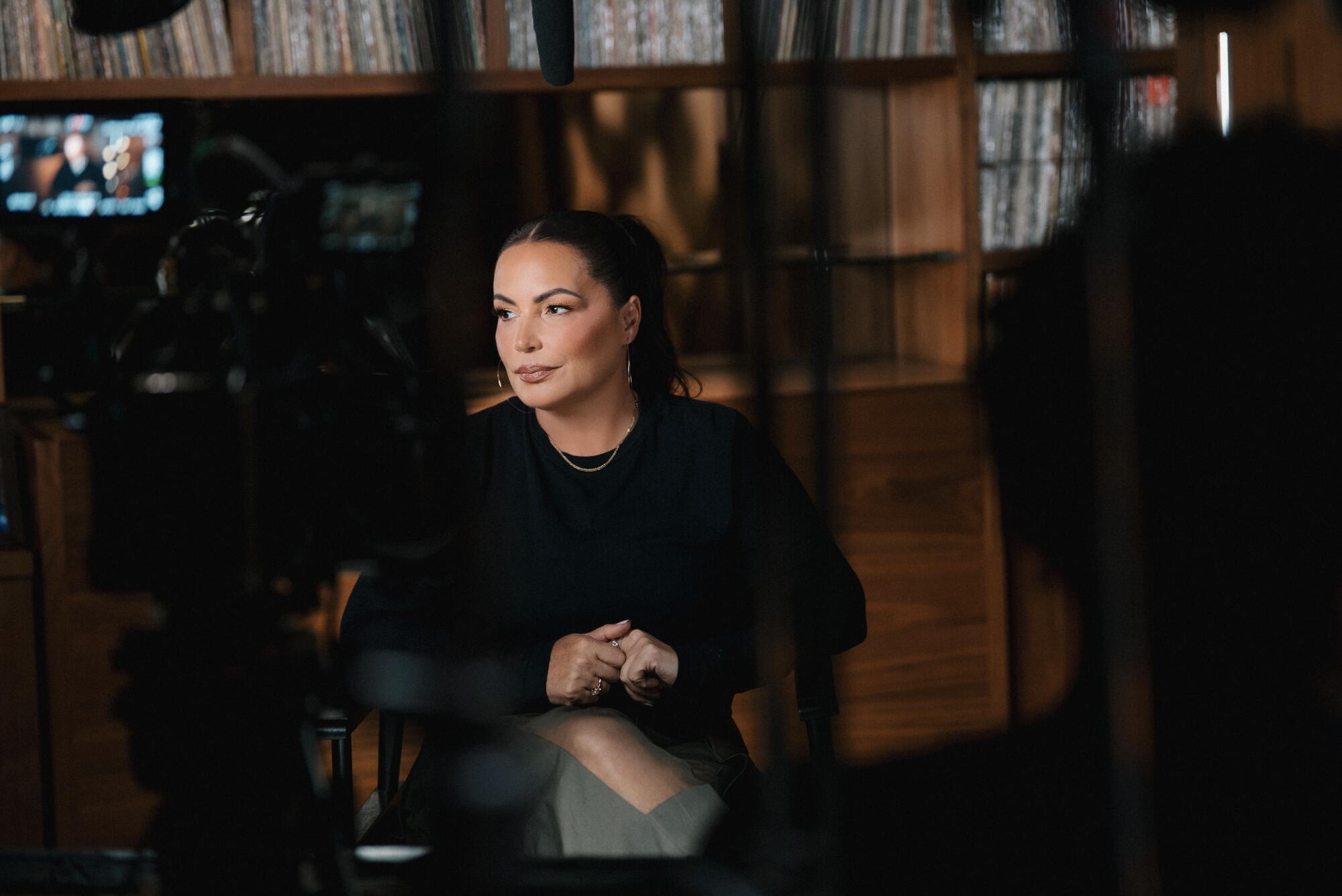
Angie Martinez on the set of “The Tupac Tapes.”
(Netflix)
The cassettes of an unreleased two-hour interview she did with Tupac Shakur inside his L.A. apartment in 1996 were recorded three months before he was fatally shot in Las Vegas. But 30 years after the conversation, her decision to co-produce and host “The Tupac Tapes With Angie Martinez,” a four-part video podcast that premiered Friday on Netflix, is her way to honor the West Coast hip-hop legend and examine their eye-opening conversation through a modern lens. It exposes why Martinez, who showed up to the Shakur interview as a bright-eyed, 25-year-old rising personality sporting chunky hooped earrings and a Nautica T-shirt, turned out to be the perfect person for the job. She’s also the person who would keep the recordings hidden for years out of respect for the damage they could’ve done.
“I don’t feel I’m the person to make the Tupac documentary, but I am the person to tell the story of how these tapes came to be, what the climate was for me, especially in New York, how it felt as a young woman going out there to do that,” Martinez said. “That’s my story to tell.”
In the summer of 1996, Martinez sat with Shakur (surrounded by his g-funk proteges, the Outlawz), with just a microphone and a tape recorder. Her intent was to help quash the legendary beef between Shakur and Notorious B.I.G., a.k.a. Biggie Smalls, at the height of the media-fueled East Coast/ West Coast rap war. But when they started talking, Pac’s anger directed at Biggie — his friend-turned-rival — along with now disgraced Bad Boy Records CEO Sean “Diddy” Combs (who is in prison) and acts like Mobb Deep did the exact opposite. Martinez ultimately decided to cut out the bulk of her interview and only broadcast a select 12 minutes on air, leaving the rest to be hidden away until now.

Angie Martinez and Tupac Shakur in his L.A. apartment in 1996.
(Netflix)
The explosive sit-down didn’t come about in the way most big interviews typically do. Shakur had initially asked Martinez to appear in his music video for “I Ain’t Mad at Cha” — which she politely declined. Not only did she have no desire to be a video girl, but with the East-West rap rivalry inciting violence across the country, an N.Y. radio DJ being involved with Pac’s latest hit would’ve made her a prime target for hometown hate and possibly worse.
“I was just trying to protect myself,” she remembers. “And he understood that, and he was lovely on the phone.”
Shakur had a special level of trust in Martinez as a voice on the radio he deemed credible. During his time in a New York prison serving eight months on a sexual assault conviction, hearing her fair approach to reporting about him on Hot 97 FM enticed him to follow up his music video request with an offer to do an interview with her that she could use for the radio. He said he’d be willing to talk about his feud with Biggie that erupted when Shakur was nearly killed after being ambushed, robbed and shot five times at Quad Recording Studios in Manhattan in 1994. Surprisingly, Shakur said his rage wasn’t meant to be directed at the entire East Coast. Born in East Harlem, he spent his formative years in New York and Baltimore before relocating to Oakland and later L.A., where his rap career took off.

Rapper Tupac Shakur poses for photos backstage after his performance at the Regal Theater in Chicago in March 1994.
(Raymond Boyd / Getty Images)
“He was just like, ‘I wouldn’t be mad at the whole coast. That’s f–ing stupid,’” Martinez recalls. “He was laughing, very personable, not this big, bad, scary person. I thought if I could just get everybody to hear what I’m hearing on the phone, everybody could calm down.”
But what transpired over the course of the interview in ‘96 — which Martinez unpacks during four hour-long episodes for Netflix — was nothing close to kumbaya. The tapes capture an unvarnished time capsule of rage and Shakur’s frustrations with the justice system, various rappers and former members of his friend circle, the media and the world. He talked about how street warfare, incarceration and philosophies ingrained in him by the Black Panther movement, of which his mother, Afeni Shakur, was a prominent leader, caused his life to be in danger on a daily basis. Three decades later, Martinez guides several panels of experts on Pac’s life — including Charlamagne Tha God, Joe Budden, Big Boy, Dream Hampton, RZA, Wallo, Matt Barnes, E.D.I. Mean, Lil’ Cease, Ed Lover and others — to break down Shakur’s fiery rhetoric. At times, his answers to Martinez’s questions ranged from poetic and revolutionary to nonsensical and cringe by today’s standards.
From his sexual relationship with Faith Evans, Biggie’s then-wife, to surviving the Quad shooting and retaliating against anyone who he believes crossed him, it’s obvious why broadcasting these tapes on the radio in the ‘90s at the height of the epic rap beef between Tupac and Biggie would’ve been the airwave equivalent to an atomic bomb. On top of that, there are aspects of Shakur’s philosophy on women, homophobia and threats of forced sodomy against the rappers Prodigy and Havoc of Mobb Deep that have definitely aged poorly.

DJ Hed, from left, Big Boy of Power 106, Martinez, podcaster Bootleg Kev and former L.A. Laker Matt Barnes pose during a panel discussion for “The Tupac Tapes.”
(Netflix)
“When you hear this interview, yeah, some of it’s uncomfortable and weird and doesn’t age well,” Martinez said. “We can sit and talk about a recollection of s— that happened, but when you’re listening to an actual audio tape, there’s no prettying it up. It is what it is. He said what he said. I said what I said. Memory is one thing, but actual artifacts don’t lie.”
After listening back to the tapes for the first time in years while putting the Netflix podcast together, Martinez is often critical of herself in hindsight. Would she have challenged Shakur a little more on some of his rhetoric during the interview? Could she have decided on a different 12 minutes of their conversation to air on the radio that might’ve gave us more insight into Tupac the man instead of his myth? The answer to all of that, she says, is undoubtedly yes.
“In that moment, I just was like, ‘Oh man, he’s pissed. I can’t help this situation. It’s so bad.’ But now I’m like, damn, he was hurt, he was angry. But he also had so much going on inside of him,” she says.
Throughout the Shakur interview, a younger version of Martinez struggles to grapple with the rapper’s narrative. While trying to deescalate boiling tensions with reasonable questions, her ability to get the rapper to see where he may be wrong in his perception went beyond her role in hip-hop media. She speaks to him as a friend and a peer trying to stop him from getting in his own way. In the modern era where viral social media clips rule the internet, this kind of unfiltered discussion could probably never have happened.
“Today everything we do is looked at and analyzed, and especially if you do anything high-profile, it’s all out there for the camera even if you’re not a celebrity,” Martinez said. “Everything any of us do in the age that we live in is up for grabs. And I think Pac, yes, he was up for grabs, but I just think he operated like he was not up for grabs. He was just fearless.”

“I don’t feel I’m the person to make the Tupac documentary, but I am the person to tell the story of how these tapes came to be, what the climate was for me, especially in New York, how it felt as a young woman going out there to do that,” Martinez said. “That’s my story to tell.”
(Joshua J. Argue)
While pursuing the podcast project at Netflix, Martinez reached out to his estate, which was aware of Martinez’s project. However, she says the estate did not participate because of a preoccupation with the long-awaited conclusion of the trial for the rapper’s 1996 murder. That ended in August with Duane “Keffe D” Davis being convicted of first-degree murder with the use of a deadly weapon for orchestrating the fatal shooting in Las Vegas. But it was important that Shakur’s family was represented in the project, so Martinez made sure to include people like Pac’s cousin, entertainment executive Aiyisha T. Obafemi, and Erica Ford, who founded anti-violence group the Code Foundation with Pac and his stepfather, Mutulu Shakur, in 1994.
“It was important to me also that in any panel discussion, that at least one person actually knew Pac,” she said. “I did my best, could there have been other people involved, sure. I could make a list sitting here with you right now of 10 people I would’ve loved to talk to. But with my resources and what we were making, I made what felt right in the moment and I felt really good with how everyone showed up.”
Martinez was adamant she was not trying to do something for the sake of cashing in on Shakur’s legacy, but to add to the wealth of knowledge about his tragically short life 30 years later in the hopes of helping the world better understand him as “a perfect storm of a human being.” At various times she said Shakur’s spirit let her know she was on the right path with the project through a handful of “God winks,” whether it was one of his songs coming on her stereo, or the lights flickering out on the set of the podcast during filming — not once, but twice.
“I don’t claim to be all-knowing. That’s why I didn’t want to make a documentary. I don’t think that’s my place to make a Tupac documentary,” she said. “The story that I’m qualified to tell is these tapes in this very specific moment with this extraordinary person from my very unique seat in the culture. Otherwise what else is there to do? Am I gonna go to the grave with it?”