tumble

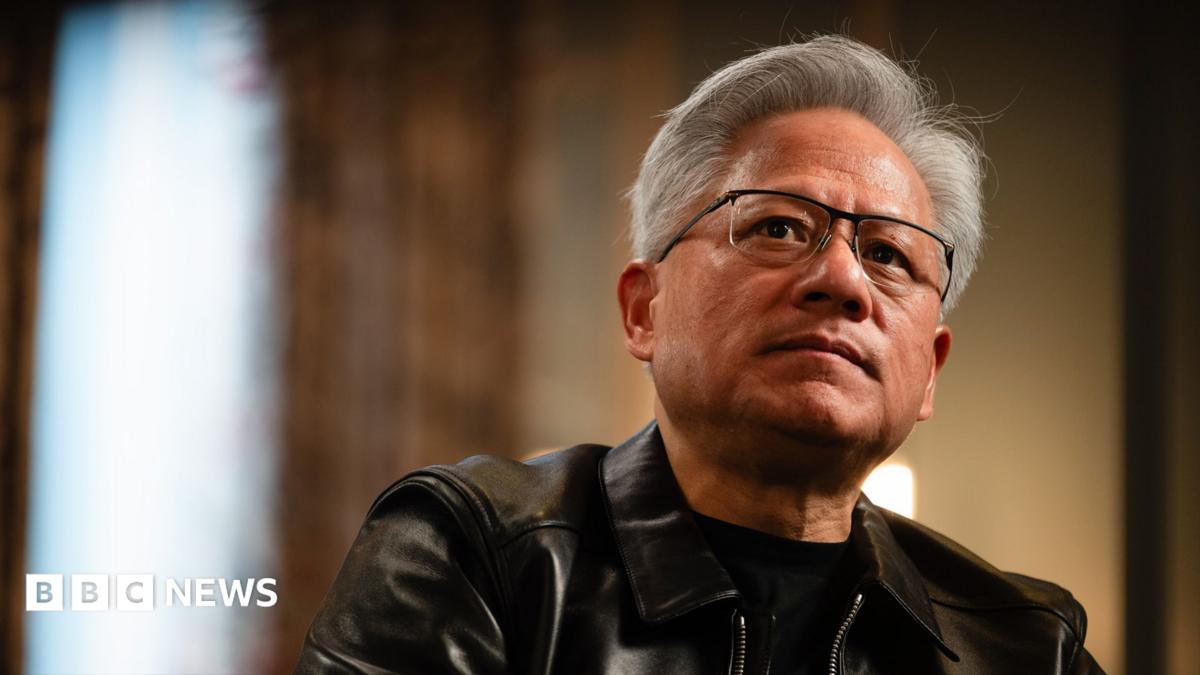
Nvidia shares tumble over investigation into Huang’s affair with alleged Chinese spy

Hundreds of billions of dollars have been wiped off the value of Nvidia after the US chipmaker announced an independent investigation would be carried out into its chief executive’s affair with an alleged Chinese spy.

The tech firm saw its shares fall by about 6% on Monday after Jensen Huang admitted having an extramarital affair.

Nvidia’s probe came after reports that the US believed the Nvidia boss had been targeted in an espionage campaign by China.

However, China has rejected the claims, with its foreign ministry saying “allegations about Chinese spies were “entirely groundless, speculative and intended to smear and malign China”.

Nvidia said it had no reason to believe the company’s secrets or national security were compromised, but a statement by the firm’s board of directors said it would begin an investigation in “light of recent reporting that founder and chief executive Jensen Huang has been the target of a foreign intelligence effort”.

US intelligence officials believe Alice Huang, also known as Huang Le, was a spy for Beijing, according to a New York Times report, external.

The report said Secretary of State Marco Rubio sent a memo to top officials in Washington last spring warning that the Nvidia boss was in a close relationship with a Chinese spy.

Alice Huang was managing director of Singaporean company Megaspeed, which has had dealings with Nvidia.

Huang admitted he was “unfaithful” to his wife and apologised for hurting her and their children. He added he was “committed to protecting Nvidia and supporting America’s national security” and would cooperate with the investigation.

The Nvidia co-founder has also been requested to appear for a joint closed-door briefing for several Congressional committees next week.

Members of the US House Foreign Affairs Committee last week asked Huang to appear for a closed-door briefing on his interactions with Alice Huang, as well as Nvidia’s security protocols around espionage.

“Recent reports raise significant national security concerns regarding the PRC’s [China’s] access to sensitive US technology and information,” congressmen Brian Mast, John Moolenaar, and Rick Crawford wrote in a letter.

“It is vital that Congress determines the extent to which US national security has been placed at risk.”

After Nvidia’s investigation was announced, other big tech bosses, including Elon Musk, came out in support of Huang to continue leading the firm.

US President Donald Trump said the Nvidia boss was an “honourable guy”.

However, the news sparked a sell-off in Nvidia’s shares, with about $250bn (£190bn) wiped of the company’s market value.

Source link

US tech stocks tumble as investors fret over AI spending | Business and Economy News

Tech-heavy Nasdaq falls 2.6 percent as debate rages over whether AI is a bubble.

US tech stocks have dropped sharply amid market jitters over the sustainability of companies’ enormous capital investments in AI.

The Nasdaq Composite, which is dominated by tech firms linked to the AI boom, fell 2.6 percent on Thursday, its steepest fall since the index tumbled 4.2 percent on June 5.

Recommended Stories

list of 4 itemsend of list

The broader S&P 500 slid 1.21 percent, the benchmark’s biggest drop since a 1.52 percent decline on July 29.

Apart from Apple, each of the “Magnificent 7”, which make up more than one-third of the overall market, saw substantial losses.

Meta dropped nearly 7 percent after it raised its projected capital spending for this year to $135bn to $145bn in its latest earnings report, even as the Facebook parent company’s net profit fell short of expectations.

Amazon fell 4.6 percent, while Nvidia dropped 4.4 percent.

Tesla and Alphabet both fell 3.1 percent, while Microsoft declined 2.2 percent.

Apple rose 1.2 percent.

The sell-off extended to other major tech players, including Intel and Advanced Micro Devices, both of which fell about 8 percent, and Broadcom, which slid 4.3 percent.

Rising oil prices since February, due to the fallout of the US-Israel war on Iran, added to the downbeat mood.

Brent crude futures rose 4 percent on Thursday and continued to climb on Friday morning, taking the international benchmark above $114.20 a barrel, its highest since May.

Stocks slip in Asian trading

Major stock markets in Asia opened lower on Friday, following the losses on Wall Street.

Japan’s benchmark Nikkei 225 fell more than 2 percent in morning trading before recovering some ground, while South Korea’s KOSPI dropped as much as 3.5 percent.

The Hang Seng Index in Hong Kong fell about 0.5 percent.

Jay Goldberg, a senior analyst at Seaport Research Partners in San Francisco, said the swings in the market appeared to be driven more by sentiment than underlying fundamentals.

“In short, nothing has changed. Investors have just decided to be afraid this week. Everyone I speak to points to a different cause for the downfall … It’s just a giant wall of worry,” Goldberg told Al Jazeera.

“There are legitimate concerns about the AI trade, but this level of shift in the markets is driven much more by investor sentiment than any tangible reason.”

US tech companies’ huge investments in AI have stoked intense debate about whether a market bubble is forming similar to the one that preceded the 2000 dot-com crash.

While some Wall Street analysts view current levels of investment in datacentres and graphics processing units as unsustainable, others argue that AI will revolutionise society to a degree that justifies the eye-watering sums involved.

Global AI investment is forecast to reach $2.7 trillion in 2026 and $3.6 trillion in 2027, according to technology insights company Gartner.

Source link