Put away the trumpets. Pack them up, put them in the attic, let them collect some dust.
Nobody wants to hear them.
Nobody wants to be subjected to one more triggering, off-key note of an Edwin Díaz dirge. Not anytime soon, not in any high-leverage moments for the foreseeable future.
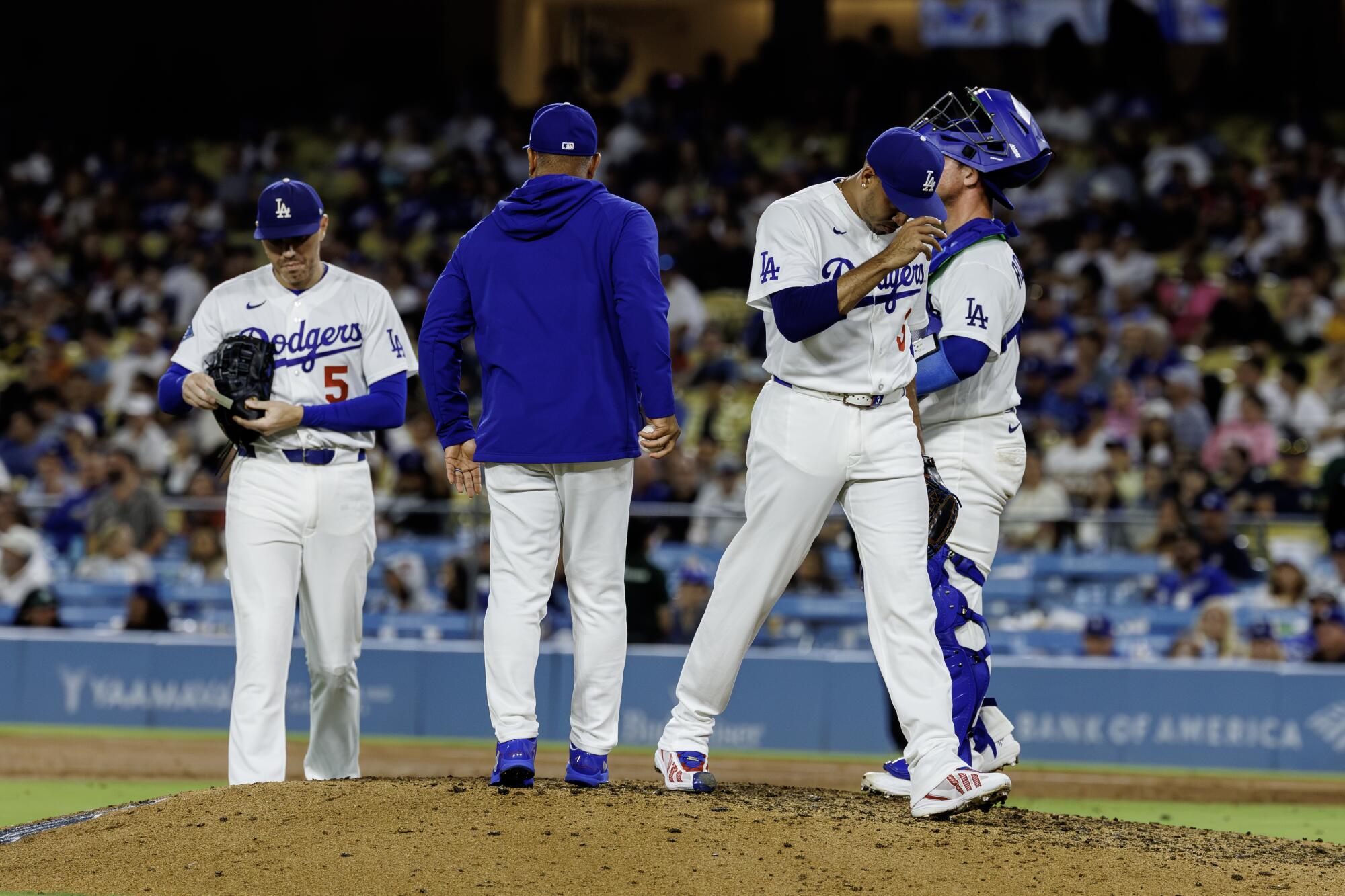
Not after another Díaz disaster class. This time, after he trotted in to Timmy Trumpet’s “Narco” as usual, he gave up four consecutive hits and coughed up a two-run lead before getting yanked in a 5-4 loss to the Milwaukee Brewers at Dodger Stadium. It spoiled Max Muncy’s pinch-hit home run in the sixth inning that staked Díaz to a 4-2 lead.
Díaz was the high-profile free agent the Dodgers signed to lock down the ninth inning for the next three seasons, inking him to a $69-million deal to do it, a record for relievers.
He has an ERA of 11.57 for the season. And in the 5⅔ innings since returning from a procedure to remove “loose bodies” in his right elbow, he has given up 12 hits and three walks. On Thursday, he left everybody in the stands rooting for the Dodgers up in arms, booing.
Those folks might still be booing when they hear what Dodgers manager Dave Roberts said saltily postgame: “Give me another option … I can’t just say change him to low-leverage. I have to have options.”
So plan a search party, do it by committee.
Or give the ball back to Tanner Scott. He isn’t perfect, but has 16 saves and was serviceable filling in for Díaz before he was activated off the injured list on July 29.
Just don’t give the ball to Díaz.
Not while the 32-year-old right-hander is flailing. Not while he’s flustered and frustrated — which you can’t spell without rust, though even Roberts admitted, “I don’t know how long you can use the rust thing, which I’ve certainly used.”
Go with anyone but Díaz, who has been the biggest disappointment of this Dodgers’ trek toward what they hope is a three-peat.
Dodgers manager Dave Roberts, center, pulls closer Edwin Díaz from the game in the ninth inning Thursday against Milwaukee.
(Gina Ferazzi / Los Angeles Times)
He’s not the only disappointment: Mookie Betts is hitting worse than ever before in his career while another newcomer, $240-million man Kyle Tucker, is hitting just .239 with 11 home runs. Fittingly, he flew out for the final out and went 0 for 4 on Thursday.
But Díaz was heralded as the best reliever on the free-agent market when the Dodgers signed him.
Instead, he’s making a run at Worst Reliever in the Game.
His slider hasn’t been sliding. He’s been consistently inconsistent. His location has been spotty — or right down the middle, and as he showed and told Thursday: “I was throwing my fastball right in the middle. When you miss in the middle, you pay.”
And, like Roberts, Díaz doesn’t know the answer, just that “I just gotta sit down with the pitching coaches to see what I’m missing and what they say to see if we can fix it and keep working hard.”
In a short-sleeved T-shirt and shorts, he stood with his hands on his hips and faced the music — and the facts, saying he’s ready to relinquish his closer role if Roberts wants to try another option.
“I just gotta see what they wanna do,” Díaz said. “I wanna do the best thing for the team. At the end of the day, if they give me the ball in the ninth I will try to do my job. If they give me the ball in another inning, I will try to do my job.”
Roberts would prefer he do the job for which he’s being paid so richly: “Everyone’s got a role, they all have jobs to do, and they all have to do their job. That’s it.”
But Díaz hasn’t been up to the job. He had a 10.50 ERA in seven shaky appearances before he went on the IL on April 20.
It can seem like the Dodgers print money with all their high-priced players, but they might as well be lighting it on fire with the relievers they’ve brought in.
For them, the concept of the high-priced reliever should be an oxymoron. Because being fooled once is a shame; being fooled twice — that’s moronic.
In 2025, they signed Scott — then considered perhaps the best relief pitcher on the free-agent market — to a four-year, $72-million contract.
And he blew his opportunities like a trumpet too, ending last season with a 4.74 ERA (second-worst of his career) and 1.263 WHIP with 60 strikeouts through 57 innings. He didn’t pitch for the Dodgers in the playoffs.
Now they’ve got the Díaz debacle to deal with before the postseason, when it looks like the Dodgers, if they don’t have their big-name closer to rely on, will again be forced to find other options.
On a Thursday in early June, under the hot bright lights of the famous Blue Note jazz club in Hollywood, the legendary trumpeter and composer Arturo Sandoval took center stage with a microphone in hand — and a hip wiggle for good measure. Rocking a silk shirt adorned with rhinestones, and backed by his incredibly nimble band, the Cuban-born virtuoso kicked off his four-night residency at the club with sizzling banter and panache.
“I had to watch what I said in Cuba,” he told the audience. “Now I live in the United States of America, man — I say whatever the hell I want. Do you like it? Well, if you don’t, I don’t care!”
Now 77, Sandoval feels he was liberated by the power of jazz. Released in May, his dynamic new album, “Sangú” — Spanglish for “sounds good!” — is bursting with the free-spirited energy he’s cultivated in the decades since he came to the United States from Cuba. Sandoval maintains a fiery pace throughout the album, commanding not only the trumpet, but the timbales and piano. (He even recorded his own scat singing for the appropriately-titled track, “Scat.”)
Once derided by the revolutionary government as “Yankee imperialism,” jazz music became a staple of Sandoval’s daily diet. As a young trumpet player in Cuba’s national band, he sought refuge in the sounds of Charlie Parker and Dizzy Gillespie by tuning into Voice of America: a radio program covertly broadcast from the States. Sandoval eventually served three-and-a-half months in jail in the 1970s when he was caught listening to the program — but with famed pianist and director Chucho Valdés, Sandoval would pioneer a distinctly Afro-Cuban jazz fusion with the Orquesta Cubana de Música Moderna, which was renamed Irakere and won a Grammy for best Latin recording in 1980.
“Jazz is synonymous with freedom,” he said. “And I’ve always said the most important word in any dictionary around the world is the word ‘freedom.’”
Inside his Tuscan-style home in the Valley, Sandoval’s shelves are lined with the myriad of awards he’s collected in the time since he arrived in the States: an Emmy award for scoring the 2000 movie based on his own life, “For Love or Country,” which starred Cuban American actor Andy García; 10 Grammy statuettes and the Presidential Medal of Freedom, which was presented to him by President Obama in 2013.
Just last month, Sandoval was also awarded knighthood by the King of Spain. “Does that make me Don Arturo Sandoval?” he audibly asked the ChatGPT application on his phone; indeed, it does. (“My wife gets a little jealous of ChatGPT,” he added with a laugh.)
Come July 4, Sandoval will perform at the America250 concert in Washington D.C., which is a bipartisan celebration of the United States’ 250th birthday. Co-chairs of the event include former President George W. Bush, former First Lady Laura Bush, former President Obama and former First Lady Michelle Obama. Seated next to his Bösendorfer grand piano, Sandoval spoke with The Times while on break from his world tour to discuss the new album, his collaborations with Karol G and Ariana Grande, as well as his weakness for a good cigar.
This interview was edited and condensed for clarity.
Share via
What keeps you playing the trumpet after all these years? I have no choice. The piano is not that complicated, but the trumpet is a pain in the butt. The trumpet is merciless. You have to practice every single day, otherwise it sends you a bill.
How do you smoke cigars and stay healthy enough to play the trumpet? I’ve been a big time cigar smoker since I was 14 years old. I never miss a day. I had a good one already. Every year they put me in the MRI to check my lungs. And the doctor always says, “Man, you have lungs like a person who never smoked.” A cigar is completely different from cigarettes. [With] a cigar you don’t inhale to the bottom of the lung, you know, it’s from here [taps his throat]. That’s the art.
You’ve been knighted by the king of Spain! How does that feel? Great! We’re having 30 people over tonight. My wife is cooking for everyone. The consul [from Spain] called me three or four days ago [and] said, “Arturo, I got a surprise for you. I just got a package from the king at my house, ready to give it to you.” And I said, “What kind of joke is that?” My four grandparents came from Spain to Cuba — from my mother’s side, they were from Tenerife, Isla Canaria. From my dad’s side, they were Gallegos from Galicia. Even if I weren’t related to my family in Spain, whatever — I love Spain!
Given how restricted music and expression were in Cuba, how did you get into the international jazz community? We put together a big band called Orquesta Cubana de Música Moderna [later called Irakere]. I met a journalist who played the saxophone — he said, “Man, you ever hear any jazz music?” He played for me a compilation or recordings of Dizzy Gillespie and Charlie Parker. That was in ’67 or ’68. Ten years later, I got a phone call from the guy — there was a jazz cruise going around the Caribbean and they [were in Havana] for 48 hours. I told him, “Pretend we never had this conversation!” But I went to the harbor. When the boat arrived, I saw Maestro Gillespie coming down the stairs. I didn’t know how to say one word in English. But God has always been good to me.
A guy behind him started talking to me in perfect Spanish. He was a percussionist playing with the great Stan Getz … a bunch of good musicians there. Dizzy started asking me questions through him. They said, “You have a car?” I had a Primo 1951, but it was falling apart. He said, “Ok, show me Havana.” He stayed for a jam session that night with Irakere. Gillespie went back to New York and told everybody about those musicians he heard in Cuba. Then one day a guy came to Irakere’s rehearsal and introduced himself with a translator — he was the president of CBS Records. A few months later, he put us on the plane [to New York] and drove us in a little bus straight to [perform at] Carnegie Hall. CBS made a recording of that, [which gave us] our first Grammy.
Many years later, in 2013, you were awarded the Presidential Medal of Freedom. What’s something special you remember about that night? My granddaughter Lola was there, she was 6. It’s customary to take a photo with the president and the first lady. And we did, the whole family. When we got together for the photo, Lola started pulling at Obama’s jacket. He looked her and said, “May I help you?” She said, “Mr. President, I missed school today. I need a note from you.”
I said, “Oh Lord.” But Obama smiled and said, “Of course.” Then he got a paper with the White House [logo] on top and wrote, “Please excuse Lola from the school today … [Signed,] Barack Obama.”
Legendary jazz trumpeter Arturo Sandoval, shown performing at Dorothy Chandler Pavillion in Los Angeles in 2016.
(Courtesy of Timothy Norris)
Your new album is so cinematic. What’s the story behind it? One day my son and his wife, who’s my manager, came over and said, “Papa, you’re getting old. You have to change your repertoire.” I said to my son, “I’ve been feeding you for 50 years and then you come and tell me what to do? Gimme a break!” But to be honest, when the pandemic happened, I was locked [inside] here. I used to travel a lot, and I was so frustrated and sad. So for two-and-a-half years, I started writing two or three new tunes a day and recorded a few hundred on my own. They picked 100 out of those; I said, “[Now] pick 12.”
When I got with the band, when somebody told me what to play — a little faster, a little slower — I said, “What the heck, man?” But I did it. And they were right. I’m so happy, blessed and grateful because they are amazing musicians. Nobody’s weird. No drugs, no alcohol, strictly into the music.
You joined Karol G’s band at Coachella this year — how did that happen? As an old man, it’s not every day you have the opportunity to play Coachella. She called me last year to play on a tune in her latest album, “Ivonny Bonita.” So when they invited her to Coachella, she said, “Arturo, we’d like to play with you there.” She’s got great charisma and knows how to put a show together. To play for [more than] 150,000 people each night? That’s not my daily gig. I was nervous, but grateful for the opportunity. And when I checked my followers on Instagram, I got like 5,000 people in a few days — that never happens to me!
Let’s talk about Instagram! Oh that’s a funny story. [In 2018] I did an album of duets with Stevie Wonder, Pharrell Williams, Ariana Grande … big time people. When Pharrell wrote a song for our duet, we were in the studio, cutting the track. He said, “Arturo, I’m producing for Ariana Grande in a studio across the hall. You would like me to call her?” I said, “Of course, man.” They sang together, Pharrell and Ariana. And by the end, I got my phone and said, “Ariana, can we take a photo with Pharrell?” She took my phone out of my hand to take [a selfie] and said to me, “Put it on Instagram.” I didn’t know what that was. She said, “You don’t know what Instagram is?” Sorry, I’m old! But I put it on Instagram, thanks to Ariana Grande. She’s so talented, man.
How do you stay dedicated to music after all this time? People talk a lot about the word “talent.” What’s that? A lot of people supposedly have big talent, but they don’t have the passion, the discipline, the commitment. See those roses in my yard? If somebody gave you a seed, you put it in a vase with fresh dirt. Add some vitamins and water, and if you’re lucky, you’re gonna have a rose. But if they gave somebody the exact same seed and they left it on a table somewhere, that rose is gonna die! I’m 77 years old and I still practice every day. Nothing goes to my head. All those awards would mean nothing if I didn’t take care of what I had.