trump ally

After Lindsey Graham’s death, questions linger about aging politicians and health transparency

The sudden death of Sen. Lindsey Graham, a top ally of President Trump and one of Washington’s best-known politicians, is renewing focus on the country’s aging lawmakers.

Graham, a South Carolina Republican who had turned 71 just two days before dying on Saturday, was far younger than many of his Senate colleagues and appeared to have been in good health. He suffered a tear in his aorta, according to a preliminary report from the medical examiner.

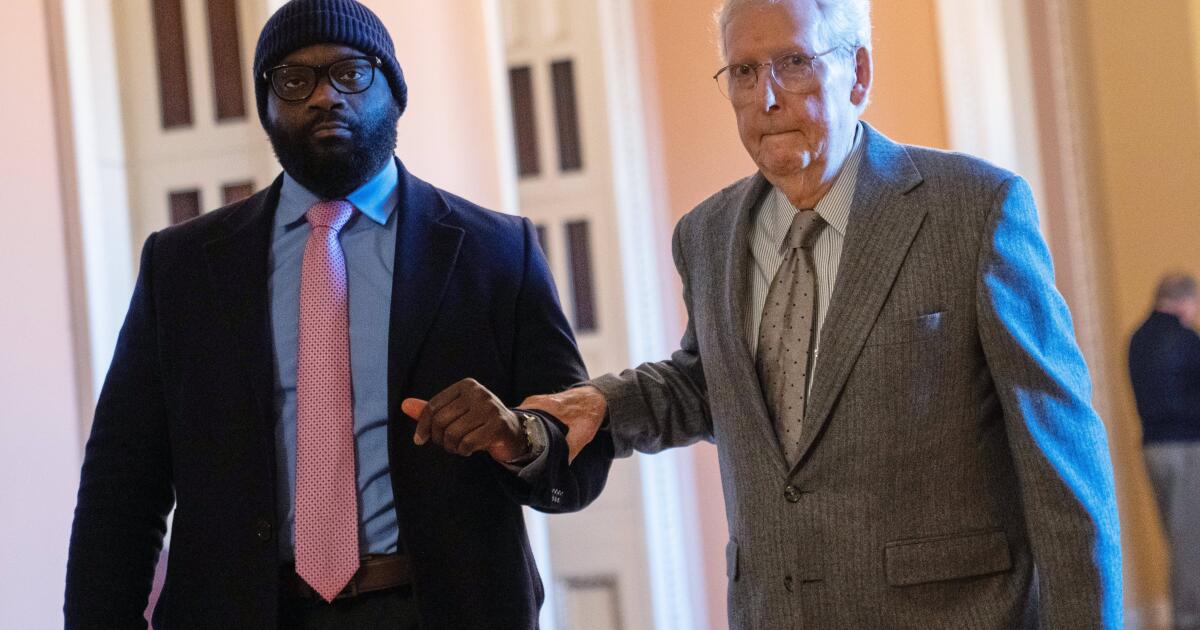
It was the second time in less than a month that emergency personnel were dispatched to the home of a U.S. senator. In early June, Mitch McConnell of Kentucky, the former Republican Senate leader, was hospitalized for undisclosed reasons.

After weeks of increasingly dire speculation about his health, he finally revealed on Sunday that he had fallen and suffered from mild pneumonia. He released a photo, complete with a copy of the day’s newspaper.

Graham’s death and McConnell’s hospitalization have come amid an ongoing reckoning about the nation’s aging leaders, two years after the disastrous presidential debate that sparked widespread panic among Democrats about then-81-year-old President Biden’s capacities and accusations of a cover-up.

Some politicians have continued to obscure details about their health challenges, asking for privacy despite their public positions, and fueling conspiracy theories.

“I think we need some transparency,” Sen. John Cornyn (R-Texas) said Monday. “I wish Sen. McConnell and his team would have done that earlier. I think it would have resolved a lot of questions.”

McConnell is admitted to a hospital

McConnell, who at 84 is only the third-oldest member of the Senate, was admitted to the hospital on June 14 with barely any explanation. Aides said he was “receiving excellent care” but offered no details about his condition.

The dearth of information fueled a wave of speculation about his prognosis, with Laura Loomer, a Trump ally and conspiracy theorist, claiming on social media that a “high level source close to the White House” had told her he was “officially brain dead.”

But McConnell, who will retire from Congress at the end of January after serving as the longest-ever Senate leader, said in a statement that he is on the mend. He said a fall had led to his hospitalization and that he was “briefly unconscious” and treated for mild pneumonia.

“You all know how folks of my generation often hesitate to share the vulnerability that comes with growing older,” he said. “Even in the public eye, I feel that same instinct — I can’t help it.”

That wasn’t enough to put speculation to rest. On social media, many refused to believe the veracity of a photo his office released that included the front page of the sports section of the Washington Post.

Conspiracy theories about McConnell’s health are “a symptom of our times,” said Sen. Rand Paul, a Republican who is also from McConnell’s home state of Kentucky. Paul said people should “give him a break.”

“People think they have a right to know everyone’s medical problems,” he said, “but I don’t know, where does it begin and where does it end?”

Trump’s medical reports offer limited details

The oldest person ever elected president, at age 78, has long offered only the rosiest picture of his health.

“Everything checked out PERFECTLY,” he boasted after his last physical in May, adding that he took yet another cognitive test aimed at detecting early dementia and has “aced them all.”

His past medical reports have been criticized for offering limited detail and including statistics that some health professionals have viewed with skepticism.

When he first ran for president in 2016, Trump declined to release his health records, breaking with longtime precedent. He instead offered a four-paragraph note from his doctor declaring that he would be “the healthiest individual ever elected to the presidency.” Rep. Ronny Jackson (R-Texas), White House doctor during Trump’s first term, later drew headlines when he extolled the president’s “incredibly good genes.”

When he was infected with COVID-19 in the midst of his 2020 reelection campaign, Trump’s doctors and aides withheld key details of his treatment and tried to downplay the severity of his illness.

And after an attempted assassination at a Pennsylvania rally, Trump aides kept the public in the dark for days, declining to discuss the extent of his injuries or release medical records after assuring he was “fine.”

Kean Jr. goes absent for months

The obfuscation extends beyond the septuagenarian and octogenarian set. New Jersey Republican Rep. Tom Kean Jr. spent four months missing without explanation before he finally disclosed late last month that he had been in treatment for depression.

He said in a brief floor speech after his return that he had remained silent about his condition because he is a “private person by nature.”

He won an uncontested primary during his absence, despite missing more than 100 votes in the House, and is running for reelection.

The approach stood in contrast to Sen. John Fetterman, a Pennsylvania Democrat, who disclosed his hospitalization for clinical depression the day after he was admitted to Walter Reed National Military Medical Center for treatment. He also suffered a stroke while running for office.

Biden’s stumbles doom his reelection effort

Biden’s halting gait, frail appearance and frequent verbal stumbles eventually doomed his 2024 reelection campaign. After a debate in which he frequently lost his train of thought, he chose to withdraw from the race, sparking an unprecedented swap at the top of the Democratic ticket that ultimately paved the way for Trump’s return to office.

Many others have refused to retire. California Sen. Dianne Feinstein, a Democrat, died in office in 2023 at the age of 90, after years of declining health, including a bout of shingles. Though she returned to the Senate after her illness, she appeared frail and confused at times. It was later revealed that her office had failed to disclose in real time that she had contracted encephalitis while recovering.

Longtime Republican Rep. Kay Granger of Texas spent the final months of her more than two decades in Congress, when she was in her early 80s, suffering from what her office called “unforeseen health challenges” that made travel to Washington difficult.

Eleanor Holmes Norton, 89, the longtime House delegate for the District of Columbia, announced earlier this year that she would not run for reelection amid questions about her competency.

Colvin writes for the Associated Press. AP writers Mary Clare Jalonick and Lisa Mascaro in Washington contributed to this report.

Source link

Judge upholds Hannah Dugan conviction for helping immigrant evade ICE

A federal judge on Tuesday declined to overturn a Wisconsin judge’s obstruction of justice conviction for helping a man evade immigration officers who showed up at a courtroom looking to detain him.

The case against Hannah Dugan, who resigned from the Milwaukee County Circuit Court following her conviction, was an early test of how the courts would respond to President Trump’s sweeping immigration crackdown.

Trump allies branded Dugan as an activist judge, while her supporters said she was unfairly targeted.

U.S. District Judge Lynn Adelman postponed Dugan’s sentencing June 3 to consider arguments about whether he should overturn her conviction. But in his ruling Tuesday, Adelman said Dugan’s conviction would stand. He did not immediately set a sentencing date.

“The court’s decision is wrong,” Dugan’s legal defense team said in a statement.

Questions about a similar case in Virginia

Dugan’s attorney had argued that her conviction in helping Eduardo Flores-Ruiz leave the courthouse was invalid and should be overturned. He said that was necessary because a federal appeals court in April overturned a key Virginia immigration case that the judge and prosecutors had cited in Dugan’s case.

In the Virginia case, an immigrant who was in the country illegally was detained by U.S. Immigration and Customs Enforcement agents and later escaped. He was recaptured and indicted on a charge of obstructing a pending immigration proceeding.

The federal appeals court found that the ICE action did not constitute a “pending proceeding,” as is required under the federal obstruction law.

Dugan’s attorneys argue that she should not have been charged because there was no “pending proceeding” against the immigrant in her courtroom being sought by ICE agents, only a warrant filed for his arrest. The filing of a warrant does not constitute a “proceeding” under the law, Dugan’s attorneys argued.

Prosecutors countered that the facts in the Virginia case are different and don’t apply to Dugan’s. They also argued that other cases support Dugan’s conviction.

Adelman said the attempted arrest of Flores-Ruiz did count as a “pending proceeding,” in part because it was a planned and targeted operation rather than an arrest resulting from a random encounter.

“Defendant argues that ICE was acting as a law enforcement agency here,” Adelman wrote. “But this ignores the fact that, unlike, say, the FBI, ICE can issue its own warrants and adjudicate and effectuate a removal, as it did with Flores-Ruiz, without the involvement of a court. This makes a difference.”

Dugan faces 5 years in prison, but will likely get probation

Dugan, 67, faces up to five years in prison after a jury convicted her Dec. 19, 2025, but she is unlikely to be sentenced to time behind bars. Federal sentencing guidelines generally call for probation for defendants like her, who have no criminal history and are convicted of a nonviolent crime.

Dugan resigned from her position as a Milwaukee County circuit judge two weeks after her conviction amid threats of impeachment from Republican state lawmakers. She had been a judge for nine years.

The Trump administration brought the case against Dugan as the president pressed ahead with his sweeping immigration crackdown. Trump’s administration and his allies branded Dugan as an activist judge, while Dugan’s attorneys said she was being unfairly targeted and argued, unsuccessfully, that she was immune from being charged because she was a judge.

Dugan’s case marked the first time that a state judge in Wisconsin went to trial on charges of obstructing immigration agents. She was acquitted of concealing an individual to prevent arrest, which is considered a misdemeanor.

Dugan helped an immigrant wanted by ICE agents

On April 18, 2025, immigration officers went to the Milwaukee County courthouse after learning Flores-Ruiz had reentered the country illegally and was scheduled to appear before Dugan for a hearing in a state battery case.

Dugan confronted agents outside her courtroom and directed them to the chief judge’s office because she told them their administrative warrant wasn’t sufficient grounds to arrest Flores-Ruiz.

After the agents left, she led Flores-Ruiz and his attorney out a private jury door. Agents spotted Flores-Ruiz in the corridor, followed him outside and arrested him after a foot chase. A week later, FBI agents arrested Dugan in the courthouse, leading her outside in handcuffs.

Flores-Ruiz was deported in November.

Bauer writes for The Associated Press.

Source link

Blanche doesn’t rule out payments to violent Jan. 6 rioters as he defends $1.8B fund

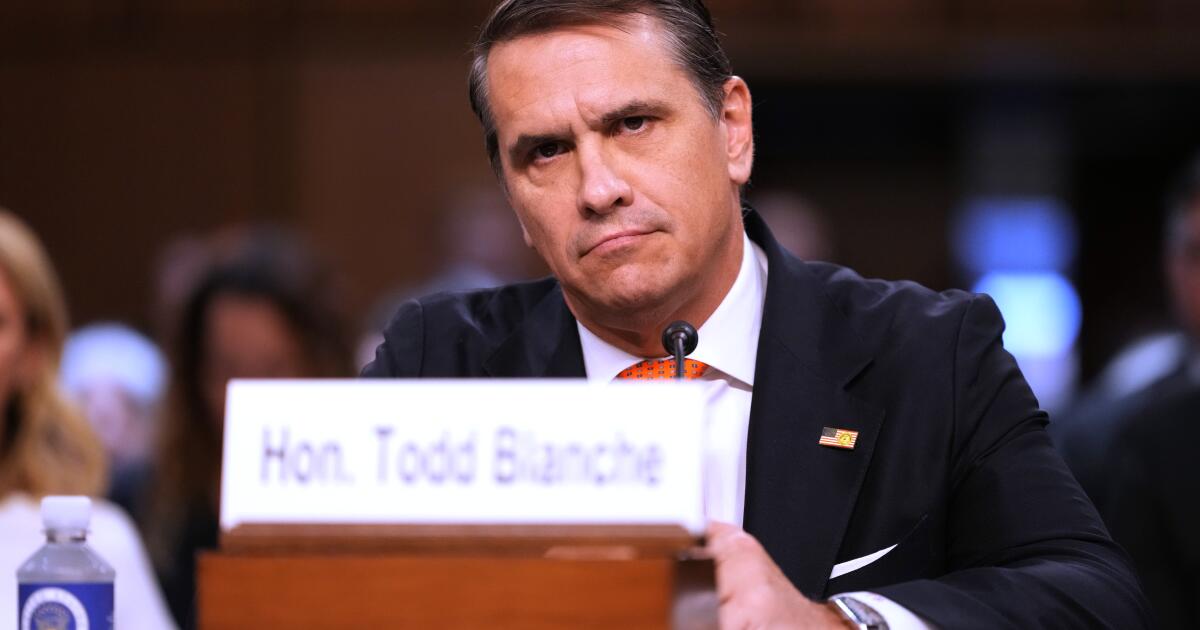
Acting Atty. Gen. Todd Blanche on Tuesday wouldn’t rule out the possibility that people who carried out violence during the Jan. 6, 2021 riot at the U.S. Capitol will be considered for payouts from a new $1.776 billion fund to pay individuals who believe they were targeted politically.

Pressed during a Congressional hearing over whether those who assaulted police officers would be eligible for compensation from the “Anti-Weaponization Fund,” Blanche responded that all people can apply if “they believe they were a victim of weaponization.” The acting attorney general also refused to say whether he would direct those responsible for deciding who receives payments — a commission whose members he is tasked with appointing — to restrict funds to those convicted of violence.

“What I will commit to is making sure that the commissioners are effectively doing their jobs, and that includes setting guidelines as you’re describing,” Blanche told Sen. Jeff Merkley, an Oregon Democrat. The decisions on payouts will be made a five-member commission appointed by the attorney general.

Appearing before Congress for the first time since taking the reins of the Justice Department last month, Blanche was peppered with questions about the fund announced on Monday to compensate those who believe they were mistreated by prior administrations’ Justice Department. Blanche said the fund was “unusual” but not unprecedented, adding that those who benefit will not be limited to Republicans or to people who were investigated or prosecuted by the Biden administration. At one point, Blanche said President Joe Biden’s son, Hunter — who faced gun and tax prosecutions under his father’s administration — could also apply.

Blanche defends $1.8 billion fund

Tuesday’s hearing was meant to address the Trump administration’s budget request for the Justice Department but quickly delved into other controversies that have escalated concerns about the erosion of the law enforcement agency’s tradition of independence from the White House. Blanche defended the creation of the fund without any acknowledgment that the Trump administration has pursued investigations of Trump’s political opponents, sparking criticism that the department is being weaponized in precisely the same way they allege it was under Biden’s administration to prosecute Trump.

In the weeks since assuming control of the Justice Department after Pam Bondi’s firing, Blanche has moved aggressively to advance the president’s priorities — pushing forward cases against Trump’s political foes, cracking down on leaks to media outlets and establishing the new fund to resolve Trump’s $10 billion lawsuit against the Internal Revenue Service over the leak of his tax returns.

Democrats described it as an illegal abuse of power designed to line the pockets of Trump supporters with taxpayer dollars. Sen. Chris Van Hollen, the top Democrat on the Senate appropriations subcommittee holding the hearing, blasted the move as a “pure theft of public funds.”

“Rewarding individuals who committed crimes is obscene,” the Maryland Democrat said. “Every American can see through this illegal, corrupt, self-dealing scheme.”

The fund is in keeping with Trump’s long-running claims that the Justice Department during the Biden administration was weaponized against him, even though then-President Biden himself was investigated during that time and his son was prosecuted. Merrick Garland, who served as attorney general during the Biden administration, has repeatedly denied allegations of politicization and has said his decisions followed facts, the evidence and the law.

Trump administration has been rewriting the history of Jan. 6

The mere possibility that violent rioters at the Capitol could be considered for payouts is consistent with a Trump administration pattern of rewriting the dark history of Jan. 6, a trend that began when the president pardoned and commuted the prison sentences of the participants in the melee and that continued with the Justice Department firing some prosecutors who put them behind bars.

Under questioning from Merkley, Blanche said that he “will definitely encourage the commission” responsible for deciding on the payouts to “take everything into account.” But when asked whether he believes those convicted of violence should be entitled to compensation, Blanche said: “My feelings don’t matter.”

When Merkley suggested that Trump was using the Justice Department to target his political enemies, Blanche replied that this was precisely the sort of “disgusting” behavior of the Biden administration that the fund was meant to address.

“That is completely inappropriate and wrong,’ Merkley said. “There is no comparison to the absolute fair minded pursuit of justice under the previous administration, and this administration’s pursuit of an enemies list.”

Questions over the meaning of ‘weaponization’

In announcing the fund Monday, the Trump administration did not name specific individuals who might stand to benefit from it. The money itself would come from the federal judgment fund, which pays out court judgments and compromise settlements of lawsuits against the government.

Blanche told lawmakers that the Justice Department is committed to “full transparency” in providing public information about beneficiaries of the new fund.

“It’s not limited to Republicans. It’s not limited to Democrats. It’s not limited to January 6th defendants. It’s limited only by the term weaponization,” Blanche said, though the administration has not said how it will define “weaponization.”

Meanwhile, there were signs of discomfort about the fund even among some Republican members of Congress. Senate Majority Leader John Thune told reporters that he’s “not a big fan,” adding that he isn’t sure how the administration intends to use it, but doesn’t “see a purpose for that.”

Thune’s comments come after Louisiana Sen. Bill Cassidy, who lost reelection in a GOP primary on Saturday, called it a “slush fund.”

“We are a nation of laws,” Cassidy said. “You can’t just make up things.”

Richer and Tucker write for the Associated Press. AP reporter Mary Clare Jalonick in Washington contributed to this report.

Source link