trouble

War with Iran fuels Russian oil boom — and trouble for Ukraine

Russia is emerging as one of the few early economic beneficiaries of the war with Iran, as disruptions to energy infrastructure drive up demand for Russian exports and the world casts its gaze to the Middle East and away from Moscow’s war in Ukraine.

The U.S. and its European counterparts slapped severe sanctions on Russia in March 2022, barely a month into Russian President Vladimir Putin’s full-scale invasion of Ukraine. The effect was a stranglehold on Russia’s exports, depriving Putin’s war effort of at least $500 billion, experts say. But over the last week, as President Trump’s war in the Middle East choked energy markets worldwide, the White House began easing its restrictions on Moscow.

“It is traitorous conduct for you to help Russia,” California Rep. Ted Lieu (D-Torrance) said on X, demanding the Trump administration reverse course. “Russia is giving intelligence info to Iran that helps Iran target American forces.”

Crude droplets rained over Tehran after Israeli airstrikes decimated oil depots, draping the Iranian capital in a dense smog. Iranian counterattacks have also targeted refineries and oil fields in Saudi Arabia and Bahrain. Crude oil prices have surged, and traffic through the Strait of Hormuz has all but ceased, sending energy importers in search of alternate sources.

Those spikes are giving Russia, one of the world’s largest oil and gas exporters, a rare advantage. After spending a decade as the world’s most sanctioned nation over his aggression in Ukraine, Putin is finally starting to regain some leverage in global markets.

“In the current economic situation, if we refocus now on those markets that need increased supplies, we can gain a foothold there,” Putin said at a meeting at the Kremlin on Monday, according to Russian state media. “It’s important for Russian energy companies to take advantage of the current situation.”

On March 4, the Treasury Department issued a temporary 30-day waiver allowing Indian refiners to purchase Russian oil. The appeal by the Trump administration was described as a way to ease demand for Mideast oil, but was criticized as a reversal of sanctions placed against Putin meant to deny him the capital needed to fund his occupation of eastern Ukraine.

Now, Moscow is poised to press that advantage further, after Trump said Monday he will further lift sanctions on oil-producing countries to ease the trade friction and reintroduce additional oil and gas supplies. The only countries with U.S. oil sanctions are Russia, Iran and Venezuela.

“So, we have sanctions on some countries. We’re going to take those sanctions off until this straightens out,” Trump said at a news conference at his golf club in Doral, Fla. “Then, who knows, maybe we won’t have to put them on — they’ll be so much peace.”

The surprise concession to Moscow comes as reports suggest Russia is assisting Iran in targeting U.S. personnel.

Trump’s announcement followed an unscheduled hourlong call with Putin about the situation in the Middle East.

The war has also set the stage for Russia to make gains in Ukraine, as hostilities draw the global spotlight away from Kyiv and its struggle to hold back the bigger Russian army. U.S.-brokered talks between the two adversaries have been sidelined as Washington shifts focus to its war in Iran.

“At the moment, the partners’ priority and all attention are focused on the situation around Iran,” Ukrainian President Volodymyr Zelensky said on X. “We see that the Russians are now trying to manipulate the situation in the Middle East and the Gulf region to the benefit of their aggression.”

Putin is unlikely to intervene militarily on Iran’s behalf, according to Robert English, an international foreign policy expert at USC. Instead, Putin is expected to play his position carefully, reap the economic rewards, and keep focused firmly on Ukraine at a time when key air defense systems are diverted from Ukraine to the Persian Gulf.

“Russia is winning the Iran-U.S.-Israel war, at least so far. Oil and natural gas prices have soared, filling Putin’s Ukraine war chest,” he said. “Russia is gathering forces for a big spring offensive in Eastern Ukraine, and it’s not even front-page news.”

Ukraine has dispatched drone interceptors and ordered its anti-drone experts to pivot from their war with Russia to help Western allies help intercept Iranian attacks. Zelensky’s allegiance may not pay off, English said.

“When will Ukraine see the benefits of helping the U.S. with anti-drone technology? No time soon, apparently,” he said.

Even several weeks of interruption in Gulf energy supplies could bring the largest windfall to Russia, the Associated Press reported, citing energy analysts.

The economic turmoil caused by the war has exposed vulnerabilities in Europe’s energy system, particularly its lingering dependence on Russian fuel.

Despite sanctions, the European Union remains a major purchaser of Russian natural gas and crude oil. Russian gas accounted for approximately 19% of E.U. gas imports in 2025. Allied Europeans have agreed to completely stop importing Russian liquefied natural gas, oil and pipeline gas by late 2027.

Putin expressed no desire Monday to rescue the European market now that U.S.-Israeli escalations and Iranian retaliation have choked oil production and shipping. The Russian president instead proposed to divert volumes away from the European market “to more promising areas” like the Asia-Pacific region, Slovakia and Hungary, which he said were “reliable counterparties.”

European leaders have been criticized for being “stunned, sidelined, and disunited” since hostilities began in late February. Excluded from the initial military planning by the U.S. and Israel, Europe entered the conflict with gas storage at only 30% capacity, the lowest levels in years. Instead of bold action, English said, European leaders have quarreled over internal divisions and rivalries.

“Sky-high energy prices are the underlying cause of many of these frictions, as Europe struggles now more than ever to find affordable alternatives to the cheap Russian petroleum,” English said.

Antonio Costa, president of the European Council, told European leaders in Brussels on Tuesday that rising energy prices and the world’s shifting attention risk strengthening the Kremlin at a critical moment in the war in Ukraine.

“So far, there is only one winner in this war,” Costa said. “Russia.”
Source link

Trump’s remarks about the parents of a fallen Army captain become the latest trouble spot in his campaign

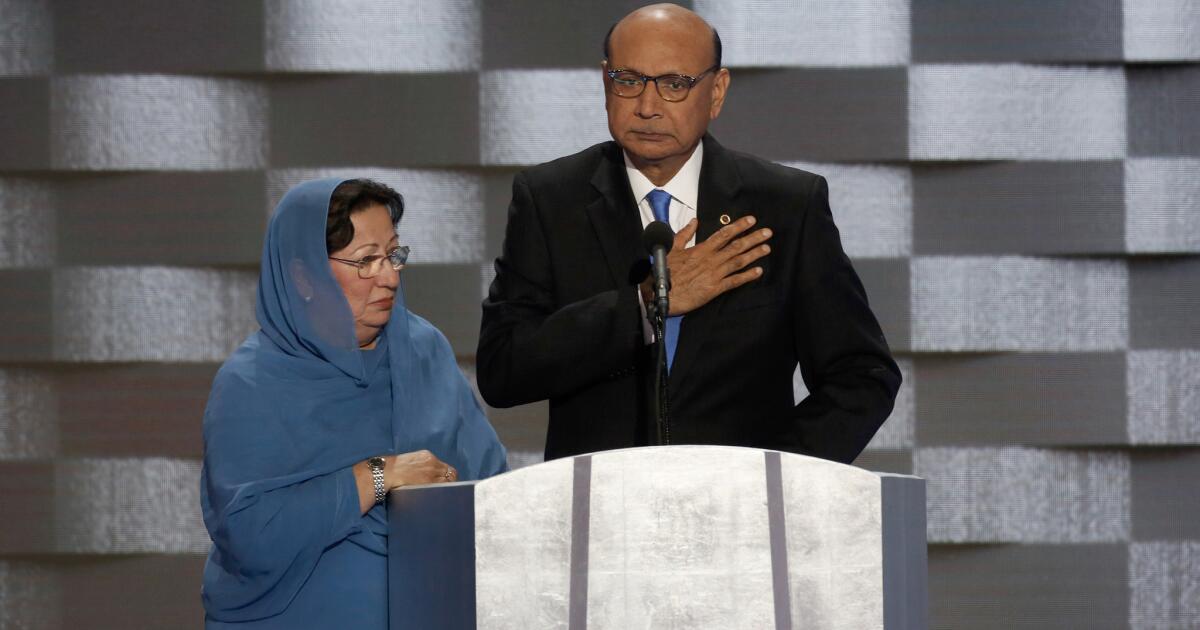
The father of an Army captain who died a hero in Iraq looked incredulous.

Donald Trump had seemed to criticize his wife on national television, suggesting that her Muslim faith might be the reason she stayed silent during the couple’s high-profile appearance at the Democratic National Convention last week, when Khizr Khan criticized the GOP presidential nominee.

Speaking to CNN on Sunday, Khan said his wife was simply too grief-stricken to speak that night. Then the father said something that may sum up Trump’s biggest challenge between now and November: “He had to take that shot at her.”

Trump has built an unlikely presidential campaign on his combative style and language. He can’t seem to resist taking a shot or responding to an attack, even when the political fight seems unwinnable.

That instinct arguably has served Trump well so far, allowing him to win a crowded Republican primary and stay competitive in national polls with Hillary Clinton.

But it has also caused him unneeded political wounds, playing into the Clinton campaign’s argument that he lacks the temperament to lead the country and sometimes stealing attention from Clinton’s own political liabilities.

The public feud with the Khans looks to stir up the biggest self-inflicted controversy since Trump criticized a federal judge in a fraud lawsuit against Trump University. Trump repeatedly questioned the judge’s ability to be fair because his parents were born in Mexico.

The Khan flap may also linger because Trump’s words were directed at grieving parents whose son died while serving the United States, rather than the politicians he usually targets.

“It violates almost every hallmark of traditional politics, but I guess that’s Donald Trump,” said Reed Galen, a veteran Republican consultant who is not supporting Trump or Hillary Clinton. “The way to get to a guy like Trump — and the Hillary campaign is now finally understanding this — this is a guy who can’t let slights, major or minor, go by.”

Trump’s puzzling engagement with the Khans not only inspired an unusually pointed rebuke from Clinton on Sunday, it also sparked broad condemnation from many Republicans.

For much of the weekend, Trump found himself squaring off against the Khans, whose convention appearance was an emotional high point for many Democrats. During the last night of the convention, Khizr Khan, his wife, Ghazala, beside him, recounted the loss of their son, Humayun. Then he questioned Trump’s call to ban Muslims from entering the U.S., pulling out a pocket Constitution and asking whether Trump had even read the document.

Trump could have let the moment pass, or simply praised their sacrifice without confronting them, as other politicians have done when met by military families who have rendered the highest sacrifice.

See the most-read stories in National News this hour >>

Instead, Trump, in an ABC interview broadcast Sunday, said Khizr Khan looked like a “nice guy,” but he questioned why Ghazala Khan did not speak during the convention, saying “maybe she wasn’t allowed to.”

He pushed back against Khizr Khan’s assertion that Trump’s proposal to ban Muslims from entering the country would have kept his son out. “He doesn’t know that,” Trump said. Then the businessman, who avoided the draft during the Vietnam War, said he too had made “sacrifices,” citing his hiring of “thousands and thousands of people.”

After the ABC transcript from the taped interview was released Saturday, Trump’s campaign attempted to correct course. In a statement released late Saturday, Trump called Humayun Khan “a hero to our country” and said “the real problem here are the radical Islamic terrorists who killed him.”

Yet he still could not resist keeping the fight alive.

“While I feel deeply for the loss of his son, Mr. Khan, who has never met me, has no right to stand in front of millions of people and claim I have never read the Constitution, (which is false) and say many other inaccurate things,” Trump added.

On Sunday, as the controversy festered, Trump complained on Twitter that “I was viciously attacked by Mr. Khan at the Democratic Convention.”

“Am I not allowed to respond? Hillary voted for the Iraq war, not me!” he said.

The Khans proved formidable and sympathetic foes as they granted multiple rounds of nationally televised interviews. Ghazala Khan wrote an emotional essay Sunday for the Washington Post, recounting her 12 years of grief since her son died, her inability to enter a room where his picture is displayed because of the pain, and the fact that she could not even bring herself to clean out his closet.

“I don’t think he knows the meaning of sacrifice, the meaning of the word,” Ghazala Khan said of Trump on ABC. “Because when I was standing there, all of America felt my pain. Without saying a single word. Everybody felt that pain, but I don’t know how he missed that.”

While trying to remain above the partisan swamp, they looked shaken yet defiant — casting Trump as someone who lacks a moral compass and the capability for empathy. They challenged Republican leaders to denounce Trump.

As the pressure simmered, Senate Majority Leader Mitch McConnell issued a statement of support for the Khans, saying he agreed “that a travel ban on all members of a religion is simply contrary to American values.”

House Speaker Paul D. Ryan also called out Trump’s proposed ban on Muslim travel and praised the “many Muslim Americans [who] have served valiantly in our military, and made the ultimate sacrifice. Capt. Khan was one such brave example. His sacrifice — and that of Khizr and Ghazala Khan — should always be honored. Period.”

Other Republicans were even more forceful.

“There’s only one way to talk about Gold Star parents: with honor and respect,” Ohio Gov. John Kasich, who lost to Trump in the primary and has withheld his endorsement, wrote on Twitter. “Capt. Khan is a hero. Together, we should pray for his family.” (Gold Stars are awarded to the family members of soldiers who die serving in the U.S. armed forces.)

Tim Miller, a former aide to Mitt Romney, wrote on Twitter that Trump’s words were a “grotesque slander of a dead soldier.” He contrasted them with George W. Bush’s response to an antiwar protest in 2005 by Cindy Sheehan, whose son died in Iraq.

“I grieve at every death,” an emotional Bush said at the height of the protest. “It breaks my heart to think about a family weeping over the loss of a loved one.”

Bush said he recognized and thought about the “sincere desire” of those who wanted to pull out of Iraq while laying out his case to keep troops there.

Clinton faced a similar question Sunday on Fox News. She was asked about the assertion by two parents who lost their sons in the 2012 attack on a U.S. compound in Benghazi, Libya, that Clinton had come to them on the day their bodies were returned to the United States and claimed their deaths were the result of an inflammatory video, rather than terrorism.

“My heart goes out to both of them,” she said, bemoaning their loss and praising them as “extraordinary men.”

“As other members of families who lost loved ones have said, that’s not what they heard — I don’t hold any ill feeling for someone who in that moment may not fully recall everything that was or wasn’t said,” Clinton added.

Clinton spoke directly about the controversy later Sunday at a church in Ohio.

“Mr. Khan paid the ultimate sacrifice in his family, didn’t he? And what has he heard from Donald Trump?” Clinton said. “Nothing but insults, degrading comments about Muslims, a total misunderstanding of what made our country great — religious freedom, religious liberty.”

Clinton has made Trump’s reactive style central to her critique. “A man you can bait with a tweet is not a man we can trust with nuclear weapons,” she said during her convention speech.

Even in defending against that charge, Trump showed his instinct to counterpunch, something many of his supporters admire.

“She’s a very dishonest person. I have one of the great temperaments,” he said on ABC. “I have a winning temperament. She has a bad temperament. She’s weak. We need a strong temperament.”

Trump’s campaign manager, Paul Manafort, blamed the controversy on Clinton, a tactic he has used after previous blowups.

“This is the Clinton narrative,” Manafort said on NBC, when asked about Trump’s comments about Khan. “Mr. Trump, of course, feels sorry for what the Khan family has gone through.”

The controversy came just a few days after another headline-grabbing moment, when Trump on Wednesday effectively baited Russia to hack Clinton’s old email account to try to recover more than 30,000 emails she deleted from the private server she used when she was secretary of State.

“He’s going off down these rabbit trails,” said Ron Nehring, a former national spokesman for Texas Sen. Ted Cruz’s presidential campaign and former chairman of the California Republican Party. “Every day that is spent on these manufactured non-issues is another day he is not training fire on Hillary Clinton’s vulnerabilities.”

Such controversies tend to overshadow issues that might otherwise gain broader attention, experts say, such as Friday’s disappointing economic growth figures.

During Sunday’s interview with ABC, for example, Trump tried to sidestep questions about his failure to release his tax returns and raised concerns about the timing of three upcoming presidential debates, complaining that two dates overlap with NFL games.

Times staff writer Chris Megerian in Columbus, Ohio, contributed to this report.

noah.bierman@latimes.com

Twitter: @noahbierman

MORE NATIONAL NEWS

Here’s how Democrats are trying to reclaim patriotism from Republicans — and how Trump helps

Shooting in downtown Austin leaves 1 dead, 3 wounded; suspect sought

A sparkling new Sandy Hook school arrives, with high-tech features and security ‘second to none’


UPDATES:

3:15 p.m.: The story was updated with additional reaction.

The story was originally published at 12:15 p.m.


Source link

Tom Steyer’s bets on private prisons and coal mining could spell trouble in 2020

When Tom Steyer was running a hedge fund in 2000, he wrote a letter telling some wealthy investors their money would soon flow through an offshore company that would shield their gains from U.S. taxes.

It was routine in finance, but could prove toxic in politics.

Now that the San Francisco billionaire has joined the crowd of Democrats running for president, much of what he did to build his personal fortune, including a stint at Goldman Sachs in the 1980s, could turn off voters. His fund’s investments in coal mining and private prisons are two of the biggest hazards.

Part of Steyer’s challenge is timing. Wall Street’s reputation is in tatters in the aftermath of the Great Recession. Many Democrats are upset about growing income inequality. And billionaires — President Trump first among them — are routinely demonized by the party’s left wing.

Steyer is the founder of Farallon Capital Management, one of America’s largest hedge funds, the high-risk investment pools for big investors. He left Farallon in 2012 after running the San Francisco firm for 26 years.

He did not mention his experience there when asked by The Times what qualified him to serve as president. He focused instead on his work fighting climate change and big corporations over the last decade.

Attacks by Steyer’s opponents have been mild so far, but that will change if he starts gaining support.

“He will have to answer for his involvement in anti-climate-control activities, his relationship to the coal industry, and his relationship to Wall Street, which young people particularly find abhorrent,” said Democratic ad maker Hank Sheinkopf, who is unaligned in the presidential race.

“In a political campaign, there is no past tense and there is no future tense. Everything in your life you’ve ever done, thought of and said is in present tense.”

In written responses to questions sent by email, Steyer expressed remorse over some of Farallon’s investments.

A key liability is Farallon’s 2005 investment of $34 million in Corrections Corp. of America, which runs migrant detention centers on the U.S.-Mexico border for U.S. Immigration and Customs Enforcement. Many of the roughly two dozen Democrats in the presidential race have denounced profits from incarceration as immoral.

“I deeply regret that Farallon made that investment, and I personally ordered the investment in CCA to be sold because it did not accord with my values then or now,” Steyer said.

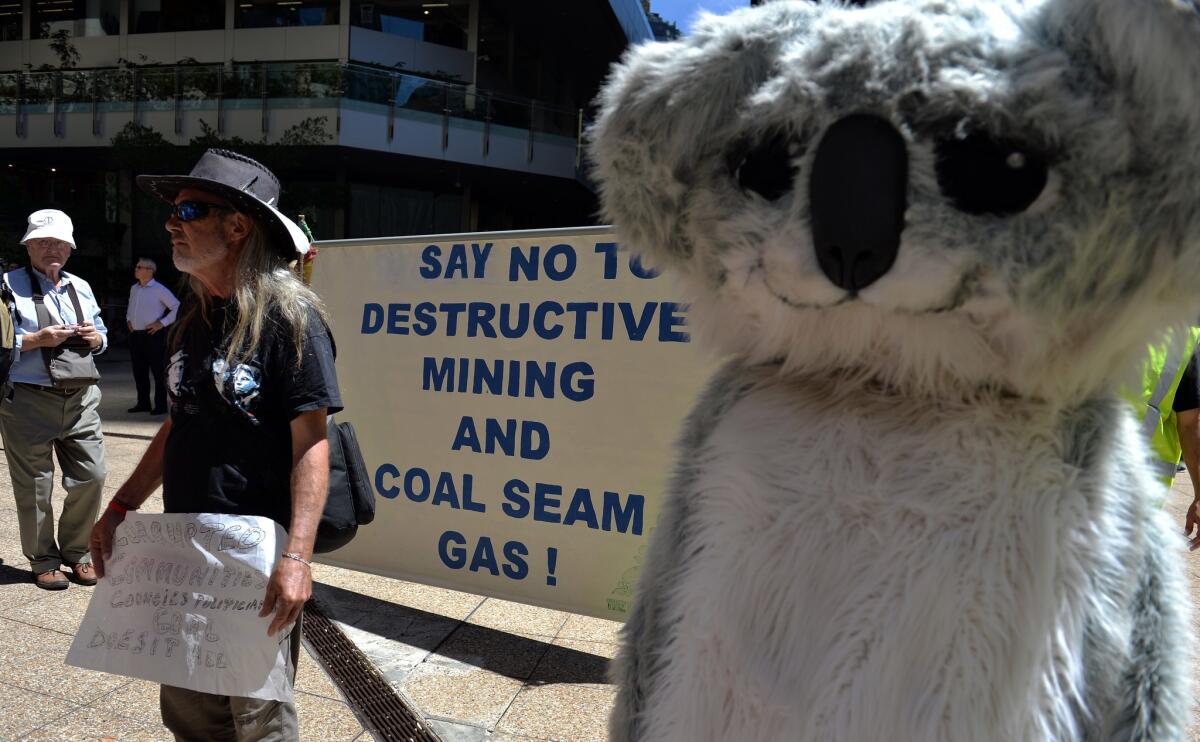
More troublesome for Steyer’s public image is the fund’s history of investing in fossil fuel projects, including a giant coal mine in Australia that generates vast quantities of carbon emissions.

The owners overcame protests by environmentalists and won permission to clear 3,700 acres of forest that served as a koala habitat and mine 12 million tons of coal per year. Steyer’s critics have long seen his past personal stake in coal mining as hypocritical.

The hedge fund led by Tom Steyer invested in an Australian coal mine that drew protesters in Sydney.

The hedge fund led by Tom Steyer invested in an Australian coal mine that drew protesters in Sydney.

(Saleed Khan / AFP/Getty Images)

“If you’re running as a liberal, idealistic candidate, as Tom Steyer is, it’s a serious problem when the story you’re trying to tell uses words like private prisons and coal,” said Jessica Levinson, a Loyola Law School professor. “It just goes directly against the rainbows and sunshine and clean air and better tomorrow narrative he’s trying to paint.”

Steyer said he left Farallon in part because of its holdings in fossil fuels. “I wish I’d made the move away from fossil fuels sooner,” he said.

Steyer, 62, muscled his way onto the public stage by becoming one of the Democratic Party’s top donors over the last decade. He put $74 million into the 2018 midterm election. He has carefully crafted his political profile around his spending to promote liberal causes, most visibly the fight against global warming and the drive to impeach President Trump.

Some of Steyer’s record has yielded bad publicity over the years as he weighed runs for elected office in California. But his entry into the presidential race on Tuesday and his vow to spend $100 million of his own money on his campaign will draw fresh scrutiny to the means he used to amass what Forbes estimates to be his net worth of $1.6 billion.

Steyer, who grew up on Manhattan’s East Side, started his career on Wall Street in the late 1970s at Morgan Stanley and worked later on mergers and acquisitions at Goldman Sachs. In 1986, he opened Farallon, which grew from $9 million to $36 billion on his watch, according to Steyer.

Some Democrats say Steyer has atoned for his sins. RL Miller, chairwoman of the state Democratic Party’s environmental caucus, was perplexed by his candidacy and said his money would be better spent advancing other Democrats.

“I do feel he has demonstrated substantial good faith in that yes, he made a lot of money from bad places, but he’s been very, very open about the fact that he’s turned over a new leaf and is no longer taking money from those bad places and is instead spending to do good,” Miller said.

The business records of wealthy candidates are often weaponized by rivals. Former President Obama cast GOP challenger Mitt Romney in 2012 as a ruthless plutocrat who made millions of dollars on corporate takeovers that put thousands of Americans out of work. Romney co-founded Bain Capital, a private equity firm.

Mitt Romney's career running a private equity firm was criticized by President Obama in the 2012 presidential campaign.

Mitt Romney’s career running a private equity firm was criticized by President Obama in the 2012 presidential campaign.

(Erik S. Lesser / EPA-Shutterstock)

Gray Davis won California’s Democratic primary for governor in 1998 after portraying rival Al Checchi as a tycoon who pillaged Northwest Airlines, firing thousands and forcing thousands more to take pay cuts.

“When these wealthy, self-financing first-time candidates want to throw their hat in the ring, whether they’re Democrat or Republican, they have to be prepared for a complete drill-down on how it is they made those millions of dollars,” said Garry South, who was Davis’ chief strategist.

As for Steyer, South said, “It’s pretty hard for me to see a billionaire on the Democratic side credibly take on the whole issue of wealth inequality.”

Tom Steyer joins swarm of Democrats running for president »

Within hours of Steyer’s announcement, two of his opponents took shots at him.

“I’m a bit tired of seeing billionaires trying to buy political power,” Sen. Bernie Sanders of Vermont told MSNBC.

Sen. Elizabeth Warren of Massachusetts, who is competing with Sanders for progressive voters, tweeted, “The Democratic primary should not be decided by billionaires, whether they’re funding super PACs or funding themselves.”

In an email seeking donations on Thursday, she said, “We need our candidates to compete to have the best ideas — not just to write themselves the biggest checks.”

Sen. Elizabeth Warren says the Democratic presidential primary should not be decided by billionaires.

Sen. Elizabeth Warren says the Democratic presidential primary should not be decided by billionaires.

(Brynn Anderson / Associated Press)

Both Sanders and Warren, who frequently rail at what they see as unfair advantages for the super-rich, have declined to take money from Wall Street donors.

Steyer’s wealth will enable him to run more television ads than most of his opponents can afford. He is already spending $1.4 million on advertising over the next two weeks on national cable news networks and in the first four states to hold a primary or caucus.

“Maybe he feels he can overwhelm these questions by spending a lot of money telling his story the way he wants to tell it,” said David Axelrod, the architect of Obama’s campaigns. “The problem is in the presidential race, the coverage is so intense and social media such a big piece of that, these kinds of vulnerabilities get shared virally very readily, and I’m not sure you can overwhelm that, even with hundreds of millions of dollars.”

Steyer could also face questions about spending that much money on himself. “Does all that spending help in the end of the day or does it become an emblem of excess and self-aggrandizement?” Axelrod said.

Asked about his letter to Farallon investors on the British Virgin Islands company that was going to help them avoid federal taxes, Steyer did not address his past actions, but called for new taxes on the rich to reduce inequality.

“I use no offshore tax havens and pay all U.S. taxes in full,” he said. “I believe we should have a much simpler and fairer tax code and get rid of all loopholes.”

Source link