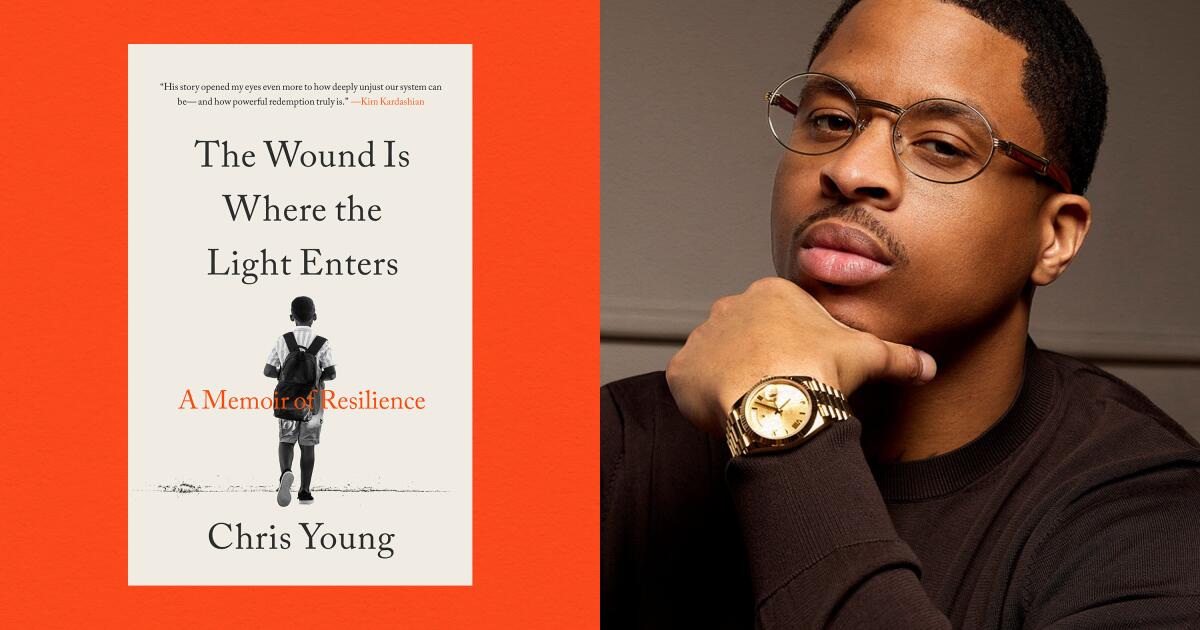
Kim Kardashian and Trump helped free him from prison. Now Chris Young tells his triumphant story
Book Review
The Wound is Where the Light Enters: A Memoir of Resilience
By Chris Young
Little, Brown and Company: 336 pages, $35
If you buy books linked on our site, The Times may earn a commission from Bookshop.org, whose fees support independent bookstores.
Chris Young grew up in Clarksville, Tenn., in the direst imaginable circumstances — unimaginable, in fact, to many of us.
He never knew his father. His mother was a crack addict with a habit of stabbing her romantic partners. While his mom was in prison, Young and his older brother, Robert, mostly fended for themselves, often in a home that lacked electricity and running water. Young, tormented by sickle-cell disease, saw many of those closest to him die by homicide or suicide.
The two boys weren’t totally bereft. They had a grandfather, cousins, friends and a stepfather. A neighbor provided showers, until his water bill got too high; another supplied hot meals. A woman known as Big Mama offered shelter and tough love. But it wasn’t nearly enough. Desperate for money, the teenage Young — smart, entrepreneurial, dreaming of a rap career — became a gun-toting drug dealer.
Young’s searing memoir, “The Wound Is Where the Light Enters,” chronicles this bitter childhood and its devastating consequences. The evocative title is a quotation from the 13th century Persian poet Rumi.
Unlike some prison memoirs, this isn’t an innocence story. But it is no less an indictment of the U.S. justice system — its laws, its courts and its brutal prisons. “The constant state of heightened agitation and awareness that it takes to survive a single day in a federal penitentiary is enough to drive a man insane,” Young writes. “At every turn, the system is designed to crush your humanity. You’re an animal in there and are expected to act like one.”
But not everyone does. “The Wound Is Where the Light Enters” not only reveals the system’s horrors, but also celebrates the redemptive power of hope, intellect and community.
By the time Young was swept up in a federal drug investigation, he already had two felony drug convictions. His involvement in the federal conspiracy case, as he tells it, was marginal. He was no kingpin and had never met most of the people being charged.
But he faced a zealous prosecutor, with only court-appointed attorneys at his side. Worse yet, he was up against a harsh “three-strikes” law that replaced judicial discretion with mandatory minimum sentences.
Young’s own pride and sense of justice also came into play. He could have pleaded guilty, perhaps even cooperated, and received a finite (though still hefty) prison sentence. Instead, determined to argue his case, he opted for a trial at which conviction was all but certain. Then, against advice, he presented a meticulously crafted and rehearsed speech at his sentencing hearing.
The 26-year-old Young, who’d already spent four years behind bars, had used that time productively. A former straight-A student who had dropped out of high school, he had embarked on a program of self-education, reading deeply in African American history, Greek philosophy, finance and other subjects. “Every day,” he writes, “I left the library with new language to put to my thoughts.”
Young told the court about his chaotic upbringing and his recent scholarly pursuits. “He spoke of the things he could do if he did not have to die in prison. He told me of the possibilities that would never be,” the trial judge, Kevin H. Sharp, writes in the book’s foreword. “It was impossible to listen to someone so full of compassion, intelligence, and, above all, promise, and not question the system that had not just allowed this to happen but required it.”
Sharp sentenced Young to life without the possibility of parole, as the law mandated. But two years later, he stepped down from the bench and joined Young’s defense team.
Young describes his childhood mostly from the perspective of a boy — alternately bewildered, hurting, depressed and “mad all the time.” His account of his incarceration, with its mind-numbing routines, gang hegemony and intermittent violence, is equally gripping.
At McCreary, the tense high-security federal prison in Kentucky known as Misery Mountain, Young meditated, adhered to a workout routine, read prodigiously, taught GED classes to fellow inmates and maintained ties to his few surviving loved ones. And he kept hoping. “The system’s control over my body was absolute,” Young writes. “Its control over my mind was not.”
In 2015, the sickle cell-related disintegration of his hips prompted Young’s transfer to a low-security prison, Federal Medical Center Lexington. Here the surroundings are less bleak, the library better, the prisoners friendlier. Young teaches himself to code and envisions an app that will focus on mental health and suicide prevention. Yet he still must fight to obtain the hip replacement surgery he so desperately needs.
By now, his case has attracted sympathetic press attention and more effective lawyers. Even so, his story takes a dark turn. From Lexington, he is sent to his most terrifying prison yet, known as Bloody Beaumont, where COVID-19 adds another layer of threat. A judge reduces his sentence, but, for reasons never entirely clear, he is suddenly thrown into the prison’s “hole,” its barbarous solitary confinement cells.
It is from that hell that Young, more than a decade after his arrest, emerges to freedom — earning a degree in economics and public policy from Southern Methodist University, pursuing a consulting career and writing this indelible book. For his 2021 grant of executive clemency, he has his lawyers and reality-TV star Kim Kardashian to thank — as well as President Trump.
Klein, a cultural reporter and critic in Philadelphia, has been a three-time finalist for the National Book Critics Circle’s Nona Balakian Citation for Excellence in Reviewing.