P-8 Poseidon Crews Controlling MQ-4C Triton Drones Becoming A Reality
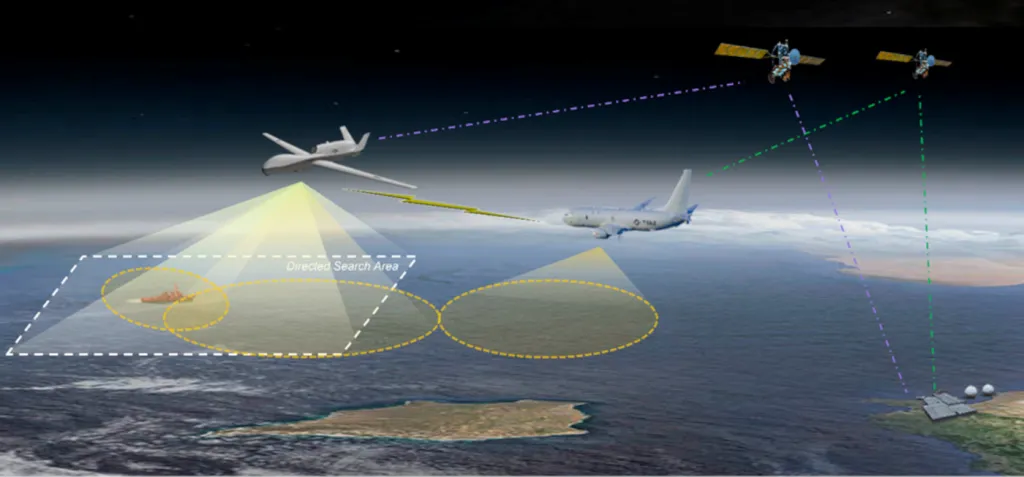
Boeing and Northrop Grumman are laying the groundwork to take teaming between the P-8A Poseidon maritime patrol plane and the MQ-4C Triton long-endurance maritime surveillance drone to a new level. A first-of-its-kind test has demonstrated common command and control architectures that will enable P-8A crews to issue orders to MQ-4Cs. The drones would then perform their assigned missions autonomously and report back. The Poseidon and Triton were designed to operate as a team from the start, but the ability to task the uncrewed aircraft directly in flight would offer new flexibility, especially to respond to sudden changes in the battlespace.
Press releases today from Boeing and Northrop Grumman shared details of the recent P-8/MQ-4 teaming test. The testing was conducted in a laboratory environment and no real aircraft were involved.
“A P-8A operator issued machine readable, machine actionable mission tasking to a simulated MQ-4C Triton using UCI [Universal Command & Control Interface] formatted messages,” according to Boeing’s release. “The P-8A cued the Triton transit to a specific area. After receiving the request, the Triton autonomously planned and executed a transit to the area, employed sensors per the tasking, processed findings onboard, and reported results back to the P-8A Poseidon.”

“In the exchange, Triton’s system used AI [artificial intelligence] algorithms to collect, process and share intelligence data with P-8A Poseidon in response to a request sent by the P-8A Poseidon system,” Northrop Grumman also said in its release.
“Data routes included satellite relay to reflect realistic operational communications. Mission management and autonomy layers communicated via OMS/UCI [Open Mission Systems/Universal Command & Control Interface] rather than custom point to point interfaces,” Boeing’s release adds. “Using UCI, the platforms can collaborate with any U.S. or allied asset sharing the same interface – reducing operator workload by distributing the mission tasks and accelerating commander decisions, making integration across platforms quicker and more cost effective.”
The P-8A was designed primarily as a maritime patrol platform, but has substantial additional intelligence, surveillance, and reconnaissance (ISR) capabilities baked in. This includes a surface search radar that also has a synthetic aperture radar (SAR) mode, allowing it to capture still radar ‘images,’ even through cloud cover, smoke, and dust, and at night. It also has a sensor turret with electro-optical and infrared full-motion video cameras, as well as a robust signals intelligence suite, as you can read more about here. Its communications capabilities are also critical to making use of all the intelligence it gathers, as well as leveraging data gathered by other platforms. The U.S. Navy also operates more specialized versions of the Poseidon with very advanced add-on sensor systems.

The MQ-4C, which was derived from the RQ-4 Global Hawk drone, has a radar with a SAR mode, as well as electro-optical and infrared cameras, as well. In addition, the drones have electronic support measures systems that allow for the collection of electronic intelligence passively. Unlike Global Hawk, Triton also notably has the ability to descend to lower altitudes to more closely investigate targets of interest.
So far, the United States and Australia are the only countries to operate the MQ-4C, and both of them also have fleets of P-8s. Canada, Denmark, Germany, India, New Zealand, Norway, South Korea, and the United Kingdom all fly P-8s or are in the process of acquiring them, as well. Last month, Denmark, Finland, Germany, and Norway announced a new joint plan to acquire and operate a fleet of Triton drones under the umbrella of the NATO alliance.

As already noted, the intention has always been for the P-8A and MQ-4C to work closely together, and the U.S. Navy actively teams the two platforms up today.
“Currently, the MQ-4C is being used as a long endurance, maritime ISR [intelligence, surveillance, and reconnaissance] asset, that often times feeds us updated posits [positions] on contacts of interest,” a P-8A pilot assigned to the Navy’s Patrol Squadron Five (VP-5), the “Mad Foxes,” explained to TWZ in an interview years ago. “They can fly significantly higher and longer than us and are able to provide a more constant feed of ISR.”
“The Triton will be flown and monitored out of NAS Jacksonville [Naval Air Station Jacksonville in Florida], and we have already seen some pilots and NFOs [naval flight officers] being selected to operate the aircraft,” the Navy P-8A pilot also noted at that time, and this is the crux of the matter.
What Boeing and Northrop Grumman have now demonstrated, at least in a test lab, is the ability of P-8A crews to dynamically task and retask MQ-4Cs without having to go through a command center on the ground that could be thousands of miles away. This, in turn, can only speed up the process of responding to sudden developments, which could include potential threats that pop up unexpectedly or targets of interest that appear to be fleeting.

As the pilot from VP-5 previously explained, the MQ-4C already offers a valuable broad-area maritime surveillance asset that can cover vastly more area, and do so more persistently, than a P-8A can by itself. This, in turn, can also help keep Poseidons further away from potential dangers.
Though treated as something of an aside in the press releases today, work to enable the MQ-4C to do at least some level of immediate autonomous processing of the data it collects using AI-driven systems is also an important development. The amount of data that drones like the Triton can collect can easily be overwhelming for sensor operators and intelligence analysts. A new electronic and signals intelligence (ELINT/SIGINT) suite is in development now for the MQ-4C that will only expand the breadth and volume of data the drones can collect. The U.S. Navy is also in the process of upgrading its P-8As with the explicit aim of improving their already substantial ISR, targeting, and networking capabilities.
With all this in mind, the ability to detect and classify potential items of interest and then highlight them for human personnel offers immense benefits for shrinking down the time it takes to go from data collection to appropriate action. Having a collection platform, crewed or uncrewed, do at least some of that work in an automated fashion upfront can only help further speed up the process. Not having to send as much data can help reduce bandwidth demands and, by extension, latency in the transfer, too.

The OMS/UCI architecture used to support the new P-8/MQ-4C teaming testing could further open the door to pairing the Poseidon with other uncrewed teammates, as well. General Atomics has already been pitching the SeaGuardian version of its MQ-9B drone as a new partner for the P-8A. In its standard configuration, the SeaGuardian is also primarily intended for maritime surveillance and reconnaissance. However, there has also been work to give the drone new capabilities to support anti-submarine warfare missions, including with underwing dispensers for sonobuoys and the ability to pass data they collect along to other nodes.

We could see more teaming opportunities emerge for the P-8A in the future on the smaller tactical side if the aircraft gain the ability to launch drones of their own. TWZ has laid out a detailed case for adding this capability to the Poseidon in the past. More broadly speaking, the U.S. military is investing heavily in crewed-uncrewed teaming capabilities in the air and in other domains, and this is also a growing trend globally.
Especially with the P-8 user base already large and continuing to expand, a new level of interoperability between the Poseidon and the Triton, specifically, could be valuable for the U.S. military and its allies and partners during future coalition operations. This could also create new interest in the MQ-4C among existing and future P-8 operators.
“MQ-4C Triton and P-8A are the backbone of the U.S. Navy’s maritime patrol and reconnaissance force, delivering complementary capabilities unmatched by any other platforms,” Jane Bishop, Vice President and General Manager of the Global Surveillance Division at Northrop Grumman, said in a statement today. “This demonstration underscores the flexibility of our systems, our unwavering industry investment and the strength of our industry relationships. Our commitment to pushing the boundaries of advanced technology ensures that the U.S. and allied nations operators maintain an unparalleled edge against evolving maritime threats.”
“This Poseidon-Triton teaming demonstration unlocks real-world capability and interoperability for the U.S. and allies,” Tory Peterson, Vice President of the P-8 program at Boeing, also said in a statement. “We’re investing so that current and future global P-8A operators can expand the scope and effectiveness of their missions with low risk, evolutionary enhancements on the most advanced maritime patrol and reconnaissance aircraft already in service.”

It remains to be seen when Boeing and Northrop Grumman might demonstrate the new P-8/MQ-4C teaming capabilities in a real-world flight test.
“Next steps and timing will depend on customer requirements and would follow established acquisition, testing and fielding paths,” a Boeing spokesperson told TWZ when asked about any potential flight testing plans. “This was a jointly funded technology collaboration between Boeing and Northrop Grumman, demonstrating a practical, low-risk approach for integrating standards-based capabilities into existing platforms.”
The recent laboratory test is still an important step toward a future in which P-8A crews are able to issue direct commands to their uncrewed MQ-4C partners.
Contact the author: joe@twz.com