What to Make of the US Killing of the Tren de Aragua Leader
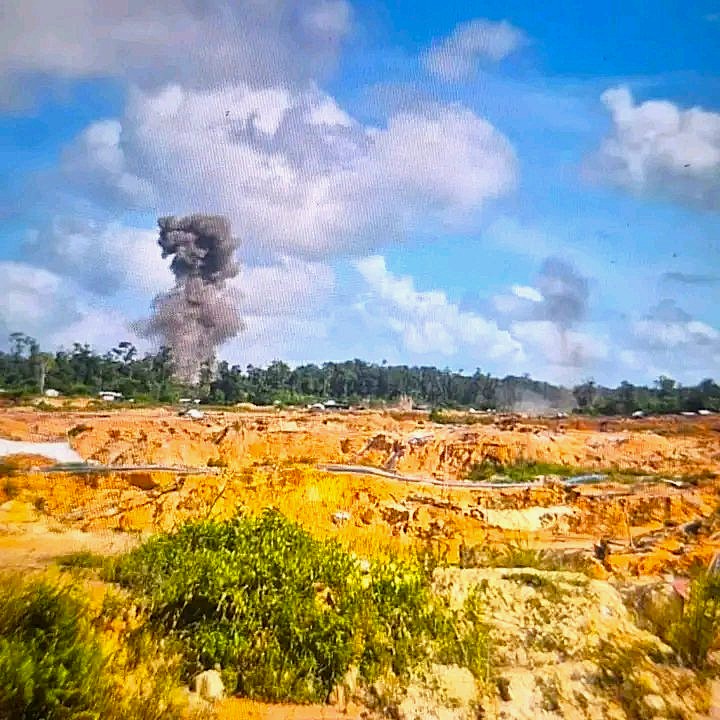
Photo: Las Brisas del Cuyuní gold mining area, as posted by reporter Fritz Sánchez on June 10
Donald J. Trump turned back to breaking out big news on Truth Social about Venezuela on a Friday evening, like it’s a movie premiere. On June 12, he claimed US forces had killed Héctor Guerrero Flores, AKA El Niño Guerrero, who was the number 1 of the Venezuelan mega-gang Tren de Aragua, TDA. That same week, Secretary of Defense Pete Hegseth had promised that a great announcement about drug trafficking was on the way. Naturally, it was the boss who had to reveal the news on prime time. But people in Venezuela were already on alert after news broke, mid-week, that the Venezuelan armed forces, FANB, were attacking the mines near the village of Las Claritas.
Amid a rain of AI-generated fakes and videos coming from other contexts that flooded social media, we were able to see real videos from people on site, showing two Superpuma choppers shooting at targets on land, bringing support to special forces on the ground. The main hypothesis at that point was that they were raiding the compound of AKA Johan Petrica, a TDA co-founder. With Trump’s announcement on Friday, we learned that the trophy was Guerrero, whose whereabouts were unknown since Maduro agents raided the Tocorón prison where the TDA capo had his headquarters.
This is not about drugs, but gold
You may associate TDA with drugs and terrorism, but in this case drugs are secondary. Years ago, TDA turned into a big criminal organization in Venezuela by displacing other gangs or turning them into subsidiaries, by dealing in a wide array of crimes that went from drug trafficking to kidnapping, classic mafia extortion and non-violent scams. When they were able to expand from that Tocorón prison in Aragua state that Guerrero, then an inmate, turned into a fortress, they not only started to venture in the rest of the continent but fought to control the lucrative mining pole of Las Claritas, in the massive state of Bolívar, where international mining companies were expelled by Chavez’s expropriation.
Killing Guerrero is more relevant for the White House as a propaganda piece than as a real hit against drug trafficking in the Americas. It serves to justify the incursion in Venezuela and to give US voters another win amid the Iran fiasco and the lack of results in Cuba.
The military-managed Mining Arc was theoretically the legal frame. We are talking about one of the biggest reserves of gold on the planet. Just look at the numbers mentioned by Lorena Meléndez in this piece. By establishing a presence there, TDA got a cut from human trafficking, the black market of mining supplies and gas, and of course the production and export of minerals. As happened throughout the gang’s history, its involvement in the drug industry prospered because they had corrupt officials in their payroll. Until the regime’s priorities changed, Maduro ordered to raid Tocorón and impose a new Bukele-style prison regime where gangs don’t control jails. Guerrero went elsewhere, likely after reaching an agreement with chavismo that saw him leave his old turf unharmed. TDA continued taking part in the mines business in Bolivar, but sharing the place with other gangs.
This is not law enforcement but business
The kinetic attack on Guerrero, that seems to have taken place at the start of last week, and the FANB raids that came after must be read as part of the Rodríguez interim government to comply with everything Team Trump is demanding from them. Yes, TDA is a criminal organization and Guerrero was guilty of many crimes, but what we must see here, rather than a legitimate Venezuelan government fighting crime, is an illegitimate regime clearing a terrain with the help of a foreign army to allow the return of foreign companies. We mustn’t compare this event with the killing of Pablo Escobar in Medellín in 1993. It’s not that the Venezuelan authorities made the commitment of restoring the rule of law. Actually, we haven’t seen any legal procedure here. There’s no transparency or accountability, we don’t know what happened to the civilian population or whether any rights were respected there. It’s the same level of State violence and lack of due process that the police and military have deployed in poor communities for years.
This is happening because, after US special forces removed Maduro and his wife on January 3, the remaining chavista officers met in Caracas with CIA Director John Ratcliffe (on January 16), US Interior Secretary Doug Burgum (March 4), US Southern Command commander Francis Donovan (in February and May), and more recently the highest military officer from that country, the chairman of the Joint Chiefs of Staff, Dan Caine (June 3). All of them had issued instructions to their Venezuelan counterparts and the top echelons of the chavista regime, including Delcy Rodríguez, related to the improvement of local conditions to allow US companies to invest in Venezuela. This is why the regime has been dismantling Chávez-era laws that discourage foreign investment in oil and mining, why Interior Secretary Burgum has praised Venezuela’s potential for the mining business, and why the armed forces seem to be clearing Las Claritas to take the area back to what is was when companies like Gold Reserve and Crystallex were operating there, instead of a gang ruling over thousands of semi-slaved informal miners.
Of course, taking over the mines from the gangs sounds like rule of law is being restored, but the fact is that it was done with the same opacity that has been the norm regarding this whole Washington-Caracas relationship that appeared when the smoke of January 3 dispersed in the air.
This is not only business but also propaganda
This followed the same script of the kinetic attacks on boats that preceded the incursion of January 3: the social media post with the video, Trump taking the lion’s part of the story, followed by a more formal confirmation by the Rodríguez administration and the SouthCom. After months of repeating that everything’s fantastic in Venezuela and people like Burgum telling Trump that Venezuelans were about to raise statues of him in the cities, Trump needed to underline with a new spectacular event his old narrative of TDA as the spearhead of Maduro’s war against the US. In fact, most of Trump’s post of last Friday goes on trashing Joe Biden, as if Trump was still in the presidential campaign using the TDA trope to win the 2024 election.
The Trump government, which is testing the limits of US institutions, has attacked Venezuela to complete a story (the one about Maduro, TDA and Cartel de los Soles) and to open an investment horizon where business allies of the presidential family would have a head start.
Killing Guerrero is more relevant for the White House as a propaganda piece than as a real hit against drug trafficking in the Americas. It serves to justify the incursion in Venezuela and to give US voters another win amid the Iran fiasco and the lack of results in Cuba. For chavismo, instead, the killing of Guerrero has another meaning. The Maduro regime routinely denied that TDA existed; the Rodríguez regime, coherently, refused to mention TDA or even Guerrero in its Friday night statement. But for Delcy Rodríguez and her minister of Defense Gustavo González López, the operation is a message for three audiences that need some convincing about the case for leaving them in power: the Republican Party, the CEOs of foreign mining and oil companies, and the Venezuelan business community. For Delcy Rodriguez, those three audiences must see that the peace and order they need will come from her, not María Corina Machado.
This isn’t a game of countries but of tight elites
The operation in Las Claritas is a clear example of the true nature of what’s happening between Venezuela and the US.
Everybody is saying that Venezuela is being controlled by the US. It’s more precise to say that the Rodríguez regime is being controlled by the Trump administration. What tends to be described as a relationship between two countries is in practice a relationship between two very specific models of power and networks of political and economic relationships. On one side, a dictatorship where an unelected president simply took the place of a dictator removed by force, but that continues to control the Venezuelan population under the same legal framework that suspended the people’s rights, and that shows flexibility in some matters (releasing some political prisoners, admitting back some exiled politicians) to generate favorable headlines in the global media. On the other side, a North American government that is testing the limits of US institutions and that attacked Venezuela to complete a story (the one about Maduro, TDA and Cartel de los Soles) and to open an investment horizon where business allies of the presidential family would have a head start. So far, Rodríguez and Trump need each other, and are making decisions on Venezuela that have improved the expectations on the economy, but so far have failed to improve the living conditions for most of the population.
The Venezuelan armed forces seem compliant
In a continent so reluctant to allow US military presence, this operation shows the extent to which the Venezuelan armed forces—which according to the Trump administration has given sanctuary to terrorists and are led by a drug-trafficking military mafia designated as terrorist—are cooperating with the Southern Command (that narrative may be simplistic, we must say, but is not completely false). The same FANB that talked about the US as a mortal enemy during a quarter century failed to down a single drone in January 3, when their commander in chief was being captured in the main fort of the country, and now meets with the highest echelons of the US armed forces and cooperates with them in killing Venezuelans citizens on Venezuelan soil. We are not only seeing high-level officials like Defense Minister González López and Interior Minister Diosdado Cabello meeting American generals and doing, apparently, what the Americans want, even if González and Cabello are still under US sanctions, accused of several serious crimes that do not expire. Our Political Risk Report sources say that middle-rank officers are happy to cooperate with the US military.
Why? We can speculate that men under threat like Cabello are complying to avoid the fate of Maduro, hoping that they just need to wait until Trump is out of the picture and the US looks elsewhere. But, what about the many officers and soldiers who benefit from the corrupt State that Chávez and Maduro built for them, to buy their allegiance? If foreign companies are coming to Venezuela to exploit gold under contracts with the State, what will happen with the bribes those officers were collecting by allowing the gangs to operate the mines?
How deep, sincere and stable is the US-FANB military and intelligence cooperation that made it possible to locate and kill the leader of the Tren de Aragua?
The next target will be harder to hit
Another question is who’s next. Now that a powerful message was sent with the obliteration of Guerrero’s last hideout, we must assume that the next targets will be the other Venezuelan gangs, the colectivos that ceased to be of use for chavismo, and Colombian guerrillas (ELN and FARC dissidents, all of them designated terrorists), which also have interests in the mines in other parts of the country. If Abelardo De la Espriella wins the Colombian election, military pressure from that country should increase as well on those armed actors.
The Venezuelans gangs are vulnerable. Colombian guerrillas, on the contrary, have survived for decades and know how to mix with civilians. Not even the Plan Colombia during the Uribe administrations was enough to eradicate them. However, the Trump and Rodríguez governments don’t need to push all armed actors to extinction or to make Venezuela a country free of paramilitary and gangs. For the moment, they just need to clear exploitation sites, logistical routes, ports and main cities. All the places foreign executives and their families would need for a safe relocation in Venezuela.
