The airline has issued guidance online after a passenger shared their concerns
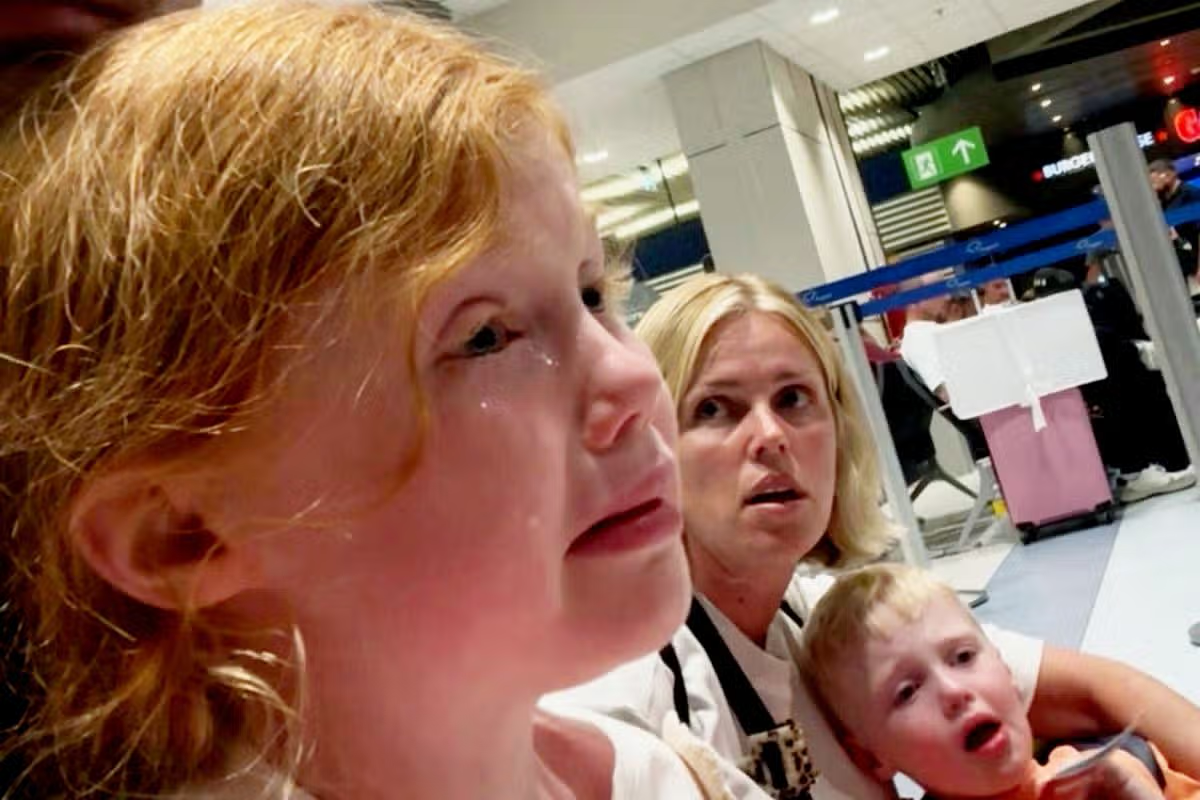
The new system has meant long waiting times for many passengers across Europe(Image: Getty )
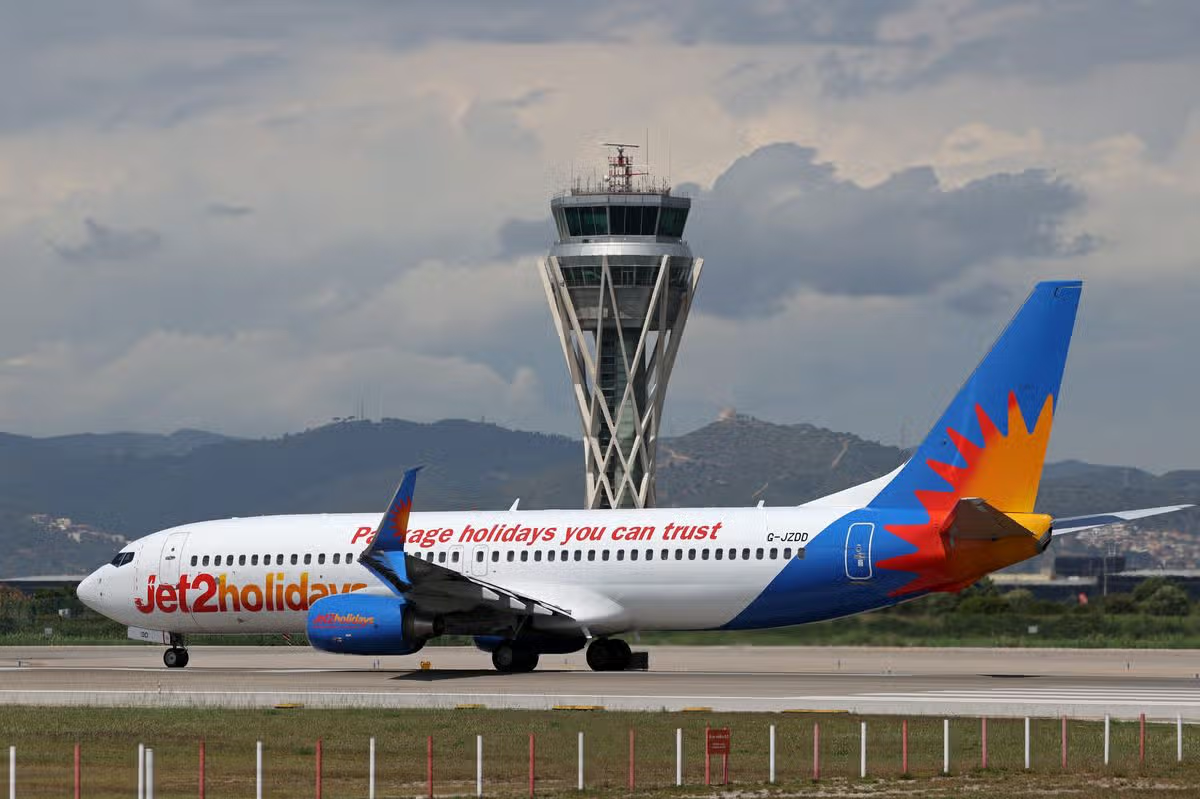
EasyJet Holidays has responded after passengers shared concerns online that they may miss their flights due to long queues at popular European airports. As the European Union’s (EU) new Entry/Exit System (EES) continues to roll out across the continent, passengers face long waits because it requires non-EU travellers to register biometric data, such as fingerprints and photos, on arrival, replacing passport stamps.
The new automated digital border system launched on October 12, 2025, and is expected to be fully operational in the Schengen Area by April 10, 2026. A statement on Gov.uk reads: “EES may take each passenger extra time to complete, so be prepared to wait longer than usual at the border.”
The countries in the Schengen area include: Austria, Belgium, Bulgaria, Croatia, Czechia, Denmark, Estonia, Finland, France, Germany, Greece, Hungary, Iceland, Italy, Latvia, Liechtenstein, Lithuania, Luxembourg, Malta, Netherlands, Norway, Poland, Portugal, Romania, Slovakia, Slovenia, Spain, Sweden, and Switzerland. Many airports are reportedly facing long border check queues due to the new system.
The Republic of Ireland and Cyprus are not part of the Schengen area, so EES is not required when travelling to either country. Gov.uk adds: “You may also be asked to provide either your fingerprint or photo when you exit the Schengen area. The checks may take slightly longer than previously, so be prepared to wait during busy times.”
People have taken to social media to share their concerns about missing their flights due to long passport control queues, including EasyJet passengers. One woman, called Jenny, who goes by the username @MunchkinMumsie on X, posted about her worries of not getting through border control on time for her upcoming flight home.
Content cannot be displayed without consent
She said: “Hi @EasyJetholidays, I’m returning home from Palma tomorrow, our coach transfer is picking us up at 12.30, our flight is at 15.40 and we are 90 minutes away from the airport. I’m worried this will not give us enough time to get through the airport with my child, will this be ok?”
A spokesperson replied: “Hello Jenny, thanks for reaching out. Our transport providers are the local experts and will use their knowledge of the destination and airport experience to calculate your transfer pick up time to ensure your journey to the airport is stress free and that you arrive with enough time to drop off your bags and clear security. Do let us know if you’d prefer to make your own way, and we’ll be happy to update our suppliers! – Alex.”
Jenny then asked: “If we catch your transfer and don’t get through in time, do you cover all our expenses and book our alternate flight home?” The spokesperson told her: “Yes – our dedicated On Holiday Support teams will be more than happy to assist with rescue flights if required – Alex.”
Jenny responded with: “Thank you, there are lots of posts on Mallorca travel forums of the children’s queue for border control at Palma being 2-3 hours long. It seems crazy you are not arranging transfers for families to get to the airport earlier.”
Updating Jenny with guidance, the spokesperson issued an alert about ‘missed flights’ and what happens. They told her: “If we are alerted to any flights being missed, we will work alongside our in destination teams to address the issue at hand. As it stands, our customers have not advised us of any major issues with flights being missed – Alex.”
In another post in the thread, the spokesperson added: “Please do let us know if you are looking to make your own way to the airport on this occasion, and we’ll be more than happy to update our suppliers. We are unable to assist with adjusting your pick-up time – Alex.”
A statement on Palma Airport’s website reads: “The EES is mainly designed to save time and improve border security. It automates passport checks, identifies travellers who overstay, and helps detect fraudulent documents. It also supports authorities in preventing and investigating terrorism and other serious crimes.”
When passengers find out they might be late to their boarding gate, they should tell their airline using their app, email, or phone. They can also ask airport staff for assistance, since some airports have electric cars or allow passengers with short connections or flights leaving soon to skip to the front of the line.
It is advised that passengers arrive at the airport early to handle any unexpected delays at security or passport control. A spokesperson for ABTA, the association of travel agents and tour operators, says: “We’re advising passengers to go straight to passport control as soon as you have gone through check-in and security; that way you get the EES checks out of the way as early as possible.
“We’re also advising passengers to follow their transport provider’s advice on when to arrive at airports/ports etc. If flying, the usual rule is to arrive at the airport for a flight from Europe at least two hours before, so we’d encourage people to apply that as a minimum, but to also check with their airline and airport.”
People are being urged to check theirs as soon as possible before peak season
13:20, 12 Apr 2026Updated 13:31, 12 Apr 2026
More than 1.2 million are due to expire in 2026 (stock image)(Image: Getty)
An alert has been issued by money specialists, as an important document is expected to expire for millions of people in the UK this year. It is raising concerns that large numbers of British travellers could be caught out just as the holiday season reaches its peak.
More than 1.2 million UK Global Health Insurance Cards (GHICs) are due to expire in 2026. Nearly 800,000 are expected to run out during the peak summer holiday months of July to September, according to new Freedom of Information data accessed by PayingTooMuch, a travel insurance comparison site.
The NHS says a GHIC lets you get necessary state healthcare in the European Economic Area (EEA) and in some other countries on the same basis as a resident of those countries. This may be free, or it may require a payment equivalent to that which a local resident would pay.
On the NHS website, it states: “A UK GHIC is free and lasts for up to five years. Apply for your new card through the NHS website. Avoid unofficial websites – they may charge you a fee to apply. The UK GHIC is not a replacement for travel insurance. We advise you to have private travel and medical insurance for the duration of your trip.”
The FOI sent to NHS Business Services Authority also highlights a significant rise in expiring cards this summer. The data shows that more than 290,000 GHICs are due to run out in August alone, coinciding with the busiest period for overseas travel.
In response, a money specialist warns that thousands of travellers could unknowingly head abroad with expired GHICs this summer. While this is a small detail often missed amid holiday planning, it’s one that could lead to serious consequences.
Hannah Mayfield (DipFA), founder of What Is Wealth, says the sheer volume of 2026 expiries could leave many people caught out. She said: “If you fall ill or face a medical emergency, discovering too late that your GHIC is no longer valid only adds stress at the worst possible moment.
“With such a high number of GHICs expiring this year, particularly during the busy summer holiday period, it’s vital that travellers check their card well in advance. It is an easy detail to overlook, but one that could leave you seriously exposed once you are already overseas.”
Mayfield warns that the risks do not stop at travelling with an expired card. The FOI data also shows how expensive medical treatment abroad can become, even when state support is accessible. The highest GHIC/EHIC claim last year exceeded £340,000, while the second highest topped £226,000.
“That is the part many travellers may not fully realise,” explains Mayfield. “While a GHIC can help to access basic state-provided healthcare, it is not designed to cover the full range of issues travellers commonly encounter – from private treatment costs if needed to flight cancellations, lost bags or emergency repatriation to bring you home.”
A GHIC is accepted in most EU countries, plus a few additional countries with reciprocal healthcare agreements. It can reduce your medical costs abroad if you need treatment, but it doesn’t make treatment completely free or cover everything.
You might still have to pay for your treatment upfront and buy prescriptions, which you can then claim back through your travel insurance. If you use your GHIC to pay medical fees abroad and make a medical claim through your travel insurance, some providers waive the policy excess on the medical claim, ultimately saving you money.
Mayfield reminds holidaymakers that travel insurance is an essential part of holiday planning, as a good policy provides protection in areas that the GHIC does not. When choosing a policy, she advises checking that cancellation cover matches the full cost of your holiday and ensuring it is tailored to your health needs, destination, and excursions. Comparing travel insurance is a good way to find cover that suits you and the type of trip you are taking, especially if you have with pre-existing health conditions.”
With so many GHICs expiring this year, experts recommend travellers check their card and travel insurance at the same time they book the trip. Renewing early is particularly important if your card expires within six months of your trip, as leaving it too late can lead to complications if treatment is needed overseas.
“You can apply for a free GHIC directly from the official UK government website. All family members should have one in their name. You’ll need your UK address and some basic personal details and usually it will arrive within 7-10 working days.
“Be wary of bogus sites asking you to pay for a GHIC as you don’t need to, they are free,” she adds. Mayfield urges travellers to “check their GHIC now, don’t wait until the airport to discover it has expired.”
The FCDO has all the latest travel warnings listed online, advising against all travel to multiple countries
10:08, 12 Apr 2026Updated 10:18, 12 Apr 2026
An FCDO warning can affect your travel insurance(Image: Getty )
The Foreign, Commonwealth and Development Office (FCDO) provides regularly updated travel guidance for British nationals heading abroad. It’s vital to check the latest FCDO advice before your trip, as it could affect your holiday plans and travel insurance.
Choosing to travel against FCDO warnings can invalidate your travel insurance. You may also find that consular assistance is severely limited should you face an emergency. On its travel advice page, the government agency says: “No travel can be guaranteed safe. Read all the advice in this guide.”
To safeguard British nationals travelling overseas for work or pleasure, the FCDO provides up-to-date travel advice for every country worldwide. It’s essential to consult this guidance before every journey.
Should the FCDO consider a situation dangerous, it may advise against all travel or only non-essential travel to a particular country or specific regions within it. Alongside travel warnings, the FCDO provides useful information, including entry requirements, crime statistics, local laws and customs, and details regarding any forthcoming strikes or industrial action that could disrupt your holiday.
It’s important to be aware that if the FCDO issues a warning against all travel or all but essential travel to your chosen destination before your departure, your travel insurance is unlikely to provide cover. Consequently, any claims you make will in all probability be rejected.
Travel insurance is designed to safeguard you against unexpected and unforeseen risks. However, heading to a destination that the FCDO has declared dangerous carries a considerably greater risk than jetting off to a generally regarded safe country.
Should the FCDO issue a warning while you are already in an affected region, you will remain covered under the medical and personal accident sections of your travel insurance policy. However, this is provided you comply with the latest FCDO guidance for British nationals in that area.
While most travel insurance policies do not cover trips taken against official advice, there are a handful of exceptions. These particular policies were originally designed to protect individuals travelling to high-risk areas for professional reasons, such as journalists and aid workers. But, they are increasingly being taken up by leisure travellers keen to press ahead with their plans during the COVID-19 pandemic.
Political instability, natural disasters, and safety concerns are among the factors that can prompt an FCDO warning. The FCDO has issued numerous travel advisories, advising against “all travel” and “all but essential travel” to certain nations or regions across Europe, Africa, Asia, and South America.
Of the 226 countries featured on the FCDO’s travel advice page, certain destinations are currently marked as ‘do not travel’ zones owing to various concerns that ‘can not guarantee safety’, including security threats, health risks, and legal differences from Britain. Your travel insurance may be rendered invalid if you travel contrary to FCDO guidance concerning the following nations, as of April 2026.
Afghanistan
The FCDO advises against all travel to Afghanistan, saying: “Your travel insurance could be invalidated if you travel against advice from the FCDO.” The government agency says the security situation is volatile and tensions between Afghanistan and Pakistan have previously resulted in violent clashes in border regions.
It adds: “Travel throughout Afghanistan is extremely dangerous and a number of border crossings are not currently open. There is a heightened risk of British nationals being detained in Afghanistan. If you are a British national and you are detained in Afghanistan, you could face months or years of imprisonment. FCDO’s ability to help you is extremely limited and support in person is not possible in Afghanistan. For more details about the risks in Afghanistan, see Safety and security.”
Belarus
FCDO advises against all travel to Belarus. You face a significant risk of arrest if you have at any time engaged in any activity now considered illegal by the Belarusian regime. There is also a low risk that direct conflict linked to the war in Ukraine may spread to Belarus. Find out more about why FCDO advises against all travel.
Burkina Faso
FCDO advises against all travel to Burkina Faso. This is due to the threat of terrorist attacks and terrorist kidnappings, and the unstable political situation in the country.
It explains: “There is no British Embassy in Burkina Faso and all consular support is provided from the British Embassy in Accra, Ghana. They cannot provide in-person assistance. If there is serious violence, unrest or a deterioration in the security situation, it could be difficult to leave safely.
“Do not rely on the British government to evacuate you as they may not be able to do so. Have your own plans on how you would leave the country, make sure you keep all travel documentation up to date and monitor the local situation.”
Haiti
The FCDO advises against all travel to Haiti owing to the unstable security situation. There are presently no British consular officials in Haiti and the capacity to provide consular assistance is severely restricted and cannot be delivered in person in Haiti. British nationals may receive consular services assistance at our diplomatic mission in the Dominican Republic.
The government agency says: “If you choose to travel to or stay in Haiti against FCDO advice, try to avoid all crowds and public events, and take appropriate security precautions.”
Content cannot be displayed without consent
Iran
FCDO advises against all travel to Iran. It says: “If you are a British national already in Iran, either resident or visitor, carefully consider your presence there and the risks you take by staying. British and British-Iranian dual nationals are at significant risk of arrest, questioning or detention.
“Having a British passport or connections to the UK can be reason enough for the Iranian authorities to detain you.” British nationals should:
read if you’re affected by a crisis abroad. This includes guidance on ‘how to prepare for a crisis’ with suggestions on what you might include in your emergency supplies and ‘what to do in a crisis’
sign up to FCDO Travel Advice email alerts
monitor local and international media for the latest information
stay away from areas around security or military facilities
keep your departure plans under review, and ensure your travel documents are up to date
if you are advised to take shelter, stay indoors or find the nearest safe building or designated shelter. An interior stairwell or a room with as few external walls or windows as possible may provide additional protection
Mali
FCDO advises against all travel to the whole of Mali due to the unpredictable security conditions. The FCDO says if you’re in Mali, you should leave immediately by commercial flight if you judge it safe to do so.
It explains: “The international airport in Bamako is open, and commercial flights are available. Do not try to leave Mali by overland routes to neighbouring countries, as this is too dangerous. This is due to terrorist attacks along national highways. Terrorist group Jama’a Nusrat ul-Islam wa al-Muslimin (JNIM) has implemented blockades on key routes throughout Southern and Western Mali, including the capital city of Bamako.
“These blockades are targeting fuel trucks and are enforcing checkpoints for individuals attempting to pass through them. Attacks can occur at any time. There is a high threat of kidnapping and criminal activity across Mali, including in the capital, Bamako. If you choose to remain in Mali, you do so at your own risk. You should have a personal emergency plan that does not rely on the UK government. If you are a British national already in Mali, either resident or visitor, carefully consider your presence there and the risks you take by staying.”
Niger
FCDO advises against all travel to Niger. This is due to the rise of reported terrorist and criminal kidnappings of foreign nationals, which have taken place this year in Niger.
There is an ongoing risk of terrorist attacks throughout Niger, including in the capital, Niamey. The political situation remains unstable following the July 2023 military coup. Further instability is possible.
Russia
FCDO advises against all travel to Russia due to the risks and threats from its continuing invasion of Ukraine, including:
security incidents, such as drone attacks, and Russian air defence activity
lack of flights to return to the UK
limited ability for the UK government to provide support
There is an increased risk of British nationals being detained in Russia, including if the Russian authorities suspect you of engaging in or supporting activities against Russian law, even if the activities took place outside Russia.
Russia has a track record of targeting foreign nationals and holding them in detention as leverage over other countries. FCDO’s ability to assist you in these circumstances is extremely limited. There is also a high likelihood that terrorists will try to carry out attacks, including in major cities
South Sudan
The FCDO strongly advises against all travel to South Sudan owing to the threat of armed violence and criminal activity. The political and security situation remains unpredictable. Political tensions are high, and the security situation across the country could deteriorate rapidly and unpredictably.
If the unstable security situation deteriorates, routes into and out of South Sudan may be blocked. Juba airport may close or be inaccessible. Flights may be cancelled at short notice. Regional developments may also affect international transport. For example, in 2019 and 2023, events in Sudan caused South Sudan’s airspace to close temporarily. Consular assistance to British nationals is severely limited in South Sudan. In-person consular assistance is not available.
Syria
FCDO advises against all travel to Syria due to unpredictable security conditions and the threat of terrorist attacks. Regional escalation poses significant security risks and has led to travel disruption. British nationals should:
read If you’re affected by a crisis abroad. This includes guidance on “how to prepare for a crisis” with suggestions on what you might include in your emergency supplies and “what to do in a crisis”
follow advice from the local authorities and sign up to receive information and alerts
sign up to FCDO Travel Advice email alerts
monitor local and international media for the latest information
stay away from areas around security or military facilities
keep your departure plans under review, and ensure your travel documents are up to date
if you are advised to take shelter, stay indoors or find the nearest safe building or designated shelter. An interior stairwell or a room with as few external walls or windows as possible may provide additional protection
Yemen
FCDO advises against all travel to the whole of Yemen due to the unpredictable security conditions. If you’re in Yemen, you should leave immediately.
It says: “Support for British people is severely limited in Yemen. British Embassy services in Sana’a are suspended, and all diplomatic and consular staff have been withdrawn. The UK government cannot help British nationals leaving Yemen. There are no evacuation procedures in place.
“FCDO cannot offer advice on the safety of travelling to any potential departure point. The UK government’s ability to help with onward travel is severely limited and you’ll be expected to cover the cost of visas, accommodation, insurance and onward travel yourself. If you choose to remain in Yemen, you should minimise movement around the country and within cities and towns, monitor developments in the local security situation and follow other precautions in this travel advice.”
If you’re a British national in Yemen and need help from the UK government, you can call FCDO on 020 7008 5000 (24 hours).
Travel Health Pro has issued a reminder to holidaymakers
Brits are urged to do one thing before going on holiday abroad(Image: Getty)
Brits planning overseas holidays are being urged to complete one crucial task before jetting off. According to experts, this applies to “all” travellers.
Adhering to this advice, which addresses any possible health and security concerns, will help you “stay safe”. Travel Health Pro said: “Most travellers have a safe, enjoyable trip without any problems, but basic precautions should be taken to help maintain personal safety.
“The Foreign, Commonwealth and Development Office (FCDO) recommend all travellers from the United Kingdom (UK) prepare well and research their destinations before they go.” It continued: “FCDO travel advice provides country-specific safety and security advice, along with information about local laws and customs.
“Researching destinations before departure (ideally before booking a trip) and following FCDO advice helps you stay safe.” Should the FCDO deem the risk of travel to be “unacceptably high”, they will formally advise British nationals against “all but essential travel” or “all travel” to a specific country or region.
This information can be accessed by searching for a specific country via the FCDO country page. Additionally, you can also receive FCDO email alerts regarding particular countries by registering through a link on the FCDO country page for your chosen destination.
It’s crucial to note that your travel insurance could be rendered void should you travel against FCDO guidance. Travel Health Pro also provided the following general advice for those heading abroad.
Take care
It encouraged people to “take care” with important documents, insurance details, contact numbers and belongings.
Dress and behave appropriately
Avoid obvious displays of wealth, dress suitably and behave appropriately, it said. “For example, public displays of affection are unacceptable in some regions and alcohol is banned in certain countries,” the website said.
Alcohol
It continued: “Some accidents and injuries can be prevented by careful behaviour. Alcohol may be a factor, as it can affect judgment and lower inhibitions. Ideally, if you drink alcohol, only do so in moderation.”
Further to this, you should not drink alcohol in countries where it is prohibited.
Drugs
Possessing or smuggling illegal drugs, even in tiny amounts, are serious crimes in many countries. This includes cannabis.
Travel Health Pro said: “UK residents caught carrying illegal drugs while visiting or passing through a country will face that country’s laws. These can be much stricter than UK laws, as some countries have a zero-tolerance policy to drug offences.
“Punishment could include arrest and detention, with a long prison sentence if charged and convicted. Many international airports, train stations and ports have excellent technology and security for detecting illegal items, which may be used to scan the baggage of transiting passengers.”
LGBTQ+ travellers
It added: “FCDO advise that attitudes towards lesbian, gay, bisexual and transgender (LGBT+) travellers worldwide can be very different to those in the UK. They advise LGBT+ travellers to find out about local laws and social attitudes towards same-sex relationships, gender expression and identity before you visit a country.”
To check specific advice on your destination, visit the FCDO country pages here.
The finance expert has said these could help make travelling much smoother
15:02, 07 Apr 2026Updated 15:07, 07 Apr 2026
Martin Lewis’ wallet ‘essentials’ before any trip abroad(Image: ITV)
Martin Lewis has said that Brits going abroad should have up to five essential items in their dedicated ‘holiday wallet’. These important items could make travelling much easier, and in some cases, cheaper, through one simple money-saving technique.
According to the Money Saving Expert (MSE) website, founded by Martin Lewis, he has previously suggested that people set aside a separate wallet or purse for use only when abroad. He recommends keeping five items inside at all times, even when you get back to the UK, to make future holidays ‘easier’.
The financial broadcaster calls this his ‘overseas wallet or purse‘, and he has followed this advice for decades. In the 2013 blog post, the ITV regular said: “I genuinely have a second wallet I pick up when I go abroad. Not to better match my overseas shoes, but as a MoneySaving arsenal to ensure that when I am away, I get more bang for my buck.”
Starting with some of the most common and relevant to the average traveller. Martin suggested that this wallet should have a specific bank card for overseas use.
He said: “Everyone who regularly travels abroad should hold a specialist overseas credit card. This isn’t about borrowing, it’s simply an easy vehicle to get the best exchange rates in every country.
“Spending abroad on most plastic should be avoided. While banks and building societies themselves get the nigh-on perfect Visa/Mastercard wholesale rate, they then add a 3% load to what they charge us.” If you can’t get a credit card or don’t want one, prepay cards are effectively an electronic traveller’s cheque.
Martin wrote: “Load it up with cash in advance and use it while away. If you lose it, no problem, pay a replacement fee and the cash is re-credited.”
If you frequent the same country or region often, cash leftover from previous trips. Although it can be tempting to swap anything back into pounds straight away, it could be a welcome surprise for future trips – whether that be a few months, a year or more later.
If people are often travelling in European countries, such as Spain, France, Italy, and Greece, it might be worth keeping a UK Global Health Insurance Card (GHIC) in their travel wallet for emergency medical care . It is free on the official NHS site and lets UK travellers access state-run healthcare in EU countries and Switzerland for certain medical costs, often at the same price locals pay.
These cards don’t replace travel insurance, which you’ll need for things such as cancellations, private hospitals or repatriation. Check the expiry date at the bottom right of your card now, as many could be travelling with expired cards.
For anyone who drives abroad, keep your original driving license handy (and remember to swap it out of any physical travel wallets before packing them away). Martin said: “As well as the obvious car hire advantages, it’s also useful as ID, which is often demanded when paying by card.”
When travelling further afield, and over to the United States, a copy of your ESTA (Electronic System for Travel Authorisation) number will be handy to keep close. An ESTA lasts for two years, or until your passport expires, whichever comes first. Once it runs out, you’ll need to apply for a new one.
Although you don’t need to present the reference number at Border Protection when you land in the US, print or screenshot it and bring it to the airport. That’s because some airlines may require it at check-in, so check with yours.
Martin also said: “My wallet’s also packed with unspent small euro and dollar notes. After all, why pay to change back £30 or £40 of foreign currency? Leave it sitting for next time.” Martin also recommends keeping a photocopy of your passport. He said: “Just in case my passport goes missing, the key details can be very useful.”
Travelling to these countries could put your safety at risk
The Foreign Office currently advises against travelling to a number of countries(Image: Getty)
Brits are reminded to check important information before jetting off on holiday, as the Foreign Office currently has travel warnings in place for 52 countries. The Government body advises people not to venture to these locations amid safety and security concerns.
And a further 24 countries have “all but essential travel” guidelines set by the Foreign, Commonwealth and Development Office (FCDO). Failing to adhere to these warnings can not only put your safety at risk but invalidate any travel insurance you have.
As reported by The Independent, political conflicts, natural disasters and safety concerns are some of the reasons the UK Foreign Office will advise people to avoid certain destinations.
Among these current restrictions are advice against “all travel” and “all but essential travel” to entire countries or parts of countries in Europe, Africa, Asia and South America.
Of a total of 226 countries or territories with foreign travel advice pages, 76 are currently flagged as having no-go zones due to security issues, health risks and legal differences with the UK.
Below is the full list of countries on the FCDO “do not travel” list.
FCDO advises against all travel
Afghanistan
Belarus
Burkina Faso
Haiti
Iran
Iraq
Israel
Mali
Niger
Palestine
Russia
South Sudan
Syria
Yemen
FCDO advises against all travel to parts
Algeria – all travel to within 30km of Algeria’s borders with Libya, Mauritania, Mali, Niger, Tunisia
Armenia – within 5km of the full eastern border between Armenia and Azerbaijan, the M16/H26 road between the towns of Ijevan and Noyemberyan
Azerbaijan – within 5km of the Azerbaijan-Armenia border
Benin – northern border regions
Burundi – FCDO advises against all travel to Mugina, Cibitoke, Bukinyayana, Bubanza and Mpanda communes, and parts of Ntahangwa commune, specifically the RN5 road north of Melchior Ndadaye International Airport
Cameroon – Bakassi Peninsula, parts of the Far-North Region, North-West Region and South-West Region and within 40km of the Central African Republic, Chad and Nigeria borders
Central African Republic – against all travel except to the capital, Bangui
Chad – Borkou, Ennedi Ouest, Ennedi Est and Tibesti provinces, Kanem Province, including Nokou, Lake Chad region and within 30km of all Chad’s other borders
Congo – within 50km of the Republic of Congo-Central African Republic border in Likouala Region
Côte d’Ivoire – FCDO advises against all travel within 40km of the borders with Burkina Faso and Mali, to the Northern Zanzan and Savanes provinces and to Comoé National Park
Democratic Republic of the Congo – within 50km of the border with the Central African Republic, the province of Kasaï Oriental, the Kwamouth territory of Mai-Ndombe Province and provinces in Eastern DRC
Djibouti – Djibouti-Eritrea border
Egypt – within 20km of the Egypt-Libya border and the North Sinai Governorate
Eritrea – within 25km of Eritrea’s land borders
Ethiopia – international border areas, the Tigray region, Amhara region, Afar region, Gambela region, Oromia region, Somali region, Central, Southern, Sidama and South West regions and Benishangul-Gumuz region
Georgia – South Ossetia and Abkhazia
India – within 10km of the India-Pakistan border and Jammu and Kashmir
Indonesia – Mount Lewotobi Laki-Laki, Mount Sinabung, Mount Marapi, Mount Semeru, Mount Ruang, Mount Ibu
Jordan – within 3km of the border with Syria and all but essential travel to all other areas
Kenya – Kenya-Somalia border and northern parts of the east coast
Lebanon – areas in Beirut and Mount Lebanon Governorate, the South and Nabatiyeh Governorates, the Beqaa Governorate, the Baalbek-Hermel Governorate, the Akkar Governorate, the city of Tripoli and Palestinian refugee camps
Libya – advises against all travel to Libya except for the cities of Benghazi and Misrata
Mauritania – Eastern Mauritania and within 25km of the Malian border
Moldova –Transnistria
Mozambique – Cabo Delgado province, parts of Nampula province and Niassa province
Myanmar (Burma) – Chin State, Kachin State, Kayah State, Kayin State, Mon State, Rakhine State, Sagaing and Magway regions, Tanintharyi Region, Shan State North, North Mandalay Region, and East of the Yangon-Mandalay Expressway in Bago region
Nigeria – Borno State, Yobe State, Adamawa State, Gombe State, Katsina State, Zamfara State and the riverine areas of Delta, Bayelsa, Rivers, Akwa Ibom and Cross River states
Pakistan – within 10 miles of the border with Afghanistan, areas in Khyber Pakhtunkhwa Province and the Balochistan Province
Philippines – western and central Mindanao and the Sulu archipelago
Saudi Arabia – within 10km of the border with Yemen
Somalia – advises against all travel except the western regions Awdal, Maroodijeh and Sahil, for which it advises against all but essential travel
Sudan – against all travel except to the Hala’ib Triangle and the Bir Tawil Trapezoid, for which it advises against all but essential travel
Togo – within 30km of the border with Burkina Faso except for the city of Dapaong and the N1 highway leading to it from the south
Tunisia – parts of Western Tunisia, including the Tunisia-Algeria border and Southern Tunisia, including the Tunisia-Libya border
Turkey – within 10km of the Turkey-Syria border
Ukraine – all regions of Ukraine with the exception of some western areas, for which it advises against all but essential travel
Venezuela – border areas, the Orinoco Mining Arc, south of the Orinoco river and the Zulia state. All but essential travel to all remaining areas of Venezuela
Western Sahara – within 30km of ‘the Berm’ boundary line and areas south and east of the Berm boundary line
FCDO advises against all but essential travel
The FCDO clarifies: “Whether travel is essential or not is your own decision. You may have urgent family or business commitments which you need to attend to. Only you can make an informed decision based on your own individual circumstances and the risks.”
FCDO advises against all but essential travel to parts
Angola – Cabinda Province, except Cabinda city and border areas in Lunda Norte Province
Bangladesh
Bolivia – Chapare region
Brazil – four river areas towards the west of Amazonas State – along the Amazon River and its tributaries west of the town of Codajás and east of the town of Belém do Solimões, the Itaquaí River, the Japurá River and along the Rio Negro and its tributaries north or west of the town of Barcelos
Cambodia – within 20km from the land border with Thailand
Colombia – within 5km of borders and parts of northern, central and southern Colombia and the Pacific Coast
Ecuador – seven coastal region provinces and within 20km of the Ecuador-Colombia border
Ghana – Bawku Municipality
Guatemala – within 5km of the Mexican border and the towns of Santa Ana Huista, San Antonio Huista and La Democracia
Kosovo – the municipalities of Zvečan, Zubin Potok and Leposavic, and areas of Mitrovica north of the river Ibar
Laos – Xaisomboun Province
Malaysia – Eastern Sabah coastal islands
Mexico – parts of Baja California, Chihuahua, Sinaloa, Tamaulipas, Zacatecas, Guanajuato, Michoacán, Jalisco, Colima, Guerrero and Chiapas
Papua New Guinea – Hela and Southern Highlands provinces, Enga Province in the Highlands, except Wabag District
Peru – within 20km south of the Peru-Colombia border and the Valley of the Apurímac, Ene, and Mantaro River
Rwanda – Rusizi district
Tanzania – within 20km of the Tanzanian border with Cabo Delgado Province in Mozambique
Thailand – parts of the south, near the Thailand-Malaysia border and within 20km of the land border with Cambodia
To check the travel advice for a country before you visit, see the Foreign Office’s complete guide here.
This handy map tool allows you to calculate the percentage of the world you’ve seen by selecting all the countries you’ve visited.
Travellers admit they compare how many countries they’ve visited with other people(Image: Getty Images)
Ever wondered how much of the world you’ve really seen? Use this handy tool to find out. By selecting all the different countries you’ve ever visited, it’ll work out a percentage of the world you’ve managed to explore and how many continents you’ve covered. It’ll also tell you how your stats compare against other travellers, and will show your footprint on the globe.
A poll of 2,000 travellers revealed 43% enjoy comparing the number of destinations they’ve visited abroad with others. Reasons for mentioning their ‘country count’ include wanting to impress others with their worldliness and sense of adventure, get others to think ‘that’s more than me’ or to see them as someone ‘loaded’ with money.
Of those who mention their country count, more than four in 10 (44%) will casually raise the subject in general holiday chatter, while 38% will jump at the chance to name a nation they’ve visited the second someone else mentions it.
It also emerged 34% of travellers consider their list of countries visited ‘as a bit of a badge of honour’ and a fifth feel ‘quietly superior’ to those who have been to fewer nations.
A spokesperson from travel insurance specialist Staysure, which commissioned the research and tailors policies for people with health conditions, said: “Travelling abroad is exciting and the memories made with friends and family can last forever.
“So, it’s not surprising people love talking about where they’ve been and comparing the number of countries they’ve visited. Sharing experiences is something we all love to do and it’s great to be able to inspire others to visit somewhere new.
One in 10 attempt to sound better travelled than they really are by counting countries they visited as a child in their list. And some go as far as including an airport layover or counting a day trip as a full visit. But four in ten described other people discussing how well-travelled they are as ‘annoying’.
Find out how much of the world you’ve actually seen with this new tool
New Zealand (24%), Japan (23%) and Australia (18%) were at the top of respondents’ wish lists, along with Iceland, Sweden and Switzerland. While Canada was nearly twice as popular as a future destination than the United States (17% versus 8%).
The average traveller has been to seven countries by the time they’re 30 – this number nearly doubles to 15 by the time they reach the age of 60. However, it also emerged 56% of those polled wish they were better travelled.
On average, respondents said their travel peaked at age 34, while 44% admitted their trips abroad have generally decreased as they’ve gotten older.
Four in 10 consider it important that their list of countries visited keeps growing, with those with a set goal aiming to tick off 30 individual countries. To do this, 56% would consider a multi-destination holiday such as a cruise.
Staysure’s spokesperson added: “Our customers often share where they’ve been and where they’re planning to go next.
“It’s good to know people are dreaming big and want to keep ticking off their dream destinations. Although technically correct to do so, would you include a layover in your country list if you’d not set foot outside the airport?
“Wherever people choose to travel, having the right cover and financial protection in place helps them keep ticking countries off their list making the whole experience more enjoyable and worry-free.”
With the summer holidays on the horizon, travel lovers are preparing for their getaways
The insurer shared advice for people planning holidays (stock photo)(Image: Getty)
An insurance provider has shared a checklist for drivers planning a European getaway. Ahead of summer, many families and adventurers are preparing for road trips or holidays abroad. For anyone planning to drive their car in Europe, Green Flag recommends checking five things before setting off.
Sharing advice for motorists online, Green Flag said: “It’s worth taking a few minutes to make sure everything is properly arranged before you head off on your European travels. A quick check, a few weeks before you go, means you’ll have time to address anything that’s not already in place. Take a few minutes and check:
Whether any existing breakdown cover includes European travel
Which countries are covered under the policy
You have your vehicle insurance documents
Your driving licence and passport are valid
Any local driving requirements, such as safety equipment rules and items you’re expected to have in your car.”
The motoring experts explained that drivers should know their breakdown cover options, which could help them decide whether to take out European breakdown cover for the trip. Green Flag said the insurance helps drivers if their car develops a fault or breaks down during a trip outside of the UK but within Europe.
If drivers don’t take out insurance and then experience difficulties, it could prove costly. Green Flag said: “If you don’t have European breakdown cover and your car develops an issue while travelling abroad, you’d need to call up a breakdown and rescue service that operates in the country you’re in.
“This usually means contacting a local recovery operator and paying for roadside help and towing directly. Costs vary depending on the country, time of day and distance involved.
“In many cases, payment is required upfront, and getting English-speaking help may be difficult depending on where you are.” Green Flag added that you might also need to arrange accommodation and pay the costs to return your car to the UK if it can’t be repaired locally.
Despite this, some drivers might decide to go ahead without additional breakdown cover. The blog advised: “Whether it’s worth getting breakdown cover for your trip to Europe depends on how much of a risk you consider breaking down abroad to be.
“If you’re happy to figure things out should they happen, then maybe European breakdown cover isn’t for you. But if you’d rather set off knowing you’re covered should your car break down, then you’ll probably want to consider getting European breakdown cover.”
Nonetheless, knowing your options ahead of travel means you’re prepared in case of an emergency. For drivers considering European cover, insurers often offer single-trip or multi-trip cover.
Holiday makers have been urged to think carefully about what they share online(Image: Getty)
Families have been warned to be careful to avoid a costly mistake when heading away on holiday. The word of warning comes as key changes to the passport system are coming in soon.
Your holiday photos could cost you a lot of money and could invalidate your home insurance. Karishma Darji, from storage group Ready Steady Store, said: “Posting holiday selfies while you’re away might seem harmless, but it tells the world your home is empty. Insurers could view that as poor security.”
She said this mistake could land you a large bill if the worst happens.
Ms Darji said: ” If your property is burgled and investigators find public posts showing you were away, they may argue you didn’t take ‘reasonable care’ to protect your home.”
If your insurance is invalidated due to you posting a holiday snap while you are away from home and you are burgled, you will be responsible for covering the costs of any loss and damages yourself. Ms Darji said this could mean you end up with a four-figure bill to pay.
She explained: “The annual Crime Survey for England and Wales, published by the ONS in April 2025 shows that the average loss from burglary equates to £4,269. The average value of stolen items sits around £2,800, whereas damage from forced entry averages at £1,400.
“However, every house differs based on the value of possessions they own, so the total cost to replace items could be significantly higher.” In light of this danger, her simple word of advice is: “Save the snaps until you’re back to avoid invalidating your claim.”
Passport changes
This update comes as the cost of applying for a passport is soon to increase. Application fees are increasing by 8 per cent, with the new fees coming in from April 8.
The proposed increases, which need to be approved by Parliament, will include the following:
The standard online application submitted from within the UK will rise from £94.50 to £102 for adults
This will go up from £61.50 to £66.50 for children under 16
Postal applications will increase from £107 to £115.50 for adults and £74 to £80 for children under 16
The charge for a Premium Service (one-day) application submitted from within the UK will rise from £222 to £239.50
The charge for a standard online application for a UK adult passport when applying from overseas will rise from £108 to £116.50
This will also increase from £70 to £75.50 for children under 16
Standard paper applications for overseas passports will see a rise from £120.50 to £130 for adults, and from £82.50 to £89 for children under 16.
An expert has explained all(Image: John Lamb via Getty Images)
Holidaymakers are being made aware they may face additional expenses due to continuing unrest in the Middle East. With flight cancellations, disrupted travel routes and official advisories now in effect, many with travel plans remain uncertain about their financial position should trips be delayed or cancelled entirely.
Alicia Hempstead, Travel Insurance Expert at MoneySuperMarket, has addressed a series of questions concerned travellers may be asking. She explained: “Unfortunately, there is no guarantee that travel insurance will cover travellers affected by the current situation in the Middle East.
“Most standard policies will not allow claims resulting from events that fall under standard exclusions like war and civil unrest. This means any claims for costs linked to disruption, such as cancelled trips, lost items, emergency accommodation, or medical treatment resulting from the conflict are unlikely to be covered.”
Foreign Office guidance
“In serious crises, such as the current situation in the Middle East, which has prompted updated Foreign, Commonwealth and Development Office (FCDO) warnings, the FCDO will usually coordinate support and evacuation efforts. However, this assistance is not guaranteed and does not replace travel insurance. Depending on the circumstances, travellers may still be responsible for some costs, even if they receive help from the FCDO.”
Can I get my money back if my flight is cancelled?
“As flights are being cancelled and significantly delayed, airlines have legal obligations under UK and EU passenger rights rules to offer either a full refund or to re-route at no additional cost. Once services resume, carriers must also offer re-routing options. Passengers’ first point of call should be to check directly with their airline for the latest updates, as policies may vary by departure location and the specific disruption.
“For those due to travel in the coming weeks or months, refunds are not automatic simply because the FCDO advises against travel. However, many airlines and tour operators may offer refunds or flexible rebooking options if the FCDO formally advises against all travel to a destination. Travellers should check the terms and conditions of their booking carefully, and contact their airline or travel provider if they are unsure.
“Be aware that operators may be experiencing high volumes of enquiries, so refunds or rebooking arrangements may take several days or weeks to process and you may need to be prepared for longer waiting times on the phone or online.”
Can I get specialist insurance?
“Travellers who knowingly travel to high-risk areas typically require specialist high-risk or conflict-zone insurance that explicitly covers war-related incidents. These policies tend to be more expensive and come with strict conditions, but they are the only way to secure cover for conflict-related risks.
“For instance, Dubai has previously been a very popular destination, and travellers who have holidays booked may find their hotel costs aren’t covered because their standard policy excludes war-related incidents.
“It’s always a good idea to check directly with your hotel, or if you’re on a package holiday, with your provider, to understand what might be refundable or rebookable if your plans are affected.”
Cancel for any reason (CFAR) option
“A future option to ensure you’re always as protected as possible is to opt for Cancel for Any Reason (CFAR) travel insurance, which can offer reimbursements of around 50-75% of non-refundable, prepaid trip costs. However, these premiums come at a higher price and aren’t offered by all UK insurers.
“If you don’t have specialist cover in place, your best first step is to speak directly to your airline, hotel, or tour operator to understand what flexibility or refunds they may be able to offer before assuming your travel insurance will pay out.”
The Foreign Office has updated travel guidance warning Brits heading to popular destinations to expect potential flight disruptions
Nicola Roy Multimedia content creator
13:02, 21 Mar 2026
Australia is a hugely popular destination for Brits(Image: Kieran Stone via Getty Images)
This week, British travellers heading overseas have been warned that their holiday plans could face disruption.
The UK Foreign, Commonwealth and Development Office (FCDO), the government department responsible for issuing travel guidance to ensure public safety, has updated its advice for several popular tourist destinations.
The continuing tensions in the Middle East mean delays and other forms of disruption are likely, even for those not travelling to the region itself. The FCDO sometimes advises against all travel to particular countries.
While these destinations don’t fall into that bracket, it remains crucial to follow the guidance.
The update states: “Escalation in the Middle East has caused widespread travel disruption, including airspace closures, delayed and cancelled flights.
“Your travel plans may be affected, even if your destination is not in the Middle East.”
The FCDO has issued this update for countries including Australia, New Zealand and Thailand this week. Before departing, travellers are advised to review the guidance for any countries or territories they’ll be passing through, reports the Express.
It’s also recommended that you check the latest information from your airline or tour operator before setting off.
Additionally, reviewing your travel insurance policy beforehand can be beneficial, just to confirm what’s covered if your arrangements are disrupted.
The FCDO added: “Monitor local and international media for the latest information and sign up for travel advice email alerts.”
Ignoring advice from the FDCO could potentially render your travel insurance null and void, so it’s crucial to check over the details before you take off.
Your insurance should cover your planned itinerary, activities and any emergency expenses.
Experts have urged holidaymakers to make this check before jetting off
12:57, 21 Mar 2026Updated 12:57, 21 Mar 2026
If you fail to check this before your holiday, your travel insurance could be invalidated(Image: Getty)
Brits planning a getaway have been warned to check one crucial detail beforehand or risk potentially losing hundreds or even thousands of pounds. Neglecting to do so could leave your travel insurance worthless, meaning you’d be left out of pocket should anything go wrong.
The team at Travel Health Pro stressed that travellers must always keep abreast of guidance regarding their destination from the Foreign, Commonwealth and Development Office (FCDO). You should “keep checking” during the “days and weeks leading up to your trip” to ensure you don’t miss anything.
This guidance will inform you whether there are any present dangers associated with your chosen location. These could stem from severe weather conditions, criminal activity, political instability, conflict, or terrorism threats.
Occasionally, the advice may be severe enough to recommend not travelling altogether, whilst in other instances it might suggest steering clear of particular regions or remaining vigilant about certain circumstances. Travel Health Pro stated: “Planning to travel abroad?
“Before you book your trip, check Foreign, Commonwealth and Development Office (FCDO) foreign travel advice for information on safety and security at your destination. Remember to keep checking FCDO advice in the days or weeks leading up to your trip too, as circumstances can change very quickly.” The guidance elaborated on the meaning of these warnings: “If the FCDO think the risk of travel is unacceptably high, they will formally advise British people against ‘all but essential travel’ or ‘all travel’ to a particular country or region.
“The ‘warnings and insurance’ section of each FCDO country advice page lists all the areas (if appropriate) to which this applies. You can also receive FCDO email alerts about specific countries by signing up through a link on the FCDO country page for your destination.”
Neglecting to carry out this verification and venturing to a high-risk destination could result in your insurance policy becoming void. This could mean you’re left out of pocket for hundreds or even thousands of pounds if something goes wrong and your trip is cancelled or cut short.
Travel Health Pro warned: “Remember – your foreign travel insurance could be invalidated if you travel against FCDO advice. If you travel, remember to check FCDO travel advice regularly, as situations can change quickly.”
Nations with an FCDO warning currently active
At the time of publication, numerous countries are currently subject to an FCDO travel warning. These include:
Afghanistan
Belarus
Burkina Faso
Haiti
Iran
Iraq
Israel
Mali
Niger
Russia
South Sudan
Syria
Ukraine
Yemen
The complete list of foreign travel advice for countries can be viewed online here.
He has just returned from the UAE with crucial advice
The war in the Middle East is having a major knock-on effect on international travel(Image: NurPhoto via Getty Images)
A travel expert has issued a warning to individuals with flights booked to or from the Middle East. The alert comes as tensions continue in the area, with Israel and the US maintaining their strikes on Iran which commenced over a fortnight ago.
Iran continues to hit back with drone and missile attacks on several neighbouring and nearby nations. This resulted in Dubai, a major hub for international travel and home to the world’s busiest airport, temporarily closing its airspace for the second time in 48 hours due to strikes in the vicinity.
Simon Calder, a journalist with the Independent, has just returned from the United Arab Emirates. He provided an update on the current situation for those flying to or from the Middle East, including passengers transiting through the region en route to other destinations.
He stated: “I’ve just arrived at London Heathrow Terminal 4 after a fairly normal flight from Abu Dhabi on Etihad. What wasn’t normal was just how quiet it was when I arrived. Terminal 4, the main hub for the Middle East from London, is frankly a bit of a ghost town. Many of the flights that you would normally expect to see multiple departures on Qatar Airways to Doha and on Etihad to Abu Dhabi are not flying, and there’s also, for instance, Gulf Air based in Bahrain who are not going there.
Content cannot be displayed without consent
“Having said that, there’s perhaps more flights than you might expect, given that, for example, Qatar and the UAE are on the Foreign Office no-go list. There’s a departure this evening to Abu Dhabi on Etihad and one a little later on Qatar Airways overnight to Doha. As well as that, El Al is going out to Tel Aviv. Now, you might have heard that the airspace in Israel is closed; well, it kind of is, but if you’ve got permission, and El Al certainly has, then you can go in.
“And finally, Gulf Air is flying from here later on today, but not to the normal destination of Bahrain. Instead, it’s going to Dammam, which is very close by in Saudi Arabia, from where passengers can travel to that island quite happily over the causeway. But bear in mind that the UAE, Qatar, Kuwait, and Bahrain are all on the Foreign Office no-go list. If you choose to ignore that advice, then it’s likely your travel insurance will not be valid.
Unsurprisingly, the conflict has impacted international travel in numerous ways. Not only have passenger numbers and flights passing through the Middle East declined dramatically, but neighbouring countries favoured by Brits seeking spring sunshine, including Cyprus and Turkey, have also experienced a fall in visitor numbers.
Conversely, nations to the west boasting milder weather, including Spain and Portugal, have witnessed a surge in reservations – as has the Caribbean. The situation has not only left thousands of British holidaymakers stuck in the Middle East, but many are also anxious about their upcoming travel arrangements.
The Association of British Insurers attempted to address these worries with the following statement when questioned about whether insurance will cover the cancellation of a trip to the Middle East due to concerns over the conflict.
It stated: “As the situation evolves, we can understand why people may be reconsidering their future plans to travel to the region. If you wish to cancel your trip, contact your airline, accommodation provider or tour operator in the first instance. They may be able to rebook parts of your trip or offer a refund.
“Travel insurance may not cover cancellations linked to the conflict, depending on your policy’s terms, any war exclusions, and when you bought it. Policies differ, and insurers may take different approaches, so it’s important to check with your insurer to understand what’s covered.”
Other money-saving tips include leaving jewellery and laptops in the UK
12:02, 17 Mar 2026Updated 12:03, 17 Mar 2026
Britons urged to ‘leave watch at home’ this summer to save hundreds
Specialists at travel insurance firm Staysure have revealed the key factors that determine insurance prices and provided guidance on cutting costs when arranging your travel cover this summer. Travel insurance premiums can vary considerably depending on numerous factors, including existing medical conditions, age and your chosen destination.
Luckily, holidaymakers can slash costs by avoiding travelling with expensive valuables. The travel specialists recommended always “leave expensive valuables such as laptops, watches and jewellery at home”.
This is because “adding protection for valuable items, such as cameras or precious watches and jewellery, will push premiums higher”.
“If you need to insure expensive gadgets like cameras or valuables like watches and jewellery, your premium will be higher as there are pricier sums involved.
“Travelling without these items can help to lower the cost of your travel insurance policy and means you are at less risk of losing them,” reports the Express.
Premiums increase with age due to higher illness risk, especially for those aged over 65. Existing medical conditions are equally important as they raise the probability of needing emergency medical care abroad.
The specialists emphasised it is vital to consistently “declare all of your pre-existing medical conditions to ensure your policy is valid, should you need to make a claim”. Trip length and location also affect insurance costs, as extended holidays raise the chances that travellers might need emergency medical care.
Cover works out cheaper for countries deemed low risk, such as Spain, whilst high-risk destinations such as Sri Lanka may attract higher premiums due to repatriation costs.
The experts recommended opting for a lower-risk destination to cut expenses. “A change of country could save you hundreds. For example, a holiday to Paris will usually cost you less in insurance premiums than a trip to New York.
“It’s also important to check the country you are travelling to will be covered by your travel insurer. Some places in the world are considered too high risk.”
Brits heading to Greece have been urged to check the latest travel advice as tensions linked to the Iran conflict raise wider security concerns across the region
The conflict in Iran has disrupted air travel across the globe(Image: ANIK)
Brits planning a Mediterranean getaway are being urged to check official travel guidance before heading abroad. Experts say no trip can ever be guaranteed completely safe amid growing tensions linked to the Iran conflict.
The latest reminder comes from the Foreign, Commonwealth & Development Office, which publishes travel advice for British holidaymakers. Its guidance for Greece stresses that travellers should read all advice carefully before departure.
On the UK Government travel advice website, officials warn: “No travel can be guaranteed safe.” It urges visitors to research destinations carefully and make sure they have comprehensive travel insurance before travelling.
The guidance also highlights passport rules that travellers must meet before entering the country. Greece follows Schengen Area rules, meaning passports must have been issued within the last 10 years and remain valid for at least three months after leaving the region.
British tourists can visit Greece without a visa for short trips. According to the government, travellers can stay in the Schengen area for up to 90 days within any 180-day period for tourism, family visits or business meetings.
However, new border procedures are also on the horizon for travellers heading to Europe. The European Union is introducing its Entry/Exit System, which will require visitors to register biometric details such as fingerprints or a photo when entering the bloc.
The system is expected to become fully operational from April 10. Officials warn the process could add several minutes to border checks for each passenger.
It comes as tensions continue to grow in the Middle East following the ongoing conflict involving Iran. The crisis has raised wider regional security concerns across parts of the eastern Mediterranean.
Neighbouring Cyprus, which lies roughly 800km from mainland Greece and around 300km from parts of the Middle East, has already been monitoring the situation closely. The island has previously served as an evacuation hub for foreign nationals during regional crises.
According to reports cited by international media and the United Nations, the latest escalation has fuelled fears of broader instability across the region. Military exchanges between Iran and its rivals have already heightened security alerts across several neighbouring countries.
The UK has also stepped up its military presence in the region. The HMS Dragon has been deployed to Cyprus as a precautionary measure. The Royal Navy says vessels may be deployed to support British nationals and regional security as required.
Despite the geopolitical tensions, Greece remains one of Europe’s most popular holiday destinations. Data from the Greek National Tourism Organisation shows the country welcomed more than 36 million international visitors in 2024.
Officials say the key message for travellers is to stay informed. Checking the latest government advice and ensuring documents meet entry requirements can help avoid problems when travelling abroad.
In a blow to Brits planning to get away for summer 2026, experts have revealed that the situation in the Middle East could cause holiday prices to rise, even in destinations not affected by the conflict
This article contains affiliate links, we will receive a commission on any sales we generate from it. Learn more
Brits could find their usual break is more expensive this year(Image: Getty Images)
Brits planning to get away overseas for Easter or summer this year are being warned they may need to expand their budget, as holiday prices could rise across all destinations.
Hannah Mayfield, a qualified financial advisor, has explained that the situation in the Middle East could have a “knock-on effect” on prices, following similar patterns seen during times of instability. Even those who opt for a UK-based staycation, or visit countries nowhere near the Middle East, could see higher prices for flights, accommodation, and even everyday spending.
Hannah explained: “Rising tensions in the Middle East can have a knock-on effect on holiday costs, even if you’re travelling somewhere completely different. But this isn’t a new phenomenon. We’ve seen similar patterns during previous periods of geopolitical instability, where travellers change their plans and demand shifts toward destinations perceived as safer.”
Hannah, who is working with travel insurers PayingTooMuch, gave the reasons why flight prices could rise: “Airlines can face higher operating costs during periods of geopolitical instability. If flights need to avoid certain airspaces, routes can become longer. At the same time, global oil prices usually rise during conflicts in major energy-producing regions, and that can eventually feed through into the price for fuel. For travellers, that might mean more expensive plane tickets.”
And it’s not just overseas jaunts that could become more expensive. Hannah said: “There’s also the potential impact on taking holidays, especially to destinations closer to home. If some holidaymakers decide not to travel as far afield, demand for popular destinations such as coastal towns, national parks and major cities can increase.
“When that happens, accommodation prices often rise during peak periods, particularly if availability is limited.” This could mean that, like during Covid, staycations could become pricier.
If you’re planning a trip, even to ‘safe’ destinations, you Hannah advises: “When travel feels more uncertain making sure you have the right level of cover for your trip becomes even more important, so you are less likely to face unexpected costs. Booking early, staying flexible with travel dates, comparing travel insurance policies and prices for flights can make a noticeable difference to the overall cost of a trip.”
She also had this warning: “Most standard travel insurance policies don’t cover acts of war, so conflicts itself may not typically have a direct impact on premiums. However, travellers should always check their policy details carefully, so they understand exactly what is and isn’t covered.
“Consider getting a policy that offers additional cover for travel disruptions which can offer another layer of protection in situations where official government travel advice changes and costs can’t be recovered elsewhere. It’s also worth noting that travel insurance does not cover events that are already known at the time the policy is purchased.”
Hannah, who also runs What is Wealth, which offers financial education for women, also gave some additional money saving tips for holidaymakers: “Keeping an eye on exchange rates and fuel prices can also help holidaymakers budget more accurately and avoid unexpected costs closer to their trip.”
Have a story you want to share? Email us at webtravel@reachplc.com
The Foreign Office has advised against travel to certain countries.
Mia O’Hare Senior Spare Time Reporter and Courtney Eales
09:31, 12 Mar 2026
There’s advice for anyone going to Egypt(Image: murat4art via Getty Images)
At the start of this month, the UK Government issued guidance advising British citizens in Bahrain, Israel, Kuwait, Lebanon, Palestine, Qatar and United Arab Emirates to register their whereabouts. The Foreign, Commonwealth and Development Office (FCDO) is then able to send them direct updates.
There are roughly 300,000 British nationals in the region, of which over 170,000 have registered their presence with the FCDO. The Foreign Office has been revising its travel guidance for Middle Eastern countries and those in the vicinity, as the ongoing conflict continues to cause significant disruption.
The Government stated it is in discussions with commercial operators and regional countries regarding the arrangement of additional flights, as regional airspace has now partially reopened.
One of the most recent updates from the UK Foreign Office relates to entry into Egypt from Jordan.
Guidance stated: “Ferry services operate between Aqaba, Jordan and Taba Heights and Nuweiba in Egypt. Contact ferry operators directly for schedules and availability. Please check travel advice for Jordan for the latest on exit requirements.
“If your stay in Sinai will exceed 15 days, or you are planning to travel in Egypt beyond the Sinai Peninsula, including to fly from mainland airports, for example Cairo or Hurghada, you will need an entry visa”, reports the Liverpool Echo.
The statement continued: “If entering at Taba Heights, this costs 35 US dollars. If entering at Nuweiba, this costs 30 US dollars. Visas can be purchased at the port terminals. Travellers should obtain USD in cash before travelling given payments are often required in cash.”
Currently, the Foreign Office advises against all but essential travel to certain regions of Egypt. Ignoring advice from the Foreign, Commonwealth and Development Office could invalidate your travel insurance.
There is an increased risk of regional tension which could result in travel disruption and other unforeseen consequences. The Foreign Office stated: “British nationals should take sensible precautions, considering their own individual circumstances.”
These precautions include:
Subscribing to FCDO Travel Advice email alerts.
Keeping an eye on local and international media for the latest updates.
Signing up to local information alerts/resources and following the instructions of the local authorities.
Avoiding areas surrounding security or military facilities.
The Foreign Office strongly advises against all travel within a 20km radius of the Egypt-Libya border, with the exception of the town of El Salloum, where it recommends only essential travel.
Active military operations targeting criminal activity are ongoing in this area.
It recommends against all travel to North Sinai Governate owing to ongoing criminal activity and terrorist attacks targeting police and security forces that have led to fatalities.
The complete list of areas the FCDO advises against travelling to can be found here.
Simon Calder gave his thoughts on when travel disruption will start to ease following the strikes on Iran
13:00, 11 Mar 2026Updated 16:05, 11 Mar 2026
Travel remains severely disrupted as strikes on Iran continue
A travel expert has shared his views on when ‘people will be able to travel again’ as the Middle East conflict continues to escalate. Journalist Simon Calder, who specialises in travel, discussed the crisis and its impact on worldwide travel.
American and Israeli strikes on Iran are approaching the end of their second week, with no resolution in sight. Travel to the Middle East remains limited, with airlines cutting back on the number of flights to and from the area.
Countries such as Oman, Qatar, and the United Arab Emirates serve as vital transport hubs for destinations including Asia and Australasia. The outbreak of hostilities has left hundreds of thousands of travellers stuck.
Speaking to Sky News, Mr Calder offered his perspective on when travel might become more straightforward. He said: “We’ve already seen missiles sent to Turkey and attacks on Cyprus. Now, personally, I think the chances of anything happening to a tourist in Turkey or Cyprus are microscopically low, but I also know that people are rebooking away. They’re going to the western Mediterranean – typically Spain and Portugal – because they believe they will be safer there.
Content cannot be displayed without consent
“If you’re flying from the UK to a holiday spot such as Turkey or Cyprus and that flight is cancelled, then, fortunately, air passenger rights rules are squarely on your side. The airline that cancels the flight has to get you to your destination as soon as possible, regardless of the cost. And if you can’t get there immediately, the airline has to provide meals and accommodation, if necessary, before you are able to get to your destination.
“The Foreign Office warns against travel to Kuwait, to Bahrain, to Qatar and, crucially, to the UAE, home to the busiest hub in the world: Dubai International Airport. But I’m also predicting that, actually, that ruling is going to lift fairly quickly, and people will be able to travel again.”
Flights are still operating through Dubai International Airport, despite two Iranian drones injuring four people after exploding at the facility. The Dubai Media Office, which releases statements on behalf of the city-state’s government, confirmed flights are continuing, and that the attack caused ‘minor injuries to two Ghanaian nationals and one Bangladeshi national, and moderate injuries to one Indian national’.
Officials have been attempting to restore its flight schedule, though the airport has been targeted amid the conflict. The war has created uncertainty for travellers with flights booked in the coming weeks, prompting Mr Calder to offer his guidance on what passengers should do.
“If your flight is due to go, I’d say, a week or more from now, well, all you can do is just hope that it goes ahead,” he stated. “If you’re going imminently and you do not know if your trip is running, well, the basic news is that if you go to Abu Dhabi, to Dubai, to Doha, you will be going against Foreign Office advice. So, be aware of that; your travel insurance will be invalidated.
“I’ve got some skin in the game. I am booked to fly out on Saturday night from Jakarta, the Indonesian capital, through to Abu Dhabi and connect onwards to London. Now, at the moment, along with many, many other travellers, I’m absolutely promised the flight will go ahead as normal, and I trust that it will. But I simply do not know.
“At the moment, I’m definitely not cancelling my flight because, well, bluntly, if you cancel the flight – which is what the airlines would really like you to do – you will simply be removing yourself from the problem. If, like me, you’re booked in a few days’ time and you do have a bit of flexibility, then absolutely keep your booking open.
“If you go for a refund, first of all, the airline will be delighted because you’ll be a problem that’s removed from their cares and, secondly, you could find yourself paying three times, five times, 10 times as much to get back. Much better to remain a problem for the airline; they’ve got to get you where you need to be.”