Trains

UK’s smallest station is shorter than a train carriage — only 1 door can open

You’ll have to hurry

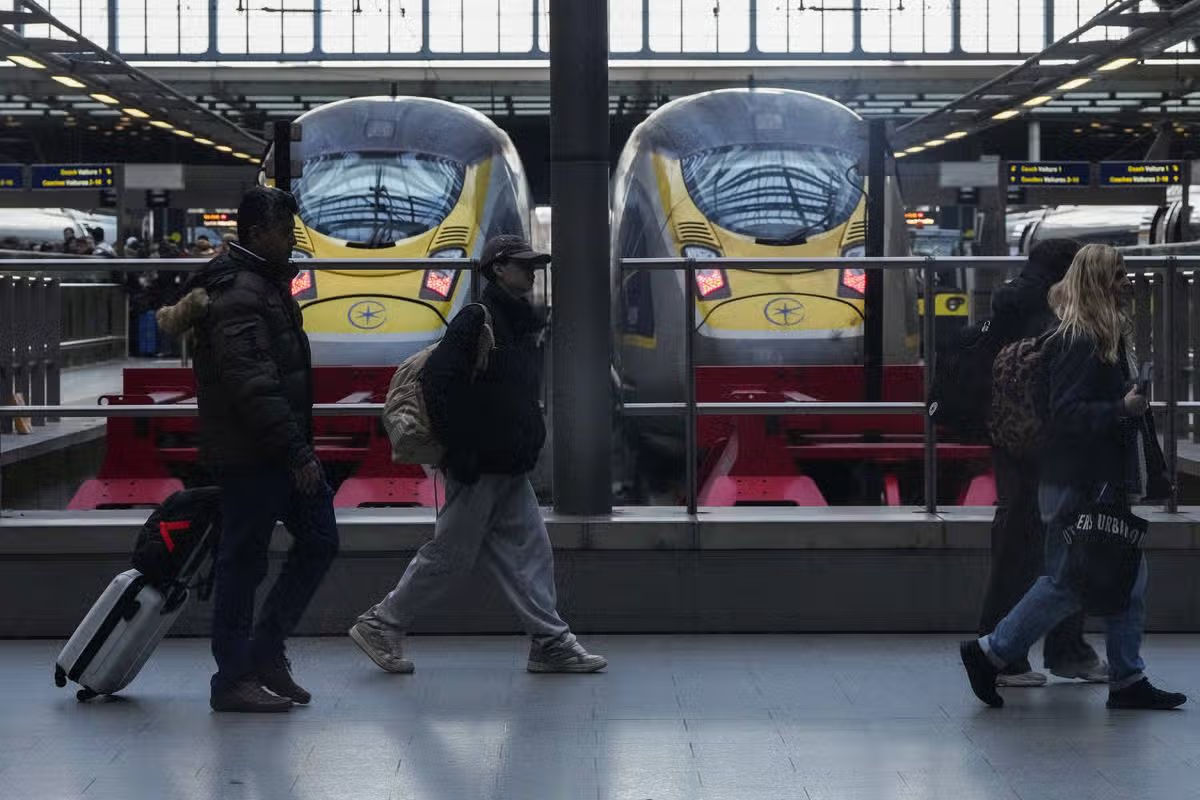
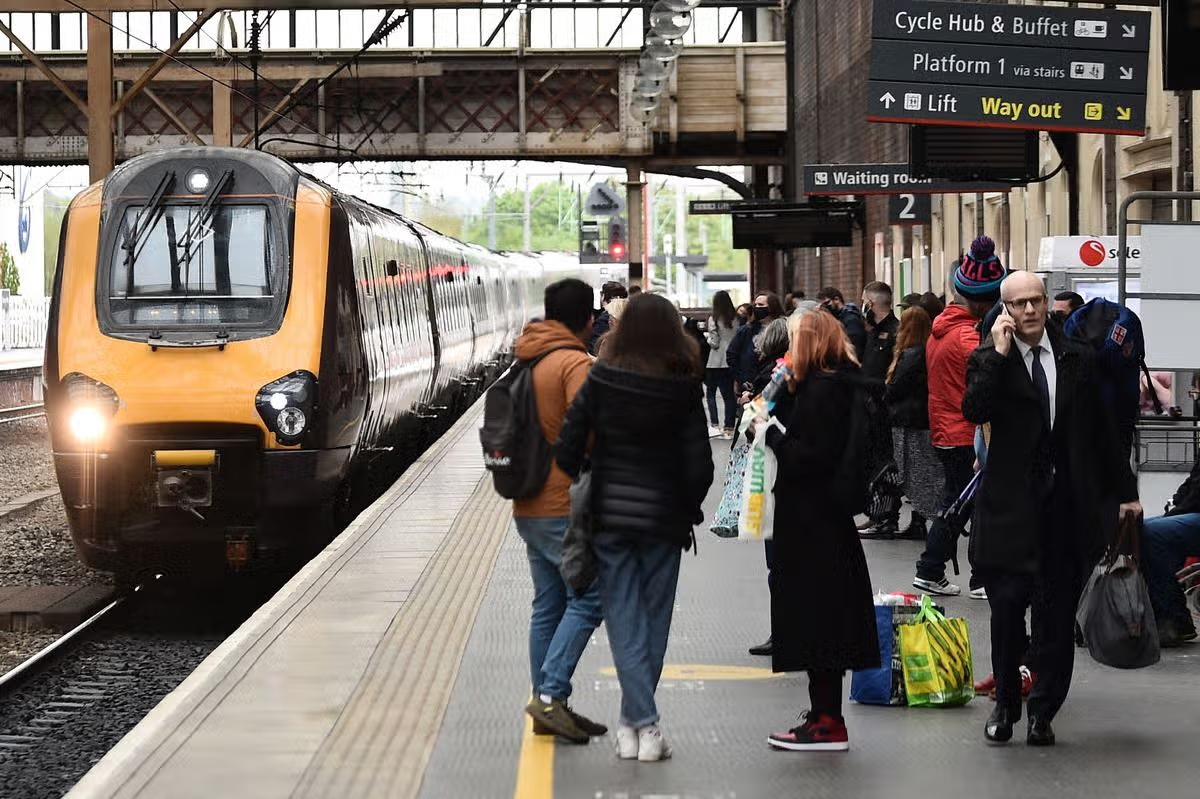
The UK’s tiniest railway station measures just 15 metres in length and can only accommodate one train door opening at a time. Among the hundreds of stations dotted across Britain linking villages, towns and cities, one holds the record for being the smallest.

Beauly Station in the Scottish Highlands claims this unique distinction. Its platform is considerably shorter than a single train carriage, meaning passengers must be given advance notice if they wish to alight there.

An announcement alerts travellers to plan accordingly if Beauly is their destination.

The station boasts a rich heritage, having first opened its doors in 1862. But by 1960, fierce competition from local bus services forced its closure.

Content cannot be displayed without consent

More than four decades later, following determined campaigns by local residents, it reopened. Since 2002, Beauly Station has featured a modest 10-space car park, bicycle storage and shelter facilities, reports the Express.

Whilst there’s no ticket office, the diminutive station remarkably handles approximately 35,000 passenger journeys annually, according to figures from the Carno Station Action Group. Located roughly 10 miles west of Inverness, it serves ScotRail services.

Trains calling at Beauly travel onwards to Wick, Kyle of Lochalsh, Dingwall, Invergordon, Ardgay and Inverness.

The station wasn’t always this compact, having previously boasted two platforms. Originally constructed for the Inverness to Invergordon line in the 1800s, it featured twin platforms, a passing loop and a goods shed.

During the 1960s, Beauly was amongst numerous stations axed. All stations between Inverness and Dingwall were shut down.

The solitary platform at Beauly standing today was constructed in 2002 when the station reopened. The reinstatement scheme came with a £250,000 price tag.

Class 158 trains normally operate on this line, which extend beyond Beauly’s platform length.

Usually, only the front door of the train opens to allow passengers to board and alight.

Source link

World’s oldest railway is still running in UK with parts dating back to 1621

The railway operates on tracks dating back to 1725 and 1621, making it the world’s oldest. Heritage steam trains run every Sunday along the three-mile route, kept alive by dedicated volunteers

Britain boasts a remarkable industrial heritage, with its railway network standing as a particular point of pride. Through decades of ingenuity and hard graft, tracks were laid across the country, linking villages, towns and cities together.

While many of these lines remain operational today, only one can claim the distinction of being the world’s oldest. Sections of this historic route stretch back to 1725 and continue to operate as a heritage railway.

A passenger service travels along the three-mile stretch every Sunday.

The Tanfield Railway winds its way through Gateshead and County Durham. Its origins began as a horse-drawn colliery wooden waggonway, then evolved into a rope-and-horse railway, and eventually into a rope-and-loco railway.

Preserved industrial steam locomotives still traverse the route between East Tanfield, Durham, and Sunniside, Gateshead. The railway holds the distinction of being the world’s oldest, with track sections dating to 1725 and other portions in service since 1621, reports the Express.

The Tanfield Railway was constructed for transporting coal, not people, to the River Tyne for shipping to London and further afield. It employed cutting-edge technology for its era, with wooden wagons running on wooden rails, hauled by horses.

This predated the arrival of iron rails and steam power on the railway by a century. Today, dedicated volunteers have shouldered the responsibility of maintaining Tanfield Railway’s remarkable heritage.

Last year marked the railway’s 300th anniversary, with celebrations featured in the BBC documentary, The World’s Oldest Railway. Tom Hartley joined as a volunteer in 2004 after being captivated by the North Polar Express train during a childhood trip with his parents.

At 19, Tom and three fellow volunteers set out to restore their own steam engine. They purchased the National Coal Board No. 38 from veteran volunteer Peter Weightman for just £1, working out at 25p each.

The group has invested countless hours and considerable funds into the restoration project, with hopes that the locomotive will soon be operational again.

Peter reflected: “It was frightening to see so many lovely machines that were getting scrapped in the 1960s, and that was my motivation really. Somebody had to do it before we lost our history, our local history.

“It has taken a lifetime to do it all, but I have confidence knowing that the next generation is going to repair it and get it working.”

Around 170 volunteers contribute to Tanfield’s operations, alongside three full-time employees.

General manager David Watchman expressed his pride: “I am really proud of our railway; we have a fantastic bunch of volunteers. Everyone has their own skill set. It is all about the people, and we have volunteers aged 12 through to 92. The railway wouldn’t exist without them.”

Source link

UK railway line to launch new trains with free water refill stations and reclining seats

LNER has revealed its new fleet of trains in first-look images – and they’ve got perks for every customer.

The upgraded carriages will have water refill stations throughout the trains and in First Class even mood lighting and reclining seats.

LNER’s first-look images of its new Class 897 trains – First Class will have reclining seatsCredit: LNER
Throughout all its carriages will be water refill stationsCredit: LNER

LNER, which operates trains across the East Coast Main Line, has revealed what its new fleet of Class 897 trains will look like.

The latest upgrades include “improved seating” across all classes with enhanced seat pads, side bolsters and wider head cushions .

One huge perk for all customers, especially those on a long journey, is that they’ll will be able to stay hydrated for free, thanks to the introduction of five water bottle refill stations throughout the train.

Travellers won’t have to pop to the cafe to buy a bottle of water – instead, just top up as you go.

GO SEA IT

£9.50 holiday spot with shipwrecks, seals offshore & horseshoe-shaped waterfalls


SIGHT SEA

£9.50 holidaymakers’ favourite Skegness activities… away from the beach

The only other train line that offers complimentary water with refill stations is Avanti West Coast on its Pendolino and Evero trains.

Also onboard the new LNER trains will be new digital screens in each carriage so customers can keep an eye on their journey and the upcoming stops.

Each seat will have its own plug socket and USB-C ports too for phone charging.

For Standard Class customers, there will be a new and improved Café Bar.

Here, you can pick up snacks and drinks and can see what’s available in real-time on digital menu screens.

Those sitting in First Class can fully relax in seats that actually recline.

There will also be softer lighting, including mood and table lighting in First Class – so the lights won’t be too bright for those travelling during early mornings and evenings.

Other changes include the redesign of bike storage areas and toilets.

A digital menu will be outside the cafe so customers can see what’s actually availableCredit: LNER
There will be larger spaces for suitcases and bikesCredit: LNER

For wheelchair users, tables have been redesigned to make more room with seat legs moved and additional space created for assistance dogs.

The 10-carriage trains called ‘Serenza’, will each have a total of 569 seats across Standard and First Class, alongside wheelchair spaces.

No date for introduction of the Class 897s has been announced yet.

But the new fleet is set to replace LNER’s InterCity 225 fleet, which focuses on services between London King’s Cross and destinations like Leeds, York, Bradford Forster Square, and Skipton.

For more on rail upgrades, UK’s busiest train station faces ‘decade of chaos’ ahead of multi-million pound renovation.

And here’s the UK’s ‘best rural train station’ – next to the seaside-themed town that is MILES from the coast.

LNER have revealed what its new fleet of trains will look likeCredit: LNER

Source link

A £15.6trillion tunnel could go from London to New York in under an hour

An ambitious transatlantic tunnel connecting London and New York could see travellers make the journey in just 54 minutes, though the project carries an estimated £15.6 trillion price tag.

Travelling from London to New York in less than an hour might one day become reality. Bold proposals could materialise following suggestions for a tunnel linking the two cities across the Atlantic.

The concept isn’t fresh, as countless visionaries have imagined such an achievement, though it’s long been deemed unfeasible. Nevertheless, Elon Musk weighed in on the notion, claiming his firm, The Boring Company, could turn it into reality.

Technological advances have progressed significantly, thanks to vacuum tubes and pressurised vehicles.

Despite carrying an eye-watering price tag, the journey could potentially come to fruition. Estimates for excavating beneath the Atlantic Ocean have exceeded £15trillion.

However, Musk insisted he could deliver it for considerably less. In 2024, he posted on X: “The @boringcompany could do it for 1000X less money,” responding to the cost projections, reports the Express.

The proposals might appear outlandish, but vacuum technology could be edging it towards reality. Newsweek reported that a vacuum within the tunnel could enable trains to achieve speeds exceeding 3,000 mph.

This would slash the London to New York journey time to just under an hour. The train could prove more environmentally sound as it may reduce air pollution from aviation.

The technology behind a vacuum tunnel resembles superloop trains, which Swiss engineers believe will “change the future of travel”. Yet, numerous companies have attempted and struggled to perfect the hyperloop technology.

Plans for the tunnel have prompted some engineers to suggest it should be constructed below the seabed, whilst others argue that suspending it using cables or supports would prove superior.

The Channel Tunnel serves as the closest comparison to the Transatlantic proposals, linking Britain to France.

It spans merely 40 miles in contrast to the 3,000 miles separating Britain from New York.

Moreover, it required six years to build. Should the proposed tunnel connecting Britain and America proceed at an identical pace, it would demand an extraordinary 782 years to finish.

Source link

Only some passengers returned on the UK’s creepy ‘death railway’

Only a few parts of this long-forgotten railway line remain standing, but it once carried up to 2,000 people a year on their final journeys along with their mourning loved ones clad in black

The Victorians have a reputation for dealing with death in strange ways, from photographing the dead to their obsession with Memento Mori objects, reminding them of the inevitability of death. But one almost forgotten part of Victorian history is particularly creepy and involves a long-abandoned railway line.

Early into Queen Victoria’s reign, the city faced a horrific problem. It had doubled in size thanks to the Industrial Revolution, bringing the population up to 2.5 million, many of whom lived in crowded, unsanitary conditions, causing outbreaks of conditions such as Cholera. London was the largest city in the world, but it also had insufficient sewage facilities and poor water quality, leading to disease and death. A Londoner born in the 1840s had an average life expectancy of just 36.7 years.

London’s churches soon found their graveyards were full to capacity, leading to the horrific practice of exhuming the recently deceased to make way for newer burials. As a solution, a huge new cemetery was planned in Brookwood, Surrey, but the plodding horse and carriages of the time would have taken hours to transport a body to this location. Therefore, the idea for the London Necropolis railway was formed.

The London Necropolis railway station was built next to Waterloo, and had a beautiful, ornate exterior typical of Victorian architecture. Here, the bodies of people of all ages and social classes were readied for their final 23-mile journey to the new Brookwood Cemetery in leafy Surrey, a world away from the grubby streets of London.

Coffins were issued a one-way ticket, while the mourners accompanying them would get a return ticket to take them back into the city after the service. Once the trains arrived in Brookwood, they made two stops in the Anglican and Nonconformist parts of the cemetery, depending on the religion of the deceased.

While all sorts of people were laid to rest in Brookwood, the rich, of course, enjoyed a better class of funeral than the Victorian poor. A first-class funeral came with a choice of burial plots and the ability to erect a permanent memorial. Those who chose a second-class funeral could put up a gravestone or other memorial for an additional cost, but if they failed to do so, the grave could end up being reused.

In third class were people who had a pauper’s funeral, paid for by their local parish. While these people weren’t given their own gravestone, they did get separate graves, which were much more dignified than the horrific burial practices going on at London’s graveyards at the time. The London Necropolis Company (LNC) carried out the burials, and about 80% of the funerals it held were third class, for those whose families couldn’t afford a service.

First and second class passengers had a separate waiting area, and their loved ones’ names were announced as their coffins were carried onto the train, a ceremonial touch not afforded to those headed to unmarked graves.

As London grew, and with the building of the London Underground, proper sewage systems, and overground railways, many churchyards stood in the way. The Necropolis Railway took on a huge new project, relocating the bodies from 21 churchyards across the city to the Surrey cemetery

Trains ran daily, and Sundays were a particularly busy day for funerals. It was the only day of the week when many workers had off, and by scheduling their loved ones’ funerals, they could avoid taking an extra day off.

The London Necropolis Railway ran until 1941, when a World War Two bomb destroyed the London station and track. By that point, funeral directors were increasingly using motorised hearses, and in the post-WW2 reconstruction of the city, the destroyed funeral train service wasn’t seen as a priority.

READ MORE: Weather turns on Champagne-sipping passengers as Antarctic cruise ship gets stuckREAD MORE: Cruise packing mistake as passengers warned 1 common item in luggage will be confiscated

Visit Westminster Bridge House and you can still see some of the façade of the old station building, although the old sign is boarded up. However, in Brookwood Cemetery, the remains of this unusual chapter of history are still on display. You can still see parts of the track, and plaques commemorate the 200,000 people who reached their final resting place on this unique train line.

Have a story you want to share? Email us at webtravel@reachplc.com

Source link