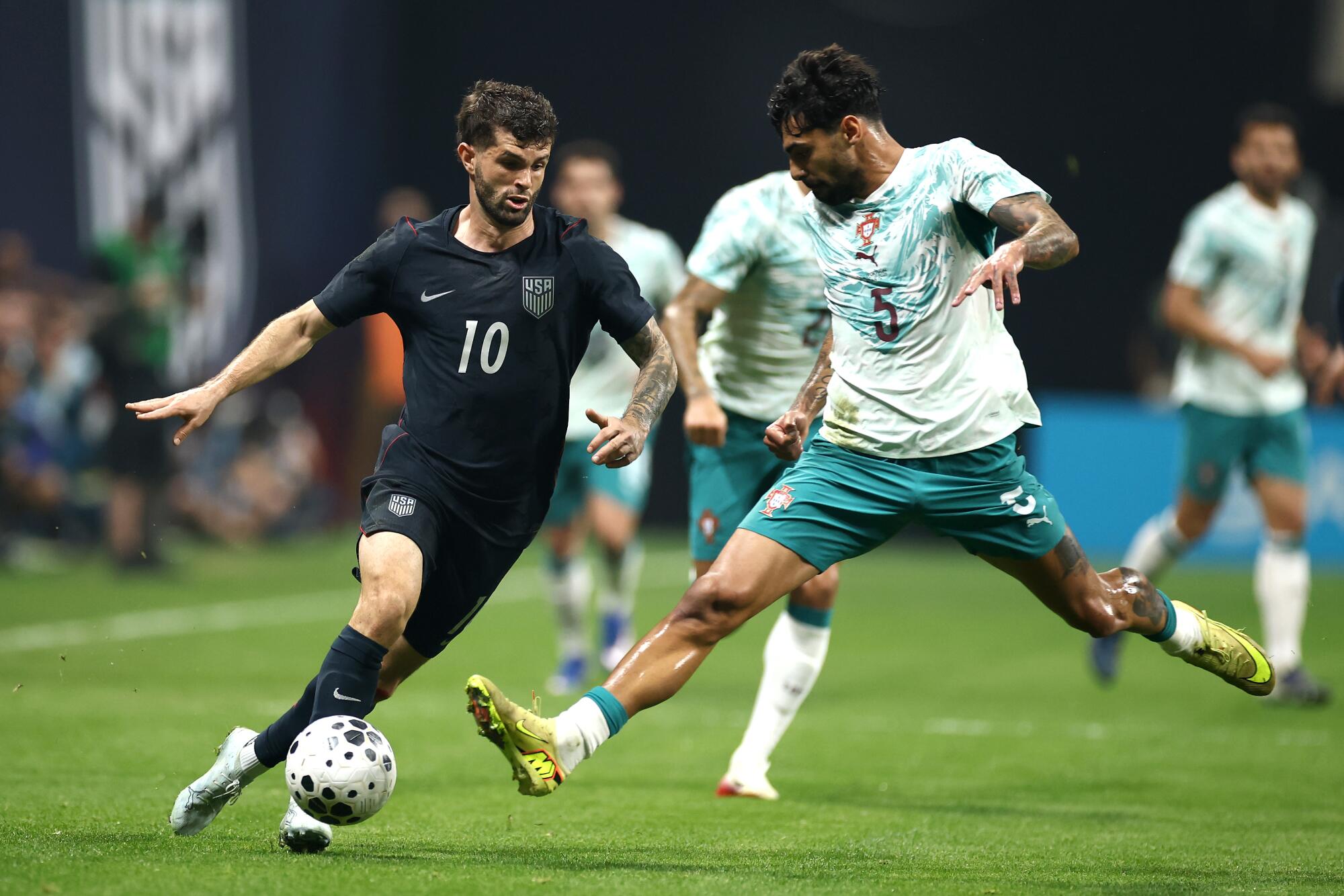
U.S. soccer’s World Cup ambitions are wildly off from reality
Mauricio Pochettino said last month that he plans to take the U.S. national team to the semifinals of this summer’s World Cup. If that’s the case, he’d better buy tickets because there’s no way the Americans are getting to that game on the field.
In its two March friendlies, the U.S. was blitzed by Belgium 5-2 and Portugal 2-0. By way of comparison, Mexico played the same two teams, in reverse order, to draws.
But wait, it gets worse. Because from the smoldering ruins of that mess, Pochettino has less than two months to choose a roster for the World Cup, a tournament U.S. Soccer has been pointing to for eight years.
Yet the March friendlies raised more questions than they answered — and it’s too late to start over.
“Right now, it’s just not enough,” DaMarcus Beasley, a four-time World Cup player, told TNT Sports. “We want to see these players compet[ing] and creating chances and being hard to play against every single match. Right now, it’s not happening.”
Pochettino ran the March training camp like an audition rather than settling on a starting 11 and trying to win games. He experimented with Tim Weah at outside back, where he has played for his club teams, and tried unsuccessfully to shake Christian Pulisic out of a career-long scoreless streak by playing him as a striker.
But he seems unable to solve some of the core issues plaguing the team. The U.S., which hasn’t posted a clean sheet since September, has become an error-prone mess on defense, with Pochettino’s wide, attack-minded approach revealing a structural fragility that has left the Americans’ thin back line exposed.
Consider the two goals in the Portugal loss. The first came after a turnover at midfield that led to a lightning-quick counterattack and the second on a poorly defended corner in which the Americans kept seven players in the six-yard box, leaving João Félix all alone at the top of the penalty area.
Behind the defense, no one has stepped up to seize the starting job in goal. Matt Turner, so spectacular four years ago in Qatar, gave up as many goals as he made saves against Belgium. And while Matt Freese was markedly better against Portugal, that was just his 14th international start.
Those are just the lowlights of the myriad issues facing Pochettino’s team.
Pulisic, the talisman who was supposed to carry the U.S., has gone cold. He hasn’t scored for the U.S. since November 2024 and hasn’t scored for his club team, AC Milan, this year. So Pochettino used him as a No. 9 against Portugal, a role Pulisic has made clear he does not like.

Christian Pulisic, left, controls the ball during an international friendly against Portugal on March 31.
(Jared C. Tilton / Getty Images)
It didn’t work, with Pulisic extending his goal-less streak to 15 games for club and country.
Tyler Adams, the captain in Qatar, has been saddled by injury and hasn’t played for the national team since September; right back Sergiño Dest, who started all four games in Qatar, is also hurt; center back Tim Ream, at 38, suddenly looks his age; and Gio Reyna, who has been unable to win a starting job on three teams in two countries since Qatar, nonetheless keeps getting called to the national team with little affect.
In the middle of it all is Pochettino, the highest-paid coach in U.S. Soccer history, who, despite a stellar resume as a club coach, has failed to find a consistent winning formula on the international level. In its 18 months under Pochettino, the national team has gone 11-2-1 against teams outside the FIFA top 25 and just 2-7-1 against teams ranked 25th or higher, according to ESPN. It has also lost eight consecutive games to European rivals.
Guess which kinds of teams the U.S. will have to beat to get to the semifinals of the World Cup?
It wasn’t supposed to be this way, of course. After failing to qualify for the 2018 World Cup, the U.S. team was ripped down to its foundation and built anew. Interim manager Dave Sarachan was tasked with reconstructing a roster that had grown old and stagnant, and in his 12 months in charge he gave a record 23 players — including nine who made the team for the last World Cup — their international debuts. With an average age of 25, the squad in Qatar was the second-youngest World Cup team in U.S. history.
But Qatar was just a trial run. The real goal was to have a mature, experienced team ready for this summer when the World Cup would be played at home. A deep run could fuel the kind of transformation the 1994 tournament in the U.S. achieved.
Instead, the U.S. team has regressed.
“It feels like four years have gone down the drain,” said ESPN’s Herculez Gomez, another former World Cup player.
Fortunately, the U.S. was drawn into a soft group for the World Cup. And because the tournament’s expansion to 48 teams means just 16 countries will be eliminated in the first round, even a poorly built American team should advance.
But the semifinals? Not this team and not in this tournament. To do that the U.S. would have to be better than at least four teams on a list that includes England, France, Spain, Argentina, Germany, Morocco, Brazil and the Netherlands. We already know it’s not better than Belgium or Portugal.
It might not even win its group now that Turkey, a top 25 team which beat the U.S. 2-1 last June, has qualified. And a stumble early in the tournament would make the kind of deep run Pochettino promised that much more difficult.
“We are so close to the World Cup,” Pochettino said after the Portugal loss. “But I think we are intelligent enough to know what we need to do.”
Buy tickets was not supposed to be the answer.
⚽ You have read the latest installment of On Soccer with Kevin Baxter. The weekly column takes you behind the scenes and shines a spotlight on unique stories. Listen to Baxter on this week’s episode of the “Corner of the Galaxy” podcast.