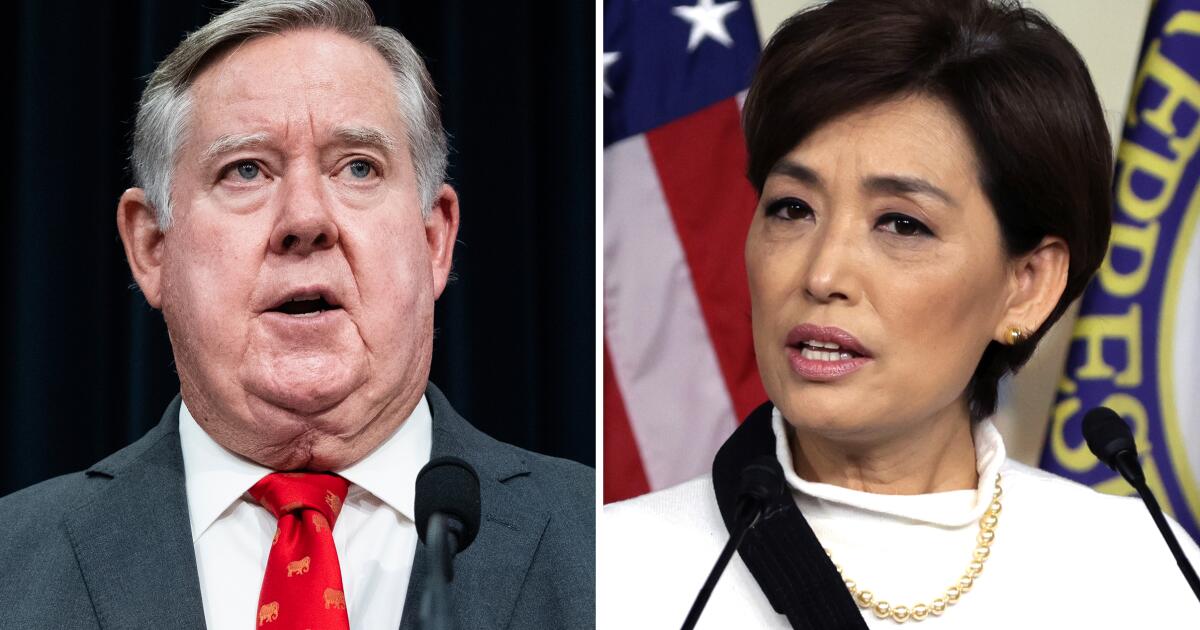
Will California voters ‘orphaned’ in top-two primary be strategic in November House races?
Esther Kim Varet has gotten a lot of questions recently from “depressed” liberals wondering whom they should vote for in November to represent them in the redrawn 40th Congressional District, which covers a large swath of inland Orange County and portions of San Bernardino and Riverside counties.
The Democratic art gallery owner placed third in last month’s closely watched primary for the seat, behind Republican incumbent Reps. Ken Calvert of Corona and Young Kim of Anaheim Hills. Calvert and Kim were pushed into the same district by last year’s Proposition 50 and will be the only two candidates facing off for the seat in November.
Kim Varet said her supporters have “obviously put a lot of thought into” which of the incumbents to support, but they have had a hard time swallowing the idea of voting for either. So she tells them why, “if we’re playing a kind of longer game,” they should vote for Kim.
She says Calvert is favored to win, so supporting Kim will “force both sides to spend more on this race” and reduce Republican spending on other races where Democrats still have a shot at beating a GOP incumbent. She says Calvert is “much more senior” than Kim, so ousting him would be “more significant.” And Calvert, as chair of the House Appropriations Subcommittee on Defense, has funded Trump’s war in Iran and would be “morally the better target.”
In last month’s primary, Kim Varet and other Democratic candidates collectively won 42.9% of the district vote, compared with Calvert’s 34.9% and Kim’s 20.6%. If enough of those Democratic voters coalesced behind Kim, they could end Calvert’s 33-year run in Congress.
Whether they will, however, is unclear. Such “orphaned” voters — those left without a candidate of their party in a general election — are historically just as likely to abstain from voting or to vote based on far less strategic considerations. Californians created that dilemma more than a decade ago when they approved the top-two primary system that puts all candidates on the same ballot and only allows the top-two finishers to advance to the general election, regardless of their party affiliation.
Paul Mitchell, a Democratic redistricting expert who devised California’s new congressional map under Proposition 50, said the backers of California’s primary system sold it years ago as a moderating force, where those orphaned voters would be encouraged to select the least partisan general election candidate.
But in reality, Mitchell said, “it doesn’t work that way.”
Voter decisions
Mitchell said intraparty matchups in the past have shown 35% of orphaned voters or more simply abstain from voting in that race.
A recent analysis Mitchell conducted of races, including for seats in the state Legislature, showed such undervoting among orphaned voters in every intraparty race for a state Senate seat in 2024 — one clear example being the competitive and costly battle between two Democrats, Laura Richardson and Michelle Chambers, in South Los Angeles.
Many others vote based on “tertiary things,” he said, such as a candidate’s race or gender, or whether they seem local or a Washington insider.
“Traditionally, it isn’t so much about somebody being more moderate,” he said, in part because voters can’t always discern moderation among candidates of an opposing party. “Republicans might be able to tell the difference between a moderate Republican and a conservative Republican, but Democrats can’t tell the difference.”
Incumbency can also be a drag on a candidate if orphaned voters dislike their track record, even if their opponent is even further from those voters politically. As one example, Mitchell pointed to rural, more conservative parts of the state going for Kevin de León over Sen. Dianne Feinstein when he challenged her in 2018, despite his running to her left.
“You’re like, how in the hell did these rural counties vote for Kevin de León? And it was because there were a lot of Republicans who, if they were going to vote in the U.S. Senate race, just wanted to vote against Feinstein,” Mitchell said.
Katelyn Stauffer, an associate politics professor at University of Georgia who has studied voter behavior in top-two races in California, said people “like to make decisions that are easy,” and “for most people, the ultimate cue is, does this person share my party?”
When party doesn’t differentiate candidates, voters tend to rely on other “simple cues or heuristics,” Stauffer said.
For example, based on her research, she said, women regardless of party and Democrats regardless of gender are more likely to vote for a woman in such scenarios.
Candidate messaging
Candidates could consider moderating their message to attract orphaned voters, though that can be perilous.
In a statement to The Times, Calvert accused Kim of trying to woo orphaned voters with a more bipartisan message, as evidence she is untrustworthy.
“Young Kim has bragged to some voters that she’s a moderate who censured President Trump. She’s then claimed to others that she [is] a 100% Trump Republican. It’s obvious Young Kim will say anything to try and hold on to her job, which is why voters from every party just can’t trust her,” Calvert said.
He said he has “been a consistent conservative in Congress for many years and that’s not going to change.” He also claimed to be “one of the most effective members of Congress,” saying he has secured funding to reduce traffic congestion, fight fires and improve water infrastructure in his district — things “voters from all parties want.”
Chris Pack, a spokesman for Kim, denied that Kim is changing her tune depending on her audience, and dismissed Calvert’s claims of serving his constituents well, calling him a “do-nothing dinosaur” who has failed to improve his constituents’ lives for decades.
“The truth is he’s had more than enough time to deliver for the people of California, and he hasn’t,” Pack said.
Similar intraparty battles are playing out in other congressional races between Democrats.
In the 4th Congressional District, which stretches through the Napa and Sacramento valleys, Republican voters could help decide between incumbent Rep. Mike Thompson (D-St. Helena) and his challenger from the left, venture capitalist Eric Jones.
Thompson — who has been in Congress since 1999 and sits on the powerful Ways and Means Committee — won 41% of the vote in the primary, while Jones won 22.2%. A slate of six Republican candidates collectively won 36.1%.
Jones, who backs progressive measures to expand Medicare and cut working-class taxes, said he hopes voters of all stripes look beyond political labels and see that he is the only candidate in the race who will take on big utilities, healthcare lobbyists and other big-business interests who fund Thompson’s campaigns.
“I want voters to realize that there’s a real choice in front of them,” he said.
Thompson said he is focused on doing his job, introducing himself to voters in the new parts of his district, reconfigured under Proposition 50, and “figuring out how I can work with them” to address their concerns. He said there is “a lot of commonality” among voters of all parties who want “good roads, clean air, water, strong [agriculture], safe communities,” and that he’s been endorsed by local Republicans and Democrats alike.
Thompson also rejected Jones’ criticism of his fundraising, saying he has “done a lot of good work that’s not necessarily in the interests” of those who have contributed to his campaign. He also said fundraising is necessary in a race against a wealthy opponent like Jones, who donated millions of dollars to his own campaign.
In the 7th Congressional District, Republican voters will help decide between incumbent Rep. Doris Matsui (D-Sacramento) — who has been in Congress since replacing her late husband there in 2005 — and her challenger from the left, progressive Sacramento City Councilmember Mai Vang.
Vang won 31.2% of the primary vote. Matsui won 29.1%. Two Republican candidates together won 37%.
In a statement to The Times, Matsui said November’s general election “will be a significantly different race because there will be many more voters that didn’t vote in the primary,” and that she will “work harder to court voters by meeting them where they are and informing them how I’ve delivered on my promises,” including on healthcare, public safety and jobs.
Vang did not respond to a request for comment but has previously accused Matsui of not delivering on her promises for decades.
“After 20 years, families are living paycheck to paycheck, people of my generation are no closer to owning a home, and you still can’t afford a doctor visit,” Vang said last month.
Party involvement
Political parties have traditionally shunned meddling in races where they lack a candidate of their own, experts said. They sometimes endorse in races where two members of their own party are facing off against each other, but not always.
Nick Poche, a Republican National Committee spokesperson, said his organization is largely focused on three races in which Republicans are either looking to hold or win seats from Democrats: the 13th Congressional District, where Republican Kevin Lincoln is challenging Rep. Adam Gray (D-Merced); the 22nd Congressional District, where Rep. David Valadao (R-Hanford) is trying to fend off Democrat Randy Villegas; and the 48th Congressional District, where Republican Jim Desmond is facing off against Democrat Marni von Wilpert for the seat of retiring Rep. Darrell Issa (R-Bonsall).
He called the Democrats in those races “radical socialists and emblematic of California’s far-left failures,” and said his party would be campaigning against them. But he declined to speak to the Calvert-Kim race, or the races in which two Democrats are facing off.
The California Republican Party did not respond to a request for comment.
Rusty Hicks, chair of the California Democratic Party, said his party is focused on “fulfilling the promise of Proposition 50” to flip five seats to help his party win control of the House, and is also focused on three competitive races: those for Valadao’s and Issa’s seats, and one in the 6th Congressional District, where Democrat Richard Pan is taking on Republican-turned-independent Rep. Kevin Kiley of Rocklin.
Hicks said the party will not endorse Calvert or Kim, whom he called “two rotten choices,” but has endorsed incumbents Matsui and Thompson in their races against fellow Democrats because they have “been leading” on issues of affordability and access to healthcare and “are best positioned to be reelected.”
Jones scoffed at his party endorsing his opponent. “Are we really excited that the Democratic machine keeps trying to choose our electeds for us?” he said.