California backtracks on good-government policies in divided Trump era
Tired of budget stalemates, deficits and continuous acrimony in the state Capitol, California voters in 2010 started taking action to temper political gridlock and loosen the grip of entrenched special interests.
They approved statewide ballot measures to create an independent congressional redistricting commission, taking that power away from self-interested Sacramento lawmakers, as well as a new “top-two” primary system intended to stifle the power of the major political parties and provide more representative, less hyperpartisan candidates with a greater chance of victory.
Now, in an era of even more bitter divisions in the state and nation, those reforms face severe threats.
Last month, supporters of a proposal to repeal the state’s current primary system, in which the two candidates in state and congressional elections who receive the most votes move on to the general election regardless of party affiliation, received permission to gather voter signatures to place the measure on the 2028 ballot.
In November, Californians voted to temporarily scrap the congressional districts that were crafted by a voter-approved independent commission and instead replace them by ones approved by Democratic lawmakers in Sacramento. The move, aimed at giving Democrats an edge in the November midterm election, was in response to President Trump urging GOP state leaders, notably in Texas, to alter their districts to boost Republican numbers in the closely divided U.S. House of Representatives after the 2026 election.
“In the olden times, California liked to see itself as the epicenter of good-government reform,” said Jessica Levinson, an election law professor at Loyola Marymount University.
But the sense of optimism when voters approved these reforms has faded, she said, because of the divisiveness cultivated by Trump but also because of polarization that predates him.
“There’s no world in which you can look at California or any other state in 2026 and say it looks like 2010,” Levinson said. “We, the public, speak to each other in different ways. Politicians talk to each other in different ways. … It feels to me like we talk a lot more about triage than we do about building a shining city on a hill. It’s a different universe.”
But others question the effectiveness of the California’s good-government reforms and merits of the self-glorification that followed.
“It’s not clear that any of these reforms helped elect more moderates or limit polarization,” said Rick Hasen, a professor of law and political science at UCLA. “Reformers may have over-promised in the early 2010s what election reform could actually do to improve the lives of Californians. And Californians did not fully appreciate the unintended consequences of reforms enacted with even the best of intentions.”
The efforts to claw back the 2010 reforms occurs at a time of declining trust in institutions and during a fragile moment in the nation’s democracy. Trump continues to push debunked claims that the 2020 election was rigged, as well as other voting misconduct conspiracies that often focus on California.
In a prime-time speech last month, the president again raised concerns about the length of time it took California elections officials to count ballots in the June 2 primary.
“It took a month to count the votes,” he said. “I wonder what they were doing.”
Lauded by civic groups, the good-government reforms were championed by then-Gov. Arnold Schwarzenegger and funded by major GOP donor Charles Munger Jr.
Both of the state’s major political parties as well as prominent politicians and several labor unions opposed the efforts when they were placed on the 2010 ballot.
Jessica Millan Patterson, a former state GOP chairwoman, is among those who believe the temporary pause in independent redistricting that voters approved in November will not be temporary. And she said the top-two primary is a failed experiment.
“Speaking as a Republican, I just don’t feel that it has served us well at all,” she said. “Not only has it locked us out of many general election ballots, but it has also not moderated Sacramento at all.”
California Democratic Party Chairman Rusty Hicks, who supported the suspension of independent redistricting, agreed with Millan Patterson about the top-two primary.
“The current top-two system has failed to deliver on what its supporters promised,” he said. “It’s well past time to review, revise and maybe even repeal it.”
Hicks expressed fears earlier this year that the top-two primary would result in two Republican gubernatorial candidates advancing to the November ballot in a strongly Democratic state because of a sprawling and splintered Democratic field.
Hicks’ rare public move urging low-polling Democratic candidates, which included every minority candidate of color in the race, to consider their viability sparked widespread controversy during the primary.
The tension was heightened by a controversial USC debate selection process that would have resulted in no candidates of color taking the stage. (The debate was canceled less than 24 hours before it was scheduled to take place.)
Ultimately, the June primary resulted in the same outcome Californians have seen since the top-two primary was approved — a gubernatorial general election contest between a Democrat and a Republican. Xavier Becerra, a former Biden Cabinet member, and Steve Hilton, a GOP strategist and television commentator, will face off in November.
Still, a bipartisan coalition is striving to rescind the top-two primary system, which has created many noteworthy intraparty races, such as U.S. Senate contests between Atty. Gen. Kamala Harris and Rep. Loretta Sanchez of Orange in 2016, and incumbent Sen. Dianne Feinstein and state Sen. Kevin de León of Los Angeles in 2018, all Democrats.
In Congress, independent redistricting and the top-two primary created a brutal 2012 contest between veteran Democratic Reps. Brad Sherman and Howard Berman in the San Fernando Valley. Four years later, veteran Bay Area Rep. Mike Honda was toppled by fellow Democrat Ro Khanna, now viewed as a potential 2028 presidential candidate.
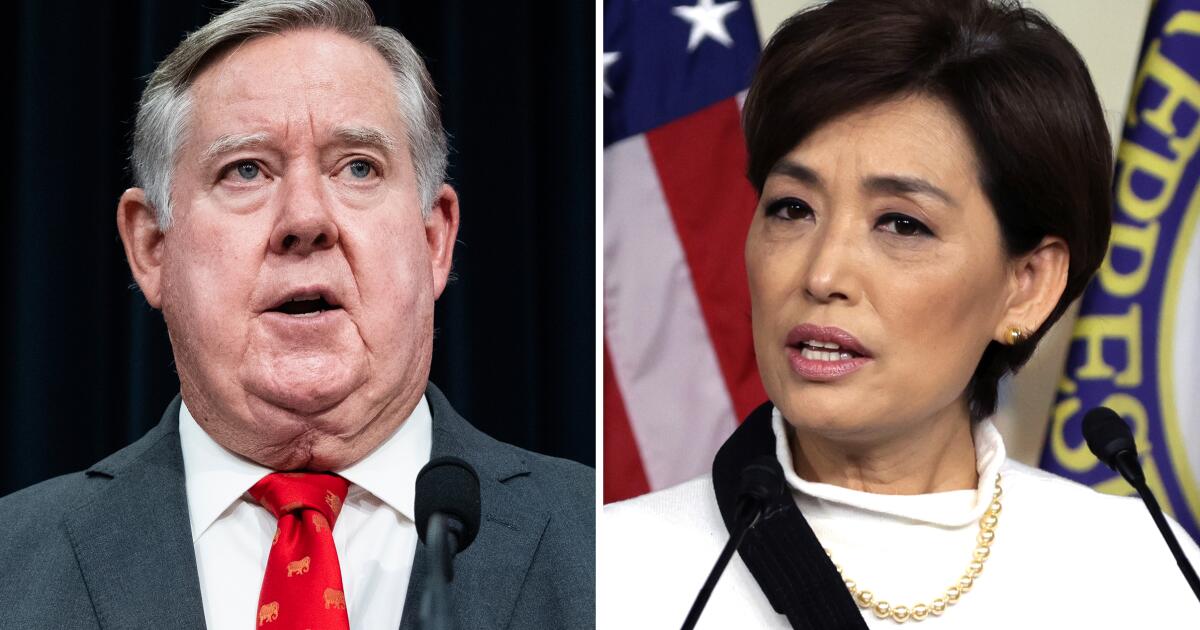
This year, a combination of the redrawing of the state’s congressional districts and the top-two primary means Republican Rep. Ken Calvert of Corona is battling with Republican Rep. Young Kim of Anaheim Hills.
On July 14, Secretary of State Shirley Weber announced that the proposal by veteran Democratic strategist Steve Maviglio — also backed by Republicans such as former state GOP Chair Ron Nehring — has 180 days to gather the signatures of nearly 875,000 registered voters to qualify the effort for the November 2028 ballot. If approved by voters, the top-two primary would be repealed and the system would revert to its prior version, insuring every qualified political party could have a candidate advance in the primary to the general election.
Maviglio argued that the top-two primary has failed to deliver on its promises to reduce partisanship and budget deficits in Sacramento.
“It’s gotten worse, not better,” he said. “I find it’s hard to make that argument if you look at what’s coming out of the Legislature the last 10 years.”
Supporters of the top-two primary repudiated these arguments and vowed to challenge the title of the proposed 2028 ballot measure about the state’s primary, arguing it would disenfranchise 5.4 million Californians who are not registered with either major political party.
“Voters passed Proposition 14 [which created the top-two primary] to take control away from party insiders and put it in the hands of the people,” said Cara McCormick, campaign manager of More Choice California, a group opposing the top-two primary being rescinded. “This initiative does the opposite. It takes away the rights of millions of California voters and gives them back to political parties. The least voters deserve is a ballot title that says so.”
Abel Maldonado, who served as lieutenant governor under Schwarzenegger and backed both 2010 reforms, staunchly supported the top-two primary as a response to a historic state government shutdown because of the failure of lawmakers to approve a balanced budget.
“Some of us thought that a complete open primary top two would create a system [that elects] people who were open-minded, pragmatic and had common sense,” he said. “It has happened in some races, but in other areas it has not.”
Maldonado said that he disagrees with returning to the prior system, in which political parties could opt to allow only voters affiliated with them to cast ballots in their primaries. But he said the current system ought to be tweaked, allowing voters to cast ballots for a candidate of any political party in a primary, with a candidate from each party moving onto the general election.
Schwarzenegger did not respond to a request for comment. But his prior comments, as well his efforts to end gerrymandering across the nation since leaving office, have made clear that his views have not changed.
“Of course the politicians want to undo reform that is good for the people and not for the politicians,” Schwarzenegger said in a statement earlier this year after the “Undo the Top Two” ballot measure was proposed. “They will always choose to move the goal posts instead of performing better.”
After California Democrats sought to redraw the state’s congressional districts last year, Schwarzenegger posted a picture of himself on X working out wearing a T-shirt that said “Terminate Gerrymandering,” a reference to one of his hit films.
Munger said he hoped groups he worked with to pass these reforms such as Common Cause and the California League of Women Voters would stay “true to their principles” and defend them when they “are under assault.”
“It was disappointing they stayed on the sidelines during last year’s fight over independent redistricting, and they should not do so going forward,” said Munger, who spent more than $30 million opposing the November ballot measure to suspend independent redistricting. “In order for the citizens to trust their government, they must have confidence that our elections are fair and free.”
Maldonado, who lauded the work of California’s independent redistricting commission, said he believes California Democrats will make the temporary pause of independent drawing of district boundaries permanent.
“We as Republicans have zero say in redistricting, and as much as I like to say this is what I like to have, the Democrats control supermajorities in both houses, and they get to choose whatever the hell they want,” he said. “The only way they’ll return it is by an initiative process with the will of the voters.”
He said he supports a national effort to create independent redistricting in every state, but believes it has no chance of passage.
“That would be great. It would be a step in the right direction. I think voters would have more confidence in politicians,” Maldonado said. “But, I mean, in this polarized era, this notion — think about it. The fox is building the henhouse for the chickens.”