Top Stories

S.C. measles outbreak is the nation’s largest in decades

South Carolina on Tuesday has reported the nation’s largest measles outbreak in decades, which mostly is occurring among unvaccinated children and youth. File Photo by Annie Rice/EPA-EFE

Jan. 27 (UPI) — A rapidly growing measles outbreak in South Carolina is the nation’s worst since measles was declared eradicated in 2000, with 789 reported cases.

The South Carolina Department of Public Health reported 89 new measles cases since Friday, raising the state’s total to 789, the most in one state in decades, WOLO-TV reported.

The state’s Public Health Department reported 756 cases in Spartanburg County in northwestern South Carolina, followed by 28 in Greenville County, which is adjacent to and west of Spartanburg.

Fewer than five cases were reported in Anderson County, which is directly southwest of Greenville County, and Cherokee County, which is directly east of Spartanburg.

The outbreak began in October, and most of the state’s measles cases — 692 — were among those who are not vaccinated against measles, mumps and rubella, and another 63 have an unknown vaccination status, for a total of 755 cases and 96% of those reported.

Another 20 cases occurred among those who are fully vaccinated, and 14 are among those who are partially vaccinated. At least 18 have been hospitalized, and no deaths have been reported.

When broken down by age, young children between ages 5 and 11 accounted for 345 cases, followed by 201 among those ages 0 to 4.

Another 149 cases were reported among youth between ages 12 and 17, followed by 26 among those between ages 18 and 29, and 25 cases among those between ages 30 and 49.

Five cases have been reported among people ages 50 and over, while 28 cases are among those whose ages are unknown.

The U.S. Department of Health and Human Services is allocating $1.4 million in aid to help South Carolina officials counteract the outbreak.

The U.S. Centers for Disease Control and Prevention also is working with state officials to identify transmission trends and helping to coordinate the state’s response.

The 789 cases reported as of Tuesday in South Carolina exceed the 762 reported in Texas a year ago during a measles outbreak that ended in August.

The outbreaks in those states and others might result in the United States being removed from the Pan American Health Organization’s list of nations in which measles has been eliminated.

Source link

Minnesota Gov. Tim Walz meets with border czar Tom Homan

Jan. 27 (UPI) — Minnesota Gov. Tim Walz met with President Donald Trump‘s border czar Tuesday to discuss the situation on the ground as immigration enforcement personnel operate in the state.

“Governor Walz met with Tom Homan this morning and reiterated Minnesota’s priorities: impartial investigations into the Minneapolis shootings involving federal agents, a swift, significant reduction in the number of federal forces in Minnesota, and an end to the campaign of retribution against Minnesota,” the governor’s office said in a statement to the media.

The two agreed to continue talks on the matter.

“The Governor and Homan agreed on the need for an ongoing dialogue and will continue working toward those goals, which the President also agreed to yesterday. The Governor tasked the Minnesota Department of Public Safety as the primary liaison to Homan to ensure these goals are met.”

Homan was sent to the state by Trump after he recalled Immigrations and Customs Enforcement commander Greg Bovino. Trump said that Homan will manage ICE operations in the state and will report directly to him.

“He has not been involved in that area but knows and likes many of the people there,” Trump said of Homan on Monday. “Tom is tough but fair and will report directly to me.”

Since ICE began Operation Metro Surge in Minneapolis in December, two people in the state were killed by federal immigration agents, causing a swell of protests throughout the state. Renee Nicole Good and Alex Pretti were both shot by agents. Good was driving away, and Pretty was filming an agent with his cell phone.

Walz said he had a “productive call” with Trump on Monday.

“The President agreed to look into reducing the number of federal agents in Minnesota and to talk to DHS [Department of Homeland Security] about ensuring the Minnesota Bureau of Criminal Apprehension is able to conduct an independent investigation, as would ordinarily be the case,” Walz posted on X.

Thousands of protesters march in sub-zero temperatures during “ICE Out” day to protest the federal government’s immigration enforcement surge in Minneapolis, Minnesota on Friday. Photo by Craig Lassig/UPI | License Photo

Source link

Minnesota judge orders head of ICE to appear in federal court

Jan. 27 (UPI) — Minnesota’s chief federal judge has summoned the acting director of U.S. Immigration and Customs Enforcement to appear in a Minneapolis court on Friday or be held in contempt.

U.S. District Judge Patrick Schiltz said in an order on Monday that the court has run out of patience with ICE head Todd Lyons after ICE has defied the court’s orders for weeks.

“The Court acknowledges that ordering the head of a federal agency to personally appear is an extraordinary step but the extent of ICE’s violation of court orders is likewise extraordinary and lesser measures have been tried and failed,” Schiltz wrote.

Schiltz’s order is in response to the case of a man who challenged his detention by ICE in Minnesota earlier this month. The federal court ordered that the man be given a bond hearing on Jan. 14 or be released within a week of that date.

As of Jan. 23, the man had not received his hearing and was still in detention. Schiltz said in his order that this is one of dozens of orders that ICE has defied.

“The practical consequence of respondents’ failure to comply has almost always been significant hardship to aliens (many of whom have lawfully lived and worked in the United States for years and done absolutely nothing wrong),” Schiltz wrote.

“The Court has been extremely patient with respondents, even though respondents decided to send thousands of agents to Minnesota to detain aliens without making any provision for dealing with the hundreds of habeas petitions and other lawsuits that were sure to result.”

Schiltz was appointed to the bench by President George W. Bush. U.S. District Judge Michael Davis, an appointee of President Bill Clinton, has also accused the Trump administration of defying court orders, “or at least to stretch the legal process to the breaking point in an attempt to deny noncitizens their due process rights.”

Last week, the Trump administration pushed for Schiltz to assist in the arrest of former CNN anchor-turned independent journalist Don Lemon. This was after Lemon visited a Minneapolis-area church to cover a demonstration by anti-ICE protesters.

Schiltz refused the Trump administration’s bid to arrest Lemon.

Source link

Social media companies face trials for alleged addictive design

Jan. 27 (UPI) — Meta, Snap, TikTok and YouTube will face accusers in a series of lawsuits alleging that they intentionally design their platforms to be addictive.

The trials begin in Los Angeles Superior Court Tuesday, filed by a group of parents, teens and school districts. Once teens are addicted to the platforms, plaintiffs allege, they suffer from depression, self-harm, eating disorders and more. There are about 1,600 plaintiffs involving 350 families and 250 school districts.

“The fact that a social media company is going to have to stand trial before a jury … is unprecedented,” Matthew Bergman, founder of the Social Media Victims Law Center and an attorney in the cases, said in a press conference.

The first case involves a 19-year-old identified as KGM and her mother, Karen Glenn. They are suing TikTok, Meta and YouTube because they say the companies created addictive features that damaged her mental health and led to self-harm and suicidal ideation. Snap was also a defendant in the case, but it settled the case last week.

Her case’s outcome could help determine the outcomes of more than 1,000 injury cases against the companies. The case is expected to last several weeks.

The thousands of cases against these tech giants have been lumped together in a judicial council coordination proceeding, which allows California cases to collaborate and streamline pre-trial hearings.

The plaintiffs want financial damages as well as injunctions that would force the companies to change the design of their platforms and create industry-wide safety standards.

Top company executives are expected to testify, including Meta founder Mark Zuckerberg, Snap CEO Evan Spiegel, Instagram’s Adam Mosseri and more. Experts in online harm are also expected to testify.

“For parents whose children have been exploited, groomed, or died because of big tech platforms, the next six weeks are the first step toward accountability after years of being ignored by these companies,” Sarah Gardner, CEO of the Heat Initiative, which advocates for child safety online, told CNN. “These are the tobacco trials of our generation, and for the first time, families across the country will hear directly from big tech CEOs about how they intentionally designed their products to addict our kids.”

KGM alleges in court documents that on Instagram she was bullied and sextorted, which is when someone threatens to share explicit images of the victim unless they send money or more photos.

For two weeks, KGM’s friends and family had to ask other Instagram users to report the people targeting her before Meta would do something about it, court documents said.

“Defendants’ knowing and deliberate product design, marketing, distribution, programming and operational decision and conduct caused serious emotional and mental harms to K.G.M. and her family,” the suit said. “Those harms include, but are not limited to, dangerous dependency on their products, anxiety, depression, self-harm, and body dysmorphia.”

Tech companies and their CEOs reject the allegation that social media harms teens’ mental health. They argue that it offers a connection with friends and entertainment. They also lean on Section 230, a federal law that protects them from liability over content posted by users.

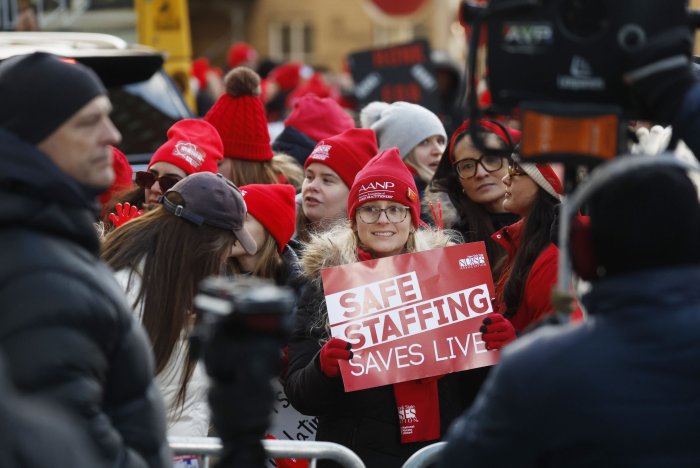
Picketers hold signs outside at the entrance to Mount Sinai Hospital on Monday in New York City. Nearly 15,000 nurses across New York City are now on strike after no agreement was reached ahead of the deadline for contract negotiations. It is the largest nurses’ strike in NYC’s history. The hospital locations impacted by the strike include Mount Sinai Hospital, Mount Sinai Morningside, Mount Sinai West, Montefiore Hospital and New York Presbyterian Hospital. Photo by John Angelillo/UPI | License Photo

Source link

Treasury Department drops Booz Allen Hamilton contracts

Jan. 26 (UPI) — Treasury Secretary Scott Bessent announced Monday that the department canceled all contracts with consulting firm Booz Allen Hamilton because of a data leak that included President Donald Trump‘s tax returns.

The department has 31 contracts with Booz Allen for a total of $4.8 million in annual spending and $21 million in total obligations, a press release said.

“President Trump has entrusted his cabinet to root out waste, fraud, and abuse, and canceling these contracts is an essential step to increasing Americans’ trust in government,” Bessent said in a statement.

Between 2018 and 2020, a Booz Allen employee, Charles Edward Littlejohn, “stole and leaked the confidential tax returns and return information of hundreds of thousands of taxpayers.”

The breach affected about 406,000 taxpayers, including Trump, Amazon founder Jeff Bezos and Tesla CEO Elon Musk.

“Booz Allen failed to implement adequate safeguards to protect sensitive data, including the confidential taxpayer information it had access to through its contracts with the Internal Revenue Service,” Bessent said.

Littlejohn pleaded guilty in October 2023 to one charge of disclosure of tax return information and was sentenced to five years in prison. He admitted to leaking Trump’s tax information to The New York Times and leaking other tax information to ProPublica.

Booz Allen’s stock price dipped by 8% on the news, CNBC reported.

Source link

Commerce Department takes equity stake in USA Rare Earth

Jan. 26 (UPI) — Critical minerals startup USA Rare Earth announced Monday that the Department of Commerce will give the company a $1.3 billion loan and $277 million in federal funding.

USA Rare Earth will issue Commerce 16.1 million shares of common stock and 17.6 million in warrants. The federal government will have an 8% to 16% stake in the company, depending on whether it uses the warrants, a filing with the Securities and Exchange Commission said.

USA Rare Earth shares rose more than 20% Monday after the announcement, CNBC reported.

The injection of funds will help the company build a magnet manufacturing plant in Stillwater, Okla., and a mine at the Round Top mineral deposit in Sierra Blanca, Texas.

CEO Barbara Humpton said the government deal will turn USA Rare Earth into an industry leader.

“This is a watershed moment in our work to secure and grow a resilient and independent rare earth value chain based in this country,” CNBC reported that Humpton told analysts Monday.

“We have long said that meeting the urgent call to reassure the rare earth and critical minerals industry will require a multiplayer solution, and this establishes our company as one of the leaders,” she said.

Commerce will allocate the funding from 2026 through 2028 based on milestones in USA Rare Earth’s business plan, Chief Financial Officer Rob Steele told analysts.

The company needs about $4.1 billion for its plan, he said. It still needs to raise about $600 million more capital.

“We believe we can raise the remaining capital from attractive sources, and you should assume that’s equity capital but that can come from strategic investments as well as institutional investors,” Steele said.

China dominates the global supply chain of rare earth materials. During trade disputes with President Donald Trump, Beijing tried to cut off rare earth exports.

“USA Rare Earth’s heavy critical minerals project is essential to restoring U.S. critical mineral independence,” Commerce Secretary Howard Lutnick said in a statement. “This investment ensures our supply chains are resilient and no longer reliant on foreign nations.”

“The Department of Energy is ending America’s reliance on foreign nations for the critical materials essential to our economy and national security,” said U.S. Energy Secretary Chris Wright in a statement. “The DOE is partnering with USAR to rebuild the critical minerals supply chain. By expanding domestic mining, processing and manufacturing capabilities, we are creating good-paying American jobs and safeguarding our national security.”

“Accelerating the onshoring of rare earth minerals, metals, and magnets is paramount to national and economic security,” U.S. Investment Accelerator Executive Director Michael Grimes said in a statement. “With the Department of Commerce’s funding for USA Rare Earth’s vertically integrated mine-to-magnet operations, we will significantly increase the domestic supply of crucial components for semiconductors, defense and numerous other industries strategic to the United States.”

Source link

No clear plan to replace aging, but vital, Navy ‘test ship,’ GAO says

The Navy’s Self Defense Test Ship, formerly known as the USS Paul F. Foster, is shown returning to its home port at Port Hueneme, Calif., on June 12 following 14 months of repairs. Watchdogs say the Navy hasn’t developed a clear way to replace the aging vessel, which is used to test self-defense systems for warfighting ships. Photo by Dana Rene White/U.S. Navy

ST. PAUL, Minn., Jan. 26 (UPI) — A aging, decommissioned destroyer that plays a little-known, but vital, role in maintaining the self-defense systems of Navy warfighting ships is on its last legs, but there’s no clear plan to replace it, government watchdogs say.

The Government Accountability Office reported last week that the 564-foot Self-Defense Test Ship, which before being decommissioned in 2003 was a Spruance-class destroyer known as the USS Paul F. Foster, is aging quickly and is beset by problems

That could compromise its one-of-a-kind role as a vessel fitted to undergo missile attacks as a way to test the Navy’s shipboard self-defense systems.

The unique vessel is equipped with the SSDS Mk 2, the command-and-control system aboard the Navy’s amphibious ships and aircraft carriers, which can be operated by remote control without any crew onboard as a safety precaution as it faces incoming missiles.

The insights it provided about the effectiveness of shipboard self-defense systems were used extensively by the Navy to address the needs of the Gerald R. Ford-class aircraft carrier and the DDG 1000 Zumwalt class destroyer in the last decade, and the test ship is expected to continue to carry out more vital tests over the next few years.

But even after extensive upgrades in 2024 and 2025, the ship is on its last legs and could become inoperable at any time, the GAO warned, leaving the Navy without a clear plan for some way to replace its functionality quickly.

“The Self-Defense Test Ship is critical to the Navy’s ability to test and understand how ship self-defense systems will behave as missiles approach a ship,” said Shelby Oakley, director of contracting and national security acquisitions for the GAO and lead author of last week’s report.

He told UPI there’s a risk of a gap in U.S. testing and training capabilities if the test ship goes out of commission with no replacement immediately available — which could have dire repercussions as U.S. naval forces confront missile-wielding foes such as Yemen’s Houthi rebels in the Red Sea.

“Due to the speed of incoming missiles, the systems must function with precision. Without a test ship, the Navy is reliant on computer modeling to evaluate operational performance of self-defense systems at close range,” he said.

“Thus, without a test ship, the Navy would have less confidence that the systems will protect the ship from incoming fire, which could result in disastrous consequences in the heat of battle.”

The risk of having a gap in such test capability is amplified “when considering the steady advances in the weapons available to potential U.S. adversaries,” Oakley added.

The vessel underwent 14 months of repairs at Naval Base San Diego beginning in April 2024, after which it returned to its home base at Port Hueneme, Calif.

While it was out of commission, technicians examined and mended fuel tanks, the firefighting system, the fire main pipe and sea water service valves, according to the Naval Sea Systems Command.

Its superstructure was also inspected for corrosion and its deck was restored.

But Navy officials told the GAO during the lay-up period that regardless of any further maintenance it may receive in the next few years, “continuing to effectively operate it to the end of the decade will be a challenge based on its poor condition.”

The issue has come up as the Navy is struggling to achieve the goals of the Trump administration and bipartisan majorities in Congress to grow the size of the fleet.

The service has failed to consistently produce new ships at the scale, speed and cost demanded by the government due to “a series of interwoven, systemic issues,” such as ever-shifting specifications by military officials and the inability of defense contractors to find a stable and adequate workforce, according to a December report by the Center for Strategic and International Studies.

Amid those challenges, a concrete plan to replace the self-defense test ship remains elusive. The Navy explored several options to do so in the decade between 2013 and 2023, including extending the service life of the current vessel, replacing it with commercial ships or decommissioning and converting another destroyer.

The last option appeared to become less feasible when Secretary of the Navy John Phelan extended the service lives of the five DDG 51 class destroyers that were identified as potential replacements.

A request for comment by UPI to the secretary’s office was not returned. But in a brief written response included in the GAO report, officials of the Navy’s Operational Test and Evaluation Force, or OPTEVFOR, concurred that a new test ship is needed and that a “capability gap” may be created due to the lengthened decommissioning schedule of the DDG 51 class destroyers.

They also confirmed the test ship is scheduled to be retired after a new round of testing for the SSDS Mk 2 system slated to begin in fiscal year 2027.

While the vessel can still be used, its down time due to maintenance needs are increasing and it’s becoming increasingly hard for the Navy to plan around them, said defense analyst Christine Cook, a senior fellow at the bipartisan Center for Strategic and International Studies in Washington.

“The age and condition of the ship means that it would be useful for the Navy to develop a plan and make investments in a new one,” she told UPI. “However, the question is always, what will the Navy not be able to do with the funds spent on a new test ship?

“Recommendations on gaps don’t always ask this question, but it is one that Navy programmers have to grapple with,” she said. “A delay in developing a plan for a replacement ship does not mean that the test ship is not available — but it does create some level of future risk.”

The Navy’s larger shipbuilding challenges are indirectly affecting the situation because the sluggish pace of new production is forcing its leaders to keep existing vessels in service longer, Cook added.

“If the Navy wants to keep ships operational longer because shipbuilding constraints mean that it can’t access sufficient new builds, then there may not be a ship available for retrofitting,” she said.

“The goal of growing the size of the Navy may require delaying ship retirements, which also means that the fleet needs more maintenance, competing with the ability to maintain the test ship.”

Source link