Former Fox News host Steve Hilton clinches a top spot in governor’s race, will challenge Xavier Becerra
Republican Steve Hilton, a former Fox News commentator, clinched one of the top spots in California’s gubernatorial primary on Tuesday, earning him the right to challenge veteran Democratic politician Xavier Becerra in the November election to determine the state’s next governor.
The contest offers voters two starkly different politicians. Hilton was endorsed by President Trump and has wooed his MAGA supporters, blaming Democratic policies for California’s homelessness crisis, high cost of living and other entrenched ills. Becerra campaigned as a battle-tested warrior against the Republican president and a champion of affordable healthcare. He could make history as the state’s first elected Latino governor.
Hilton’s victory was declared by the Associated Press on Tuesday, days after Becerra secured one of the top spots and a week after the June 2 election. Under California’s primary system, the two candidates who receive the most votes in the primary advance to the November general election, regardless of their party affiliation. According to the latest vote count, which is ongoing, Becerra has a slight edge over Hilton.

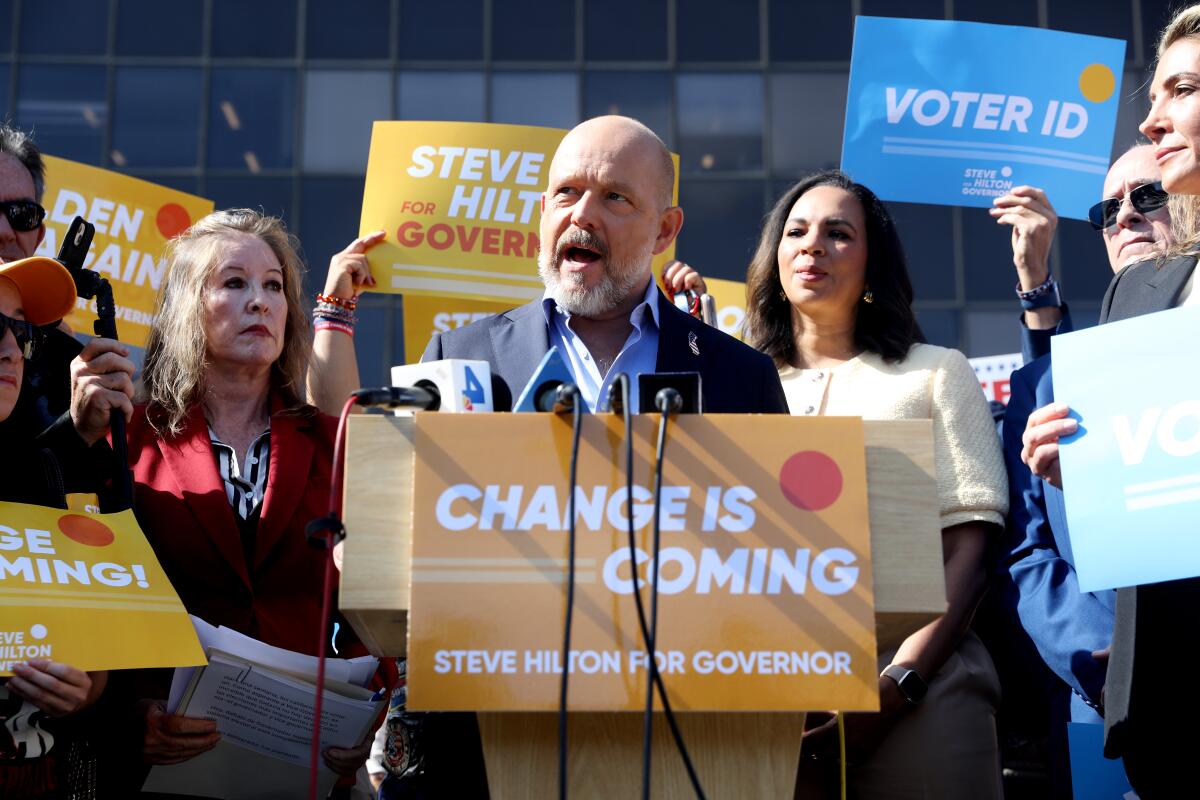
California Republican gubernatorial candidate Steve Hilton, center, flanked by lieutenant governor candidate Gloria Romero, left, and California Republican Party Chairwoman Corrin Rankin, right, hold a press conference to discuss election and voting reforms at the Los Angeles County Registrar-Recorder/County Clerk headquarters on Tuesday in Norwalk.
(Gary Coronado / For The Times)
Democrat Tom Steyer finished in third place. The hedge fund founder and environmental activist spent $216 million of his own money on his campaign, and now joins the legion of other high-profile, self-funding candidates rejected by California voters.
Becerra heads into the Nov. 3 election with a distinct advantage — Democratic voters in California outnumber Republicans by an almost 2-to-1 margin, a telltale reason why no GOP candidate has won a statewide race since 2006.
The contrast between Becerra and Hilton, both on policy and political personas, couldn’t be more pronounced.
A British immigrant and former political advisor to U.K. Prime Minister David Cameron, Hilton, 56, embraces traditional conservative ideals that have echoed across the country since the days of President Reagan — cutting taxes, weeding out government fraud and waste and promising to unbridle entrepreneurs and homebuilders from stifling state regulation.
But he’s also ventured into MAGA territory, declining to acknowledge that Trump lost the 2020 presidential election and promising to extradite California doctors who provide abortion pills to other states for prosecution.
Becerra, 68, came up in Los Angeles politics in the 1980s and has long supported policies to expand protections and resources for immigrants with or without legal status. Married to Harvard-educated OB-GYN Carolina Reyes, Becerra has also staunchly opposed abortion restrictions throughout his career.
In Congress and other positions, Becerra earned a reputation as a cerebral, analytical politician who would fully commit to his positions after taking time to mull them through.
A straight-laced family man with a Catholic upbringing, Becerra was more reserved during the debates — a quiet confidence that drew some voters to support him. He also faced criticism from his rivals for failing to offer detailed housing and healthcare policies.
Hilton, who cuts an unmistakable image with his bald crown and clipped English accent, proved himself as a polished communicator during the debates, skills honed by his years as a Fox News analyst.
Television hosts must translate complex issues into easily digestible sound bites, said Republican strategist Matt Klink. “Most voters want a CliffsNotes version of the issues,” Klink said.
Republican strategist Kevin Spillane credits Hilton’s TV show, “The Next Revolution,” which ran for six years, with boosting his profile, calling Fox News the most important media vehicle within the conservative and Republican framework.
Hilton “understands how politics and how communications work,” Spillane said.
He often appeared relaxed during the gubernatorial debates, at points even complimenting or joking with his rivals as they parried on stage.
At a CBS debate earlier this year, Becerra referred to President Trump, who endorsed Hilton, as the Republican candidate’s “daddy.” Hilton responded with a quip that quickly deflated the attack.
“It would be rather amazing,” said Hilton, at the possibility of being Trump’s son. “My daddy was the goalie for the Hungarian national ice hockey team.”
In an interview last week, before the election, Hilton said he enjoyed the debates. “In a weird way, I was sad when we had the last one,” he said. “I’m looking forward to debating whoever it is.”
As a former political advisor to Britain’s Conservative Party, Hilton helped usher in a green, socially liberal strain of conservatism.
He also infuriated colleagues in the coalition government, the British press reported, proposing a stream of unconventional ideas: scrapping maternity leave, abolishing job centers, even buying cloud-bursting technology so Britain would have more sunshine. In 2012, he moved full time to the Bay Area.
Hilton, who founded a nonprofit on California policies, was known for his frequent visits in the last couple of years to the state Capitol for discussions with legislators.
Rival Republican candidate Riverside County Sheriff Chad Bianco, who was trailing Steyer in fourth place in the latest vote count, ultimately didn’t seek to appeal to those beyond his rural, MAGA base, Klink said.
By contrast, Hilton presented himself as the “more cosmopolitan” candidate who “can talk to the hedge fund manager or the small-business owner or the Sacramento lobbyist,” said Klink said.
“Hilton was more energized at the end, when it mattered,” said Spillane, contrasting the two Republicans.
Past Republican candidates, including businessman John Cox in 2018 and former eBay CEO Meg Whitman in 2010, have self-financed their campaigns with their vast fortunes.
By contrast, Hilton spent just a few million dollars on media advertising, he said in an interview last week.
He said he ignored advice from consultants who told him to do a launch announcement and then unleash a wave of ads in the last month of the campaign.
“I just said, ‘I want to do it the old-fashioned way,’ and that’s what we’ve been doing,” said Hilton in the interview before the election. “We’ve been to nearly every single county…. stepped it up with our town halls.”
Nina Royal, 83, who lives in Los Angeles and is a community advocate for her Tujunga neighborhood, voted for Hilton, saying that he understands California’s problems.
“He’s a realist,” said Royal. “He has a clear view of what needs to be done.”
Times staff writer Jenny Jarvie contributed to this report.