Brazilian Supreme Court Justice Alexandre de Moraes suspends use of law to reduce prison sentences, pending further review.
Published On 9 May 20269 May 2026
Brazilian Supreme Court Justice Alexandre de Moraes has barred the implementation of a law that could dramatically reduce the prison sentence of former President Jair Bolsonaro for involvement in a coup plot after his loss in the 2022 election.
De Moraes ordered the law’s suspension on Saturday until the Supreme Court can convene a full hearing to consider appeals challenging its constitutionality.
Recommended Stories
list of 3 itemsend of list
Bolsonaro’s conviction for involvement in a plot to remain in office after losing to left-wing rival Luiz Inacio Lula da Silva in 2022 has become a cause celebre for the country’s political right, which has pushed for Bolsonaro’s release from prison.
The Supreme Court sentenced the former far-right president to 27 years in prison in September, but a law passed by Brazil’s conservative-majority Congress in December would apply to Bolsonaro and others convicted in the plot, paving the way for reductions in their sentences.
President Lula vetoed the bill in January, but a vote led by Bolsonaro’s allies in Congress overrode the veto in late April.
Plaintiffs have subsequently asked the Supreme Court to overturn the bill, stating it is unconstitutional.
Lawyers for those convicted must file individual requests for sentence reduction. The ruling by de Moraes essentially suspends such requests until the court has had the opportunity to decide on the law’s constitutionality.
Lawyers for the 71-year-old Bolsonaro filed a new appeal to the Supreme Court on Friday, asking it to overturn what they called a “miscarriage of justice”.
Bolsonaro’s conviction and sentencing remain a matter of controversy in Brazil, where his allies have decried it as a political witch-hunt.
Opponents have welcomed it as a necessary form of accountability, from which not even former presidents are exempt.
Thiago Avila, a member of the Global Sumud Flotilla, arrives to attend a hearing at the Ashkelon Magistrate’s Court in Ashkelon, Israel, on May 3. Israel has said he and Saif Abukeshek will be released Saturday. Photo by Abir Sultan/EPA
May 9 (UPI) — Two activists being held in Israel after the country intercepted its Gaza-bound aid flotilla are scheduled to be released Saturday, an aid organization said.
Human rights organization Adalah said that Brazilian Thiago Ávila and Spanish-Swedish citizen Saif Abukeshek were set to be released on Saturday.
The organization said on Instagram it had been told “that the two Global Sumud Flotilla leaders will be transferred to immigration authorities later today, pending deportation back to their home countries.
“Adalah is closely monitoring to ensure their release. Adalah and FIDH stress that Ávila and Abukeshek were abducted by the Israeli navy from international waters near Greece, held in total isolation under punitive conditions, and subjected to ill-treatment and torture, despite their mission being entirely civilian.
“Both have been on hunger strike since their detention began. Abukeshek escalated to refusing water on the evening of May 5. Their detention was unlawful from the start,” Adalah said.
“We are outraged that instead of speaking out and taking action to ensure the safety and immediate release of the at least 14 U.S. citizens illegally abducted by the Israeli military, the Department of State went out of its way to issue a formal condemnation of their humanitarian efforts,” it said.
The activists arrived via the Global Sumud Flotilla, which originated in Spain on April 12 bound for Gaza. It was intercepted by the Israelis in the Mediterranean Sea.
The flotilla alleged Israeli forces held people at gunpoint, smashed engines and destroyed navigation equipment on its ships.
“Intentionally leaving hundreds of civilians stranded on powerless, broken vessels directly in the path of a massive approaching storm. Furthermore, communications with multiple vessels have been jammed, severing their ability to coordinate or signal for help,” the group said.
The Freedom Flotilla Coalition announced that Ávila’s mother, Teresa Regina de Ávila e Silva, died while he was detained by Israel.
“[Avila’s and Abukeshek’s] continued imprisonment is not only arbitrary and illegal, but also an act of profound cruelty that has denied Thiago the most basic human right: to say farewell to his mother,” the Coalition said in a statement.
Bomber and several fighters detonate explosives-laden vehicle near security post in Bannu, Khyber Pakhtunkhwa, near Afghanistan.
Published On 9 May 20269 May 2026
A car bombing at a police post followed by an intense firefight has killed at least three officers in northwestern Pakistan, according to police and security sources.
The attack took place in Bannu, a district in Khyber Pakhtunkhwa province bordering Afghanistan, late on Saturday.
Recommended Stories
list of 3 itemsend of list
Police official Zahid Khan told The Associated Press that a suicide bomber and several fighters detonated an explosives-laden vehicle near a security post. Shortly after, multiple explosions were heard and the security post collapsed from the impact of the blast, he said.
Pakistan’s Dawn reported that nearby civilian areas also suffered severe damage due to the blasts, and two civilians were injured.
The Reuters news agency, citing security officials, reported that after the bombing, there was an ambush on police personnel rushing to the scene to provide backup.
Police official Sajjad Khan told Reuters that more casualties were feared. He added that fighting was ongoing and the extent of the damage would only be known once the operation was over.
Police sources told Reuters the aggressors also used drones in the attack.
Ambulances from rescue agencies and civil hospitals were dispatched to the scene, with officials saying a state of emergency has been declared in government hospitals in Bannu.
No group immediately claimed responsibility. However, such attacks have the potential to reignite fighting along Pakistan’s border with Afghanistan.
The worst fighting in years erupted between the allies-turned-foes in February, with Pakistani air strikes inside Afghanistan that Islamabad said targeted fighters’ strongholds.
Fighting has since eased, with occasional skirmishes breaking out along the border, but no official ceasefire has been brokered.
Islamabad blames Kabul for harbouring armed groups who use Afghan soil to plot attacks in Pakistan. The Taliban has denied the allegations and said militancy in Pakistan is an internal problem.
The Pakistan Taliban, known as Tehrik-e-Taliban Pakistan (TTP), and allied fighter groups have carried out similar attacks in the past. The Pakistan Taliban is a separate group but is often aligned with the Afghan Taliban, who seized power in Afghanistan in 2021.
Large-scale crude oil storage tanks are seen in the background at a Sodegaura Refinery in Sodegaura, Chiba Prefecture, Tokyo Bay, Japan, 06 April 2026. Photo by FRANCK ROBICHON / EPA
May 8 (Asia Today) — Japan is expanding imports of Russian Sakhalin-2 crude oil beyond a one-time emergency purchase, extending supply arrangements to multiple refiners and fuel networks around Tokyo Bay as concerns grow over instability in the Strait of Hormuz.
Japanese officials have reportedly asked Fuji Oil, an Idemitsu Kosan affiliate, to accept crude shipments from the Sakhalin-2 project after similar imports were arranged through Taiyo Oil.
The move comes as Japan seeks to reduce risks tied to Middle Eastern oil supplies while continuing to use sanction exemptions that remain in place for Sakhalin-2 energy resources.
The Sankei Shimbun reported Wednesday that the tanker Voyager, carrying crude oil from the Russian Far East project, was heading toward Fuji Oil facilities in Sodegaura, Chiba Prefecture.
Fuji Oil became a subsidiary of Idemitsu Kosan in November 2025 and operates a refinery that supplies petroleum products to the greater Tokyo metropolitan area.
According to ship tracking data cited by the newspaper, the Voyager departed Prigorodnoye Port in southern Sakhalin on April 24 and arrived near Imabari in western Japan on Sunday. The vessel later conducted unloading operations at Taiyo Oil facilities before departing for Tokyo Bay.
The tanker is expected to arrive in Sodegaura on Friday and leave Tokyo Bay on Saturday.
Idemitsu Kosan acknowledged the shipment was made at the request of Japan’s Ministry of Economy, Trade and Industry.
A company spokesperson told Sankei that the import did not violate sanctions and described it as part of efforts to diversify procurement sources and maintain stable fuel supplies.
Before halting most Russian crude purchases after Moscow’s invasion of Ukraine in 2022, Idemitsu sourced roughly 4% of its oil imports from Russia.
Analysts say the significance of the latest shipment lies not simply in Japan buying Russian oil again, but in Tokyo integrating Sakhalin-2 crude into a broader emergency procurement network involving multiple refiners.
Japan had already begun using the sanctions exemption amid rising Middle East tensions, but the latest deliveries suggest the mechanism is evolving into a more permanent contingency supply channel.
The development is also drawing attention in South Korea, which remains heavily dependent on Middle Eastern oil imports.
According to Korea National Oil Corp. data, South Korea imported about 1.03 billion barrels of crude oil in 2024, with 71.5% sourced from the Middle East. Saudi Arabia accounted for 32.2% of imports, followed by the United States at 16.4% and the United Arab Emirates at 13.7%.
Although South Korea has steadily increased imports of U.S. crude, its supply structure remains highly exposed to shipping disruptions through the Strait of Hormuz.
Energy analysts say South Korea may eventually need to move beyond reliance on strategic petroleum reserves alone and develop broader contingency planning that includes alternative suppliers, refinery compatibility and supply stability at major refining hubs such as Ulsan, Yeosu, Daesan and Incheon.
Japan’s latest actions suggest governments are increasingly seeking practical emergency supply options within existing sanctions frameworks rather than relying solely on traditional energy security measures.
1 of 2 | Peter Magyar, left, takes the oath of office as prime minister of Hungary during the inaugural session of the new National Assembly in Budapest, Hungary, Saturday. Photo by Tibor Illyes/EPA
May 9 (UPI) — Péter Magyar has been sworn in as Hungary’s new prime minister, ending Viktor Orban’s 16-year, right-wing leadership.
“I will not rule over Hungary — I will serve my country,” Magyar said Saturday after he took the oath of office in parliament, The BBC reported.
Orbán’s Fidesz party dropped from 135 to 52 seats in the election in April.
Tisza is not a strong swing to the left; Magyar, 44, was once a Fidesz Party operative. But on March 15, 2024, he left the party to join Tisza, then an unknown startup.
Now, Magyar is a center-right politician: not quite a liberal or progressive, and definitely a conservative. But he is pro-Europe and European Union, which Orbán was not.
The EU flag was hung on the Hungarian parliament building for the first time since 2014.
Magyar had invited people to join him to “write Hungarian history” together Saturday and “step through the gate of regime change.” Supporters gathered outside the parliament building, cheering and waving Hungarian flags.
Leftist and liberal parties will have no seats in the parliament for the first time since 1990, when Hungary broke free of the Soviet Union. But Budapest’s liberal mayor Gergely Karácsony said the new regime is still cause for celebration.
“Teachers fired, civilians and journalists humiliated, small churches torn apart,” Karácsony wrote on social media. “We can finally leave this era behind us — but first, let us remember the everyday heroes and express our gratitude with a farewell to the system.”
“This is the first time I feel like it’s good to be Hungarian,” Erzsébet Medve, 68, from Miskolc in northeastern Hungary, told The Guardian. “I feel like I could cry.”
Orbán and the Fidesz government cut education funding in Hungary. “The government had enough money, but they didn’t spend it there,” said Medve, a teacher.
Marianna Szűcs, 70, said she hoped Hungary would become more livable. “Now we feel like our children and grandchildren have a future here.”
New Tisza ministers said that while there will be no revenge against Orban’s people, those guilty of financial crimes will be held accountable. There will be a new office created to “recover stolen assets.”
“I don’t think that we should talk about a guillotine,” said Zoltán Tarr, incoming minister for Social Relations and Culture.
“We are talking about investigations and actions which are totally in line with the rule of law. Interestingly enough, the current chief prosecutor, and the police, have started certain investigations which they did not start before the election. They are questioning people.”
The Magyar government plans to convince the EU to release $20 billion in funds that the EU had held back from the Orbán government.
“I’m not worried, I’m excited,” Tarr said. “We are serving the country. We are serving the people. We are not here to rule. We are here to serve. We are here to fulfill a mandate.”
Al Jazeera’s Tareq Abu Azzoum reports from Al-Shati Refugee Camp, where families search through the rubble after overnight Israeli airstrikes despite a ceasefire. Residents described the attacks as a breach of the truce, saying they lost shelter, belongings and the only places they had left to stay.
In the occupied West Bank, a marathon is a political statement. Palestinians ran alongside the separation wall today, a structure that cuts them off from their land, their families, and even the sea. Al Jazeera’s @leila.shw reports from Bethlehem.
Japanese Prime Minister Sanae Takaichi (top 2-R) smiles to lawmakers before the arrival of Japan’s Emperor Naruhito at the parliament in Tokyo, Japan, 20 February 2026. File. Photo by FRANCK ROBICHON / EPA
May 8 (Asia Today) — A new political group supporting Japanese Prime Minister Sanae Takaichi is set to launch within the ruling Liberal Democratic Party, raising questions about the return of faction-style politics less than two years after the party formally moved to dismantle its traditional factions.
The Yomiuri Shimbun reported Thursday that the new group, called the National Power Research Association, will hold its first meeting on May 21 with participation from senior ruling party figures including former Prime Minister Taro Aso and former Foreign Minister Toshimitsu Motegi.
The organization is being positioned as a policy study group, but analysts say it could effectively serve as a new political base for Takaichi inside the party.
The group’s abbreviated name, “JiB,” is derived from Takaichi’s campaign slogan, “Japan is Back,” used during the Liberal Democratic Party leadership race last year.
Founding documents distributed to lawmakers this week state that the government and ruling party “will work as one” to implement policy, with a focus on security, energy and resource issues.
George Glass, the U.S. ambassador to Japan, has reportedly been invited to speak at the inaugural meeting on U.S.-Japan relations and related topics.
Although Takaichi herself is not expected to attend the first gathering, the decision to feature the American ambassador highlights the group’s emphasis on the U.S.-Japan alliance, economic security and defense cooperation.
The organization was reportedly spearheaded by Hiroshi Yamada, a lawmaker close to Takaichi, along with senior party officials including Koichi Hagiuda.
Other participants include prominent ruling party lawmakers and potential future leadership contenders such as Defense Minister Shinjiro Koizumi and policy chief Takayuki Kobayashi.
The group is encouraging participation across current and former factions, both chambers of parliament and newly elected lawmakers.
Still, questions remain over whether the organization will be accepted as a legitimate policy forum or criticized as a de facto revival of faction politics under a different name.
The Liberal Democratic Party pledged reforms after political funding scandals triggered public backlash and accelerated efforts to dissolve traditional factions.
Critics argue that reorganizing lawmakers through policy groups risks recreating the same power structures the party had promised to dismantle.
The development is also being closely watched in South Korea because of its potential implications for regional security and economic policy.
If Takaichi strengthens her position inside the ruling party, analysts expect Japan to pursue more consistent policies on military expansion, the U.S.-Japan alliance, trilateral cooperation with the United States and South Korea, and energy and supply chain security.
At the same time, observers warn that a stronger conservative political base inside the ruling party could also affect disputes involving history, defense policy and constitutional revision.
Analysts say the launch of the new group signals that the Takaichi administration is beginning to build a longer-term organizational foundation for its security and economic agenda inside the ruling party.
Trump signed off on the decision to replace Makary as he has clashed with Trump, officials in the Department of Health and Human Services and other officials in the administration, multiple reports said on Friday.
Makary, a former surgeon at Johns Hopkins, was confirmed to run the FDA in March 2025 on a vote the included two Democratic members of the Senate voting yes.
His nomination carried some controversy because, like several other Trump cabinet members and nominees, is a former Fox News contributor who preferred that society develop natural immunity to the virus that causes COVID-19 instead of the CDC’s preferred method of using vaccine-induced immunity during the pandemic.
The reports suggest that Makary has struggled to run the FDA as long-time staff have left the agency and a range of healthcare, pharmaceutical and advocacy groups have been highly critical of its actions.
The Department of Health and Human Services and Makary have not commented on the reports, and sources for all four news organizations noted that the plan could change if Trump changes his mind.
President Donald Trump delivers remarks at an event he is hosting for a group that includes Gold Star Mothers and Angel Mothers in honor of Mother’s Day in the Rose Garden of the White House on Friday. Photo by Aaron Schwartz/UPI | License Photo
Football has gained a foothold in the United States, and the country seems ready to host the World Cup this summer – which was not clear in 1994.
Back then, when the US last hosted the World Cup, the country had no professional league and the national team was cobbled together with ex-collegians, journeymen, and semi-professionals.
Recommended Stories
list of 4 itemsend of list
“Leading into ’94, we were at risk on the ticket side,” former US Soccer President Sunil Gulati told Al Jazeera in a recent interview. “For the US Organizing Committee, it was a big concern if we could sell all the tickets.’’
In the end, the 1994 tournament was successful. A record 3.5 million (68,991 per game) attended matches; the US advanced from the group stage for the first time since 1930, losing 1-0 to eventual champions Brazil in the last 16; and seeds were planted for a professional league, Major League Soccer.
Football has since moved from the margins to the mainstream in the US.
MLS is thriving, the national team is ranked a creditable 16th in the world by FIFA, and as the World Cup returns this summer, ticket demand far outpaces supply.
“If you said in 1994 MLS would be a 30-team league, with [22] soccer-specific stadiums and averaging 20,000 crowds – not in our wildest dreams,” Gulati said.
“The landscape is completely different. The most visible thing is the development of professional leagues, MLS and the women’s league [NWSL]. We had no first division league. And now there is [also] USL Division 2 and 3. The number of teams has increased dramatically.”
Today, the US Soccer Federation, commonly referred to as US Soccer, sanctions 127 professional teams – 102 men’s and 25 women’s.
“Eighteen of the top 50 [valued] teams in the world are in MLS,” Gulati said. “That’s an extraordinary statistic. The women’s team in Columbus just sold for $205m. Commercial interest in soccer and soccer leagues is at an all-time high.”
Credit Joao Havelange for seeing the future. During his reign as FIFA president, Havelange usually got what he wanted, and he wanted the 1994 World Cup in the US, along with a professional league.
Easier said than done, though. Organised football has been played in the US since the late 19th century, with the American Cup inaugurated in 1884. But over the following decades, several professional leagues collapsed, and after the North American Soccer League (NASL) folded in 1984, there appeared to be little future for the game. Enter Havelange and FIFA.
“FIFA recognised a long time ago that, for the sport to grow internationally, it had to be successful in the US,” Farrukh Quraishi, a Tampa, Florida-based administrator who played in the NASL, told Al Jazeera.
“For me, it was purely a matter of time. This is a huge and wealthy market. Now, you look at who is buying clubs in MLS, and it’s a who’s who of NFL owners.”
Looking back, it’s remarkable that the US actually competed in World Cups and played host to one at all, without a nationwide professional league.
Brazil celebrates winning the 1994 World Cup after defeating Italy 3-2 in a penalty shootout [Ben Radford/Getty Images]
For years, football’s foundation in the country was built on amateur and youth participation. By the early 1990s, the numbers were high, with an estimated 18 million people playing the sport at some level in the US. But the pyramid lacked a top tier, leaving a dead end for aspiring players, little media coverage, and scattered fan interest.
The 1994 World Cup came and went, and, in 1996, MLS finally kicked off.
Havelange duly arrived to commemorate the inaugural game, sitting in the rickety stands of Spartan Stadium in San Jose, California.
The San Jose Clash edged DC United 1-0, as Eric Wynalda scored an 88th-minute goal – just in time to avoid the game going to a “shootout”, in which draws were decided by players going one-on-one with goalkeepers from 32 metres (35 yards) out. This novel method of deciding games ended in 2000.
Football-specific stadiums started springing up in 1999. Lamar Hunt’s Columbus Crew Stadium became the country’s first major purpose-built football venue since Mark’s Stadium in Fall River, Massachusetts, in 1922. Now, Columbus are on their second stadium, the ScottsMiracle-Gro Field, and a total of 22 MLS teams compete at their own venues.
Football finally became part of the American sporting scene.
“Is it in the same way as the NFL, with [average figures of more than 18 million] watching it, or the American Pastime that baseball is? No,” Gulati said.
“It’s not at that viewership level, [but] there is worldwide coverage of games. Look at everyone wearing jerseys on the street, Lionel Messi playing in Miami. It is part of the mainstream.”
‘Soccer still isn’t king in the US’
Not that the picture is not flawed. Wynalda, who went on to score 34 goals in 106 games for the US national team, sees the current system as a recipe for mediocrity, registering millions of youngsters but limiting their ambition as few US players take up prominent roles on MLS teams.
Most are offered the league’s minimum annual salary ($80,622) and only two US players were listed last year among the top 40 highest-paid, according to the MLS Players Association – Austin FC forward Brandon Vazquez (24th at $3.55m) and Nashville SC defender Walker Zimmerman (27th at $3.45m).
“Look at the growth of [MLS] and you can say soccer looks professional, looks like a big deal, looks major league. And a lot of people look at the sport with a different lens now because it’s a legitimate sport,” Wynalda, now a coach and commentator, told Al Jazeera.
“[But] facilities do not create ability. We need more focus on a competitive environment to develop players. We tell them winning doesn’t matter and then wonder why they can’t win. We’ve lost that competitive mentality.”
He favours introducing promotion/relegation as a solution.
“If you’re going to a team that is never going to be relegated, because it’s got enough money, you never learn how to fight relegation, how to beat 11 angry men with their livelihood on the line,” Wynalda said.
And while the MLS franchise model has created riches, with teams valued as high as Los Angeles FC at $1.25bn (thanks to owning the 22,000-seat BMO Stadium) by Forbes Magazine, the quality of play does not always correspond.
MLS teams have tended to struggle in CONCACAF competitions, although in 2022 the Seattle Sounders ended a 22-year drought for an MLS side to win the federation’s elite competition, which was previously won by DC United in 1998 and LA Galaxy in 2000.
“There are things we agree with and disagree with, on and off the field, but [MLS] is successful,” Fox Sports commentator Alexi Lalas, a central defender for the US in 1994, told Al Jazeera. “I don’t think you can argue against that.”
Thanks to the 1994 WC and MLS, football in the US became “a very different world, to finally be even recognised for what you did, let alone respected”, Lalas said. “You know, soccer still isn’t king in the US, but, let’s be honest, it’s part of the palate and certainly part of the landscape when it comes to this generation.”
Lalas predicts the US will harness the “magic” of being hosts to reach the quarterfinals, while Gulati expects the sport to continue to grow in the US after the World Cup.
“That is what the legacy of the tournament is about and why we bid,” Gulati said.
Russia has held one of its most scaled-back Victory Day parades in years, citing the threat of attack from Ukraine, where a decisive victory for Moscow’s forces has remained elusive more than four years into the deadliest conflict in Europe since World War II.
The May 9 parade on Moscow’s Red Square is Russia’s most revered national holiday, a moment to celebrate the Soviet Union’s defeat of Nazi Germany and to commemorate the 27 million Soviet citizens, including many from what is now Ukraine, who were killed during the war.
Once used to showcase Russia’s military might, including its nuclear-capable intercontinental ballistic missiles, this year’s parade featured no tanks or other heavy military hardware rolling across the cobblestones of Red Square.
Instead, weapons including a Yars intercontinental ballistic missile, the new Arkhangelsk nuclear submarine, the Peresvet laser weapon, the Sukhoi Su-57 fighter jet, the S-500 surface-to-air missile system and a range of drones and artillery were displayed on giant screens on the square and broadcast on state television.
Soldiers and sailors, some of whom have served in Ukraine, marched and chanted as President Vladimir Putin looked on, seated alongside Russian veterans in the shadow of Vladimir Lenin’s Mausoleum. North Korean troops, who have fought against Ukrainian forces in Russia’s Kursk region, also took part in the march.
Fighter jets flew above the Kremlin’s towers and Putin delivered an eight-minute address, promising victory in the war in Ukraine, which the Kremlin refers to as a “special military operation”.
“The great feat of the victorious generation inspires the soldiers carrying out the tasks of the special military operation today,” Putin said. “They are confronting an aggressive force armed and supported by the entire NATO bloc. And in spite of that, our heroes march forward.”
The hacker group, ShinyHunters, threatened to leak student data after breaching the educational platform Canvas.
By Al Jazeera Staff and Reuters
Published On 9 May 20269 May 2026
An educational platform used by thousands of schools and universities has been partially restored following an international cyberattack that caused major chaos as students prepare for end-of-year exams.
ShinyHunters, a hacking group, claimed responsibility for crashing the web-based educational platform Canvas, created by tech firm Instructure.
Recommended Stories
list of 4 itemsend of list
The group said it had stolen 3.5 terabytes of data, including names, email addresses, student ID numbers and private messages, and threatened to release this if ransoms were not paid by May 12.
Instructure’s website said on Saturday that Canvas is now “available for most users” and no incidents were reported on Saturday. It is not clear if a ransom was paid.
The University of Sydney reported on Saturday that Canvas had been restored but was not yet “accessible to staff or students, as we need to complete checks”.
Canada’s University of Alberta said Canvas was partially restored with “reduced functionality”.
The countries that have been affected include the United States, the Netherlands, Sweden, Australia and the United Kingdom.
According to Canvas, about 30 million people across the globe use its system. The breach reportedly targeted close to 9,000 institutions across the globe.
Breach came at ‘worst time’
The Federal Bureau of Investigation said it was “aware of a service disruption” impacting a learning system, although it did not name Canvas, in a statement Friday.
“This disruption has impacted schools, educational institutions, and students across the country,” it said.
Al Jazeera’s correspondent in Florida, Phil Lavelle, said the hack could not have “come at a worse time” as many US schools are in the middle of exam season.
Institutions like Penn State, Harvard, Illinois, Columbia and Georgetown are all “scrambling” to extend or change exam deadlines, said Lavelle.
The Harvard Crimson, a student newspaper, said it could not access the platform since Thursday, with the University of Cambridge also saying it had “temporarily suspended access” to Canvas on Friday.
The Reuters news agency reported that, on May 5, the group posted a message saying Instructure had “not even bothered speaking to us” to prevent a data leak, and that their demand “was not even as high as you might think it is”.
Who are ShinyHunters?
The group is a global cybercrime syndicate that was established in 2019.
Over the years, they have claimed responsibility for cyberattacks, with the most recent data breach being Rockstar Games, a gaming giant that owns Grand Theft Auto.
“This goes to show how vulnerable schools are, how vulnerable other institutions are by individuals who seek to exploit or extort at the worst possible time – armed with just a keyboard and a mouse,” said Lavelle.
Dozens of Israeli settlers stormed various areas of the West Bank, set cars on fire and attacked Palestinians.
Published On 9 May 20269 May 2026
Israeli settlers have launched another wave of raids in the occupied West Bank, with houses and cars set on fire and a Palestinian child attacked.
The Palestinian Wafa news agency reported that a man and his child were attacked with “sharp instruments” in the village of Khirbet Shuweika, south of Hebron, on Friday.
Recommended Stories
list of 4 itemsend of list
The father and child were taken to hospital due to head injuries.
Israeli settlers torched a home in the village of al-Lubban Asharqiya, south of Nablus, after which members of the Palestinian Civil Defence arrived to extinguish the blaze.
In Abu Falah, northeast of Ramallah, Wafa cited security sources that the settlers “stormed the outskirts of the village, burned a citizen’s vehicle, and wrote racist slogans on the walls of houses”.
In the village of al-Asa’asa in Jenin, Israeli forces forced residents to exhume a newly buried body and take it elsewhere. They claimed the first site was too close to an illegal Israeli settlement.
Israeli settlers also attacked a Palestinian man in the town of Beit Fajjar, south of Bethlehem, and stole his mobile phone.
A group of Palestinians were picnicking in the Burak Sulayman (Solomon’s Pools) area, south of Bethlehem, but were forced to leave after Israeli forces fired stun grenades at them.
The Palestinian Red Crescent Society treated two people for tear gas inhalation and evacuated five others from the scene after the attack.
‘Tear gas and sound bombs’
In the town of Tuqu, southeast of Bethlehem, the mayor, Taysir Abu Mufreh, told Wafa that Israeli forces fired “tear gas and sound bombs” at a group of worshippers who were leaving a local mosque and locked a number of them inside.
On Friday, Israeli forces arrested four Palestinian men in the town of Battir, west of Bethlehem, while they were hiking near a railway line. The following day, three more Palestinians were arrested during a raid on the city of Nablus.
Settlers attacked the town of Silwad, northeast of Ramallah, leading to clashes when residents confronted them.
Human rights groups say Israeli authorities have allowed the settlers to operate with total impunity in their attacks against Palestinians.
In February, Israel approved a plan to claim large areas of the occupied West Bank as “state property”.
More than 700,000 Israelis live in illegal settlements in the occupied West Bank.
Sailors aboard the ROKS Dosan Ahn Chang-ho, a 3,000-ton South Korean naval submarine, bid farewell to family members at a naval port in Changwon, South Gyeongsang Province, South Korea, 25 March 2026. The submarine is departing across the Pacific for the first time to take part in joint drills with Canada in June aimed at bolstering maritime security and defense industry cooperation. Photo by YONHAP /EPA
May 8 (Asia Today) — South Korea’s first domestically designed 3,000-ton submarine has completed a long-distance Pacific deployment as Seoul seeks to strengthen its bid for Canada’s next-generation submarine procurement program.
The South Korean Navy said the Dosan Ahn Chang-ho departed Pearl Harbor-Hickam in Hawaii on Friday with two Canadian Navy submarine personnel aboard and is scheduled to arrive at Esquimalt Harbor in Victoria, British Columbia, in late May.
The submarine left Jinhae Naval Base on March 25 and traveled through Guam and Hawaii before heading toward Canada.
The deployment is seen as a major test of the submarine’s endurance, reliability and operational performance, as South Korean shipbuilders compete for Canada’s submarine project, estimated at about $42 billion.
The Dosan Ahn Chang-ho is expected to travel up to about 18,600 miles round trip, much of it independently. Defense officials say the mission is intended to demonstrate the submarine’s long-range capabilities, quiet operation, onboard living conditions and air-independent propulsion system.
Two Canadian Navy personnel, Maj. Britany Bourgeois and Petty Officer Jake Dixon, joined the submarine for the final leg from Hawaii to Canada.
The submarine is expected to take part in joint training with the Canadian Navy after arriving in late May. The exercises are expected to focus on anti-submarine warfare and interoperability.
Canadian officials are expected to assess whether the South Korean submarine meets key requirements for long-range patrols and operations near Arctic waters.
The Dosan Ahn Chang-ho will later participate in the U.S.-led Rim of the Pacific exercise, known as RIMPAC 2026, alongside South Korea’s next-generation Aegis destroyer Jeongjo the Great.
South Korea’s participation is expected to highlight its growing ability to operate with U.S. and allied naval forces in complex maritime environments.
Canada’s submarine procurement program calls for the acquisition of 12 submarines. South Korean shipbuilders Hanwha Ocean and HD Hyundai Heavy Industries are competing against Germany’s Thyssenkrupp Marine Systems for the contract.
Defense analysts say the Pacific deployment gives South Korea an opportunity to demonstrate proven operational capabilities directly to Canadian officials rather than relying only on written proposals or technical specifications.
The Dosan Ahn Chang-ho is the lead vessel of South Korea’s KSS-III Batch-I class. The submarine has an underwater displacement of about 3,700 tons, is 83.5 meters long and was designed and built in South Korea.
South Korean defense officials say the deployment marks a milestone for the country’s submarine program and reflects the expansion of the Navy’s operating range from coastal waters to the open ocean.
If South Korea wins the Canadian contract, it would mark the largest single defense export deal in the country’s history.
South Korean President Lee Jae-myung engaged in a phone discussion in his
presidential office. Photo by Yonhap / EPA
May 8 (Asia Today) — South Korean President Lee Jae-myung spoke by phone Friday with Canadian Prime Minister Mark Carney to discuss ways to strengthen cooperation between the two countries, the presidential office said.
The two leaders agreed that South Korea and Canada should work more closely with the international community to support a peaceful resolution to tensions in the Middle East, secure freedom of navigation in the Strait of Hormuz and maintain stable energy supplies.
Kang Yu-jung, senior presidential spokesperson, announced the details in a written briefing.
Lee and Carney also reviewed follow-up measures from their bilateral summit held on the sidelines of last year’s Asia-Pacific Economic Cooperation summit in Gyeongju, South Korea, and assessed that the efforts were proceeding smoothly.
The leaders agreed that bilateral relations are expanding beyond security cooperation into the economy, energy, advanced industries and culture. They pledged to deepen strategic cooperation based on that momentum.
“For South Korea, Canada is a key partner,” Lee said. “At a time when the international order is increasingly complex and global energy supply chains remain unstable, I hope South Korea and Canada will further strengthen cooperation in security, the economy, energy, critical minerals and advanced industries.”
Carney expressed agreement and said it was important for middle powers such as Canada and South Korea to strengthen solidarity through a more practical approach.
The two leaders agreed to maintain frequent communication and direct officials at various levels to pursue concrete results across multiple areas of cooperation.
1 of 2 | Lee Ae-rirana, a birth mother whose daughter was adopted to the United States, cries in front of a photo of her late daughter, Park Mi-ae, outside the Truth and Reconciliation Commission in Seoul on Friday. Photo by Asia Today
May 8 (Asia Today) — Five South Korean birth mothers who lost children to overseas adoption filed petitions Friday seeking a truth investigation into alleged abuses involving foreign adoptions.
The women submitted the petitions to South Korea’s Truth and Reconciliation Commission, saying their children were taken through kidnapping, false documents, deception by adoption agencies or without parental consent.
TRACE, a coalition advocating for truth-finding on overseas adoptions and child rights, held a news conference outside the commission’s office in central Seoul and disclosed several cases.
“The methods differed, but the result was the same,” the group said. “The mothers lost their children, and the children had to live their lives believing they had been abandoned.”
One case involved Lee Ae-rirana, 53, who said she was told after giving birth in 1993 that her baby daughter was seriously ill. A week later, she was told the child had died.
More than a decade later, Lee learned that her daughter, Park Mi-ae, had been adopted to Minnesota. Park later left her adoptive family after conflict, experienced homelessness and died in 2023, according to the group.
Another mother, Lee Gui-im, said she temporarily placed her two sons in a childcare facility in 1983 because of financial hardship after being told she could take them back when they reached middle school.
When she returned three months later with winter clothes for the boys, she learned they had already been sent to France for adoption.
Lee said an adoption consent form kept by the facility contained a signature in the birth mother’s name that she had never written. She said she could not read or write at the time.
Other cases included children who were reported missing but later sent overseas by orphanages and children allegedly taken through kidnapping or abduction before being placed for adoption.
Han Tae-soon, who was reunited with her daughter through DNA testing 44 years after the child disappeared at age 5 and was adopted to the United States nine months later, attended the event to support other mothers.
Han is pursuing legal action against the government and adoption agencies, accusing them of turning missing children into orphans for overseas adoption.
Park Min-seo, an attorney at Wongok Law Office, said no one involved in the adoption process made a proper attempt to verify the children’s identities.
TRACE called for investigations into false records and illegal adoptions by agencies and childcare facilities, a full review of overseas adoptions conducted without parental consent, a dedicated investigative body, a formal government apology and a support system to reunite birth parents and adoptees.
Protesters in Tenerife are voicing opposition to the imminent arrival of a cruise ship hit by a deadly hantavirus outbreak. Authorities say the ship will anchor inside Granadilla port. Passengers will be screened before disembarking and being taken directly to evacuation aircraft.
At this year’s Venice Biennale, the story isn’t just about what’s on display—but what’s missing. Withdrawn countries, postponed ceremonies, and a fractured jury have turned the world’s oldest art exhibition into a stage for geopolitical tension.
Al Jazeera’s Karly Abou Samra explains.
Fernandez enters office with her right-wing party holding absolute majority in the country’s legislature.
Published On 8 May 20268 May 2026
Laura Fernandez has been sworn in as Costa Rica’s new president and has vowed to fight rising crime in the Central American country, as well as maintain close ties with the United States.
Fernandez defeated a crowded field in the February 1 vote to replace outgoing president Rodrigo Chaves, who has remained a close ally of US President Donald Trump.
Recommended Stories
list of 3 itemsend of list
In an unorthodox move, Chaves is set to remain in the government as dual minister of the presidency and finance, assuring outsized influence in the incoming administration.
Further underscoring plans to maintain close ties with the US, Fernandez has appointed her second vice president, Douglas Soto, as ambassador to Washington.
Kristi Noem, the US special envoy spearheading the Trump administration’s militaristic approach to Latin America, dubbed “Shield of the Americas”, was at Friday’s inauguration.
So too was Israeli President Isaac Herzog, as part of efforts to boost ties with the region during the political fallout from the genocide in Gaza.
The 39-year-old Fernandez has vowed sweeping reforms to Costa Rica’s judiciary and security laws, as well as a broad crackdown on crime.
Last week, as she introduced her new security minister, Gerald Campos, Fernandez vowed “a war without quarter, a heavy-handed war against organised crime”.
Costa Rica has long been considered one of the most stable countries in Central America, but crime has surged in recent years as it has increasingly become a transit route for smuggling drugs to the US.
Costa Rica is building a maximum security prison modelled on El Salvador’s anti-terrorism CECOT centre, where hundreds of Venezuelans were held without trial after deportation from the US early last year.
Like El Salvador, Costa Rica has also agreed to accept non-citizens deported from the US per an agreement signed in March.
Rights groups have condemned the so-called “third-country agreements” for stranding deportees in countries in which they have no ties and could be subject to inhumane conditions.
Fernandez’s right-wing Sovereign People’s Party (PPSO) won 31 of 57 seats in the single-chamber legislature.
That gives her party an absolute majority as she takes office.
Footage released by the Pentagon shows US strikes on two Iranian oil tankers in the Strait of Hormuz. The US military says the vessels were disabled following overnight exchanges of fire with Iranian forces, preventing them from reaching ports in the Gulf of Oman.
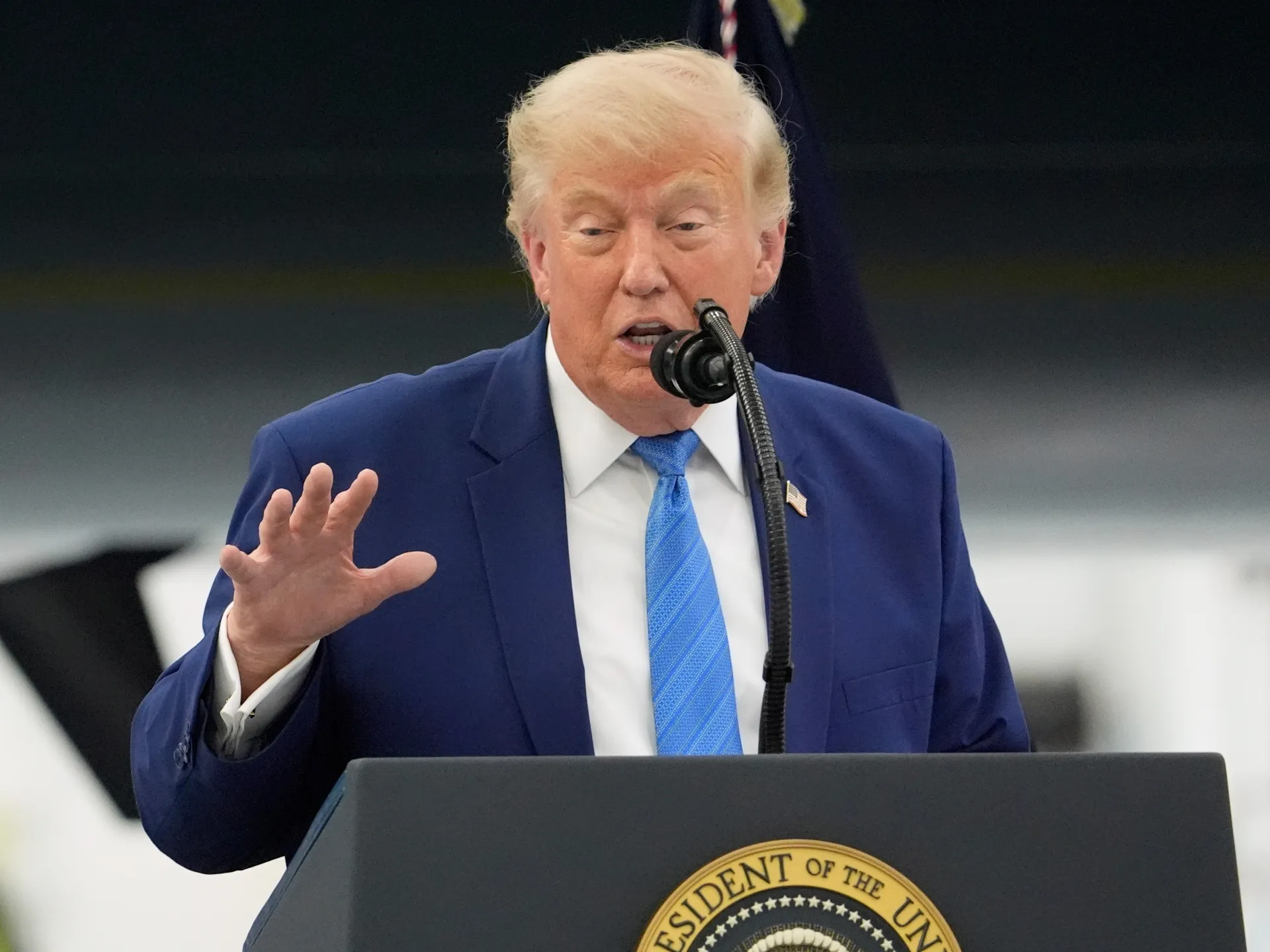
1 of 5 | President Donald Trump delivers remarks at an event for Gold Star Mothers and Angel Mothers to honor Mother’s Day, which is this Sunday, in the Rose Garden of the White House on Friday. Photo by Aaron Schwartz/UPI | License Photo
May 8 (UPI) — President Donald Trump on Friday delivered a Mother’s Day address as he hosted Gold Star Mothers and Angel Mothers in the White House Rose Garden.
Starting with his own mother, Trump thanked mothers across the country in a 20-minute speech that included specific thanks for mothers in the audience and those who work for his administration.
“I want to thank every single mother here this afternoon and all across our nation for your work,” Trump said.
“Every single day, America’s moms are raising — really — raising the future of our country … You have the most important job there is in America or any place else, and you’re doing an incredible job,” he said.
During the speech, Trump honored the mothers of children who died in crimes linked to illegal immigrants, whom he has dubbed Angel Mothers, noting that he hoped to prevent their ranks from growing due to “open borders” and what his administration has in pursuit of that goal.
The president honored Gold Star Mothers — the mothers of members of the military who have been killed in action — some of whom in attendance lost children during the war in Afghanistan.
Questioning whether “time heals all wounds,” Trump said that “our hearts are out to you on Mother’s Day.”
He also spoke about legislative and executive actions his administration has meant to benefit mothers and families.
“We’re honored to be joined by many strong and truly heroic moms who have stood up for their children,” he said, wishing them a Mother’s Day “filled with love and gratitude and joy.”
President Donald Trump delivers remarks at an event he is hosting for a group that includes Gold Star Mothers and Angel Mothers in honor of Mother’s Day in the Rose Garden of the White House on Friday. Photo by Aaron Schwartz/UPI | License Photo