As war strikes Iran, Sanaz Toossi’s ‘English’ has its L.A. premiere
War has a way of curtailing imagination. When the news breaks of faraway civilian casualties — an erroneous air strike on a school that relied on outdated intelligence, for example — the mind takes refuge in abstractions and statistics.
Grief isn’t an infinite resource. There’s only so much distant suffering anyone can take in. Yet our moral health as a society depends on the recognition of our common humanity. We share something with the inhabitants of those countries whose civilization our government has threatened to destroy.
This is an important moment to experience “English,” Sanaz Toossi’s Pulitzer Prize-winning drama, set in an English-language classroom outside of Tehran in 2008. The play, now having its L.A. premiere at the Wallis Annenberg Center for the Performing Arts, reminds us of the lives — the hopes, the dreams, the sorrows — on the other side of the headlines. (As I write this, the New York Times homepage has a story that stopped me dead in my tracks: ”Iranian Schools and Hospitals Are in Ruins, Times Analysis Shows.”)

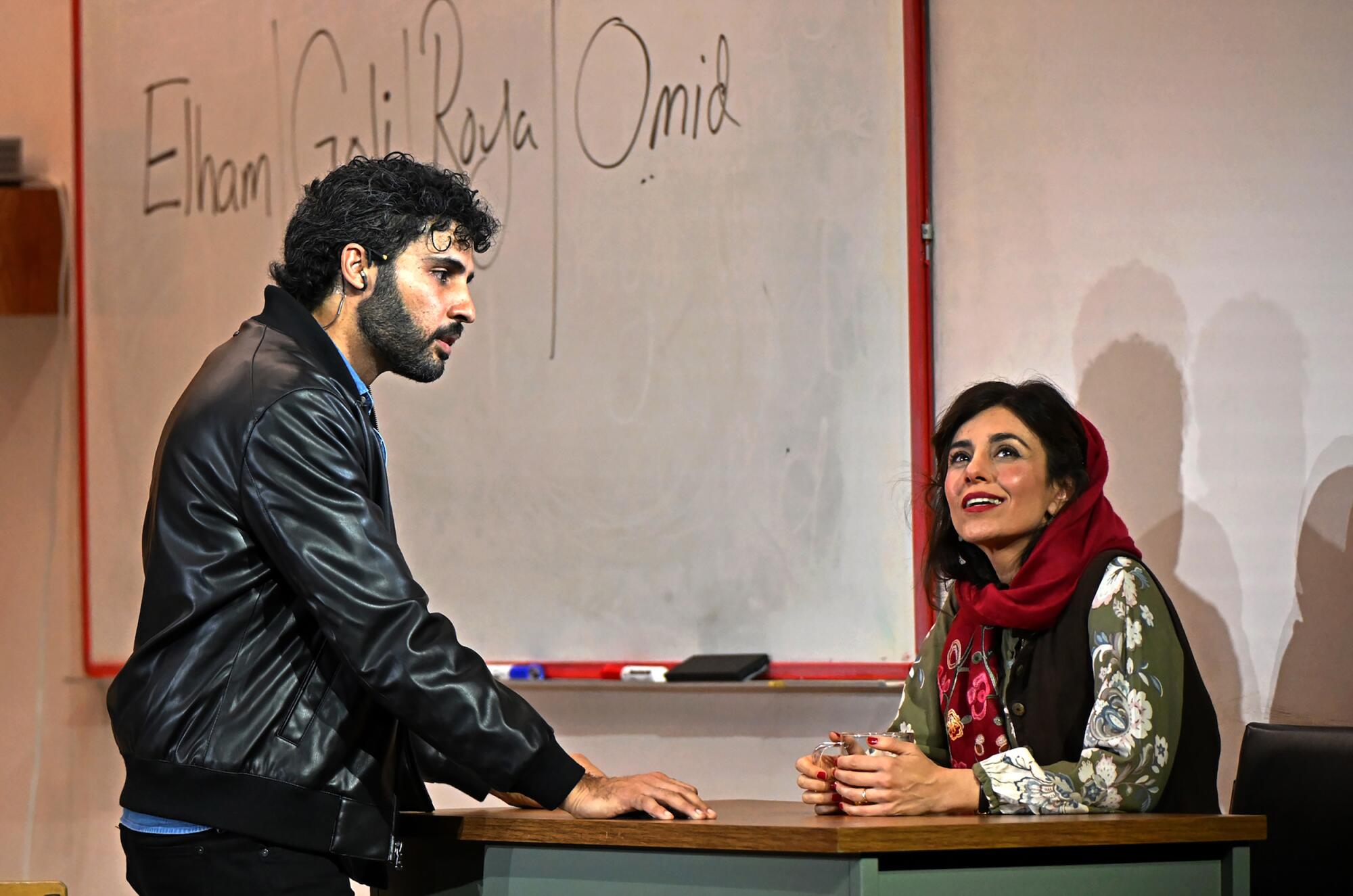
Babak Tafti, left, and Marjan Neshat in “English” at The Wallis.
(Kevin Parry)
“English” isn’t trying to win any political arguments. Its focus is on the characters, who are in a Test of English as a Foreign Language (TOFL) prep class. The exam will have an oversize effect on the future possibilities of this small, mishmash group of students.
Elham (Tala Ashe) needs a high score to pursue her medical education in Australia. Roya (Pooya Mohseni) wants to join her son in Canada to be part of her granddaughter’s life, but Persian is frowned upon in her son’s assimilated, English-language household. Omid (Babak Tafti), whose English is far beyond anyone else’s level in the class, has a U.S. green card interview coming up. And Goli (Ava Lalezarzadeh), the youngest of the students, wants at the very least to be fluent in the lingua franca of American pop culture.
Marjan (Marjan Neshat), the teacher whose love for the English language is infused with longing and regret, harks back nostalgically on her years in Manchester before she returned to Iran. She insists for pedagogic reasons that the students only speak English in the classroom. But Elham, a contentious and fiercely competitive student, suspects that Marjan’s zeal for anglophone culture, including Hollywood romantic comedies, masks a resentment for the Iranian life she is now stuck with. (Neshat and Ashe are gracefully reprising their Tony-nominated performances.)

Tala Ashe, left, and Pooya Mohseni in “English” at The Wallis.
(Kevin Parry)
Mastering English can open doors, but what if you wish you didn’t have to walk through them? Elham is angry that she has to leave to pursue her medical dreams. When she speaks English, she feels like a diminished version of herself. She calls her accent “a war crime,” and grows frustrated in class that she can’t easily explain what she’s thinking and feeling in her halting English.
The other students might not be as truculent as Elham, but they are just as ambivalent about the necessity of learning English. Toossi doesn’t grapple explicitly with the fraught internal politics of the Iran of the period. The conversation in the classroom doesn’t turn to the repressive regime or the state requirement of headscarves or the geopolitical strategies that have alienated the Islamic Republic of Iran from the global community.
When I saw “English” in 2024 at the Old Globe in San Diego, I was acutely aware of what the playwright was not addressing. At the Wallis in 2026, in the wake of Operation Epic Fury and the blitzkrieg of unhinged rhetoric from President Trump, whose rationales and goals for the war seem to change with every public utterance, I was intensely appreciative of what Toossi was putting front and center — the variegated humanity of her characters.

Tala Ashe and Marjan Neshat in “English” at the Wallis.
(Kevin Parry)
This Atlantic Theater Company & Roundabout Theatre production, directed by Knud Adams, had a critically touted Broadway run, receiving four Tony nominations, including best play. The physical staging, featuring a rotating cube from set designer Martha Ginsberg, shows us the classroom from different vantages, bringing the play’s shifting perspective to three-dimensional life.
Toossi follows the interplay of the differing viewpoints and lived experiences. She’s not as concerned with settling differences as with understanding the thoughts and emotions animating the clashes of her divergent characters. The actors relish the pesky, droll, frequently adorable, sometimes incendiary individuality of their roles.
The play does something unique with language. When a character speaks English, an accent is employed and the manner is often a bit stumbling. When a character speaks Persian, the English that is heard is natural and relaxed, the sound of a native speaker.
The result is that these Iranian characters, when talking among themselves in their native tongue, sound awfully like Americans having a conversation in the mall or at a nearby table at a restaurant. We are no longer separated by language. The notion of the Iranian “other” falls by the wayside.

The cast of “English” at the Wallis.
(Kevin Parry)
It’s hard not to wonder if one of those missiles raining down on schools in recent weeks hit when Marjan was showing “Notting Hill” or another favorite rom-com to one of the students she was hoping might realize her dreams of living abroad. Omid, whose English surpasses Marjan’s own level, has excited such hopes, and the touchingly Chekhovian quasi-romance between them adds a gentle note of amorous wistfulness.
Adams’ production creates a cinematic penumbra through the projections of Ruey Horng Sun, a soundscape by Sinan Refik Zafar that lyrically underscores the actions and the emotionally attuned lighting of Reza Behjat. The effect heightens the romanticism of characters who are no longer lost to us in translation.
But the destination of the play is less about what these students sound like to an American audience than what they sound like to themselves. And that is a universal journey that transcends even the starkest barriers of language, culture and politics.
‘English’
Where: Wallis Annenberg Center for the Performing Arts, Bram Goldsmith Theater, 9390 N. Santa Monica Blvd., Beverly Hills
When: 7:30 p.m. Tuesdays to Fridays, 2 and 7:30 p.m. Saturdays, 2 and 7 p.m. Sundays. (Check for exceptions.) Ends April 26
Tickets: Start at $53.90
Contact: (310) 746-4000 or TheWallis.org
Running time: 1 hour, 40 minutes (no intermission)