The opening ceremony of the Milano Cortina 2026 Winter Olympics on Friday was marked by audible boos from the crowd as delegations from the US and Israel entered the San Siro stadium, Anadolu reports.
US Vice President JD Vance and Secretary of State Marco Rubio led the American delegation.
As Vance appeared on the stadium’s big screen, waving the US flag, the crowd responded with jeers, according to live coverage of the event.
“There is the Vice President JD Vance and his wife Usha. Oops — those are a lot of boos for him,” an announcer was heard saying during the broadcast.
The reaction followed days of tension surrounding the participation of US Immigration and Customs Enforcement (ICE) agents in Olympic security.
The Department of Homeland Security confirmed the presence of Homeland Security Investigations personnel in Milan, prompting widespread protests and opposition from Italian lawmakers and citizens.
“They’re not welcome in Milan,” said Milan Mayor Giuseppe Sala in a radio interview, calling ICE a “militia that kills.”
Thousands gathered in Piazza 25 Aprile last weekend to demonstrate against the agents’ presence and raise concerns about civil rights violations.
International Olympic Committee President Kirsty Coventry responded to concerns ahead of the ceremony, saying: “I hope that the opening ceremony is seen by everyone as an opportunity to be respectful of each other.”
The Israeli delegation, which included nine Olympians and one Paralympian, also faced a “smattering of boos” as they entered the stadium, though the crowd noise was largely drowned out by music.
Additional protests were reported in Cortina d’Ampezzo and Predazzo, where simultaneous parades were held.
Security remains a top concern for several delegations, with increased attention to political sensitivities throughout the Games.
More than 800 athletes have been killed in Gaza since the start of Israel’s offensive on Oct. 7, 2023, as the sports community continues to suffer under bombardment, famine, and the collapse of infrastructure, according to Palestinian officials.
Move comes after council tried to oust PM Fils-Aime and the US recently deployed warship to waters near Haiti’s capital.
Published On 7 Feb 20267 Feb 2026
Share
Haiti’s Transitional Presidential Council has handed power to US-backed Prime Minister Alix Didier Fils-Aime after almost two years of tumultuous governance marked by rampant gang violence that has left thousands dead.
The transfer of power between the nine-member transitional council and 54-year-old businessman Fils-Aime took place on Saturday under tight security, given Haiti’s unstable political climate.
Recommended Stories
list of 2 itemsend of list
“Mr Prime Minister, in this historic moment, I know that you are gauging the depth of the responsibility you are taking on for the country,” council President Laurent Saint-Cyr told Fils-Aime, who is now the country’s only politician with executive power.
In late January, several members of the council said they were seeking to remove Fils-Aime, leading the United States to announce visa revocations for four unidentified council members and a cabinet minister.
Days before the council was dissolved, the US deployed a warship and two US coastguard boats to waters near Haiti’s capital, Port-au-Prince, where gangs control 90 percent of the territory.
US Secretary of State Marco Rubio stressed “the importance” of Fils-Aime’s continued tenure “to combat terrorist gangs and stabilise the island”.
The council’s plan to oust Fils-Aime for reasons not made public appeared to fall to the wayside as it stepped down in an official ceremony on Saturday.
Fils-Aime now faces the daunting task of organising the first general elections in a decade.
Election this year unlikely
The Transitional Presidential Council was established in 2024 as the country’s top executive body, a response to a political crisis stretching back to the 2021 assassination of President Jovenel Moise.
It quickly devolved into infighting, questions over its membership, and allegations of corruption falling overwhelmingly short of its mission to quell gang violence and improve life for Haitians.
Just six months after being formed, the body removed Prime Minister Garry Conille, selecting Fils-Aime as his replacement.
Despite being tasked with developing a framework for federal elections, the council ended up postponing a planned series of votes that would have selected a new president by February.
Tentative dates were announced for August and December, but many believe it is unlikely an election and a run-off will be held this year.
Last year, gangs killed nearly 6,000 people in Haiti, according to the United Nations. About 1.4 million people, or 10 percent of the population, have been displaced by the violence.
The UN approved an international security force to help police restore security, but more than two years later, fewer than 1,000 of the intended troops – mostly Kenyan police – have been deployed. The UN says it aims to have 5,500 troops in the country by the middle of the year, or by November at the latest.
Brief but deadly armed clashes in May last year on a disputed section of the Thai-Cambodia border escalated into the deadliest fighting in a decade between the two countries, killing dozens of people and displacing hundreds of thousands.
Now, while the fighting may have ceased, the conflict remains an emotive topic for Thais and a means for Anutin to rally support for his conservative Bhumjaithai Party as a no-nonsense prime minister, unafraid to flex his country’s military muscle when required, analysts say.
“Anutin’s party is positioning itself as the party that’s really willing to take the initiative on the border conflict,” said Napon Jatusripitak, an expert in Thai politics at the ISEAS-Yusof Ishak Institute in Singapore.
“It’s a party that has taken the strongest stance on the issue and the most hawkish,” Napon said of the recent military operations.
Anutin had good reason to focus on the conflict with Cambodia in his election campaign. The fighting created a surge in nationalist sentiment in Thailand during two rounds of armed conflict in July and December, while the clashes also inflicted reputational damage on Anutin’s rivals in Thai politics.
Chief among those who suffered on the political battlefield was the populist Pheu Thai Party, the power base of Thailand’s former prime minister Thaksin and his family.
Pheu Thai sustained a major hit to its popularity in June when a phone call between its leader, then-Thai Prime Minister Paetongtarn, and the strongman of Cambodian politics, Hun Sen, was made public.
In the June 15 call, Paetongtarn referred to Hun Sen, an erstwhile friend of her father, as “uncle” and promised to “take care” of the issue after the first early clashes between Thai and Cambodian troops, according to Reuters news agency.
For factions in Thailand’s politics and Thai people, Paetongtarn’s deference to Hun Sen was beyond the pale of acceptable behaviour for a prime minister, especially as she appeared to also criticise Thailand’s military – a major centre of power in a nation of more than 70 million people.
Hun Sen later admitted to leaking the call and claimed it was in the interest of “transparency,” but it led to the collapse of Paetongtarn’s government. She was then sacked by the constitutional court at the end of August last year, paving the way for Anutin to be voted in as Thailand’s leader by parliament the following month.
The border conflict with Cambodia has given a major boost to Thailand’s armed forces at a time of “growing popular discontent with the military’s involvement in politics, and with the conservative elite”, said Neil Loughlin, an expert in comparative politics at City St George’s, University of London.
Anutin’s government focused its political messaging when fighting on the border re-erupted in early December. Days later, he dissolved parliament in preparation for the election.
“Bhumjaithai has leaned into patriotic, nationalist messaging,” said Japhet Quitzon, an associate fellow with the Southeast Asia programme at the Center for Strategic and International Studies (CSIS) in Washington, DC.
“Anutin himself has promised to protect the country at campaign rallies, signalling strength in the face of ongoing tensions with Cambodia. He has vowed to retaliate should conflict re-emerge and will continue protecting Thai territorial integrity,” Quitzon said.
‘War against the scam army’
During the fighting, Thailand took control of several disputed areas on the border and shelled Cambodian casino complexes near the boundary, which it claimed were being used by Cambodia’s military.
Bangkok later alleged some of the casino complexes, which have ties to Cambodian elites, were being used as centres for online fraud – known as cyber scams – a major problem in the region, and that Thai forces were also carrying out a “war against the scam army” based in Cambodia.
Estimates by the World Health Organization say the conflict killed 18 civilians in Cambodia and 16 in Thailand, though media outlets put the overall death toll closer to 149, before both sides signed their most recent ceasefire in late December.
While the fighting has paused for now, its impact continues to reverberate across Thai politics, said the ISEAS-Yusof Ishak Institute’s Napon.
Pheu Thai is still reeling from the leaked phone call between Paetongtarn and Hun Sen, while another Thai opposition group, the People’s Party, has been forced to temper some of its longstanding positions demanding reform in the military, Napon said.
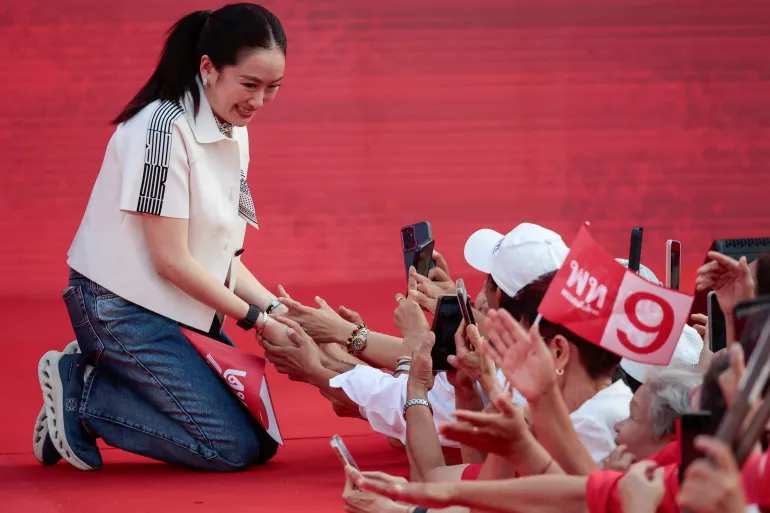
Former Prime Minister Paetongtarn Shinawatra shakes hands with Pheu Thai Party supporters during a campaign event in Bangkok [Patipat Janthong/Reuters]
“[The People’s Party] vowed to abolish the military’s conscription and to cut the military’s budget, but what the border conflict with Cambodia did was to elevate the military’s popularity to heights not seen in longer than a decade since the 2014 coup,” Napon told Al Jazeera.
“Its main selling point used to be reform of the military, but after the conflict it seems to be a liability,” Napon continued.
The party has now shifted its criticism from the military as an institution to specific generals, and turned its focus back to reviving the economy, which is expected to grow just 1.8 percent this year, according to the state-owned Krungthai Bank.
In the past two weeks, that messaging seems to be hitting home, Napon said, with the People’s Party once again leading at the polls despite a different platform from 2023.
“It will be very different from the previous election,” Napon said.
“Right now, there’s no military in the picture, so it’s really a battle between old and new,” he added.
Iranian Foreign Minister Abbas Araghchi says he hopes talks with the United States will resume soon, while US President Donald Trump pledged another round of negotiations next week following mediated discussions in Oman.
Araghchi told Al Jazeera on Saturday that Iran’s missile programme was “never negotiable” in Friday’s talks, and warned Tehran would target US military bases in the Middle East if the US attacks Iranian territory.
Recommended Stories
list of 4 itemsend of list
He added that despite the negotiations in Muscat being indirect, “an opportunity arose to shake hands with the American delegation”. The talks were “a good start“, but he insisted “there is a long way to go to build trust”.
Iranians in the capital, Tehran, however, seemed less positive.
“In my opinion, like previous times, negotiations will end without results because both sides are sticking to their own positions and not willing to back down,” a woman who asked to remain anonymous told Al Jazeera.
Abdullah al-Shayji, a US foreign policy expert at Kuwait University, said he hopes for a new deal between the two foes but is not feeling optimistic.
“There is a strong position” from the US and “being provoked by” Israel to “clamp down on the Iranians because they feel that Iran is at its weakest point” so that it will be easy to extract concessions from it, especially after last month’s antigovernment demonstrations, al-Shayji said from the Al Jazeera Forum in Qatar’s capital Doha.
‘Inalienable right’
Despite calling the talks “very good” on Friday, Trump signed an executive order effective from Saturday that called for the “imposition of tariffs” on countries still doing business with Iran.
The US also announced new sanctions against numerous shipping entities and vessels aimed at curbing Iran’s oil exports.
More than one-quarter of Iran’s trade is with China, including $18bn in imports and $14.5bn in exports in 2024, according to World Trade Organization data.
Nuclear enrichment is Iran’s “inalienable right and must continue”, Araghchi said, adding, “We are ready to reach a reassuring agreement on enrichment. The Iranian nuclear case will only be resolved through negotiations.”
Iran’s missile programme is non-negotiable because it relates to a “defence issue”, he said.
Washington has sought to address Iran’s ballistic missile programme and its support for armed groups in the region – issues that Israel has pushed to include in the talks, according to media reports.
Tehran has repeatedly rejected expanding the scope of the negotiations beyond the nuclear issue.
“The Iranians are vehemently opposed to any concessions,” said al-Shayji, as is the US, which makes it extremely hard for countries leading mediation efforts to “get them closer together”.
Friday’s negotiations were the first since nuclear talks between Iran and the US collapsed last year following Israel’s unprecedented bombing campaign against Iran, which triggered a 12-day war.
The Nimitz-class aircraft carrier USS Abraham Lincoln transiting the Arabian Sea in 2012 [File: AFP]
‘Peace through strength’
Trump’s lead negotiators in Oman, special envoy Steve Witkoff and presidential adviser Jared Kushner, visited the aircraft carrier stationed in the Arabian Sea on Saturday.
In a social media post, Witkoff said the aircraft carrier and its strike group are “keeping us safe and upholding President Trump’s message of peace through strength.”
Witkoff said he spoke with the pilot who downed an Iranian drone that approached the carrier “without clear intent” on Tuesday.
“Proud to stand with the men and women who defend our interests, deter our adversaries, and show the world what American readiness and resolve look like, on watch every day,” said Witkoff.
While Trump has sought to use the aircraft carrier’s deployment as a means to exert pressure on Iran, al-Shayji said this cannot be a long-term strategy.
“He [Trump] can’t keep his forces at alert stage for too long. This would really discredit Trump’s administration regarding being very harsh and hard-liners on Iran,” he said.
Israeli Prime Minister Benjamin Netanyahu is set to meet Trump on Wednesday to discuss the Iran talks, his office said in a statement.
Netanyahu “believes any negotiations must include limitations on ballistic missiles and a halting of the support for the Iranian axis”, it said, referring to Iran’s allies in the region.
During the 12-day war, US warplanes bombed Iranian nuclear sites.
Araghchi expressed hope that Washington would refrain from “threats and pressure” so “the talks can continue”.
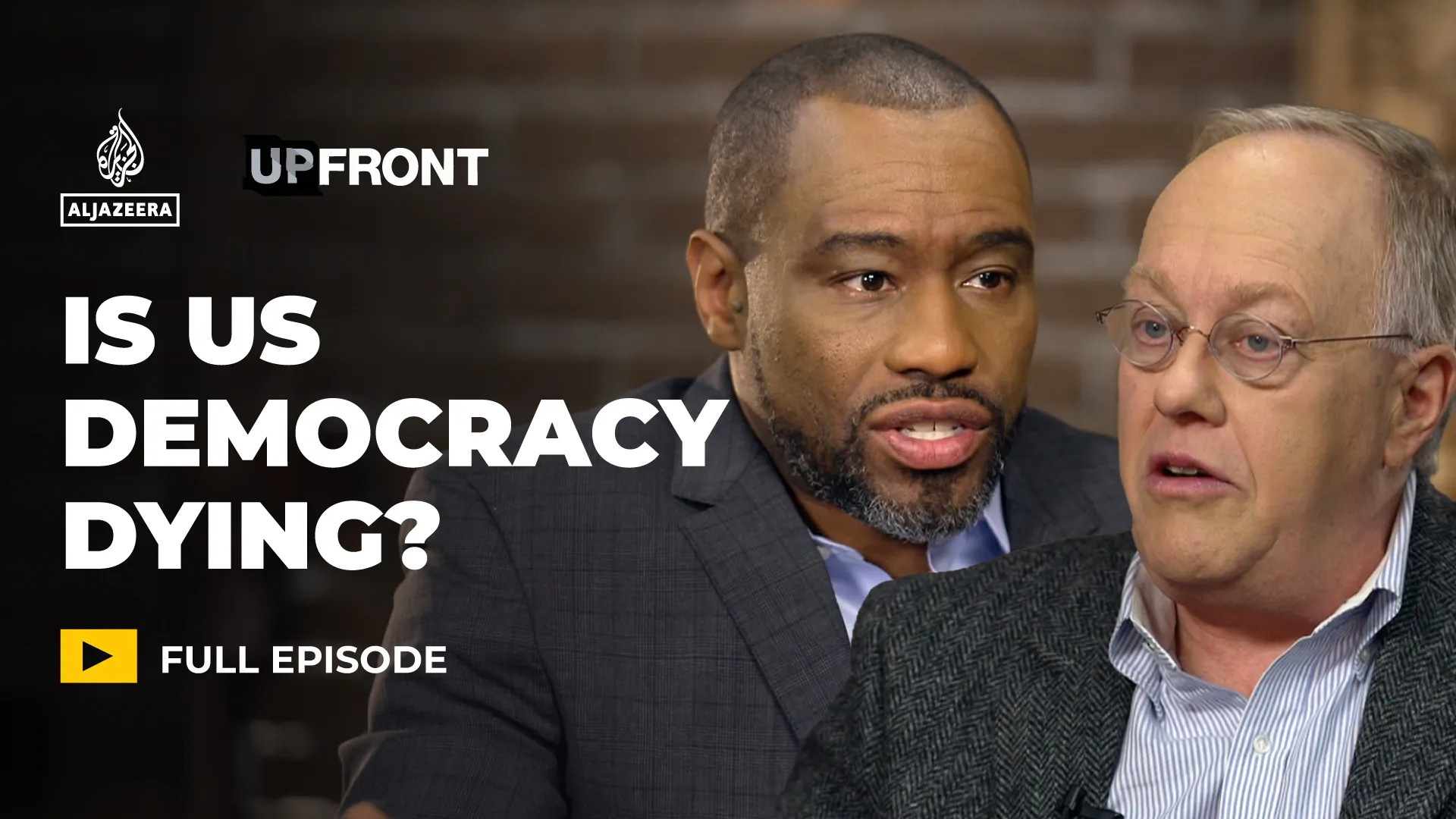
Journalist Chris Hedges speaks to Marc Lamont Hill on Trump’s first year and the future of US democracy.
One year into Donald Trump’s return to office, a wave of hardline actions – from volatile ICE raids to growing concern over political pressure on the media – has raised alarm about the expansion of the president’s power.
Then with US midterms approaching, attention is turning to whether there is any meaningful challenge to Republican grip on Congress.
So what happens next?
This week on UpFront, Marc Lamont Hill speaks with journalist and author Chris Hedges about Trump’s second presidency and whether US democracy is on the decline.
India recover from 77-6 as captain Suryakumar Yadav hits an unbeaten 84 in 29-run World Cup win against United States.
Published On 7 Feb 20267 Feb 2026
Share
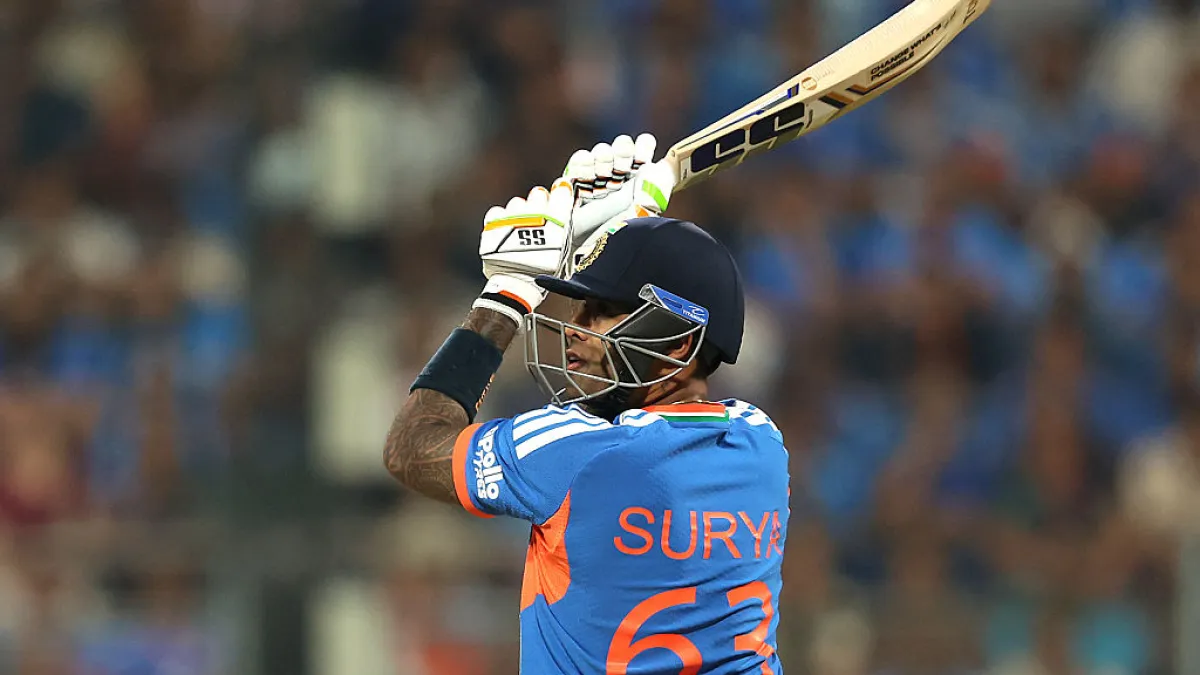
India captain Suryakumar Yadav led by example as the tournament co-hosts began their Twenty20 World Cup title defence with a 29-run victory against the United States in a group A contest on Saturday.
India recovered from a dire 77-6 to post a decent 161-9 with Suryakumar hitting a scintillating 84 not out off 49 balls.
Recommended Stories
list of 4 itemsend of list
The US managed 132-8 in reply, putting up a decent fight but never really coming close to chasing down the target.
Earlier, the predominantly Indian fans at the Wankhede Stadium probably expected sixes and fours to rain down after US captain Monank Patel elected to field.
Instead, it was a long procession of India’s top-order batters returning to the pavilion after a spectacular meltdown of the world’s top-ranked T20 team.
Opener Abhishek Sharma, currently the world’s number one T20 batter, fell for a first-ball duck in perhaps an inkling of what was in store for the home side.
The real nightmare unfolded in the final Powerplay over when Shadley van Schalkwyk claimed three wickets in five deliveries to leave India reeling on 46-4.
Ishan Kishan (20) and Tilak Varma (25) could not convert their starts, while Shivam Dube departed with a golden duck against his name in that eventful over from van Schalkwyk.
It could easily have been worse, but bowler Shubham Ranjane could not hold onto a return catch from Suryakumar when the batter was on 15.
Wickets kept tumbling at the other end though.
Rinku Singh, Hardik Pandya and Axar Patel perished trying to swing their way out of trouble.
Suryakumar responded to the crisis with a captain’s knock as he raced to a 36-ball fifty before plundering 21 runs from the final over from Saurabh Netravalkar.
India’s pace spearhead Jasprit Bumrah missed the match due to illness, and they were also forced into replacing Harshit Rana, who was ruled out of the tournament barely 24 hours before their opening match with a thigh injury.
Mohammed Siraj (3-29) vindicated his last-minute inclusion as Rana’s replacement with a two-wicket burst, while Arshdeep Singh also tasted success as they reduced the US to 31-3 in the six Powerplay overs.
Sanjay Krishnamurthi (37) and Milind Kumar (34) defied India for a while with a 58-run stand, but once the partnership ended, India were firmly in charge.
In Colombo, the Netherlands nearly pulled off a major upset before Faheem Ashraf’s breezy cameo secured Pakistan’s nervy three-wicket win with three balls to spare in another group A contest.
In a group C match in Kolkata, West Indies fast bowler Romario Shepherd claimed four wickets in five balls, including a hat-trick, as the twice champions thumped Scotland by 35 runs.
The Super Bowl, the biggest event in American football, is set for Sunday with the Seattle Seahawks facing the New England Patriots at Levi’s Stadium in Santa Clara, California.
The massive sporting event is set to energise fans in both cities and will send thousands this year to the San Francisco Bay Area. Those unable to make the trip are still expected to spend heavily on food, drinks and watch parties across the United States.
Recommended Stories
list of 4 itemsend of list
Historically, the Super Bowl has been a major economic boon for host cities. For the Bay Area, the event is part of a stretch of three major sporting spectacles lifting the regional economy.
A local boost?
In 2024, the Bay Area Host Committee commissioned a report forecasting the economic impact of the 2025 NBA All-Star Game, the 2026 Super Bowl, and the FIFA World Cup, all taking place in the region. The report estimated that Sunday’s game alone would generate between $370m and $630m in economic output for the Bay Area.
Last year’s Super Bowl was hosted in New Orleans, Louisiana. State officials reported the event brought in 115,000 visitors who spent $658m in the city.
For consumers, Bank of America estimates a 77 percent jump in spending near the stadium. A study analysing spending patterns from Super Bowl games between 2017 and 2025 found that, on game day, spending surged in the postal code closest to the stadium, with the biggest surge in food and parking costs.
Hosting the game does come with its own expenses for cities.
In the case of Santa Clara, it is small compared with the forecasted output. Last year, it was projected the city would cost them $6.3m, which includes training personnel for the influx of visitors and other logistical needs. However, other games have cost municipalities much more. When Atlanta hosted the Super Bowl in 2019, it cost the city an estimated $46m.
In 2023, the day after the game, which was played in Glendale, Arizona, outside of Phoenix, was the single busiest at Phoenix Sky Harbor international airport in its history, with more than 200,000 passengers passing through the airport, which is a hub for American Airlines and where budget carriers Southwest Airlines and Frontier maintain a large presence.
Other cities have used major sporting events to kick off large-scale infrastructure projects. In 2004 – ahead of the Super Bowl in Houston, Texas – METRO, the city’s transit authority, launched its first light rail line just a month before the game. The line, now one of three in the system, runs from downtown Houston to the city’s football stadium.
Prior to its launch, Houston was the only major metropolitan city in the US without a rail system.
But not all infrastructure projects paid off. Las Vegas built Allegiant Stadium in the neighbouring suburb of Paradise when the city acquired the Raiders football team from Oakland during the 2020 season. A year later, in 2021, Las Vegas won the bid to host the 2024 Super Bowl. The stadium cost $1.9bn. Nearly $750m came from hotel taxes, but the rest was shouldered by local taxpayers.
“The economic benefits are relatively short-term, not just in duration, but also in scope. They’re limited to certain industries and specific locations,” Michael Edwards, a professor of sport management at North Carolina State University, told Al Jazeera.
“The NFL [National Football League] often uses the Super Bowl as a carrot to encourage cities to invest taxpayer money in new stadiums. You’re seeing that dynamic play out in places like Chicago and Cleveland, where officials are considering domed stadiums. Part of that push is almost certainly driven by the possibility of hosting a Super Bowl, which the league dangles as an incentive,” Edwards said.
Food spending
For those who can’t make it to the game itself, there is still a surge in Americans heading to bars and restaurants to watch the game or spending money throwing a watch party.
The National Retail Federation, which has been tracking Super Bowl spending for the last decade, expects that Americans will spend a record $20.2bn, or $94.77 per person, on the big game with 79 percent of that on food.
Spending has skyrocketed since 2021 when consumers spent $13.9bn, or $74.55 per person. However, that dropped from $17.2bn in 2020 when the Super Bowl happened about a month before the COVID-19 lockdowns in the US began.
For those hosting a Super Bowl watch party at home, it will cost more than last year to stock up on the quintessential game-day foods. Wells Fargo estimates that hosting 10 people will cost about $140 per person, up from $138 last year.
Chicken wings, a staple for football fans, are a bright spot for wallets; prices are down 2.8 percent compared with this time last year. Potato chip prices are flat, but dips like salsa have jumped 1.7 percent.
Healthier options are getting more expensive as well for those opting for a veggie platter. Cherry tomatoes are up 2 percent, celery has risen 2.6 percent, and both broccoli and cauliflower are up 4 percent. Beer prices are also climbing, up 1.3 percent from a year ago.
Advertising hits records
The Super Bowl is airing on NBC with the network getting a boost in advertising spending for the big game. NBC sold out of advertising spots for the Super Bowl in September for a record $10m on average for a 30-second spot – up from $8m on average last year when the games aired on Fox.
NBC also benefits from a collection of sporting events all taking part in February that drive up advertising revenue, including from the Winter Olympics. The opening ceremony is on Friday and will run until February 22. NBC has exclusive broadcasting rights for the Olympics in the US.
“With the resurgence of the Olympic movement, our strongest Sports Upfront in history, the early sell-out of Super Bowl LX, and the remarkable return of the NBA, NBCUniversal has solidified itself as a sports powerhouse, and brands have taken notice,” Mark Marshall, chairman of NBCUniversal’s global advertising and partnerships, said in a release.
The last time the games were in the same year, back in 2024, the two events were the most-watched events on linear television.
On Wall Street, the looming sporting events set to air on NBC have sent parent company Comcast’s stock surging up more than 4 percent over the past five days.
Kina dauke da ciki na watanni tara, ba takalmi a ƙafa, kina gudu cikin ƙaya, kura da tsoro.
Kusan shekaru goma, Ya Busam Ali ta shafe tana rayuwa a matsayin yar gudun hijira, tana tafiya me nisa a kowace kakar noma zuwa gonakin da ‘yan ta’adda ke iko da su, domin kawai ta kula da kanta da ‘ya’yanta.
Wannan shirin na #BirbishinRikici ya bi labarin yadda ta tsira, juriyarta, da ƙarfin zuciyar da ke tura ta ci gaba da tafiya duk da ƙalubalen da ke gabanta.
Earlier this week, the Pentagon’s Defense Innovation Unit (DIU) laid out broad requirements for what it referred to as a Containerized Autonomous Drone Delivery System (CADDS). DIU’s central focus is on leveraging new and improved commercial-off-the-shelf technologies to help meet U.S. military needs.
“The Department of War (DoW) faces a robotic mass challenge: current methods for deploying and sustaining unmanned aerial systems (UAS) rely on direct human interaction to launch, recover, and refit each system,” the CADDS notice explains. “This 1:1 operator-to-aircraft model limits deployment speed and scale while exposing operators to unnecessary risks.”
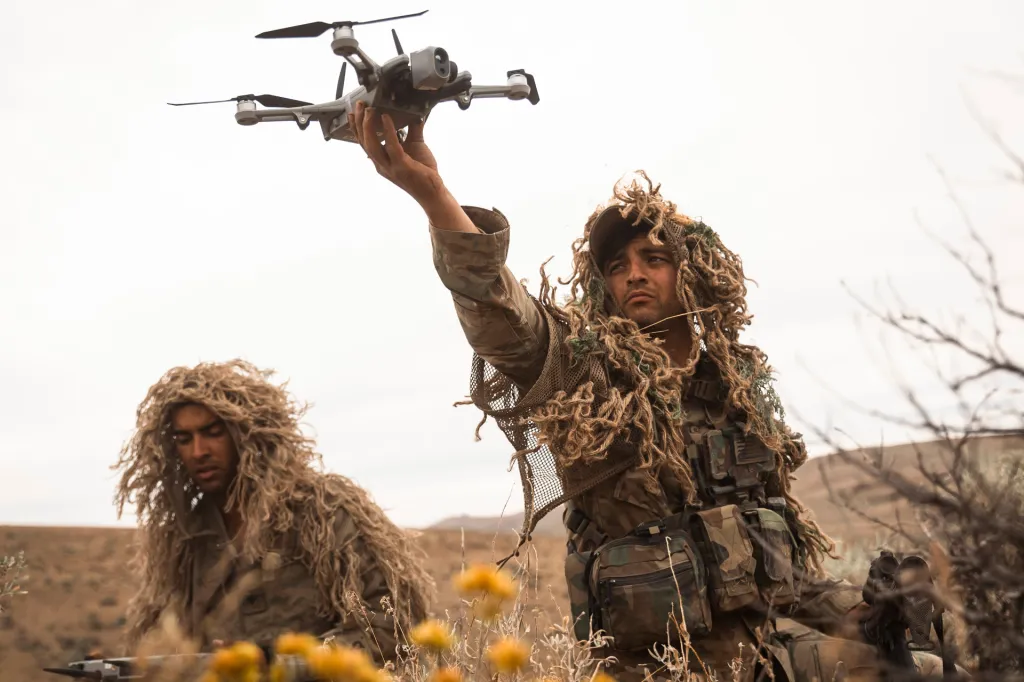
A sniper assigned to the Washington National Guard’s 81st Stryker Brigade Combat Team prepares to launch a quadcopter-type drone. US Army/Staff Sgt. Adeline Witherspoon
The “problem” to solve then is that “the DoW requires the ability to deploy large quantities of UAS rapidly, while minimizing the risk and burden to human operators executing kinetic and non-kinetic UAS operations in contested environments,” it adds.
To that end, “DOW seeks innovative solutions that enable the storage, rapid deployment, and management of multi-agent systems to provide either persistent UAS coverage over extended periods or massed effects within a single geographic region and time,” per DIU. It needs to be “employable from land and maritime platforms, in both day and night conditions, and during inclement weather.”
These have to be “designs [that] can be transported by military or commercial vehicles (land, sea, air)” and that “can be quickly positioned and made operational with minimal handling or setup.” They also have to be able to provide “automated functions for drone storage, launching, recovering, and refitting within the containerized platform; the intent is for the system to exist in a dormant state for a period of time and launch UAS upon command.”
DIU does not name any particular drones that the CADDS has to be able to accommodate or say how many UASs a single launcher should be able to hold. The notice does say the system will need to support “homogeneous and heterogeneous mixes of Government-directed UAS.”
The launch system also has to be capable of being set up and broken back down in a time frame measured in minutes and have a small operational footprint. “Ideally, the system should require a crew of no more than 2 personnel,” per DIU.
Another example of the “1:1 operator-to-aircraft model” that DIU says it wants to help get away from using CADDS. US Army
When it comes to the “autonomous” element of the launch system, DIU says it needs to support “both operator-on-the-loop and operator-in-the-loop decision-making processes.”
The market space for containerized launchers for various payloads, and for use on land and at sea, has been steadily growing globally in recent years. There has already been a further trend in the development of such systems for launching loitering munitions and other uncrewed aerial systems, or the adaptation of existing designs to be able to do so.
As one example, in the past year or so, Northrop Grumman has begun touting the ability of what it is currently calling the Modular Payload System (MPS) to launch drones, as seen in the computer-generated video below. TWZ was first to report on the development of that system all the way back in 2018, when it was being presented solely as a way to surface-launch variants of the AGM-88 anti-radiation missile. MPS is also now being pitched as a launcher for the Advanced Reactive Strike Missile (AReS), a surface-to-surface missile derived from the AGM-88G Advanced Anti-radiation Guided Missile-Extended Range (AARGM-ER) and its Stand-in Attack Weapon (SiAW) cousin.
Modular Payload System: Launching from Land or Sea
Last year, another concept for a containerized launcher capable of holding up to 48 drones at once also emerged from Mitsubishi Heavy Industries in Japan. Back in 2024, Germany’s Rheinmetall and UVision in Israel had also unveiled two very similar designs, specifically for launching members of the latter company’s Hero series of loitering munitions.
A rendering of UVision’s containerized launch system loaded on a truck. UVision
However, many of these systems are focused squarely on the launch aspect and lack the recovery and refit capabilities that DIU has outlined for CADDS. Chinese drone firm DJI and others in the commercial space are increasingly offering container-like ‘docks,’ but which are often designed to accommodate just one uncrewed aerial system at a time.
What is particularly interesting here is how many of the stated CADDS requirements actually sound very similar, at least in very broad strokes, to a containerized system capable of launching, recovering, and recharging thousands of small, electrically-powered quadcopter-type drones at the touch of a button that the Chinese company DAMODA rolled out last year. That launcher, dubbed the Automated Drone Swarm Container System, is for drone light shows for entertainment purposes rather than military use.
Behind the Scenes of DAMODA Automated Drone Swarm Container System.✨
China just dropped a new level of drone swarm tech | One-click auto-deploy of thousands | by DAMODA
It is worth reiterating that DAMODA’s Automated Drone Swarm Container System, at least as it exists now, is clearly designed for entertainment industry use first and foremost. Though the company’s drone light show routines are certainly visually impressive and often go viral on social media, they are pre-scripted and conducted in a very localized fashion. What the company is offering is not a drone swarm capable of performing various military-minded tasks in a highly autonomous manner at appreciable ranges from its launch point.
At the same time, large-scale drone light shows put on by DAMODA (and a growing number of other companies), do highlight, on a broad level, the already highly problematic threats posed by swarms. The new Automated Drone Swarm Container System underscores the additional danger of these same threats hiding in plain sight. The steady proliferation of advances in artificial intelligence and machine learning, especially when it comes to dynamic targeting, will only create additional challenges, as TWZ has explored in detail in this past feature.
Even in an overt operational context, readily deployable containerized systems capable of acting as hubs for drone operations across a broad area with limited manpower requirements could offer a major boost in capability and capacity. Ships, trucks, and aircraft, which could themselves be uncrewed, could be used to bring them to and from forward locations, even in remote areas. If they can support a “heterogeneous mix” of uncrewed aerial systems, a single container could be used to support a wide array of mission requirements, including intelligence, surveillance, and reconnaissance, electronic warfare, kinetic strikes, and/or communications signal relay.
An inherent benefit of a drone swarm, in general, is that each individual component does not have to be configured to perform all of the desired tasks. This creates additional flexibility and resilience to threats, since the loss of any particular drone does not necessarily preclude the swarm from continuing its assigned missions. There are tangential design and cost benefits for the drones themselves, since they can be configured to carry only the systems required for their particular mission demands.
Army Aviation Launches Autonomous Pack Hunters
TWZpreviously laid out a detailed case for the many benefits that could come along with loading containers packed with swarms of drones onto U.S. Navy ships. Many of those arguments are just as relevant when talking about systems designed to be employed on land. Containerized systems are often readily adaptable to both ground-based and maritime applications, to begin with.
Drone swarms are only set to become more capable as advancements in autonomy, especially automated target recognition, continue to progress, driven by parallel developments in artificial intelligence and machine learning, as you can read more about here. Future highly autonomous swarms will be able to execute various mission sets even more efficiently and in ways that compound challenges for defenders. Massed drone attacks with limited autonomy already have an inherent capacity to just overwhelm enemy defenses. In turn, electronic warfare systems and high-power microwave directed energy weapons have steadily emerged as some of the most capable options available to tackle swarms, but have their own limitations. Even powerful microwave systems have very short ranges and are directional in nature, and electronic warfare systems may simply not work at all against autonomous drones.
In terms of what DIU is now looking at for CADDS, the stated requirements are broad. It remains to be seen what options might be submitted, let alone considered for actual operational U.S. military use.
Still, DIU has laid out a real emerging capability gap amid the current push to field various tiers of drones to a degree never before seen across America’s armed forces, which counterinsurgency launch systems look well-positioned to fill.
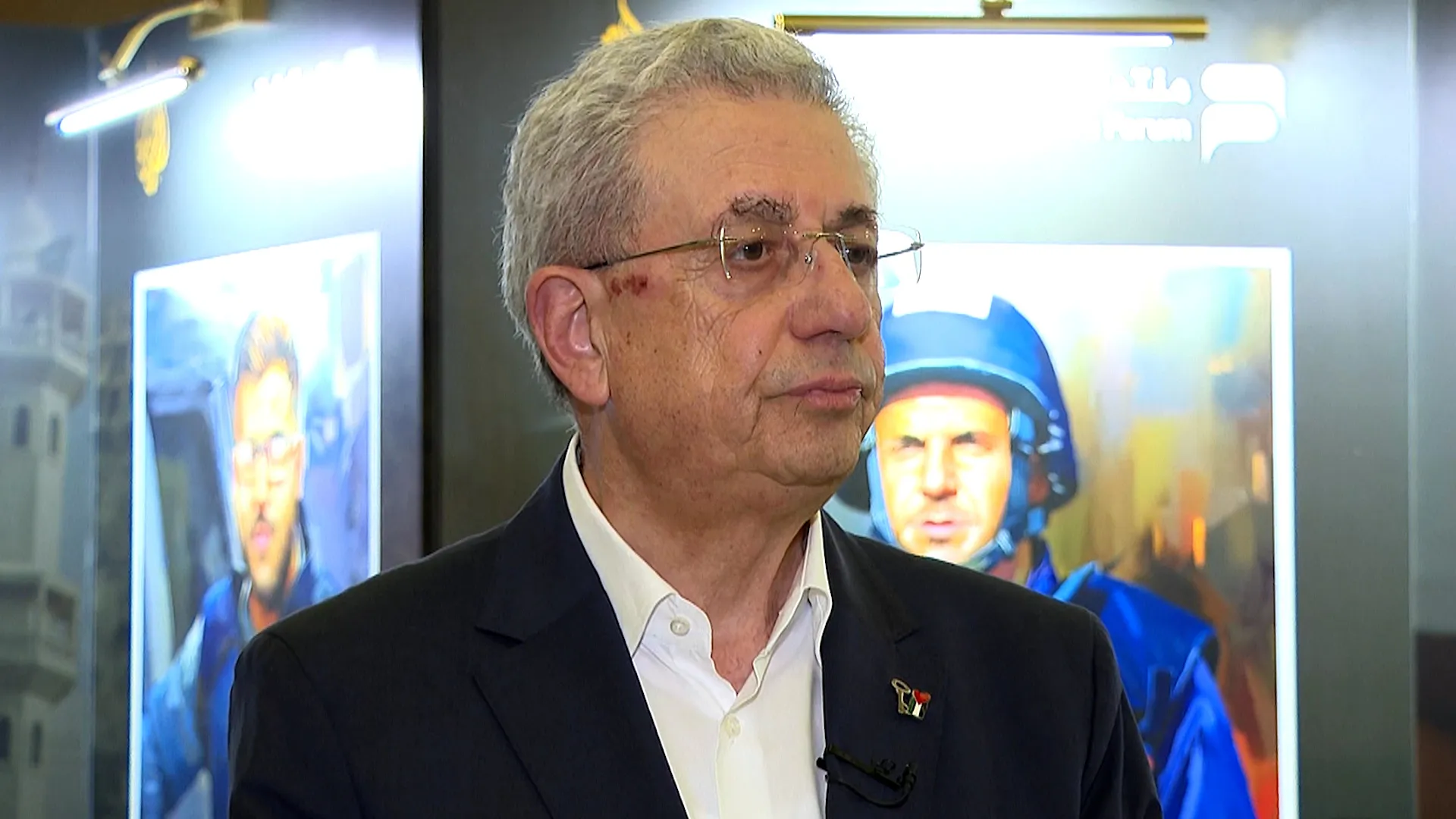
Mustafa Barghouti, secretary-general of the Palestinian National Initiative, said that the steadfastness of Palestinians in Gaza despite genocide, shows ‘the failure of Israel’. Barghouti is at the Al Jazeera Forum, an event focusing on geopolitical shifts in the Middle East.
Iraq launches investigations into ISIL detainees from Syria, with 7,000 expected to arrive in total.
United States forces have transported a third group of ISIL (ISIS) detainees from Ghwayran prison in Syria’s Hasakah province to Iraq by land, as activity around a US military base in the region points to possible operational changes, an Al Jazeera correspondent reports.
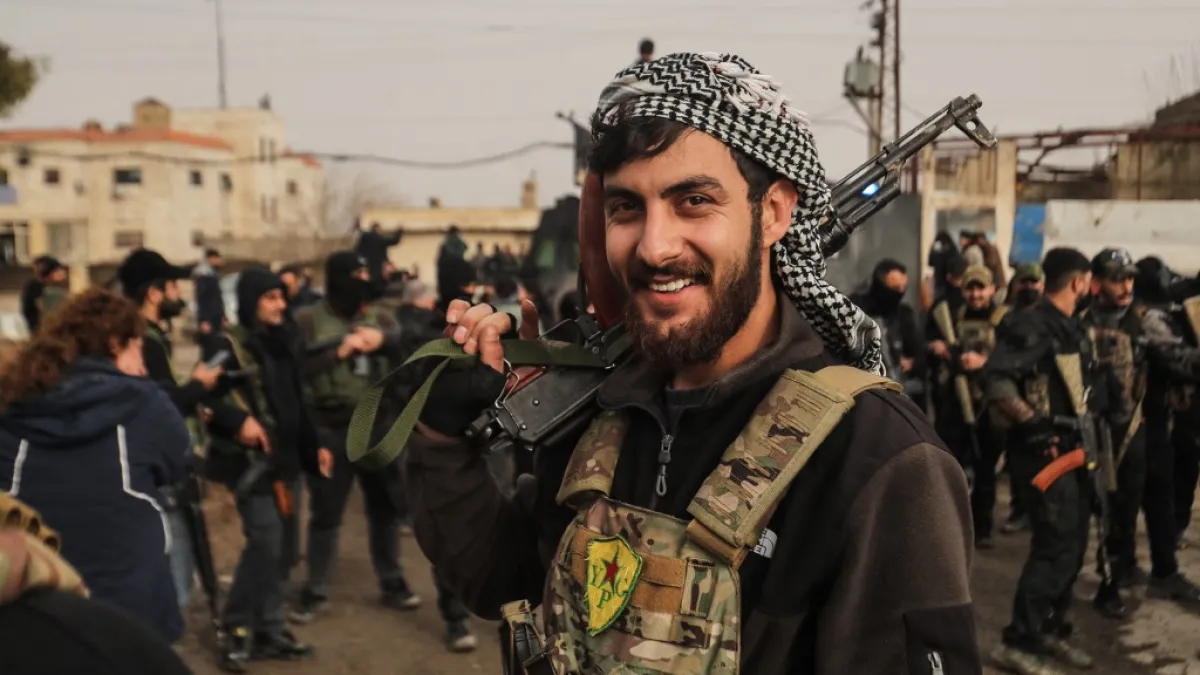
The transfer on Saturday forms part of a trilateral arrangement, which has emerged as part of a painstaking ceasefire after deadly clashes involving the Syrian government and the Syrian Democratic Forces (SDF), under which detainees held in northeastern Syria are being relocated to Iraqi custody. US forces are the third party to that agreement.
Recommended Stories
list of 3 itemsend of list
Earlier, US Central Command (CENTCOM) confirmed the start of a broader operation to move detainees from facilities across the region, with officials outlining a plan to transfer about 7,000 prisoners.
Iraq has launched investigations into ISIL detainees from Syria over atrocities committed against its citizens.
Security developments in northeastern Syria have accelerated in recent weeks in the wake of government forces sweeping across the north and SDF retreats.
On Saturday, SDF governor-designate Nour Eddien Ahmad met a Damascus delegation at the Hasakah government building before a Syrian national flag-raising ceremony.
The meeting carries political significance as the agreement between Damascus and the SDF allows the group to nominate the governor of Hasakah, with Ahmad expected to be formally appointed by the Syrian government.
The visiting delegation includes senior government security officials, underscoring Damascus’s expanding administrative control in the province. The raising of the Syrian national flag over the government building signals the reassertion of central government authority in Hasakah.
Syrian government forces entered the city of Qamishli earlier this week, one of the remaining urban strongholds of the Kurdish-led SDF, following a ceasefire agreement reached on Friday last week.
The accord ended weeks of confrontations and paved the way for the gradual integration of SDF fighters into Syrian state institutions, a step Washington described as an important move towards national reconciliation.
The agreement followed territorial losses suffered by the SDF earlier this year as government troops advanced across parts of eastern and northern Syria, reshaping control lines and prompting negotiations over future security arrangements.
Separately, an Al Jazeera correspondent on the ground reported that US personnel vacated most watchtowers surrounding a military installation in the al-Shaddadi area of Hasakah province, leaving only the western tower staffed.
Soldiers were also seen lowering the US flag from one tower, while equipment used to manage aircraft take-offs and landings at the base’s airstrip was no longer visible.
No combat aircraft were present at the facility, although a large cargo aircraft landed at the base, remained for several hours, and later departed.
The US established its formal military presence in Syria in October 2015, initially deploying about 50 special forces personnel in advisory roles as part of the international coalition fighting ISIL. Since then, troop levels have fluctuated.
Reports in mid-2025 indicated that roughly 500 US troops withdrew from the country, leaving an estimated 1,400 personnel, though precise figures remain unclear due to the classified nature of many deployments.
US forces continue to focus on countering ISIL remnants, supporting the Syrian government now, providing intelligence and logistical assistance, and securing oil and gas infrastructure in Hasakah and Deir Az Zor provinces.
Who: Liverpool vs Manchester City What: English Premier League Where: Anfield, Liverpool, UK When: Sunday at 4:30pm (16:30 GMT) How to follow: We’ll have all the build-up on Al Jazeera Sport from 13:30 GMT in advance of our live text commentary stream.
Liverpool host City for a match with huge ramifications for the title race and the battle to qualify for next season’s Champions League.
Recommended Stories
list of 4 itemsend of list
City trail leaders Arsenal by six points and could find themselves nine adrift by the time they kick off, with the Gunners hosting Sunderland on Saturday.
Liverpool could also be four points outside the top five, which should secure a place in the Champions League, should Manchester United and Chelsea win on Saturday.
The champions head into the weekend in sixth place on 39 points but in high spirits after a commanding 4-1 win over Newcastle United last weekend, while City dropped points against 14th-placed Tottenham Hotspur, surrendering a two-goal advantage in a 2-2 draw.
Hugo Ekitike and Florian Wirtz, two of Liverpool’s big-money summer signings, are beginning to deliver returns. Ekitike scored twice in the win over Newcastle to take his tally for the season to 15, while Wirtz has netted six times in 10 matches since ending a 22-game wait for his first Liverpool goal.
City’s Erling Haaland, meanwhile, is experiencing an unusual lean spell with just two goals in his last 12 games. He has never scored for City at Anfield.
Ekitike, left, and Wirtz celebrate scoring against Newcastle on Saturday [Jon Super/AP Photo]
Slot targets improved display against City
Liverpool are eager to showcase how far they have progressed after losing 3-0 to City in November, manager Arne Slot said on Thursday.
“I mainly remember the game we played at Etihad, and we were outplayed for large parts in the first half,” Slot told reporters.
“So, this is another moment to see where we are in the development of this team. We know the importance of a result.”
Liverpool have endured a difficult season so far, but have regained some measure of form in recent weeks.
“It’s the end phase of the season, so results matter more,” Slot said.
“We have not found the consistency for the results, but we have shown against all the [teams], that we can compete.”
Liverpool know there has to be ‘life after Virgil’
Slot also explained the club’s decision to recruit four central defenders during the winter transfer window – Jeremy Jacquet, Ifeanyi Ndukwe, Mor Talla Ndiaye and Noah Adekoya – describing it as planning for life after captain and star centre-back Virgil van Dijk, who will turn 35 this year.
“Hopefully, Virgil can stay fit for multiple years, but this club is not stupid,” Slot said.
“We do know, somewhere in the upcoming years, there is life after Virgil, but that is for every position. We don’t think about short term only.”
Slot singled out the Jacquet for extra praise. The France under-21s defender was also linked with Chelsea, but will move to Anfield in July after Liverpool agreed to a big-money deal to sign him from Rennes, where he will finish the season.
“Such a big talent and another example of the model we’re using at this club,” Slot said.
“Young, very talented players, sometimes at the start of their careers or sometimes already a little bit a few years into their career, but always players that are young and can improve us in the short term but also definitely in the long term.”
Van Dijk remains a rock on Liverpool’s defence but will turn 35 this year [Stu Forster/Getty Images]
Guardiola emphasises mental fortitude ahead of tough trip
Manchester City manager Pep Guardiola said mental strength separates elite players from the rest as his team prepares for the game against Liverpool.
“The biggest stages and the biggest games always need big personalities,” Guardiola told reporters on Friday.
“I have said many times, it’s not about the skills of the players in the top leagues. In the top clubs, the skills are there. I never know one player that is not good enough to play in the top clubs, it is how you behave.
“How you play in the latter stages of the biggest competitions is what defines you as a player. The mind of the players you have defines the big teams.”
Guardiola said that despite their travails this season, playing Liverpool at Anfield is still one of the toughest away fixtures in football.
“They remain an exceptional team,” he said. “Top-class manager and an exceptional team, no doubt.”
Haaland leads the top scorer charts with 20 goals, but the striker has not found the net in his last three league games [Oli Scarff/AFP]
City boss lauds Haaland as ‘world’s best striker’ but won’t confirm Liverpool start
Guardiola insisted Haaland is the “best striker in the world” despite refusing to confirm if the misfiring City star will start Sunday’s crucial clash.
“I don’t know until tomorrow. But all I say is Erling is the best. Erling is the best striker in the world,” Guardiola told reporters.
The 55-year-old also doubled down on his comments about the “hurt” he feels for victims of conflicts in Palestine, Ukraine and Sudan after Jewish community leaders told him to “focus on football”.
“To be honest, I didn’t say anything special. I think, why should I not express how I feel just because I am a manager? So I do not agree, but I respect absolutely all opinions,” he said.
“What I said basically is how many conflicts there are right now around the globe or around the world. How many? A lot, right? I condemn all of them. All of them.”
Head-to-head
The two clubs have faced each other on 219 occasions, with Liverpool winning 110 of those games, City winning 61, and 58 ending as draws.
While City comfortably won their home league game against Liverpool this season, their only victory away to Liverpool since 2003 came in an empty stadium during COVID restrictions in 2021.
Liverpool’s team news
Slot confirmed that defender Jeremie Frimpong will miss the game, but Joe Gomez could return to the squad to bolster the defensive line.
Dominik Szoboszlai is expected to continue deputising for Frimpong at right-back.
Alexander Isak, Conor Bradley and Giovanni Leoni all remain on the sidelines with long-term injuries.
Predicted lineup:
Alisson (GK); Szoboszlai, Konate, Van Dijk, Kerkez; Gravenberch, Mac Allister; Salah, Wirtz, Gakpo; Ekitike
City’s team news
City could be without Bernardo Silva, who has a back issue, so Nico O’Reilly could move into midfield to replace him.
Ruben Dias has returned from injury but likely lacks full match fitness and sharpness, so Abdukodir Khusanov will likely start in the centre of defence alongside new signing Marc Guehi.
Lahore, Pakistan – As funerals were held on Saturday for more than 30 people killed in a suicide bombing at a mosque in Islamabad, analysts warned the attack could be part of a broader attempt to inflame sectarian tensions in the country.
A suicide bomber struck the Khadija Tul Kubra Mosque, a Shia place of worship, in the Tarlai Kalan area of southeastern Islamabad during Friday prayers.
Recommended Stories
list of 4 itemsend of list
In a statement, the Islamabad administration said 169 people were transferred to hospitals after rescue teams reached the site.
Hours later, a splinter faction of the ISIL (ISIS) group in Pakistan claimed responsibility on its Telegram channel, releasing an image it said showed the attacker holding a gun, his face covered and eyes blurred.
Pakistan’s Defence Minister Khawaja Asif said mosque security guards tried to intercept the suspect, who opened fire before detonating explosives among worshippers. He alleged the attacker had been travelling to and from Afghanistan.
Security officials on Saturday told Al Jazeera that several key arrests had been made, including close family members of the suicide bomber in Peshawar and Karachi. They did not clarify whether there was evidence of their involvement in the plot.
Capital under fire?
Islamabad had seen a relative lull in violence in past years, but things have changed in recent months. The bombing marked the second major attack in the federal capital since a suicide blast targeted a district court in November last year.
Abdul Sayed, a Sweden-based analyst on conflict in Afghanistan and Pakistan, said ISIL’s Pakistan branch, referred to as ISPP, claimed responsibility for what appears to be its deadliest operation in the country since its formation in May 2019.
“Since its formation, ISPP has carried out approximately 100 attacks, more than two-thirds of which occurred in Balochistan. These attacks include three suicide bombings targeting Afghan Taliban members, police, and security forces in Balochistan,” Sayed, founder of the Oxus Watch research platform, told Al Jazeera.
Pakistan has witnessed a steady rise in violence from fighters over the past three years. Data released by the Pak Institute of Peace Studies for 2025 recorded 699 attacks nationwide, a 34 percent increase compared with the previous year.
Islamabad has repeatedly accused the Afghan Taliban, who returned to power in August 2021 following the withdrawal of United States forces, of providing a haven to armed groups that launch attacks inside Pakistan from Afghan soil.
The Afghan Taliban condemned Friday’s mosque bombing and have consistently denied sheltering anti-Pakistan fighters.
In October, this very issue ignited the deadliest border clashes between the two sides in years, which killed dozens of people and led to evacuations on both sides.
A United Nations report last year stated that the Afghan Taliban provides support to the Pakistan Taliban, or TTP, which has carried out multiple attacks across Pakistan.
The report also said the Balochistan Liberation Army (BLA) has ties with both the TTP and ISIL’s affiliate in Khorasan Province (ISKP), indicating a convergence of groups with distinct but intersecting agendas.
Just days ago, Pakistan’s military concluded a weeklong security operation in the restive southwestern Balochistan province, claiming the deaths of 216 fighters in targeted offensives.
A military statement on Thursday said it followed the province-wide attacks by the separatist BLA carried out to “destabilise the peace of Balochistan”.
Fahad Nabeel, who heads the Islamabad-based consultancy Geopolitical Insights, said Pakistan is likely to maintain its hardened stance towards Kabul, citing what he described as Afghanistan’s failure to act against anti-Pakistan fighter groups.
He added that officials would probably share preliminary findings of the investigation and point to a possible Afghan link.
“The upward trajectory of terrorist attacks witnessed last year is expected to continue this year. Serious efforts need to be made to identify networks of facilitators based in and around major urban centres, who are facilitating militant groups to carry out terrorist attacks,” Nabeel told Al Jazeera.
Sectarian fault lines
Manzar Zaidi, a Lahore-based security analyst, cautioned against equating the latest bombing with the district court attack last year.
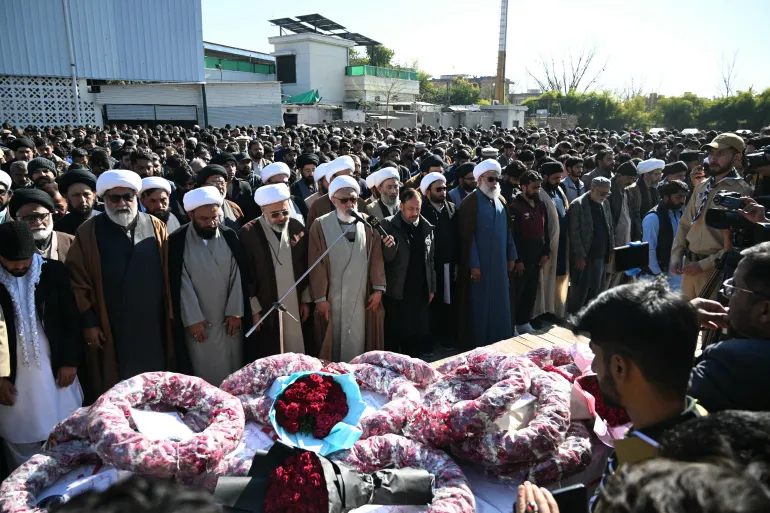
Mourners offer funeral prayers as they stand around the coffin of a Shia Muslim, a day after a suicide bombing at a mosque in Islamabad on February 7, 2026 [AFP]
“The last year’s attack was essentially a target on a state institution, whereas this one was plainly sectarian in nature, something that has certainly gone done in the recent times, and that is why I will urge caution against a knee-jerk reaction to conflate the two incidents,” he told Al Jazeera.
Shia make up more than 20 percent of Pakistan’s population of about 250 million. The country has experienced periodic bouts of sectarian violence, particularly in Kurram district in northwestern Khyber Pakhtunkhwa province, which borders Afghanistan.
Regional tensions have added to domestic anxieties.
Zaidi said armed groups in the region backed by Iran remain alert amid “the simmering geopolitical tensions”.
“For Pakistan, it really has to keep a close eye on how things develop in Kurram region, where things can get out of control and there could be a fallout. The region currently has an uneasy peace; that can easily be instabilised,” he said.
Kurram, a tribal district bordering Afghanistan, has a roughly equal Sunni and Shia population. It has long been a flashpoint for sectarian clashes and witnessed prolonged fighting last year.
Nabeel said a timely conclusion to the investigation could shape the government’s response and help prevent the attack from becoming a trigger for wider sectarian unrest.
“However, the possibility of low-intensity sectarian targeting in different parts of the country is likely,” he warned.
Sayed added that an examination of Pakistani nationals who joined ISIL and affiliated groups shows that many came from anti-Shia Sunni armed organisations.
“The role of these sectarian elements is therefore an important factor in understanding such attacks. Moreover, such attacks appear significant in facilitating further recruitment of anti-Shia Sunni extremists within Pakistan, thereby contributing to IS efforts to strengthen its networks in the country,” he said.
After Pakistan announced their boycott of the forthcoming T20I World Cup match against India, the International Cricket Council (ICC) was quick to lament the position the Pakistan Cricket Board (PCB) had put fans in. “[Pakistan’s] decision is not in the interest of the global game or the welfare of fans worldwide,” the ICC said in a release, before going on to make special mention of “millions in Pakistan”, who will now have no India fixture to anticipate.
Through the course of this statement, and the one the previous week, justifying the ICC’s ultimatum to the Bangladesh Cricket Board (BCB) – which eventually led to Bangladesh’s exit from the tournament – the ICC leaned on ideals of fairness and equality. The “integrity and sanctity” of the World Cup was invoked, as well as the “neutrality and fairness” of such an event.
Pakistan’s fans may clock, of course, that they had not attracted such concern before the Champions Trophy in 2025, when India had refused to play in Pakistan for what were, in truth, purely political reasons. As it happened, a semifinal and the final of that tournament were eventually moved away from Pakistan, India’s cricketing magnetism pulling the knockouts to Dubai, after the ICC had adopted a “hybrid” model wherein India played all its matches outside the “host” country.
This was a key moment setting cricket on its current trajectory. In return for India’s refusal to play in its home country, Pakistan insisted they would not travel to India for this year’s T20 World Cup – two of the most storied cricketing nations on the planet descending to reciprocal petulance. In the lead-up to this World Cup, Bangladesh was also drawn into the fray, the Indian Premier League (IPL) franchise’s jettisoning of Bangladesh bowler Mustafizur Rahman prompting Bangladesh to demand all its matches be played in Sri Lanka (India’s co-host for this tournament), and that demand, in turn, leading to it being thrown out entirely.
All claims that any of these boycotts are founded on security concerns are, in fact, bogus; security assessments ordered by the ICC had found India sufficiently equipped to handle Bangladesh’s visit, while Pakistan had hosted ICC-sanctioned international cricket involving multiple touring teams, and Pakistan had played an entire One Day International (ODI) World Cup in India as recently as 2023.
What is also clear, however, is that the ICC has now allowed its sport to become the medium through which South Asian states, currently as riven as they have been for decades, exchange geopolitical blows. What’s more, the ICC has begun to favour one set of geopolitical ambitions over others, India never so much as copping a censure for its refusal to play in Pakistan, while India’s men’s team’s refusal to shake hands with the Pakistan players in last year’s Asia Cup has now been adopted across the Board of Cricket in Control’s (BCCI’s) teams – the women’s and Under-19 (U19) sides following suit. To take the ICC at face value would also require believing that ICC Chair Jay Shah is conducting his business in complete separation from Amit Shah, who is India’s home minister.
It is India’s stupendous cricket economy that has chiefly brought about this imbalance. Since 2014, when a Big Three (India, Australia, England) takeover at the ICC diverted cricket to a hypercapitalist path, the game’s top administrators have been adamant that it is profits that must define cricket’s contours. Because India is the wellspring of much of the game’s finances, the ICC has organised for the Board of Control for Cricket in India (BCCI) to receive close to 40 percent of the ICC’s net earnings, while international men’s cricket largely surrenders a fifth of the calendar to the IPL. The sport’s high-octane driver of financial growth demands protection, or so the official line goes. If member boards fail to align with the BCCI agenda at the ICC, it has long been taken as read that the BCCI may threaten to cancel India’s next tour of that country, which in turn may shatter the smaller board’s revenues. The vote to issue that ultimatum to the BCB had run 14-2 against Bangladesh. A board must never forget at whose table it eats.
A cricket world that has spent 12 years lionising economic might cannot now be surprised that politics has now begun to overrun even the game’s financial imperatives. That monopolies tend to lead to appalling contractions in consumer choice has been a fundamental tenet of economics for generations. Hundreds of millions of Bangladesh fans are about to discover this over the next few weeks, as will the remainder of the cricketing world on February 15, when India and Pakistan were due to play. That profit-driven systems, which equate wealth with power, frequently lose the means to check the most powerful, is another longstanding principle in political economics.
The tournament’s competitive standards will also undoubtedly slip for Bangladesh’s absence. Bangladesh have a body of work in cricket that, respectfully, utterly dwarfs that of Scotland, who have replaced them. There are warnings here, too, for other cricketing economies. Although broadcast revenues from Bangladesh are a mere sliver of the mountains India presently generates, macroeconomic indicators from Bangladesh (a growing population, an improving gross domestic product (GDP) per capita and Inequality-adjusted Human Development Index (IHDI) ranking) suggest that market is set to grow in future decades. If the ICC is willing to freeze a Full Member with Bangladesh’s potential, what will it do to more vulnerable boards – Sri Lanka, New Zealand, and the West Indies, for example?
The irony for many boards is that they have largely served the BCCI’s agenda at the ICC for a dozen years, helping extend its financial dominance. Since the Big Three first carved up governance and finances at the ICC in 2014, most smaller boards have been enthusiastic supporters of the BCCI’s programme, believing that only by appeasing India can they survive, which in itself is a tacit admission of a galling lack of ambition. And still, a dozen years of carrying this water has delivered them to no less bleak a position. In fact, several of the smaller Full Members have regressed..
Sri Lanka Cricket, for instance, has in recent years been among the BCCI’s most loyal allies. But it has now been a dozen years since any of their senior teams made the semifinal of a global tournament. Their Test cricket survives, but barely – the schedule is increasingly thin. Sri Lanka men only have six Tests on their slate in 2026, having had as few as four Tests to play last year. Cricket West Indies, meanwhile, has not seen a major resurgence on the field either, their men’s T20 fortunes having subsided since 2016, while both their men’s and women’s ODI teams have failed to qualify for the most recent World Cups. Zimbabwe Cricket is in no less challenging a footing now than it was two decades ago.
New Zealand and South Africa have held their own on the field, especially in women’s cricket and in the Test format. But to get here, Cricket South Africa (CSA), in particular, has had to be publicly chastened by the BCCI – in 2013, when India shortened a tour there because the BCCI resented the appointment of a CEO it didn’t like. More recently, South Africa’s top T20 league has also failed to feature Pakistan players, because each of the SA20’s franchise owners has a base in India. Excluding sportspeople based on the circumstances of their birth cuts hard against the ethos of post-Apartheid sport in South Africa. And yet even this national ambition has been subjugated by Indian political interests. Smaller boards have become so reliant on funds flowing from India that India increasingly chooses the terms of their cricketing survival.
Now, a World Cup is about to begin with Bangladesh having learned the harshest lesson of all. The BCB had been among the first of the smaller boards to sign away power to the Big Three during the first takeover in 2014. In 2026, the BCB now finds itself deeply out of favour for non-cricketing reasons.
India is inarguably the greatest cricketing superpower there ever has been. Even in the days of the Imperial Cricket Conference (the ICC’s predecessor), Australia and England could perhaps be relied on to check each other’s most predatory instincts. Such checks do not hold when one board is the sun, and the remainder are merely planets in its orbit. Perhaps the lesson for CA and the ECB – the BCCI’s most eager collaborators – is that the time may be coming when India has decided they are past their use-by date too. Why shouldn’t the BCCI freeze them out eventually? Would India not merely be doing what all superpowers tend to do, which is to leverage its stupendous power until all others either conform or are cast off? And why should the BCCI’s ambitions fall short of gobbling up even those established markets?
Cricket is now making clear its allegiances, and despite the ICC’s rhetoric, its commitments are no longer to neutrality and competitive equilibrium which are such vital rudiments of any sport. Other boards have allowed India’s will to prevail to such an extent that its motives now need not be merely economic; they can be nakedly political. And cricket is being eaten alive in this dark intersection between money and politics.
The views expressed in this article are the author’s own and do not necessarily reflect Al Jazeera’s editorial stance.
Weekly insights and analysis on the latest developments in military technology, strategy, and foreign policy.
Welcome to Bunker Talk. This is a weekend open discussion post for the best commenting crew on the net, in which we can chat about all the stuff that went on this week that we didn’t cover. We can also talk about the stuff we did or whatever else grabs your interest. In other words, it’s an off-topic thread.
This week’s second caption reads:
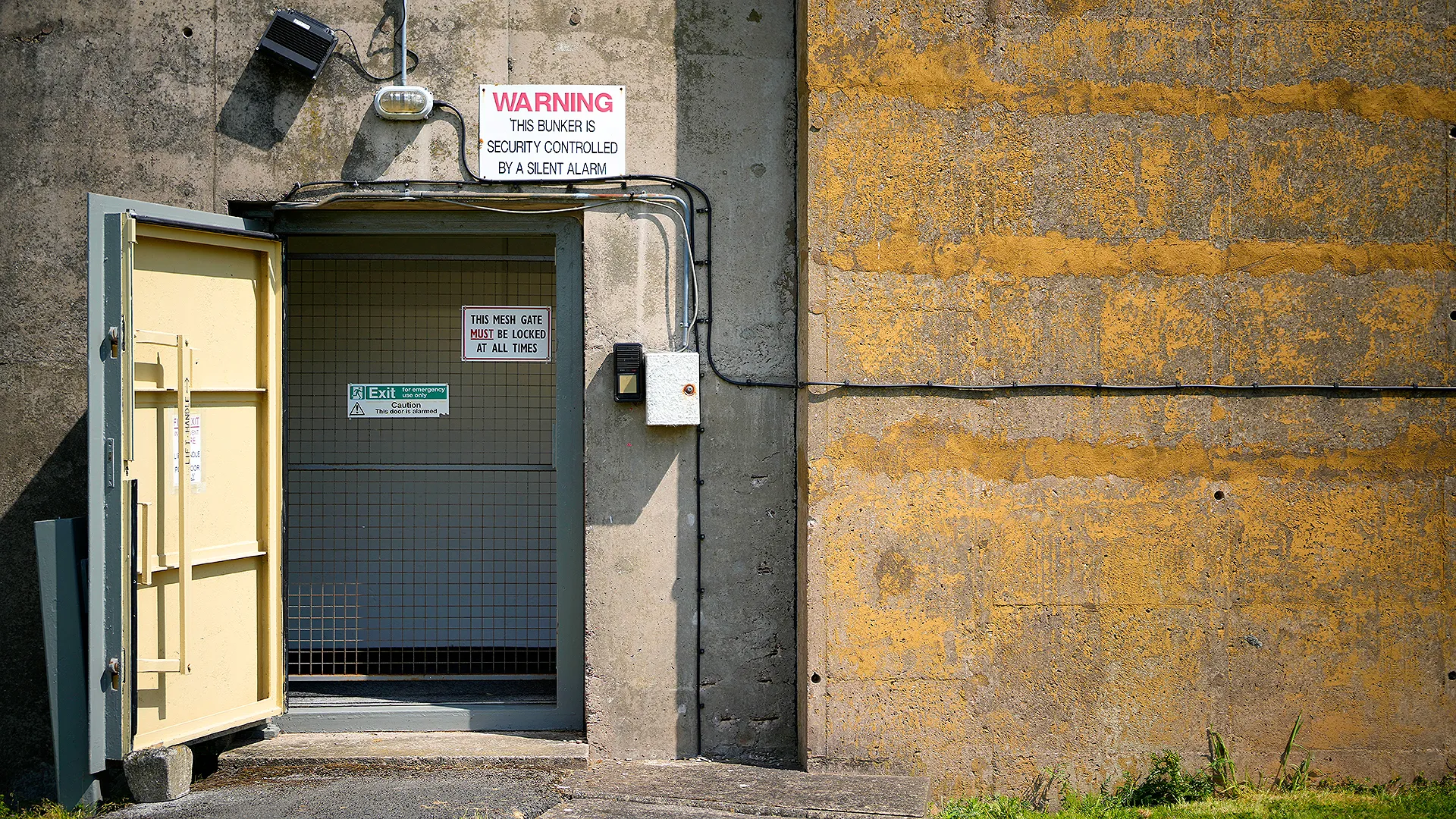
NANTWICH, ENGLAND – MAY 24: A general view outside of the former RAF Hack Green secret nuclear bunker on May 24, 2023 in Nantwich, England. Hack Green played a central role in the defence of Britain for almost sixty years. It was chosen during WW2 to protect the land between Birmingham and Liverpool from hostile attack and as a location for the new RADAR equipment. The bunker went on to be used for shelter and protection during the Cold War. As relations between East and West thawed many of the UK’s nuclear bunkers were sold off. The Secret Bunker is now privately owned by the Siebert family and is run as a museum trust. (Photo by Christopher Furlong/Getty Images)
Also, a reminder:
Prime Directives!
If you want to talk politics, do so respectfully and know that there’s always somebody that isn’t going to agree with you.
If you have political differences, hash it out respectfully, stick to the facts, and no childish name-calling or personal attacks of any kind. If you can’t handle yourself in that manner, then please, discuss virtually anything else.
No drive-by garbage political memes. No conspiracy theory rants. Links to crackpot sites will be axed, too. Trolling and shitposting will not be tolerated. No obsessive behavior about other users. Just don’t interact with folks you don’t like.
Do not be a sucker and feed trolls! That’s as much on you as on them. Use the mute button if you don’t like what you see.
So unless you have something of quality to say, know how to treat people with respect, understand that everyone isn’t going to subscribe to your exact same worldview, and have come to terms with the reality that there is no perfect solution when it comes to moderation of a community like this, it’s probably best to just move on.
Finally, as always, report offenders, please. This doesn’t mean reporting people who don’t share your political views, but we really need your help in this regard.
An array of political parties and alliances will be vying for seats in the Bangladesh Parliament on February 12 in the country’s first election since the ousting of former Prime Minister Sheikh Hasina in 2024. About 127 million registered voters are eligible to cast votes to elect 350 members of the Jatiya Sangsad, the country’s parliament.
The South Asian country has been in the hands of a caretaker government led by Nobel laureate Muhammad Yunus since August 2024, when a student-led uprising ended Hasina’s long rule. Hasina ordered troops to crack down on protesters, killing 1,400 people. She has since been sentenced to death by a special tribunal in Bangladesh for the brutal crackdown, but remains in exile in India, and her Awami League party has been banned from political activity.
Recommended Stories
list of 3 itemsend of list
Besides the election on February 12, Bangladesh will also hold a referendum on the July National Charter 2025 – a document drafted following the student protests, setting the foundation for future governance of the country.
The two biggest groups competing for parliamentary seats across the country’s 300 constituencies are the Bangladesh Nationalist Party (BNP), which is leading a coalition of 10 parties, and Jamaat-e-Islami (JIB), which heads an 11-party alliance, including the National Citizen Party, a group formed by students who led the anti-Hasina movement in 2024. The Awami League, which dominated Bangladeshi politics for decades, has been barred from fielding candidates.
Besides the two main blocs, the Islami Andolan Bangladesh, which broke away from the JIB-led alliance, and the Jatiya Party, a longtime ally of Hasina’s Awami League, are contesting independently.
Here is a look at the main political parties and their leaders vying for parliament seats this year, and the key players influencing the election.
Bangladesh Nationalist Party
Led by Tarique Rahman, the son of the late former Prime Minister Khaleda Zia, the BNP is seen as one of the main contenders in the upcoming elections.
The party was founded in 1978 by Ziaur Rahman, Tarique’s father and one of the leading military figures of the country’s independence war against Pakistan in 1971, on the principles of Bangladeshi nationalism. According to the BNP website, this is an “ideology that recognises the right of Bangladeshis from all walks of life, irrespective of their ethnicity, gender or race”.
As a centre-right political party, the BNP has been a popular political force in the country for decades and has traditionally exchanged power with the Awami League.
For four decades after Ziaur Rahman’s assassination in 1981, his wife and Tarique’s father, Khaleda Zia, led the party. Khaleda served as the country’s first female prime minister from 1991 to 1996 and again from 2001 to 2006. In that period, Jamaat was an ally of the BNP as they together fought against Hasina’s Awami League.
After Hasina came back to power in 2009 – she had also ruled between 1996 and 2001 – the BNP faced the wrath of her government over corruption charges, and Khaleda was put under house arrest in 2018 in two related cases. She was acquitted of all charges after Hasina’s departure in 2024.
Since Hasina’s ousting in 2024, the BNP has risen again as a political frontrunner. A December survey by the United States-based International Republican Institute indicated the BNP had the support of 33 percent of respondents. That was also the only month when the BNP — seeking to position itself as a liberal force ahead of the elections — broke its alliance with Jamaat. Polls show Jamaat just marginally behind the BNP in popular support.
Tarique, 60, had been living in London, United Kingdom, since he fled Bangladesh in 2008 over what he called politically motivated persecution. He arrived in Dhaka on December 25, 2025 to take over the BNP leadership ahead of his mother Khaleda’s death on December 30.
“We will build a Bangladesh that a mother dreams of,” he said in December after returning to the country and calling on citizens from the hills and plains – Muslims, Hindus, Buddhists and Christians – to join him in creating a secure and inclusive nation.
In election rallies, he has pledged to improve the country’s infrastructure, among other promises.
“If elected, the healthcare system will be improved, a flyover will be constructed in Sherpur, permanent embankments will be built in the river erosion areas of Dhunat, and the youth will be made self-reliant through the establishment of IT education institutions,” he said.
According to Khandakar Tahmid Rejwan, lecturer in global studies and governance at the Independent University, Bangladesh, since Rahman’s return, the BNP has become more organised.
“The party has basically revived with a newfound spirit in both its central and grassroots-level leadership,” he said.
“Typical objections against BNP and affiliated party activists, like [allegations of] extortion … have also significantly declined. Top leaders of the central committee have also been comparatively cautious to avoid any statement that might create popular outrage. Significantly, the people are flocking in thousands to hear from Rahman at his electoral rally, even late at midnight,” he said.
Rejwan added that it is widely believed that Rahman is the only man who can currently unite Bangladesh with an “inclusive vision”, unlike his Jamaat rivals, who have failed to address any clear stance or acknowledge what are seen by many as their restrictive policies towards women and religious minorities.
Jamaat-e-Islami
The party was founded in 1941 by Sayyid Abul Ala Maududi during British rule in India.
In 1971, during Bangladesh’s war of independence, Jamaat supported staying with Pakistan, and was banned after the country won its freedom.
But in 1979, four years after the assassination of Sheikh Mujibur Rahman, who had fought for Bangladesh’s independence and is seen by many as the country’s founding father, BNP founder Ziaur Rahman, who was the country’s president at the time, lifted the ban. Ziaur Rahman was also assassinated in 1981.
Over the next two decades, Jamaat developed into a significant political force. It supported the BNP-led coalition in 1991 and 2001.
But while Hasina was in power from 2009 until she was toppled in student-led protests in 2024 and fled to India, five top Jamaat leaders were executed, while others were jailed for crimes committed during the independence war of 1971. The party was barred in 2013 from running in elections.
In June 2025, the country’s Supreme Court restored the party’s registration, paving the way for its participation in elections.
While Jamaat no longer has an alliance with the BNP, its current leader, 67-year-old Shafiqur Rahman, has also focused on reorganising the party into a strong contender in the election.
Speaking at an election rally in Jamalpur city on Sunday, Shafiqur Rahman said the upcoming election “will be a turning point”.
“It is an election to end the cries of the families of martyrs. It is an election to bury the rotten politics of the past,” he said, according to The Daily Star newspaper.
But his party’s resurgence has also prompted debate over whether Bangladesh is prepared to be led by an Islamist force, which some fear could seek to enforce Islamic law or try to restrict women’s rights and freedoms.
However, Jamaat has rejected such fears and has told reporters it is focusing on expanding its electoral power. Last December, the party announced an alliance with the National Citizen Party, founded by 2024 leaders of the student-led uprising, and with the Liberal Democratic Party, led by 1971 war hero Oli Ahmad.
For the first time in its history, Jamaat is also fielding a Hindu candidate, Krishna Nandi, from Khulna, in a bid to attract non-Muslim voters.
The International Republican Institute survey suggested the Jamaat-led alliance at number two, with 29 percent, closely behind the BNP.
According to Independent University’s Rejwan, Jamaat has an appeal across Bangladesh’s social classes.
“Its student wing has literally outperformed any other political rivals in the university union elections. We are also seeing the Jamaat-affiliated women’s wing reaching out door-to-door in both rural and urban areas to expand their women’s base of voters. Moreover, since the fall of Hasina, we are seeing pro-Jamaat active and retired elites from security forces, university academics, and civil services constantly pushing the pro-Jamaat narratives within their respective capacities,” he said.
“Jamaat’s upper hand and pragmatic postures are now being extended to its allies, like NCP, which is explicitly reaping all the benefits of its senior partner in the alliance,” he added.
National Citizens Party (NCP)
The NCP, one of Jamaat’s allies, was formed in February 2025 by students who led the mass protests in July 2024 over government job quotas, which ultimately toppled Hasina’s government.
Seeking to stand for the 2026 elections, the leaders told a rally in February 2025 that they had formed the party “to uphold the spirit of the July movement among students”.
Led by Nahid Islam, 27, the stated ideals of the NCP are to ensure “governance without corruption” and to unite the country. The party says it aims to uphold freedom of the press, increase women’s representation in parliament and improve Bangladesh’s relations with neighbouring countries, such as India.
But lacking adequate funds to run by itself in an election, the party has allied with Jamaat. However, the move has been received poorly by some in Bangladesh. It also triggered some resignations by some NCP members over ideological differences.
According to local media reports, those members submitted a memorandum stating that Jamaat’s controversial political history and historical views against Bangladesh’s independence in 1971 were contrary to the NCP’s values.
In an interview with ABC News last month, Nahid Islam defended the decision to unite with Jamaat and said, “When we are forming an electoral alliance, we are not abandoning our own political beliefs. It’s just a strategic alliance.”
“It’s unfortunate to see the leader of the political party that arguably claims to own and lead the 2024 mass uprising and depose Hasina, now become a junior partner to a major political party,” Rejwan said.
“As a result, we see defections of many top leaders of NCP, and astonishingly, by allying, it was only able to bargain for 30 seats for its own candidate. To sum up, Nahid has sold his political autonomy and image of an exclusive figure by de facto becoming subservient to Jamaat,” he added.
Who are the other key players in the election?
Besides the main political parties, Muhammad Yunus, who currently leads the interim government, and General Waker-Uz-Zaman, the army chief, are also influential figures in this election.
Yunus, who was selected to run the government after Hasina’s ousting, is facilitating the election in his capacity as the country’s chief adviser.
But while political parties are campaigning for the election, Yunus is focusing on the referendum on the July Charter, which will take place on the same day.
After Hasina’s ousting, Yunus formed the Constitution Reform Commission (CRC) in 2025, seeking to amend the governance of the country. The commission proposed an anticorruption mechanism, electoral reforms and new rules the police must follow, among other issues. The July Charter is the culmination of the CRC’s work and takes its name from the protests which dismantled Hasina’s government in July 2024. Bangladeshis will vote to approve or reject it in the referendum.
Last month, Yunus expressed confidence in the results of the referendum and told the media he expected people and political parties to agree to the charter. But some critics have said holding the referendum and establishing the charter is not constitutional.
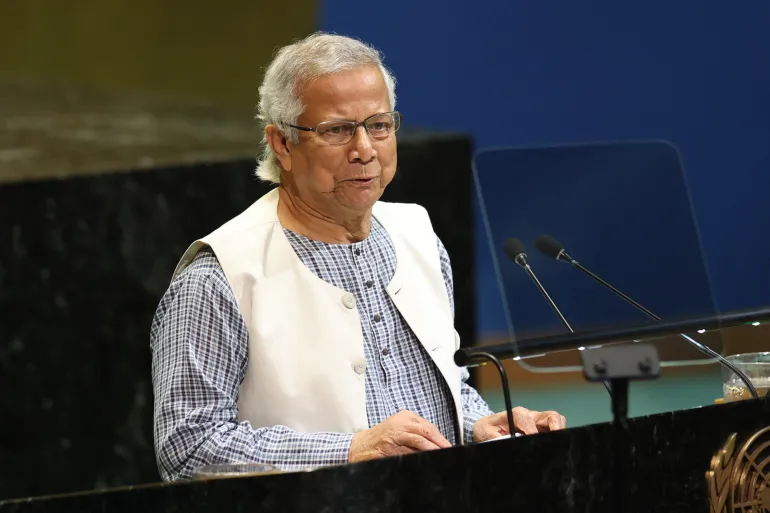
Muhammad Yunus addresses the United Nations General Assembly in New York, US [File: AFP]
General Zaman is also a key player in the election.
Following the 1975 assassination of Sheikh Mujibur Rahman, Bangladesh’s founding leader and then-president, the country entered a period marked by coups, countercoups and military rule, which reshaped the state.
Currently, the army is not vying for electoral power, but its focus will be on ensuring public order and security during the election, in light of political violence that has spread in the country since the upheaval of 2024.
The military also plays a role with respect to backing the political party in power or deciding how to govern the country during a political crisis.
In September 2024, after the protests against Hasina, Zaman told the Reuters news agency that he would back Yunus’s interim government “come what may”, while also floating a timeline for elections within 18 months, placing him central to the political debate.
A successful election will require goodwill from both Yunus and the army chief, according to Rejwan.
“Executives under the leadership of Yunus are critical to ensure the nationwide voting, while the Chief of Army Staff Waker’s forces, which would be deployed throughout the country, are indispensable to maintain public order and prevent the proliferation of political instability, violence and chaos,” he said.
General Waker-uz-Zaman gestures during an interview with Reuters at his office in the Bangladesh army headquarters in Dhaka [File: Mohammad Ponir Hossain/Reuters]
Does Hasina have any power at all?
Hasina, who is currently in exile in India, has denounced the upcoming elections since her party, the Awami League, has not been allowed to take part. However, those who voted for her in the past must now choose how to vote this time.
In a message sent to the media last month, Hasina stated that “a government born of exclusion cannot unite a divided nation”.
“Each time political participation is denied to a significant portion of the population, it deepens resentment, delegitimises institutions and creates the conditions for future instability,” the former leader warned in an email to The Associated Press news agency.
Bangladesh’s Ministry of Foreign Affairs said it was “surprised and shocked” that Hasina had been allowed to make a public address in India. Her speeches and statements are banned from the media in Bangladesh.
“Allowing the event to take place in the Indian capital and letting mass murderer Hasina openly deliver her hate speech … constitute a clear affront to the people and the Government of Bangladesh,” the ministry said in a statement.
Hasina was sentenced to death in absentia by a tribunal in Bangladesh last November, and Dhaka has called on New Delhi to extradite her.
But she remains in India, and Rejwan says she will be a key political instigator of unrest as the elections approach.
“If Hasina were a negligible figure, then the interim government wouldn’t have banned all of her speeches and statements from being aired on television or printed in newspapers … the interim government would also not have reacted so firmly against India for allowing her to speak,” he noted.
“This means Hasina is a factor that the interim government implicitly believes has an influence over the Awami League populace, who are yet undecided on whom to cast their vote for, given that AL is banned from the polls,” he said.
“The reality is that AL has its own clear political ideology and a base of loyal cadres, many of whom have declined to change their allegiance despite living a harsh clandestine life in Bangladesh or abroad,” he added.
Harassment claims were made against the peer in 2013, but in 2014 a barrister appointed by the party to investigate the allegations concluded that whilst the accounts of the four women were “broadly credible,” they could not be proved beyond reasonable doubt.