Deadly protests followed the 92-year-old president’s re-election, which opponents have called ‘fraudulent’.
Published On 6 Nov 20256 Nov 2025
Share
Cameroon’s longtime leader, Paul Biya, has been sworn in for a new seven-year term following his victory in last month’s presidential election, which his opposition rival has described as “a constitutional coup”.
Addressing Parliament on Thursday, the world’s oldest president promised to stay faithful to the confidence of the Cameroonian people and pledged to work for a “united, stable and prosperous” country.
Recommended Stories
list of 3 itemsend of list
There were deadly protests in several parts of Cameroon days after the October 19 vote, followed by a three-day lockdown this week after former minister and key contender Issa Tchiroma claimed victory and alleged vote tampering.
The government has confirmed that at least five people were killed during the protests, although the opposition and civil society groups claim the figures are much higher.
The incumbent, Africa’s second-longest serving leader, took the oath of office during a session of Parliament in what residents describe as the heavily militarised and partially deserted capital, Yaounde.
Priscilla Ayimboh, a 40-year-old seamstress in Yaounde, does not see a new term for Biya as likely to change anything.
“I’m tired of Biya’s rule and I no longer care whatever he does. It’s a pity. I wonder what will become of Cameroon in the next seven years: there are no roads, water, and jobs,” she said.
Munjah Vitalis Fagha, a senior politics lecturer at Cameroon’s University of Buea, told The Associated Press news agency that Biya’s inauguration was “taking place in a tense yet controlled political atmosphere, marked by deep divisions between the ruling elite and a growingly disillusioned populace”.
Fagha added: “The ceremony occurs amid calls for political renewal, ongoing security challenges in the Anglophone regions, and widespread concerns over governance and succession.”
President Paul Biya’s campaign posters are visible in Anglophone [File: Beng Emmanuel Kum/Al Jazeera]
Cameroon’s top court on October 27 declared Biya the winner of the election, with 53.66 percent of the vote, ahead of his ally-turned-challenger, Tchiroma, who secured 35.19 percent.
Tchiroma insists Biya was awarded a “fraudulent” victory in the election.
“The will of the Cameroonian people was trampled that day, our sovereignty stolen in broad daylight,” Tchiroma wrote on Wednesday night. “This is not democracy, it is electoral theft, a constitutional coup as blatant as it is shameful.”
Biya came to power in 1982 following the resignation of Cameroon’s first president and has ruled since, following a 2008 constitutional amendment that abolished term limits. His health has been a topic of speculation as he spends most of his time in Europe, leaving governance to key party officials and family members.
He has led Cameroon longer than most of its citizens have been alive – more than 70 percent of the country’s almost 30 million population is below the age of 35. If he serves his entire term, Biya will leave office nearly 100 years old.
The results of his nearly half-century in power have been mixed; armed rebellions in the north and the west of the country, along with a stagnant economy, have left many young people disillusioned with the leader.
Fault Lines investigates the killings of Palestinians seeking aid at GHF sites in Gaza.
After months of blockade and starvation in Gaza, Israel allowed a new United States venture – the Gaza Humanitarian Foundation (GHF) – to distribute food. Branded as a lifeline, its sites quickly became known by Palestinians and dozens of human rights groups as “death traps”.
Fault Lines investigates how civilians seeking aid were funnelled through militarised zones, where thousands were killed or injured under fire.
Through the testimonies of grieving families, a former contractor, and human rights experts, the film exposes how GHF’s operations replaced UNRWA’s proven aid system with a scheme critics say was designed for displacement, not relief. At the heart of this investigation is a haunting question: was GHF delivering humanitarian aid – or helping turn breadlines into killing fields?
England squad: AJ Brimson, Joe Burgess, Daryl Clark, Herbie Farnworth, Tom Johnstone, Mikey Lewis, Harry Newman, Mikolaj Oledzi, George Williams (capt), Harry Smith, Mike McMeeken, Jez Litten, Matty Lees, Kai Pearce-Paul, Kallum Watkins, Morgan Knowles, Owen Trout, Alex Walmsley, Morgan Smithies.
Australia XIII: Reece Walsh, Mark Nawaqanitawase, Kotoni Staggs, Gehamat Shibasaki, Josh Addo-Carr, Cameron Munster, Nathan Cleary, Patrick Carrigan, Harry Grant, Tino Fa’asuamaleaui, Angus Crichton, Hudson Young, Isaah Yeo (captain).
Interchanges: Tom Dearden, Lindsay Collins, Reuben Cotter, Keaon Koloamatangi.
Obidah Habila Albert, an alumnus of the third cohort of HumAngle’s Accountability Fellowship, is among the 15 Nigerian journalists selected for the Digital Public Infrastructure Journalism (DPIJ) Fellowship, which will run from October 2025 to April 2026.
After receiving over 200 applications, 45 candidates were shortlisted, and 15 finalists emerged from 14 media organisations, including The Guardian Newspaper, Premium Times, Foundation for Investigative Journalism, and TheCable.
Organised by the Ghana-based Media Foundation for West Africa (MFWA) in partnership with Co-Develop, the fellowship is a flagship initiative that aims to strengthen public awareness and participation through journalism, promoting the adoption of Digital Public Infrastructures (DPIs) and Digital Public Goods and Services (DPGS).
Obidah, who is excited about his selection, said he applied for the opportunity because it aligns with his curiosity about technology’s impact on everyday life and how their stories could be more effectively documented.
“By the end of the programme, I want to understand DPI and DPGs better and tell stories about them. I hope my stories will drive conversations and help more people and policymakers in Nigeria and beyond to pay attention and take action,” he said.
During his fellowship with HumAngle, Obidah reported extensively on conflict and peacebuilding efforts in Nigeria’s North East, as well as the rising cost-of-living crisis affecting vulnerable communities. His experience, he said, deepened his commitment to reporting stories that highlight the human dimensions of development and policy issues.
According to Sulemana Braimah, Executive Director of MFWA, the DPIJ Fellowship is a strategic investment in shaping informed media narratives around inclusive design, implementation, and the uptake of DPI development in areas such as policy, governance, and utility.
The selected fellows and their newsrooms will receive grants to support reporting projects, as well as editorial mentorship, training, and access to resources on DPIs and DPGS. Each fellow is expected to produce at least six original stories before the end of the fellowship on issues relating to inclusive digital identification, digital payments, data exchange, and other digital safety issues. Fellows will also join a growing network of alumni across West Africa.
Last year, HumAngle’s Investigations Editor, Ibrahim Adeyemi, was selected for the West Africa cohort of the same fellowship, where he produced several stories exploring the intersection of DPIs and national security.
Obidah Habila Albert, a journalist and alumnus of HumAngle’s Accountability Fellowship, has been selected as one of 15 Nigerian journalists for the Digital Public Infrastructure Journalism (DPIJ) Fellowship from October 2025 to April 2026. The fellowship, organized by the Media Foundation for West Africa in partnership with Co-Develop, aims to enhance public awareness and engagement through journalism, focusing on Digital Public Infrastructures and Digital Public Goods and Services.
Obidah expressed enthusiasm for learning and documenting technology’s impact on everyday life. Throughout the fellowship, fellows will receive grants, mentorship, and resources to produce at least six original stories on digital issues, joining a network of West African alumni. The initiative also supports inclusive approaches in policy and governance, as highlighted by previous fellow Ibrahim Adeyemi, who explored DPIs and national security.
Weekly insights and analysis on the latest developments in military technology, strategy, and foreign policy.
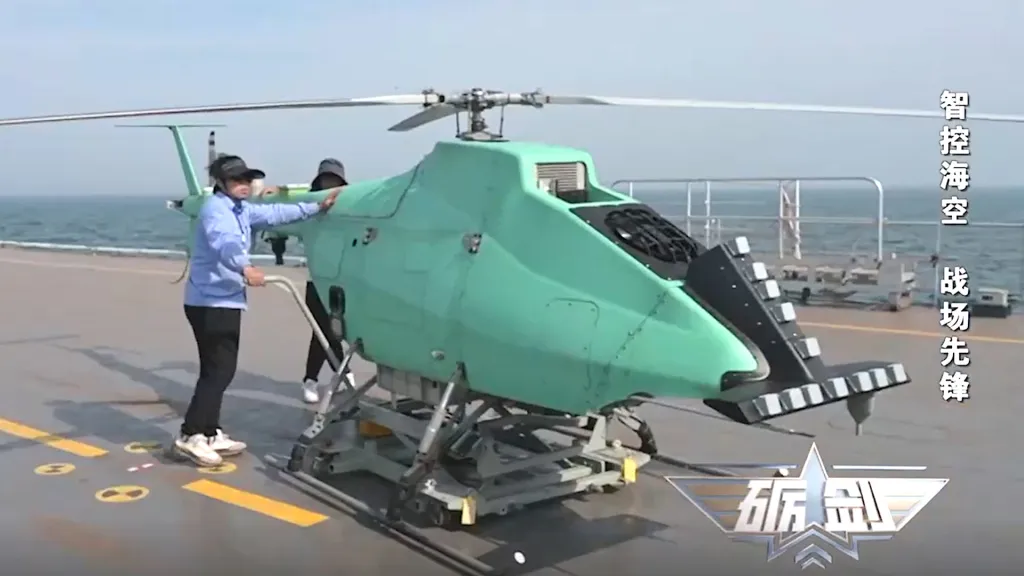
We appear to have gotten our first look at a curious Chinese ship, which some have dubbed a ‘drone carrier,’ actually in use, supporting at-sea testing of the AR-500CJ uncrewed helicopter. The vessel is one of a number of unusual designs with open flight decks that have emerged in China in recent years as China’s drone ambitions have increasingly extended into the naval domain.
China’s state-run television station CCTV-7, which focuses on news related to the People’s Liberation Army (PLA), broadcast clips of the AR-500CJ being tested at sea back on October 30. The AR-500CJ, a version of the Aviation Industry Corporation of China’s (AVIC) larger AR-500 family optimized for shipboard operations, first flew in 2022.
A screen capture from the CCTV-7 segment showing the AR-500CJ drone helicopter being moved around the deck of the ship during at-sea testing. CCTV-7 capture
The CCTV-7 segment does not appear to name the ship the AR-500CJ is seen operating from, nor does it offer a full view of the vessel. However, the size and configuration of the flight deck, especially a trapezoidal section on the starboard side toward the stern, as well as its markings, match up directly with the design of a ship that was launched at the Jiangsu Dayang Marine shipyard back in 2022. Naval Newswas first to report in detail on that vessel, which is approximately 328 feet (100 meters) long and some 82 feet (25 meters) across, and has a small island on the starboard side toward the bow, last year.
A screen grab from the CCTV-7 segment offering a wide view of the ship’s deck, including the trapezoidal section on the starboard (right) side. CCTV-7The ‘mini drone carrier’ as seen from above in this satellite image of the Jiangsu Dayang Marine shipyard taken in August 2024. Google Earth
It had been suggested that the ship seen in the CCTV-7 footage might be a mysterious Chinese vessel with a large open flight deck and three superstructures that TWZ was first to report on last year. That ship bears the logo of the state-run China State Shipbuilding Corporation (CSSC) and may be named the Zhong Chuan Zi Hao, and could also be a first-of-its-kind ostensibly civilian research ship, as you can read more about here. However, the CSSC ‘carrier’ has a much larger and differently shaped flight deck that also has very distinct markings on it.
A side-by-side comparison of the deck of the ship as seen in the CCTV-7 segment, at left, and the stern end of the still-mysterious big-deck ship with the CSSC logo seen in an image that emerged on social media in August, at right. Note the distinct differences in the color and position of the markings, as well as the general configuration of the decks. CCTV-7 capture/Chinese internet
The CSSC aviation platform remains tied up at the cruise ship terminal in Guangzhou, where the vessel was docked in early June. Via “by78″/SDF. pic.twitter.com/z8eSd4lZT9
As mentioned, a number of unusual open-decked vessels have emerged in China in recent years. Jiangsu Dayang Marine, also known as the New Dayang shipyard, has become particularly notable in this regard. The yard has also produced at least two catamaran drone ‘motherships,’ which TWZ was also first to report on in detail, as well as various specialized barges. These all largely appear to be intended for use in training and/or testing, and to be particularly focused on replicating drone and/or electronic warfare threats. The first known imagery of one of the catamaran motherships in use also notably came from a CCTV-7 segment in 2022.
A broader look at the Jiangsu Dayang Marine yard in August 2024, showing the two catamaran ‘drone motherships,’ as well as barges, together with the ‘mini drone carrier.’ Google Earth
As TWZhas noted in the past, the maritime platforms that Jiangsu Dayang Marine has produced could potentially have roles in an actual operational context, including when paired with larger crewed warships. At the same time, the relatively small size and general configuration of the ‘mini drone carrier’ would limit its suitability for any kind of sustained employment in support of real-world operations.
An image from the ground of the reported Chinese experimental drone platform. If accurate, it illustrates the relatively modest proportions of the design. Via “斯文的土匪—”/Wb (H/t Temstar/SDF). pic.twitter.com/LAFHRqaGfK
Even without a secondary operational role, dedicated naval drone test and training platforms still offer value to the PLA, which has been steadily working to expand the scale and scope of its shipboard uncrewed aviation capabilities. AR-500CJ, which AVIC has said could be used as a surveillance asset or an aerial signal relay node, among other roles, is part of this evolving ecosystem. Another drone helicopter intended for shipboard operations, based on the larger AR-2000 design from China National Aero-Technology Import & Export Corporation (CATIC), was among a host of new uncrewed aircraft designs showcased at a huge military parade in Beijing in September.
Navalized drone helicopters based on the AR-2000 design on parade in Beijing in September. Chinese internet
Chinese naval drone developments extend well beyond vertical takeoff and landing capable designs. Work on a navalized version of the stealthy flying-wing GJ-11 Sharp Sword uncrewed combat air vehicle (UCAV) has become a particular centerpiece of these efforts. Imagery just recently emerged that offered the first clear look at one of those drones with its arrestor hook deployed. The naval GJ-11, also sometimes referred to as the GJ-21, is expected to fly from at least some of China’s growing fleet of aircraft carriers and big-deck amphibious assault ships.
As it seems, for the first time clear images of a GJ-21 in flight are posted and this one – based on the still installed pitots – has its tail hook down. pic.twitter.com/5h1nVZHzIe
With all this in mind, China’s use of bespoke ships with open flight decks to support drone testing and training, as well as other purposes, only looks likely to grow.
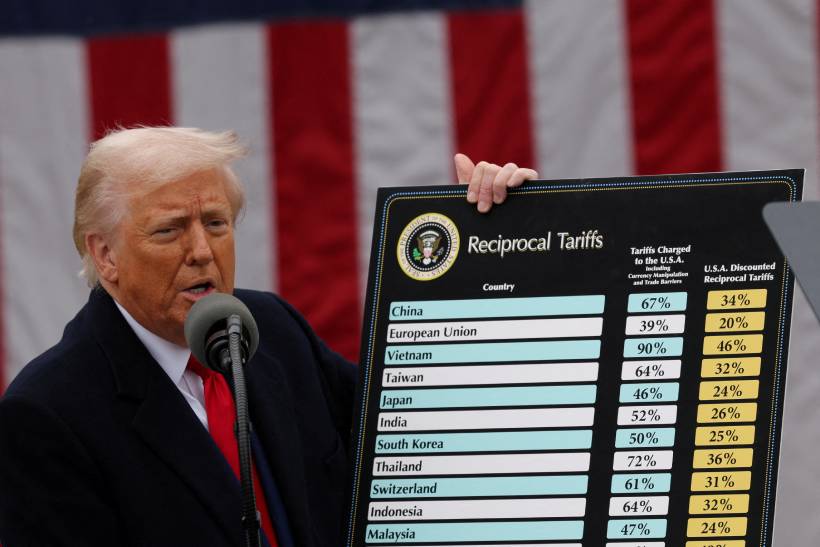
The U.S. Supreme Court’s skeptical questioning of former President Donald Trump’s global tariffs has fueled speculation that his trade measures may be struck down, potentially upending the already fragile trade landscape.
The case centers on Trump’s use of the 1977 International Emergency Economic Powers Act (IEEPA) to impose sweeping tariffs on imports. The law grants presidents broad authority to regulate trade during national emergencies but makes no mention of tariffs, raising constitutional questions about the limits of executive power.
During oral arguments on Wednesday, justices across the ideological spectrum except Samuel Alito and Clarence Thomas appeared doubtful that Trump had legal authority to levy such blanket global tariffs.
Trade experts now warn that if the court invalidates Trump’s tariff policy, it could trigger a new wave of economic uncertainty, as the administration is expected to pivot quickly to other trade laws to reimpose duties.
Why It Matters
The outcome of this case could reshape U.S. trade policy for years. Businesses have paid over $100 billion in IEEPA-related tariffs since 2025, and a ruling against Trump could open a complex refund battle or force the White House to seek alternative legal pathways for its protectionist agenda.
Corporate leaders, already weary of erratic trade shifts, say a ruling either way offers little stability. “Even if it goes against IEEPA, the uncertainty still continues,” said David Young of the Conference Board, who briefed dozens of CEOs after the hearing.
Trump Administration: Faces potential legal defeat but can pivot to Section 232 (Trade Expansion Act of 1962) or Section 122 (Trade Act of 1974), both of which allow temporary or national security-based tariffs.
U.S. Supreme Court: Balancing presidential powers with statutory limits on trade actions.
Businesses & Importers: Risk being caught in regulatory limbo over refunds and future duties.
Federal Reserve: Monitoring potential economic fallout from prolonged trade instability.
Refunds Could Get “Messy”
Justice Amy Coney Barrett raised concerns about how refund claims would be handled if the tariffs are ruled illegal, calling it “a mess” for courts to manage. Lawyer Neal Katyal, representing five small businesses challenging the tariffs, said only those firms would automatically receive refunds, while others must file administrative protests a process that could take up to a year.
Customs lawyer Joseph Spraragen added that if the court orders refunds, the Customs and Border Protection’s automated system could process them, but he warned, “The administration is not going to be eager to just roll over and give refunds.”
Economic and Policy Repercussions
Analysts expect the administration to rely on alternative statutes if IEEPA tariffs are overturned. However, implementing new duties under those laws could be slow and bureaucratic, potentially delaying trade certainty until 2026.
Natixis economist Christopher Hodge said such a ruling would be only a “temporary setback” for Trump’s trade agenda, predicting renewed tariff rounds or trade negotiations in the coming year.
Meanwhile, Federal Reserve Governor Stephen Miran warned the uncertainty could act as a drag on economic growth, though it might also prompt looser monetary policy if trade instability dampens business confidence.
What’s Next
A Supreme Court ruling is expected in early 2026, leaving companies in limbo over the future of U.S. tariff policy. If Trump’s powers under IEEPA are curtailed, analysts expect a new wave of trade maneuvers potentially invoking national security provisions to maintain his “America First” economic approach, prolonging the climate of global trade unpredictability.
A months-long siege on the Malian capital, Bamako, by the armed al-Qaeda affiliate group, Jama’at Nusrat al-Islam wal-Muslimin (JNIM), has brought the city to breaking point, causing desperation among residents and, according to analysts, placing increasing pressure on the military government to negotiate with the group – something it has refused to do before now.
JNIM’s members have created an effective economic and fuel blockade by sealing off major highways used by tankers to transport fuel from neighbouring Senegal and the Ivory Coast to the landlocked Sahel country since September.
Recommended Stories
list of 4 itemsend of list
While JNIM has long laid siege to towns in other parts of the country, this is the first time it has used the tactic on the capital city.
The scale of the blockade, and the immense effect it has had on the city, is a sign of JNIM’s growing hold over Mali and a step towards the group’s stated aim of government change in Mali, Beverly Ochieng, Sahel analyst with intelligence firm Control Risks, told Al Jazeera.
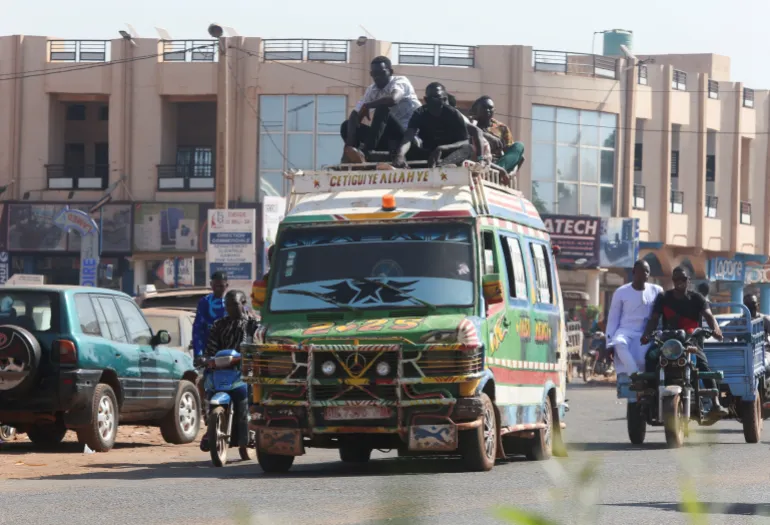
For weeks, most of Bamako’s residents have been unable to buy any fuel for cars or motorcycles as supplies have dried up, bringing the normally bustling capital to a standstill. Many have had to wait in long fuel queues. Last week, the United States and the United Kingdom both advised their citizens to leave Mali and evacuated non-essential diplomatic staff.
Other Western nations have also advised their citizens to leave the country. Schools across Mali have closed and will remain shut until November 9 as staff struggle to commute. Power cuts have intensified.
Here’s what we know about the armed group responsible and why it appears to have Mali in a chokehold:
People ride on top of a minibus, a form of public transport, amid ongoing fuel shortages caused by a blockade imposed by al Qaeda-linked fighters in early September, in Bamako, Mali, on October 31, 2025 [Reuters]
What is JNIM?
JNIM is the Sahel affiliate of al-Qaeda and the most active armed group in the region, according to conflict monitor ACLED. The group was formed in 2017 as a merger between groups that were formerly active against French and Malian forces that were first deployed during an armed rebellion in northern Mali in 2012. They include Algeria-based al-Qaeda in the Maghreb (AQIM) and three Malian armed groups – Ansar Dine, Al-Murabitun and Katiba Macina.
JNIM’s main aim is to capture and control territory and to expel Western influences in its region of control. Some analysts suggest that JNIM may be seeking to control major capitals and, ultimately, to govern the country as a whole.
It is unclear how many fighters the group has. The Washington Post has reported estimates of about 6,000, citing regional and western officials.
However, Ulf Laessing, Sahel analyst at the German think tank, Konrad Adenauer Stiftung (KAS), said JNIM most likely does not yet have the military capacity to capture large, urban territories that are well protected by soldiers. He also said the group would struggle to appeal to urban populations who may not hold the same grievances against the government as some rural communities.
While JNIM’s primary base is Mali, KAS revealed in a report that the group has Algerian roots via its members of the Algeria-based al-Qaeda in the Maghreb (AQIM).
The group is led by Iyad Ag-Ghali, a Malian and ethnic Tuareg from Mali’s northern Kidal region who founded Ansar Dine in 2012. That group’s stated aim was to impose its interpretation of Islamic law across Mali.
Ghali had previously led Tuareg uprisings against the Malian government, which is traditionally dominated by the majority Bambara ethnic group, in the early 1990s, demanding the creation of a sovereign country called Azawad.
However, he reformed his image by acting as a negotiator between the government and the rebels. In 2008, he was posted as a Malian diplomat to Saudi Arabia under the government of Malian President Amadou Toumani Toure. When another rebellion began in 2012, however, Ghali sought a leadership role with the rebels but was rebuffed, leading him to create Ansar Dine.
According to the US Department of National Intelligence (DNI), Ghali has stated that JNIM’s strategy is to expand its presence across West Africa and to put down government forces and rival armed groups, such as the Mali-based Islamic State Sahel, through guerrilla-style attacks and the use of improvised explosive devices (IEDs).
Simultaneously, it attempts to engage with local communities by providing them with material resources. Strict dress codes and bans on music are common in JNIM-controlled areas.
JNIM also destroys infrastructure, such as schools, communication towers and bridges, to weaken the government off the battlefield.
An overall death toll is unclear, but the group has killed thousands of people since 2017. Human rights groups accuse it of attacking civilians, especially people perceived to be assisting government forces. JNIM activity in Mali caused 207 deaths between January and April this year, according to ACLED data.
How has JNIM laid siege to Bamako?
JNIM began blocking oil tankers carrying fuel to Bamako in September.
That came after the military government in Bamako banned small-scale fuel sales in all rural areas – except at official service stations – from July 1. Usually, in these areas, traders can buy fuel in jerry cans, which they often resell later.
The move to ban this was aimed at crippling JNIM’s operations in its areas of control by limiting its supply lines and, thus, its ability to move around.
At the few places where fuel is still available in Bamako, prices soared last week by more than 400 percent, from $25 to $130 per litre ($6.25-$32.50 per gallon). Prices of transportation, food and other commodities have risen due to the crisis, and power cuts have been frequent.
Some car owners have simply abandoned their vehicles in front of petrol stations, with the military government threatening on Wednesday to impound them to ease traffic and reduce security risks.
A convoy of 300 fuel tankers reached Bamako on October 7, and another one with “dozens” of vehicles arrived on October 30, according to a government statement. Other attempts to truck in more fuel have met obstacles, however, as JNIM members ambush military-escorted convoys on highways and shoot at or kidnap soldiers and civilians.
Even as supplies in Bamako dry up, there are reports of JNIM setting fire to about 200 fuel tankers in southern and western Mali. Videos circulating on Malian social media channels show rows of oil tankers burning on a highway.
What is JNIM trying to achieve with this blockade?
Laessing of KAS said the group is probably hoping to leverage discontent with the government in the already troubled West African nation to put pressure on the military government to negotiate a power-sharing deal of sorts.
“They want to basically make people as angry as possible,” he said. “They could [be trying] to provoke protests which could bring down the current government and bring in a new one that’s more favourable towards them.”
Ochieng of Control Risks noted that, in its recent statements, JNIM has explicitly called for government change. While the previous civilian government of President Ibrahim Boubacar Keita (2013-2020) had negotiated with JNIM, the present government of Colonel Assimi Goita will likely keep up its military response, Ochieng said.
Frustration at the situation is growing in Bamako, with residents calling for the government to act.
Speaking to Al Jazeera, driver Omar Sidibe said the military leaders ought to find out the reasons for the shortage and act on them. “It’s up to the government to play a full role and take action [and] uncover the real reason for this shortage.”
Which parts of Mali is the JNIM active in?
In Mali, the group operates in rural areas of northern, central and western Mali, where there is a reduced government presence and high discontent with the authorities among local communities.
In the areas it controls, JNIM presents itself as an alternative to the government, which it calls “puppets of the West”, in order to recruit fighters from several ethnic minorities which have long held grievances over their perceived marginalisation by the government, including the Tuareg, Arab, Fulani, and Songhai groups. Researchers note the group also has some members from the majority Bambara group.
In central Mali, the group seized Lere town last November and captured the town of Farabougou in August this year. Both are small towns, but Farabougou is close to Wagadou Forest, a known hiding place of JNIM.
JNIM’s hold on major towns is weaker because of the stronger government presence in larger areas. It therefore more commonly blockades major towns or cities by destroying roads and bridges leading to them. Currently, the western cities of Nioro and gold-rich Kayes are cut off. The group is also besieging the major cities of Timbuktu and Gao, as well as Menaka and Boni towns, located in the north and northeast.
How is JNIM funded?
For revenue, the group oversees artisanal gold mines, forcefully taxes community members, smuggles weapons and kidnaps foreigners for ransom, according to the US DNI. Kayes region, whose capital, Kayes, is under siege, is a major gold hub, accounting for 80 percent of Mali’s gold production, according to conflict monitoring group Critical Threats.
The Global Initiative Against Transnational Organised Crime (Gi-Toc) also reports cattle rustling schemes, estimating that JNIM made 91,400 euros ($104,000) in livestock sales of cattle between 2017 and 2019. Cattle looted in Mali are sold cheaply in communities on the border with Ghana and the Ivory Coast, through a complex chain of intermediaries.
Heads of state of Mali’s Assimi Goita, Niger’s General Abdourahamane Tchiani and Burkina Faso’s Captain Ibrahim Traore pose for photographs during the first ordinary summit of heads of state and governments of the Alliance of Sahel States (AES) in Niamey, Niger, July 6, 2024 [Mahamadou Hamidou/Reuters]
In which other countries is JNIM active?
JNIM expanded into Burkina Faso in 2017 by linking up with Burkina-Faso-based armed group Ansarul-Islam, which pledged allegiance to the Malian group. Ansarul-Islam was formed in 2016 by Ibrahim Dicko, who had close ties with Amadou Koufa, JNIM’s deputy head since 2017.
In Burkina Faso, JNIM uses similar tactics of recruiting from marginalised ethnic groups. The country has rapidly become a JNIM hotspot, with the group operating – or holding territory – in 11 of 13 Burkina Faso regions outside of capital Ouagadougou. There were 512 reported casualties as a result of JNIM violence in the country between January and April this year. It is not known how many have died as a result of violence by the armed group in total.
Since 2022, JNIM has laid siege to the major northern Burkinabe city of Djibo, with authorities forced to airlift in supplies. In a notable attack in May 2025, JNIM fighters overran a military base in the town, killing approximately 200 soldiers. It killed a further 60 in Solle, about 48km (30 miles) west of Djibo.
In October 2025, the group temporarily took control of Sabce town, also located in the north of Burkina Faso, killing 11 police officers in the process, according to the International Crisis Group.
In a September report, Human Rights Watch said JNIM and a second armed group – Islamic State Sahel, which is linked to ISIL (ISIS) – massacred civilians in Burkina Faso between May and September, including a civilian convoy trying to transport humanitarian aid into the besieged northern town of Gorom Gorom.
Meanwhile, JNIM is also moving southwards, towards other West African nations with access to the sea. It launched an offensive on Kafolo town, in northern Ivory Coast, in 2020.
JNIM members embedded in national parks on the border regions with Burkina Faso have been launching sporadic attacks in northern Togo and the Benin Republic since 2022.
In October this year, it recorded its first attack on the Benin-Nigeria border, where one Nigerian policeman was killed. The area is not well-policed because the two countries have no established military cooperation, analyst Ochieng said.
“This area is also quite a commercially viable region; there are mining and other developments taking place there … it is likely to be one that [JNIM] will try to establish a foothold,” she added.
Why are countries struggling to fend off JNIM?
When Mali leader General Assimi Goita led soldiers to seize power in a 2020 coup, military leaders promised to defeat the armed group, as well as a host of others that had been on the rise in the country. Military leaders subsequently seizing power from civilian governments in Burkina Faso (2022) and in Niger (2023) have made the same promises.
However, Mali and its neighbours have struggled to hold JNIM at bay, with ACLED data noting the number of JNIM attacks increasing notably since 2020.
In 2022, Mali’s military government ended cooperation with 4,000-strong French forces deployed in 2013 to battle armed groups which had emerged at the time, as well as separatist Tuaregs in the north. The last group of French forces exited the country in August 2022.
Mali also terminated contracts with a 10,000-man UN peacekeeping force stationed in the country in 2023.
Bamako is now working with Russian fighters – initially 1,500 from the Wagner Mercenary Group, but since June, from the Kremlin-controlled Africa Corps – estimated to be about 1,000 in number.
Russian officials are, to a lesser extent, also present in Burkina Faso and Niger, which have formed the Alliance of Sahel States (AES) with Mali.
Results in Mali have been mixed. Wagner supported the Malian military in seizing swaths of land in the northern Kidal region from Tuareg rebels.
But the Russians also suffered ambushes. In July 2024, a contingent of Wagner and Malian troops was ambushed by rebels in Tinzaouaten, close to the Algerian border. Between 20 and 80 Russians and 25 to 40 Malians were killed, according to varying reports. Researchers noted it was Wagner’s worst defeat since it had deployed to West Africa.
In all, Wagner did not record much success in targeting armed groups like JNIM, analyst Laessing told Al Jazeera.
Alongside Malian forces, the Russians have also been accused by rights groups of committing gross human rights violations against rural communities in northern Mali perceived to be supportive of armed groups.
A person walks past cars parked on the roadside, amid ongoing fuel shortages caused by a blockade imposed by al-Qaeda-linked fighters in early September, in Bamako, Mali, October 31, 2025 [Reuters]
Could the Russian Africa Corps fighters end the siege on Bamako?
Laessing said the fuel crisis is pressuring Mali to divert military resources and personnel to protect fuel tankers, keeping them from consolidating territory won back from armed groups and further endangering the country.
He added that the crisis will be a test for Russian Africa Corp fighters, who have not proven as ready as Wagner fighters to take battle risks. A video circulating on Russian social media purports to show Africa Corps members providing air support to fuel tanker convoys. It has not been verified by Al Jazeera.
“If they can come in and allow the fuel to flow into Bamako, then the Russians will be seen as heroes,” Laessing said – at least by locals.
Laessing added that the governments of Mali and Burkina Faso, in the medium to long term, might eventually have to negotiate with JNIM to find a way to end the crisis.
While Goita’s government has not attempted to hold talks with the group in the past, in early October, it greenlit talks led by local leaders, according to conflict monitoring group Critical Threats – although it is unclear exactly how the government gave its approval.
Agreements between the group and local leaders have reportedly already been signed in several towns across Segou, Mopti and Timbuktu regions, in which the group agrees to end its siege in return for the communities agreeing to JNIM rules, taxes, and noncooperation with the military.
US Treasury accuses Pyongyang of stealing $3bn in digital assets to finance its nuclear weapons programme over three years.
Published On 6 Nov 20256 Nov 2025
Share
North Korea has denounced the latest United States sanctions targeting cybercrimes that the US says help finance its nuclear weapons programme, accusing Washington of harbouring “wicked” hostility towards Pyongyang and promising unspecified countermeasures.
The statement on Thursday by a North Korean vice foreign minister came two days after the US Department of the Treasury imposed sanctions on eight people and two firms, including North Korean bankers, for allegedly laundering money from cybercrime schemes.
Recommended Stories
list of 3 itemsend of list
The US Treasury accused North Korea of operating state-sponsored hacking schemes that have stolen more than $3bn in mostly digital assets over the past three years, an amount unmatched by any other foreign actor. The Treasury Department said the illicit funds helped finance the country’s nuclear weapons programme.
The department said North Korea relies on a network of banking representatives, financial institutions and shell companies in North Korea, China, Russia and elsewhere to launder funds obtained through IT worker fraud, cryptocurrency heists and sanctions evasion.
The sanctions were rolled out even as US President Donald Trump continues to express interest in reviving talks with North Korean leader Kim Jong Un. Their nuclear discussions during Trump’s first term collapsed in 2019 amid disagreements over trading relief from US-led sanctions on North Korea for steps to dismantle its nuclear programme.
“Now that the present US administration has clarified its stand to be hostile towards the DPRK to the last, we will also take proper measures to counter it with patience for any length of time,” the North Korean vice minister, Kim Un Chol, said in a statement.
He said US sanctions and pressure tactics will never change the “present strategic situation” between the countries or alter North Korea’s “thinking and viewpoint”.
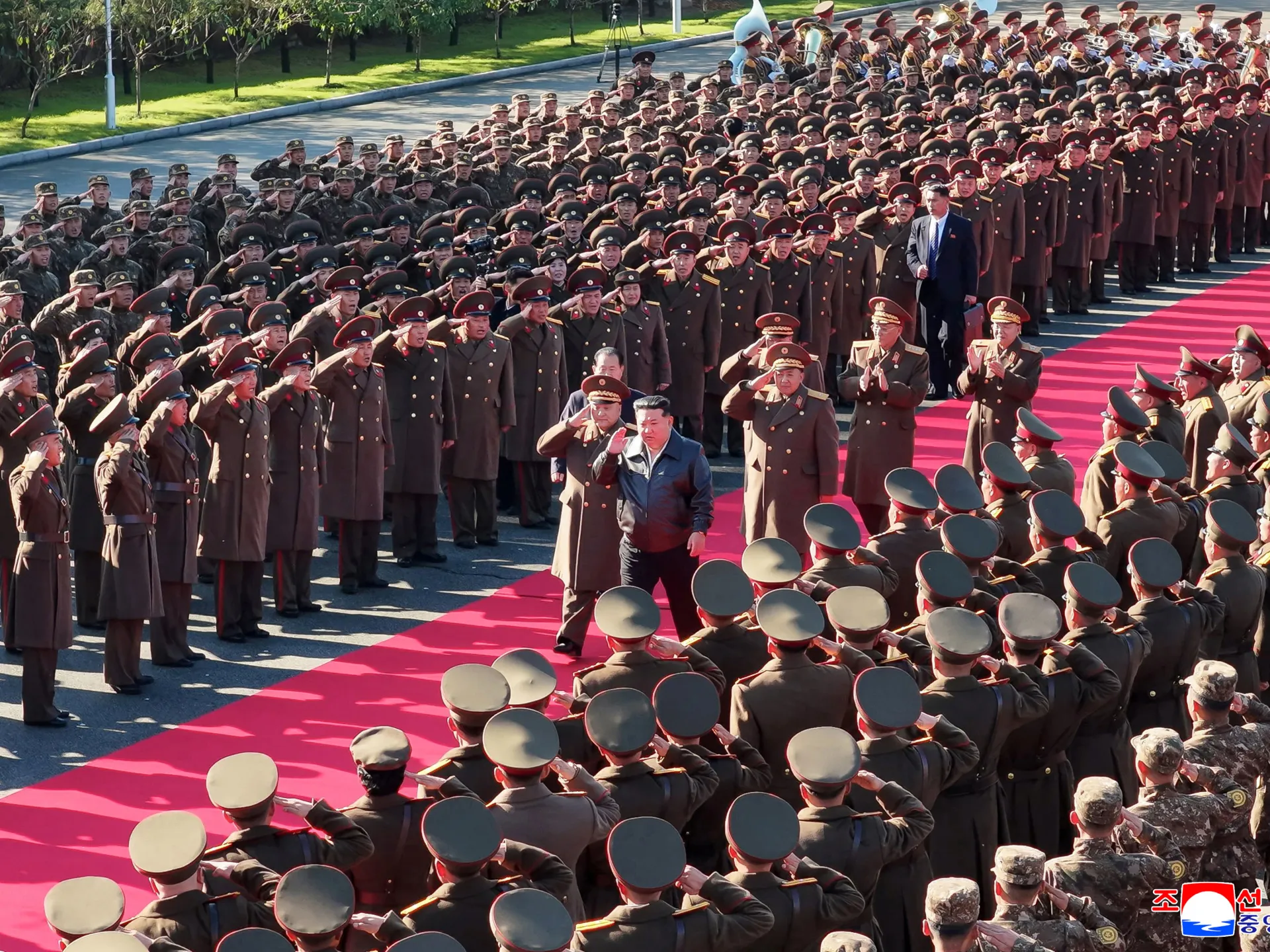
Kim Jong Un has shunned any form of talks with Washington and Seoul since his fallout with Trump in 2019. He has since made Russia the focus of his foreign policy, sending thousands of soldiers, many of whom have died on the battlefield, and large amounts of military equipment for President Vladimir Putin’s war on Ukraine while pursuing an increasingly assertive strategy aimed at securing a larger role for North Korea in a united front against the US-led West.
In a recent speech, Kim Jong Un urged Washington to drop its demand for the North to surrender its nuclear weapons as a condition for resuming diplomacy. He ignored Trump’s proposal to meet while the US president was in South Korea last week for meetings with world leaders attending the Asia-Pacific Economic Cooperation summit.
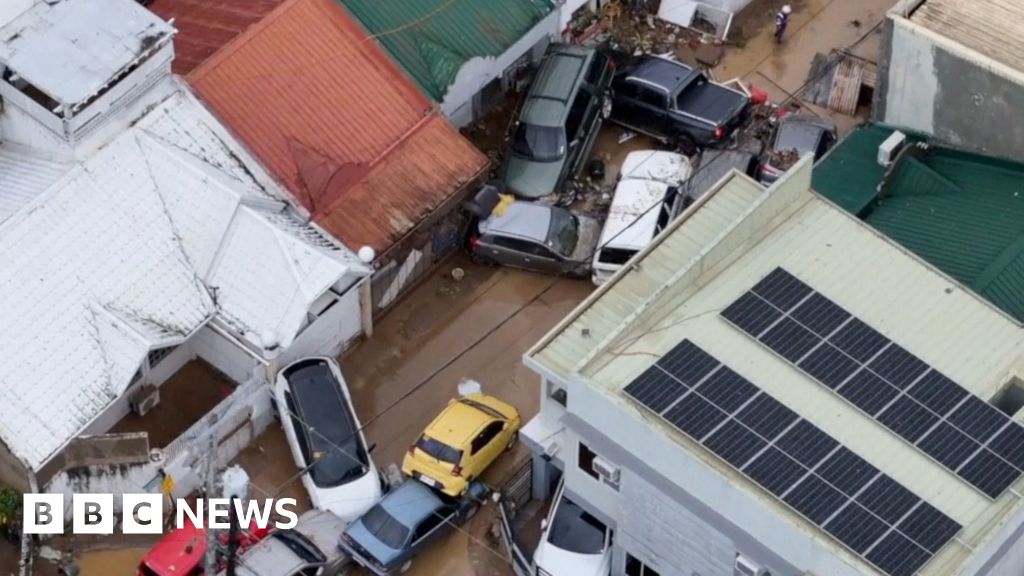
Aerial footage from the Philippines shows the destruction wrought on homes and streets by Typhoon Kalmaegi.
It was one of the strongest typhoons in the Philippines this year.
At least 85 people have died in the flooding and another 75 are missing. The floodwaters swept shipping containers through the streets and cars have been left in piles.
Weekly insights and analysis on the latest developments in military technology, strategy, and foreign policy.
General Atomics’ Gambit family of drones, with its common modular core ‘chassis’ concept, now has a sixth member optimized for air-to-surface missions, such as attacking hostile air defenses or enemy ships. The company is already eyeing international sales of the new Gambit 6, particularly in Europe, but it could also be of interest to branches of the U.S. military. The latest Gambit configuration underscores the growing pursuit of loyal wingman-type drones, also now often referred to as Collaborative Combat Aircraft (CCA), by armed forces globally.
Gambit 6 made its official debut yesterday at the annual International Fighter Conference in Rome, Italy. General Atomics’ Aeronautical Systems, Inc. division (GA-ASI) first unveiled the Gambit family back in 2022, at which time it included four designs. They were joined last year by Gambit 5, which is intended for carrier-based operations.
“The Gambit Series is a modular family of unmanned aircraft designed to meet diverse mission requirements, including intelligence, surveillance, and reconnaissance; multi-domain combat; advanced training; and stealth reconnaissance,” according to a press release from GA-ASI. “It’s built around a common core platform that accounts for a significant proportion of the aircraft’s hardware, including the landing gear, baseline avionics, and chassis. This shared foundation reduces costs, increases interoperability, and accelerates the development of mission-specific variants like Gambit 6.”
“The multi-role [Gambit 6] platform is optimized for roles such as electronic warfare, suppression of enemy air defenses (SEAD), and deep precision strike, making it a versatile option for evolving defense needs,” the release adds.
An accompanying rendering, seen in part at the top of this story and below, shows a trio of Gambit 6s. Each one is depicted releasing several GBU-53/B StormBreaker precision-guided bombs, also known as Small Diameter Bomb IIs (SDB II).
General Atomics is also now among the companies under contract to develop conceptual CCA designs for the U.S. Navy.
“It’s best to think of Gambit 1 as optimized for advanced sensing, and represented by our XQ-67A OBSS [Off-Board Sensing Station] flying today,” C. Mark Brinkley, a spokesperson for General Atomics, told TWZ. “Gambit 2 is optimized for air-to-air combat and represented by our YFQ-42A, which has multiple airframes currently flying. Loaded with the proper weapons, a Gambit 2 could conduct a ground or surface strike as a multirole aircraft, but it is not optimized for that ground mission.”
From top to bottom, General Atomics’ Avenger drone, the experimental XQ-67A, and the first YFQ-42A CCA prototype. GA-ASI
“The Gambit series, including YFQ-42A, can be equipped with EW [electronic warfare] suites or EW-capable launched effects [uncrewed aerial systems],” Brinkely added.
The Gambit 3 design is primarily intended to act as a ‘red air’ adversary during training. The flying wing Gambit 4, so far the most visually distinctive member of the family, is focused on intelligence, surveillance, and reconnaissance (ISR) missions. As noted, Gambit 5 is designed for carrier-based combat operations.
“Gambit 6 will be truly optimized for air-to-ground/surface operations. It might visually look like a Gambit 2, and perhaps the differences would be imperceptible to the casual viewer, as both would utilize RF [radiofrequency] and optical sensing,” Brinkley added. “But the mission systems inside Gambit 6 are fine-tuned specifically for ground/surface operations, missions in which General Atomics has developed deep experience over decades of ground/surface sensing and strikes. Gambit 6 could also be outfitted for an electronic warfare mission, for instance, or even naval strikes.”
Overall, “the idea is that Gambit 6 will be primarily looking down.”
Just like an air-to-air combat optimized CCA-type drone, an air-to-surface focused design would help friendly forces expand their coverage and capacity to perform relevant missions over one or more areas of the battlespace, while also reducing the risk to crewed platforms. As described, Gambit 6s seems geared to be particularly well-suited to the suppression and destruction of enemy air defenses mission sets, or SEAD/DEAD, to aid in clearing the way for follow-on operations.
A previously released General Atomics rendering showing members of the Gambit family, some of which are depicted firing air-to-air missiles. General Atomics
The idea of CCA-type drones taking on these ‘downward-focused’ missions is not new. Though the U.S. Air Force’s CCA program is currently focused on air-to-air missions, the service has expressed interest in future air-to-surface strike and electronic warfare capabilities. Previous U.S. Marine Corps testing of Kratos’ XQ-58 Valkyrie has put particular emphasis on the ability to launch electronic warfare attacks as part of SEAD/DEAD missions conducted together with F-35 Joint Strike Fighters. Earlier this year, the Marines confirmed that experimental work with the XQ-58 was transitioning into a full program of record with a clear eye toward a real operational capability. Air-to-surface missions are also a component of other CCA-type programs globally.
“Air forces throughout the world are looking to air-to-ground-capable CCAs to enhance operational capabilities and address emerging threats in a denied environment,” the General Atomics press release says. “Airframes will be available for international procurement starting in 2027, with European missionized versions deliverable in 2029. GA-ASI is building industry partnerships throughout Europe with the aim of providing sovereign capabilities for all its platforms.”
It has been pointed out that the schedule stated aligns particularly well with a German requirement for a CCA-type drone capable of air-to-surface missions. Last year, Airbus also unveiled a loyal wingman drone with a clear eye toward meeting German Air Force needs. Airbus and Kratos also announced a partnership earlier this year to supply a version of the XQ-58 to the Germans.
Gambit 6 sounds a lot like it’s General Atomics’ pitch for Germany’s ‘fighter bomber drone’ requirement.
Notice the system being described as a ‘deep precision strike’ solution and that European missionized versions will be deliverable in 2029 (Germany’s readiness deadline). https://t.co/HA06tR9eel
General Atomics has made clear that it is looking at multiple potential foreign sales opportunities with Gambit 6.
“Many international allies and partners have expressed interest in a CCA optimized for ground or surface strike. Gambit 6 was announced here in Rome on the first day of the International Fighter Conference, and the resulting interest and inquiry from attending military representatives has been great,” Brinkley, the General Atomics spokesperson, also told TWZ. “We look forward to continuing those discussions here this week. We absolutely intend to submit Gambit 6 for various emerging international opportunities.”
“Nothing would prevent the United States from procuring a Gambit 6 variant, fine tuned to American specifications,” he added.
“I don’t have any additional details to offer on Gambit 5 or the US Navy opportunity. We’ve been talking about the Gambit 5 concept for about 16 months at this point, since Farnborough 2024,” Brinkley also said when asked for a general update on the work the company is doing in relation to the Navy’s CCA effort. “There is no specific relationship between Gambit 5 & Gambit 6 at this time. The point of the Gambit Series is to quickly deliver affordable mass at scale, and to adjust to customer demands rapidly, and each of these aircraft does that, while also leveraging years of hard work and demonstrated success. “
As has been made clear in this story already, the market space for CCA-type drones has been steadily growing in recent years, and extends well beyond General Atomics. Just since September, Lockheed Martin’s Vectis and Shield AI’s X-BAT have joined the growing field of relevant designs. The jet-powered X-BAT is a particularly novel design, intended to take off and land vertically, as you can learn more about in great detail in this recent TWZ feature. In addition to the Gambit family, Vectis, X-BAT, and Anduril’s Fury, among other drone designs, are also being showcased at the International Fighter Conference this week. Also on the market now is Boeing’s MQ-28 Ghost Bat, originally developed for the Royal Australian Air Force (RAAF). Aviation Week just recently disclosed the existence of a new drone design from Northrop Grumman subsidiary Scaled Composites, referred to now simply as Project Lotus, which could be in the broad CCA category, as well.
Digital technologies, particularly AI, are accelerating democratic backsliding and revitalizing authoritarian governments. AI-focused companies have been forming close partnerships with government actors, often in ways that undermine democratic norms. Around the world, private firms are supplying or co-designing technologies that enhance mass surveillance, predictive policing, propaganda campaigns, and online censorship. In places like China, Russia, and Egypt, a blurring of boundaries between the state and the technology industry has led to serious consequences. This collusion has undercut privacy rights, stifled civil society, and diminished public accountability.
This dynamic is now playing out in the United States. Companies like Palantir and Paragon Solutions are providing government entities with powerful AI tools and analytics platforms, often under opaque contracts. In September, U.S. President Donald Trump approved the sale of TikTok to U.S. private entities friendly with the administration. Unchecked public-private integration within the technology industry poses serious risks for democratic societies, namely that it offers increased power to unaccountable actors. The focus of this article is to examine case studies on how these emerging alliances are enabling authoritarian practices, as well as what they might mean for the future of democratic societies.
Russia: Manipulating Digital Tools
In Russia, democratic norms under Vladimir Putin have eroded while Russian tech companies continue to work hand in glove with state authorities. Sberbank, the country’s largest financial institution, and their development of Kandinsky 2.1, an AI-powered, text-to-image tool owned by the firm, illustrate this long-running trend.
Despite the quality of its outputs compared to rivals like DALL-E, the solution came under fire in 2023 from veteran lawmaker Sergey Mironov, who argued that it generated images that tarnished Russia’s image. He would go on to charge that Kandinsky 2.1 was designed by “unfriendly states waging an informational and mental war” against the country.
Not long after, some in the tech space noticed that Kandinsky 2.1’s outputs changed. For instance, while the tool previously churned out images of zombies when prompted with “Z Patriot,” users noted that it now repeatedly produced pictures of hyper-masculine figures. Critics claim that this alteration not only represented an overt manipulation of the technology itself but also an attempt to curry favor with those in the government.
This episode shows how AI-powered tools are being specifically tailored to serve the needs of authorities. The modifications made to the model transformed it into an invaluable resource the government could use to amplify its messaging. As a result, users are no longer likely to see Kandinsky 2.1 as a tool for creativity, particularly if its outputs remain blatantly skewed. Developers in countries like Russia may look to this case for inspiration on how to succeed in restrictive political contexts.
United States: Supercharging Mass Surveillance
AI-centric firms in the United States have also taken note. Palantir Technologies stands as the most prominent example of how private technology firms can deepen government surveillance capabilities in ways that test the limits of democratic accountability. The firm, established in the wake of 9/11, has expanded its domestic footprint through lucrative contracts with local police departments and, most notably, Immigration and Customs Enforcement (ICE).
Investigations reveal that Palantir’s software enables ICE agents to compile and cross-reference vast amounts of personal data, from Department of Motor Vehicle (DMV) records and employment information to social media activity and utility bills. This capability gives the government a unique opportunity to build detailed profiles on individuals and their community networks. This has helped facilitate deportations and raids on immigrant communities. Critics argue that Palantir’s tools create a dragnet that vastly expands state power, all while shielding the company and its government clients from public oversight.
Beyond immigration enforcement, Palantir’s Gotham platform has been adopted by police departments for predictive policing initiatives, which attempt to forecast locations and suspects for crimes. Civil liberties groups have warned that such uses reinforce systemic biases by encoding discriminatory policing practices into algorithmic decision-making. Predictive policing algorithms inherit bias because they rely on historical data shaped by discriminatory over-policing of Black communities, among others. Scholars of “surveillance capitalism” also note that these partnerships normalize the commodification of personal data for state security purposes.
The deeper concern lies in how this private-public nexus erodes societal trust and transparency. Unlike government agencies bound by Freedom of Information Act (FOIA) requirements, companies like Palantir operate under corporate secrecy, limiting democratic oversight of technologies that profoundly affect civil rights. In this sense, the Palantir case illustrates how authoritarian-style practices, combined with technological breakthroughs, can be incubated within democratic societies and later contribute to their overall decline.
Challenging Anti-Democratic Alliances
The deepening collaboration between AI firms and authorities in developing repressive technologies is alarming. Across the globe, these partnerships have flourished, often to the detriment of average citizens. The examples of Russia and the United States underline how AI firms have been willing and able to work with governments engaging in repression when convenient, leaving the public in the lurch.
Advocates for democracy must educate themselves on how to combat the misuse of AI. Leaders in civil society, for example, could build up their technical knowledge as a starting point. Capacity-building may also have the bonus of enabling pro-democracy groups to create their own AI solutions that support civic accountability actions. Activities like these may provide a counterbalance to corporate-state collusion that places citizens at a disadvantage. It may also help ensure that AI tools are designed in ways that strengthen democracies, not undermine them.
*Aaron Spitler is a researcher whose interests lie at the intersection of human rights, democratic governance, and digital technologies. He has worked with numerous organizations in this space, from the International Telecommunication Union (ITU) to the International Republican Institute (IRI). He is passionate about ensuring technology can be a force for good. You can reach him on LinkedIn
Mayor-elect of New York says he will not mince words on Trump, but ‘door open’ to dialogue.
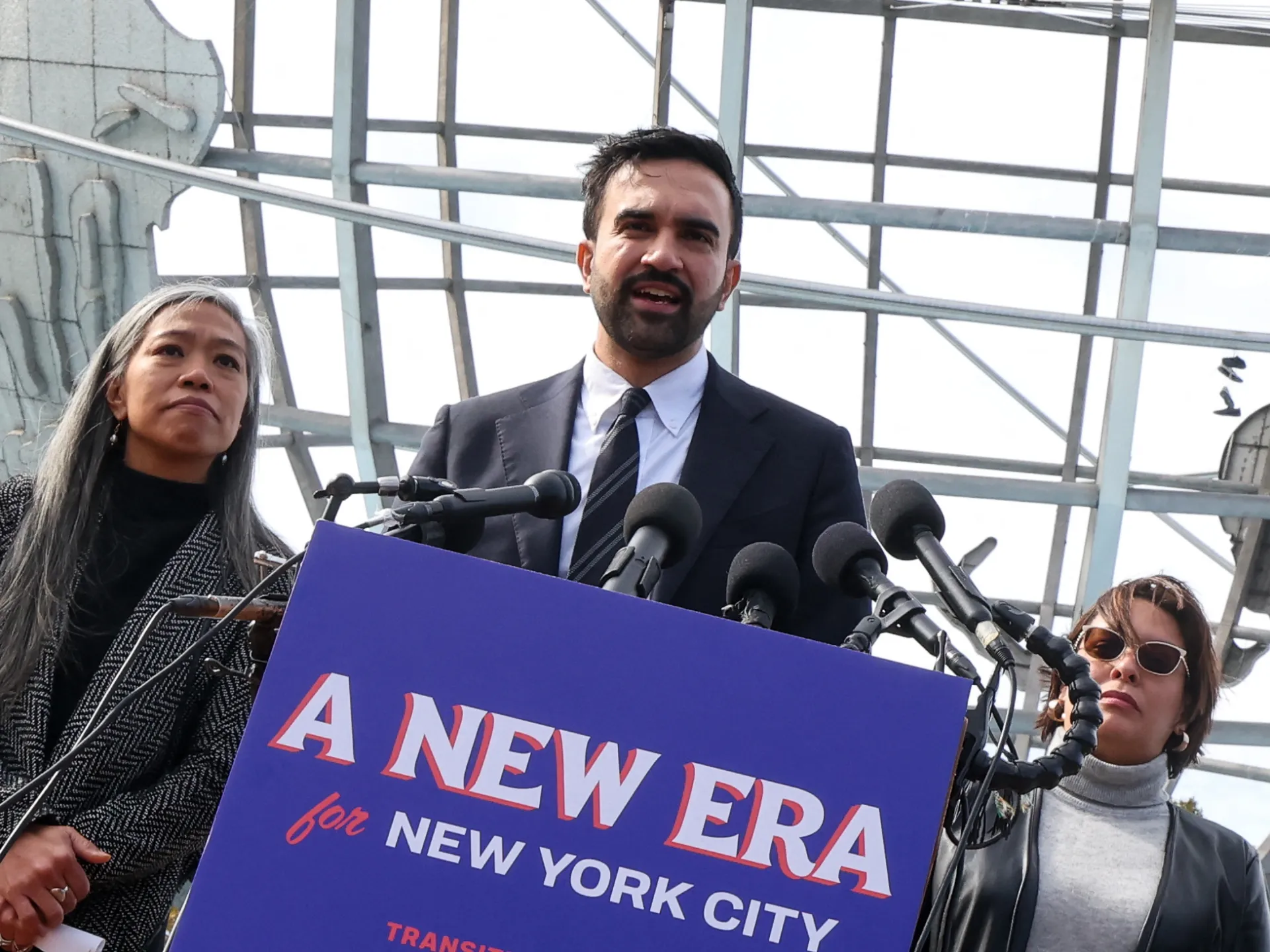
United States President Donald Trump has suggested that he is open to assisting New York Mayor-elect Zohran Mamdani, but warned that the trailblazing democratic socialist will need to be “respectful” of Washington to succeed.
Trump made the comments on Wednesday as Mamdani announced his transition team following his historic election as the first Muslim and first South Asian mayor of the US’s largest city.
Recommended Stories
list of 4 itemsend of list
Responding to Mamdani’s victory night remarks pledging to stand up to Trump, the US president described the mayor-elect’s comments as a “dangerous statement”.
“He has to be a little bit respectful of Washington, because if he’s not, he doesn’t have a chance of succeeding,” Trump said in an interview with Fox News’ Bret Baier.
“And I want to make him succeed. I want to make the city succeed,” Trump added, before quickly clarifying that he wanted New York City, not Mamdani, to succeed.
Earlier on Wednesday, Trump suggested that his administration would “help” the new mayor, even as he branded him a “communist”.
“The communists, Marxists, and globalists had their chance, and they delivered nothing but disaster, and now let’s see how a communist does in New York. We’re going to see how that works out,” Trump said in a speech to the American Business Forum in Miami, Florida.
“We’ll help him, we’ll help him. We want New York to be successful. We’ll help him a little bit, maybe.”
Trump railed against Mamdani in the run-up to Tuesday’s mayoral election in New York, describing him as a “communist lunatic” and threatening to cut off federal funding to the city if he won the race.
Mamdani, whose platform includes free universal childcare, free buses, and government-run grocery stores, has rejected the communist label, describing himself as a democratic socialist.
While Mamdani will be responsible for governing a city of about 8.5 million people, his election has been widely seen as having implications nationwide amid the Democratic Party’s struggles to reconcile its centrist and progressive factions and effectively counter Trump.
In his victory speech, Mamdani cast his election as a model for how to defeat Trump, addressing the TV-loving president directly by telling him to “turn the volume up”.
In a speech laying out his priorities on Wednesday, Mamdani, who is set to take office on January 1, reiterated his determination to oppose Trump, while also indicating his willingness to engage with the administration.
“I will not mince my words when it comes to President Trump,” the mayor-elect said.
“I will continue to describe his actions as they are, and I will also always do so while leaving a door open to have that conversation.”
Sheinbaum calls for nationwide review of sexual harassment laws, as attack shines light on Mexico’s poor record on women’s safety.
Published On 6 Nov 20256 Nov 2025
Share
Mexican President Claudia Sheinbaum has called for sexual harassment to be made a crime nationwide after being groped on the street while greeting supporters near the presidential palace in Mexico City.
Sheinbaum, 63, said on Wednesday that she had pressed charges against the man and would review nationwide legislation on sexual harassment following the attack by a drunk man who put his arm around her shoulder, and with the other hand touched her hip and chest, while attempting to kiss her neck.
Recommended Stories
list of 4 itemsend of list
Mexico’s first woman president removed the man’s hands before a member of her staff stepped between them. The president’s security detail did not appear to be nearby at the moment of the attack, which was caught on camera.
The man was later arrested.
“My thinking is: If I don’t file a complaint, what becomes of other Mexican women? If this happens to the president, what will happen to all the women in our country?” Sheinbaum told her regular morning news conference on Wednesday.
In a post on social media, the president said the attack was “something that many women experience in the country and in the world”.
Presenté una denuncia por el episodio de acoso que viví ayer en la Ciudad de México. Debe quedar claro que, más allá de ser presidenta, esto es algo que viven muchas mujeres en el país y en el mundo; nadie puede vulnerar nuestro cuerpo y espacio personal.
Translation: I filed a complaint for the harassment episode that I experienced yesterday in Mexico City. It must be clear that, beyond being president, this is something that many women experience in the country and in the world; no one can violate our body and personal space. We will review the legislation so that this crime is punishable in all 32 states.
Sheinbaum explained that the incident occurred when she and her team had decided to walk from the National Palace to the Education Ministry to save time. She said they could walk the route in five minutes, rather than taking a 20-minute car ride.
She also called on states across Mexico to look at their laws and procedures to make it easier for women to report such assaults and said Mexicans needed to hear a “loud and clear, no, women’s personal space must not be violated”.
Mexico’s 32 states and Mexico City, which is a federal entity, all have their own criminal codes, and not all states consider sexual harassment a crime.
“It should be a criminal offence, and we are going to launch a campaign,” Sheinbaum said, adding that she had suffered similar attacks in her youth.
The incident has put the focus on Mexico’s troubling record on women’s safety, with sexual harassment commonplace and rights groups warning of a femicide crisis, and the United Nations reporting that an average of 10 women are murdered every day in the country.
About 70 percent of Mexican women aged 15 and over will also experience at least one incident of sexual harassment in their lives, according to the UN.
The attack also focused criticism on Sheinbaum’s security detail and on her insistence on maintaining a degree of intimacy with the public, despite Mexican politicians regularly being a target of cartel violence.
But Sheinbaum dismissed any suggestion that she would increase her security or change how she interacts with people following the incident.
At nationwide rallies in September to mark her first year in power, the president allowed supporters to embrace her and take selfies.
Here are the key events from day 1,351 of Russia’s war on Ukraine.
Published On 6 Nov 20256 Nov 2025
Share
Here is how things stand on Thursday, November 6:
Fighting
The Russian Ministry of Defence said encircled Ukrainian troops in the cities of Pokrovsk and Kupiansk should surrender as they have no chance to save themselves otherwise.
Russia said its forces were advancing north inside Pokrovsk in a drive to take full control of the Ukrainian city, but the Ukrainian army said its units were battling hard to try to stop the Russians from gaining new ground.
Ukraine has acknowledged its troops face a difficult situation in the strategic eastern city, once an important transport and logistics hub for the Ukrainian army, which Russia has been trying to capture for more than a year.
Russia sees Pokrovsk city as the gateway to its capture of the remaining 10 percent, or 5,000 square-kilometres(1,930 square miles), of Ukraine’s eastern industrial Donbas region, one of its key aims in the almost four-year-old war.
A Ukrainian drone attack caused minor damage to oil pumping stations in two districts of Russia’s Yaroslavl region, Mikhail Yevrayev, the regional governor, said.
Energy
Ukraine has resumed gas imports from a pipeline that runs across the Balkan peninsula to Greece, to keep its heating and electric systems running through the winter after widespread damage from intensified Russian attacks on Kyiv’s energy infrastructure.
Data from the Ukrainian gas transit operator showed that Ukraine will receive 1.1 million cubic metres (mcm) of gas from the Transbalkan route on Wednesday, after the import of 0.78 mcm on Tuesday. The route links Ukraine to LNG terminals in Greece, via Moldova, Romania and Bulgaria.
Poland is working on a deal to import liquefied natural gas from the United States to supply Ukraine and Slovakia, an agreement that would further tighten the European Union’s ties to US energy, the Reuters news agency reports, citing two sources familiar with the negotiations.
Nuclear weapons
Russian President Vladimir Putin ordered his top officials to draft proposals for a possible test of nuclear weapons, something Moscow has not done since the 1991 collapse of the Soviet Union.
Putin’s order – made in response to US President Donald Trump’s announcement last week that Washington would resume nuclear testing – is being seen as a signal that the two countries are rapidly nearing a step that could sharply escalate geopolitical tensions.
The US notified Russia in advance of its test launch of an unarmed Minuteman III intercontinental ballistic missile from Vandenberg Space Force Base in California on November 5, Russia’s Interfax news agency reported, citing Kremlin spokesperson Dmitry Peskov.
Russia-US relations have deteriorated sharply in the past few weeks as Trump, frustrated with a lack of progress towards ending the war in Ukraine, has cancelled a planned summit with Putin and imposed sanctions on Russia for the first time since returning to the White House in January.
Trump said he “may be working on a plan to denuclearise” with China and Russia, during a speech at the American Business Forum in Miami.
Sanctions
Bulgaria is drafting legal changes that will allow it to seize control of sanctioned Russian oil firm Lukoil’s Burgas refinery and sell it to a new owner to protect the plant from US sanctions, local media reported.
Estonian Foreign Minister Margus Tsahkna called on China to stop its economic support of Russia’s war in Ukraine and urged Beijing to join European and US efforts to pressure President Putin into a ceasefire.
“China says that they are not part of this military conflict, but I was very clear that China has huge leverage over Russia, every week more and more, because the Russian economy is weak,” Tsahkna told Reuters.
Economy
Ukraine plans to replace its kopek coins to shake off a lingering symbol of Moscow’s former dominance, Central Bank Governor Andriy Pyshnyi said, adding that he hoped the change could be completed this year.
Ukraine introduced its hryvnia currency in 1996, five years after it gained independence from the Soviet Union, minting its own coins but retaining the former Soviet name kopek – kopiyka in Ukrainian. The new coins will be known by the historical Ukrainian term “shah”.
Policymakers at the Bank of England are widely expected to hold interest rates at 4% following their final meeting before the chancellor’s Budget.
Some Bank watchers have suggested that the latest inflation data could strengthen the case for a cut, but most commentators think such a move is more likely in December.
In September, the Bank’s governor Andrew Bailey said he still expected further rate cuts, but the pace would be “more uncertain”.
The Bank’s base rate has an impact on the cost of borrowing for individuals and businesses, and also on returns on savings.
Uncertainty over pace of cuts
The Bank’s Monetary Policy Committee (MPC) will make its latest announcement at 12:00 GMT with most analysts predicting a hold.
The Bank of England has reduced its benchmark interest rate by 0.25 percentage points every three months since August last year. However, that cycle is widely expected to be broken this time.
Members of the MPC will be closely considering the latest economic data on rising prices, as well as jobs and wages as they cast their vote on interest rates.
The rate of inflation in September was 3.8%, well above the Bank’s 2% target, but lower than expected. Within that data, food and drink prices rose at their slowest rate in more than a year.
That has eased some of the squeeze on family finances, and also led to some analysts, including at banking giants Barclays and Goldman Sachs, to predict a cut in interest rates this month to 3.75%.
They expect a split in the vote among the nine-member committee. For the first time, the views of each individual on the MPC will be published alongside the wider decision.
Danni Hewson, head of financial analysis at AJ Bell, said the market was giving a one in three chance of a rate cut to 3.75%.
“The odds are still firmly in favour of a hold,” she said.
All eyes on Budget
Members of the MPC will be fully aware of the potential implications of the Budget which will be delivered by Chancellor Rachel Reeves on 26 November.
The case for a cut in interest rates in December could be boosted if the Budget includes substantial tax rises that do not add to inflation.
The chancellor, in a speech on Tuesday, said measures in the Budget “will be focused on getting inflation falling and creating the conditions for interest rate cuts”.
However, detail remains thin until the Budget is delivered and more economic data will be published before the Bank’s next meeting in December that could sway MPC members’ thinking.
“It’s possible Rachel Reeves’ surprise press conference on Tuesday was partly a cry for help to the Bank of England,” AJ Bell’s Ms Hewson said.
“By promising to push down on inflation, she might have been signalling that the Bank didn’t have to wait until after the Budget to cut rates. Whether they do or not is a finely balanced call.”
The Bank’s interest rates heavily influence borrowing costs for homeowners – either directly for those on tracker rates, or more indirectly for fixed rates.
In recent days and weeks, many lenders have been cutting the interest rates on their new, fixed deals as they compete for custom, and in anticipation of future central bank rate cuts.
Savers, however, would likely see a fall in the returns they receive if the Bank cuts the benchmark rate on Thursday or in December.
Rachel Springall, from financial information service Moneyfacts, said many savers were feeling “demoralised” as a result of falling returns and still relatively high inflation, which reduces the spending power of their savings.
The 300 metres separating Aisha Ali’s new house from the old farmhouse may seem short, but it represents the long journey of her life. The 45-year-old widow crosses fields of various crops that she tends.
Aisha was not an active farmer; her late husband handled that. However, he was abducted in 2023 by Boko Haram terrorists while working on their farm in Malari Village, Mafa Local Government Area of Borno State, northeastern Nigeria, and was later killed after they failed to pay a ransom.
“My life changed tragically,” she recounted with a weary calm.
Aisha’s husband’s death made her the breadwinner of a 10-person household, which included her six children and three of her husband’s siblings. She had no choice but to take up the hoe.
A year later, her 10-year-old son was abducted by terrorists. He was later released when they learned that they had killed his father in the past.
Aisha is the breadwinner of her ten-person household. Photo: Abdulkareem Haruna/HumAngle
Aisha and her son, who was abducted and later released. Photo: Abdulkareem Haruna/HumAngle
It was under this constant shadow of fear, relying on subsistence farming and petty trade, that Aisha and her family found a fragile balance until the night the water came.
The midnight escape
In September 2024, a ruptured dam in nearby Alau, coupled with heavy rainfall, led to floods that submerged Maiduguri and surrounding communities, including Muna displacement camp, where Aisha lived with her family.
They had gone to bed after an exhausting day, but around midnight, screams from the neighbours woke them up. “I woke up and saw water everywhere,” she recounted.
Amid the terrifying mix of darkness and rising water, there was no time to save their belongings. She rallied her children, strapped the youngest to her back, and fled into the downpour.
Together with other displaced persons, they walked for hours until they found dry land, where they stayed until dawn. When the water subsided, Aisha returned to find her entire life washed away. “We became homeless without our belongings,” she said.
A doorless shelter and hope
Staying at the displacement camp was not an option, as the government had already planned to shut it down. “Returning to Dubula, our ancestral home, was not an option either,” she said
Aisha looked for shelter nearby and found one on credit—an uncompleted building. The structure had no doors, leaving her family vulnerable to constant theft. What few items they acquired were often stolen when they stepped out, turning their temporary shelter into a trap of insecurity. The widow, who had survived both Boko Haram and the flood, now faced the demoralising grind of daily survival in an exposed space.
The uncompleted building where Aisha and her family lived after the flood. Photo: Abdulkareem Haruna/HumAngle
Since there was no other alternative, they continued living in the building.
Aisha said it was overwhelming, but she held onto hope and did the best she could to care for her children. Weeks later, SOS Children’s Village, a global humanitarian organisation, visited the community for an assessment. “When they came around, I initially dismissed them for one of those numerous NGOs that normally come around to take our data but offer nothing much but some measures of grains,” Aisha told HumAngle. However, she registered with them as a widow and head of her household.
SOS returned with support that Aisha describes as “an investment in dignity”. She underwent training in smart farming techniques, followed by a starter kit of essential tools: a pumping machine for irrigation, a spraying machine, insecticides, fertiliser, a wheelbarrow, and processed seeds.
“This support transformed our lives and brought relative comfort to us,” she added.
Aisha received farm implements as aid from SOS Children’s Village. Photo: Abdulkareem Haruna/HumAngle
The first harvest
With the implements, cash support, and farming inputs, Aisha got to work. She cultivated beans, pepper, tomato, okra, onion, and yams.
She made her first harvest this farming season. “I was able to use the money from my first farm harvest to escape the unsafe shed,” she said, adding that she paid ₦30,000 for half a year’s rent on their current house. Her family now has enough food, and the surplus is sold to cover essential needs like medication.
“I am most excited that for the first time, my children are now in school—something we could not afford before,” she told HumAngle.
Aisha explained that her income varies depending on what she takes to the market and how much she can harvest. “There is no fixed amount,” she said. “For beans, a full ‘mudu’ — that’s a standard measuring bowl — sells for between ₦1,200 and ₦1,300. Sometimes I sell up to half a bag, which is about 20 mudus. For tomatoes, a basket goes for about ₦25,000, and we usually get two or three baskets, depending on the yield.”
She hopes that the cycle of loss and disaster has finally been broken.
“I thank the SOS people for coming to our aid because only God knows the fate that would have befallen me and my family if I had not received their support. They didn’t come to give us fish, but they came to teach us fishing,” she said.
Aisha said other women also received the support: “I saw them during the training, and I believe they are doing well with their families as well.”
Aisha used the proceeds from her first harvest to rent a better house for her family. Photo: Abdulkareem Haruna/HumAngle
According to Fredson Ogbeche, the Humanitarian Action Manager at SOS Children’s Village Nigeria, “One hundred families, many headed by women transforming grief into drive just like Aisha, benefitted from the intervention.”
One of the women, Aisha Bukar, is also a widow. The 55-year-old lives in the Elmiskin 2 area of Jere LGA, Borno State. Life has been a relentless succession of personal loss as she has buried seven of her 12 children over the years due to the conflict and lost her husband to a prolonged illness. This overwhelming hardship was compounded last year when destructive floodwaters swept through her home. Having lost everything in the flood, she had to start all over again.
“What the government offered as a palliative for the flood survivors did not go around to many of us. We were almost stranded until SOS came to assist us,” she said.
SOS Children’s Villages Nigeria is one of the humanitarian organisations that provided post-flooding recovery support for survivors. Aside from the farm implements and inputs, the organisation gave ₦395,000 to each beneficiary.
Bukar did not go to the farm. She used the funding to meet domestic needs and also started a tailoring business where they mass-produce and sell children’s clothes.
She said that the steady income has given her daughter a second chance at education.
It remains unclear whether Trump was referring to restarting live nuclear detonations or tests on the reliability of warhead delivery systems, like the one conducted today with an unarmed Minuteman III intercontinental ballistic missile, which already occur regularly. U.S. officials have appeared to clarify, at least to some degree, that Trump’s testing will be limited to delivery systems and the nuclear deterrent apparatus, not detonations. Still, there are questions as to his true intent, which could always change. Regardless, Russian officials “assess that Washington is aiming to prepare and conduct nuclear tests,” according to the official Russian TASS news outlet.
An unarmed Minuteman III Intercontinental Ballistic Missile launches during an operational test at 1:35 a.m. Pacific Time, Nov. 5, 2025, at Vandenberg Space Force Base, Calif. (U.S. Space Force photo by Tech. Sgt. Draeke Layman) Tech. Sgt. Draeke Layman
Belousov offered no further details, so we asked several nuclear weapons experts for their assessments on how quickly Russia could detonate a nuclear device – something it hasn’t done since 1990 – and what it would entail to make it happen. Some responses have been lightly edited for clarity.
“Short notice is relative. The quickest would be to drive a warhead into an existing tunnel and seal it off. But that wouldn’t give them any new data and probably risk a leak.
So, unless they already have one prepared, if they want to do a new fully instrumented test, I suspect it would involve preparing a tunnel, the device, and rigging all the cables and sensors to record that data. There has been a lot of tunnel-digging at Novaya Zemlya for quite some time for their existing experiments, so presumably a new fully instrumented test would be in addition to that.
Preparing a new one would probably take several months, possibly six-plus, but difficult to estimate because we don’t know what they already have prepared.“
This satellite image shows tunnel construction at the Russian Novaya Zemlya nuclear weapons test site. (Google Earth)
“Russia also has an active nuclear maintenance program as does the U.S. However, Russia tests near the Arctic Circle at Novaya Zemlya Island. As a result, they can really only – barring a real emergency – test in summer and late fall. So it would take them some time, and at least until next year.
However, if they want to gain a lot of technically useful data from a test, it may take them longer. Just to conduct a basic test could take less than 12 months. But as I have said, this is what an arms race looks like. Action/reaction cycles. Russia will test if we do. I suspect they will not if we do not.
I don’t know what Russia would test. It would not have to be a massive bomb to be useful. You generally only need to test the first stage of a thermonuclear device to get useful data. It could be as small as 1 to 5 kilotons or up to 15 to 20, but there is no way for people outside of the Russian scientific community to predict well.”
“The U.S., China, and Russia all have ‘nuclear test readiness’ plans and I would assess that Russia would be able to resume nuclear explosive testing more quickly than the United States.
I just know it would be less than the optimistic 24-36 months for a full-scale underground contained nuclear test explosions at the Nevada National Security Site (NNSS). Russia would not be encumbered by the same safety and environmental safeguards and domestic political obstacles that the National Nuclear Security Administration (NNSA) would have to deal with in order to conduct a full-scale multi-kiloton nuclear explosion underground at the former U.S. nuclear test site in Nevada.
But, most importantly, there is no technical, military or political reason why Putin or Trump should order the resumption of nuclear explosive testing, and Defense Minister Belousov’s comments are counterproductive and irresponsible.
The United States and Russia deploy some 1,700 strategic nuclear warheads and they possess other sub-strategic nuclear weapons. Their arsenals consist of various, well-tested warhead types. The United States conducted more than 1,030 nuclear test explosions and Russia 715, the vast majority of which were to proof-test new warhead designs. Neither side needs to or wants to develop a new warhead, so any new nuclear test explosions would be purely for ‘show,’ which would be extremely irresponsible.“
“We know from both open source and official U.S. assessments that the Russians maintain a relatively high level of test readiness at Novaya Zemlya. They’ve also strongly emphasized the parity principle on the testing issue, so it makes sense that they’d take these steps given Trump’s recent comments.
They want to be positioned so that if the U.S. tests, they can follow quickly. The specific timeline of Russian readiness is difficult to nail down, but they could test probably without significant instrumentation without much difficulty. I would think weeks if there was sufficient political demand for a rapid demonstration.“
“The United States has an enormous advantage in nuclear testing over every other country in the world, partly because we conducted more tests than everyone else combined (1,030, involving 1,149 individual detonations), and because we have a very elaborate and well-funded ($345 billion to date) Stockpile Stewardship program. Since 1996, this has enabled us to ‘test’ our nuclear bombs and warheads via extremely powerful computers, eliminating the need for actual underground tests and providing us with critical insights into our weapons we could not obtain from physical nuclear testing alone.
So given that, and given Trump’s recent out-of-the-blue demand that we resume nuclear testing immediately, it is unfortunately not surprising that Russia is responding the way that it is. In Russia, as in the United States, there are political and military leaders and weapons scientists who have never given up on one day resuming nuclear testing. Russia, like the United States, has long maintained a readiness program to resume nuclear testing. It is an unfortunate escalation of at least rhetoric at this point, sliding the United States and Russia, and perhaps also China and maybe North Korea and other states further down the road toward resuming nuclear testing, which has not happened in decades.
Right now, we and the Russians conduct what are known as subcritical tests, which are tests that do not result in a nuclear yield, but nevertheless provide useful scientific information that can make our weapons more safe and reliable.
Russia could probably resume underground nuclear testing pretty quickly. Satellite imagery from 2023 and this past July indicates that they’ve been doing some work at the test site to expand the facilities there and potentially make them more ready to resume nuclear testing. I suspect Russia could probably do this faster than the United States. Our testing would take place in Nevada – at least that’s the only test site that we have available right now, and it would probably take on the order of one to three years (for the U.S.) to do a fully instrumented test.
We can’t see inside the [Russian] buildings that have gone up, so we don’t know exactly what’s going on there. But, if I have to guess, and it is only a guess, I would say a matter of several weeks to several months, perhaps [for a Russian test]. But it really depends on what their intentions are.
If they simply want to blow something up to demonstrate that they’ve returned to doing that kind of testing that can be done fairly quickly if they want to actually have a scientifically and militarily useful test where there’s all sorts of diagnostic equipment and they’re able to measure the results, and determine something about the test other than the fact that it simply went off, that could take more time.
If they’ve been planning and preparing, if they have personnel and equipment there, they could probably do something fairly quickly – on the very short end, potentially a matter of a few weeks to perhaps a few months. It could be longer; it could be a matter of six months. But again, if you only want to send a political message that we are resuming nuclear testing, you can take a nuclear bomb or warhead out of your stockpile and transport it to Novaya Zemlya, stick it in an underground tunnel, seal it off and detonate it.“
We reached out to the White House to see what concern, if any, they have about Putin’s order for proposals on how to resume nuclear testing. We are waiting for a response. The experts we spoke with, however, voiced their own worries.
“As for concerns, Russia’s testing could enable them to develop a new generation of nuclear weapons via computer simulations where now it is hard for them to do so,” explained Wolfsthal. “Russia could close the testing advantage the U.S. now possesses.”
Obviously, the devasting Pol Pot regime plunged Cambodia into genocide, armed conflict, destruction and isolation during the dark period between 1970s to 1990s. This tragic history left Cambodia in social, economic and political ruins. As a war-torn country, despite these historical scars of the catastrophic decades, the government has implemented various policies and initiatives to reach national reconciliation and unity as well as to build peace and political stability, leading to economic growth and enhancement of living standards for its people. Prior to the pandemic, from 1998 to 2019, Cambodia’s economic growth remarkably flourished leading to the attainment of lower middle-income status in 2015, with the impressive average annual increase rate of 7.7 percent, making Cambodia one of the fastest-growing economies in the world.
Having seen the immense importance of regional integration and cooperation as the pivotal catalysts for national security, peace and sustainable development, Cambodia has actively engaged in the regional and international organizations such as the Association of Southeast Asia Nations (ASEAN), Asia-Europe Meeting (ASEM), the United Nations (UN) and other not mentioned international organizations and blocs. Noticeably, Cambodian foreign policy puts strong emphasis on the crucial role of ASEAN. Phnom Penh recognizes the key role of this regional bloc in safeguarding stability and peace in Southeast Asia and the broader Indo-Pacific region. Since its accession to ASEAN in 1999, Cambodia has assumed the role of ASEAN chair on three occasions—2002, 2012, and 2022, fostering regional cooperation, integration and solidarity for the sake of regional peace, stability and development.
Additionally, since its membership in 2004, Cambodia has played a vital role in ASEM through its active participation in various discussions and initiatives, promoting cooperation and understanding between Asia and Europe. Noticeably, in spite of the pandemic, Cambodia successfully hosted the virtual 13th Asia-Europe Meeting Summit in 2021, offering the platform for leaders from over 50 countries to have fruitful dialogues in order to explore ways and means to tackle regional and global issues for collective interest.
More importantly, one of the main aspirations of Cambodia’s foreign policy is to establish international peace on the basis of the principles of equality and rights for all people. In this sense, since 2006, notwithstanding the limited resources, Cambodia has emerged as an active participant in peacekeeping missions under the UN’s umbrella by transforming itself from being a host country of UNTAC (United Nations Transitional Authority in Cambodia) to a country that has contributed blue berets to 12 missions involving nine countries. These missions have involved 9,205 personnel, including 726 female peacekeepers. In fact, sending Cambodian peacekeeping forces to join the peace-keeping endeavors under the UN framework is also one of the priorities stipulated in Cambodia’s defence white paper 2022 for strengthening Cambodian armed forces’ capacities in the areas of humanitarian assistance and disaster relief.
Furthermore, to promote the gender equality and women empowerment, Cambodia has acknowledged the women’s ability of performing tasks as capable as men. This acknowledgement has been concretely evidenced by their constant accomplishments. In this regard, Cambodia has enlarged the number of its female troops dispatched to all levels of UN peacekeeping operations. Consequently, for its participation in UN peacekeeping operations, the UN rated Cambodia third in ASEAN (after Indonesia and Malaysia) and 28th out of 122 countries in the globe. In terms of deploying female peacekeepers overseas, Cambodia was placed 13th in the world and second among ASEAN nations, behind Indonesia. This gender equality promotion is also in line with the UN’s Sustainable Development Goals.
More essentially, Cambodia’s essential role in the UN peace keeping mission was also highly praised by the UN Secretary-General Antonio Guterres during his discussion with Cambodian Prime Minister Hun Manet on the sidelines of the 78th UN General Assembly (UNGA). Additionally, while receiving the courtesy visit from the UN representative in Cambodia last year, Cambodian Foreign Minister Sok Chenda Sophea ensured the Cambodia’s resolute commitment to its continued support to the UN peacekeeping missions by stressing the country’s firm dedication to global peace and security. The top diplomat also revealed the Kingdom’s ambitious plan to expand its peacekeeping operations to other UN frameworks.
Noticeably, the world’s political and socio-economic landscapes is uncertain and unpredictable due to its rapid evolution. On top of this, the ongoing Russian-Ukraine war, the escalated crisis in the Middle-East, geopolitical rivalry among the superpowers just to name a few has considerably affected the regional and global cooperation, security, and stability. Bitterly experienced falling victim of the geopolitical competition during the Cold War, Cambodia intends to maintain its current course of “independent and neutral foreign policy, grounded in the rule of law, equal mutual respect and adherence to the principles of the UN Charter” in order to further foster its domestic interests, nourish current friendships, and build more harmonious relationships.
Like other small states, Cambodia places utmost significance on peace and security for its survival. Hence, Cambodia vehemently opposed an aggression against other sovereign states, meddling in their domestic affairs, and the threat or use of force in international relations. Through bilateral, regional, and international frameworks, Cambodia will proactively pursue the possibility of strengthening and broadening close cooperation with other countries in order to support global peace, security, stability, sustainable development, and prosperity that can be shared and cherished by all.
As such, Cambodia is firmly dedicated to promoting peacekeeping operations and partaking in this righteous endeavor. Undoubtedly, as one of the regional outstanding contributors to the UN peacekeeping missions, Cambodia has chosen to run for membership in the Organizational Committee of the Peacebuilding Commission for the years 2025–2026 aimed at further contributing to this noble humanitarian task, eventually benefiting the humanity as a whole.
Obviously, this membership will enable Cambodia to play more roles and responsibilities in advocating the global peace, security, and stability, all of which are the essential prerequisites for sustainable development. Most significantly, being part of this body will also provide Cambodia with a platform to share its experiences, best practices and lessons learned in the process of peacebuilding, national reconciliation, and socio-economic development to other warring nations which are eager to taste the blissful flavors of peace and development like the rest of the world.
“You have to deliver on addressing that crisis.” New York City Mayor-elect Zohran Mamdani criticised President Donald Trump for not fixing the affordability crisis he campaigned on, adding that Republicans are scared the new mayor may actually deliver.
Investigators are working to determine cause of the blaze that broke out at facility in Tuzla in northeastern Bosnia.
Published On 5 Nov 20255 Nov 2025
Share
A fire at a retirement home in northeastern Bosnia has killed at least 11 people and injured about 30 others, officials said.
It remained unclear what caused the blaze, which engulfed the seventh floor of the building in Tuzla, about 80km (50 miles) northeast of Sarajevo, after it broke out on Tuesday evening.
Recommended Stories
list of 4 itemsend of list
The fire, which took about an hour to bring under control, sent flames and smoke pouring out of the building into the night sky.
Bosnian media reported that higher floors in the complex were occupied by elderly people who could not move on their own or were ill.
“I had gone to bed when I heard a cracking sound. I don’t know if it was the windows in my room breaking,” resident Ruza Kajic told national broadcaster BHRT on Wednesday.
“I live on the third floor,” she said. “I looked out the window and saw burning material falling from above. I ran out into the hallway. On the upper floors, there are bedridden people.”
Admir Vojnic, who lives near the retirement home, also told the Reuters news agency that he saw “huge flames and smoke, and elderly and helpless people standing outside” the building.
Bystanders watch the scene of the blaze at the retirement home in Tuzla, November 4, 2025 [STR/AFP]
Investigators were still working to determine the cause of the fire and identify those killed in the blaze, prosecutor spokesperson Admir Arnautovic told reporters.
“The identification of the bodies will take place during the day,” Arnautovic said.
Meanwhile, the retirement home’s director said he had offered his resignation.
“It’s the only human thing to do, the least I can do in this tragedy. My heart goes out to the families of the victims,” Mirsad Bakalovic told the Fena news agency.
“Last night was a truly difficult event, a tragedy not only for the city of Tuzla, but for all of Bosnia.”
Officials from across government in Bosnia and Herzegovina offered their condolences and help to the Tuzla authorities.
“We feel the pain and are always ready to help,” Savo Minic, the prime minister of the country’s autonomous Serb Republic, wrote on X.