David Lee Roth popped out at Coachella on Friday to sing Van Halen’s classic “Jump” with Teddy Swims. After the show, we grabbed a few minutes with the 71-year-old rock star, who wore a beaded vest and tight silver-and-black trousers and sipped from a red plastic cup.
Ted, Teddy, Theodore — what do you call Teddy swims? I call him Teddy. Teddy Swims is one of the best names ever — everybody’s saying it. All around in the city here are visitors from Germany, Holland, Japan, China, and they all know that name. Something like Greenberg? Helfenbein? [Shrugs]
What if you’d been Dave Roth? My full name is David Lee Roth — it’s an anagram. When I was born, I had a traumatic birth — I was backwards, I had the cord around, I was hyperactive. My grandfather, who was a 70-hour-a-week physician — graduated medical school in 1920 — took a look at me two hours after I was born and told my mom, “He’s gonna be trouble.” And Mom’s way of saying “Go schtup yourself,” she added the middle name Lee. If you reverse the letters, it comes out the devil.
Share via
You ever been to Coachella before? This is my first time on this stage, and it’s the most forgiving audience. What a colorful, noisy bunch.
A forgiving audience? What does that mean? It means if you go to Kenny Chesney, you gotta have the hat — the girls have to have the cut-offs. There’s rules. If you go heavy metal, you gotta cut the sleeves off a black shirt — not blue.
And here it’s catch-as-catch-can? It’s inventive, creative, imaginative without rules — the way artwork perhaps used to be in the middle ’80s. In 1985, graphic art, sculptural art, automotive art — there were no rules. Today, you’re not getting on any gallery walls without a political bias. And today, here, I’m not sure what the bias is. I can wear something like this and it’s like, “Too bad you showed up in your day clothes.”
What is this outfit? This is Artemis moon mission. I’m vacuum-packed for your safety — kid-tested, mom-approved. She likes it because it’s good for ’em. I like it because it’s gonna taste so good.
“I got my back against the record machine,” from “Jump.” Could you explain to the kids what a record machine is? It’s a jukebox. And it’s a visual — like Broadway: [Sings] “When you’re a jet, you’re a jet / All the way from your first cigarette…” Now, I know Tony like I know me — the playground is neutral territory.
Wait, who’s Tony? “West Side Story.”
What’s a jukebox have to do with “West Side Story”? It suggests an image of a human being leaning against a jukebox saying, “I may not be the best thing in your mind today — but I’m the right tool for the job.”
Van Halen’s highest-charting single — what was it? Either “Panama” or “Jump.”
It was “Jump” — a No. 1 hit in 1984. Remember what was No. 2 behind it? Oh my God, “Boogie Oogie Oogie”?
“Karma Chameleon,” Culture Club. OK, that’s Boy George.
You ever meet Boy George? Yes, I did. Boy George would have fit into Coachella perfectly. Where is he? A Boy George comeback at Coachella? Stop lying.
What’s the best Van Halen song? It depends what verb you’re attaching.
You choose. Pairing, for example, the right alcoholic beverage with the right firearm is important. A light Pilsner goes with that new Czech machine pistol we saw in the last John Wick movie. And a Benelli shotgun for Guinness stout. Van Halen music is the same thing: What verb are you participating in? Are you dancing? How long? The whole night. Are we running? Sure. Who with? The devil.
What’s in your cup here? This is what made me what I am today — fat and unemployed.
GETTING into Europe for your holiday is now different and there are things you must know.
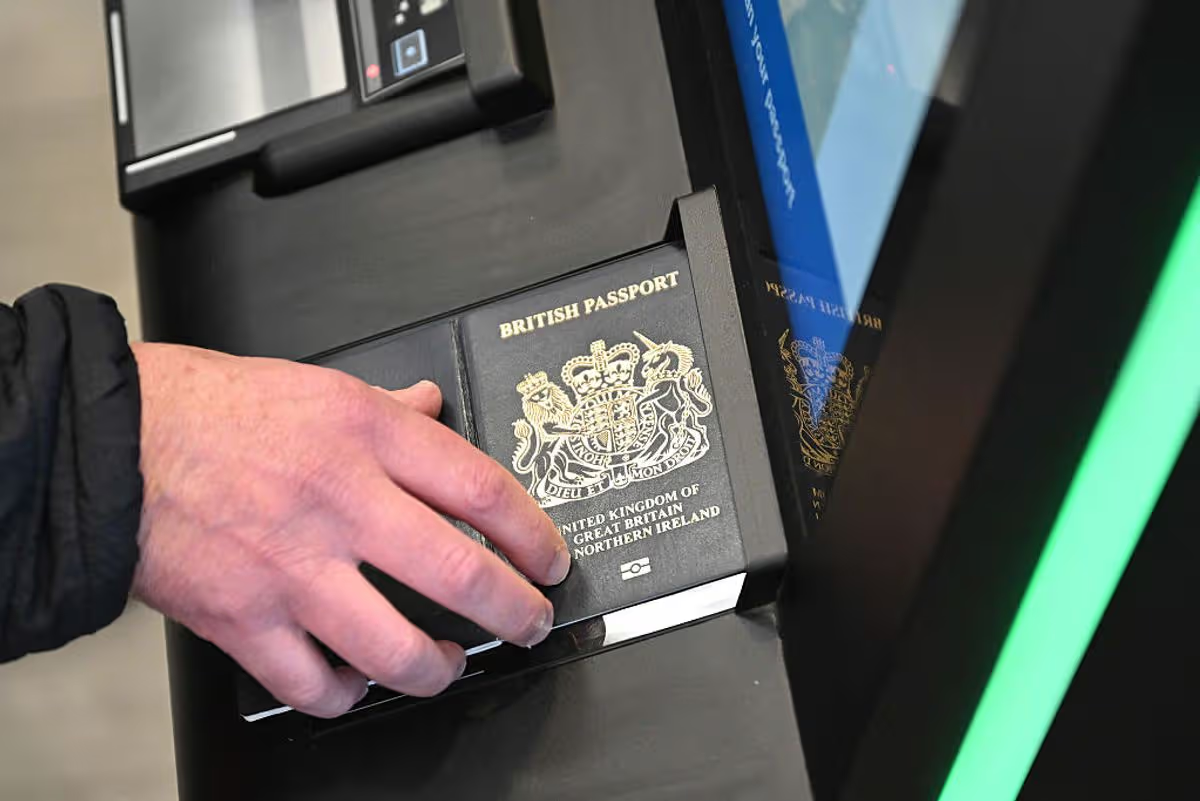
The EU’s Entry/Exit System (EES) started a phased rollout on October 12, 2025 in 29 European countries and is fully operational from today – April 10, 2026.
Sign up for the Travel newsletter
Thank you!
The new Entry/Exit System to Europe is fully operational from todayCredit: Alamy
What is EES?
EES is a new automated IT system that has been introduced across airports, ferry terminals and Eurostar stations across the Schengen area.
The system tracks short stays in Europe – up to a maximum of 90 days in any 180-day period.
Why has it been introduced?
EES has been introduced to replace the need for passport stamps.
Instead, going forward, visitors will automatically be checked-in when they enter and exit an EU country.
The aim of the system is to tighten border control, prevent illegal immigration and prevent identity fraud.
Is it also designed to make border crossings more efficient in the long run?
What travel does it impact?
No matter how you are travelling, whether that be by train, plane or sea, Brits (as well as all non-EU nationals) visiting Europe will have to follow the new rules.
If you are going on holiday to any of the following 29 countries, you will be required to follow EES.
Austria
Belgium
Bulgaria
Croatia
Czech Republic
Denmark
Estonia
Finland
France
Germany
Greece
Hungary
Iceland
Italy
Latvia
Liechtenstein
Lithuania
Luxembourg
Malta
Netherlands
Norway
Poland
Portugal
Romania
Slovakia
Slovenia
Spain
Sweden
Switzerland
How will it work?
All non-EU nationals – which includes Brits – are required to register their details on their first visit to a Schengen area country.
This will be done by using specific EES machines which will be at airports, ferry terminals and the Eurostar terminals.
The machines will log your fingerprints, facial images and scan your passport as well.
From today, every traveller has to register with EES.
Once you have registered (such as taking fingerprints and a photo), it is valid for three years.
It impacts all Brits heading to EuropeCredit: Alamy
Each time you travel within those three years, you must complete a shorter and faster check in, which, for example, usually involves scanning your fingerprints already on the system every time you enter or exit the Schengen Area.
If your passport expires before the three year mark, you will need to re-register with your new passport.
You will also have to re-register when the three years expires.
Will it cost me anything?
EES does not cost anything and is free for all travellers.
It is not a paid visa.
Will it make my journey time longer?
There have already been some reports of delays due to travellers registering for EES, including long queues and lengthy wait times.
Travel Reporter Alice Penwill spent three hours getting through the arrivals hall at Lanzarote Airport last month.
And delays have been reported at other airports like Brussels, Lisbon and Prague.
Some airports have put preparations in place to avoid travel chaos.
For example, Spanish operator, Aena, has said that is adapting security and border control for Brits at Ibiza, Menorca, Malaga and Palma, Majorca airports.
You must register, which includes scanning your fingerprintsCredit: Reuters
Tips to help with EES
The FCDO has recently updated its advice for countries impacted by EES.
On the website it states: “EES may take each passenger extra time to complete so be prepared to wait longer than usual at the border.
“EES is replacing the previous system of manually stamping passports when visitors arrive in the Schengen area for short stays. You may be asked to input biometric details every time you enter or exit.
“If you enter the Schengen area through the Port of Dover, Eurotunnel at Folkestone or Eurostar at St Pancras International, any information will be taken at the border before you leave the UK.
“Your digital EES record is valid for 3 years.”
While you might not be able to beat the long queues, Sun Travel has a few tips to make the process less stressful.
For example, book a seat at the front of the plane – this will help you get off the plane and to border control before the rest of passengers on your flight.
Where possible, booking the first flight of the day may help as they are generally fewer flights scheduled at this time and could mean less disruption.
If you have a connecting flight, try and go to a bigger airport when connecting as they are likely to be better equipped for the introduction of EES.
If travelling with children, think about the entertainment you can take with you, like an iPad.
This could help to keep them occupied and calm in long queues.
If you are disabled, make sure to let the airline know in advance as after landing, staff should escort you straight through to the front of the border control queues.
And last but not least, if you are going to be waiting in line for a while you want to make sure you are comfortable – so ditch the uncomfortable shoes, head to the toilet on the plane before you land and make sure you have some water with you.
New EU rules for Brits kick off today – what it means for your holiday plans – The Mirror
Need to know
The European Union’s (EU) new Entry/Exit System (EES) is now fully operational, meaning that Brits travelling into major European holiday hotspots will need to go through a new digital border
The EU’s new Entry-Exit System (EES) has been fully rolled out(Image: Getty Images)
Five things to know about the new EU rules
As of Friday, 10 April, the European Union’s (EU) new Entry/Exit System (EES) has been fully rolled out, and Brits will be required to go through the digital border system when travelling to the Schengen area.
Countries in the Schengen area include: Austria, Belgium, Bulgaria, Croatia, Czechia, Denmark, Estonia, Finland, France, Germany, Greece, Hungary, Iceland, Italy, Latvia, Liechtenstein, Lithuania, Luxembourg, Malta, Netherlands, Norway, Poland, Portugal, Romania, Slovakia, Slovenia, Spain, Sweden, and Switzerland. The EES system is not required for travel into the Republic of Ireland and Cyprus, as they are not within the Schengen area.
With the new system in place, Brits will need to “create a digital record” and register their biometric details, such as fingerprints and a photograph, on their first visit to the Schengen area at the airport border upon arrival. This will be free of charge, and holidaymakers do not need to do anything before arriving at the border.
The new EES registration has replaced the former system of manual passport stamps when arriving in the EU. The government noted that the EES may take “each passenger a few extra minutes to complete”, but once done, the EES record is valid for three years. During this time, when entering the Schengen area again, Brits will only need to provide a fingerprint or photo at the border on entrance and exit.
Brits have been warned to expect delays and allow for extra time at the airport following the full introduction of the EU system, which was first rolled out on 12 October 2025. Luke Petherbridge, director of public affairs at ABTA, said: “What we have said to customers is that, because of the checks, you might need to prepare for delays with extra water and snacks.”
When booking holidays, you might forget to check when your passport expires. Different countries have their own rules on passport validity, with some requiring it to be valid for your entire trip while others for even longer.
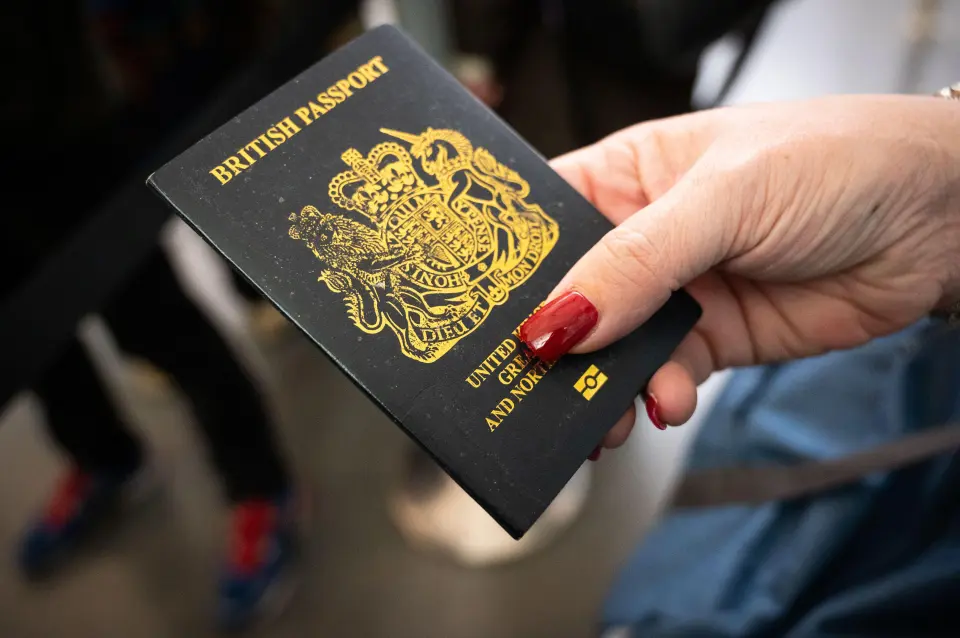
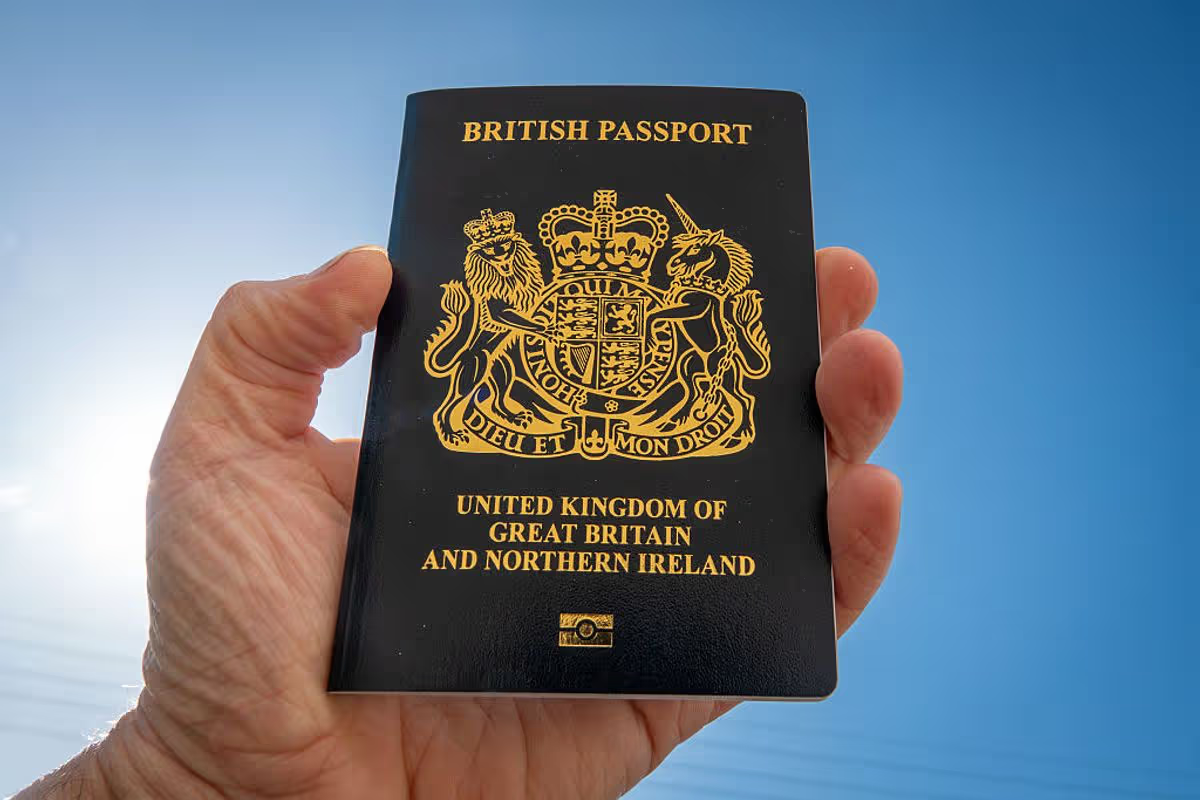
To travel to Europe and Schengen countries, passports must be less than 10 years old before your departure date and valid for at least three months after your planned return date.
If your passport doesn’t meet these requirements, you’ll need to renew it. However, on Wednesday, April 8, the prices are set to increase.
A new passport application online currently costs £94.50 for an adult standard 34-page passport and a standard child passport costs £61.50.
The fee for a standard online application will then be £102 for adults and £66.50 for children.
Applications made by post are currently £107 for an adult and £74 for a child. Yet, as of tomorrow, these will go up to £115.50 and £80 respectively.
Other passport fees are set to increase this week. If you need a passport quickly, the fee for a premium one day service made within the UK will rise from £222 to £239.50.
If you apply for a UK passport overseas, this will increase from £108 to £116.50 for adults and £70 to £75.50 for children. Overseas standard paper applications will increase from £120.50 to £130 for adults and £82.50 to £89 for children.
The Home Office said of the increase: “The new fees will help the Home Office to continue to move towards a system that meets its costs through those who use it, reducing reliance on funding from general taxation.
“The government does not make any profit from the cost of passport applications.
“The fees contribute to the cost of processing passport applications, consular support overseas, including for lost or stolen passports, and the cost of processing British citizens at UK borders.”
It said that in 2025, 99.7% of standard passport applications from the UK were processed within three weeks when no further information was required.
If you are requiring a new passport and don’t want to pay the additional fees, it has been recommended to submit your application before the increase on Wednesday.
New passport prices
Adult standard online application from within the UK – £102
Child standard online application from within the UK – £66.50
Adult standard postal application from within the UK – £115.50
Child standard postal application from within the UK – £80
Premium one day application from within the UK – £239.50
Adult standard online application from outside the UK – £116.50
Child standard online application from outside the UK – £75.50
Adult standard paper application from outside the UK – £130
Child standard paper application from outside the UK – £89
As “The Super Mario Galaxy Movie” lands in theaters, coloring stations, collectible popcorn containers and mascot Marios are all in place to entice arguably the most prized moviegoers to Hollywood today: kids.
By Sunday, Universal Pictures expects the five-day opening of the “Super Mario” sequel to reach $186 million domestically, and around $350 million worldwide. That would make it easily the biggest hit of the year, surpassing a pair of successes that also launched with young moviegoers in mind: Pixar’s “Hoppers” ($297 million worldwide) and Amazon MGM’s “Project Hail Mary” ($300.8 million).
It’s not the start of a new trend but the culmination of one. In 2024, PG-rated movies outgrossed any other rating for the first time in decades, with $3.18 billion in domestic ticket sales according to Comscore. Five of the top six movies worldwide were PG movies: “Inside Out 2,” “Moana 2,” “Despicable Me 4,” “Wicked” and “Mufasa: The Lion King.”
Last year was no different. PG-rated films amassed $2.96 billion, again besting the longtime leader, PG-13. The top draws globally were “Ne Zha 2,” “Zootopia 2,” “Lilo & Stitch,” “A Minecraft Movie” and the PG-13-rated but not exactly kid-adverse “Avatar: Fire and Ash.”
Good news has been hard to come by in Hollywood. Contraction, most recently with Paramount Skydance’s planned purchase of Warner Bros. Discovery, has added to the anxieties of an already jittery industry. While ticket sales are up so far in 2026, they remain more than 20% below pre-pandemic levels. In February, AMC, the nation’s largest exhibitor, said it would continue to shutter underperforming theaters.
But despite a lot of talk about the imperiled future of moviegoing, future moviegoers — kids — are turning out in droves.
“There’s a recognition that this is an increasingly important group of movie fans and we’re doing everything we can to make sure their experience is wonderful,” says Michael O’Leary, president and chief executive of Cinema United, the trade group for theater owners.
Gen Alpha, those aged 12 or younger, may even be the movies’ best hope. A study last year by the National Research Group found that no generational group wanted to watch movies on the big screen, as opposed to at home, more than Gen Alpha.
“We’re emboldened by some of the research that indicates younger folks are the fastest growing demographic of people going to the movies,” O’Leary says. “We’re very much focused on the fact that we have to build the next generation of movie fans.”
Mario, Minions and more
In 2023, “The Super Mario Movie,” part of Universal’s collaboration with Nintendo and “Minions”-maker Illumination, grossed $1.36 billion. Its sequel is likely to get close to that, and add to a mounting string of $1 billion kids movies. The most recent was The Walt Disney Co.’s “Zootopia 2,” which became the highest-grossing Hollywood animated film of all time with a whopping $1.87 billion.
Increasingly, a generation that grew up with smartphones, iPads and Netflix is propelling today’s biggest blockbusters.
“What’s been true for a long time and is maybe even truer today: Families want to be out,” says Jim Orr, distribution chief for Universal, which recently announced the expansion of its exclusive theatrical window from three weekends to five. “They want to do things. They want to make memories.”
“No one talks about: Remember that great time when we sat on the couch?”
And this year may be the most kid-catered year at the movies yet. There are 26 wide-release PG movies slated for 2026, up from 24 in 2025 and 18 in 2024.
That includes a summer lineup that’s family friendly on a nearly week-to-week basis. Potential blockbusters lined up include “Toy Story 5” (June 19), “Minions & Monsters” (July 1) and the live-action “Moana” (July 10). Though currently unrated, “The Mandalorian and Grogu” (May 22) and “Supergirl” (June 26), not to mention “Spider-Man: Brand New Day” (July 31), will all also target young moviegoers.
A PG comeback
The PG surge comes several years after most family movies detoured to streaming during the pandemic, a shift that some, at the time, feared would become permanent.
“The family film has literally come back from near-extinction,” says Paul Dergarabedian, head of marketplace trends for Comscore. “The one genre that really took a major hit with the pandemic was the family film.”
But kids increasingly count among a key category for theaters: the habitual moviegoer. That’s considered going to six or more movies a year. And it’s not just younger kids. Last year, 41% of Gen Z moviegoers went to the movies at least six times, according to NRG, up from 31% two years earlier.
For cinephiles who have long feared movie theaters effectively turning into mini theme parks, the predominance of kid-oriented franchise blockbusters is unlikely to allay those concerns. Mid-budget, adult releases are increasingly rare. Dramas and comedies have struggled to attract audiences. Family-friendly movies occupying a bigger slice of cinemas is partially because adult moviegoing has waned.
But if older moviegoers are harder to coax away from the couch, families have been more eager. For them, the appeal of getting out of the house, despite rising ticket costs or the options on streaming services, is as strong as ever.
“In many instances, they’re going to the theater to get away from all of the other screens that inhabit their lives,” says O’Leary. “When I was a kid, you went to the movies, in part, to escape from something. So it’s a new variation on that old theme.”
Dergarabedian has taken to calling PG the new PG-13. If slightly adult-leaning movies once occupied the center of the multiplex, that territory now belongs to the PG movie.
“The kids that are going to the movies today are going to take their kids tomorrow,” Dergarabedian says. “As long as people keep making kids, the future of the movie theater experience is assured.”
COLEEN ROONEY will mark her 40th birthday today with a series of celebrations at her £20million Cheshire mansion.
But the hundreds of bottles of champers on ice this weekend are far from the only corks she will be popping this year.
Coleen, above at the National Television Awards last year, will mark her 40th birthday with a series of celebrations at her £20million mansion in CheshireCredit: GettyMum-of-four Coleen with former Man Utd superstar Wayne and kids Klay, Cass, Kit and KaiCredit: Instagram
Mum-of-four Coleen — wife of former Manchester United superstar Wayne — has big plans in the pipeline — with one pal telling The Sun: “She’s entering her powerful era.”
One friend explained: “Coleen’s sons are growing up fast and she is excited about the opportunities coming her way.
For a long time her primary focus was being a mum to her four boys. She is the backbone of their household, a constant for her sons and for Wayne.
“But now they’re growing up — the boys somewhat more than Wayne at times — Coleen is ready to reclaim some of herself.
“Going into I’m A Celebrity was a great way for her to dip her toe into the water. She loved it and it was obvious the nation still has a massive soft spot for her.
“Coleen said she would take a break after that to work out her next move.
“Turning 40 and with loads of exciting things coming her way, she’s entering this powerful new era.”
Coleen will celebrate today with Wayne and their sons, budding Man Utd footballer Kai, 16, Klay, 12, Kit, ten, and eight-year-old Cass.
She will then throw a huge bash for her closest friends and family.
An enormous white marquee has been erected in the 50-acre grounds of their home, previously dubbed “Morrisons mansion” because of its vast size and appearance.
“I’m looking forward to it, I love a birthday and a celebration,” Coleen said ahead of her bash.
“I have decided to enjoy a couple of different celebrations with family and friends over the year, and with my birthday falling over Easter weekend, some friends are away — so any opportunity to extend the celebrations…”
Caterers and staff will keep the party running smoothly, with insiders saying no expense has been spared.
“Coleen loves a good knees-up,” another pal explained.
“She can afford a lovely lifestyle and everything at the party will be classy and beautifully done. But for her, plenty of booze, good music and her family is all she will want.
There’s going to be live music and you can guarantee Wayne will be getting up on the microphone
Pal
“There’s going to be live music and you can guarantee Wayne will be getting up on the microphone.
“He loves to sing and will be keen to give everyone a tune or two.”
Those close to Coleen say eyes will be kept on Wayne following a rather embarrassing boozy night out before the Brit Awards in February.
Photographs and videos from a posh bar in Manchester obtained by The Sun showed Wayne struggling to do up his trousers after he spent time chatting with a mystery woman.
He was later seen leaving the venue at 3.45am and getting into a car alone to head home.
At the time, pals close to Coleen said they were furious at his behaviour, which came in the same week Coleen was launching her Primark clothing collection.
Coleen is now said to have big plans in the pipeline, above posing in her range from Primark as part of a deal worth millionsCredit: Matt Healy for PrimarkThe mum, pictured here at a fashion awards event in 2006, will throw a huge bash for her closest friends and family to celebrate her 40thCredit: Shutterstock Editorial
Branding Wayne an “idiot”, one seethed: “It’s upsetting to see Wayne acting this way because it takes the spotlight away from her.”
After dating Wayne since she was 16 years old, Coleen is well-versed in facing down his antics. She has stuck by him through every crisis in their marriage — including visits to sex workers in 2004 and 2009 and being charged with drink-driving in 2017.
In recent years Wayne has curbed his wayward ways, but has still had his share of controversial moments.
Turning 40 and with loads of exciting things coming her way, she’s entering this powerful new era
In 2020 he allegedly poked fun about his lack of a sex life, while the following year he was photographed fast asleep in a hotel room chair while three women struck comic poses around him.
“If Coleen is the angel then Wayne has definitely always been the devil on her shoulder,” one friend joked.
“Her friends think she’s the strongest woman out there for putting up with everything that Wayne has done. It takes a certain kind of woman to tolerate that behaviour and live with it. But Coleen has always just asked for honesty.
“The only time I think she’d draw the line is with anything that could affect her children.
“Her four boys are Coleen’s world. And when it comes to her kids, she is like a lioness with her cubs.
“Wayne absolutely knows that. She is just as fiercely protective over him too, to be honest. Coleen comes across as soft on the surface but she’s got balls of steel. No one would mess with her.”
Coleen herself confessed she was used to Wayne’s poor decision making and said she stuck with him for love.
She told British Vogue: “We’ve had our ups and downs. Obviously everybody knows. It’s been hard to go through it in the public eye but there has always been true love there.
“If the love is gone then, it’s pointless. But if not, you’ve got something to work for.”
Coleen added: “We’ve never backed away from it. We own it.
Coleen was the 2024 I’m A Celebrity runner-upCredit: RexA young Coleen, aged 16, famously photographed in school uniform in 2003Credit: Mirrorpix
‘Cheering her on’
“I remember having a conversation about this with someone and I said, ‘Well, do you know what your wife gets up to every day and night? At least I know what my husband is doing!’
“It might not be good, but I know. People lie to themselves.”
Coleen first came into the public eye when Wayne burst on to the scene as a teenager at Everton — and she was famously photographed in her school uniform aged 16 in 2003.
Her fashion choices saw her becoming a regular at high-end Liverpool boutique Cricket, once dubbed the “unofficial footballers’ wives headquarters” for how often she and other local Wags, including Steven Gerrard’s wife Alex, shopped there.
But it was at the 2006 World Cup at Baden-Baden in Germany that Coleen cemented her status as one of our favourite Wags alongside Cheryl Cole and Victoria Beckham.
Coleen comes across as soft on the surface but she’s got balls of steel. No one would mess with her
Friend
In that same year she teamed up with Asda as the face of its George clothing brand, before kicking off a lucrative deal with Littlewoods four years later for her own range.
It is expected that Disney TV cameras will capture parts of Coleen’s birthday celebrations, with the family opening the doors of their home for a fly-on-the-wall series.
Simply called The Rooneys, the three-parter has filmed both Wayne and Coleen, while also shadowing Coleen as she worked with Primark on her clothing line.
Insiders say the big plan for Coleen is to help make her star shine brighter.
Undeniably, she now has the opportunity to bring in the bigger pay packets.
Her deal with Primark was worth millions, while further lucrative deals have been coming in thick and fast.
Those close to Coleen say eyes will be kept on Wayne following a rather embarrassing boozy night out before the Brit Awards in February, the pair above in 2004Credit: News Group Newspapers Ltd
He now has regular gigs as a pundit on Match Of The Day but, as one pal puts it, that is not going to sustain their lifestyle.
“Coleen is the golden ticket for the family now,” a friend explained.
“Wayne was the breadwinner for so long and now the roles have started to slowly reverse.
“To put it bluntly, Coleen is very marketable. She is popular, unproblematic and relatable. Her decision to create an affordable brand with Primark shows that.
“Watching her next steps is going to be really interesting. Everyone who knows and loves Coleen is cheering her on and wants her to succeed.
“This is just the beginning for Coleen. Now you just have to sit back and watch her rise.
“We just hope Wayne catches on and keeps himself in line.”
If you grew up in the ‘70s or ‘80s, your vision of suburban America probably looks a lot like South Pasadena. There’s good reason. The picturesque town on the western edge of the San Gabriel Valley was often used as a backdrop in films like “Halloween,” “Pretty in Pink” and “Back to the Future” (the street where George McFly, Lorraine and Biff lived is actually Bushnell Avenue).
Today in South Pasadena, you’ll still find this idyllic Anytown USA landscape — but with a twist: Along with verdant parks, Craftsman bungalows and tree-lined streets, the city gleams with cool new developments like the recently opened Sid the Cat Auditorium, an all-ages live music venue in a converted 1930s elementary school; the always-packed Cannonball from chef Matt Molina; L.A.’s first nonalcoholic bottle shop Burden of Proof and a high-tech head spa imported from Japan. Add on a walkable downtown and a bustling Thursday night farmers market and it’s easy to see why so many Angelenos are drawn to this increasingly hip community.
Get to know Los Angeles through the places that bring it to life. From restaurants to shops to outdoor spaces, here’s what to discover now.
“So few pockets of L.A. County are actually great for families and that’s what makes South Pas so compelling,” said my friend Tom, who moved to the area after having a baby two years ago. “Plus, it has light-rail.”
Located six miles from downtown L.A., South Pasadena was marketed as a “garden community” when it was founded in the late 19th century. New residents were promised homes with flowering vines and sweet-smelling gardens, all just a short cable car ride away from a bustling metropolis.
“It was that early promise of suburbia,” said Becky Nicolaides, a historian and author of the book “The New Suburbia: How Diversity Remade Suburban Life in Los Angeles After 1945.” “When it was incorporated, there weren’t cars, so the town was built to be walkable.”
But that peaceful facade hid an ugly truth. Like many suburbs in the L.A. area, the town’s officials put race restrictive covenants into place soon after its founding, making it illegal for residents to sell property to people of color.
Those covenants became illegal in 1948, but the town continued to discourage people of color from living within its boundaries for several more decades. That began to change in the 1960s and South Pasadena has diversified, particularly over the past decade. In recent years, town leadership has taken steps to acknowledge its racist past.
Now, even as a new energy permeates, the city continues to lean into its early suburban history. The town is just 3.4 square miles, but it encompasses 100 acres of parks and playgrounds as well as 21,000 trees. There’s an old-fashioned pharmacy where parents have taken their kids for a phosphate soda (or just a regular old milkshake) for over 100 years and volunteers from the community still decorate a float for the Tournament of Roses each year, just as they have since 1911.
And though its historic Red Car trolleys have been discontinued for decades, today it’s still a comfort to take the Metro home from work at the end of a long day and enjoy the peace and quiet of this pastoral suburb, just like its founders did more than a century ago.
What’s included in this guide
Anyone who’s lived in a major metropolis can tell you that neighborhoods are a tricky thing. They’re eternally malleable and evoke sociological questions around how we place our homes, our neighbors and our communities within a wider tapestry. In the name of neighborly generosity, we may include gems that linger outside of technical parameters. Instead of leaning into stark definitions, we hope to celebrate all of the places that make us love where we live.
Our journalists independently visited every spot recommended in this guide. We do not accept free meals or experiences. What L.A. neighborhood should we check out next? Send ideas to guides@latimes.com.
Depending on where people stay, they could be paying more than £13 a night in the municipal surcharge
The Las Ramblas district of Barcelona, Spain. People visiting are to be hit by new charges from April 1(Image: Getty)
UK travellers to Spain have been told of a ‘doubling’ of a charge for all tourists going to a popular hotspot from today. It has been reported in Spain that the doubling of the municipal surcharge comes into effect on April 1.
Depending on the type of accommodation, tourists may pay up to €15 more per night in Barcelona. This is due to an increase in the tourist tax on the one hand now ranging from €1 to €7 depending on the category of accommodation and a municipal tax which rises from €4 to €8.
Applicable to stays in hotels, hostels and short-term rentals, these taxes can, when combined, amount to up to €15 per night per person, LeFigaro reported.
The measure was announced in March 2025 but was only approved by the Catalan parliament a few weeks ago. Barcelona City Council has voted in favour of increasing the council tax by one euro per year until 2029. The aim is to tackle the housing crisis. Residents regularly protest against rising rents, which they believe are partly due to the growing number of short-term rentals such as Airbnb.
In a four-star hotel – which accounts for nearly half of the local hotel stock – a two-night stay for a couple could therefore cost up to €45 more. Cruise ship passengers must also pay these taxes: they will pay €12 – instead of €8 – if they disembark for more than twelve hours, or €14 (instead of €11) if they stay for less than twelve hours. One exception remains for a specific category of accommodation: hostels listed in the Generalitat de Catalunya’s Youth Hostel Register, for which the fee remains at €1.
With these new rules, the Autonomous Community of Catalonia hopes to raise 200 million euros a year. On its website, the Catalan government states that “25% of the revenue from the tourist tax will be allocated to the Generalitat’s housing policies, whilst 75% will be channelled into the Tourism Promotion Fund, [in particular] for housing policies [and] economic development policies.”
With the new regulation, the tax will rise to seven euros per night in five-star accommodations in Barcelona and to 3.40 euros in four-star accommodations. It will also be more expensive for cruise passengers, especially those disembarking in the Catalan capital. Those staying for less than 12 hours will pay six euros in Barcelona and 4.50 euros in the rest of the ports in Catalonia , 20 Minutos reported.
The tax increase will be phased in over two years. The first increase will take place this April, while the remainder will be implemented a year later, in April 2027. At that point, the tourist tax will be completely doubled. However, in Barcelona, the increase will be more immediate and will begin this month to address the high tourist pressure the city experiences, unlike the rest of Catalonia.
The revenue from the tourist tax will be divided into two parts. 25% of the total income will be allocated to housing policies of the Generalitat (Catalan government), one of the main pillars of Catalan President Salvador Illa’s policies. The remaining 75% of the revenue will be integrated into the Tourism Promotion Fund.
The increase in the tourist tax in Catalonia already has the support of a majority of the parliamentary groups, as well as the backing of a large part of the population. This is especially true in Barcelona, where overtourism has wreaked havoc on both housing and community life. In fact, in the Catalan capital, there have already been demonstrations by residents against the massive influx of visitors, and proof of this is that 76.7% of the population says the city has reached its maximum capacity for receiving tourists.
These data are reflected in the latest survey on tourism perception in Barcelona, published by the city council itself, in which 56% of residents support the increase in the tourist surcharge.
Public support for the increase in the tourist tax contrasts sharply with the total opposition from the Catalan tourism sector. Following the announcement of the agreement between the PSC, ERC, and Comuns parties, business owners in Catalonia’s tourist accommodation sector expressed their “total and unanimous rejection.” The employers’ association Confecat asserted that the measure is “improvised, lacking strategic rigour, disconnected from the country’s real needs, and driven solely by revenue collection.”
Furthermore, the Catalan Federation of Tourist Apartments (Federatur) warned that the tax increase will lead to a loss of competitiveness for the region and make Catalans’ holidays more expensive. This position is also supported by other employers’ associations, trade groups, and federations within the sector, such as Foment del Treball, the Barcelona Hotel Guild, Pimec, and the Barcelona Tourist Apartment Association.
According to Jordi Clos, president of the Hotel Association, there is some concern among representatives of the tourism sector about how the tax increase will affect business. “It will be necessary to monitor the impact this measure may have to prevent a significant and lasting decline,” he stated after the Catalan Parliament approved the increase in February.
HOLIDAYS are getting more expensive from today with a rise in Air Passenger Duty (APD).
ADP, first introduced in 1994, is the ‘tax’ that passengers have to pay when flying from the majority of UK airports, which is built into the cost of flights.
Sign up for the Travel newsletter
Thank you!
Going on holiday is getting more expensive from todayCredit: AlamyAir Passenger Duty has increased from today – and will go up again this time next yearCredit: Alamy
From today, the rates have increased, and how much you pay depends on the final destination and the class of travel.
Band A is any destination abroad whose capital city is 2,000 miles or less from London, which covers all of Europe and parts of North Africa.
For example, flying in economy to a short-haul destination like Spain, Greece or Portugal has some of the lowest rates from £15.
A family of four could therefore expect to pay £60 under the new rules if travelling in economy.
The government will review the rates of APD again on April 1, 2027.
The new APD rates can range from £8 to £1141Credit: gov.uk
There aren’t many ways to avoid paying APD, but if you still want to go abroad and avoid the extra fee, there are a few ways to do so.
Passengers under 16 who are travelling in basic economy are exempt from paying APD – although if they fly premium economy or above, they will be charged.
One is to fly into the UK on one plane and out within 24 hours on another.
But you need to have them both included in the same ticket.
Or, fly on a route from a UK airport that is not subject to APD.
Scottish Highlands and Islands region are exempt like Inverness, Oban, Sumburgh and Stornoway.
Direct long-haul flights from Northern Ireland are also exempt as long as the first part of the journey is to a destination not in the UK or in Band A.
When the departure tax was first introduced, it was just £5 European flight and £10 on long-haul services.
Peter Alexander, who covered Washington for NBC News for more than a decade, is leaving the network to join MS NOW, according to people familiar with his plans.
Alexander, 49, will serve as an anchor and chief national reporter for MS NOW. He will have a weekday program and also handle breaking news coverage throughout the day.
A 22-year veteran of NBC News, Alexander served as chief White House correspondent and co-host of the Saturday edition of “Today” with Laura Jarrett. He is among the most familiar faces in the White House briefing room.
Alexander told viewers at the end of his Saturday broadcast that he is departing NBC News but did not mention his new job. A representative for MS NOW declined comment.
MS NOW is the progressive-leaning cable channel formerly known as MSNBC. The network changed its name after it was spun off from Comcast into a new company called Versant.
After the split, MS NOW ended its relationship with NBC News. Journalists who worked on both MSNBC and NBC News had to chose which entity they would work for going forward.
Correspondents Jacob Soboroff and Ken Dilanian switched from NBC News to MS NOW. Data guru Steve Kornacki decided to stick with NBC News as he also has assignments at NBC Sports. Willie Geist, a co-host on MS NOW’s “Morning Joe,” is an exception as he continues to anchor NBC’s “Sunday Today.”
Alexander is the first NBC journalist to cross over to MS NOW since the split. His deal with Versant also gives him the opportunity to contribute to sports coverage on the company’s other cable properties, USA Network and the Golf Channel.
Alexander will anchor the 11 a.m. Eastern hour on MS NOW, succeeding Ana Cabrera, who is leaving the network when its daytime programming changes take effect in June.
Alexander joined NBC News after serving as an anchor on the network’s Washington station WRC.
He was White House correspondent from 2012 to 2014 during President Obama’s second term and returned to the assignment in 2018 to cover President Trump.
An aggressive questioner, Alexander has been chastised by Trump publicly over news conference questions that made him unhappy.
Viewers of NBC’s morning program learned Friday that Guthrie will be back to her hosting duties at the network’s Rockefeller Plaza studio in New York on April 6.
Guthrie has been absent from “Today” since Feb. 2, the day after learning her mother Nancy was abducted from her Tucson home. She appeared on the program this week in a taped interview with Hoda Kotb, her first since her mother went missing..
Guthrie’s re-entry on “Today” is certain to generate significant viewer interest. Her 84-year-old mother’s case, still being investigated by law enforcement, generated an outpouring of public affection for the co-host.
Many media industry insiders expressed serious doubts over whether Guthrie would return to television before law enforcement determined what happened to Nancy Guthrie. But people close to Guthrie believe her grit and deep religious faith will provide her with the strength to move forward.
Guthrie’s daily presence on “Today” will also help keep her mother’s case in the public eye. NBC is also airing a special “Dateline” episode on the abduction on Friday.
Guthrie has spent most of the last seven weeks in Tucson with her family. She canceled plans to be a part of NBC’s coverage of the Winter Olympics in Milan and before this week only appeared on TV and social media in taped messages asking for the help in finding her mother.
Nancy Guthrie was last seen Jan. 31, when she spent the evening with family members. Law enforcement officials believe she was removed from her Catalina Foothills home later that night against her will as her phone, wallet, car and medication were left behind.
Surveillance videos of a masked man who was outside Guthrie’s front door on the night she disappeared were released by the FBI.
Christmas is still quite some way away, but one attraction is already putting tickets on sale for its magical experiences, and if previous years are anything to go by it could sell out quickly
This immersive experience takes kids on a magical journey to meet Father Christmas(Image: LaplandUK)
It doesn’t feel that long since the Christmas decorations were packed away, but one festive attraction is already putting its tickets on sale today (March 27) for the Christmas 2026 season.
Tickets for LaplandUK, which has locations in Ascot and Cheshire, will go on sale tomorrow at 10AM with over a million people expected to join the queue. The experience is often likened to booking Glastonbury tickets, as hopeful parents will need to wait in a virtual queue and have ten minutes to complete their order once they reach the front.
Ticket prices for 2026 have been confirmed, starting at £60 for midweek dates in November, up to £155 per person for peak weekends in December. Both venues will also host a ‘Superstar Day’ on November 25 which is “adapted for families and guests with access requirements to create a quieter, more relaxed and accessible environment.”
While the tickets are costly, the cost does include a range of experiences that set it apart from the average Santa’s grotto. Families receive a special gift boxed invitation ahead of their day out to build the excitement, and this message from Father Christmas personally invites little ones to visit LaplandUK to help the elves with toy-making.
On arrival, visitors step into a magical world, walking through several different interactive experiences from the Elven Bazaar, where guests have to work out how to enter the door to Lapland, to the Lapland Bakery where kids can help make some Christmas treats before enjoying storytime with Mother Christmas.
The experience lasts around four-and-a-half hours, according to the LaplandUK website, and also includes ice skating, a soft toy for every child, a small toy to give to kids on Christmas Day, and of course, a special visit with the man in red himself, deep in a snowy forest.
Husband-and-wife founders of LaplandUK, Mike and Alison Battle, took to Facebook to update fans of the attraction about changes that are being made for 2026. Alison said: “Every year, we challenge ourselves to make the experience more special, more magical, more believable. And this year, we’ve got some very exciting things in store for you.”
The pair announced that invites would be sent earlier this year, towards the end of the summer, to build anticipation of the event. They added that the return experience will be upgraded, so that “coming home will be just as magical”, and that visitors to Little Rudy’s Stables will now be able to make reindeer food to take home with them.
One of the major changes will be in the Elven Village, which the pair said has expanded over the years to be more immersive and include more characters. Guests will now get more time in the village to listen to stories at Fable’s Library, skate on the ice rink, and meet characters along the way.
Those hoping to grab tickets for LaplandUK can either register on the official site to get a ticket booking link ahead of the sale, or visit the website from 9am to join the queue.
LaplandUK’s Facebook page confirmed that both sites will have their own booking queues accessed through a unique link. It said: “Upon entering a queue, you will be randomly assigned a place before bookings open. When the queue begins moving at 10 AM, you’ll gradually make your way forward.
“Once you reach the front, you will have 10 minutes to complete your booking for your chosen location.. We truly cannot wait to welcome you to Lapland to make treasured memories together this Christmas.”
Have a story you want to share? Email us at webtravel@reachplc.com
The shiny new escalators will be up and running from today – eight days earlier than TfL had announced – and should last the station 30-40 years.
The station is also much brighter as the escalators have rows of lights and the area has been whitewashed.
The pale blue panels have been replaced with white panels, which reflect light much better and have a noticeable effect on the station’s appearance.
A new lift has also been installed as well as energy-efficient lighting, upgraded safety features, local artwork, and a new raised ceiling.
Seb Dance, Deputy Mayor for Transport, told The Sun previously that it was “fantastic” the major upgrade at Cutty Sark DLR station could be delivered earlier than expected.
Before it closed, Cutty Sark was the third busiest station on the Docklands Light Railway (DLR), after Canary Wharf and Limehouse.
Thousands of passengers were forced to take the 121 station steps at Cutty Stark due to faulty escalatorsCredit: Alamy Stock Photo
The Bird Cage Theatre has stood inside Knott’s Berry Farm for 72 years — albeit not always soundly. Long framed by a tin roof and a tent, the theater had a reputation for discomfort, as it was a source of punishing heat and the occasional mouse sighting.
“It was hot, it stunk and it was dirty,” says Payden Adams, the park’s VP of entertainment.
Still, though it has long felt like an endangered species, the Bird Cage Theatre is one of Southern California’s most historic revival houses, a place for vaudeville-style, fourth-wall-breaking shows that deviate from the expected theme park fare. To quote the theater’s most recent production, its entertainment can be “flirtatious and a little bit saucy.”
Knott’s Berry Farm’s Bird Cage Theatre is modeled after a historic venue in Tombstone, Ariz.
(Kyusung Gong / For The Times)
Opened in 1954, the Bird Cage Theatre has specialized in vaudeville-style melodramas.
(Knott’s Berry Farm)
And now, against all odds, the Bird Cage is getting a second life. Knott’s Berry Farm recently completed a renovation designed to keep it thriving for another 72 years. Gone is the tarpaulin roof: The Bird Cage is now a fully enclosed, soundstage-like structure. And blessedly, it has modern air conditioning.
The theater reopened this past weekend with “The Great Bank Robbery,” a 30-minute-plus show in which audiences are encouraged to boo, hiss and swoon over the characters, a Bird Cage tradition since 1954. Characters are caricatures, be it a villain that feels plucked from a cartoon western, complete with a purring raccoon for a sidekick, to a greedy wannabe politician of a bank manager. Though set in Ghost Town with period garb, there are modern flourishes, such as tongue-in-cheek nods to the theme park’s attractions and a damsel in distress who ultimately proves to be anything but.
Though it once operated as a daily theater, the Bird Cage is today most active during holidays and seasonal events, such as the park’s annual Boysenberry Festival, which also began this weekend. Popular summer show “Miss Cameo Kate’s Western Burle-Q- Revue” is a 20-minute cabaret-style performance, complete with a torch song and a slightly risqué cancan finale.
When it’s running, the Bird Cage is a must-see attraction. Live theater in theme parks can feel like a moving target, as conventional wisdom often argues that today’s smartphone-addled guests are after thrills and more attention-grabbing, interactive experiences. But when it works, such as during the over-the-top silliness of “The Great Bank Robbery,” or at Universal Studios’ “Waterworld”-themed stunt show, it can offer guests some of the most memorable, personal moments at the parks.
The Bird Cage Theatre reopened this past weekend with the show “The Great Bank Robbery.”
(Kyusung Gong / For The Times)
“You’re not wrong, especially when it comes to attention spans. We experience that,” says Adams, who oversaw the theater’s restoration. “The way we’ve pivoted and navigated is just ensuring our shows are tight and clean. It might be a little over 30 minutes, but audiences are engaged. In melodramas, we ask the audience to participate, and we can train them how to participate beforehand. When you see characters, even when they’re heightened or over-the-top, people still connect with them.”
The Bird Cage Theatre first opened in the summer of 1954, its facade a near-replica of the original Bird Cage in Tombstone, Ariz. That the family-focused Knott’s would nod to the Arizona locale is an oddity in and of itself, as the actual theater had a bawdy reputation. Stories today speak of a place that initially opened with grand ambitions but eventually succumbed to gambling and prostitution.
At Knott’s, the theater was built around existing structures, although park founder Walter Knott, according to the book “Knott’s Preserved” by Chrstopher Merritt and J. Eric Lynxwiler, often talked about completing it as a full tribute to the Arizona space. That never really happened.
Knott’s re-created the original wallpaper of the Bird Cage Theatre for its remodeling.
(Kyusung Gong / For The Times)
And yet over the years the Bird Cage won over audiences thanks to programming from Vaudeville veterans. Early on, students from nearby colleges would appear at the space, including Steve Martin, whose signed photograph graces a celebrity wall in the Bird Cage’s introductory hall. Donna Mills and singer Rick Nelson have graced the Bird Cage’s horseshoe-shaped stage, as have Dean Jones and Skip Young.
It was, to say the least, a quirky place to perform. “Knott’s Preserved” tells of a show in which a mouse once sat at the base of the stage, and quotes Martin as reminiscing over performances affected by the weather. “When it rained, no one could hear each other because the rain was beating so hard on that tarp,” Martin said.
None of that should be a problem anymore, although returning guests will likely feel they’re in a familiar space. Though the Bird Cage has been outfitted with modern lighting capable of new theme park tricks and projections, the rig is hidden among curtains designed to re-create the look of the original tent. Lights, in bird cage enclosures, still hang above the audience seating area, which has room for about 250 guests.
The Bird Cage Theatre at Knott’s Berry Farm now has a properly enclosed roof and air conditioning.
(Kyusung Gong / For The Times)
And along the way a few discoveries were made. Adams says that when they began stripping away wooden walls added sometime in the 1970s, they found the Bird Cage’s original wallpaper, a scarlet-red strip that surrounds the space with flower-adorned bird cages. Not all of it could be salvaged, so Knott’s meticulously re-created the look. With the new-old wallpaper intact, Adams estimates that guests can count about 11,055 bird cages throughout the theater.
The original pieces will be preserved in the park and gifted to important Bird Cage players. Adams jokes, “If you have a mailing address for Mr. Steve Martin, I have a gift to send him.”
Many airlines are operating restricted schedules due to airspace restrictions in the Middle East, with 21,915 of the 38,193 services scheduled to fly since February 28 cancelled
15:11, 11 Mar 2026Updated 15:11, 11 Mar 2026
Yesterday, British Airways announced that it has suspended all flights to and from Amman, Bahrain, Doha, Dubai, and Tel Aviv until later this month,(Image: Getty Images)
Dozens of flights to and from the UK have been cancelled today as the war in Iran continues.
Many airlines are operating restricted schedules due to airspace restrictions in the Middle East, with 21,915 of the 38,193 services scheduled to fly since February 28 cancelled.
On Wednesday morning, Dubai International Airport was forced to temporarily pause operations due to a drone strike nearby, which wounded four people. Authorities have confirmed that flights have since continued.
Emirates and Etihad are still operating limited schedules from Dubai and Abu Dhabi airports, respectively. Qatar Airways said it is “doing everything possible to support affected passengers and help reunite them with family and loved ones” while Qatari airspace remains closed.
The airline said that operations will resume“ once the Qatar Civil Aviation Authority confirms the safe reopening of Qatari airspace.”
Yesterday, British Airways announced that it has suspended all flights to and from Amman, Bahrain, Doha, Dubai, and Tel Aviv until later this month, while its services to and from Abu Dhabi are cancelled until later this year. The decision means hundreds of BA services will be cancelled over the coming months.
Flight data shared exclusively with the Mirror by analytics firm Cirium shows that 55 of the planned services due to fly today had been cancelled as of 12.45 pm, which is 2.49% of the total scheduled to fly into the UK from the Middle East and vice versa.
UK flights cancelled on March 11
Arrival Country: Flights; Cancelled; Cancel %
Qatar: 18; 17; 94.44%
United Kingdom: 493; 15; 3.04%
United Arab Emirates: 32; 11; 34.38%
Bahrain: 3; 3; 100.00%
United States: 113; 2; 1.77%
Jordan: 3; 1; 33.33%
Israel: 7; 1; 14.29%
Germany: 116; 1; 0.86%
Denmark: 29; 1; 3.45%
Cyprus: 20; 1; 5.00%
Uganda: 1; 1; 100.00%
Ireland: 121; 1; 0.83%
If you are due to fly from or to the Middle East in the coming days, make sure you check your airline’s website for instructions and the Foreign Office website for the latest advice.
What have the airlines said?
Aegean Airlines – Greece’s largest carrier cancelled flights to Tel Aviv until March 20; Beirut, Erbil and Baghdad until March 25; Dubai and Abu Dhabi until March 19; and Riyadh until March 14.
Air France–KLM – Air France cancelled flights to Tel Aviv and Beirut through March 13, and to Dubai and Riyadh until March 12. KLM suspended flights to Dubai, Riyadh and Dammam until March 10, and to Tel Aviv for the rest of the winter season.
Cathay Pacific – Cancelled all flights to and from Dubai and Riyadh until March 31.
Delta – Cancelled flights from New York to Tel Aviv until March 22 and from Tel Aviv to New York until March 23.
Emirates – Operating a reduced flight schedule but expects to return to full operations within days, depending on airspace availability and operational requirements.
Etihad Airways – Resumed a limited commercial flight schedule between Abu Dhabi and several key destinations.
Iberia Express cancelled all flights to and from Tel Aviv through March 10.
Lufthansa Group – Lufthansa, Austrian Airlines, Swiss and Brussels Airlines suspended Tel Aviv flights through April 2 and Beirut flights through March 28. Flights to Tehran are suspended until April 30, and to Amman, Erbil, Dammam, Dubai and Abu Dhabi until March 15.
Norwegian Air – Now plans to start flights to Tel Aviv and Beirut on June 15, instead of the previously scheduled April 1 and April 4.
Qatar Airways – Operating a limited schedule to and from Doha, with some flights resuming from March 9 following temporary authorisation from Qatar’s civil aviation authority.
Saudia Airlines – Suspended flights to Amman, Kuwait, Abu Dhabi, Doha and Bahrain until March 10, and to Moscow and Peshawar until March 15. Limited operations to Dubai have resumed.
Wizz Air – Suspended flights to Israel until March 29, and flights from mainland Europe to Dubai, Abu Dhabi, Amman and Jeddah until mid-September.
Back in the early 2010s, the music industry was at a low point.
Piracy was rampant. Compact disc sales were on a steady decline. And the then-new audio streaming services, like Spotify, were taking hits from creators for paying low royalty rates.
Today, Spotify has grown into the world’s most popular audio streaming subscription service and the highest-paying retailer globally — paying the music industry over $11 billion last year. The Swedish company said in a recent post that the payouts aren’t strictly going to ultra-popular artists, but that “roughly half of royalties were generated by independent artists and labels.”
“A decade ago, a lot of the questions were really fair. Spotify had to be able to prove out if it could scale as an economic engine. People didn’t know if streaming would scale as a model,” said Sam Duboff, Spotify’s global head of marketing and policy of music business.
Duboff said Spotify’s payouts aren’t “plateauing — we’re still growing that royalty pool on Spotify more than 10% per year.” He credits the streaming platform’s growth to “incentivizing people to be willing to pay for music again” by providing personalized experiences and global accessibility.
The company, founded in 2006, serves more than 751 million users, including 290 million subscribers, in 184 markets.
“The average Spotify premium subscriber listens to 200 artists every month, and nearly half of those artists are discovered for the first time,” Duboff said. “When you build an experience where people can explore and fall in love with music, it inspires them to upgrade to premium and keep paying.”
The platform offers a wide variety of playlists, curated by editors like the up-and-comer-driven Fresh Finds or rap’s latest, RapCaviar. There are also personal playlists generated for users, such as the weekly round-up Discover Weekly and the daily mix of tunes called the “daylist.”
The streamer considers itself the first step toward “an enduring career” for today’s indie artists. Last year, more than a third of artists making $10,000 on the platform in royalties started by self-releasing their music through independent distributors.
“Streaming, fundamentally, is about opportunity and access. It’s artists from all over the world releasing music the way they want to and reaching a global audience from Day One,” Duboff said. He adds that when fans have a choice, they will discover new genres and music cultures that may have otherwise languished in obscurity.
In 2025, nearly 14,000 artists earned $100,000 from Spotify alone. The streamer’s data also show that last year the 100,000th highest-earning artist made $7,300 in Spotify royalties, whereas in 2015, an artist in that same spot earned around $350.
The company, with a large presence in L.A.’s Arts District, emphasizes that the roster of artists on its platform who earn significantly more money — well into the millions — is no longer limited to the few. A decade ago, Spotify’s top artist made around $10 million in royalties. Today, the platform’s top 80 artists generate over $10 million annually. Some of 2025’s top artists globally were Bad Bunny, Taylor Swift and the Weeknd.
Spotify claims those who aren’t household names can earn six figures, with more than 1,500 artists earning $1 million last year.
For some musicians, the outlook is not as clear
Damon Krukowski, a musician and the legislative director for United Musicians & Allied Workers, argues that Spotify’s money isn’t necessarily going to artists — it’s going to their labels.
Those without labels usually upload music through distributors such as DistroKid and CD Baby. These platforms charge a small fee or commission. For example, DistroKid’s lowest-level subscription is $24.99 a year, and the site states users “keep 100% of all your earnings.”
”There are zero payments going directly to recording artists from Spotify,” Krukowski asserts. “Recording artists deserve direct payment from the streaming platforms for use of our work.”
The advocacy group, which has mobilized more than 70,000 musicians and music workers, recently helped draft the Living Wage for Musicians Act to address the streaming industry. The bill, introduced to the U.S. House of Representatives last fall, calls for a new streaming royalty that would directly pay artists a minimum of one penny per stream.
In the Q&A section of Spotify’s Loud and Clear website, the streamer confirms that it “doesn’t pay artists or songwriters directly. We pay rights holders selected by the artist or songwriter, whether that’s a record label, publisher, independent distributor, performance rights organization, or collecting society.”
Instead of following a penny-per-stream model, Spotify pays based on the artist’s share of total streams, called a “streamshare.”
“Streaming doesn’t work like buying songs. Fans pay for unlimited access, not per track they listen to,” wrote the company online. “So a ‘per stream’ rate isn’t actually how anyone gets paid — not on Spotify, or on any major streaming service.”