Boston Symphony Orchestra’s grand AI experiment is a boon to democracy
The symphony orchestra takes its name from the Greek symphonía, meaning sounding in agreement, and orkhēstra which implies a public stage for dance or, in ancient Rome, where senators and other big shots sat. Democracy comes from dēmokratia, rule by the people. Even though the modern orchestra originated three centuries ago as a plaything of princes, there has always been an implicit connection — and tension — between orchestras and democracy.
Despite the orchestra never having been a financially sustainable model, dependent on some form of patronage, the symphony orchestra was embroiled in political activism by the early 19th century. Beethoven brazenly yanked the dedication to Napoleon from his “Eroica” Symphony when the “hero” proclaimed himself emperor in 1804, a betrayal of the democratic ideals of the French Revolution.
More than two centuries later, the orchestra continues to be a potent reminder of power to the people, a community of exquisitely trained artists marching to a beat, staying in tune and on message. In this year’s election season orchestras have been practicing the call for democratic thinking on a global scale, including in Los Angeles, Boston and Leipzig, Germany. Strikingly, this comes at a time when beleaguered orchestra musicians have also been demanding a more democratically minded workplace.
Throughout October and up to election day, Wild Up in L.A. has taken the lead in orchestral electoral activism. Its “Democracy Sessions” are an ongoing procession of interdisciplinary concerts, theatrical events, interactive gatherings, environmental presentations and gabfests in theaters, museums, libraries, parks, on neighborhood streets and around the L.A. River. Wild Up winds up its call for democracy with “Music to Vote By,” lunchtime solo acoustic sets, noon to 2 p.m., through Tuesday at the Democracy Center at the Japanese American National Museum Plaza in Little Tokyo.
Wild Up, itself, is a uniquely egalitarian collective, a chamber orchestra of composers and soloists, although one that nonetheless requires traditional leadership of its visionary founder, conductor Christopher Rountree. Rountree’s interdisciplinary “sessions” run from the musically sophisticated and accomplished to ad hoc and participatory funkiness, less designed to change minds than to relieve democracy anxiety.
A democracy zeitgeist, for instance, pervaded a performance at REDCAT of Louis Andriessen’s “De Staat,” a Dutch minimalist masterpiece from the mid-1970s. To intense rhythmic propulsion of piano and winds, four women vocalists intone excerpts from “The Republic,” in which Plato calls for rule of the people not the rule of music, fearful of a music that can alter “the most fundamental laws of the state.” Andriessen set out to show how mistaken Plato was.
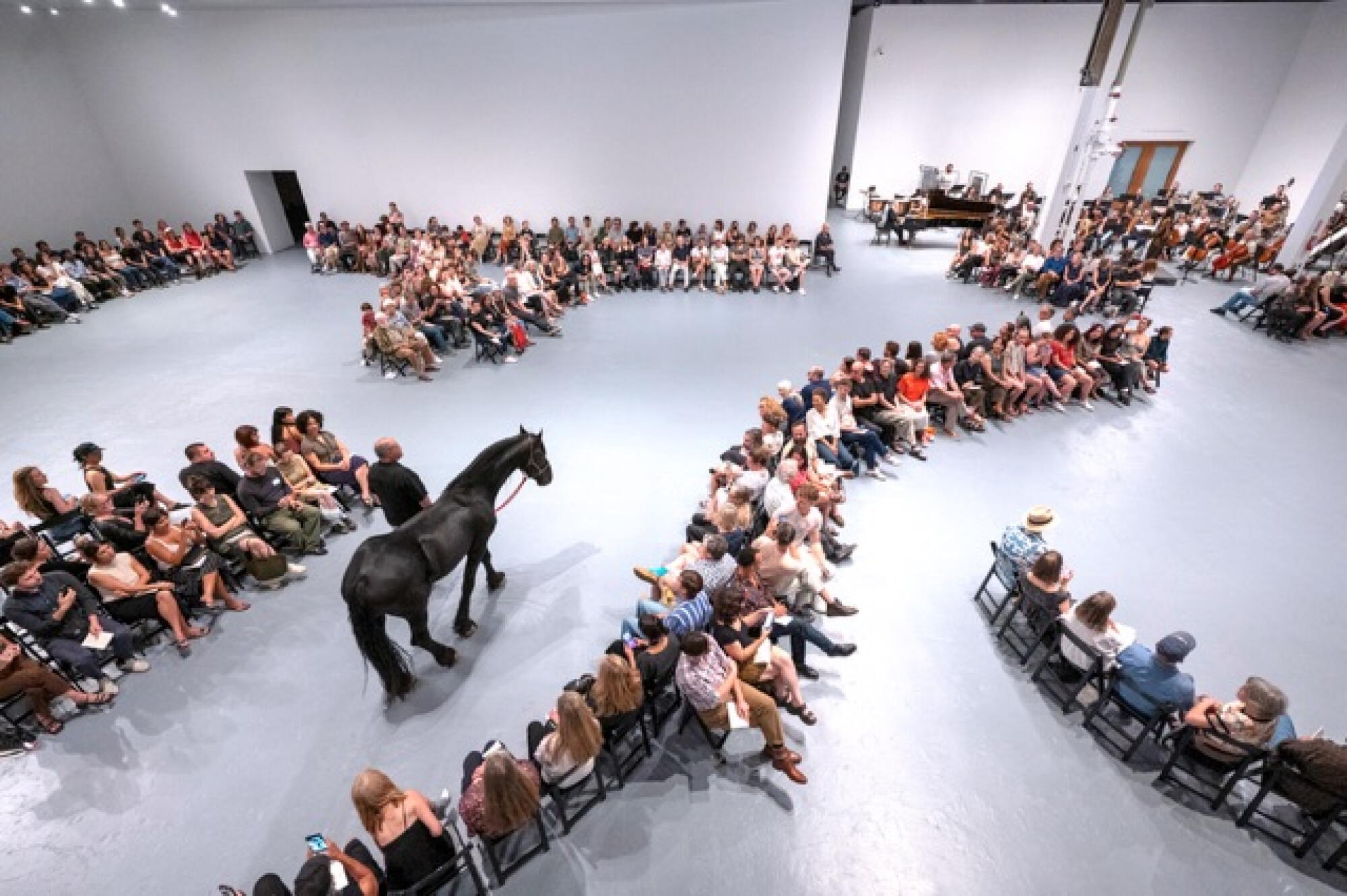
Elsewhere, Rountree acted as an assembler, demonstrating democracy in action. In British composer Oliver Leith’s “Garland,” a kind of musical and theatrical tool kit, Rountree created a spectacle of song, dance, instrumental mayhem (whirly tubes, button whistles and the like added to the mix) and included amateur performers from the community hymn singing with the pros. It ended with a lovely appearance by a black horse all in the expanses of MOCA’s Geffen Contemporary. What does this have to do with the price of gasoline? Nothing more than a reminder that the quotidian world around us can be a hymn all by itself.

Wild Up’s performance of “Garland” at the Geffen Contemporary at MOCA.
(Josh Rose / Wild Up)
Germany is having its own brush with democracy with a recent election in which the far-right Alternative for Germany party won power in the central state of Saxony-Anhalt. The city of Leipzig borders that state, and its historic Gewandhaus Orchestra marked the days preceding the election with a democracy weekend it called “Reading the Signs.” The suggestion here was rather than falling for oversimplification and conspiracy theories when it comes to examining the interaction of “music, discourse and social action,” look to Beethoven.
That included a performance by Stegreif, an improvising orchestra that functions as a kind of German Wild Up. For Democracy Weekend, Stegreif “exploded” Beethoven’s “Eroica.”
It so happens that the Boston Symphony and Gewandhaus share a music director in Andris Nelsons, who has strived to bring the two orchestras together in joint projects. Sure enough, the BSO has been living up to its calling as the orchestra in the birthplace of American democracy. At Tanglewood, the orchestra’s summer home in the Berkshires, the orchestra celebrated the semiquincentennial with the premiere of Philip Glass’ “Lincoln” symphony and Yo-Yo Ma’s weeklong “We the People” residency, which offered a widely varied look at our democratic musical roots.
Then barely two weeks before the midterms, the BSO channeled Boston’s revolutionary spirit with explosive AI. At a time when much of the country sees artificial intelligence as a significant threat to democracy, the premiere of Tod Machover’s “already and not yet,” a concerto for orchestra with electronics bathed in AI, begs otherwise.
Machover’s brilliant new half-hour orchestral score asks AI for agency. It does so by treating the technology as stupid, musicians as creative artists and the audience as capable of opening its collective mind. It handles democracy not as a done deal, but a series of scary questions — and doesn’t trust the heartless machines for answers.
A commission in celebration of the 40th anniversary of the MIT Media Lab, “already and not yet” challenges us to make the world more beautiful by looking deeply into ourselves. The Media Lab is an unprecedented electronic playground born of AI. For one of the optimistic developers of AI, the musically minded computer scientist Marvin Minsky, the Media Lab functioned akin to a surgeon removing blockages to the imagination.

The interior of MIT’s groundbreaking Media Lab.
(Mark Swed)
Minsky was also a mentor to Machover, who has been at the Media Lab since the start and now heads the faculty. Machover’s AI is not a data collector in the sense of the commercial, data-gobbling, mind-numbing monstrosities lately foisted on the public. It becomes a new tool in his piece, not a way of life, something merely taught to listen and analyze in hopes of giving musicians a new idea or two.
With the help of an AI operator, Manaswi Mishra, who is embedded in the orchestra, the AI becomes the “already” in “already and not yet.” It doesn’t have much use in the tumultuous first movement, “SMASH UP,” when the world is a mess and that’s our problem. In the ethereal second movement, “WAKE UP,” players become individual and AI spits out responses that read as ordinary electronic mimicry, but the players, if game, take that as a challenge. Weirdly the machine brings them to life and as individuals. In the last movement, “STAND UP,” the machine is tamed! We frolic in a new, sonic wonderland. Even Thoreau might approve!
Can AI-assisted utopian art save democracy? That’s a tall order. Let it first try to do something about the BSO. As conductor, Kent Nagano was the ultimate listener (he can cut off the AI when it’s not interesting). After the performance he told me the orchestra was always game. And he sandwiched Machover with lithe, colorful Mendelssohn performances (including the Fifth Symphony).
But this is an orchestra in revolt, and it looked it. Grim of mien, many players on the night I attended sported red flowers on their lapels, a sign of their dissatisfaction with the administration for not renewing Nelsons’ contract when it expires this summer, after 13 years leading the BSO. The orchestra claimed it was broadsided by the announcement that management and Nelsons did not have a shared vision. The players want a say, an orchestra as democracy and more than just AI’s version of agency.
Ironically, Nelsons, who signed a nondisclosure agreement, doesn’t seem to show much vision when it comes to democracy. The Latvian conductor did not participate in Tanglewood’s democracy concerts (although he did conduct excerpts from John Adams’ “Nixon in China,” which sounded, in the radio broadcast, as having such a heavy hand that there was no room for free thinking).
In Leipzig, Nelsons’ contribution to the Gewandhaus democracy weekend was no democracy at all, only an irrelevant program of Tchaikovsky and Dvorak standards. Leipzig, bursting like Boston with young people, has become a German tech hub, it too could have used a whirl with democratic AI.
Swed is The Times’ former classical music critic.