tiny

Sweden’s Gripens Are Doing Big Things With A Tiny Footprint In Poland

Russian cruise missiles enter Polish airspace during a major attack on Ukraine. NATO fighters scramble. Two Swedish Gripens join Polish F-16s in the response, tracking airborne threats over Poland. One Swedish pilot attempts to intercept an object believed to be a Russian Kh-101 cruise missile and has conditional NATO authorization to engage. But exceptionally difficult weather prevents positive identification, and the pilot holds fire.

The incident on November 20 highlights the operational value of Sweden’s small forward presence at the airbase of Mińsk Mazowiecki, outside Warsaw. Just two days earlier, TWZ made an exclusive visit to the base, where Sweden is supporting NATO air operations with a forward team of just eight personnel. The Gripens themselves remain primarily based in Sweden, but the small forward support element provides an additional operating location that can help sustain missions on very short notice and give the Swedish fighters greater flexibility as they scramble to defend NATO’s eastern flank.

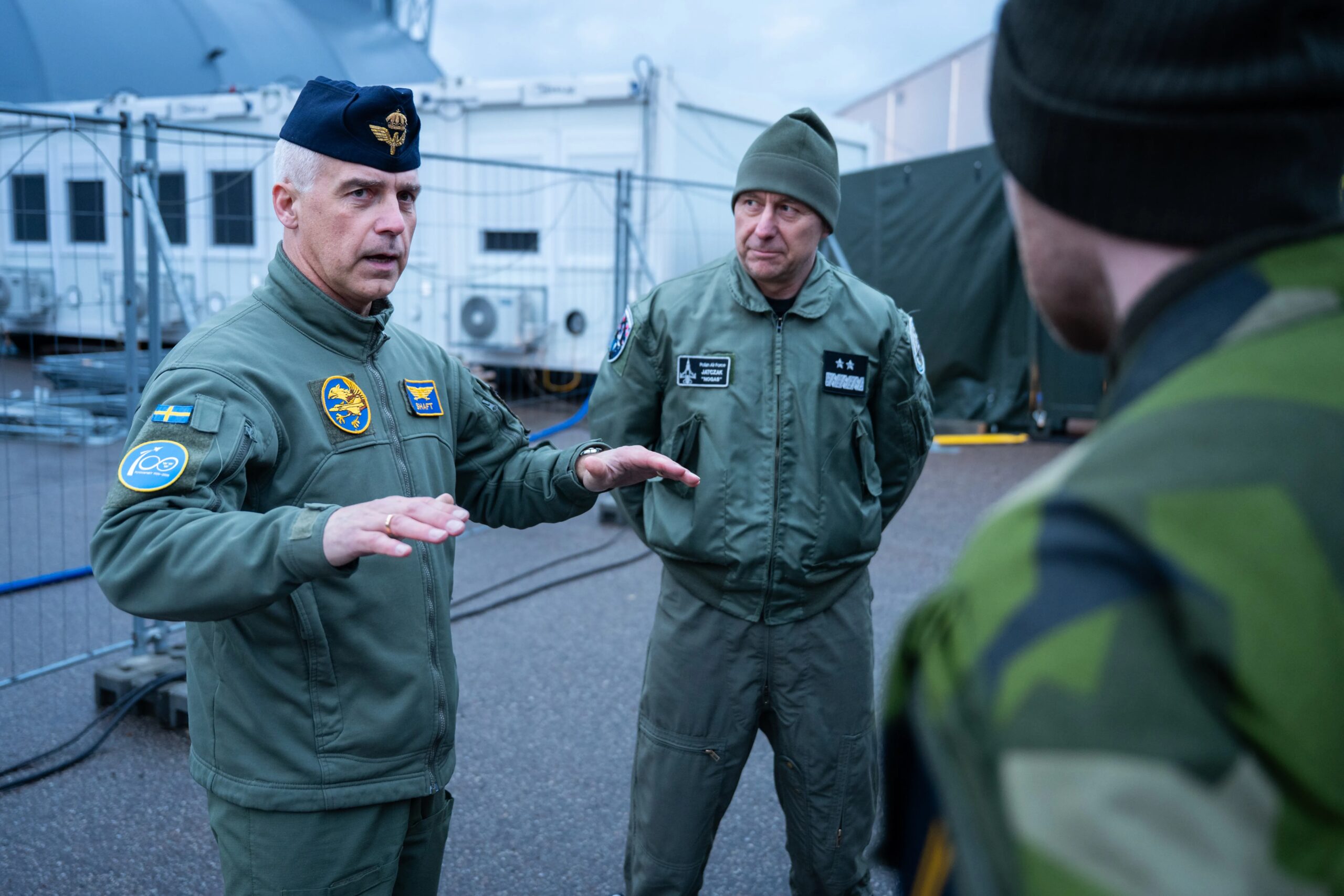
Major General Jonas Wikman at Mińsk Mazowiecki during a visit by TWZ. Swedish Armed Forces

The operation is a practical illustration of Sweden’s effort to extend its long-established dispersed fighter operations concept across NATO — not as a future capability waiting to be validated, but as an operational approach continuously evolving through real-world missions.

“The events of the past few days have demonstrated the operational value of the concepts we have been developing,” Major General Jonas Wikman, chief of the Swedish Air Force, tells TWZ. “In both Poland and Finland, Swedish fighters have responded rapidly and decisively alongside our allies, while maintaining our national alert commitment.”

A map shows the locations of Mińsk Mazowiecki, as well as the three Swedish Gripen bases (yellow), and the Finnish fighter bases (blue) where the Swedish jets can also routinely refuel from. Google Earth

“In Poland, we conducted a demanding air defense mission lasting several hours under very challenging conditions. Our small forward support element was instrumental in enabling us to sustain that operation.”

Wikman is particularly proud of the personnel involved, describing the professionalism, judgement, and resolve demonstrated by Swedish personnel in the air and on the ground.

“We are not developing these concepts for some future scenario. We are using them in real-world operations today, learning from every mission and continuously improving our ability to defend our shared airspace. That is what being ready means to me.”

Stock photo of a Swedish Air Force Gripen scramble. Swedish Armed Forces

Expanding the Swedish model deeper into NATO

Sweden has spent roughly 60 years building its air arm around the ability to operate fighters from locations beyond their normal air bases, including road strips, civilian airports, and the strategic island of Gotland. The approach is focused on moving aircraft and support personnel quickly, limiting their exposure and avoiding dependence on a small number of large, fixed installations. They are truly masters of dispersed operations, and everything is designed to operate with a minimal logistics and manpower footprint. It turns out that this Cold War concept of operations is more relevant today than it has been in decades.

A Swedish Saab JAS 39 Gripen fighter jet escorts a distinguished visitor party aboard a Swedish C-130H over Gotland Island, Sweden, October 23, 2021. The distinguished visitors toured the island as part of a Swedish-led bilateral engagement which included a demonstration of HIMARS (High Mobility Artillery Rocket System) from the Wisconsin Army National Guard displaying the United States’ and Sweden’s continued effort in maintaining interoperability and rapid response readiness in the region. (U.S. Army Photo by Sgt. Patrik Orcutt)
A Swedish JAS 39C Gripen over Gotland Island, Sweden, October 23, 2021. U.S. Army photo by Sgt. Patrik Orcutt

Now, Sweden is adapting that model to NATO operations, while other air forces are replicating it out of necessity.

“We are really ambitious about our NATO operations, our integration into NATO, and our role as a security provider within the alliance,” Wikman says.

The Swedish Air Force has already deployed fighters to NATO missions in Iceland and Poland, while also maintaining national commitments. Wikman describes the broader effort as an evolution of Sweden’s dispersed operations concept, incorporating the flexibility associated with the U.S. Air Force’s Agile Combat Employment (ACE) while extending the ability to operate from locations across allied territory.

Sweden is extending its dispersed fighter operations across NATO through a tiny forward support element in Poland—one that is already supporting real-world air defence missions as the Alliance confronts Russian airspace violations.
A Swedish JAS 39C Gripen arrives for a hot refuel at Mińsk Mazowiecki on November 18, 2026. Swedish Armed Forces

The scale of the current Polish deployment marks a significant change from an earlier operation at Malbork, where Sweden sent more than 100 personnel.

Wikman wanted to reduce that footprint substantially, challenging the wing commander to determine how little personnel and equipment were actually required to support the mission.

The result was a forward team of just eight personnel.

Swedish personnel unload a Gripen pilot ladder from a support vehicle at Mińsk Mazowiecki. Swedish Armed Forces

Rather than establishing a substantial forward operating base, the team uses familiar Swedish equipment and procedures, bringing what is required to support aircraft operating from Sweden. The approach is intended to be repeatable, reducing the preparation and logistical burden associated with deployments and making it easier to shift support between different NATO directions.

Wikman believes the concept can make operations more flexible, allowing Sweden to sustain commitments in different locations without having to build a large support organization for each one.

The Missed Refueling Base

The forward location in Poland is described as a Missed Refueling Base, or MRB. Originally established as a contingency option, it has proven sufficiently useful to become routinely used for forward Gripen operations, including for scheduled turnarounds (landing, basic service/refuel, and departure) of the jets.

Gripens normally operate from Swedish bases, even when patrolling over Polish skies, and can use air-to-air refueling to extend their time and reach. The MRB provides another option if an aircraft needs to land, whether because of an unexpected issue or as part of a planned operation.

A Gripen undergoes hot refueling at Mińsk Mazowiecki. Swedish Armed Forces

A problem with the refueling probe, for example, could prevent an aircraft from receiving fuel in the air. Having a forward location available means the aircraft can recover without necessarily having to return to its home base in Sweden.

But its broader value is not simply emergency recovery.

The location extends operational reach, flexibility, and the number of options available to commanders. Aircraft can land, refuel, and receive limited maintenance, and even rearm during a crisis, with the tiny forward team providing a means of sustaining operations without deploying a full squadron support infrastructure.

A Swedish JAS-39 Gripen prepares to take on fuel from a U.S. Air Force KC-135R Stratotanker during the Arctic Challenge exercise Sept. 20, 2013, over Norway. Sweden and other members of the Nordic Defense Cooperation train with the U.S. Air Force regularly to maintain proficiency operating in a multinational environment. (U.S. Air Force photo by 1st Lt. Christopher Mesnard/Released)
A Swedish JAS 39C Gripen prepares to take on fuel from a U.S. Air Force KC-135R Stratotanker during an exercise over Norway. U.S. Air Force photo by 1st Lt. Christopher Mesnard/Released

The Swedish approach is built around the idea that an operating location does not need to replicate a home air base to provide significant operational value.

The Gripen itself is famously designed for rapid servicing. Wikman says an aircraft in the air-to-air role can be refueled and rearmed in less than 15 minutes using one officer and five conscripts. That combination of aircraft design, procedures, and personnel is central to the Swedish model.

A ground refueling tanker was among the handful of vehicles brought by the Swedish contingent at Mińsk Mazowiecki. Swedish Armed Forces

Tankers, turnaround and surviving the targeting cycle

The MRB also ties into Sweden’s thinking about how fighters will operate in a high-intensity conflict.

Air-to-air refueling remains valuable, but Wikman stresses that Sweden must be able to conduct operations without depending on tanker availability. Tankers could be heavily tasked, unavailable, or threatened in a contested environment.

The objective is not to abandon aerial refueling, but to ensure it is not a single point of failure.

A Swedish JAS 39C Gripen after being topped up by a Swedish ground refueling tanker that was brought to Mińsk Mazowiecki. Swedish Armed Forces

“We intend to do the quick refueling within the enemy targeting cycle,” Wikman says, describing the importance of being able to land, refuel, and get back into the air quickly, frustrating an adversary’s efforts to detect and successfully attack those same aircraft while they sit on their airfield.

Sweden is also developing procedures for hot rearming, allowing weapons to be replenished as aircraft are turned around without the engine shutting down. Wikman expects this process to take less than 10 minutes, potentially around five or six minutes, although the procedures continue to evolve.

Swedish Armed Forces airmen ground refuel and rearm a Swedish JAS 39 Gripen fighter jet at the Uppland Wing at Ärna Air Base in Uppsala, Sweden, Sep. 17, 2025. This was part of a demonstration of the Swedish Air Force’s capabilities during a visit by the National Guard’s top leaders. (U.S. Air National Guard photos by Tech. Sgt. Sarah M. McClanahan)
Swedish airmen ground refuel and rearm a Gripen in Sweden. The trolley and loading hoist are the only items of equipment needed for a weapons reload. U.S. Air National Guard photo by Tech. Sgt. Sarah M. McClanahan

The challenge becomes more complex as the distance between operating locations and logistical support grows.

As Sweden develops the ability to disperse fighters and operate farther from its main bases, it must also develop the logistics to sustain aircraft, personnel, fuel, ammunition, and maintenance across those same distances. Extending operational reach without extending the supporting supply system would ultimately limit the value of the concept.

Swedish ground crew watch as a JAS 39C Gripen arrives at Mińsk Mazowiecki. Swedish Armed Forces

That is an important area for continued development within NATO, particularly as nations seek to make dispersed operations sustainable rather than simply achievable for short periods.

Finland, Poland and national QRA simultaneously

The Polish deployment is taking place alongside Swedish support for air defense operations in Finland and Sweden’s own national quick reaction alert (QRA) mission.

In Finland, Sweden has trained Finnish maintenance personnel at each wing to support Gripen hot refueling. The Finnish personnel have also received virtual-reality training equipment to help them maintain their skills.

Wikman describes the Finnish arrangement as more bilateral in nature, while the Polish deployment is part of Sweden’s effort to establish a repeatable way of operating across NATO. At the same time, the involvement of the Gripens speaks to the situation in Poland, where jets are scrambling from Sweden to deal with growing airspace incursions by Russian drones and cruise missiles. They execute this mission alongside Polish F-16s and other NATO fighters based, even if temporarily, in Poland and the wider region.

At the same time, Sweden is maintaining its national QRA commitment. Wikman said the effort is centered on Ronneby, in southern Sweden, but draws on aircraft and pilots from other wings, including Luleå, close to the Arctic Circle.

A Swedish Saab JAS 39 Gripen C takes off for an integrated training sortie at Luleå-Kallax Air Base, Sweden, Feb. 26, 2024. Bomber Task Force operations provide U.S. leaders with strategic options to assure Allies and partners, while deterring potential adversary aggression across the globe. (U.S. Air Force photo by Staff Sgt. Jake Jacobsen)
A Swedish JAS 39C Gripen takes off for an integrated training sortie at Luleå-Kallax Air Base, Sweden, February 26, 2024. U.S. Air Force photo by Staff Sgt. Jake Jacobsen

“More or less three directions: Finland, Poland, and our national QRA at the same time, which is a new kind of record for us,” he says.

For a relatively small air force with six fighter squadrons, sustaining those commitments is a significant undertaking. Of those squadrons, more than one is also pretty busy with introducing the new Gripen E version. The smaller Polish footprint is intended to make that kind of activity more manageable, allowing personnel to rotate without maintaining a much larger deployed contingent.

The approach also allows Sweden to concentrate on generating fighter sorties while relying on forward support locations to provide flexibility when operational circumstances demand it.

Lessons from Ukraine

Wikman sees a close connection between Sweden’s approach and the way Ukraine has had to operate its air force under sustained Russian attack.

He says the Swedish and Ukrainian air forces are aligned in their thinking about dispersed operations, and that the relationship has shifted rapidly from one of support to partnership. Ukrainian experience is now feeding back into Swedish thinking.

“This fits Ukraine perfectly,” Wikman says, pointing to the value of movement, dispersal and the ability to continue operating despite an adversary’s efforts to target air bases.

A Swedish JAS 39C Gripen at Mińsk Mazowiecki. Aside from a fuel tanker, the two vehicles in the foreground are the only ones needed to run the operation in Poland. Swedish Armed Forces

Wikman draws a distinction between preparing for a conflict and conducting one under fire.

“They are fighting the fight. We prepared the fight.”

Ukraine’s need to keep aircraft moving between locations and avoid predictable operating patterns has demonstrated the importance of dispersal in practice. For Sweden, those lessons reinforce an approach it has developed over decades, while also highlighting the need to make it work with allies and partners.

A Ukrainian-developed package of ground support vehicles that was developed to support mobile F-16 operations. Come Back Alive capture

Indeed, the Gripen has frequently been promoted as a particularly suitable fighter for Ukraine because its design and support concept are built around these kinds of operations, including the ability to operate from austere locations with small ground crews and rapid turnaround. Kyiv is scheduled to receive its first of up to 16 Gripen C/D fighters early next year, with longer-term plans calling for more advanced Gripen Es to join the Ukrainian Air Force, too.

For now, the Polish Gripen deployment is a modest operation in terms of personnel and equipment, but that is precisely the point. Sweden is demonstrating how a small support element, backed by aircraft and deeper maintenance capacity at home, can extend the reach of its fighters without recreating a full air base abroad.

And now, with Swedish Gripens responding to real airspace threats over Poland, the value of that approach is no longer theoretical.

Major General Jonas Wikman after watching the hot refueling of two Gripens at Mińsk Mazowiecki. Swedish Armed Forces

The longer-term challenge will be sustaining the model across different NATO locations, with host-nation support, ammunition access, fuel, maintenance, and common procedures needed for more demanding operations.

For Wikman, however, the process is already underway.

Sweden is not waiting for the next conflict to determine how its dispersed fighter operations will work across NATO. It is learning, adapting, and refining the concept while flying the missions that make it necessary.

Contact the author: thomas@thewarzone.com
Thomas Newdick is a staff writer at TWZ, where he covers military aviation, defense technology, weapons systems, and international security. Based in Berlin, Germany, he reports on conflicts, military modernization efforts, and emerging aerospace technologies around the world, with a particular interest in airpower and its role in contemporary warfare. His reporting is informed by deep expertise in modern and historical airpower, particularly in Europe, with a focus on military aviation, air campaigns, and aerospace developments across the continent and beyond.


Source link

Inside the tiny glamping resort in the middle of an English vineyard

THE Great Bear – Ursa Major – burns bright against the darkening sky.

And if I twist my body a little, I can spot the Cygnus constellation shimmering through the gaps between the branches of a nearby tree.

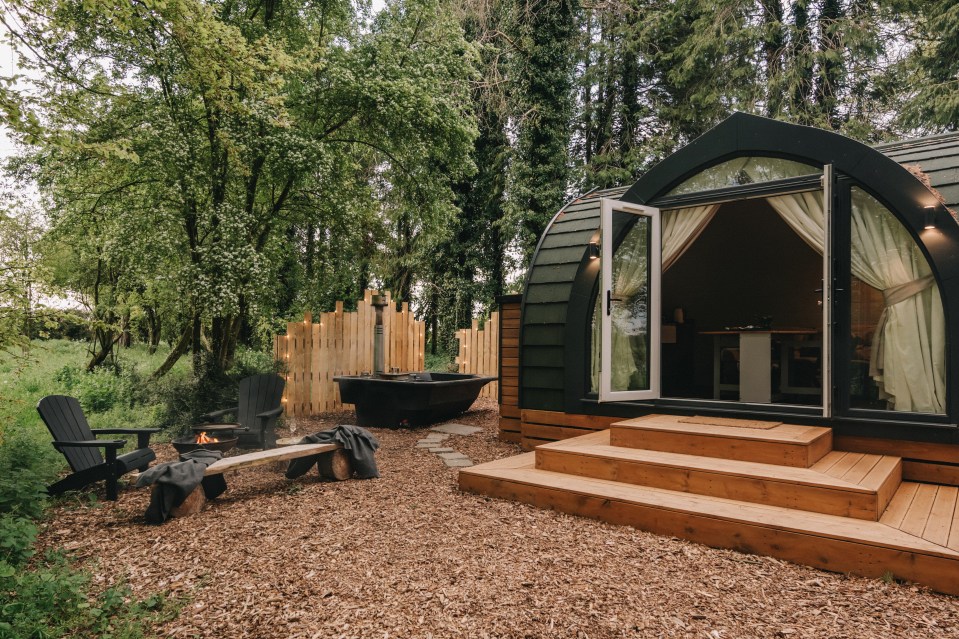
A modern glamping pod set in a wooded area, with a wooden deck, outdoor seating, a fire pit, and a hot tub.
The vineyard’s fabulous glamping pod Source: Supplied
Three alpacas of different colors stand in a vineyard.
The alpacas keep the vineyard trim Source: Supplied

It’s not every day that you get to stargaze from your bath. But at Liba Vineyard, the woodfired tubs are perfectly positioned for it beneath some of the darkest skies in the country.

This glamping site, on an old farm in rural Wiltshire, is home to just three snug pods, each set just beyond the vineyard’s young vines which are preparing for their first harvest next year.

Chris, the founder of the vineyard and glampsite, fires up the hot tub furnaces ahead of guests’ arrivals to ensure waters are kept at a balmy 40C.

Although that evening, I’m left to tend the dying embers solo, chucking on extra logs until smoke billows from the bath’s chimney in a magical plume.

WAIL OF A TIME

I drove Irish Route 66 with deserted golden beaches and pirate-like islands


TEMPTED?

Tiny ‘Bali of Europe’ town with stunning beaches, €3 cocktails and £20 flights

It’s pretty satisfying to watch nature work its magic beneath the glittering sky.

That’s a big selling point of the off-grid Liba, whose name stems from a blend of the words ‘life’ and ‘balance’. Here, you’re fully at one with your surroundings and there’s a huge emphasis on organic materials and natural methods.

The vineyard’s alpacas, for example, are used to keep the site nice and tidy instead of fertilisers. Every so often, they roam among the vines and gobble up weeds, trim the grass and . . . provide some of the best natural fertiliser.

It’s much easier to manage this type of natural wine-making on a smaller scale, and this small-scale production is partly what will make Liba’s wine so special.

After a soothing evening gazing up at the stars and toasting marshmallows, I was up early the next morning to feed the alpacas before helping out with some grape-picking at a neighbouring vineyard.

While Chris is currently waiting for his own vines to ripen, he has still been able to hone his wine-making techniques by using grapes from nearby vineyards.

I discovered how to weed out the ripe fruit from the rotten stuff and even got involved in the sticky action of smushing grapes the traditional way – with my bare feet.

This is the sort of hands-on experience Chris is hoping to introduce to guests once he produces his first bottles.

The glampsite has only been open for around a year and already enjoyed a sell-out summer.

I can’t say I’m surprised. It is idyllic, especially during autumn when the outdoor fire pit can be used to its full advantage.

The finer details are just as important. The mattress in my pod was incredibly comfy, while fairy lights around the fence ensured I could easily get in and out of the hot tub at night.

A small kitchen is well equipped for fry-ups and the sofa can be turned into a bed for two extra guests.

The pods also have lots of windows, to fully embrace nature – including that glittering night sky.

GO: LIBA VINEYARD

Self-catering stays in a two to four-person pod at Liba Vineyard cost from £149 per night, with a minimum two-night stay.

See liba-vineyard.co.uk.

Source link

How tiny French idyll is quietly turning into ‘the new St Tropez’

HOLLYWOOD superstar George Clooney revealed last week his plans to open a new restaurant in the tiny Provencal town of Cotignac.

The French fishing village, which is home to just 2,000 people, has seen an extraordinary influx of Hollywood celebrities in recent years.

George Clooney (pictured with his wife Amal) is planning to open at restaurant in Cotignac Credit: Splash
George has partnered with entrepreneur Graham Porter to open the restaurant, who also owns the Lou Calen hotel Credit: BackGrid

Yet this latest development is the first likely to draw hordes of selfie-stick-wielding tourists to the quaint medieval town.

And residents are split over the move, with many fearing the commune is being transformed into a new A-list enclave to rival St Tropez.

While some welcome the creation of jobs in the area, others feel the town risks being overwhelmed by celebrity residents such as George, 65, and his wife Amal, 48.

Writing on a local Cotignac Facebook page, local resident Veronique Luisetti wrote that the town is being “taken over.”

The Canadian entrepreneur backing George’s restaurant, Graham Porter, also owns the Lou Calen hotel, which includes the Michelin-starred Le Jardin Secret restaurant, and the La Falaise art centre.

Another, Viviane Palumbo, added: “We don’t have any money left!”

Meanwhile a comedy mock-up cartoon showing the Ocean’s Eleven actor serving a platter at his new venue is being shared among neighbours.

Titled Cotignac: Hollywood Passe en Cuisine – or Hollywood hits the kitchen – it sees a caricature of George serving up a platter of pasta in an apron.

Some Cotignac locals welcome the jobs the restaurant will create, but others are worried the town is being “taken over” Credit: Alamy
Angelina Jolie and Brad Pitt bought the Chateau Miraval vineyard close to Cotignac in 2008 Credit: Alamy

Jeany Cronk, who runs vineyard Maison Mirabeau, welcomes the jobs the venue will create for locals and said it will bring in much-needed cash.

But she said the residents hope they won’t be overrun by visitors desperate to ogle the actor, saying: “We are not St Tropez.”

Jeany, 53, told The Sun: “You can’t really escape the fact that people will want to come here to see George when his restaurant opens.

“It will impact people wanting to come and eat there.

“And he’s been a celebrity for a very long time, he understands that, you know.

“We’re expecting it to be over the top at first, but we’re hoping it settles down.

“Some people are negative about it, because not everyone likes change, but others are positive about the jobs it will create.

“We are just hoping that everyone will be respectful, and keep the spirit of our community alive.

“We are a former fishing village, we are not St Tropez.

“We don’t have a big Chanel villa or crowds of visitors.”

Jeany, author of the book At Home in Provence, has had plenty of chances to meet the celebrities who have moved into the area – from George and his wife Amal to Brad Pitt and Angelina Jolie, who bought the Chateau Miraval vineyard just minutes away from Cotignac in 2008.

The vineyard was later at the centre of a toxic legal battle between the couple, after actress Angelina sold her share in 2021.

Chateau Miraval became part of a legal battle when Angelina Jolie sold her share in 2021 Credit: Reuters
A comedy mock-up cartoon (an AI image) depicts George Clooney at his new venue, and translates to “Cotignac: Hollywood steps into the kitchen! Very nice… but do you also do the lunch special?” Credit: Facebook/Passon Var

Also within a 30 minute radius is John Lucas’s Skywalker Vineyard, while John Malkovich owns a private wine-making estate named Les Quelles de La Coste.

And Ridley Scott produces wine at his Mas des Infermieres vineyard in the heart of the Luberon National Park in Provence.

Jeany continued: “Cotignac has always been quite a famous place.

“I mean, it’s one of the most beautiful villages in France.

“And it is, you know, it has a long history with, you know, celebrities.

“Eric Idle’s lived there for many years.

“And hugely famous people, like David Bowie and Pink Floyd recorded albums in the Studio Miraval.

“George and Amal have obviously built a strong connection to our village.

The former fishing village has a long history with celebrities Credit: Getty
John Malkovich has a private wine-making estate in the area Credit: Getty

“I think what’s very nice for him – and I really hope that this remains, now that the restaurant is so public – is that he’s been very free to move around and be amongst people who live in the village.

“He feels happy and safe here.

“I think the celebrities always love that people just go about their business while they’re there and don’t make a big fuss.”

But what of the rivalry among neighbouring vineyards?

David Bowie and Pink Floyd have both recorded albums in the Studio Miraval Credit: AFP
George Clooney (pictured with Brad Pitt) has recently became a French citizen after buying an estate in Brignole Credit: Getty

She continued: “It’s generally very friendly.

“We all share a common goal – to bring our beautiful rose wines to the world.

“And these big names do lend a hand in raising our profile.

“We are doing very well at the moment, especially in the UK, and we have a great global partnership with Soho House.

“So it isn’t nasty in any way.

“However,” she added, “Of course, business is business.”

George’s latest venture comes as he recently became a French citizen after buying an estate in nearby Brignoles.

And he reportedly wants his restaurant ready to open next year, according to the local mayor.

Jean-Pierre Véran told the newspaper Nice-Matin: “He wants to create a well-designed restaurant, with a terrace and the option to reserve the dining room for private events when he hosts celebrities.”

He continued: “We discussed their restaurant, and I told them I wasn’t opposed to this project, which can benefit everyone.”

However, both the actor and his wife are likely to stay far away from the kitchen – after joking that they are not the world’s greatest cooks.

“I’ll tell you what,” Clooney said three years ago.

“My wife, who is a brilliant lawyer, she’s one of the advocates of the world.

“She takes on Isis.

“But I better be doing the cooking or we will all die.”

Source link

Denise van Outen, 52, shows off endless pins in tiny hotpants and fishnet tights for sizzling snap

DENISE Van Outen, 52, has flaunted her endless pins in tiny hotpants and fishnet tights for a sizzling snap.

The broadcaster, looked stunning as she paired the look with a cream faux‑fur jacket and chunky black boots – in her latest Instagram story.

Denise Van Outen has flaunted her endless pins in tiny hotpants and fishnet tights Credit: vanouten_denise/instagram
Denise recently stunned in a daring bondage style dress Credit: vanouten_denise/Instagram

Mum of one Denise styled her blonde shoulder-length hair poker straight as she appeared at HOUSE V INDIE with her old friend Johnny Vaughan.

Earlier this month, the screen star – who recently told how she feels sexier in a bikini in her Fifties than she did when she was younger – sizzled in a daring bondage style dress.

Denise uploaded a mirror selfie showing her black attire – complete with a studded cut-out panel top and a ruffle skirt.

Meanwhile, Denise recently told The Sun how she oozes confidence in sexy outfits – including her bikinis.

KATIE’S HELL

I’ve had death threats for falling in love with Eamonn, says Katie Alexander


DAME OVER

Queen of Scotty Road faces career ruin following disastrous Big Brother stint

Denise uploaded a mirror selfie showing her black attire Credit: vanouten_denise/Instagram
Denise recently said she feels sexier in a bikini in her fifties Credit: vanouten_denise/Instagram
Denise recently released her new single called Just Another Day Credit: Shutterstock Editorial
She is booked to DJ at the upcoming wedding reception of Towie’s Joe Blackman and Junaid Ahmed Credit: Getty

She said: “When I was younger, I’d have thought by the time I’m in my fifties I wouldn’t wear a bikini any more, and would opt for a one-piece.

“But actually, I love seeing women in mid-life rocking bikinis — because why shouldn’t we?

“I’m 52 and when I put my bikini on I feel really good. I’m surprised because I always thought that as I got older, I’d want to cover up more, but actually I’ve grown in confidence.

“We care less what people think, and just want to look and feel good”.

Denise recently released her new single, Just Another Day, which came after a summer of her DJ gigs.

She is also booked to DJ at the upcoming wedding reception of Towie’s Joe Blackman and Junaid Ahmed.

Source link