Israeli measures tighten grip on Hebron’s Ibrahimi Mosque | Israel-Palestine conflict News
Hebron, occupied West Bank – Hebron’s Ibrahimi Mosque is no more than 50 metres from Aref Jaber’s home, in the neighbourhood that bears his surname, reflecting his family’s long history in the Palestinian city.
The 51-year-old has taken advantage of that proximity since his childhood, regularly praying at the mosque, one of the most important Islamic sites, and a Palestinian national symbol.
Recommended Stories
list of 3 itemsend of list
But the Ibrahimi Mosque of Jaber’s childhood is not the one of today. A 1994 massacre of Muslim worshippers by the Israeli settler Baruch Goldstein killed 29 Palestinians. Instead of getting justice, Palestinians faced more restrictions in the aftermath of the attack.
Israeli settlers began establishing an illegal presence in Hebron, part of the occupied West Bank, in 1968, the year after Israel seized control of the Palestinian territory. The settlers have been working to grow their presence ever since, with increased support from the Israeli government.
After 1994, Israel began taking steps to, in effect, control the Ibrahimi Mosque – known to Jews as the Cave of the Patriarchs – by closing off large areas in Hebron’s Old City and the southern area surrounding the mosque, then dividing it between Muslims and a few hundred Jewish settlers, granting the latter the right to pray there.
This was followed by the signing of the Hebron Agreement with the Palestinian Authority in 1997, which stipulated the division of the city into two parts: H1, under Palestinian control, comprising 80 percent of the area, and H2, under Israeli control, comprising 20 percent, but including the Ibrahimi Mosque and the Old City.
Following this series of events, settlement activity intensified in the heart of Hebron. Settlers established illegal outposts within the Old City and began gradually expanding and seizing new homes under the protection of the Israeli army.
Meanwhile, Palestinians were subjected to closures, restrictions and repressive measures aimed at forcing them to leave the Old City, thus facilitating Israeli control over the mosque.

Neighbours of the Ibrahimi Mosque
Jaber had hoped that his children would pray at the mosque daily and become familiar with it, but Israeli measures prevented this.
He explained that since 1994, the southern gate of the mosque, which residents of his neighbourhood used for access, has been closed. They have instead been forced to take alternative routes, turning a journey of 50 metres into one that now spans almost three kilometres.
Things have gotten worse since the beginning of Israel’s genocidal war on Gaza in October 2023, when Israel also ramped up its attacks in the West Bank.
Israel tightened its grip on the mosque and its surroundings, closing more of the alternative routes.
“The difficulty of reaching the mosque is compounded by the procedures at the iron and electronic gates installed at its entrances and in its vicinity,” Jaber said. “We are subjected to searches, detention, and harassment without any justification, and often young men, boys, and even women are arrested.”
The Israeli government says that the restrictions are necessary for security reasons – to protect Israeli settlers whose presence in the West Bank’s most populous city is illegal under international law.
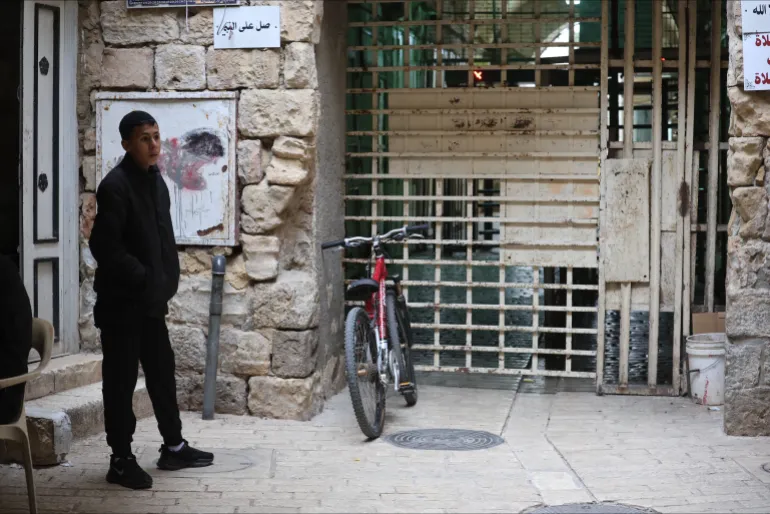
Jaber explained how the Israeli army closes barriers and gates around the mosque and the neighbourhoods that surround it for extended periods under security pretexts. Palestinian residents are not allowed to leave their homes, even to shop, while settlers are permitted to move freely throughout the Old City.
Israeli authorities also used the justification of the current conflict with Iran to close access to the Ibrahimi Mosque for Palestinians for six days from February 28, allowing it to reopen for a limited number of worshippers on March 6.

Increased control
But these measures aren’t only aimed at restricting Palestinians in the vicinity of the mosque, but also seem to be an attempt to establish complete Israeli security control over it, with measures similar to those Israel employs at the Al-Aqsa Mosque in occupied East Jerusalem.
In Al-Aqsa, the third holiest site in Islam, renewable expulsion orders are used to prevent the entry of worshippers deemed troublesome. Searches are also regularly conducted at the gates of Al-Aqsa, as well as detentions, confiscation of identity cards and restrictions on entry to certain parts of the mosque compound.
Israel now regularly conducts similar actions at the Ibrahimi Mosque.
The Israeli army issued orders to remove Moataz Abu Sneineh, the director of the Ibrahimi Mosque, and other employees from the mosque for 15 days in January. The Palestinian Authority said that the orders were part of “an attempt to reduce their role in the administration and supervision of the Ibrahimi Mosque’s religious and administrative affairs”.
Israeli officials have also tried to push through construction work in the mosque without the approval of Palestinian officials.
On February 9, the Israeli cabinet approved the transfer of licensing, building and municipal administration powers in Hebron from the municipality to the Israeli Civil Administration, in addition to establishing a separate settlement municipality within the city.
The change, part of an internationally condemned Israeli push to increase control over the West Bank and make Israeli settlement easier, is seen as illegitimate and dangerous to the existing status quo, threatening freedom of worship and public order, according to a statement issued by the Hebron Municipality in response to the decision.
Abu Sneineh told Al Jazeera that Israel has transformed the mosque into something resembling a “military barracks” due to the stringent measures it imposes, which “aim to reduce the number of worshippers there”.
According to Abu Sneineh, the Israeli government interfered in the authority of the Ministry of Religious Endowments, and the call to prayer was prevented from being performed dozens of times a month. Worshippers were subjected to humiliating treatment at the mosque entrance, including beatings, verbal abuse and expulsion. Abu Sneineh said the measures were part of a systematic Israeli policy aimed at transforming the mosque into a Jewish synagogue.
“Israel is trying to impose a new reality by controlling the mosque and obstructing worshippers’ access to it, whether during Ramadan or at other times. After October 2023, the measures became even more stringent to erase the Islamic identity of the place, as if it were racing against time to seize control of it,” he added.
On February 28, coinciding with the start of Israeli-American strikes on Iran, the Israeli army expelled worshippers and staff from the mosque and informed them of its closure until further notice, just as it had done at Al-Aqsa Mosque in Jerusalem on the same day under the declared state of emergency measures.
The director of the Youth Against Settlements group and a resident of the Old City, Issa Amro, believes that the situation at the Ibrahimi Mosque is more dangerous than at Al-Aqsa Mosque because it has suffered from temporal and spatial division since 1994.
The “arbitrary” barriers, the closure of surrounding markets and main roads leading to it, and recently the closure of checkpoints in the southern area of the city – which includes the Old City and the Ibrahimi Mosque – prevent approximately 50,000 citizens from accessing it, along with the transfer of supervisory authority of parts of the mosque to the Religious Council in the illegal Kiryat Arba settlement, are extremely dangerous steps that threaten the Palestinian identity of the site, Amro said.
“The Jewish area [of the mosque] has been expanded, and recently, residents around the mosque have been living a difficult life due to soldier violence, settler terrorism, the constant closure of barriers, and restrictions on leaving their homes. They live as prisoners in their own homes in fear of settlers and soldiers, and disturbed by the constant gatherings held by settlers in the mosque,” he added.
According to the Applied Research Institute – Jerusalem (ARIJ) – a Palestinian research institute – approximately 40,000 Palestinians live in the H2 area, alongside about 800 Israeli settlers residing in 14 small illegal settlement outposts. These outposts are under heavy protection from thousands of Israeli soldiers deployed around the perimeter of the area and in the streets of the Old City, preventing Palestinians from leading normal lives.
The outposts are managed by the Hebron Settlements Council, which is linked to the parent settlement, Kiryat Arba, located east of the city.
A research study published by the institute in November 2025 revealed a significant increase in the forced displacement of Palestinians from the H2 area over the past two decades.
The Israeli human rights group B’Tselem said in a 2019 report that about 35,000 Palestinians lived in Hebron’s H2 area when the Hebron Agreement was signed in 1997. Today, only around 7,000 remain. Roughly 1,000 of them live in a particularly restricted zone around the Tel Rumeida neighbourhood and Shuhada Street – formerly Hebron’s main shopping street, which is now closed to Palestinians, due to the presence of several illegal Israeli settlements.
Palestinian families in the Old City and the vicinity of the Ibrahimi Mosque are subjected to various forms of pressure, including demolition orders under the pretext of unlicensed construction, frequent arrests, settler attacks on residents and students travelling to and from school, economic restrictions, shop closures, and movement restrictions, particularly regarding access to places of worship and hospitals.
According to the United Nations Office for the Coordination of Humanitarian Affairs, the area contains 97 various military checkpoints and barriers.
These are often closed for hours or even days at a time without prior notice, paralysing movement within the Old City and the residential areas adjacent to the mosque.
Towards full annexation
Observers see these measures in Hebron as a prelude to establishing a fait accompli in the West Bank as a whole, which has been subjected for more than two years to accelerated policies aimed at controlling the largest possible area of land and expanding settlements.
Settlement affairs researcher Mahmoud al-Saifi told Al Jazeera that Israel has sought over the past two years to solidify the annexation of the West Bank, particularly Area C, which constitutes more than 61 percent of the total area of the West Bank.
Israeli authorities have approved 54 new official settlements and 86 smaller outposts in 2025 alone, according to data from Peace Now, which monitors settlement activity.
Planning was approved or advanced for some 51,370 settlement units in the West Bank from late 2022 to the end of 2025, a figure also announced by Israeli government agencies based on data from the Higher Planning Council.
In addition, 222 kilometres of secondary and bypass roads were constructed in the two years preceding January 2025, aimed at connecting outposts to main settlements.
As a result of these policies, the Palestinian presence has dwindled in many areas, particularly the Jordan Valley, where their number has decreased to no more than 65,000.
“Israel is implementing a policy of encirclement and strangulation of small villages in the West Bank by confiscating land and preventing Palestinian construction, in contrast to the frenzied settlement wave that Smotrich called a ‘settlement revolution,’ and the accompanying bitter reality for Palestinians,” al-Saifi said.
There are now thousands of armed settlers spread throughout the West Bank, al-Saifi noted. Skilfully trained and often called settlement guards, they are essentially a rear guard force for the Israeli army, used to attack and intimidate Palestinians and seize their land.
“All Bedouin communities are located in Area C, and 47 of them have been forcibly displaced since October 2023, meaning more than 4,000 Palestinians have been displaced in just two and a half years,” al-Saifi said. “This is part of ethnic cleansing and de facto annexation on the ground.”