AOC, Newsom, Jeffries swing through California to help Democrats in tight races
BAKERSFIELD — Top Democratic and Republican leaders are sweeping through California as the Nov. 3 election approaches, evidence of the state’s pivotal role in deciding which party will control the U.S. House of Representatives and the fate of President Trump’s final two years in office.
Seizing on their party’s momentum nationwide, Democrats rallied crowds from Orange County to the Bay Area this past week. They blamed Trump and the Republican-led Congress for rising gas and food prices, massive cuts to healthcare funding, deceitful attacks on the elections process and the vilification of immigrants.
In the Central Valley, New York Rep. Alexandria Ocasio-Cortez on Friday evening appeared alongside Randy Villegas, a Democrat challenging Republican incumbent David Valadao of Hanford in a Latino voter-heavy district in the state’s agricultural heartland. The population of the district is one of the youngest in the country, Ocasio-Cortez told the crowd, and Gen Z and millennial voters are expected to play a pivotal role.
“We have the opportunity to take the reins,” said Ocasio-Cortez, one of the nation’s most well-known progressive leaders. “And to give direction to where our future will be headed. And I got to tell you, folks, the future is not with David Valadao.”
Recent polls show Democrats may retake control of the House in the Nov. 3 election, and they may have a chance of taking power in the U.S. Senate. Republican House Speaker Mike Johnson of Louisiana, who has swung through California twice within the last month to help Republican candidates, acknowledged the challenges ahead but predicted his party would fare better than many predict.
Roughly two dozen House races across the country are expected to decide the House majority, including three competitive races in California: Those of Republican Valadao, Democratic Rep. Adam Gray in the Central Valley and the open seat of retiring Republican Rep. Darrell Issa in the San Diego area.
Democrats are hoping that the new congressional maps approved by California voters in 2025 will give them an edge. The reconfigured congressional districts approved by Proposition 50 were a response by California’s Democratic leadership to Trump urging Republicans, notably in Texas, to shift their boundaries to help the GOP hold onto control of Congress during his final two years in office.
The San Joaquin Valley district represented by Valadao, which already had a Democratic majority, added about 100,000 Fresno residents, turning it even bluer. Valadao has been a perpetual target of Democrats given their longtime voter registration edge in this area.
Aside from briefly losing the seat for one term nearly a decade ago, Valadao has hung onto the seat. He comes from a dairy farming family and is well-known in the area, winning by nearly seven percentage points in 2024, outperforming Trump.
This cycle, Democrats are hammering him for supporting Trump’s budget cuts that impacted healthcare programs, a critical issue since roughly two-thirds of the population in his district is covered by Medi-Cal, as Medicaid is known in the state, the most of any district in California, according to the UC Berkeley Labor Center.
Valadao is among a handful of GOP members in California’s 52-member congressional delegation, the largest of any state in the nation, and among the Republicans targeted by Democrats in response to Trump’s efforts to keep his party in control of Congress.
“Donald Trump’s gerrymandering scheme is going to fail,” said House Minority Leader Hakeem Jeffries in Buena Park on Thursday. “It’s going to fail in Texas. It’s failing in Florida, and it’s failing in North Carolina. But I’m grateful to the people of California who decided to decisively respond and create the situation where we’ll have a fair national map.”
The party in control of the White House typically loses seats in the midterm election, and Trump and the GOP face additional headwinds because of the affordability crisis that the president promised to address when he ran for reelection in 2024. Californians face some of the highest gas and electricity prices in the country.
“The MAGA extremists are on the run because they have failed. They’ve broken every promise that they’ve made to the American people,” Jeffries said, after stumping for Rep. Derek Tran (D-Orange) at a carpenters’ union hall. “Life has not gotten more affordable. Life is far too expensive. Trump policies … have increased costs on everyday Americans by thousands of dollars per year.”

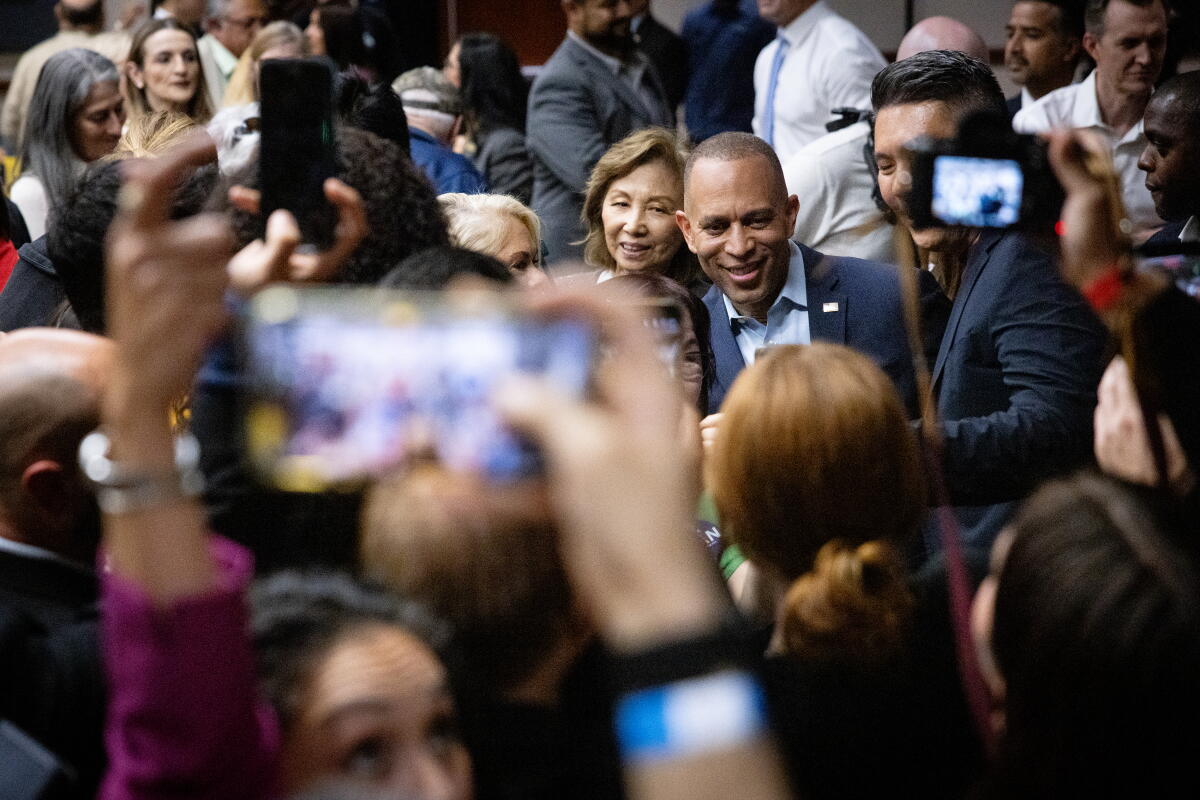
House Democratic Leader Hakeem Jeffries interacts with members of the audience after he delivered a speech during representative Derek Tran’s “Take Back the House” rally for his reelection campaign in California’s 45th Congressional District, at Carpenters Local Union 714 in Buena Park on Thursday.
(Etienne Laurent/For The Times)
Tran narrowly unseated Republican Rep. Michelle Steel in 2024, winning by just 653 votes. The recently redrawn district, which is located primarily in Orange County, could give him an edge this election.
“Prop. 50 did help me out of the battleground districts in California,” Tran said. “I got the least amount of help, but better, still better.”
On Wednesday, the Republican House speaker acknowledged his party’s hurdles while stumping for congressional candidate Kevin Lincoln in Stockton in the Central Valley.
“We’re gonna be very sober-minded about the challenge, and I want you all to know the odds that we are facing,” Johnson said.
Campaigning for Lincoln, a former Stockton mayor and an underdog in a congressional race against Democratic Rep. Gray of Merced, Johnson acknowledged that the congressional midterm will be a “very close election.” But he argued that public polling is flawed and fought back against the notion that GOP voters are dejected.

Speaker of the House Mike Johnson (R-La.), center left, and Rep. David Valadao (R-Hanford) talk to reporters after a campaign event in Bakersfield on Sept. 30.
(Jae C. Hong / AP)
“Republicans are not staying home. They are not depressed,” said Johnson, who also traveled to Bakersfield to campaign for Valadao just a few weeks ago. “They’re coming out in huge numbers, and we’re going to win because of that. You know why? Because everybody knows what’s at stake.”
Lincoln, the grandson of an immigrant and the son of a teenage mother, talked up his experiences in the military and as a pastor. He aligned himself with the “hardworking” people in the Valley, suggesting that D.C. leaders were failing the district.
“When you have a job to do, you show up, you roll up your sleeves and you get that job done, and that same standard should apply to the people that we choose to send to Washington, D.C.,” he said.
Two of California’s most powerful Democrats, Speaker Emerita Nancy Pelosi of San Francisco and Gov. Gavin Newsom, on Friday appeared at a San Francisco union hall to rally support for Democratic congressional candidates and warn that basic rights will be at risk if Republicans stay in power in Washington. They urged voters to reject Proposition 39, the Republican-led voter identification measure that comes amid Trump’s baseless claims of widespread, illegal voting by undocumented immigrants.
Pelosi, who will retire early next year after a historic 40-year run in Congress and two stints as House speaker, criticized Trump’s “vicious, malicious” attempts to undermine elections through gerrymandering, fraud claims and attempts to mandate voter ID.
“They are putting up obstacles to participation to vote. As women, if you have your husband’s name in marriage, you’re going to have to go find your birth certificate in order to vote,” Pelosi warned of voter ID requirements. After “63 years in marriage, you think I could find my birth certificate?” Newsom, a potential 2028 presidential candidate, warned that Republicans “are ruthless” in their attempts to roll back civil rights. The outgoing governor said the 2026 midterm fight began when he and state lawmakers put Proposition 50 on last year’s November ballot.

California Gov. Gavin Newsom speaks during a rally, accompanied by former Speaker of the House Nancy Pelosi, right, members of the state’s Democratic Party, organized labor and other advocates in San Francisco on Friday.
(Heather Diehl / AP)
“Everything we have done to get us to this point is unbelievable,” he told union members in the Mission District. “You’re unbelievable, but it won’t mean anything unless we run through the tape.”
The Democrats were supporting state Sen. Mike McGuire, who is trying to flip one of Northern California’s redrawn congressional districts. He faces Rep. James Gallagher (R-Yuba City), who won a June special election to finish the term of the late Rep. Doug LaMalfa. “Prop. 50’s final chapter is almost here,” said McGuire, who has represented the rural North Coast in the Senate since 2014. “It is time to close the book on Donald Trump. It’s time to take America back.”
Seema Mehta reported from Buena Park, Nicole Nixon from San Francisco and Dakota Smith from Bakersfield.