tied

US bars Fiji-based man over corruption tied to China | Corruption News

The State Department has accused the official of paying bribes to Fijian citizens to advance Chinese interests.

The US Department of State has publicly designated a Fiji-based man for his involvement in corruption on behalf of Chinese actors.

Zhao Fugang, the director of the Overseas Chinese Service Center, “abused his public position by paying bribes to Fijian citizens to advance China-based government, business, and criminal interests”, the State Department said in a press release on Wednesday.

Recommended Stories

list of 3 itemsend of list

“His actions constituted significant corruption and adversely affected U.S. interests in Fiji.”

The designation renders Zhao and his immediate family members “generally ineligible for entry into the United States”.

The US embassy in Suva, Fiji’s capital, said Zhao’s actions left the Pacific nation open to “malign foreign influence facilitated by Chinese government, business, and criminal actors”.

The embassy also said, “Public reporting shows an established trend of criminals operating across the Pacific with ties to China.”

Beijing says Overseas Chinese Service Centers help its nationals with administrative issues abroad, such as renewing driving licences. However, rights groups have alleged they are fronts for Beijing to push interests abroad, including the targeting of dissidents.

In February, the Trump administration sanctioned two leaders of Pacific island nations for alleged corruption tied to China. The US Department of State issued a notice alleging that Hokkons Baules, the president of Palau’s Senate, and Anderson Jibas, a former mayor in the Marshall Islands, had created openings for China to increase its influence in the region.

Source link

Brazil’s Lula and Flavio Bolsonaro still essentially tied in new poll | Elections News

Luiz Inacio Lula da Silva is up 2 points, but that’s still within the poll’s margin of error.

⁠Brazilian President ⁠Luiz Inacio Lula da Silva has maintained a two-percentage-point lead over Senator Flavio Bolsonaro, ⁠his main challenger, in a potential run-off ahead of October’s presidential election, a Datafolha poll has shown.

In poll results released Thursday, Lula would receive 47 percent of the vote compared with 45 percent for Bolsonaro in a simulated run-off. A previous Datafolha poll last week had ‌Lula leading Bolsonaro by 46 percent to 44 percent.

The result also represents a technical tie as it falls within the poll’s margin of error of 2 percentage points.

In a first-round scenario, Lula leads with ⁠40 percent of the vote, followed ⁠by Bolsonaro (36 percent), Augusto Cury (5 percent), Ronaldo Caiado (4 percent) and Renan Santos (3 percent).

The previous poll showed the leftist president with 39 percent against the ⁠right-wing senator’s 36 percent.

Senator Bolsonaro is the eldest son of ⁠former President Jair Bolsonaro, who ⁠is serving a 27-year prison sentence for attempting to overturn his 2022 election defeat to Lula.

Lula is seeking a fourth nonconsecutive term as Brazil’s president.

If no candidate ‌wins more than 50 percent of valid votes in the first round, the two frontrunners advance ‌to ‌a run-off.

Datafolha surveyed 2,002 people between September 22 and 23.

Earlier this week, two other polls showed similar results.

A Quaest poll released on Monday showed Bolsonaro with 42 percent of voter support in a potential run-off, versus 41 percent for Lula.

Meanwhile, a BTG Pactual/Nexus poll has Lula receiving 46 percent of voter support, compared with 45 percent for Bolsonaro in a potential run-off.

Source link

Brazil election: Lula and Flavio Bolsonaro tied in latest polls | Elections News

Luiz Inacio Lula da Silva is running in October’s election for a fourth non-consecutive mandate as Brazil’s president.

Brazilian President Luiz Inacio Lula da Silva and Senator Flavio Bolsonaro remain deadlocked in the latest polls, with the first round of Brazil’s election less than two weeks away.

Two new polls on Monday showed that the pair are statistically tied in simulated runoffs ahead of next month’s election. If no candidate wins more than 50 percent of valid votes in the October 4 first round, the two frontrunners advance to a runoff on October 25.

Recommended Stories

list of 3 itemsend of list

Lula is seeking a fourth non-consecutive term as Brazil’s president, but faces a challenge from the political right in Flavio Bolsonaro, the son of former far-right President Jair Bolsonaro, an ally of US President Donald Trump.

Brazilian presidential candidate Flavio Bolsonaro speaks at an agribusiness fair as he campaigns in Esteio, Brazil, on September 2, 2026
Brazilian presidential candidate Flavio Bolsonaro speaks at an agribusiness fair as he campaigns in Esteio, Brazil, on September 2, 2026 [Diego Vara/Reuters]

The elder Bolsonaro was ruled ineligible for office after Brazil’s top electoral court found he had abused his power while in office. He was later convicted separately over a plot to overturn his 2022 election loss to Lula.

A Quaest poll released on Monday showed Bolsonaro with 42 percent of voter support in a potential runoff, versus 41 percent for Lula.

Meanwhile, a BTG Pactual/Nexus poll has Lula receiving 46 percent of voter support, compared with 45 percent for Bolsonaro in a potential runoff.

The latest polls mark a narrowing from an earlier Quaest poll on August 5, which put Lula ahead by a wider five-point margin, 44 percent to 39 percent.

New York City Mayor Zohran Mamdani and Brazilian President Luiz Inacio Lula da Silva speak to reporters after a meeting in New York on September 21, 2026
New York City Mayor Zohran Mamdani and Brazilian President Luiz Inacio Lula da Silva speak to reporters after a meeting in New York on September 21, 2026 [Dave Sanders/Reuters]

US pressure looms over election

Lula launched his re-election bid on August 2 at the Workers’ Party convention in Sao Paulo, casting himself as a defender of Brazilian “sovereignty” as pressure from the US administration looms over the race.

The US imposed two fresh rounds of tariffs on Brazilian products in July, which Lula denounced as an attempt to influence the elections through economic pressure.

The Brazilian leader is currently in New York, where he is preparing to address the United Nations General Assembly.

Lula met New York City Mayor Zohran Mamdani for the first time on Monday. In a brief statement to reporters after the meeting, the Brazilian president said the two had talked about problems common to both Brazil and the United States, particularly the rising cost of living.

Source link

Swedish party blocs tied after Sunday vote, projections say

Sweden has two major political blocs featuring four parties on the right and four on the left – meaning coalition and minority governments are relatively common.

Andersson’s party, the Social Democrats, have been a major force in Swedish politics since the end of World War Two.

But SD – founded by Nazi sympathisers in the 1980s – had been shunned for years until 2022 when it became the country’s second largest party after campaigning on violent crime and immigration.

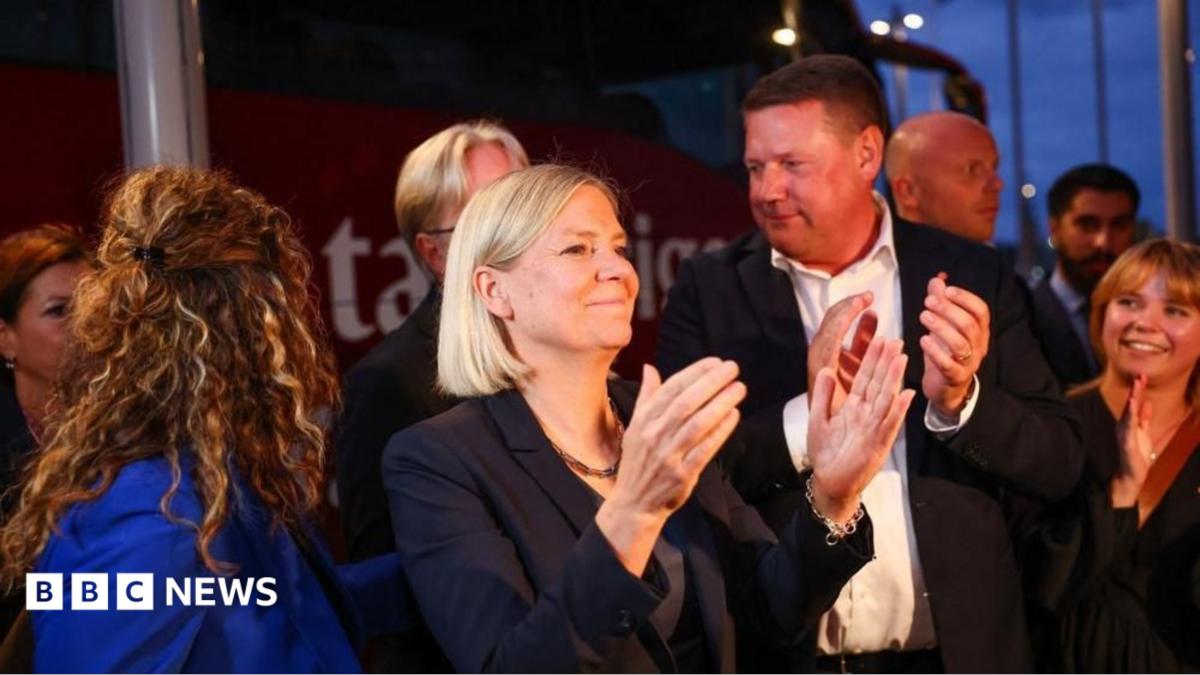
After casting her vote on Sunday, Andersson laid out the choice facing the Swedish public: “Should we have a government entirely dominated by the Sweden Democrats, something that has never happened in Sweden before? Or should we have a government led by me, which will steer Sweden in a new spirit of co-operation?”

Kristersson, for his part, said it was important he and his alliance were able to continue their work.

“I think there is a genuine enthusiasm for us being able to continue our important work,” he said after casting his ballot in his home municipality of Strangnas.

National security, gang crime and welfare spending dominated the election campaign.

Source link