Clashing with Chavismo’s Prêt-à-Porter Protesters Outside Maduro’s NYC Hearing
Nicolás Maduro and his wife Cilia Flores appeared this Thursday at the US Southern District Court in lower Manhattan for the second hearing since their extraction in January, this time to argue that the US government’s refusal to let Venezuela foot their legal bill amounts to a constitutional violation. Judge Alvin Hellerstein said he wouldn’t dismiss the case, but no decision was taken over the issue of Maduro’s lawyer fees.
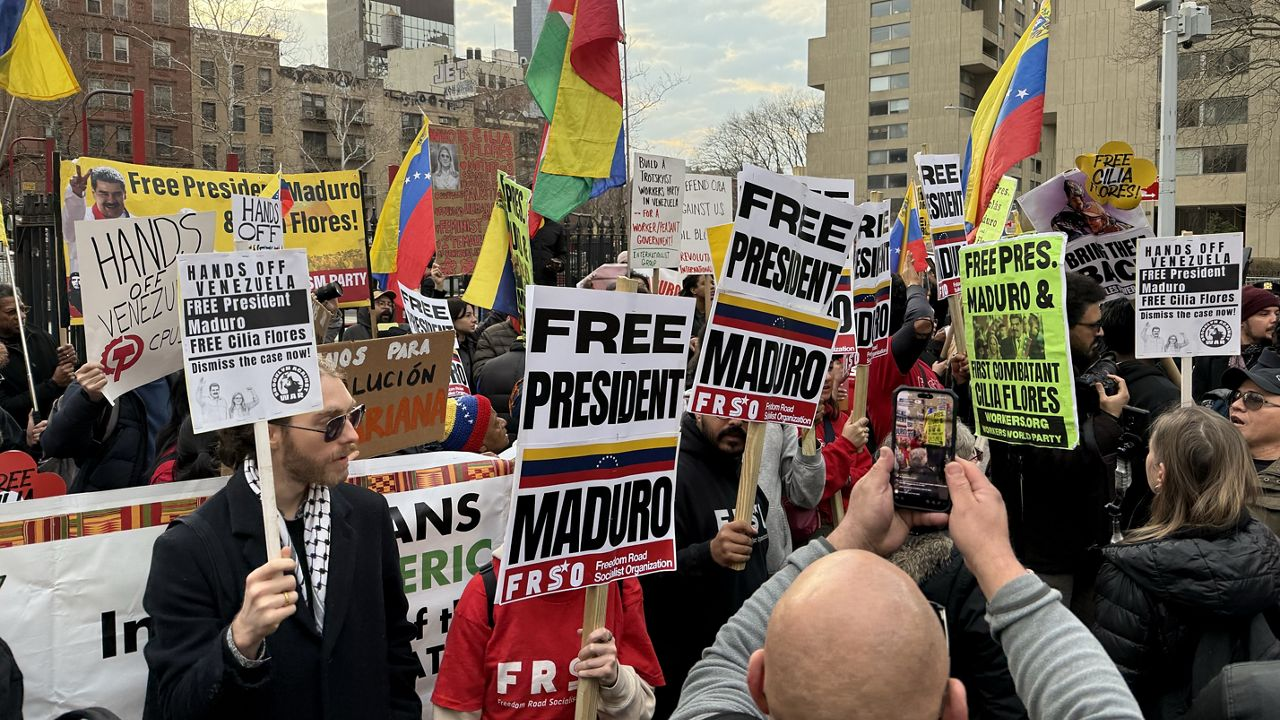
Outside, in the street, New York was doing what New York does, moving fast and with indifference, while dozens of people brought twenty-five years worth of receipts to show to a multitude of pro-Maduro advocates and those leaving the courthouse. This is what I saw.
On the way to 500 Pearl Street, I passed two men wearing matching grey Nike tech sets, the now infamous outfit that Maduro was wearing in the first image after his extraction. They weren’t there for the protest, surprisingly, but your brain does what it does.
I got there around 10 am with a Venezuelan flag, a phone and a jacket that I quickly regretted bringing. Even the maracuchos were struggling with the heat after a while. By the time I arrived, the scene outside the courthouse had long organized itself into two blocs. On one side: baseball jerseys, suits, delivery backpacks, seven and eight-starred flags, and handmade signs. Hanging from a tree like a piñata that had made bad life choices, a Maduro life-size figure in a prison uniform courtesy of artist Jorge Torrealba. A Spanish man held up a sign with the faces of Maduro, José Luis Rodríguez Zapatero and Pedro Sánchez below the word Criminales. A woman from Catatumbo, Zulia held a sign that read Libertad para Fernando Loaiza, the democratically elected mayor of her local government who was detained last March by Maduro security forces and still remains in prison without trial.
On the other side of the barricade, mass produced laminated signs asking for the release of Maduro and Flores and chants delivered with little conviction. The early birds reported that the crowd arrived around 8 am. Although I found no public call from the expected culprits (The People’s Forum, Codepink, and other usual suspects) they assembled around 20 people from different socialist groups, holding our flag with the slightly uncertain grip of someone who had picked it up that morning. Their chants were about US imperialism, sovereignty, and international law. All real things. All also, somehow, beside the point.
The pro-Maduro crowd chanted back: “Free them all.” For a second I thought we were agreeing on the immediate and unconditional release of Venezuelan political prisoners.
When Venezuelan citizens addressed the crowd in Spanish, there was mostly no reaction. Some of them got out a word or two, with the confidence of a born-and-raised Venezuelan yet the persuasiveness of a no sabo kid. When we spoke their language, American English, they either ignored us, flipped us off, or played dumb.
The Venezuelan ensemble erupted into “A mí no me pagaron, yo vine porque quise” (I didn’t get paid, I came because I wanted to) with the exasperated tone of a people who have been chanting this phrase for decades. In the background, a t-shirt with an all caps text stood out: I’M VENEZUELAN. NO PROPAGANDA.
Our Gloria al Bravo Pueblo was sung at least six times, drowning out the chants of the US protesters without fail every single time. Tambores weren’t lacking, either. The chant that carried the morning was ¿Quiénes somos? Venezuela. ¿Qué queremos? Libertad. ¿Qué queremos? Justicia. Over and over.
Ironically, the pro-Maduro crowd chanted back: “Free them all.” For a second I thought we were agreeing on the immediate and unconditional release of the 503 political prisoners that Delcy Rodríguez and Diosdado Cabello still refuse to let out. There’s a particular kind of cognitive dissonance that works like a splinter. I started drifting toward the ones within hearing range.
There was a pride flag next to a Free Maduro sign. I asked about Yendri Velázquez, LGBTQ+ activist shot alongside Luis Peche in a targeted attack in Colombia, both of them driven into exile by the regime they exposed. They too await justice to be served. I asked them about the socialist Gran Polo Patriótico bloc that has spent years with the government’s full blessing refusing to address abortion rights or same-sex marriage in the National Assembly. By 2025, Pride in Caracas had been stripped of its activist organizations, and groups that chose to march did so “as discreetly as possible” because of Maduro & Co.’s post-28J crackdown.
Almost everyone was wearing a Palestinian keffiyeh, which made the next question unavoidable. In 2017, then-Foreign Minister Delcy Rodríguez expressed Venezuela’s desire to restore full ties with Israel. The following year, Maduro welcomed Jerusalem’s Sephardic chief rabbi to Miraflores tweeting about it warmly and awarding him with the Libertadoras y Libertadores medal. Venezuela never stopped trading with Israel either, not even after Chávez cut diplomatic relations. Anti-Zionism is a costume worn for the cameras and removed at Miraflores. A useful one the international left has used to dismiss criticisms against Maduro in the name of anti-imperialism.
The man who spent decades making sure others couldn’t speak now needs a translator to follow the room.
The international left has a type when it comes to diasporas: the refugee, the grieving exile, the cautionary tale of imperialism. Step out of those lines and you become brainwashed, biased, or on somebody’s payroll. We’re victims or foe. Noble savages or CIA plants. The crowd outside the courthouse on Thursday didn’t fit any of those categories, and didn’t try to. They are the people who have spent years being told their grief is too close to be credible and their knowledge too lived-in to count as such.
Around noon, the pro-Maduro contingent quickly cleared out. Clocked out, if you will. The hearing ended at one, giving me just enough time to gather some impressions before heading uptown for my afternoon class.
Those who had been inside began filtering out into the streets and the gathering. Among them was Jorge Torrealba, wearing a colorful outfit and holding a stack of papers. A crowd formed around him immediately. He shuffled through his sketches of the hearing as questions came from every direction: What did he look like? ¿Cómo lo viste? When is the next hearing? Did he say anything?
He looked skinnier, Torrealba said. And quiet. That tracked. Unlike the January arraignment, when Maduro delivered a several-minutes-long speech professing his innocence from the defense table, he said nothing in court on Thursday. Neither did anyone in the audience. He sat in his grey prison uniform with headphones on, jotting notes, occasionally leaning over to whisper to his lawyer through an interpreter.
The man who spent decades making sure others couldn’t speak now needs a translator to follow the room. We didn’t need one to tell each other—and the world—what it costs to have been right for twenty-five years and to finally not have to whisper it.