1 of 3 | A photo of the moon, taken by the crew on day 4 of the Artemis II mission, shows the South Pole at the top and parts of the lunar far side, as well as the Orientale basin on the right edge of the lunar disk. The mission will mark the first time that humans have seen the entire basin. Photo by NASA/UPI
April 5 (UPI) — The four astronauts of the Artemis II mission were woken on Sunday by the sounds “Working Class Heroes (Work)” by CeeLo Green, and they will go to sleep as their spacecraft enters its sphere of gravitational influence.
Day 5 of NASA’s first journey to the moon in more than 50 years remained on course Sunday morning after maneuvering the Orion space capsule in its precise course to ricochet around the far side of the moon before heading back to Earth.
The crew is roughly half-way through its ten-day mission to test the abilities of the Orion space capsule and make direct observations of the far side of the moon, all of which will take them farther from Earth than any human has previously traveled.
The crew’s work for Sunday includes a full sequence of space suit operations and preparations for their approach to the moon, as well as their responsibilities during the five-hour trip around its back side, NASA said.
“We’re going to work!” NASA said in a post on X around 12:30 p.m. EDT on Sunday that the astronauts were hearing the day’s wake-up song, which the agency has been announcing each day of the mission.
In addition to the wake-up song, the astronauts were greeted this “morning” with an audio message from Apollo 16 astronaut Charlie Duke, who in 1972 became the 10th person to walk on the moon at age 36.
“Below you, on the moon, is a photo of my family,” Duke said in the 46-second recording, which the crew posted to X. “I pray it reminds you that we, in America, and all of the world, are cheering you on. Thanks for building on our Apollo legacy with Artemis.”
The suits are designed to protect astronauts during “dynamic” phases of space flight, can keep them alive should the Orion’s cabin depressurize and are designed to provide life support after splashing down in the ocean when they return to Earth.
The demonstration, like many of the other tasks the Artemis II crew is conducting, are meant to inform later Artemis missions to land on the moon and eventually build a human base there.
Although the crew was able to skip two other planned correctional burns on the way to entering the moon’s gravitational influence, an outbound trajectory correction burn is still planned for later today.
The final lunar science targets that the astronauts will be inspecting, photographing and analyzing will be sent from mission control and the crew will prepare to actually enter the moon’s gravity.
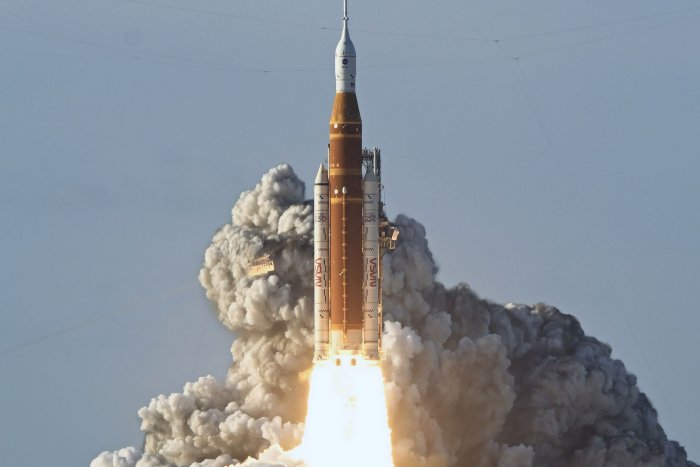
NASA’s Space Launch System rocket carrying the Artemis II crew is launched from Complex 39B at Kennedy Space Center in Florida on April 1, 2026. Photo by Joe Marino/UPI | License Photo
The Uffizi Galleries, home to Italy’s most precious art, were hit by a cyberattack, the museum said. The museum claims there was no data stolen. File Photo by Claudio Giovannini/EPA
April 3 (UPI) — The Uffizi Galleries in Florence, Italy, said Friday it suffered a cyberattack, but not a breach of data earlier this year.
The country’s top art museum said nothing had been damaged or stolen in the attack.
Italian newspaper Corriere della Sera reported that hackers had infiltrated the museums’ IT systems and taken access codes, internal maps and the locations of closed-circuit cameras and alarms, then demanded ransom.
But the museum disputed that report, saying its security systems are inaccessible from outside the museum, the BBC reported.
Corriere reported that the attackers moved through interconnected systems, computers and phones, learning the museum’s operations. It said a ransom demand was later sent to museum director Simone Verde’s personal phone threatening to sell data on the dark web.
The Uffizi houses priceless masterpieces by Michelangelo, Sandro Botticelli, Leonardo da Vinci and Raphael. It’s the home of The Birth of Venus, by Botticelli; Venus de’ Medici, a Greek sculpture by an unknown artist; and Annunciation by Leonardo.
Italian media have reported that the attack forced authorities to move some of the museum’s collection into secure vaults. But the Uffizi stressed in a note shared with Politico that the attack was “nothing like the Louvre,” referencing the $100 million jewel heist last year that eventually forced its director to resign. The items stolen from the Louvre have not been recovered.
The movement of items to vaults, which included Medici-era treasures, was because of ongoing renovations, the museum said.
Former Prime Minister and former Florence Mayor Matteo Renzi criticized Culture Minister Alessandro Giuli, an ally of Prime Minister Giorgia Meloni, for not protecting the important museum.
“Hackers are attacking the Uffizi Gallery and threatening our cultural heritage. I wonder: what is Minister Giuli doing and what has he done?” Renzi posted on X Thursday. “Did he notice or is he too busy playing the flute in honor of the god Pan … ? And what is the National Cybersecurity Agency doing? Or is Italians’ money just going into software like Paragon that spies on journalists? I’ll submit a question. I’m curious to see if anyone will have the courage to respond.”
On March 22, a three-minute heist resulted in the loss of three paintings by Renoir, Cezanne and Matisse from the Magnani-Rocca Foundation in Parma, Italy.
NASA has successfully launched the Artemis II mission, marking the first crewed mission to the moon’s vicinity since the Apollo programme ended in 1972.
The 322-foot Space Launch System (SLS) rocket lifted off at 6:35pm ET (22:35 GMT) on Wednesday from Cape Canaveral, Florida, sending the Orion crew capsule on a 10-day journey.
Recommended Stories
list of 3 itemsend of list
While Artemis II will not land on the moon, it will fly a “free-return” trajectory that swings around it to prove the spacecraft can sustain a crew on future missions.
The idea is to descend to the surface of the Earth’s only natural satellite again on Artemis IV in 2028.
“We have a beautiful moonrise,” said Reid Wiseman, the NASA astronaut serving as mission commander, about five minutes after the launch. “We’re heading right at it.”
Here is what we know:
What happened?
The Artemis II mission launched successfully from the Kennedy Space Center in Florida, sending four astronauts on a historic journey around the moon, the first crewed mission beyond low-Earth orbit in more than 50 years.
The launch followed a tense countdown, as engineers worked through several technical issues. Teams closely monitored the rocket during fuelling due to hydrogen leaks that had delayed the mission in the past, but no major leaks were detected on launch day.
Engineers also resolved last-minute problems involving battery sensors and the rocket’s flight termination system, a critical safety system used to destroy the rocket if it goes off course, before clearing the mission for liftoff.
The 32-storey rocket lifted off in the early evening in front of large crowds gathered near the launch site. The crew are now on a mission that will take them around the moon and back to Earth.
The launch had been planned for as early as February 6, and then March 6, until a hydrogen leak prompted NASA to roll the rocket back to its vehicle assembly building for scrutiny.
It had earlier been scheduled for November 2024, but NASA announced a delay due to technical investigations, particularly into the Orion’s heat shield.
Who is part of the Artemis II mission?
All three NASA astronauts are veterans of Earth-orbit science expeditions to the International Space Station, while the lone Canadian joining them on a voyage around the moon and back is a spaceflight rookie.
Reid Wiseman, 50, commander: The NASA veteran and former International Space Station commander is leading the Artemis II mission. A test pilot-turned-astronaut, he has leadership and deep spaceflight experience.
Victor Glover, 49, pilot: The US Navy aviator is the first Black astronaut assigned to a lunar mission and flew on SpaceX Crew-1.
Christina Koch, 47, mission specialist: The record holder for the longest single spaceflight by a woman at 328 days is a veteran of multiple spacewalks and has scientific and deep-space mission expertise.
Jeremy Hansen, 50, mission specialist: The first Canadian set to travel to the moon is a former fighter pilot. His presence represents international collaboration in deep space exploration.
(Al Jazeera)
When will the mission reach the moon?
If the mission goes as planned, the capsule is expected to reach the moon on about April 6, the sixth day of the mission.
The crewed Orion capsule will then fly around the moon, reaching its closest point before beginning the journey back to Earth, with splashdown expected on April 10, 2026.
What is the mission plan for the next 10 days?
The Artemis II mission is expected to last about 10 days and follows this general outline:
Days 1-2 high Earth orbit : The crew will spend their first one to two days in high Earth orbit conducting extensive checks on the spacecraft’s systems.
Once those checks are complete, Orion’s propulsion system will perform a “translunar injection”.
A translunar injection is a critical manoeuvre performed by the Orion spacecraft’s propulsion system. Occurring after the crew completes their initial systems checks in high Earth orbit, this manoeuvre propels the spacecraft out of Earth orbit and sets it onto a direct trajectory towards the moon.
Days 3-4 translunar transit: As they transit to the moon over the next several days, the astronauts will continue monitoring Orion’s systems.
The spacecraft will then pass behind the moon on a “free-return” trajectory, a strategic path that naturally swings the capsule back towards Earth without requiring any additional propulsion.
Day 5 lunar sphere of influence: Orion enters the moon’s gravitational pull, which becomes stronger than Earth’s.
The astronauts will spend the first several hours of the day testing their spacesuits, including practising how quickly they can put them on, pressurising them and strapping into their seats.
Day 6 lunar flyby: This is the day the crew fly by the moon.
The spacecraft reaches its closest approach, approximately 4,000-6,000 miles (6,450-9,650km) above the lunar surface.
Day 7-9 Return journey: Following the flyby, Orion remains on its free-return trajectory. The crew conducts deep-space science, including medical monitoring through programmes like ARCHER.
Day 10 Re-entry and splashdown: Orion separates from the service module and re-enters Earth’s atmosphere at roughly 25,000mph (40,230km/h). The mission concludes with a splashdown in the Pacific Ocean.
What’s NASA’s next mission?
Artemis III is the next mission and is currently planned for 2027.
It will involve the Orion spacecraft docking in Earth orbit with at least one of NASA’s lunar landers, either Blue Origin’s Blue Moon system or SpaceX’s Starship.
The docking manoeuvre is intended to demonstrate how the landers will collect astronauts in orbit before transporting them to the moon’s surface.
The mission is a major step in NASA’s plan to return humans to the moon and eventually send astronauts to Mars.
Published On 1 Apr 20261 Apr 2026
The Artemis II space mission has blasted off from the US state of Florida, sending four astronauts on a historic journey around the moon and marking the first time humans have travelled beyond low-Earth orbit in more than 50 years.
The mission, which launched on Wednesday, is a major step in the US space agency NASA’s plan to return humans to the moon and eventually send astronauts to Mars.
Recommended Stories
list of 1 itemend of list
The 32-story rocket rose from NASA’s Kennedy Space Center where tens of thousands gathered to witness the lift-off.
The Artemis II crew – NASA astronauts Reid Wiseman, Victor Glover and Christina Koch, and Canadian Space Agency astronaut Jeremy Hansen – are set for a nearly 10-day journey around the moon and back, taking them farther into space than humans have travelled in decades.
“On this historic mission, you take with you the heart of this Artemis team, the daring spirit of the American people and our partners across the globe, and the hopes and dreams of a new generation,” said Charlie Blackwell-Thompson, the launch director. “Good luck, Godspeed Artemis II. Let’s go.”
Five minutes into the flight, Wiseman, the commander, saw the team’s target: “We have a beautiful moonrise, we’re headed right at it,” he said from the capsule.
ATLANTA — Over the past three decades, the collection of DNA from convicted criminals has become standard in the U.S. justice system, and many states now also swab people arrested for serious crimes.
Legislation awaiting a final vote in Georgia would take that a step further by collecting DNA from people charged with less serious misdemeanors — but only if federal immigration authorities want them detained. That could include immigrants not ultimately deported.
If enacted, Georgia’s measure would make it the third state to single out immigrants believed to be in the U.S. illegally for the collection of genetic material that wouldn’t be taken from others. Florida passed a similar law in 2023. And Oklahoma in 2009 authorized DNA collection from immigrants in the U.S. illegally, though it remains subject to funding.
The new legislation comes as President Trump’s administration seeks to expand its use of DNA and biometrics in immigration enforcement as it carries out a plan to deport millions of people from the U.S.
“It is one example of something we are seeing across the landscape, which is government actors at all levels vacuuming up DNA in all available contexts,” said Stevie Glaberson, director of research and advocacy at the Center on Privacy and Technology at Georgetown University law school.
Immigrant DNA collection has grown in recent years
The FBI launched the National DNA Index System in 1998 to compile DNA samples submitted by federal, state and local authorities. It’s grown in size and scope and now contains more than 26 million DNA profiles, many from people convicted of crimes.
A federal law enacted 20 years ago allowed the attorney general to expand DNA collection to people arrested and to noncitizens detained under federal authority. But because of exceptions authorized by federal officials, few immigrants had their DNA collected.
That changed in 2020, during Trump’s first term, when a new Department of Justice rule took away much of that discretion. Over the next five years, the Department of Homeland Security added the DNA profiles of more than 2.6 million detainees to the national database, according to an analysis by the Center on Privacy and Technology.
The department did not answer questions from the Associated Press about the percentage of detained immigrants whose DNA has been collected during Trump’s second term.
But the department is looking to expand its authority. A proposed rule would allow it to collect DNA, including from U.S. citizens, to determine family relationships in immigrant benefit cases.
States don’t typically collect DNA for misdemeanor arrests
Though many states collect DNA from people arrested for felonies, just 10 states collect it from people arrested for certain misdemeanors, such as sex offenses, and none collect it for all misdemeanor arrests, according to an AP analysis of data compiled by the Boise State University Department of Criminal Justice.
But under the Florida and Oklahoma laws, any arrest could lead to DNA collection for immigrants subject to federal detainer requests. Officials in the Florida Department of Law Enforcement and Oklahoma State Bureau of Investigation did not respond to questions about whether those laws are being used.
The Georgia legislation would require DNA collection from immigrants facing any misdemeanor or felony charges if U.S. Immigration and Customs Enforcement has issued a detainer request but has not picked up the person within 48 hours.
Georgia state Sen. Tim Bearden, a Republican sponsoring the bill, described the measure as a means of solving crimes.
“Technology is changing quickly, and DNA is one of those things that help us tremendously when we’re trying to make sure to bring justice to victims in this state and across this country,” Bearden said at a March hearing.
The Department of Homeland Security said in a statement that “partnerships with law enforcement are critical to having the resources we need to arrest criminal illegal aliens across the country.”
Could a broken tail light lead to a DNA swab?
A 2024 Georgia law mandates that local law enforcement cooperate with federal authorities to identify and detain immigrants in the U.S. illegally, or else lose state funding. This year’s legislation would build upon that.
Some legal experts say it could result in DNA collections from immigrants taken into custody for minor violations. Traffic offenses that are penalized as civil violations in some states are considered misdemeanors in Georgia, making them subject to the new law, said Mazie Lynn Guertin, executive director and policy advocate with the Georgia Assn. of Criminal Defense Lawyers.
“We don’t think that swabbing a person who’s committed a traffic violation is a boon for public safety,” Guertin said. “The correlation between a broken tail light and a crime that’s solvable with DNA is pretty attenuated in most cases.”
People subject to federal immigration detainer requests aren’t necessarily undocumented or deportable, because they may later prove their legal presence, said Kyle Gomez-Leineweber, director of policy for Common Cause Georgia. But such people could have their DNA collected under the Georgia legislation.
“What this really does is it creates a two-tiered system where some of the DNA would be collected based off of the perception of an individual’s immigration status,” said Gomez-Leineweber.
Legal experts raise questions about constitutional rights
The U.S. Supreme Court in 2013 upheld a Maryland law allowing DNA to be collected from people charged — but not yet convicted — of certain serious crimes. That law allows DNA to be added to a database after it’s determined there is probable cause to detain someone, provided it’s deleted if the person is not ultimately convicted.
The Maryland case often is cited as justification for an expansion of DNA collection. But some immigrant advocates question whether civil immigration detainers meet the probable cause threshold to make DNA collection acceptable under the U.S. Constitution’s Fourth Amendment protection against unreasonable searches and seizures.
“There doesn’t appear to be any kind of meaningful justification for states to step in to require the collection of DNA — of genetic material — from noncitizens in their custody who have merely been accused of a crime, even a low-level crime,” said Jorge Loweree, managing director of the American Immigration Council. “It seems like this is just an effort to increase the surveillance of noncitizens.”
Kramon and Lieb write for the Associated Press. Lieb reported from Jefferson City, Mo.
March 30 (UPI) — NASA officials on Monday started the two-day countdown to the Artemis II mission launch, which will send a crew of four around the moon as they test the Space Launch System rocket and Orion spacecraft.
After canceling a launch attempt in February because of a helium valve concern, officials said that the only thing they are worried about ahead of Wednesday’s launch is the weather — and the forecast offers an 80% chance for the right conditions.
The 10-day mission, which will take the crew farther from Earth than any human before, is the next step in the agency’s goal of returning humans to the surface of the moon and establishing a permanent presence there.
With mission engineers starting the clock, the crew — Mission Specialist Jeremy Hansen, Mission Specialist Christina Koch, Commander Reid Wiseman and Pilot Victor Glover — are getting some rest and spending time with their families before starting their own pre-launch activities, officials said.
“The team concluded that everything continues to look good and there are no issues preventing us from pressing ahead,” NASA’s Associate Administrator Amit Kshatriya said during a media briefing from Kennedy Space Center in Florida.
“At this point, as we enter the pre-launch phase, we are in a strong posture and the mission remains on track,” he said.
Countdown to launch
The Artemis II launch window starts at 6:24 p.m. EDT on Wednesday, giving NASA two hours if the cumulus cloud cover is too heavy, which mission engineers said is the only thing about the weather forecast they are worried about.
The SLS and Orion was initially rolled out to the launch pad in February but engineers discovered an issue with a helium valve during a wet dress rehearsal and decided to bring the rock back to the Vehicle Assembly Building to check it out.
After replacing the valve, and checking on other systems, the rocket was rolled back out on March 19.
Monday’s mission management team meeting is similar to the flight readiness review but is a faster rundown than that comprehensive effort as each group updates others on their pre-launch progress.
Charlie Blackwell-Thompson, launch director for the mission, said the launch countdown officially started at 4:44 p.m. EDT on Monday, which corresponds with NASA starting to configure ground facilities at the launch pad.
She noted that, while most people are familiar with a 30-minute or 10-minute countdown, launch countdowns are generally linked to the preparation needed for launch — shuttle countdowns started three days before launch, while commercial launches may often need a countdown of one day or less.
Crew awaits launch
The Artemis crew arrived in Cape Canaveral “on Friday, getting an opportunity for some rest before we work them very hard,” Emily Nelson, the mission’s chief flight director, said of the foursome, which has been in quarantine already for a couple of weeks.
Like many crews of astronauts before them, the Artemis crew has been staying at The Astronaut Beach House, which NASA has owned since 1963 and where space mission crews have spent time ahead of launches for decades.
Before the start of their final meetings and prep for launch, the crew was expected to eat dinner and spend time with their families, all of whom also have been required to comply with some sort of quarantine before getting there.
On launch day, after fuel tanking and last-minute items by a closeout crew around 1:00 p.m. EDT, the crew will board the Orion at 2:00 p.m. EDT to conduct communication system checks, configure the crew module and run the countdown to a 10-minute hold for about 30 minutes, Blackwell-Thompson said.
During that 30-minute hold, mission engineers will run through one more system-by-system before starting the final countdown to NASA’s first crewed mission to the moon in more than 50 years.
NASA’s Space Launch System rocket emerges on Saturday morning from the Vehicle Assembly Building to start its journey to Launch Complex 39B at the Kennedy Space Center in Florida. Photo by Joe Marino/UPI | License Photo
March 27 (UPI) — Iran-linked hackers broke into FBI Director Kash Patel’s personal email account, multiple news outlets reported Friday.
The hackers published photos and emails from the account from before Patel became FBI director, CNN, CNBC and CBS News reported. CNN said a source familiar with the breach confirmed the authenticity of the photos.
The emails the group stole from Patel date from around 2011 to 2022. They include personal, business and travel communication.
The hacking group, Handala Hack Team, said on their website that Patel “will now find his name among the list of successfully hacked victims.”
The photos published include Patel sniffing and smoking cigars, riding in an antique convertible, and making a face while taking a picture of himself in the mirror with a large bottle of rum. There are family photos and details of Patel searching for an apartment.
The group calls it a breach of “impenetrable” FBI systems, but the FBI was not breached.
“This isn’t an FBI compromise — it’s someone’s personal junk drawer,” cybersecurity researcher Ron Fabela told CNN.
“The FBI is aware of malicious actors targeting Director Patel’s personal email information, and we have taken all necessary steps to mitigate potential risks associated with this activity,” a statement from the FBI said. “Consistent with President Trump’s Cyber Strategy for America, the FBI will continue to pursue the actors responsible, support victims, and share actionable intelligence in defense of networks.”
It also said the information taken, “is historical in nature and involves no government information.”
The FBI also said that the State Department has offered a $10 million reward for information that leads to the identification of the Handala Hack Team.
The hackers have said they hacked the account to retaliate for a missile strike on an Iranian school, CNN reported.
Handala claimed Thursday to have published the personal data of dozens of Lockheed Martin employees stationed in the Middle East. The company said in a statement it was aware of the reports and had policies and procedures in place “to mitigate cyber threats to our business.”
Gil Messing, chief of staff at Israeli cybersecurity company Check Point, told CNBC that the move against Patel was part of Iran’s strategy to embarrass U.S. officials and “make them feel vulnerable.”
On March 19, the FBI took down two websites used by Handala after it hacked the medical company Stryker on March 11. The two sites were: one that had information about its hacks and the other used to dox people it alleges work with the Israeli military. The website it used to post Patel’s information was registered the same day the other sites came down.
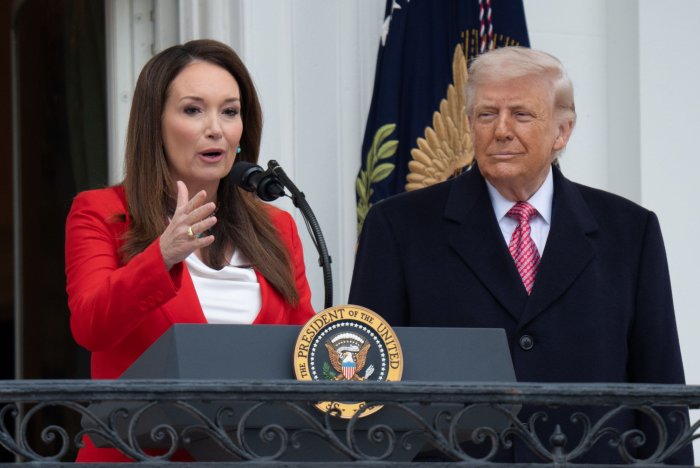
President Donald Trump stands with U.S. Secretary of Agriculture Brooke Rollins during an event celebrating farmers on the South Lawn of the White House on Friday. Photo by Aaron Schwartz/UPI | License Photo
Kano, Nigeria – On a bustling day in northern Nigeria, Marian Shammah made her way to the Sabon Gari Market, one of the largest electronics hubs in Kano state.
The 34-year-old cleaner was in need of a refrigerator, but with rising costs and a meagre income, she saw the second-hand appliances sold at the market as a lifeline.
Recommended Stories
list of 3 itemsend of list
After locating the one she wanted, she paid the vendor 50,000 naira ($36) and took it home. But just a month later, the freezer collapsed.
“Only the top half of the refrigerator was working, and the freezer wasn’t working,” said Shammah.
Her food spoiled, her savings disappeared, and she was soon back in the market searching for another appliance.
Although Shammah could have bought a new local appliance for just over 30,000 naira ($30) more, she – like millions of Nigerians – believes second-hand products from America and Europe “last longer” than new products sold in Nigeria.
Observers say this trend is part of a larger crisis. Nigeria has become a major destination for the developed world’s discarded electronics – items often near the end of life, sometimes completely dead, and frequently toxic because they contain hazardous materials. When they break down, they add to landfills, worsening an already dire e-waste crisis on the African continent.
Around 60,000 tonnes of used electronics enter Nigeria through key ports each year, with at least 15,700 tonnes already damaged upon arrival, according to the United Nations.
The trade in used electronic goods is powered largely by foreign exporters. A UN tracking study between 2015 and 2016 showed that more than 85 percent of used electronics imported into Nigeria originated from Germany, the United Kingdom, Belgium, the Netherlands, Spain, China, the United States, and the Republic of Ireland.
Many of these imports violate international restrictions, like the Basel Convention, an environmental treaty regulating the transboundary movement and disposal of hazardous electronic waste to developing countries with weaker environmental laws.
Across West Africa, the Basel Convention’s “E-Waste Africa Programme”, a project focused on strengthening e-waste management systems across the continent, estimates that Benin, Ivory Coast, Ghana, Liberia, and Nigeria collectively generate between 650,000 and 1,000,000 tonnes of e-waste annually – much of it the result of short-lifespan second-hand imports.
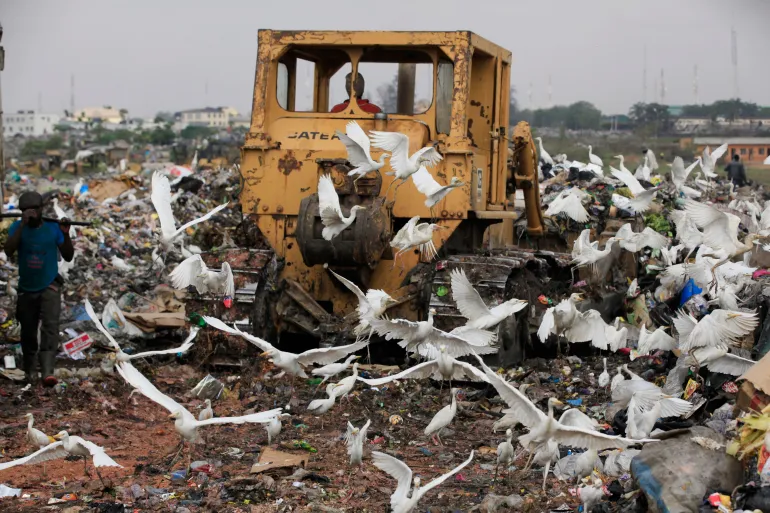
A man sorts out iron and plastic to sell while a bulldozer clears the garbage and birds surround it in a dump site in Lagos, Nigeria [File: Sunday Alamba/AP]
Health risks
The United Nations describes e-waste as any discarded device that uses a battery or plug and contains hazardous substances – like mercury – that can endanger both human health and the environment. Several of the toxic components commonly found in e-waste are included on the list of 10 chemicals of major public health concern maintained by the World Health Organization (WHO).
According to the WHO, used electrical and electronic equipment (EEE) presents a growing public health and environmental threat across Africa, with Nigeria at the centre of the trade.
“Much of the equipment shipped as used electronics is close to becoming waste,” said Rita Idehai, founder of Ecobarter, a Lagos-based environmental NGO, warning that devices imported and sold as affordable second-hand goods often fail shortly after arrival and quickly enter the waste stream.
The consequences are far-reaching. Many imported fridges and air conditioners, for instance, still contain CFC-based and HCFC-based refrigerants such as R-12 and R-22 – chemicals banned in Europe and the US for causing ozone depletion or being linked to cancer, miscarriages, neurological disorders, and long-term soil contamination. These gases live for 12 to 100 years, meaning leaking equipment adds to a multi-generational environmental burden.
After these imported items stop working or fall apart, informal recyclers then dismantle the electronics with their bare hands, Al Jazeera observed. In Kano, the recyclers inhale poisonous fumes and manage the heavy metals without protection. Their work earns them a meagre 3,500–14,000 naira ($2.50-$10) per week, they said, and the after-effects linger – including persistent coughing, chest pain, headaches, eye irritation, and breathing difficulties after long hours of burning cables and dismantling electronic devices.
The health crisis extends into Kano’s communities.
Among casual recyclers and residents who live close to e-waste dumps, many report symptoms that range from chronic headaches and skin irritation to breathing issues, miscarriages and neurological concerns, according to health surveys done by the International Journal of Environmental Research and Public Health. These ailments are consistent with longtime toxic exposure, the researchers said.
Recent field assessments conducted by Nigeria’s Federal University Dutse also stressed that in and around Kano state, where the Sabon Gari Market is located, there are rising levels of heavy metals in soil and drainage channels.
Dr Ushakuma Michael Anenga, a gynaecologist at the Benue State Teaching Hospital and second vice president of the Nigerian Medical Association, warned that toxic exposure from informal e-waste recycling poses grave health risks to communities in Kano.
“Exposure to heavy metals and refrigerant gases in e-waste causes extreme brief and long-term health issues, generally affecting the breathing and renal organs,” he told Al Jazeera.
“Common casual practices like exposed burning and dismantling result in direct, high-level exposure for workers and nearby residents. Children and pregnant girls are particularly inclined due to the fact that those toxicants can disrupt development or even skip from mother to unborn baby, [while] recyclers who work without defensive equipment face repeated, frequently irreversible damage.”
Old computer monitors discarded as electronic waste are pictured at a recycling facility in Lagos, Nigeria [File: Temilade Adelaja/Reuters]
Profits over protection
In Sabon Gari Market, second-hand electronics are advertised as less costly lifelines for households and poor business owners burdened by inflation.
Many customers say foreign-used home equipment appears sturdier and seems like better value for money than new imports from the developing world. Meanwhile, others are just looking for cheap options in difficult economic times.
“I usually go for second-hand or foreign-used electronics because brand-new ones are too expensive for me,” Umar Hussaini, who sells used electronics at the market, told Al Jazeera.
“Sometimes you can get them for half the price of new ones, and they look almost the same, so it feels like a good deal at the time.”
But the last refrigerator he bought stopped cooling after just three months. With no warranty or guarantee, the seller refused responsibility.
“For weeks, we couldn’t store food properly at home, and we ended up buying food daily, which was more expensive,” he said. “However, I have to buy another one again.”
For small business owners like Salisu Saidu, the losses can be even more devastating. He bought a used freezer for his shop, believing it had been serviced. Within weeks, it failed.
“I lost a lot of frozen food, which meant I lost money and customers,” he told Al Jazeera.
Around his neighbourhood, broken electronics are often dumped out in the street, sometimes emitting smoke or sparks.
“There’s also a lot of electronic waste piling up around,” he said, calling for tighter import controls, proper certification, and mandatory warranties to protect buyers from being sold what he described as “damaged goods disguised as fairly used”.
Umar Abdullahi’s second-hand electronics shop in Kano, Nigeria [Abdulwaheed Sofiullahi/Al Jazeera]
Bought as bargains, sold as burdens
At Sabon Gari Market, another vendor, Umar Abdullahi, is surrounded by imported refrigerators, air conditioners and washing machines stacked tightly together.
The products in his shop are advertised as “London use” or “Direct Belgium”, while he negotiates the sale of a double-door fridge for 120,000 naira ($87).
Abdullahi’s store is where Shammah returned after the refrigerator she bought failed. But he admits that much of what he sells to customers arrives unchecked.
“We buy them untested from suppliers in Europe, and we also sell them untested so we can make our profit,” he told Al Jazeera.
This despite the fact that international rules under the Basel Convention, as well as Nigerian environmental regulations, prohibit the shipment of material considered e-waste – with penalties including fines and jail terms.
Nwamaka Ejiofor, a spokesperson for Nigeria’s National Environmental Standards and Regulations Enforcement Agency (NESREA), said the country does not permit the import of e-waste. However, the entry of used electronics is allowed under regulated conditions.
“The importation of used electrical and electronic equipment is regulated and may be allowed only where such equipment meets prescribed conditions, including functionality and compliance requirements,” she told Al Jazeera.
“Nigeria applies a combination of regulatory, administrative and enforcement measures to ensure that imported used electronics comply with national law and the country’s international obligations,” she added, listing out measures including environmental regulations, cargo inspection and verifying that imported equipment is “functional”.
However, despite this, some traders find loopholes in the system, including declaring cargo they plan to sell as personal belongings or second-hand household goods to avoid scrutiny.
Although NESREA says enforcement has improved, critics say the steady flow of mediocre goods continues largely unchecked. Even dealers at Sabon Gari Market acknowledge that most appliances are sold “as is”, without certification or guarantees.
Baban Ladan Issa’s worker washes a second-hand fridge before selling it to a customer [Abdulwaheed Sofiullahi/Al Jazeera]
‘Loopholes’
Behind the second-hand electronics trade is a network of collectors and exporters who source discarded appliances across Europe.
Baban Ladan Issa, who ships used electronics from Ireland to Nigeria, said items are gathered from weekend markets, private homes that are replacing old gadgets, and contractors clearing out equipment from offices, hotels and hospitals.
“Some suppliers mix working and damaged goods together,” he told Al Jazeera, noting that while he tries to avoid faulty items, not all buyers do the same.
Once assembled, shipments worth millions of naira are sent to Lagos through ships then down to sellers in the market in Kano state, sometimes packed in containers or hidden inside vehicles to reduce inspection risks.
Shipping records seen by Al Jazeera showed consignments labelled as “personal effects”, a classification that can limit detailed checks at ports.
Chinwe Okafor, an environmental policy analyst based in Abuja, said the problem is systemic.
“Exporting nations regularly take advantage of loopholes by means of labelling nonfunctional e-waste as ‘second-hand goods’ or ‘for repair,’” she told Al Jazeera. “In some instances, research estimates that over 75 percent of what arrives in developing countries is truly junk.”
“This permits wealthy countries to keep away from highly-priced recycling at home while pushing unsafe materials into nations with weaker safeguards.”
Ibrahim Adamu, a programme officer with the NGO Ecobarter, added that mislabelling, poor inspection technology and corruption at ports make enforcement difficult.
“The highest profits are captured by exporters and brokers who arbitrage the gap between disposal costs in Europe or Asia and the strong demand for ‘tokunbo’ goods in Nigeria,” he said, using the local name for used imported electronics.
To forestall this, he said Nigeria “must reinforce border inspections” and implement a policy whereby producers and manufacturers bear financial responsibility. At the same time, “the international network has to adopt binding bans that [hold] manufacturers and exporters responsible”, Adamu said.
People shop at a market in Nigeria [File: Sodiq Adelakun/Reuters]
Little oversight, mounting risks
Although Nigeria has regulations governing the import of electrical and electronic equipment, enforcement gaps keep exposing markets like Kano’s Sabon Gari to ageing and near-end-of-life appliances, locals say.
Ibrahim Bello, a used electronics importer with a decade in the business, said many shipments that arrive from Europe are in less-than-ideal condition.
“Around 20 to 30 percent of the items we receive have issues when they arrive,” he told Al Jazeera. “Some are already damaged, while others stop working after a short time because they are old.
“That’s just part of the business.”
Retailer Chinedu Peter gave similar estimates. “From what I’ve experienced, maybe 40 percent of the electronics have some fault as they come,” he said, adding that environmental and protection checks don’t happen as they are meant to.
“Such a lot of items enter without special checks.”
Both men feel that clearer rules and certified testing systems will improve trust. But until then, thousands of ageing, unsuitable products will continue to flood Nigeria.
Shammah, back at Sabon Gari Market just weeks after her refrigerator broke, was once again searching through rows of stacked appliances, hoping her next purchase might last longer than the last.
“I don’t really trust these fairly used appliances again, but I still have to buy something because we need it at home,” she told Al Jazeera.
“This time I’m thinking … I can buy a new one from a proper shop, even if it takes longer, because I don’t want to lose my money again.”
Court dismissed xAI claim that measures were taken after plaintiff produced video of nude person shortly before hearing.
Published On 26 Mar 202626 Mar 2026
A Dutch court has ordered Elon Musk’s xAI to stop generating and distributing nude images of people without their consent in the Netherlands, warning it would impose fines of 100,000 euros ($115,350) per day for noncompliance.
The Amsterdam District Court ruled Thursday that xAI’s Grok artificial intelligence tool and the X platform that hosts it were barred from “generating and/or distributing sexual imagery” featuring people “partially or wholly stripped naked without having given their explicit permission”.
Recommended Stories
list of 3 itemsend of list
The decision in a civil suit was one of the first times a judge has weighed in on xAI’s responsibility for creating tools that can be used to create sexualised images, amid a flood of complaints and investigations over Grok in the Americas, Europe, Asia and Australia.
Grok was launched by Musk in 2023 and distributed through his social media platform X, which is now part of his rocket and space exploration company SpaceX.
Offlimits, a Dutch centre monitoring online violence, took legal action in cooperation with the non-profit Victims Support Fund over a Grok feature allowing users to ask it to create hyper-realistic deepfake montages of naked women and children using real photos.
At a hearing this month, xAI lawyers had argued it was impossible to guarantee that abuse on its platform could be prevented, and the company should not be punished for the actions of malicious users.
They said the company had taken measures in January to prevent Grok from editing images of real people in revealing clothing, including restricting its image creation features to paid subscribers.
The court website said the judge had decided that Offlimits had shown there was reasonable doubt over the effectiveness of the measures taken to date. “For example, Offlimits managed to produce a video of a nude person using Grok shortly before the hearing,” it stated.
Offlimits director Robbert Hoving said the “burden is on the company” to make sure its tools are not used to create and distribute nonconsensual sexual images, including of children.
Earlier on Thursday, the European Parliament approved a ban on artificial intelligence systems generating sexualised deepfakes, after global outrage over non-consensual Grok-produced nudes.
A Los Angeles County jury on Wednesday found Meta and YouTube liable in a social media addition case. File Photo by Adam Vaughn/EPA
March 26 (UPI) — A California jury has found Meta and YouTube liable for negligently designing addictive social media platforms that harm children, in a landmark verdict that could have lasting implications for the tech industry.
The Wednesday verdict marks the first time technology companies have been found liable for creating addictive online products, amid increased scrutiny of the industry and a wave of litigation.
“This jury saw exactly what we presented from the very first day of trial: that these companies built digital spaces designed to negatively influence the brains of children, and they did it on purpose,” Mark Lanier, lead trial counsel and founder of The Lanier Law Firm, said in a statement.
“The evidence showed that Meta and YouTube knew their platforms were hooking children and harming their mental health, and instead of fixing the problem they kept developing features to maximize the time kids spent on their apps. Now a jury has told them that is not acceptable, and you are being held accountable.”
UPI has contacted Meta and YouTube for comment.
The verdict follows a seven-week trial centered on a now-20-year-old plaintiff known to the court by her initials K.G.M., who testified that her use of Instagram, owned by Meta, and YouTube, an Alphabet product, from a young age caused her to develop anxiety, depression, body dysmorphia and suicidal thoughts.
During the trial, she testified that the platforms’ addictive design features, including algorithm-generated recommendations, beauty features and push notifications caused her severe mental harm.
“[The plaintiff] put a human face on what these companies have known for years: that their platforms were engineered to hook young users, and that the children most vulnerable to trauma were the ones they were most effectively reaching,” Rachel Lanier, co-lead counsel and managing attorney of The Lanier Law Firm’s Los Angeles office, said in a statement.
In its verdict, the jury found Meta 70% responsible for the harm the plaintiff suffered and YouTube 30% responsible, and ordered the Mark Zuckerberg-owned tech behemoth and Google‘s video-sharing service to pay her a combined $6 million, half for compensatory damages and half for punitive damages.
Of the punitive damages, Meta is to pay $2.1 million and YouTube $900,000.
This was the first trial in a much larger consolidated case involving more than 1,600 plaintiffs seeking to hold social media companies responsible for the harm they suffered from using those products.
“This is a major victory for the public, for social media users and for child safety,” Libby Liu, CEO of nonprofit legal organization Whistleblower Aid, told UPI in an emailed statement.
“Each successful lawsuit paints a crystal clear picture showing that Meta is not above the law and can and should be held accountable.”
The verdict came down a day after a New Mexico jury found Meta liable for misleading consumers about the safety of its products, ordering the company to pay $375 million in civil penalties for violating the state’s consumer protection laws.
During the trial, state prosecutors showed that Meta’s design features enabled predators to engage in child sexual exploitation, while demonstrating that Meta intentionally designed its platforms to addict young people.
Following the verdict in Los Angeles County, New Mexico Attorney General Raul Torrez, a Democrat, celebrated it as “another critical step toward justice that puts Meta and other big tech executives on notice that they cannot evade responsibility for design choices that jeopardize child safety.”
“We will seek court-mandated changes to Meta’s platforms that offer protections for kids,” he said in a statement.
The rulings come as more attention is being paid to the effects social media has on youth, resulting with Australia in December banning those under the age of 16 from social media, while other countries are considering similar restrictions.
A Los Angeles jury has found Alphabet’s Google and Meta liable for $6 million in damages in a landmark social media addiction lawsuit. The case involved a 20-year-old woman who said she became addicted to the apps at a young age due to their platform design. Meta says it plans to appeal the decision.
A California jury found Alphabet’s Google and Meta liable for $3m in damages in a landmark social media addiction lawsuit that accused the companies of being legally responsible for the addictive design of their platforms.
The decision was handed down by a Los Angeles-based jury on Wednesday after more than 40 hours of deliberation across nine days, and more than a month after jurors heard opening statements in the trial.
Recommended Stories
list of 4 itemsend of list
Among those who testified in the case were Meta CEO Mark Zuckerberg and Instagram head Adam Mosseri, although YouTube chief executive Neal Mohan was not called to testify.
The plaintiff in the case, referred to as KGM or Kaley, was awarded $3m in damages. The 20-year-old said she became addicted to social media at a young age, which exacerbated her mental health issues. She began using YouTube at age six and Meta-owned Instagram at age nine.
Kaley’s legal team alleged that the social media giants used designed features intended to hook young users, including notifications and autoplay features.
“Today’s verdict is a historic moment — for Kaley and for the thousands of children and families who have been waiting for this day. She showed extraordinary courage in bringing this case and telling her story in open court. A jury of Kaley’s peers heard the evidence, heard what Meta and YouTube knew and when they knew it, and held them accountable for their conduct. Today’s verdict belongs to Kaley,” lawyers for the plaintiff said in a statement shared with Al Jazeera.
Jurors were instructed not to consider the content of the posts and videos Kaley saw on the platforms. That is because tech companies are shielded from legal responsibility for user-posted content under Section 230 of the 1996 Communications Decency Act.
Meta consistently argued that Kaley had struggled with her mental health separate from her social media use, often pointing to her turbulent home life. Meta also said, “not one of her therapists identified social media as the cause” of her mental health issues in a statement following closing arguments. But the plaintiffs did not have to prove that social media caused Kaley’s struggles — only that it was a “substantial factor” in causing her harm.
YouTube focused less on Kaley’s medical records and mental health history and more on her use of the platform itself. The company argued that YouTube is not a form of social media, but rather a video platform, akin to television, and pointed to her declining use as she got older.
According to company data, she spent about one minute per day on average watching YouTube Shorts since its inception. YouTube Shorts, which launched in 2020, is the platform’s section for short-form, vertical videos that include the “infinite scroll” feature that the plaintiffs argued was addictive.
“We disagree with the verdict and plan to appeal. This case misunderstands YouTube, which is a responsibly built streaming platform, not a social media site,” Jose Castaneda, a spokesperson for Google, told Al Jazeera.
Meta did not respond to Al Jazeera’s request for comment.
Snap and TikTok were previously named in the suit but settled with the plaintiff for undisclosed terms before the trial began.
Shifting momentum
The verdict is the latest in a wave of lawsuits targeting social media companies. There is a looming federal social media addiction case slated to begin in June in Oakland, California.
On Tuesday in New Mexico, a jury found that Meta violated state law by misleading users about the safety of Facebook, Instagram, and WhatsApp, and by enabling child sexual exploitation on those platforms.
This case has been closely watched by legal experts, who say the verdict will shape future litigation.
“The fact the jury found Meta and Google liable represents that these cases have real exposure to the social media giants, and are going to frame how future litigation will proceed. Although this case will certainly be appealed, I would not be surprised if Meta and Google are already making changes within their platform to reflect the real exposure, and hopefully, the states will start to enact laws regulating social media in a manner congruent with the ruling,” entertainment lawyer Tre Lovell told Al Jazeera.
Professor Eric Goldman, associate dean for research at the Santa Clara University School of Law, echoed Lovell’s assessment.
“The Los Angeles jury verdict is the first of three bellwether trials in Los Angeles, with more bellwether trials to follow in summer, in the federal case. As such, today’s verdict is just one datapoint about liability and damages. The other trials could reach divergent outcomes, so this jury verdict isn’t the final word on any matter.”
Despite the ruling, Meta’s stock has not taken a hit, as it came the same day CEO Mark Zuckerberg was appointed to a new White House advisory council. The stock is up 0.7 percent. Alphabet’s stock, however, is trending downward in midday trading on the heels of the verdict, down 1 percent.
This is first big step by the ChatGPT maker to focus its business on potentially more lucrative areas, such as coding tools.
Published On 25 Mar 202625 Mar 2026
OpenAI is shutting down its social media app Sora, which went viral towards the end of last year as a place to share short-form videos generated by artificial intelligence but also raised alarms in Hollywood and elsewhere.
OpenAI said in a brief social media message on Tuesday that it was “saying goodbye to the Sora app” and that it would share more soon about how to preserve what users had already created on the app.
Recommended Stories
list of 4 itemsend of list
“What you made with Sora mattered, and we know this news is disappointing,” it said.
The company behind ChatGPT released Sora in September as an attempt to capture the attention, and potentially advertising dollars, that follow short-form videos on TikTok, YouTube or Meta-owned Instagram and Facebook.
But a growing chorus of advocacy groups, academics and experts expressed concerns about the dangers of letting people create AI videos on just about anything they can type into a prompt, leading to the proliferation of nonconsensual images and realistic deepfakes in a sea of less harmful “AI slop”.
OpenAI was forced to crack down on AI creations of public figures – among them, Michael Jackson, Martin Luther King Jr and Mister Rogers – doing outlandish things, but only after an outcry from family estates and an actors’ union.
Disney, which made a deal with OpenAI last year to bring its characters to Sora, said in a statement on Tuesday that it respects “OpenAI’s decision to exit the video generation business and to shift its priorities elsewhere”.
But Disney did not see the move coming, the Reuters news agency reported.
On Monday evening, Walt Disney and OpenAI teams were working together on a project linked to Sora. Just 30 minutes after the meeting, the Disney team was blindsided with word that OpenAI was dropping the tool altogether, a person familiar with the matter said.
OpenAI announced the move publicly on Tuesday.
“It was a big rug-pull,” according to the person, who requested anonymity to discuss the matter.
Messy process
The move is the first big step by the ChatGPT maker to focus its business on potentially more lucrative areas, such as coding tools and corporate customers.
But the abrupt cancellation of Sora illustrates how messy the streamlining process may become as OpenAI prepares for a stock market debut that could come as early as later this year.
The Sora decision means the end of a blockbuster $1bn deal between Disney and the ChatGPT maker that was announced a little more than three months ago. As part of the three-year deal, Disney said it would invest $1bn in OpenAI and lend more than 200 of its iconic characters to be used in short, AI-generated videos.
But the transaction between the companies never closed, two other people familiar with the matter said, and no money changed hands.
WASHINGTON — Melania Trump on Tuesday called on nations to work together to improve access to education and technology for children around the world, delivering her plea as she addressed a gathering of her counterparts from more than 40 countries.
The first lady’s Fostering the Future Together initiative, which she announced last year, and an inaugural two-day summit that she opened Tuesday are examples of how Melania Trump has expanded her portfolio to embrace global issues.
“As people we dream. As leaders we progress. As nations we will build,” she said in opening remarks. “Beginning today, let’s accelerate our new global alliance, this bond, to positively impact the progress of our children.”
She called on participants to host regional meetings, conduct research studies, begin new partnerships and collaborate with another member country “to cultivate the skills young people need to be successful in this rapidly evolving world.”
She said the goal of empowering children will be achieved by creating innovative programs, advocating for supportive education policies, sponsoring tech-focused legislation and building strong public-private partnerships.
“This room is filled with extraordinary human capital,” the first lady said. She urged the leaders seated around a large U-shaped table in a State Department auditorium to “harness it to elevate your children, to empower your people and to accelerate your economies.”
The gathering included technology companies such as Microsoft, Google and OpenAI.
Among those participating were Olena Zelenska, the spouse of Ukrainian President Volodymyr Zelensky, and Sara Netanyahu, the wife of Israeli Prime Minister Benjamin Netanyahu.
The first lady announced the Fostering the Future Together initiative during the U.N. General Assembly session last fall.
The agency will increase robotic missions to the moon and launch a spacecraft called Space Reactor 1 Freedom.
Published On 24 Mar 202624 Mar 2026
NASA has unveiled a major overhaul of its moon and Mars strategy, scrapping plans for a lunar-orbit space station and instead committing $20bn over the next seven years to build a base on the moon’s surface, while also advancing plans to send a nuclear-powered spacecraft to Mars.
NASA Administrator Jared Isaacman outlined the changes on Tuesday during a meeting in Washington, DC, with partners, contractors and government officials involved in the Artemis programme, saying the agency will increase robotic missions to the moon and lay the groundwork for nuclear power on the lunar surface.
Isaacman, appointed by US President Donald Trump and who took charge in December, said the changes form part of a broader overhaul of NASA’s long-term Moon-to-Mars strategy.
The planned moon base is intended to support long-term human presence on the lunar surface, with robotic missions expected to help prepare the site, test technologies and begin building infrastructure before astronauts return later this decade.
The agency also disclosed plans to launch a spacecraft called Space Reactor 1 Freedom before the end of 2028, a mission designed to demonstrate nuclear electric propulsion in deep space on the way to Mars.
The spacecraft will deliver helicopters on the Red Planet, similar to the Ingenuity robotic test helicopter that flew with NASA’s Perseverance rover, a step the agency said would help move nuclear propulsion technology from laboratory testing to operational space missions.
The Ingenuity helicopter was the first aircraft to achieve powered, controlled flight on another planet. It travelled to Mars attached to NASA’s Perseverance rover and landed in February 2021.
Pausing the Lunar Gateway station
The Lunar Gateway station, a planned space station in lunar orbit being developed with contractors including Northrop Grumman and international partners, was meant to serve as a base where astronauts could live and work before heading to the Moon’s surface.
But NASA now plans to repurpose some Gateway components for use on the surface instead.
Repurposing Lunar Gateway to create a base on the moon’s surface leaves uncertain the future roles of Japan, Canada and the European Space Agency in the Artemis programme, three key NASA partners that had agreed to provide components for the orbital station.
“It should not really surprise anyone that we are pausing Gateway in its current form and focusing on infrastructure that supports sustained operations on the lunar surface,” Isaacman said.
The changes to NASA’s flagship Artemis programme are reshaping billions of dollars’ worth of contracts and come as the United States faces growing competition from China, which is aiming to land astronauts on the moon by 2030.
The Artemis programme, begun in 2017 during Trump’s first term as president, envisions regular lunar missions as NASA’s long-awaited follow-up to its first moon missions in the Apollo programme that ended in 1972.
The “so hot right now” meme from Zoolander has found an unlikely avatar in Cashea. As Venezuela’s preeminent Buy-Now-Pay-Later (BNPL) solution, Cashea isn’t just a startup. It is a macroeconomic bellwether. By some estimates, its transaction volume accounts for roughly 4% of Venezuela’s GDP, a staggering concentration of financial flow for a single private entity.
But being “hot” attracts different kinds of heat.
Recently, a “robotic-like” user, @VecertRadar, reported a massive data breach at Cashea. The leak was forensic in its damage, exposing 29 million store records, 15,227 partner business details, and a complete history of 79 million transactions. Shortly after, the “catch-up arc” of Venezuelan tech hit another snag: Yummy, the nation’s super-app pioneer, suffered a targeted strike on its Yummy Rides vertical, compromising rider data. When tourism wholesalers like BT Travel Solutions are also hit, a pattern emerges.
Venezuela is returning to the world stage, but it is entering through a side door left unlocked. These incidents are the canaries in the coal mine for an ecosystem that has focused heavily on consumer-facing solutions, like FinTech, Crypto and Ride-Hailing, while neglecting the unglamorous, high-margin infrastructure required to protect it.
In the big leagues of global business, cybersecurity is often viewed as a vitamin (a nice-to-have) until a breach turns it into a painkiller (a necessity). For Venezuela, the transition (not THAT one) from vitamin to painkiller is happening overnight.
While the regional Latin American cybersecurity market is projected to reach between $14 billion and $23 billion, these figures often omit the Venezuela factor: a market ripe for the taking because it is basically uncontested. This is a classic innovation’s Blue Ocean business opportunity. While some local entrepreneurial efforts remains obsessively focused on crypto-wallets and payment gateways, a massive structural deficit in data protection has created an opening for sustainable, high-margin business models.
Consider the EBITDA margins (a proxy for operational cash generation). In the software-as-a-service (SaaS) cybersecurity sector, operational health is robust, with margins often hovering around 40% (good). In a country where traditional industries grapple with heavy physical overhead and regulatory friction, these light-CAPEX models offer a much cleaner path to profitability.
Venezuela’s primary competitive advantage isn’t just its lack of competition, it’s the cost of its potential defensive talent.
Historically, the country was not considered a deep pool of digital labor by companies abroad. As regional talent-pool peers like Argentina outprice themselves and Colombian talent reaches its cost-advantage ceiling, Venezuelan developers and security analysts bring a potential high-value, cost-efficient resource. This creates a price-competitive entry point for local startups to build software that can eventually scale.
Furthermore, Venezuelans have spent a decade experimenting and building solutions to protect wealth in one of the most volatile financial environments on earth. This has fostered a unique brand of technical sophistication. Our talent isn’t just coding, they are battle-testing systems against systemic instability. If this talent can be harnessed to move from protecting personal crypto-wallets to protecting corporate data infrastructure, the exit opportunity for these ventures becomes very attractive for local and international investors alike.
Venezuela does not need to reinvent the wheel. It only needs to be efficient in catching-up. Our regional peers have already proven that Latin American cybersecurity can bring international venture capital to the table:
Lumu Technologies (Colombia): Recently closed a $30M Series B by focusing on Continuous Compromise Assessment.
Strike (Uruguay): Uses AI to automate simulated attacks to find holes, proving that small markets can produce global speedboats.
Metabase Q (Mexico): Their strategic alliance with Google/Mandiant shows that local players can become essential partners for global behemoths.
The message is clear: the market is wide open for “champions” who can protect the data of both governments and the private sector.
The Cashea leak is a flagship reminder: size attracts.
For founders looking to enter this light-CAPEX space, always use the Speedboat approach. Rather than spending two years building a complex digital product in a sandbox, entrepreneurs can start as high-level consultancies. By offering assessments, due diligence, and compliance audits to major corporations or big family businesses first, a team can establish a brand of trust while identifying the exact pain points of the market. Build a custom solution, learn, MVP (minimum viable product) and pivot to a robust software solution. For my mapping of opportunities, I already stumbled with players like Niblion to begin to test these waters, but the ocean remains largely empty.
Regulation also plays a big role in this market. I’m not an expert, nor I want to focus on regulation for I see the business perspective, but doing a quick search, Venezuela does have a law centered in cybersecurity. However it does lack a unified data protection law for consumers and businesses. The current law focuses on defense and cyber-sovereignty. Maybe looking at Brazil, Colombia and Mexico, who have already done the legwork on legislative frameworks, may make our job easier.
The typical Venezuelan focus on protecting wealth via crypto and FinTech has been successful, but with its own set of risks. Without a robust cybersecurity layer, these ventures become sitting ducks for maligned players.
For investors, the opportunity lies in light-CAPEX models with high margins and a desperate client base. For founders, the opportunity is to build the champions that will protect the next decade of Venezuelan growth. Sometimes building a startup isn’t about changing the world, but making a good and profitable solution, while making a buck down the road.The catch-up arc will be hard, but for those providing the shields, it will be incredibly profitable.e
The White House Friday released a legislative framework for artificial intelligence. File Photo by Fazry Ismail/EPA
March 20 (UPI) — The White House released a new legislative framework for artificial intelligence creating a federal policy to prevent states from making their own laws about it.
“The Administration recognizes that some Americans feel uncertain about how this transformative technology will affect issues they care about, like their children’s wellbeing or their monthly electricity bill,” a White House press release said. “These issues, along with other emerging AI policy considerations, require strong federal leadership to ensure the public’s trust in how AI is developed and used in their daily lives.”
The framework lists six areas where legislation is needed: protecting children and empowering parents, “to give parents tools such as account controls to protect their children’s privacy and manage their device use”; safeguarding and strengthening American communities, “through economic growth and energy dominance”; respecting intellectual property rights and supporting creators, by “enabling AI to thrive while ensuring creativity continues propelling our country’s greatness”; preventing censorship and protecting free speech, “AI cannot become a vehicle for government to dictate right and wrong-think”; enabling innovation and ensuring American AI dominance, by “calling on Congress to take steps to remove outdated or unnecessary barriers to innovation”; and educating Americans and developing an AI-ready workforce, by “encouraging Congress to further workforce development and skills training programs.”
President Donald Trump‘s administration has embraced AI. But in December, he signed an executive order for a single national regulatory standard on the industry.
He posted on Truth Social in early December: “There must be only One Rulebook if we are going to continue to lead in AI. We are beating ALL COUNTRIES at this point in the race, but that won’t last long if we are going to have 50 States, many of them bad actors, involved in RULES and the APPROVAL PROCESS.”
“THERE CAN BE NO DOUBT ABOUT THIS! AI WILL BE DESTROYED IN ITS INFANCY! I will be doing a ONE RULE Executive Order this week,” he wrote. “You can’t expect a company to get 50 Approvals every time they want to do something. THAT WILL NEVER WORK!”
The press release said the administration wants to work with Congress to create a bill in the coming months that follows the framework.
Lawmakers in New York, California and other states have worked to enact their own state-level regulations, which AI industry leaders oppose.
They argue that a “patchwork” of laws would stifle innovation and give other competitors like China an advantage.
Michael Kratsios, director of the White House Office of Science and Technology Policy, in a Friday press release, said, ″The White House’s national AI legislative framework will unleash American ingenuity to win the global AI race, delivering breakthroughs that create jobs, lower costs, and improve lives for Americans across the country.”
It does so while reining in challenges, he added.
“At the same time, it tackles real concerns head-on — protecting our children online, shielding families from higher energy costs, respecting creators’ rights, and supporting American workers — so every citizen can trust and benefit from this incredible technology,” Kratsios said.
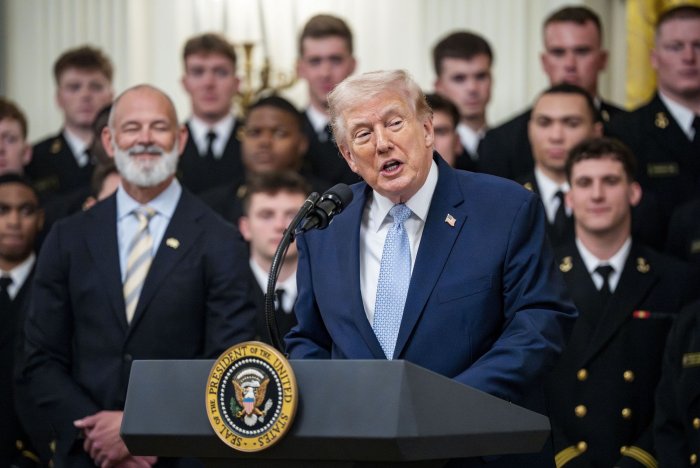
President Donald Trump presents the Commander in Chief’s Trophy to the Navy Midshipmen football team during a ceremony in the East Room of the White House on Friday. The award is presented annually to the winner of the football competition between the Navy, Air Force and Army. Navy has won the trophy back to back years and 13 times over the last 23 years. Photo by Bonnie Cash/UPI | License Photo
A review will also be allowed at the end of a point if a player feels his opponent may be guilty of hindrance.
Daniil Medvedev used the review system against Jack Draper in Indian Wells last week, after the British player briefly stretched his arms out wide during a rally to signal his belief that a Medvedev forehand was long.
Umpire Aurelie Tourte watched a replay on her tablet and ruled Draper was guilty of hindrance – of making either an action or a noise to disturb an opponent – and awarded the Russian the point.
Draper admitted it was a difficult situation for the umpire, but thought Medvedev had “played the rules quite well” and did not believe his gesture had been enough to distract him.
The US Open has been using video reviews since 2023, and the Australian Open since 2025.
It is becoming more common on the women’s WTA Tour and by next season the men’s ATP Tour will have video reviews in place at all of its events.
Another change at Wimbledon this year will be the addition of visual indicators on scoreboards to complement the audio calls produced by ELC.
Spectators have sometimes been unsure whether a ball was in or out – and at the Australian Open this year, the net posts flashed red to give the crowd a visual cue whenever a ball was out.
With exactly 100 days to go until the start of The Championships, the AELTC has also announced that capacity at the qualifying competition in Roehampton will increase from 3,500 to 4,000 each day.
March 19 (UPI) — The Federal Bureau of Investigation took down two websites that belong to an Iran-linked hacker group after it staged a global cyberattack on an American medical equipment company last week.
Two websites used by the group Handala — one that contained information about its hacks and the other used to dox people it alleges work with the Israeli military and related companies — were pulled down by the FBI on Thursday, NBC News and Techcrunch reported.
Handala was behind a “wiper attack” on the medical device maker Stryker’s computer system on March 11, which it said was in retaliation for a deadly strike on the Shajareh Tayyiba girls school in Minab, Iran.
“Law enforcement authorities determined this domain was used to conduct, facilitate, or support malicious cyber activities on behalf of, or in coordination with, a foreign state actor,” a message left on both websites by the FBI said.
Portage, Mich.-based Stryker, which employs 50,000 people worldwide and manufactures a variety of medical devices, including orthopedic implants, surgical instruments and imaging systems, was forced to shut down for the day because of the global attack.
The attack affected the company’s internal Microsoft corporate environment and was not a ransomware attack, it said four days after the attack, after determining that no malware had been installed and the system was able to be restored.
Handala, which has been active since Oct. 7, 2023, is believed to be linked to Iran’s Ministry of Intelligence and Security, American and Israeli cyber security experts have said.
The group is thought to have attacked Stryker because it was awarded a $450 million contract by the Department of Defense last year, and said at the time that the attack specifically was in response to the U.S. bombing of the school.
Handala acknowledged on Telegram that its websites were no longer under its control, and said that the “aggressive action reveals the extent to which the enemies of truth will go to silence voices that unveil their atrocities.”
“To all truth-seekers and defenders of justice, we inform you that the Handala RedWanted website, which was dedicated to exposing Zionist crimes and raising global awareness, has also been seized and taken offline by order of the FBI,” Handala said, noting that a new website is under construction.
In the wake of the attack, experts have told UPI it should be a wake-up call for a wide swatch of U.S. companies that may have similar gaps in security, especially because rather than demanding ransom, the purpose of this attack was to destroy information and wreak havoc.
Iranians attend a funeral for a person killed in recent U.S.-Israel airstrikes at Behesht-e Zahra cemetery on the southern outskirts of Tehran in Iran on March 9, 2026. Photo by Hossein Esmaeili/UPI | License Photo
Walt Disney Co. installed Josh D’Amaro as chief executive Wednesday, beginning a new chapter for the storied Burbank entertainment giant.
Bob Iger passed the reins during Disney’s virtual annual meeting of shareholders, completing the company’s high-stakes and tightly choreographed changing of the guard. After spending two decades molding Disney into a media colossus, Iger segued into a senior advisory role, which will run through December when he officially retires.
The leadership shift comes amid an upheaval in Hollywood as traditional companies wage a desperate battle for survival.
D’Amaro, in his first address to shareholders, pointed to Disney’s signature storytelling as its competitive edge.
“While others in our industry are consolidating just to compete, or struggling to be relevant in a fragmented and disrupted world, Disney is in a category of one,” D’Amaro said during a video segment at the meeting. “This next chapter will be driven by staying focused on world-class creativity, enhanced by technology, bringing unforgettable stories to audiences wherever they are.”
D’Amaro, 55, becomes the ninth leader in Disney’s 102-year history. He was selected last month by Disney board members after a two-year internal bake-off among high-ranking division leaders. Board members were impressed with his business acumen, charisma and his deep love for Disney and its fabled history.
D’Amaro inherits a company that is beloved by millions. It generates $94 billion a year in revenue and employs 230,000 people.
He faces enormous challenges as he steers the ship through a turbulent media environment and tense geopolitics. The war in Iran prompted a sharp increase in fuel costs, which could become a drag on Disney’s critically important tourism business. Executives already have signaled “headwinds” in international visitation at its U.S. theme parks this year.
Lingering Middle East tensions also could weigh on Disney’s plans for a new Persian Gulf waterfront theme park and resort near Abu Dhabi.
D’Amaro, who served as parks and experiences chief until Wednesday, got his corporate start at Disneyland 28 years ago.
“Like so many of you, my connection to Disney goes back to my childhood, long before I began my career here,” D’Amaro told shareholders. “I grew up in a Disney family. We watched ‘The Wonderful World of Disney’ on Sunday nights. I was 10 years old when my family visited Disneyland for the first time. … Disney has always been a place of imagination, innovation and infinite potential.”
Disney previously announced a $60-billion, 10-year expansion program, which D’Amaro has led. But executives must strike a balance by keeping attractions true to their nostalgic core. In Anaheim, the expansion could result in at least $1.9 billion of development.
Disney also must continue to grow its animation business and manage revenue declines from its traditional linear television channels, including ESPN and ABC. It needs to turbocharge its streaming services with compelling movies and TV shows to remain competitive with Netflix and other leaders in the field.
Disney teased upcoming fan favorites, including the May release of Lucasfilm’s “Star Wars: The Mandalorian & Grogu,” a “Bluey” feature film (the kids show featuring an animated puppy, a blue heeler) and a sequel to a “Lilo & Stitch” film for 2028.
Streaming is key to Disney’s future, D’Amaro said.
“Disney+ will continue to evolve beyond a traditional streaming service to become the digital centerpiece of our company,” D’Amaro said, calling the service “a portal that connects our stories, experiences, games, films, and more in entirely new ways.”
The company plans to unify Disney+ and Hulu later this year.
Disney also must continue to incorporate technology while safeguarding its characters and franchises.
“We will continue to develop and embrace new technologies to empower our storytellers — but never at the expense of our characters and worlds, our creative partners, or the trust people place in us,” D’Amaro said. “Because Disney at its core is a company that celebrates human creativity.”
Wednesday also marked a reorganization of the company, configured by Iger, D’Amaro and Disney’s board.
Board members recognized that D’Amaro, who has spent most of his career in the parks division, lacks deep connections among Hollywood’s writers and producers. They elevated longtime television executive Dana Walden, who had been vying for the top job, to the newly formed role of chief creative officer and the company’s first woman president.
ESPN will continue to be managed by Jimmy Pitaro and Disney Entertainment, Studios chairman Alan Bergman will remain in his influential role overseeing film studios including production, marketing and distribution, and sharing oversight for streaming programming with Walden.
D’Amaro’s total compensation package is valued at about $40 million a year, including a $2-million annual base salary, $26.2 million in annual long-term stock incentives, a cash bonus and a one-time promotion award of $9.7 million.
“Josh is a wonderful choice to lead the Walt Disney Co.,” Iger said in a pre-recorded video. “He has passion for our businesses and brands, respect for our people, and he appreciates what makes this company so unique.”
Iger is wrapping up an unprecedented 52-year career at ABC and Disney.
He first stepped into the CEO role in 2005; his first 15 years were almost magical.
Iger led acquisitions of Pixar Animation, Marvel Entertainment and Lucasfilm, the studio behind “Star Wars,” that turned Disney into a blockbuster machine. Sports king ESPN spawned staggering profits, and Disney’s theme parks set industry standards.
Disney’s former Chief Executive Bob Iger will stay on through the end of the year as a senior advisor.
(Jay L. Clendenin / Los Angeles Times)
His decision to buy much of Rupert Murdoch’s 21st Century Fox, a $71-billion deal that closed in 2019, boosted Disney’s television production, refreshed its TV executive bench, and provided a controlling stake in general entertainment streaming service Hulu. The acquisition also gave Disney access to fan-favorite franchises, including “Deadpool,” “The Simpsons,” and James Cameron’s “Avatar.”
But the purchase left Disney saddled with debt just as the COVID-19 pandemic prompted production shutdowns and closures at theme parks and sports venues. It would take several years for Disney to recover.
Iger initially passed the CEO baton to Bob Chapek in February 2020. Iger, then chairman, retired the following year but came back in November 2022 to a mess. At the time, the company was losing billions of dollars on its shift to streaming but that unit is now profitable.
Iger spent the next three years focusing on four business pillars, including improving the quality and profitability of its film studios.
During the last two years, Disney has produced five franchise films that racked up more than $1 billion in worldwide ticket sales, including “Inside Out 2,” “Zootopia 2,” and “Avatar: Fire and Ash.”
The company is banking this year on several other films with blockbuster potential, including Disney and Pixar’s “Toy Story 5,” “Star Wars: The Mandalorian & Grogu” and Marvel Studios’ “Avengers: Doomsday.”
“I would want to be known as someone who was given the keys to this kingdom and brought it to a place that even Walt would be proud of — more storytelling, more innovation, more risk‑taking, and more creation of happiness,” Iger said during a “The Rest is History” podcast last year.
During the meeting, Iger appeared in a prerecorded video that celebrated his numerous career highlights. Shown were clips from his cub years when Iger was a newscaster with bushy black hair. His journey was depicted, including his orchestration of multi-billion-dollar acquisitions that strengthened Disney with more characters and franchises.
Iger, 75 and now gray, ended by thanking shareholders “for the trust you placed in me, for the memories we created together, and for allowing me the honor of serving,” he said. “It has meant more to me than I can say.”
Animated pixie dust twinkled on the screen, courtesy of the fairy, Tinker Bell.
“Bob, on behalf of our employees, cast members, shareholders, and fans around the world, thank you so much for your tremendous leadership, your steadfast support, and your countless contributions to The Walt Disney Co.,” D’Amaro said, as the hand-off was complete.
“You’ve set an incredible example for all of us. … You will be missed,” D’Amaro said.
There was little fanfare during the business portion of the investor meeting.
The company’s slate of board directors were elected with 93% of the vote. Shareholders also approved executive compensation packages with about 85% of votes.
Shareholder-led proposals to compel reports on charities eligible for Disney’s gift-matching program, a review of the company’s accessibility practices in its theme parks for disabled guests, and a push for cumulative voting at future meetings all failed to muster support.
Disney shares closed at $99.41, down roughly 1% on the day.
Heavy social media use has contributed to ‘worrying decline’ in wellbeing in Western countries, World Happiness Report says.
Published On 19 Mar 202619 Mar 2026
Social media has played a large role in declining happiness among young people in Western countries, a United Nations-backed report has found.
Heavy social media use partly explains a “worrying decline” in the wellbeing of young people in the West, the latest edition of the annual World Happiness Report said on Wednesday.
Recommended Stories
list of 4 itemsend of list
In total, 15 Western countries, including the United States, Canada, Australia and New Zealand, saw significant declines in youth wellbeing over the past two decades, according to the report.
The trend was not observed globally, with young people in regions covering 90 percent of the world’s population reporting higher life satisfaction than before.
“The trends are caused by many factors, which differ between continents. However, the evidence in this report does suggest that heavy social media use, especially in some countries, provides an important part of the explanation,” researchers John F Helliwell, Richard Layard, Jeffrey D Sachs, Jan-Emmanuel De Neve, Lara B Aknin, and Shun Wang said in an executive summary of the report.
“Outside the English-speaking world and Western Europe, the links between social media use and wellbeing are more positive, and they vary between platforms,” the researchers added.
The report, published by the University of Oxford’s Wellbeing Research Centre in partnership with Gallup and the UN Sustainable Development Solutions Network, cited data from sources including the Programme for International Student Assessment (PISA) and research by the American social psychologist Jonathan Haidt.
Despite the decline in youth wellbeing, Western countries, particularly in Scandinavia, dominated the overall happiness rankings across age groups.
Finland ranked as the world’s happiest nation for the ninth consecutive year, followed by Iceland, Denmark, Costa Rica, Sweden and Norway.
The Netherlands, Israel and Switzerland also made the top 10.
Middle Eastern and African countries had the lowest happiness scores.
Afghanistan reported the lowest life satisfaction, with Zimbabwe, Malawi, Egypt, Yemen and Lebanon also ranking among the bottom 10 countries.
Social media use among young people has been a growing concern for governments amid reports linking platforms to bullying, sexual exploitation and worsening mental health.
Australia last year introduced the world’s first social media ban for under 16s, with plans for similar restrictions under way in Indonesia, France and Greece.
The US defence secretary designated the AI company a ‘supply chain risk’ after it refused to remove guardrails on its technology.
Published On 18 Mar 202618 Mar 2026
The administration of United States President Donald Trump has said in a court filing that the Pentagon’s blacklisting of Anthropic was justified and lawful, opposing the artificial intelligence company’s high-stakes lawsuit challenging the decision.
The administration made its comments in a court filing on Tuesday.
Recommended Stories
list of 3 itemsend of list
Defense Secretary Pete Hegseth designated Anthropic, the maker of popular AI assistant Claude, a national security supply chain risk on March 3 after the company refused to remove guardrails against its technology being used for autonomous weapons and domestic surveillance.
The Trump administration’s filing says Anthropic is unlikely to succeed in its claims that the US government’s action violated speech protections under the US Constitution’s First Amendment, asserting that the dispute stems from contract negotiations and national security concerns, not retaliation.
“It was only when Anthropic refused to release the restrictions on the use of its products — which refusal is conduct, not protected speech — that the President directed all federal agencies to terminate their business relationships with Anthropic,” the administration’s legal filing said. The filing, from the US Justice Department, said that “no one has purported to restrict Anthropic’s expressive activity”.
Anthropic’s lawsuit in California federal court asks a judge to block the Pentagon’s decision while the case plays out. Some legal experts say the company appears to have a strong case that the government overreached.
In a statement, Anthropic said it was reviewing the government’s filing. The company said that “seeking judicial review does not change our longstanding commitment to harnessing AI to protect our national security, but this is a necessary step to protect our business, our customers, and our partners.”
The White House did not immediately respond to a request for comment.
Supply chain risk
Trump has backed Hegseth’s move, which excludes Anthropic from a limited set of military contracts. But it could damage the company’s reputation and cause billions of dollars in losses this year, according to its executives.
The designation came after months of negotiations between the Pentagon and Anthropic reached an impasse, prompting Trump and Hegseth to denounce the company and accuse it of endangering American lives with its use restrictions.
Anthropic has disputed those claims and said AI is not yet safe enough to be used in autonomous weapons. The company said it opposes domestic surveillance as a matter of principle.
In its March 9 lawsuit, Anthropic said that the “unprecedented and unlawful” designation violated its free speech and due process rights, while running afoul of a law requiring federal agencies to follow specific procedures when making decisions.
The Pentagon separately designated Anthropic a supply chain risk under a different law that could expand the order to the entire government.
Anthropic is challenging that move in a second lawsuit in a Washington, DC, appeals court.