teacher

The original ‘Faces of Death’ has a dark history in California schools

It’s been decades since “Faces of Death” stirred panic among parents of teens trading the 1978 pseudo-snuff VHS. The “video nasty” spawned a number of sequels, spinoffs and now a remake starring Barbie Ferreira and Dacre Montgomery that hit theaters this month.

But back in the 1980s, the original film caused an uproar at Southern California schools.

Days before school was out for summer in 1985, Escondido High School math teacher Bart Schwartz, then 28, used a spare two hours during finals week to squeeze in a film screening with his class. Schwartz wanted to show the film because it was “interesting.”

According to the Times coverage of the incident and subsequent lawsuit, the scenes shown in the classroom included autopsies, decaying cadavers and live animals being butchered, mutilated and tortured. The original “Faces of Death” also includes scenes of a man being electrocuted, a decapitation and an orgy during which a man is gutted by a flesh-eating cult.

Although today’s audiences might be more desensitized to such gruesome scenes thanks to hyperrealistic special effects in modern horror movies, and the commonplace spread of graphic clips online, audiences of the ‘80s were reportedly traumatized and scandalized. Not only was the film considered macabre, but it also was widely believed to be composed entirely of real footage.

“The ultimate taboo,” “100% real” and “banned in 46 countries!” were taglines for the original film. It wasn’t until decades after the film’s release that director John Alan Schwartz publicly confirmed that while some footage was real and pulled from news and autopsy archives, much of the movie was staged and the shockumentary’s host pathologist, Dr. Gröss, was an actor.

“Each new generation discovers it,” Schwartz told New York Public Radio in 2012. “And even though things look hokey now, there are still segments that people actually believe are real that aren’t.”

The 2026 remake, by comparison, is clear about its fictional plot, but also includes real clips of death that were “carefully trimmed,” according to director Daniel Goldhaber.

Back to 1985 — Escondido High’s Schwartz, who had previously been named “teacher of the year,” reportedly would not allow students to leave the classroom while the film played. One student, then 16-year-old Diane Feese, said the teacher fast-forwarded through the dialogue and forced students to watch the film’s most gruesome scenes. She covered her eyes, according to reports from the time, but was still subjected to other students’ commentary and the audio of the deaths depicted on-screen.

That fall — when school was back in session — Feese sued the teacher and the school principal for $3 million. Schwartz was suspended with pay for 30 days, then an additional 15 days without pay.

In 1986, another student in Schwartz’s math class, Sherry Forget, followed suit and took the math teacher to court for being subjected to the film. In 1987, the lawsuits were settled with Feese receiving $57,500 and Forget, who asked for $1 million, netting $42,500.

Less than a decade later, a Los Angeles high school teacher was also sued by his students for showing “Faces of Death.”

Verdugo Hills High School social sciences teacher Roger Haycock showed his cultural awareness class the film in December 1993. Students Jesse Smith and Darby Hughes alleged in their lawsuit that they were required to watch the film and write a paper on it. The teen boys said they suffered nightmares, emotional problems and were harassed by other students for their reaction to the film.

According to The Times, Haycock showed excerpts from “Faces of Death” to five classes that day and gave students the option to write a paper for extra credit or go to the library if they didn’t want to see the film. Haycock said he showed only parts of the film depicting animals being killed and did not show portions of the film that depict human death.

“Basically it had to do with the treatment of animals and the way we get our food, which was the lesson,” Haycock said at the time. “We go to the supermarket and get our meat, and we think it sanitizes us because it’s wrapped in plastic. But it has to be slaughtered for us by someone else. I was trying to show how other cultures provide food for themselves versus the way we do, living in the city.”

The judge dismissed the lawsuit, siding with the district’s argument that students shouldn’t be able to sue based on what they are taught in class.

Source link

Bible stories would be part of a new Texas public schools reading list drawing attention

Biblical stories like Jonah and the whale would be required reading for Texas public schools students under proposals that are putting the state at the center of another contentious wrangling over the role of religion in classrooms.

Religious leaders, teachers, parents and students spent hours Tuesday before the state education board arguing about the reading list for the state’s 5.4 million kindergartners to 12th-graders. The debate is part of widening efforts in the U.S. to incorporate religion in schools, mostly in Republican-led states, driving legislation and legal action.

Nationally, President Trump has pledged to protect and expand religious expression in public schools. And Texas, a red state that is home to about 1 in 10 of the nation’s public school students, often helps set the agenda.

Texas became the first state to allow chaplains, in 2023. And just last year, a Republican-led mandate that the Ten Commandments be displayed in public schools took effect in the state, although around two dozen districts took them down because of a lawsuit.

But while the debate over Texas’ reading list could have national implications, to the speakers the issue boiled down to whether the passages are essential to understanding the nation’s history and morals — or unconstitutional.

“Our children need truth,” said Nathan Irving, a pastor and father of eight from Myrtle Springs, Texas. “Truth is the only currency that never devalues. Investing truth into our children is the most loving thing that we can do for them. This is the truth. This country and this state were founded upon a Christian worldview. Like it or not, it is true.”

Final vote on the changes still ahead

A final vote on the list is expected in June, and if approved by the Texas State Board of Education, the changes would take effect in 2030.

Several speakers cited the “establishment clause” of the 1st Amendment, which states that “Congress shall make no law respecting an establishment of religion.”

“This list is a tool of proselytization that has no place in our public schools,” Rabbi Josh Fixler, of Congregation Emanu El, a reform synagogue in Houston, told the board. “There is a difference between teaching about religion and teaching religion, and this list will force teachers to cross that line.”

Megan Boyden, a mother of three from Denton, Texas, described is as a direct attack on her private faith.

“As a Christian mother, it is my right and responsibility to teach our family’s religion,” she said. “It is not the state’s job to shed through the lens of a teacher who may not share the same beliefs I do. Will Bible passages be taught in conflict with my beliefs?

“What,” she asked, “of non-Christian students?”

The list stems from a state law passed in 2023, which called for the creation of a state-approved list of high-quality materials.

Third-graders would learn about the Road to Damascus, which tells the story of Paul’s transformation from an early persecutor of Christians into a follower. Seniors, meanwhile, would learn about the Book of Job, a story about a man whose faith is tested when he loses everything.

The list also includes classics like Dr. Seuss’ “The Cat in the Hat,” stories about the national folk hero Daniel Boone. And there are also works by famous African Americans like Frederick Douglass and Martin Luther King Jr. and a book about Harriet Tubman of the Underground Railroad fame.

Texas has already approved optional curriculum that incorporates the Bible

The GOP-leaning board previously approved a new Bible-infused curriculum that is optional for schools to incorporate in kindergarten through fifth grades.

The board also is considering social studies standards that have been criticized as too state-centric, not focused enough on world events and rife with an undercurrent of American exceptionalism. They call for students to “identify the Texas flag as a symbol of Texas pride,” and recognize the state song “Texas, Our Texas.”

Students also are supposed to be able to understand stories about Texas Independence.

Curriculum debates crop up occasionally. Over the years, state boards in places such as Kansas have debated whether the teaching of evolution should reflect doubt about the well-established scientific theory — and leave room for arguments that the universe’s complexity points to an intelligent design.

Allison Cardwell, a mother of a fourth-grader and a fifth-grade social studies teacher, urged the board to rethink the standards. She said fifth grade would be the only time most Texas students would receive instruction in U.S. history until high school.

“We have to ask ourselves, how can we expect to create citizens who value liberty, responsibility, and the principles this country was founded on, if we don’t ensure that they truly understand those foundations?” she said.

Hollingsworth writes for the Associated Press.

Source link

Coronation Street confirms Megan’s fate as dark truths about twisted teacher emerge

Coronation Street’s Megan Walsh was interviewed by police on Thursday’s episode of the world’s longest-running TV soap and things are not looking good for the predatory teacher

Coronation Street aired a series of dark scenes on Thursday night as various truths about Megan Walsh began to emerge.

For months, the teacher, played by Beth Nixon, has been at the heart of a controversial storyline in which she has been carrying out an illicit relationship with her student Will Driscoll.

While all this has been going on, Megan, who was introduced as the teenager’s private athletics coach, has started up a fake relationship with Daniel Osbourne (Rob Mallard) although she is pregnant with Will’s baby. Will’s schoolmate Sam, who is in the year below, was the only one to have worked it out but when Megan started threatening him about, he turned to pills to cope and then experienced an overdose. Things were only made worse when Megan became a flatmate of Sam’s stepmum Leanne, worming her way into their lives further.

READ MORE: Is Eva leaving Coronation Street? Fans predict shocking exit for icon in ‘murder’ twistREAD MORE: Coronation Street fans’ ‘blood runs cold’ as bombshell episode leaves them in tears

Once Sam confessed all to Leanne (Jane Danson) the whole situation sent shockwaves around the entire family and Will’s dad Ben (Aaron McCusker) as well as his own stepmum Eva, Leanne’s sister, have tried to take action. The furious family informed the police immediately and as the world’s longest-running TV soap continued, Megan was in a police interview, once again pleading her innocence.

Coming out with the same old story, she said: “He is a teenage boy who has a crush on me. Probably not the first, probably not the last. Believe me, I haven’t done anything wrong. This is every teacher’s worst nightmare. I’m in complete shock, to be honest. Maybe I overstepped by getting too close to them.

“But that doesn’t mean that I’m grooming their son. I… I became a teacher to give something back, not to… I can’t even say it. It makes me feel sick….” Megan and her lawyer Adam Barlow pointed out that there was no evidence as yet, but DC Kit Green revealed that they had some footage of her and Will together in her flat. This was all a result of Sam’s ill-fated attempt to catch them on camera, only for Megan to realise and stage a performance to cover things up.

Kit warned: ” It’s not looking good, is it, Megan? I think the CPS will agree!” Later on, it became apparent that Megan had been released and she returned home only to find Leanne throwing her possessions out of the upstairs window. A furious Leanne yelled: “I’m putting the rubbish out!” But Megan pleaded: “Oh, Leanne, please, I don’t need this after the day I’ve just had. I’ve already been suspended from work.”

Leanne shot back: “Well, if it was to me, I’d suspend you from that lamppost!” She launched a suitcase out the window and Megan was left with no choice but to pack up her belongings after it bust open and its contents spilled out across the cobbles and Leanne slammed the window shut, effectively making her homeless.

That afternoon, Eva (Catherine Tyldesley) and Ben, who had worked out that Megan and Will had spent his sixteenth birthday together in bed at the Chariot Square, raced to the hotel to see if they could get CCTV footage of that date but, conveniently, the footage had been wiped at midnight, owing to an automatic 90-day setting.

It was then that Eva brought up she something she had been holding back – that Megan had supposedly had an abortion some months ago.

But Megan herself never confirmed this, and Leanne had just happened to come across some pregnancy vitamins in a bedside drawer, prompting the distraught family to realise that she could still be expecting. Realising they could be onto something, Eva said: “If she has lied, then all the evidence we need is growing right there in her belly.”

Coronation Street airs weeknights at 8:30pm on ITV1 and ITV X.

Like this story? For more of the latest showbiz news and gossip, follow Mirror Celebs on TikTok , Snapchat , Instagram , Twitter , Facebook , YouTube and Threads .


Source link

Schools left wondering how to proceed after ruling on transitioning students

The Supreme Court broke new ground this month when it ruled the Constitution forbids school policies in California that prevent parents from being told about their child’s gender transition at school.

But the reach of this new parental right remains unclear.

Does it mean all parents have a right to be informed if their child is using a new name and pronouns at school?

Or is the right limited to parents who inquire and object to being “shut out of participation in decisions involving their children’s mental health,” as the high court said in Mirabelli vs. Bonta.

Both sides in this legal battle accuse the other of creating confusion and uncertainty. And that dispute has not subsided.

UC Davis law professor Aaron Tang says understanding the Supreme Court’s order calls for a close reading of the statewide injunction handed down by U.S. District Judge Roger Benitez in San Diego.

That order prohibits school employees from “misleading” or “lying” to parents. It did not say school officials and teachers had a duty to contact parents whenever they saw that a student changed their appearance or used a new name, he said.

By clearing this order to take effect, the Supreme Court’s decision “means that schools must tell parents the truth about their child’s gender presentation at school if the parents request that information,” Tang said.

“But the initial burden is on the parents. This is not a rule that schools have an affirmative obligation to inform any and all parents if their child is presenting as a different gender,” he said.

The high court’s 6-3 order also indicated the reach of the judge’s injunction was limited.

It “does not provide relief for all the parents of California public school students, but only those parents who object to the challenged policies or seek religious injunctions.”

Religious conservatives who sued say they seek to end “secret transition” policies that encourage students to adopt a new gender identity without their parents knowing about the change.

The lawsuit challenging California’s “parental exclusion” policies was first filed by two teachers in Escondido.

Peter Breen, an attorney for the Thomas More Society, said many of the parents in Escondido “had no clue” their children were undergoing a gender transition at school.

“We need to activate parents,” he said.

Ruling for them, Benitez said the state’s “parental exclusion policies are designed to create a zone of secrecy around a school student who expresses gender incongruity.”

His injunction also said schools must notify their employees that “parents and guardians have a federal constitutional right to be informed if their public school child expresses gender incongruence.”

The Supreme Court’s order cited a dramatic example of nondisclosure.

Two parents who joined the suit had gone to parent-teacher meetings and learned only after their eighth-grade daughter attempted suicide that she had been presenting as a boy at school and suffered from gender dysphoria.

John Bursch, an attorney for Alliance Defending Freedom, argues the Supreme Court’s opinion goes further to empower parents.

“Fairly read, the Mirabelli opinion creates an affirmative obligation on school officials to disclose,” he said. “It’s consistent with the way [the court] describes the parental right: ‘the right not to be shut out of participation in decisions regarding their children’s mental health.’ School officials’ silence (rather than lying) is not notice to and is shutting out parents.”

“All that said, the California attorney general is obviously not getting that message,” Bursch said.

He said the Supreme Court needs to go beyond an emergency order and fully decide a case that squarely presents the issue of parents rights.

“School officials should not be socially transitioning children without parental notice and consent. Period,” he said.

He filed an appeal petition with the Supreme Court in a case from Massachusetts that dissenting Justice Elena Kagan described as a “carbon copy” of the California dispute.

It takes only four votes to grant review of a case, but since November, the justices have repeatedly considered the case of Foote vs. Ludlow and taken no action.

The case is set to be considered again on Friday in the court’s private conference.

Meanwhile, California Atty. Gen. Rob Bonta went back to the 9th Circuit Court of Appeals seeking a clarification to limit the potential sweep of Benitez’s order.

He objected to the part of the judge’s order that said schools must post a notice that “parents and guardians have a federal constitutional right to be informed if their public school student child expresses gender incongruence.”

Bonta said that goes beyond what the Supreme Court approved.

This “could be understood to suggest that public school officials have an affirmative constitutional duty to inform parents whenever they observe a student’s expression of ‘gender incongruence,’ effectively imposing a mandatory ‘see something, say something’ obligation in all circumstances,” he said.

But the 9th Circuit said it would not act until he first presented this request to Benitez.

Meanwhile, transgender rights advocates say the voices and the views of students have been ignored.

“This case has been about states’ and parents’ rights but students have been left out of the conversation. Their voices have not been heard at all,” said Andrew Ortiz, an attorney for the Transgender Law Center. “School should be a place where young people can feel safe and confident they can confide in a teacher.”

“We’re hearing about fear and anxiety,” said Jorge Reyes Salinas, communications director for Equality California, the nation’s largest statewide LGBTQ+ civil rights organization.

“There are students who are unable to speak with their parents. Teachers can encourage them to have a conversation with their parents. But this will weaken the trust they have in their teachers,” he said.

In the past, the court had been wary of reaching into the public schools to decide on education policies and the curriculum, but it took a significant step in that direction last year.

In a Maryland case, the court said religious parents had a right to “opt out” their young children from classes that read “LGBTQ+-inclusive” storybooks.

The 1st Amendment protects the “free exercise of religion” and “government schools … may not place unconstitutional burdens on religious exercise,” wrote Justice Samuel A. Alito, the lone conservative who attended public schools.

The same 6-3 majority cited that precedent to block California school policies that protect the privacy of students and “conceal” information from inquiring parents if the student does not consent.

But the California case went beyond the religious-rights issue in the Maryland “opt out” case because it included a “subclass of parents” who objected without citing religion as the reason.

The justices ruled for them as a matter of parents’ rights.

“Parents — not the state — have primary authority with respect to the upbringing and education of children,” the court said.

That simple assertion touches on a sensitive issue for both the conservative and liberal wings of the court. It rests on the 14th Amendment’s clause that says no state may “deprive any person of life, liberty or property without due process of law.”

In the past, a liberal majority held that the protection for “liberty” included rights to contraceptives, abortion and same-sex marriages.

Conservatives fiercely objected to what was dubbed “substantive due process.”

In the California case, Kagan, speaking for the liberals in dissent, tweaked the conservatives for recognizing a new constitutional right without saying where it came from.

“Anyone remotely familiar with recent debates in constitutional law will understand why: Substantive due process has not been of late in the good graces of this Court — and especially of the Members of today’s majority,” she wrote.

She noted that when the court struck down the right to abortion in the Dobbs case, Justice Clarence Thomas said he would go further and strike down all the rights that rest on “substantive due process.”

In response to Kagan, Justice Amy Coney Barrett filed a concurring opinion that staked out a moderate conservative position.

Since 1997, the court has said it would stand behind rights that were “deeply rooted in the nation’s history and tradition,” she wrote. That includes “a parent’s right to raise her child … and the right to participate in significant decisions about her child’s mental health.”

She said California’s “non-disclosure policy” is unconstitutional and violates the rights of parent because it applies “even if parents expressly ask for information about their child’s gender identification,” she wrote.

Chief Justice John G. Roberts and Justice Brett M. Kavanaugh signed on to her opinion.

While Kagan dissented on procedural grounds, she did not disagree with bottom-line outcome.

“California’s policy, in depriving all parents of information critical to their children’s health and well-being, could have crossed the constitutional line,” she said. “And that would entitle the parents, at the end of the day, to relief.”

Source link

Longtime Venice football coach Angelo Gasca has died

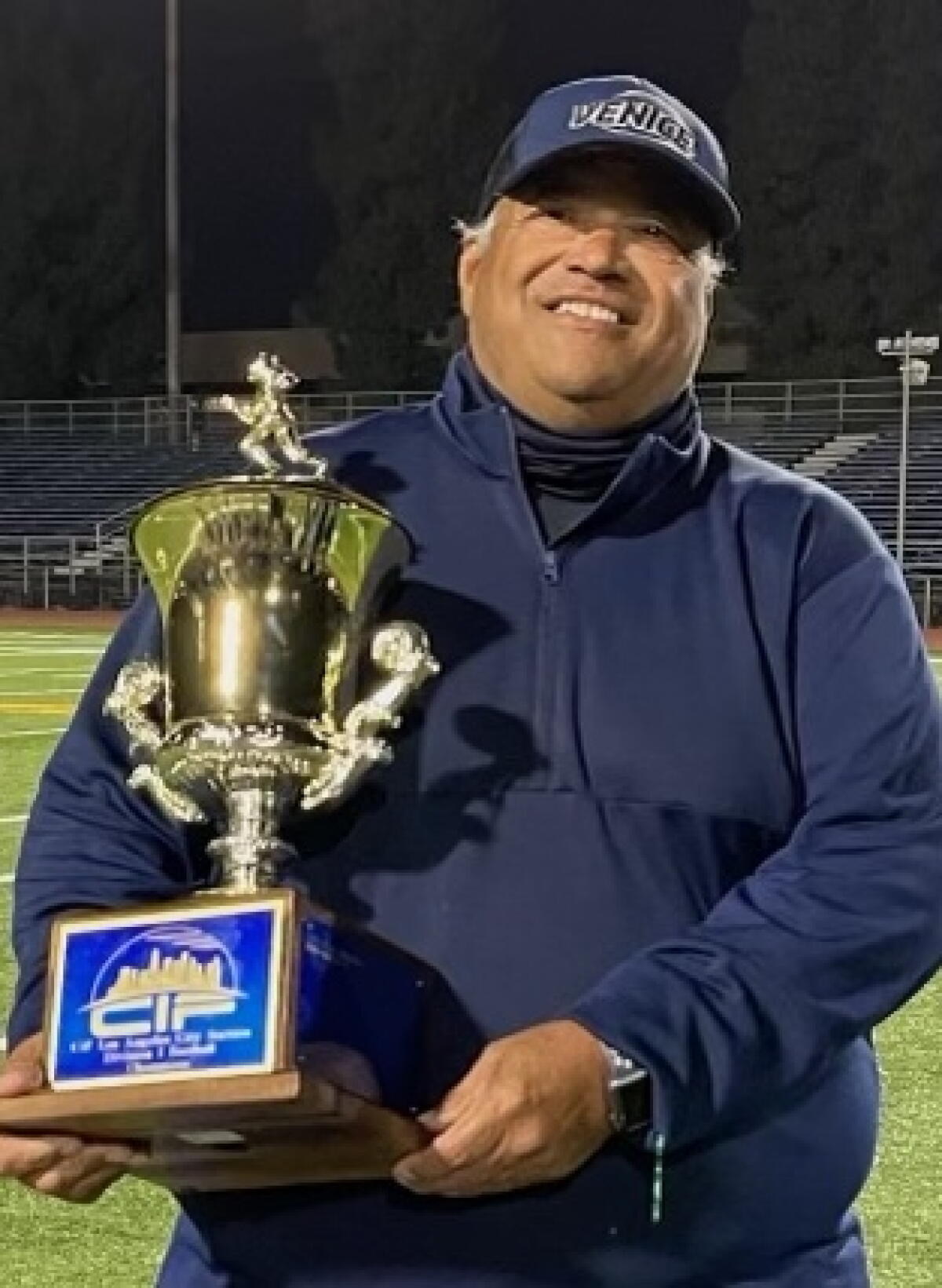
Angelo Gasca, a one-of-a-kind high school football coach who grew up using football to escape from gangs and became a beloved special education teacher, mentor and coach for 36 years at Venice High, died Monday night while watching a Lakers game on television, according to longtime friend, Steve Clarkson. He was 65.

The 1978 Venice graduate never left his neighborhood. Gasca won his first and only City Section Division I championship in 2021. He was known for his innovative passing schemes and producing numerous top City Section quarterbacks, led by former NFL player JP Losman. He was such a fixture at Venice that coaching sons of former players became the norm. He loved the concept of “neighborhood team.”

Perhaps his most important contribution was training, supporting and preparing players to become teachers and coaches. Most of his staff at Venice has been made up of former players. He’d help them stick with the difficult task of earning a teaching credential and find jobs for them.

He was most proud of former running back Byron Ellis, who became an orthopedic surgeon, and receiver Brycen Tremayne, who walked on at Stanford, went undrafted and made the Carolina Panthers.

Last month, Gasca was asked if he ever learned anything from a player and he told the story of having a coaches meeting and one of his ex-players reminded him how he wanted to quit football but Gasca wouldn’t let him.

“I’m not accepting your resignation today,” Gasca told him. “You need to go home and think about it.”

Said Gasca: “He went home and thought about it and stayed on the team and was the starting center. He taught me the best thing we can teach kids is come to school and you never know what connections you’ll make at the school you grew up at. He taught me there’s more to coaching than winning games and scoring touchdowns. In our lives as teachers and coaches, we do learn from players. When we stop learning, it’s time to stop coaching.”

Even though there were rumors last season of Gasca retiring, he insisted he was coming back because he loved teaching and coaching and believed that sports competition can change someone’s life for the better.

“My parents didn’t attend high school,” he said. “When you play, you get a little taste of success and want to play harder and people come into your life and help you. It’s just as easy to do well as it is to do bad. Sometimes when your friends zig right, you have to zig left. The life lessons we learn together is what it’s about.”

Source link