Colombian President Gustavo Petro called for regional integration of the Pix system, and he criticized international financial control mechanisms, particularly the U.S. Office of Foreign Assets Control, for enforcing economic sanctions. Photo by Mauricio Duenas Castaneda/EPA
April 6 (UPI) — Colombian President Gustavo Petro asked Brazil to extend its instant payment system Pix to Colombia and questioned U.S. financial sanctions in a message posted on X, amid Washington investigations into the Brazilian system.
In his post, Petro called for regional integration of the Pix system and criticized international financial control mechanisms, particularly the Office of Foreign Assets Control, the U.S. Treasury agency responsible for enforcing economic sanctions.
“I ask Brazil to extend the Pix system to Colombia and hopefully stop considering the OFAC list, which no longer works,” Petro wrote Saturday.
La lista OFAC ya no es un arma contra el narcotráfico, el narcotráfico se burla de ella, y se hospedan en Dubai, allí compran residencia pot unos 4.000 dólares y viven en medio del lujo.
La OFAC solo sirve para perseguir oposiciones políticas y domesticarlas en el mundo. Es un… https://t.co/gzpzWU5pIE— Gustavo Petro (@petrogustavo) April 4, 2026
The message comes after the U.S. government last week published the 2026 National Trade Estimate Report on Foreign Trade Barriers, which mentions the Pix system.
The report includes concerns from U.S. companies that the system, operated by Brazil’s central bank, may have regulatory advantages over foreign private competitors such as Visa and Mastercard.
Pix has gained popularity for allowing fast and free transfers, which has generated tensions over its impact on the traditional financial system.
In the same message, Petro criticized the international sanctions system. “OFAC only serves to persecute political opposition and domesticate them around the world. It is an aberrant system of political control,” he said.
He also contended that drug trafficking has managed to evade these mechanisms.
“Drug trafficking mocks it, and they stay in Dubai, where they buy residency for about $4,000 and live in luxury,” he added.
The message also included references to international politics and armed conflicts. Petro said that “no war is good” and said he had asked U.S. President Donald Trump to stop ongoing conflicts.
“His circle wants blood and leads him to make mistakes all the time,” he wrote.
Petro also criticized Israeli Prime Minister Benjamin Netanyahu, whom he accused of committing crimes against humanity in Gaza and Iran, and called for him to be tried.
Petro added that the homicide rate in Colombia has decreased, adding he hopes the trend is not temporary.
So far, the Brazilian government has not publicly responded to the request.
A launch vehicle of the Terminal High Altitude Area Defense (THAAD) system is seen at a U.S. military base in Seongju, North Gyeongsang Province, South Korea, 05 March 2026. File. Photo by YONHAP / EPA
April 3 (Asia Today) — South Korea will accelerate deployment of its long-range artillery interception system, known as the Korean Air and Missile Defense system, aiming to bring it into service by 2029, two years ahead of schedule.
The Defense Acquisition Program Administration said Thursday it approved a revised development and deployment plan during a Defense Acquisition Program Committee meeting.
Under the plan, the military will use prototypes to speed up deployment, advancing the timeline from the original target of 2031. The project was accelerated in response to North Korea’s expansion of long-range artillery capabilities.
The government plans to invest 842 billion won (about $630 million) in research and development for the system through 2030.
The system, under development by the Agency for Defense Development, is designed to intercept North Korea’s long-range artillery fired in large volumes at low altitudes and short ranges. Officials have said the system is intended to outperform Israel’s Iron Dome by engaging a greater number of incoming targets simultaneously.
Separately, the committee also approved plans to procure SM-3 ballistic missile interceptors from the United States by 2031 at a cost of 753 billion won (about $565 million). The missiles will be deployed on the King Jeongjo-class Aegis destroyers.
Additional measures approved include improvements to tactical information-sharing systems for joint South Korea-U.S. maritime operations, as well as a broader 2026-2030 defense industry development plan.
These stunning destinations are exempt from the new system launching in April.
14:45, 31 Mar 2026Updated 14:45, 31 Mar 2026
These countries will not use the Entry/Exit system(Image: Getty)
Following months of preparation, the new Entry/Exit System (EES) will finally be implemented across the Schengen area from April 10.
The new EES will require all non-EU nationals travelling to 29 European countries to register their biometric data, such as a facial scan and fingerprints, rather than receiving a traditional passport stamp. Numerous popular holiday destinations including Portugal, Italy and Spain will be impacted by the new system.
However, there are 14 countries (15 including the UK) outside the Schengen Area and therefore not implementing the new travel system.
Laura Evans-Fisk, head of digital and engagement at eurochange, anticipates a surge in travellers heading to non-Schengen countries as a consequence, reports the Express.
She said: “The introduction of this new border control system may be off-putting to some people who want to book last-minute trips this Easter, especially those who like to keep travel as fuss-free as possible.
“I think we should expect to see an increase in Brits travelling to countries that are exempt from the legislation over the next few months – including the Easter and summer holidays.”
For those looking to sidestep the hassle and make their travels a little more straightforward, Laura has identified three fantastic holiday destinations that will be unaffected by the EES, meaning British tourists can explore freely without the need to provide biometric data.
Kotor, Montenegro
She explained: “Montenegro is quickly becoming one of the most popular up-and-coming destinations in Europe. A less crowded alternative to Croatia, it offers similar quaint towns, gorgeous beaches and a stunning coastline, but it is around 20-30% cheaper.”
For instance, accommodation in Montenegro begins at £23 per person per night, while a three-course meal will cost you £31.78.
Kotor sits on the coast, boasting stunning beaches and a relaxed atmosphere, ideal for unwinding. Laura remarked: “This is a great spot if you’re after a chilled, slow-paced holiday, without having to pay huge prices.”
Tirana, Albania
This vibrant capital city is brimming with culture and a food lover’s dream destination. Laura noted: “One of the best ways to explore is by taking a stroll through the streets, following the eccentric street art, graffiti and murals.
“Remember to order Albanian favourites, Fërgesë Gjize (baked cheese with peppers) and Trilece (a tasty pie made with sponge cake and three different kinds of milk) for dessert.”
Sarajevo, Bosnia
Laura said: “It is one of the only places where you can visit a Mosque, a Catholic church, an Eastern Orthodox church and a synagogue in one place.
“Tucked inside a long, thin valley and surrounded by forested mountains, the city has a picture-perfect backdrop. Its broad mix of cultural influences means its architecture is also absolutely beautiful, and its restaurant scene is an eclectic mix of Turkish and Bosnian-inspired offerings.
“And, with prices averaging just £30 per person for a three-course meal, your money really does go far here.”
South Korea will remove the “China (Taiwan)” label from its e-arrival system, a foreign ministry official said Tuesday, after Taiwan changed South Korea’s name in its immigration system from “Korea” to “Korea (South)” in protest.
Seoul plans to remove the “last point of departure” and “next destination” fields from e-arrival cards, where the island nation had been listed as “China (Taiwan),” the official told reporters. It will remain listed as Taiwan in the country and region field.
“We have reviewed the matter and are moving forward with plans to remove the ‘last point of departure’ and ‘next destination’ fields from the electronic arrival card,” he said.
The official said the paper arrival cards already do not include those fields, and that the move is part of efforts to streamline the system, improve convenience for visitors from Taiwan, and align the paper and electronic arrival formats.
The Ministry of Justice is handling the matter in line with relevant procedures, the official said.
Seoul’s decision came after Taiwan called for a “correction” in its labeling as “China (Taiwan)” on e-arrivals, saying it has changed South Korea’s name in its immigration system from “Korea” to “Korea (South)” in a reciprocal measure.
Taipei had warned that it would take further corresponding steps if it sees no positive action from Seoul by the end of this month.
Taiwan’s foreign ministry said Tuesday that it has learned Seoul was under an “internal administrative and technical review” to update its e-arrival card system. It said Taiwan will temporarily suspend its own change to the e-entry registration.
Seoul noted that the decision was not made in response to Taiwan’s stated March 31 deadline for possible additional measures over the labeling, but was intended to address the issue in a way that promotes practical, unofficial cooperation with Taiwan.
Taiwan is also reportedly expected to take reciprocal steps to restore “Korea” in its foreign residents’ certificates.
Seoul’s decision to remove the two fields will be applied to all countries.
South Korea severed official diplomatic ties with Taiwan in 1992, when it established formal relations with mainland China. Since then, the two sides have maintained practical ties in an unofficial manner.
China considers Taiwan, self-governed since it broke away from the mainland in 1949, as part of its territory that must be reunified by force if necessary, and it has strongly objected to any country that challenges this stance.
“We maintain necessary communication with China on matters of mutual interest,” the Seoul official added.
Copyright (c) Yonhap News Agency prohibits its content from being redistributed or reprinted without consent, and forbids the content from being learned and used by artificial intelligence systems.
All passengers without EU passports will be required to have their fingerprints registered and their pictures taken under new rules, and this is likely to cause bottlenecks
02:28, 31 Mar 2026Updated 02:35, 31 Mar 2026
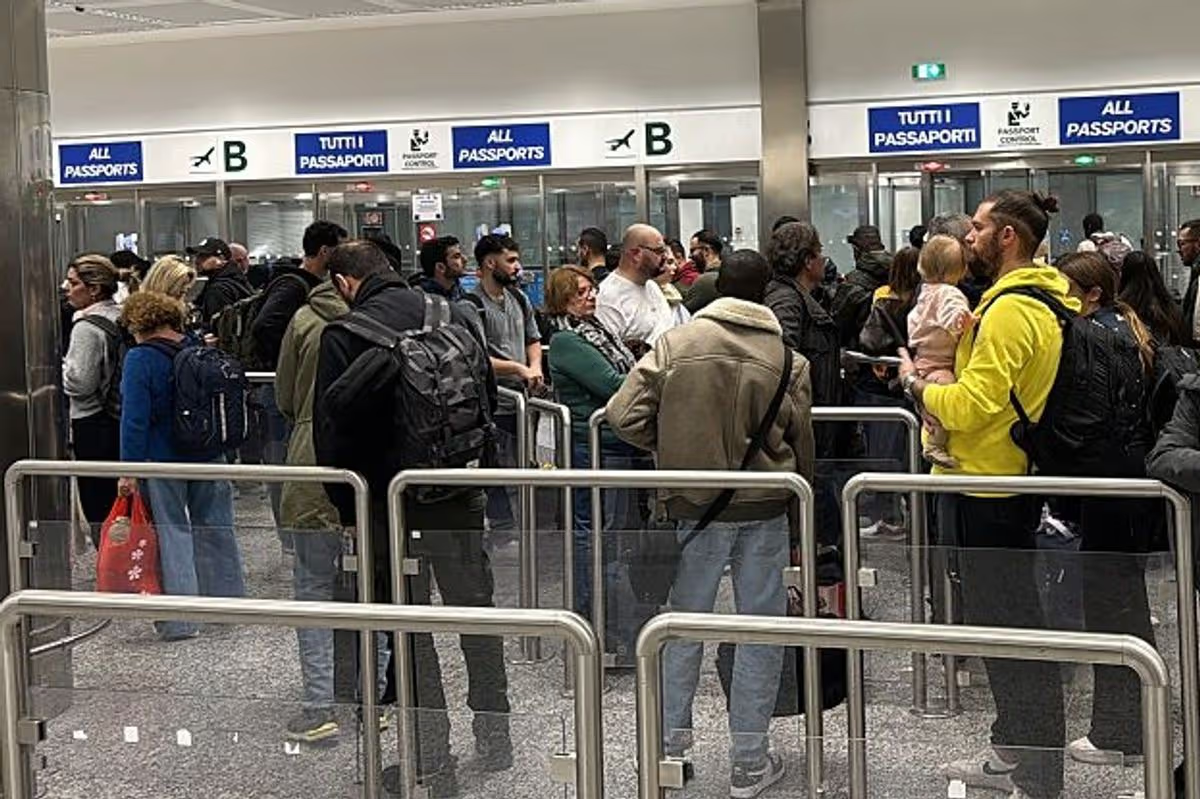
People queue at passport control in Milan, Italy (file image)(Image: NurPhoto via Getty Images)
Brits travelling to Europe over Easter face long delays — up to two hours at times — at border control as strict new entry rules come into effect.
Bottlenecks are expected due to the EU’s new entry/exit system (EES), airports and airlines are warning. Under the rules, all passengers without EU passports will be required to have their fingerprints registered and their pictures taken. These will be captured on first entry into the Schengen zone and then checked at every subsequent entry and exit.
The system, which comes into effect today, requires all non-EU arrivals to undergo the checks. Until now, only 50 per cent of passengers had to be processed at each border point.
Airports Council International (ACI), a trade body, said the latest data from across Europe “shows a continued deterioration in waiting times at border crossing points”. It said waiting times were “regularly reaching up to two hours at peak traffic times, with some airports reporting even longer queues”.
Data released last week showed at least 4,000 holidaymakers have been caught out by the new rule since it was soft-launched in October, after successive delays. During this six-month period, the number of passengers required to undergo checks increased in stages and EU members were able to suspend the system in the event of “operational pressures”.
But now the transition period is ending and passenger processing times is set to increase at border crossings. At larger airports, passengers are directed to kiosks to have their picture and fingerprints taken, although at smaller airports the process is done by an officer.
Speaking to The Times, Olivier Jankovec, the directorgeneral of ACI, and Ourania Georgoutsakou, the managing director of Airlines for Europe, said: “Passengers entering the Schengen area are likely to wait even longer at border control during Easter due to the persisting operational challenges around the EES rollout.
“We reiterate our call on the European Commission and member states to extend the possibility to fully or partially suspend EES —where operationally necessary — during the entirety of the 2026 summer season.
“This flexibility has proven vital in preventing catastrophic operational disruptions during the progressive rollout of the system. If the technical and operational issues with EES are not resolved, this flexibility should remain available during future peak travel periods, such as winter 2026-27.”
EasyJet, the UK’s biggest airline, is planning for its busiest Easter on record, handling more than a quarter more travellers than last year’s Easter weekend. It expects to operate 16,000 flights from the UK over the school holidays, with 5,000 departing during the Easter weekend.
Last week ministers warned that the introduction of EES would present a “significant change for Brits travelling this Easter”. Alex Norris, the minister for border security, said “extra time may be needed, both for your return to the UK and travelling to the EU” and advised passengers to check with their carrier.
There is little prospect of VAR being removed from the Premier League, or having its remit reduced.
In 2024, 19 out of 20 top-flight clubs voted to keep VAR, with only Wolves voting against, having proposed the poll themselves.
In order for VAR to be scrapped, 14 out of the 20 Premier League clubs would have to vote against it following a new proposal for abolition by a club.
The independent key match incident (KMI) review panel estimates there has been an accuracy rate of 96-97% for refereeing decisions made in Premier League matches since the introduction of VAR, while time delays caused by VAR have dropped by 25% in the past two seasons.
The Premier League said: “VAR delivers more correct decisions.
“In recent seasons, there have been around 100 correct VAR overturns per season – instances where goals would otherwise have been incorrectly awarded or disallowed, or red cards or penalties missed or wrongly given.
“The league applies a high threshold for VAR intervention, with the referee’s call taking precedence. As a result, VAR is less intrusive in the Premier League than in other European leagues, including the Champions League, where VAR intervenes almost twice as often.”
But the FSA believes the results of its survey should be listened to and acted upon.
“Supporters naturally raise their concerns and they fall on deaf ears far too much,” Concannon says.
“That’s really disappointing, especially when all we hear is that the fans are the lifeblood of the game.
“Don’t just ignore what supporters are telling you in great numbers – that the enjoyment of football isn’t there any more in comparison to what it used to be.”
Weekly insights and analysis on the latest developments in military technology, strategy, and foreign policy.
The Army’s revamped system for getting gear and weapons to the fight faster has already been put to work in support of the war the U.S. is waging on Iran, a service leader said Tuesday.
Speaking at the Association of the United States Army’s Global Force Symposium in Huntsville, Ala., Brig. Gen. David Phillips, deputy portfolio acquisition executive for Maneuver Air, revealed the Army was trying to innovate in real time as the conflict approaches the end of its first month.
“As I look back on the past 30 days in Operation Epic Fury, we had some immediate requests from the field in the first week,” Phillips said. “Those immediate requests in the field returned on a requirements document with the [Army Future Capabilities Directorate] and [Army Transformation and Training Command] in about 48 hours, who turned on a contract in about 72 hours. And I can say that we’ve had soldiers out training and testing the capabilities they’re going to deploy with in real time in the past 10 days. So we’ve got industry fully engaged.”
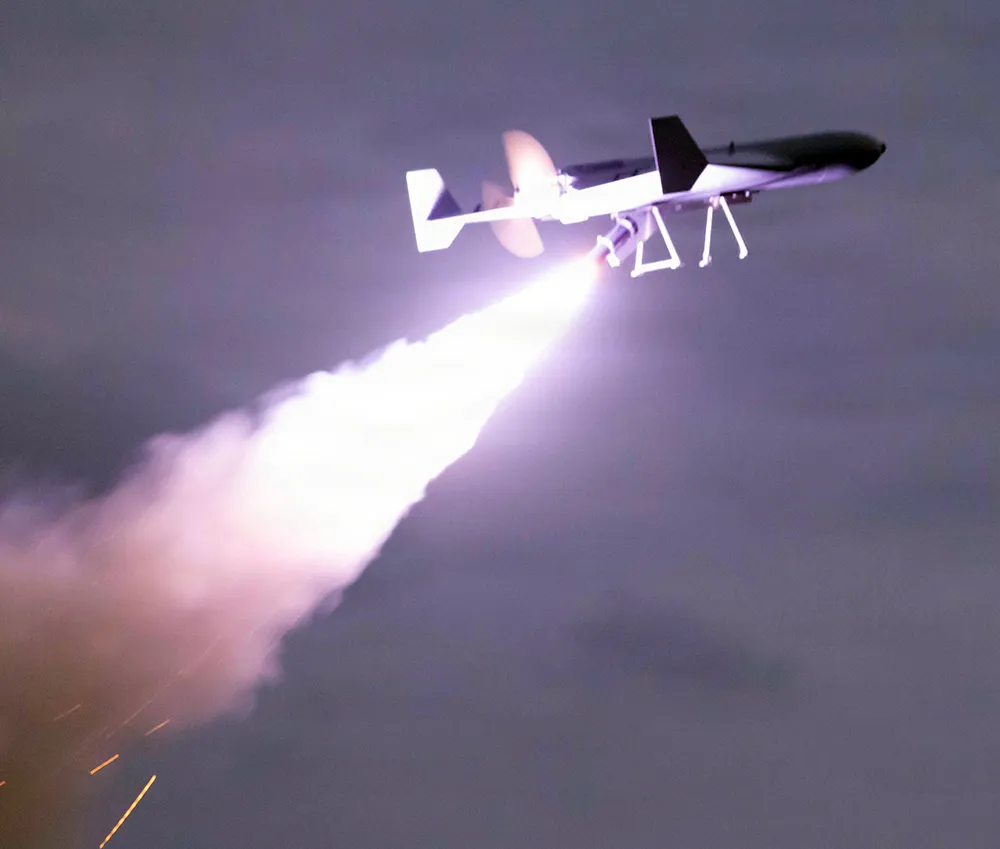
Phillips did not go into detail on what capabilities were sourced or needs identified in that short timeframe. Notably, the Pentagon has shown willingness to deploy new tech to the fight from day one, debuting the Low Cost Uncrewed Combat Attack System (LUCAS), a reverse-engineered American version of the Iranian Shahed-136 kamikaze drone, in the initial barrages.
A Low-cost Unmanned Combat Attack System (LUCAS) launches from the flight deck of the Independence-class littoral combat ship USS Santa Barbara (LCS 32) while operating in the Arabian Gulf, Dec. 16, 2025. Prior to the launch, shipboard weapons integration assessments helped ensure the system could be safely stored, moved, and handled at sea. Task Force 59 operated the LUCAS drone as part of Task Force Scorpion Strike operations. (U.S. Army photo by Spc. Kayla McGuire) NAVCENT Public Affairs
On Tuesday, the Army formally announced the creation of an “Unmanned Aircraft Systems Marketplace” in partnership with Amazon Web Services and the Army Enterprise Cloud Management Agency that purports to be a “digital one-stop shop” for procuring drones fast for Army units and their allies.
Phillips urged defense industry members, as well as academics and units currently in the field, to tell leaders what was working in the fight and what needed to change.
“We want your engagements. We want your feedback at PAE Expanded Maneuver Air, and we want to have you as a part of our team. Because we know we don’t bend the metal, we don’t really go out and talk to the sub-tier suppliers as much as you all do, but we need this to be a team sport,” Phillips said.
In a panel discussion helmed by Phillips, Army leaders who have worked with Ukraine and with mobile brigade combat teams within the 101st Airborne Division did exactly that, discussing needs and vulnerabilities with rare candor.
U.S. Army Soldiers with the 25th Infantry Division monitor a handheld controller and review sensor data during Joint Pacific Multinational Readiness Center (JPMRC) rotation 26-01, Nov. 6, 2025, at Schofield Barracks, Hawaii. JPMRC integrates U.S. forces, along with military members from France, Malaysia, Maldives, Philippines, Singapore, and Thailand, alongside New Zealand Staff Observers to refine joint capabilities and rehearse tactics, techniques, and procedures required to dominate jungle and archipelagic terrain during large-scale combat operations. The exercise underscores the U.S. Army’s commitment to ensuring regional security and strengthening partnerships in the Indo-Pacific area of responsibility. (U.S. Army photo by Sgt. Taylor Gray) Sgt. Taylor Gray
Col. Burr Miller, a former innovation advisor with the Army-led Security Assistance Group-Ukraine, warned that U.S. systems were sometimes not strong enough to sustain attacks on position, navigation and timing (PNT) capabilities. These are technologies that aid in navigation, like GPS, that are absolutely essential to modern warfighting.
“The PNT environment is incredibly corrosive,” Miller said, adding that he had observed many U.S. systems that “did not survive first contact” with a Russian adversary. “… In the same kind of tenor, we do not test a representative environment in the United States; nowhere can we test what the representative environment is … That’s not only a government responsibility, vendors; that’s your responsibility.”
“The Russians and the Ukrainians use mass,” he said. “We have forgotten how to fight mass.”
Russian fiber-optic FPV drone strikes a US-made M1A1SA Abrams main battle tank operated by the Armed Forces of Ukraine.
The tank was driving on a road covered by an anti-drone net tunnel, yet the Russian drone managed to snuck into it and hit the vehicle in the rear. pic.twitter.com/QsxlJekDdr
Leaders with the 101st Airborne added concrete numbers to the picture. For a company to attack and defeat an enemy platoon, it had to be able to take down 20 attack drones per day; accordingly, a brigade needed to be able to take out 200, or 1,000 per week, said Col. Ryan Bell, commander of the 101st’s 3rd Mobile Brigade Combat Team. For that reason, he added, the Army was beginning to issue roughly 30 reusable drones to each company training at the Joint Readiness Training Center at Fort Polk, La., allowing them to simulate the mass they’d need to be competitive in a fight.
“We need drones that are good enough to work, but not exquisite,” Bell said. “We have to get them fast. They have to be cheap enough that they compete with artillery and economies of scale; that’s the challenge. I’m shooting 1,000 of these a day. I am looking at these munitions like they are artillery racks, and I have to resupply them like artillery racks, and that is a change in how we’ve been treating them.”
Bell said his units are also working to combine effects – for example, using Starlink-connected ground intelligence, surveillance and reconnaissance robots for all-weather sensing to determine when best to employ AeroVironment Switchblade loitering munitions.
A U.S. Army Soldier with the 25th Infantry Division inspects a Switchblade launch tube during Joint Pacific Multinational Readiness Center (JPMRC) rotation 26-01, Nov. 6, 2025, at Schofield Barracks, Hawaii. JPMRC integrates U.S. forces, along with military members from France, Malaysia, Maldives, Philippines, Singapore, and Thailand, alongside New Zealand Staff Observers to refine joint capabilities and rehearse tactics, techniques, and procedures required to dominate jungle and archipelagic terrain during large-scale combat operations. The exercise underscores the U.S. Army’s commitment to ensuring regional security and strengthening partnerships in the Indo-Pacific area of responsibility. (U.S. Army photo by Sgt. Taylor Gray) Sgt. Taylor Gray
“And he can also protect his rifleman, if he has to modify the [drone] to deliver a breaching charge, an aerial breaching charge,” Bell said. “And then using two ground robots as a tertiary mechanism with 28 pounds of C4 to open up the breach before that first rifle squad makes contact.”
Col. Duke Reim, commander of the 101st’s 2nd Mobile Brigade Combat Team, also described innovating in training by pairing the Army’s small medium-range reconnaissance (MRR) drones with loitering munitions in operations to shrink down the time lag between scouting a target and raining steel down on it.
U.S. Army Soldiers assigned to the 1st Battalion, 29th Infantry Regiment, 316th Cavalry Brigade, based at Fort Moore, Ga., use the Hunter WOLF, an unmanned ground vehicle, to retrieve simulated casualties during a military capability demonstration as part of Project Convergence – Capstone 4 at Fort Irwin, Calif., March 17, 2024. The Hunter WOLF is a 6×6 robotic vehicle with a hybrid diesel/electric drivetrain, which can hold two litters on deck and can be rigged to side-carry an additional two litters for prolonged field care. (U.S. Army photo by Spc. Hunter Grice) Sgt. Hunter Grice
“The battlefield today doesn’t have time for eventually, and what we’re doing now by pairing these systems is quickening the pace at a rate that we’ve never seen before,” he said. “Our enemy is adapting. They can move quicker, they can hide and, heaven forbid, they can shoot just as fast as we can. So we’ve got to be able to take this initiative and continue to evolutionize it.”
I thought I had all the time in the world, but it turns out I needed even more.
We were lucky not to miss our flight home from Paris(Image: Vita Molyneux)
For over a year, I’ve been writing articles about the new Entry/Exit system introduced at European borders. This system, which mandates UK travellers to provide biometric data when entering or exiting the Schengen area, began its phased implementation in October 2025.
It’s expected to be fully operational across all airports by 10 April 2026. I’ve extensively covered the rollout and its potential to cause delays for travellers. However, when my partner and I flew back from Paris last month, it completely slipped my mind.
We were returning to London, and since we both prefer lounging in the airport rather than outside, we had some time to spare. We enjoyed a drink, a meal, and then decided it was time to meander towards our gate.
We had been awaiting the gate announcement, and as soon as it was made, we set off to locate it. Imagine my astonishment when we turned the corner to find a queue of people waiting for gate access.
I had entirely forgotten about the additional security checks. Even though I believed we had ample time, that time was now rapidly slipping away.
Only one kiosk was open, with a queue of at least 30 people, and the clock was ticking down to our flight’s departure. As we stood there, another 40 individuals joined the queue behind us, yet still, only one kiosk was operational.
Passengers were slowly allowed through, with groups permitted to approach the kiosk together to have their passports verified, fingers and faces scanned, before being sent on their way.
The process was painfully slow. The queue barely seemed to budge, and more people continued to join behind us. From the snippets of conversations I caught, everyone appeared as taken aback — and stressed — as I was.
I heard more than one person mutter something along the lines of “surely they won’t let us miss our flight?” Another responded: “I wouldn’t put it past them to be honest.”
Fortunately, my partner and I had started relatively close to the front, so we managed to reach the gate just in time. As for the people behind us, I have no clue.
This wasn’t even peak season, and it more than doubled the time it took to board our plane. We were flying at the end of February — very much the off-peak period. I can only envisage the chaos as the rollout completes across all of Europe, and summer travel commences.
Travelling during peak season is already stressful, and if my experience is anything to go by, it’s about to become even more so. All I can suggest is even if you think you have enough time at the airport, add more.
Welcome back to the Times of Troy newsletter, where, as colleague Chaunte’l Powell pointed out after Saturday’s thrilling win, you’d be forgiven for having already looked ahead to the next women’s college basketball season.
After all, as the USC women stumbled into this NCAA tournament on a four-game losing streak, they hadn’t offered much reason for optimism. When coach Lindsay Gottlieb added another five-star prospect — 6-4 forward Sara Okeke — to the mix for ‘26 last week, it only made it more enticing to close the book on this season and start dreaming of where USC might end up in the next one.
Fight on! Are you a true Trojans fan?
Get our Times of Troy newsletter for USC insights, news and much more.
By continuing, you agree to our Terms of Service, which include arbitration and a class action waiver. You agree that we and our third-party vendors may collect and use your information, including through cookies, pixels and similar technologies, for the purposes set forth in our Privacy Policy such as personalizing your experience and ads.
But this team, the one set to face No. 1 South Carolina on Monday night for a spot in the Sweet 16, has been limited from the start without an injured JuJu Watkins.
Through most of three quarters of Saturday’s first-round matchup with Clemson, the same issues that bothered USC through much of the season were bothersome once again. The Trojans had hit just three of 17 from three-point range heading into the fourth quarter. They made six free throws. They were outrebounded. And the bench had contributed all of two points. Gottlieb was frustrated.
But Saturday’s final quarter, plus overtime, would prove to be the defining stretch of this USC women’s basketball season. During those 15 minutes, we saw exactly what Gottlieb meant when she insisted her team had another level to unlock in the tournament.
This was the team Gottlieb had envisioned when building for a JuJu-less roster.
“We’d play with a lot of grit,” Davidson told reporters after the game, “and a lot of heart.”
That came through on the defensive end most, as USC forced six turnovers and scored eight points off of them in the fourth quarter alone. Clemson didn’t manage a single second-chance point in the second half. Kara Dunn, who’d barely been a factor, found herself in the final minutes and blew up for 11 points in a seven-minute stretch. And freshman Jazzy Davidson turned things up another notch as well, scoring 13 over fourth quarter and overtime.
There were others, too. Kennedy Smith hit a tying jumper late, in addition to her relentless defense. Malia Samuels drained a late free throw to put Clemson away. Laura Williams had a late block with the game tied. That sort of alchemy had been rare through this season.
“We were playing for each other,” Dunn said. “We made the changes we needed to make, and we didn’t repeat the same mistakes we had probably in the past. I really felt like we came together.”
Even still, it might have all been for naught, had Clemson’s Mia Moore lifted off a couple milliseconds later for her final buzzer beater. Her successful last-second heave — as well as the whistle on USC — were both called off after a lengthy review so close it required a stop watch.
Those few milliseconds turned out to be the break USC hadn’t gotten all season. They told each other in the sideline huddle that they would take advantage.
“When we heard it was overtime,” Dunn said, “we said we don’t get second chances in life.”
So the Trojans defense turned up yet another notch, while its star freshman went nuclear in overtime. A pair of clutch 3-pointers from Davidson would be the dagger. She would finish with 31 points, six rebounds and five assists in a performance that seemed to announce that this was just the start of her star turn.
She — and everyone else — will have to be special Monday to even have a shot against South Carolina, a team that beat USC by 17 in November. The Gamecocks are the more talented team. Their opponents shot 34.5% on average against them this season, the fifth-best mark in the nation, while they shoot better from 3-point range (36.5%) than all but three teams left in the tournament.
Chances are that’ll prove too much for the Trojans, who enter this game as 22-point underdogs. But even if it does end here, USC found something on the court Friday, something that should in the very least help next season, when its ceiling will be higher than ever before.
Times of Troy poll
Eric Musselman
(Ronaldo Bolanos / Los Angeles Times)
Two years into Eric Musselman’s tenure with the Trojans, the USC men have yet to return to the NCAA tournament. This season, they totally unraveled, losing their last eight games to finish 18-14.
I’ve heard varying feelings from fans about the nascent Musselman era. So let’s make the conversation a bit more scientific with a poll:
What’s your confidence level in Eric Musselman as USC’s men’s basketball coach after two seasons? (with 1 being “Let me off the Muss Bus” to 5 being “I’m still riding shotgun on the Muss Bus”
—Five-star St. John Bosco forward Christian Collins committed to USC. The No. 9 overall forward, per 247 Sports, Collins is the highest-rated player to join USC under Musselman and the highest-rated player Musselman has signed since 2022. Collins has all the tools to be a force on both ends, if he can put it all together. But he’s not necessarily the type right now to be the center of a team’s offensive attack. Expect him to get off to a slow start when he does arrive this summer.
—USC hoops assistant Todd Lee is finalizing a deal to become Cal State Bakersfield’s coach, a source says. Lee has been one of Musselman’s most trusted assistants since they first worked together with the Rapid City Thrillers of the CBA back in the early 90’s. Musselman hired Lee to join his Arkansas staff, then brought him along to USC. Now he heads to Bakersfield, where he inherits a program that’s been through a lot this last year.
—Matt Leinart won’t unretire his jersey. Good for him. Leinart’s podcast went viral last week, when he noted that USC asked him on multiple occasions if an incoming transfer or freshman could wear his No. 11 jersey. It’s his prerogative if he wants to allow that. But I completely understand why he wouldn’t. Why bother retiring jerseys at all if it doesn’t actually mean anything?
—Mason Edwards’ dominance on the mound continues. The Trojan ace struck out 12 in his most recent start against Washington and gave up just one hit. Through 36 innings, Edwards now has given up just one run and seven hits. His fellow starter, Grant Govel, has been no slouch either. Govel leads the nation in wins (6) and, after a two-run outing, now has an ERA of 0.69 and he hasn’t been the best starting pitcher on his team. Wild.
Olympic sports spotlight
It has been a tough few weeks for USC women’s lacrosse. Through their most difficult stretch of the season, the Trojans have lost four straight, all to ranked teams, by a margin of 67-31. That’s the first time in program history that USC has had a losing streak that long.
That’s a concern when you consider that USC lost five out of seven to finish out last season, too. The Trojans gave up 20 goals in a game for just the first ever against Johns Hopkins last week and were trounced by Maryland in the follow-up.
With one more loss, USC would match its loss total from 2025 … with five games still remaining.
What I’m watching this week
PJ and Anthony in “Jury Duty.”
(Courtesy of Prime)
When it premiered in 2023, “Jury Duty” was one of the most surprising and unique shows I could remember airing on TV. The first season followed Ronald, an unsuspecting, totally normal guy who was called to jury duty. What he didn’t know is that everyone else involved was an actor. Hilarity ensued.
The second follows Anthony, another unsuspecting normal guy on a company retreat for his new temp job.
I figured it was impossible to make a second season, what with everyone’s familiarity with the first go-round. But somehow Amazon has managed to make this work for another season. And that’s a hell of an accomplishment in itself.
That concludes today’s newsletter. If you have any feedback, ideas for improvement or things you’d like to see, email me at ryan.kartje@latimes.com, and follow me on X at @Ryan_Kartje. To get this newsletter in your inbox, click here.
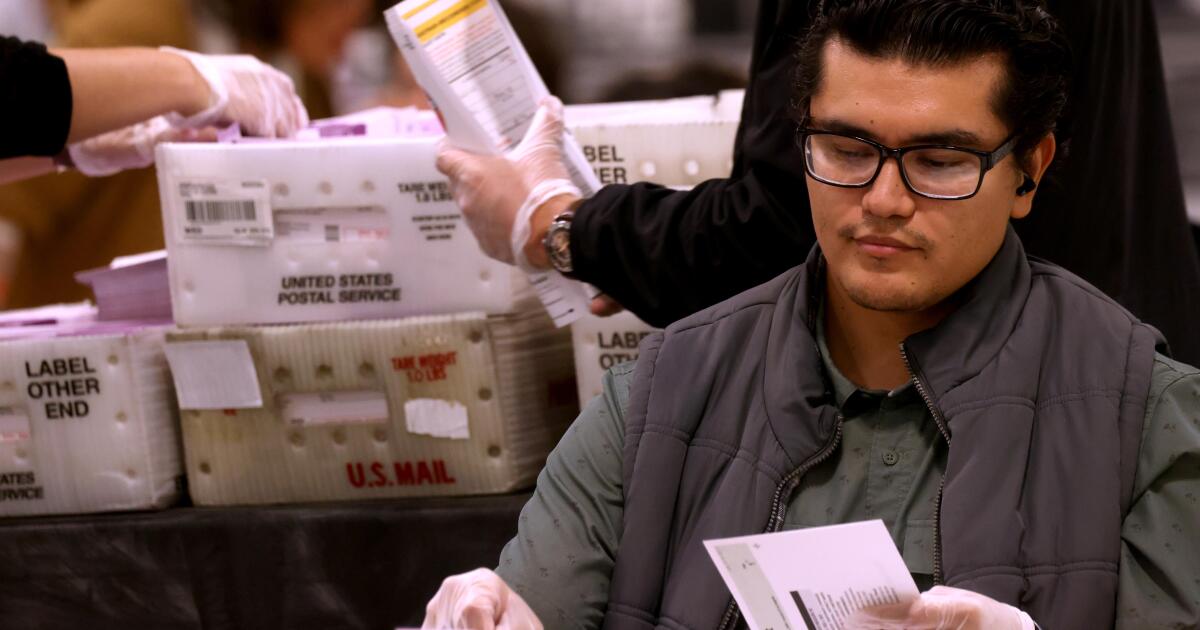
The tabulation — which can last weeks past election day — is the product, in large part, of a commendable objective: Encouraging as many people as possible to vote.
California, which mails a ballot to every eligible voter, ranks near the top of states in the ease of its elections. That’s something to be celebrated. Voting is a way to help steer the direction of our state and nation and invest, as an active participant, in its future.
“They hold the elections open for weeks after election day,” House Speaker Mike Johnson said recently, falsely suggesting that chicanery cost the GOP three House seats in California in 2024. “It looks on its face to be fraudulent.”
That’s a lot of, um, hooey.
There is no rampant cheating or election fraud in California. Period. Full stop.
Still, those sorts of phony statements have deeply diminished faith in our elections and our increasingly rickety democracy.
So — what if it were possible to preserve California’s friendly voting system while, at the same time, speeding up the tabulation of its many millions of ballots?
Kim Alexander believes it’s possible to do both.
“We need to stop explaining why it’s taking so long and start figuring out how to [produce election results] in a more satisfying way,” she said. “There are a lot of things that we could do better and do differently. It just takes some creative thinking and some will.”
Alexander, head of the nonpartisan California Voter Foundation, has spent more than three decades working to make the state’s elections more efficient, more transparent and more accountable.
Her interest in politics and election mechanics came about while growing up in Culver City, where her father served as a councilman and mayor.
As a 7-year-old, stationed in the garage, it was Alexander’s job to track the returns in her dad’s first campaign, toting up the numbers at an election night party while her mom, posted in the kitchen, called the city clerk for updates. Even at that young age, Alexander learned the importance of a fair and efficient tabulation process.
Over the years, she watched as her father’s political career was stymied by a Democratic gerrymander, which blocked any hopes he had of being elected to Congress or the Legislature as a moderate Republican. She saw firsthand the influence of money in politics. (Her father told her of turning away donations that came with strings attached.) That helped turn her into a political reformer.
After working as a legislative staffer and serving a stint at Common Cause, the good-government lobbying group, Alexander took over the California Voter Foundation in 1994.
As a political noncombatant, Alexander won’t say how it feels, and whether these days she’s more or less optimistic, watching as reckless attacks on our elections come from inside the White House. “I like to describe myself as a realist with high goals,” is all she’d allow.
There are good reasons why it takes California so long to count its ballots.
First off, there are a lot of them; more than 16 million residents voted in the last presidential election, more than the population of all but 10 states. Voting by mail has exploded in popularity and it takes longer to count those ballots, as many don’t arrive until after election day. Also, there are a number of safeguards to prevent fraud and ensure an accurate count. “We’re checking all the signatures,” Alexander said. “We’re making sure nobody votes twice.”
Simply explaining those facts can help build trust, she said. However, that won’t speed up the state’s vote counting. Here, Alexander suggested, are some things that can:
— Increase funding for California’s 58 counties to expand equipment, staff and the space needed to process ballots. In recent years, the state has been asking local election officials to do more and more without reimbursing their costs.
— Educate voters and encourage them to turn their ballots in earlier. Along those lines, a system called “sign, scan and go” allows voters to return their mail ballots in person at a designated polling place. A pilot program in Placer County found that that shaved three to four days off processing time. The system could be implemented statewide.
— Better manage California’s voter database, doing so from the top down in Sacramento, rather than having counties oversee their data and feed it into the system. That bottom-up approach creates delays and a lag time in processing ballots.
— Create “ballot swap” days to speed delivery of out-of-county ballots where they belong, also saving time. (Under California law, voters can return their ballot anywhere in the state, but it must be routed to their home county to be tabulated. That process can now take more than a week.)
The problem, apart from perennial budget pressures, is that interest in election mechanics — a technical and arcane subject if ever there was one — is episodic and fleeting. It’s like worrying about a leaky roof when the temperature is 95 degrees outside and the sun is blazing.
But even without voters clamoring to address California’s slow-poke vote count, lawmakers should act.
Gov. Gavin Newsom recently rose to defend the state’s “safe and secure elections” against one of Trump’s many unwarranted attacks. If he wants to burnish his credentials for a 2028 presidential run — which Newsom very much does — one way would be to speed up delivery of its election results.
Iran’s foreign minister is pushing back after the killings of top officials Ali Larijani and Basij commander Gholamreza Soleimani. Abbas Araghchi says the Islamic Republic is built to withstand shocks, insisting that no single figure, no matter how powerful, can destabilise the system.
WASHINGTON — Alexander Butterfield, the White House aide who inadvertently hastened Richard Nixon’s resignation over the Watergate scandal when he revealed that the president had bugged the Oval Office and Cabinet Room and routinely recorded his conversations, has died. He was 99.
His death was confirmed to the Associated Press by his wife, Kim, and John Dean, who served as White House counsel to Nixon during the Watergate scandal and went on to, along with Butterfield, help expose the wrongdoing.
“He had the heavy responsibility of revealing something he was sworn to secrecy on, which is the installation of the Nixon taping system,” Dean said. “He stood up and told the truth.”
As a deputy assistant to the president, Butterfield oversaw the taping system connected to voice-activated listening devices that had been secretly placed in four locations, including Nixon’s office in the Executive Office Building and the presidential retreat at Camp David.
Butterfield later said that, besides himself and the president, he believed that only White House Chief of Staff H.R. Haldeman, a Haldeman assistant and a handful of Secret Service agents knew about the taping system.
“Everything was taped … as long as the president was in attendance,” Butterfield told Watergate investigators when testifying under oath during a preliminary interview.
The tapes would expose Nixon’s role in the cover-up that followed the burglary in 1972 at the Democratic Party headquarters in the Watergate building. To avoid impeachment by the House, Nixon resigned on Aug. 9, 1974, less than a month after the Supreme Court had ordered him to surrender the relevant tapes to the Watergate special prosecutor.
Butterfield believed he’d had a hand in the president’s fate. “I didn’t like to be the cause of that, but I felt that I was, in a lot of ways,” he said in a 2008 oral history for the Nixon Presidential Library and Museum.
Butterfield, a college friend of Haldeman’s at UCLA who had contacted him to ask about opportunities in the new Nixon administration, served as a deputy assistant to Nixon from 1969 to 1973. In that capacity, he worked under Haldeman and, among other duties, was secretary to the Cabinet and helped oversee White House operations.
The Air Force veteran had left the White House to become administrator of the Federal Aviation Administration when Senate committee staffers privately questioned him on July 13, 1973, during their investigation of the Watergate break-in. A routine question about the possibility of a taping system had been prompted by former White House counsel John Dean’s testimony that he believed a conversation he had had with Nixon may have been recorded.
When Butterfield acknowledged that a taping system indeed existed, he was brought before a public hearing of the Senate Select Committee on Presidential Campaign Activities. The public revelation on July 16, 1973, of a taping system designed to record all the president’s conversations stunned Nixon friends and foes alike. The tapes promised Watergate investigators a rich vein of evidence in their quest to determine what Nixon and others knew about the break-in — a great deal, as it turned out.
Efforts by investigators to gain access to the tapes sparked a yearlong legal battle that was resolved in July 1974 when the Supreme Court ruled unanimously that Nixon had to give them up.
The thousands of hours of tapes made public over the years — they are now controlled by the National Archives — provide a unique, if often unflattering, view of Nixon. His words exposed a bad temper, vulgar language, bigoted racial and religious views, and unvarnished opinions about national and international figures.
“I just thought, ‘When they hear those tapes …’ I mean, I knew what was on these tapes … they’re dynamite,” Butterfield told the Nixon Library. “I guess I didn’t foresee that the president might be put out of office or impeached, but I thought it would be a perilous few years for him. I guess I couldn’t conceive of [Nixon] being forced out of office. It had never happened before.”
Butterfield later said he believed that Nixon’s successor, President Ford, fired him as FAA administrator in 1975 as part of an agreement worked out between the Nixon and Ford staff members. He said he had heard from White House friends that he had been targeted shortly after his testimony to the Senate committee.
After leaving the FAA, Butterfield worked as a business executive in California. He earned a master’s degree from UC San Diego in 1994.
Alexander Porter Butterfield was born on April 6, 1926, in Pensacola, Fla.
He left UCLA to join the Navy and later earned a bachelor’s degree from the University of Maryland in 1956 and a master’s degree from George Washington University in 1967.
In 1948, he joined the Air Force and served as an instructor at a base near Las Vegas during the Korean War and later served in Germany. In Washington, he was a military assistant to the special assistant of the Defense secretary in 1965 and 1966 and later served as senior military representative of the U.S. and representative for the commander in chief, Pacific Forces, Australia. He retired at the rank of colonel after 20 years in the Air Force.
Butterfield was unsparing in his criticism of the former president in later years. Although he commended Nixon’s achievements in foreign affairs, he considered his former boss “not an honest man” and “a crook” and believed that Nixon knew about the Watergate break-in before it occurred and was the architect of the ensuing cover-up.
Butterfield found himself “cheering … just cheering” the day Nixon resigned, he told the Nixon Library, because “justice had prevailed.”
“I didn’t think that it would for a while,” he said. “This guy was the ringleader.”
Daniel and Tackett write for the Associated Press. Daniel, the primary writer of this obituary, retired from the Associated Press in 2023.
Aimee Zambrano is a Venezuelan anthropologist, researcher, and consultant who has made significant contributions to the struggle against gender-based violence in the country. She is currently pursuing a master’s degree in Women’s Studies. She is the founder of the Utopix Femicide Monitor, a platform that collects data on femicides from open sources. In this interview, Zambrano sheds light on the main challenges to advance a feminist agenda in Venezuela.
How has gender-based violence evolved in Venezuela in recent years?
It is difficult to answer precisely because there are no official figures. The former Attorney General, Tarek William Saab, presented some figures, but he did not break them down; rather, he spoke in general terms about a period during his tenure. So it is very difficult to assess what changes have occurred, especially in quantitative terms.
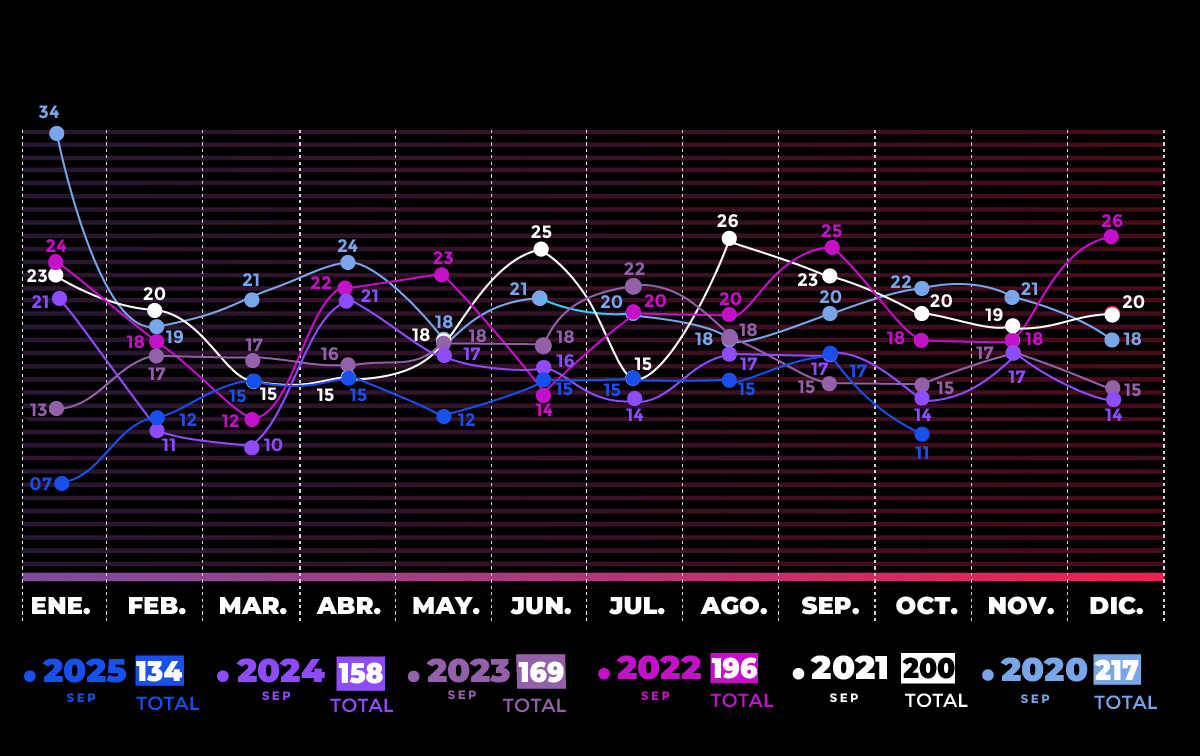
We undertake a partial registry based on cases that appear in the media, so these are not official figures. But it is enough to see patterns emerging. We have been monitoring since 2019 and saw an increase in femicides in 2020 due to the lockdown caused by the COVID-19 pandemic, which also led to an increase in all types of gender-based violence, not only in Venezuela but in most countries around the world. In 2019, when we began monitoring, we recorded 167 femicides, then in 2020 we recorded 256. In 2021, there was a decrease and we counted 239 cases. In 2022 and 2023, there were 240 and 201, respectively. In 2024, we recorded 188 femicides, and for 2025, we estimate that the figure will be around 165.
Utopix’s Femicide Monitor has tracked femicides from open sources. (Utopix)
There has been a decrease in the number of perpetrated femicides. However, when we look at other forms of violence, such as attempted femicides, we are seeing an increase compared to previous years. This is a warning sign because these are attempts to murder women that leave physical, psychological, and social consequences on both the survivor and her environment. We have also seen an increase in femicides of Venezuelan women abroad year after year. We are also witnessing a large number of cases of sexual abuse, especially child sexual abuse and trafficking, both abroad and in our country. Similarly, here in Venezuela, the disappearance of women is not classified as a type of gender-based violence, but according to various investigations we have carried out, disappearance or abduction, in the specific case of women, girls, and teenagers, is directly related to gender-based violence, and many of these disappearances are associated with femicides where the bodies are hidden, or cases of gender-based violence where the aggressors end up confining the victim. At the same time, we have seen a large number of cases of vicarious violence, where the aggressor inflicts violence on children, family members, or even pets.
So, a decrease in the number of femicides does not mean that other forms of violence are not on the rise. It is also important to talk about political violence. In the context of the July 2024 presidential elections, two femicides occurred and we saw threats against many community leaders by right-wing groups, who persecuted and harassed them. The same goes for media violence, social media, and artificial intelligence. In fact, there need to be changes in the laws so that these new forms of violence can be punished.
How does the lack of official and updated figures from the Venezuelan government affect the implementation of effective public policies to combat gender-based violence?
It has a huge impact. It’s not that there are no figures, but that they are not public. In fact, several public programs such as the Mamá Rosa Plan for Gender Equality and Equity, the various homeland plans, and even the Organic Law on Women’s Right to a Life Free of Violence, mandate that the state must create an observatory for gender-based violence.
The absence of data means that we cannot measure the efficacy of the public policies that are being enacted. Statistics could also allow organizations to develop proposals, not only legislative ones, but also from women’s groups, which must also participate in the elaboration of these policies.
“How many more must die?” poster in a feminist rally. (Archive)
It is often said that the deterioration of living conditions in Venezuela disproportionately affects women, but what does this mean in practice? Does it also impact the number of femicides?
Yes. We were affected by the rentier culture, the crisis, and economic sanctions. It has been a multifactorial phenomenon. The rentier culture did not change, public policies depended on oil revenues, and a series of US-led unilateral coercive measures were imposed on us that affected all aspects of life. In crises, it is always women’s bodies that pay the price. Currently, we have to work four or five jobs, usually informal ones, to make ends meet. For those of us with children, it is even worse, because we also have the burden of unpaid work in the home. The same is true for the care of the elderly or people with disabilities, which always falls on our shoulders.
In Venezuela, the vast majority of heads of households are women, who are either alone or part of extended families of women living together and raising children. In addition to this, women are the ones who make up a large part of the social fabric, they are grassroots leaders. At the same time, the country is experiencing a crisis in services, electricity, water, and gas, which further increases the burden of care work. Women have to figure out how to get water for cooking, washing, and bathing their children, how to cope when there is no electricity, or how to cook without gas, especially in the interior of the country, where public services are in a more dire state.
Does this have an impact on the number of femicides? It does. Violent, aggressive men find themselves in the midst of an economic crisis, where there is unemployment or underpaid work, they become increasingly frustrated, and where do they take out all this frustration? On women, their partners, their families, their homes. It would be interesting to see if GDP figures or periods of high inflation correlate with peaks in femicides.
With the US attacks on January 3, we saw the kidnapping of Cilia Flores and also the rise to power of the first female president, albeit in an acting capacity, Delcy Rodríguez. How can this be interpreted from a feminist perspective?
The bombing of Venezuela was a flagrant violation of international law, but we also saw how National Assembly Deputy Cilia Flores appeared during the arraignment hearing in New York with bruises on her face and body. Her attorney requested medical attention, which indicates that during the operation she was the victim of violence by the US military. This, of course, is indicative of what foreign powers do when they bomb and invade other countries, especially in the Global South, where they do so to extract natural resources.
Talking with friends, I have realized that many of us feel violated, as women, by everything that has happened. Now the acting president, Delcy Rodríguez, has a very difficult task: to take the reins of the state with a gun to her head. It takes a lot of courage to face this. In addition, after the bombing, Trump’s threat to her was very direct: do what I want or you will be worse off than Maduro. It is difficult to take on that role and have the responsibility of preventing more lives from being lost.
Zambrano argues that the lack of official data hamper gender-equality policies. (Archive)
In the current context, what are Venezuela’s main challenges in terms of the feminist agenda? You have suggested, for example, the need to create a structural feminist emergency plan. What would that look like?
The first thing is to define what that feminist agenda is, because in Venezuela there are different grassroots movements and organizations with different political stances, and polarization sometimes makes it very difficult to unify the points. Sometimes we try, but the efforts can get fragmented again due to specific political events. I would say that there is the issue of gender violence and also the decriminalization of abortion in Venezuela, as common ground that unifies many of us. We also demand a justice system that has a gender and feminist perspective because the current one is built from an androcentric, patriarchal perspective; that is, it is a justice system created by men and for men. An amnesty law is currently being implemented, so this has to be included in it.
By a feminist emergency structural plan, we mean that the Ministry for Women and Gender Equality should not be the only institution responsible for public policies relating to women and the LGBTIQ+ population. It should rather involve the entire state. I am not saying anything new because this already appears in the Organic Law on Women’s Right to a Life Free of Violence and also in the Mamá Rosa plan, which was supposed to culminate in 2019, but almost nothing that was stipulated ended up being implemented. All ministries, all affiliated entities, all state institutions, including governors’ and mayors’ offices, must address gender issues, and a robust budget is needed for this. For example, the Ministry of Communication must run ongoing campaigns in the media and on social networks about the different forms of violence and the telephone hotlines and websites where incidents can be reported. The Ministry of Housing must focus on creating shelters for victims. The Ministry of Education must review the curriculum to include gender studies, comprehensive sexuality education, and different types of violence, as well as implement protocols for care in schools, high schools, and universities. In addition, all state officials have a duty to educate themselves on the issue.
How do you assess the retreat of the state in certain areas and the growing “NGOization” leveraged by Western funding?
It’s complex because initiatives, activities, marches, etc., require resources, and many of our organizations don’t have them. In addition, there is another factor at play here, which is the proliferation of religious groups, especially Pentecostal evangelicals, who have grown significantly in Venezuela, have a presence within the state and within political parties, and are also very wealthy, which allows them to carry out campaigns, mobilizations, etc. Feminist movements face many obstacles because most of us also have to work several jobs and take care of our homes and communities. So it is difficult to keep up with evangelical and conservative right-wing groups.
I think we need to identify who the enemies are, who targets our rights, and then assess the contradictions and coordinate women’s and feminist movements. I make the distinction because there are women’s organizations that do not necessarily identify as feminist. But we have to grow, see what issues unite us, and begin a series of actions. I always make this call: despite our political differences, let’s try to unite around an agenda that unites us all.
Despite a downturn in femicides, other forms of gender violence have been on the rise in Venezuela, Zambrano argues. (Archive)
How does social media influence the proliferation of violence, and gender violence in particular?
I believe that violence has always been present, but now it is exposed because some forms of violence that we used to consider normal or common have been explained or denormalized. In addition, social media and the internet allow us all to learn about different cases in different parts of the world. But, on the other hand, we have the issue of anonymity and lack of accountability, meaning that people can say outrageous things, threaten, insult, and commit violence facilitated by technology. Social media also allows virtual groups to come together to commit violence, and there are also certain influencers on Instagram, YouTube, and TikTok spreading crazy ideas. Guys like El Temach in Mexico, who speak to you from their machismo, what some call “toxic masculinity” but I call “the healthy descendant of patriarchy.”
There is also another point here: the algorithm. For example, a teenager starts searching for content about exercise, and soon after, the algorithm will introduce them to these influencers, thus creating mass communities such as incels, which organize themselves through forums like Reddit. This also breaks down the entire social fabric of face-to-face interactions, and people end up isolated but believing they are “accompanied on social media.” All of this leads to disorders such as anxiety and depression. In addition, teenage girls and women become caught up in the aspirational idea of having a certain type of body, aesthetic violence, etc. In short, I’m not saying this from a moralistic point of view, but social networks have encouraged a lot of violence. Besides, who owns these networks? What ideology do they profess? What are they using them for? We have to investigate so we can arm ourselves and fight this battle.