Symbolism

This personal theater experience is disguised as an L.A. tarot reading

There’s a sense of quiet mystery in tarot. That’s why during my reading last week, it was more peculiar than disruptive when a dancer hopped on a table to lay at a 90-degree angle and jet her feet in the air.

Despite said activity, the tone was contemplative, and moments later, as I was being asked to describe the colors and mood of a Ten of Swords card, I was tapped on the shoulder. After a gesture to follow, I was handed a lantern.

The way I swayed the light would now dictate the performer’s movements. We may not have been dancing, but it was close. Melancholic and intimate, the performer (Haylee Nichele) silently guided me to become comfortable in my discomfort, to sit with the evening’s themes of longing, loss, confusion and impending grief.

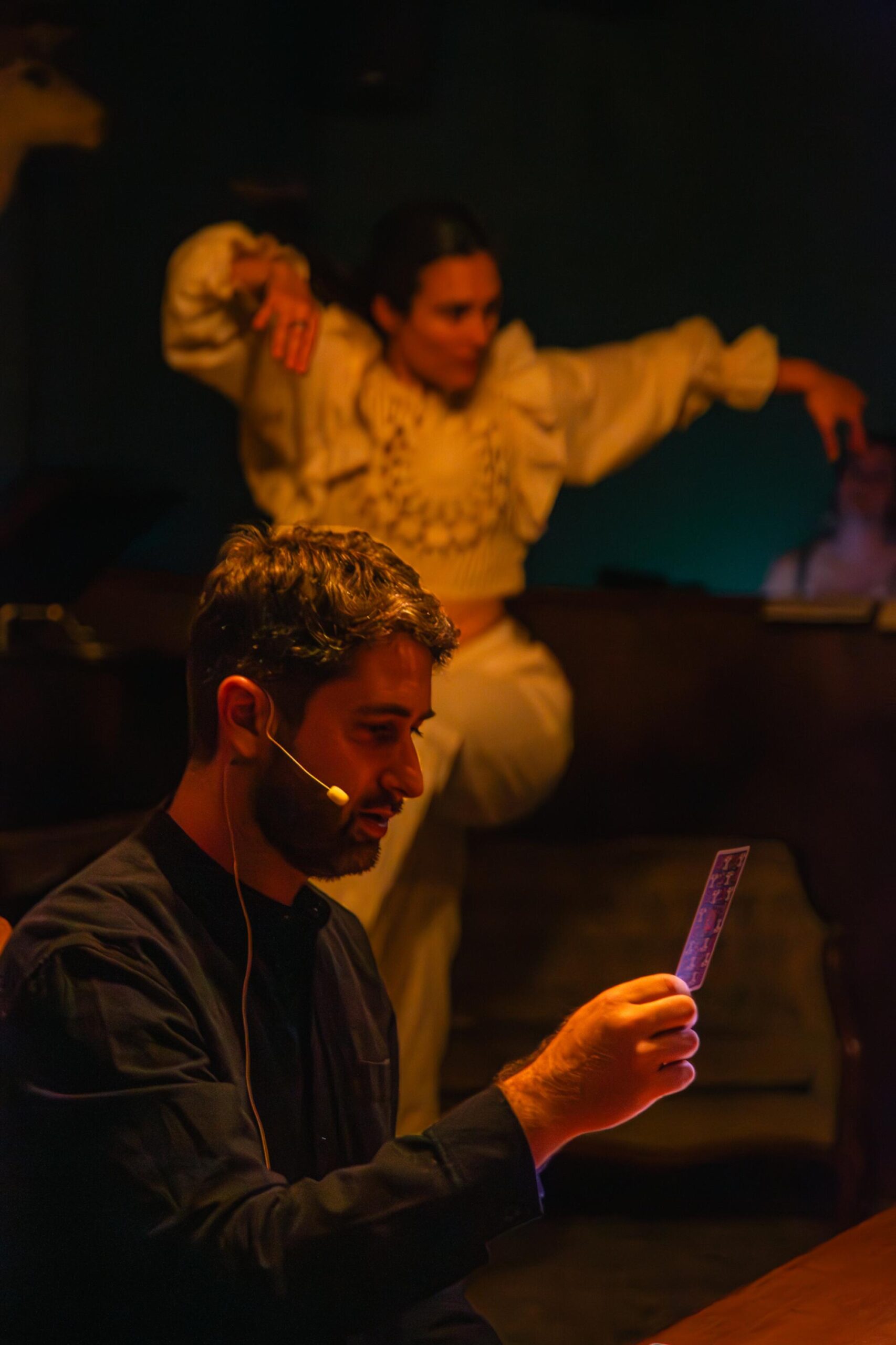
A man holding a tarot card with a dancer behind him.

Sam Alper’s Bill, foreground, and Haylee Nichele’s Constance in Koryn Wicks’ “You Must Be Here for the Reading,” an immersive tarot show.

(Daniel Kleen)

“You Must Be Here for the Reading,” running through June 20 at North Hollywood’s After Hours Theatre, is part theatrical and dance performance, part tarot reading and part cocktail hour. It’s also personal, led by two actors who encourage the attendees to open up, to complete poems and to generally tune into their vulnerability.

The 60-minute show, partly scripted and partly improvised, comes from the mind of Koryn Wicks. Trained in dance and choreography, Wicks’ day job is in themed entertainment while her personal projects explore the immersive space. They’re theatrical works that experiment with audience interaction. “You Must Be Here for the Reading” is no different.

The setup: Collectively, our group of eight has arrived at a tarot reading, only the famed reader we are there to work with, Constance, performed by Nichele on the night I saw, never arrives for her assigned role. We know her fate, but her partner, Sam Alper’s Bill, who nervously attempts to carry on with the performance in her absence, does not.

From there, “You Must be Here for the Reading” becomes a show heavy on audience participation. There are scripted, story-specific beats, but the cards pulled — and the tales they tell — is, of course, randomized.

A group gathered around a tarot reader.

Sam Alper as Bill, an unsuspecting tarot card reader in Koryn Wicks’ “You Must Be Here for the Reading.”

(Daniel Kleen)

“I knew that I wanted the audience to be the primary drivers of the tarot reading,” Wicks says. “I knew that I wanted the host to not be a tarot reader and there to be some sort of event that made it so the audience would have to take the reins and read the tarot.”

In turn, “You Must Be Here for the Reading” works for both those who are novices to the space as well as those who are more experienced. During the pre-show, guests can explore tarot books and uncover slips of paper hidden in them that prompt us to answer questions or complete poems — the latter will figure into the performance. A worksheet given to us asks us to interpret some core tenets, as well as to enter the reading with a question we would like to explore.

The show then focuses on how each attendee’s desires, concerns or lived experiences shape the perception of the reading.

“What’s drawn me to tarot is the way it’s built on symbolism and the way that symbolism is embedded in the collective unconscious,” Wicks says. “I think it’s really fascinating that we have this artifact that has this ability to give us insight into a lot of shared experiences. When I’ve read different books about tarot, or had my cards read by different people, there is an openness to interpenetration.

“The assignment I gave myself for this piece,” Wicks continues, “was to create an experience in which you had a group of people coming together and going through the process of defining the symbolism and meaning of the cards in real time.”

And yet the show also pulls from Wicks’ background in dance. While Constance never shows for the reading, her presence is still felt, often hovering or circling around the table with movements designed to interpret the tone of the reading. She’s a ghostly presence, the gracefulness heightening the somber emotions of the night. Though she and Bill never interact directly, much of the dance seeks to explore their unseen bond. At times, Constance may call on various audience members to act as a dance partner.

Artist Koryn Wicks

Koryn Wicks, creator of “You Must Be Here for the Reading,” an immersive tarot performance in which audiences are tasked with deciphering their own cards while a melancholic story unfolds around them.

(Kayla Bartkowski / Los Angeles Times)

“I really believe that one of the most beautiful things art does for us is remind us that we are not alone,” Wicks says.

Immersive art allows for a sense of participation, which Wicks hopes will increase one’s appreciation of dance.

“Dance is an embodied art form,” Wicks says. “There is science that shows that some of the enjoyment from watching dance comes from imagining yourself moving. In North America, a lot of people haven’t had an experience or education with dance, especially not concert dance. Then we ask them to sit in a dark auditorium in a small chair and not move to enjoy it. I found through my research, both practical and academic, there is something to inviting audiences to participate in dance that allows them to derive meaning from it.”

‘You Must Be Here for the Reading’

While there isn’t enough time in the show for everyone to have a one-on-one experience with the dancer, watching an audience and cast member attempt to get in sync with each other underlines the night’s themes of connecting. Ultimately, that’s the space where the show resides. “You Must Be Here for the Reading” uses tarot as a means to bring some structure to our often disconnected lives.

“It stands in contradiction to our current historical moment,” Wicks says of the show. “It’s very anti-AI. It’s asking people to sit with books and to find little seeds and not necessarily pursue solutions or puzzles. It’s asking us to connect, sometimes with strangers.”

I kept my question that I brought to the reading secret, but I found the show provided a hopeful answer. Not because the cards offered a solution. Instead, they provided a community.

Source link

From exile to judge: Symbolism in Syria’s trial of Assad, former officials | Syria’s War News

On March 13, 2013, Fakhr al-Din al-Aryan, a judge at Idlib’s Civil Court of Appeal, publicly defected from the Syrian regime – an act that led him to be sentenced to death in absentia.

In December 2024, more than a decade later, Bashar al-Assad’s regime – the very one he had defected from – was overthrown, and al-Aryan was able to finally return to Syria’s judiciary.

Recommended Stories

list of 3 itemsend of list

In the latest step on al-Aryan’s journey from defection to exile to return, he was the presiding judge on Sunday at the opening of the trial of Atef Najib, a cousin of former President al-Assad and the former head of political security in the southern province of Deraa who faces charges of premeditated murder, torture leading to death and crimes against humanity.

Al-Assad and his brother Maher al-Assad, a former top military commander, are also being tried in absentia. Both men fled to Russia after their 2024 overthrow.

Fadel Abdulghany, the founder of the Syrian Network for Human Rights (SNHR), told Al Jazeera that the moment carries deep symbolic weight.

“A judge once sentenced to death by the Assad regime for defending the rule of law has returned to the bench to apply that same law to one of the regime’s most extensively documented perpetrators of violations,” Abdulghany explained. “This reversal of power dynamics reflects the promise of the rule of law so rarely fulfilled in post-authoritarian transitions. The significance of this moment lies not in spectacle but in its adherence to due process.”

Defection and return

Al-Aryan was a judicial adviser during the early years of Syria’s uprising, which began in March 2011, as protests intensified and the state increasingly relied on security-based rule.

By 2013, he decided that he had to break from the Syrian state and defected in a recorded statement that framed his decision as a matter of legal and moral responsibility.

“In light of the responsibility placed on the shoulders of judges, who are the guardians of justice and truth, and as a result of the massacres committed by the regime against civilians, children and women, … I announce my defection from the Ministry of Justice and my joining the Independent Syrian Judicial Council … to be a strong shield for justice and equality,” he said in the video.

After his defection, al-Aryan joined the judicial bodies of the then-Syrian Interim Government and became involved in building what was described as a parallel judicial track in opposition-held areas.

As part of that, he worked on establishing alternative courts, handling legal cases and documenting alleged crimes committed by the now former regime.

In response, the authorities sentenced al-Aryan to death in absentia and confiscated his property, including assets later sold at public auction.

After the fall of al-Assad’s regime, al-Aryan’s name re-emerged in June after a presidential decree reinstating dismissed judges. That process culminated in his appointment as head of the Fourth Criminal Court in Damascus, positioning him at the centre of the country’s first transitional judicial proceedings.

The transformation in al-Aryan’s life mirrors that of the man on trial in his courtroom on Sunday.

The position of the al-Assad family member as a top security official in Deraa in 2011 placed Najib at the centre of some of the first major confrontations between civilians and state security officers. Deraa is called the “cradle of the revolution” after government repression of protesters there inspired al-Assad’s opponents in other areas of the country to rise up.

One specific incident – the arrest and torture of schoolchildren detained after scrawling, “The people want the fall of the regime,” and the killing of one of them, 13-year-old Hamza al-Khateeb – is widely regarded as the spark for the country’s revolution.

Najib’s connection to that incident and the death of Hamza is one of the reasons why his trial is so significant in Syria.

The former official was arrested in January 2025 in the Latakia region, where some former regime loyalists had taken refuge.

Transitional justice

For the Syrian Network for Human Rights, the trial is significant because of how it is being conducted and not just who is being tried.

Abdulghany stressed that “this is neither a revolutionary court nor a victors’ court” but a case that has moved through formal legal stages, including arrest by the Ministry of Interior, investigation, prosecution and referral to a criminal court in Damascus.

The charges include premeditated murder and torture leading to death, classified as crimes against humanity under international law. This framing, Abdulghany said, is deliberate: It places domestic proceedings within the framework of international criminal standards, which is essential for the credibility of any verdict.

Abdulghany also highlighted the institutional message of the trial and in particular the inclusion of the former president and his brother as defendants despite their absence from the proceedings and from Syria.

“Physical absence does not amount to legal immunity,” he said.

Despite this, Abdulghany stressed that the trial was not the end of the transitional justice process in a country where hundreds of thousands of people died and disappeared during the war and the five-decade rule of al-Assad and his father, Hafez. There is still little information in many of the cases of the disappeared and imprisoned. The SNHR has documented at least 177,000 cases of enforced disappearances since 2011 with the vast majority attributed to the former government.

Abdulghany explained that accountability in Syria cannot be reduced to criminal trials alone and instead must include four interconnected pillars: criminal accountability, truth-seeking, reparations and institutional reform.

These, he argued, must function together under a unified structure rather than as separate or sequential processes.

Abdulghany placed particular emphasis on institutional reform, noting that Syria’s judiciary was previously used as a tool of repression rather than justice.

“Without these reforms, transitional justice trials risk being conducted through judicial institutions that have not themselves been transformed,” he said, pointing to the need to dismantle exceptional courts and rebuild judicial independence.

Truth-seeking, he added, is equally essential.

Families of victims have a right to know what happened to their relatives, and this right exists independently of criminal prosecutions, Abdulghany said.

“They deserve answers,” he said, adding that recognition of truth, justice and reparations must be unconditional if any durable reconciliation is to be achieved.

Source link