
sxsw

Maturing but still messy, Joe Swanberg is back at SXSW a veteran

“The Sun Never Sets” is filmmaker Joe Swanberg’s 10th indie to premiere at SXSW but his first to play the event since 2017. The astonishing pace with which he made his early work — loose, idiosyncratic stories that were progenitors of the emergent style known as mumblecore — has slowed significantly, but also given way to a newfound maturity as both a person and an artist.

Introducing “The Sun Never Sets” at its world premiere on Friday night to a sold-out crowd at the Zach Theater, Swanberg called his latest “my favorite film I’ve ever made.” Shot on 35mm in Anchorage, the movie follows a 30-ish woman, Wendy (Dakota Fanning in a vibrant turn), torn between pursuing a fresh romance with a reckless old flame (Cory Michael Smith) or continuing on with the settled-in-his-ways divorced father of two (Jake Johnson) she’s been seeing for a few years.

A woman in shades walks in a parking lot in a mountain town.

Dakota Fanning in Joe Swanberg’s “The Sun Never Sets,” filmed in Alaska.

(SXSW)

“I guess this is what they tell you about getting older and doing this job longer,” said a thoughtful Swanberg in a video interview from his home in Chicago shortly before the South by Southwest festival. “You get better at it and you sort of mature and all of this.”

The film marks Swanberg’s fourth collaboration with Johnson, a partnership that goes back to 2013’s “Drinking Buddies.” (The actor partly financed the new project along with his brother.) Following completion of the third season of the Netflix anthology series “Easy” in 2019, for which he wrote and directed all the episodes, Swanberg was planning to take a break. A divorce and the pandemic caused that pause to grow even longer.

In the intervening years Swanberg produced a number of projects for other filmmakers, did some acting and opened a small video store in Chicago. Swanberg knew Anchorage-based producer Ashleigh Snead, who encouraged him to consider shooting something there. The scenic location would give Swanberg the opportunity to expand his visual style from his usual couches, bars and apartments of much of his work. (There still are a surprising number of scenes on couches and in bars.)

“Joe’s a real filmmaker,” says Johnson in a separate interview. “And I think sometimes he doesn’t get that credit because he can make movies with nothing. This is a real adult movie. This is a film about how complicated breakups are and how messy they get. And it’s in beautiful Alaska.”

A director looks at a monitor on a film set.

Swanberg, center, on the set of “The Sun Never Sets.”

(SXSW)

Swanberg has now gone from someone making talky, provocative and at times controversial films about the lives of post-collegiate 20-somethings to exploring the nuances and specifics of being a 44-year-old divorced father of two still trying to figure out his place in the world. His original cohort of SXSW-affiliated filmmakers, many of whom also fell under the rubric of mumblecore — nobody much liked the name, but no one ever came up with anything better, so it stuck — included Greta Gerwig, Lena Dunham, Barry Jenkins, Ti West and others who have gone on to more conventional mainstream success.

But Swanberg doesn’t seem to feel left behind. Rather, he only sees doors opening.

“It’s gone so much better than I thought it was going to go for me,” he says. “I mean, when I was making these really tiny, sexually explicit 71-minute movies, I was like, I’m just grateful to be here. I can’t even believe these festivals are showing this work and it’s so cool that there’s a space for me in this ecosystem.

“And so to watch my friends go off to do these giant movies, to see Greta doing ‘Barbie’ and stuff like that, to me it just opens up the possibilities,” he adds. “Each time a friend of mine sets some new record or moves into some new space, I’m kind of like: Oh, that just opened up for all of us now.”

His earlier work often featured raw sex scenes, sometimes featuring Swanberg himself. From practically the start of his career, well predating the #MeToo-era reckoning that began in 2017, Swanberg weathered accusations that he was exploitative and manipulative of his female performers. His stepback from productivity coincided with a moment when his explorations of sexual power dynamics fell out of favor. It would be easy to interpret that Swanberg preemptively soft-canceled himself to avoid a broader scandal. He doesn’t see it that way.

“Certainly in Chicago, where I’ve spent the last five years, I’m not unwelcome places,” he says, drawing a distinction between himself and “people who lose jobs or are capital-C canceled. But also my work has always pushed those boundaries and always attracted some amount of positive and negative attention.”

Though “The Sun Never Sets” has numerous kissing scenes, it doesn’t go too much further than that.

“I won’t do it,” Johnson says of more graphic scenes. “When I worked with Joe early on, I was like, ‘I love you, man — I’m not doing this.’”

For her part, Fanning had no reservations about working with Swanberg. He offered both Fanning and Smith the opportunity to work with an intimacy coordinator, but neither felt it was necessary.

“There was no planet where you’d ever be asked to do anything you were uncomfortable with,” Fanning says. “If there was ever a moment like, ‘I don’t want to do that,’ he’d be like, ‘Oh, then let’s not.’ There was a day where there was a scene and it was pouring rain outside. And we both looked at each other and he was like, ‘We’re not going to do it. The scene’s cut.’ He’s just open. And I just trusted him implicitly.”

Two people laugh in a room with art hanging in it.

Jake Johnson and Dakota Fanning in the movie “The Sun Never Sets.”

(SXSW)

Swanberg has long worked in an unusual style in which the script is essentially a detailed outline and the actors work to come up with their own dialogue during rehearsals. For “The Sun Never Sets,” Swanberg and Johnson developed the longest, most complete outline Swanberg has ever used, including some dialogue exchanges. Then the actors were allowed to make it their own.

Fanning recalled an early Zoom call with Swanberg and Johnson on which they explained the process.

“It’s still made like a real film,” Fanning says. “And Jake and Joe promised it’s not like we’re just flying by the seat of our pants: ‘You will know what to say, I promise.’ And then friends that know me asked, ‘Are you so nervous?’ And I was, but for some reason, I don’t know why, I just knew that it was going to be fine. And that just proved to be true.”

Even though it takes places in Anchorage, Swanberg calls “The Sun Never Sets” “extremely personal.”

“I was definitely writing a movie about a divorced mid-40s guy dating a younger person,” he says. “The questions of marriage and having children were sort of an amalgam of two real relationships that I merged into one onscreen.” He describes the material as “questions that I had and have about what my own relationships are going to look like post-divorce.”

That comes through in Fanning’s rich, layered performance, which might rank among the best of her already lengthy career. Swanberg’s style draws both an ease and an intensity from Fanning, who captures a woman at a pivotal moment of figuring out what she wants amid the emotional whirlwind she is going through. (At the film’s premiere, Fanning said, “I’ve never put so much of myself into a role before.”)

“I think the goal of Joe’s films, and I think at least my goal with this film, is trying to make everything feel real,” she says. “Things are just a mess some of the time.”

Dakota Fanning and Cory Michael Smith sit and look at each other in 'The Sun Never Sets'

Dakota Fanning and Cory Michael Smith in “The Sun Never Sets.”

(SXSW)

Swanberg himself appears in a small role as the new husband of the ex-wife of Johnson’s character. And the characters of the two kids in the movie are named after the director’s own children. With a newfound maturity and emotional depth, Swanberg is continuing to make movies that are part diary, part generational markers.

“It’d be really cool in my 40s to make movies about characters in their 40s,” he says, “and in my 50s, 60s and 70s. It’d be neat to be making sexually explicit movies about 70-year-olds in their dating lives and sex lives and stuff. It’s really exciting to have movies about characters at this phase of their life, whether they’re finally settling down in their 40s or whether they’re getting out of relationships and reexamining their life. It’s where my head is at.”
.
Source link

SXSW 2026: On aliens and UFOs, Spielberg says, ‘We are not alone’

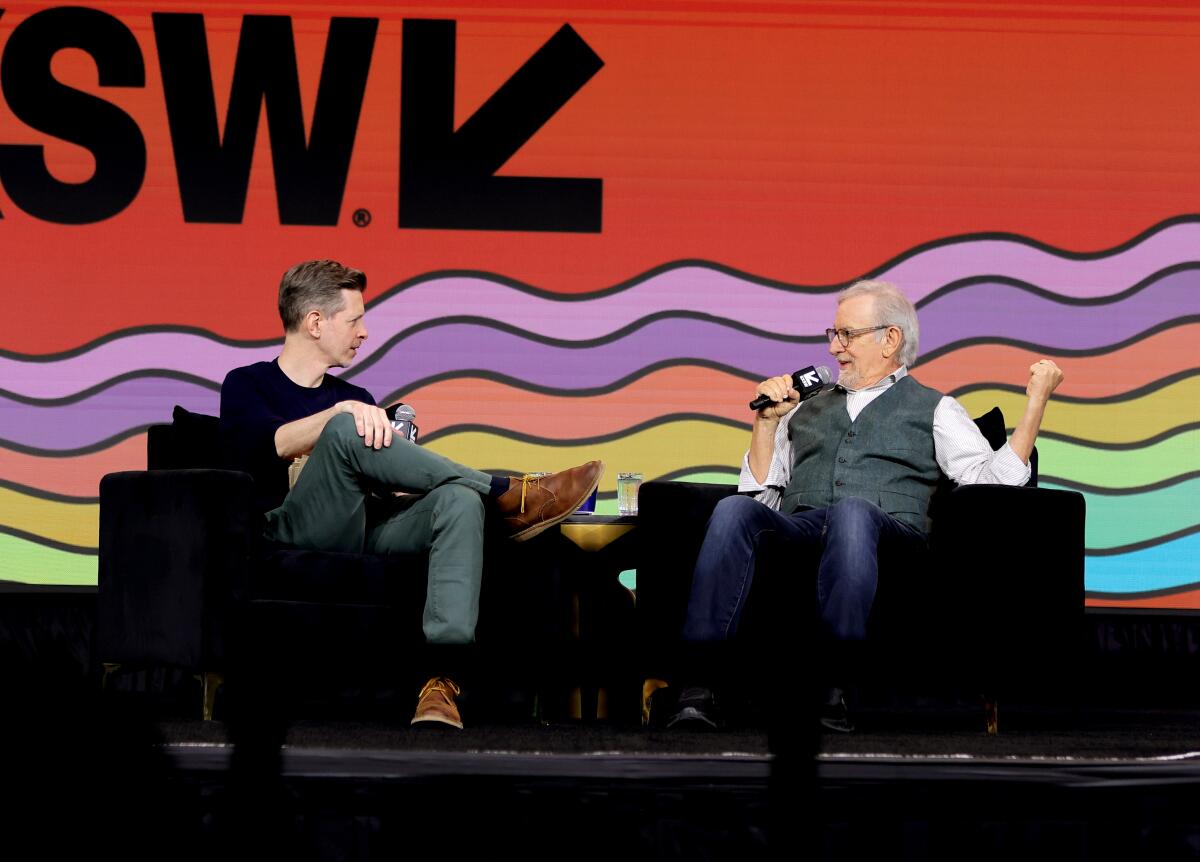
One of the most anticipated events at this year’s SXSW Film & TV Festival wasn’t a movie at all, but a speaking appearance by director Steven Spielberg. The talk, a live taping of the podcast “The Big Picture” lead by co-host Sean Fennessey, covered many aspects of the Hollywood legend’s career, with a through line of sci-fi and space aliens in conjunction with Spielberg’s upcoming alien invasion thriller “Disclosure Day,” due June 12.

Though no real details about the new film were revealed, references to it peppered the conversation as if it were very much on Spielberg’s mind — the film he was ostensibly there to promote.

To an audience that included filmmakers Robert Rodriguez and Daniel Kwan, the event began with a clip reel that served as a reminder (as if anyone in the packed hotel ballroom needed one) of just how influential the 79-year-old filmmaker is. A selection of Spielberg’s work plays like a trailer for the idea of movies themselves; this one included “Jaws,” “Raiders of the Lost Ark,” “E.T.” “Schindler’s List,” “Jurassic Park,” “The Sugarland Express,” “Catch Me If You Can,” “Munich” and many more.

Fennessey noted that Spielberg wanted to make 1977’s “Close Encounters of the Third Kind,” his first sci-fi movie about the existence of aliens from other worlds, even before making 1975’s “Jaws.” Spielberg went further, saying he had actually wanted to make “Close Encounters” — then just referred to as “The UFO Movie” — even before 1974’s “Sugarland Express.”

Asked about President Obama’s recent comments about the possible existence of intelligent life elsewhere in the universe and how his own feelings may have evolved over the years, Spielberg said, “I think that for one thing, when President Obama made that comment, I thought, ‘Oh my God, this is so great for “Disclosure Day,”’ and then, two days later, he stepped back the comment and said what he believed in was life in the cosmos, which of course everybody should believe that because no one should ever think that we are the only intelligent civilization in the entire universe. So I’ve always believed, even as a kid, that we were not alone. So that just goes without saying. The big question is: Are we alone now?”

He added this interest was “reinvigorated” by a 2017 New York Times article about U.S. Navy pilots seeing unexplained aerial phenomenon, then by a 2023 Congressional subcommittee hearing on the topic.

“I don’t know any more than any of you do,” Spielberg said, “but I have a very strong, sticky suspicion that we are not alone here on Earth right now. And I made a movie about that.”

Two men have a conversation on stage at a film festival.

Spielberg and “The Big Picture” co-host Sean Fennessey taping a live podcast at SXSW on Friday.

(Tibrina Hobson / Getty Images)

As to how he feels about that possibility, Spielberg added, “I’m not afraid of any aliens, there or here. I have no fears about that, whatsoever. I think our movie does take into consideration, without giving too much away, the social dislocation that could occur, theologically, if it would be announced that there’s evidence — not only evidence, where it’s interaction that’s has been going on for decades, that we are not just now finding out about. It is going to cause a disruption in a lot of belief systems, but I don’t think it’s a lethal disruption at all.”

Among other topics that were discussed, Spielberg revealed he is developing a western that would shoot in Texas, though he was reluctant to discuss it in any further detail except to say it would contain “no tropes.”

He also said he is not on any social media, but did install Instagram on his phone once for two weeks and felt as if he had been abducted by aliens for the amount of time he lost.

To that end, he also noted, with comic frustration, how he himself has never had any sort of alien encounter.

”I made a movie called ‘Close Encounters of the Third Kind.’ I haven’t even had a close encounter of the first or second kind,” Spielberg said. “Where’s the justice in that? If you’re listening out there, I’m talking to you.”

There was a brief moment of confusion when Fennessey asked Spielberg for his thoughts on AI and Spielberg wasn’t clear if he was asking about his own 2001 movie or the broader topic of artificial intelligence.

Once that was cleared up (Fennessey meant the latter, a serious labor issue in Hollywood), Spielberg noted he has not used AI on any of his own films. “I don’t want to go into a whole rant about AI because I am for AI in many different disciplines. I am not for AI if it replaces a creative individual.”

Speaking to the theatrical experience, Spielberg made a brief allusion to the flare-up around comments by Timothée Chalamet regarding the popularity of opera and ballet in relation to the movies.

He noted that he does not decry the at-home streaming experience and that he works with Netflix, but that “for me, the real experience comes when we can influence a community to congregate in a strange dark space. All us are strangers and, at the end of a really good movie experience, we are all united with a whole bunch of feelings that we walk into the daylight with or into the nighttime with. And there’s nothing like that. I mean, it happens in movies, it happens at concerts and it happens in ballet and opera.”

Here there was a round of applause from the audience. “And we want that sustained and we want that to go forever.”

Spielberg noted how many of his favorite filmmakers, including David Lean and Billy Wilder and more recent examples such as Paul Thomas Anderson and Christopher Nolan, are always making films that feel different from what they have done before. He sees himself as part of that same school.

“If we’re just not making the same sequel over and over and over again and they’re not the same Marvel title over and over and over again, we all get a real chance to experience something, which is freshness,” Spielberg said. “And that is why I don’t judge my accomplishments based on a single film.”

Source link

SXSW 2026: 15 Latin music acts we’re excited to see

Here’s a hot take: South by Southwest is a Latin music festival.

When the De Los team headed to Austin, Texas, in 2024 to cover the event for the first time, approximately 60 acts that fell under the expansive Latin music genre umbrella had been invited to perform. Two years later, that number has more than doubled, with more than 150 Latin music acts featured at the iconic festival, now in its 40th year.

“Latin music has seen incredible growth at SXSW in recent years, reflecting its rise across the global music industry,” said Evelyn Gómez Rivera, associate programmer for Latin music. “2026 is shaping up to be our biggest year for the genre in over a decade, with several major labels showcasing their newest and most exciting Latin talent here.”

Ahead of the festival, which kicks off Thursday, the De Los team has assembled a list of acts that have caught our attention. And before you blow up our inboxes asking why the big acts (Fuerza Regida and Junior H are also slated to perform) weren’t included, keep in mind that what makes SXSW unique is that it’s a chance for attendees to see the next big thing before they blow up. In that spirit of discovery, our list is made up of acts you might not have heard of.

Big Soto

“Terminé siendo rapero cuando quería ser doctor,” Gustavo Rafael Guerrero Soto, better known as Big Soto, confesses in his pandemic-era collaborative session with Argentine mega-producer Bizarrap. It’s safe to say that he made the right career move. The 29-year-old from Venezuela (he now lives in Mexico) is signed to Rimas Entertainment and has been at the forefront of the Latin trap movement. — Fidel Martinez

Mariangela

Mexican-born singer Mariangela started off as a tender pop darling when she first uploaded covers to her YouTube channel in 2019, drawing inspiration from indie-pop singers like Carla Morrison and Mazzy Star’s Hope Sandoval before releasing her alt-pop debut album “Sensible” under Sony Music Latin in 2024. Now the Texas-based artist is taking her musical stylings in a new direction, drawing from her Monterrey roots with the release of her latest “Cuando Una Mujer,” a cumbia norteña about fierce female empowerment. — Andrea Flores

Esty

First-generation Dominican American singer Esty doesn’t like to be boxed in. From one track to the next, she’ll shift from a mix of dembow and alternative rock to bachata and pop, as seen in her recent single “V3n3n0,” from her upcoming album, “Domi Star.” — Cat Cardenas

Marilina Bertoldi

De Los contributor Ernesto Lechner is 100% responsible for this entry — he included the avant-garde alt rocker from Buenos Aires in his 2025 list of indie artists who deserved to win a Latin Grammy, calling her “the resident hurricane of Argentine rock, blessed with a corrosive sense of the absurd, a knack for pop-punk melodies, and attitude to spare.” How could you not want to see that? — FM

Ruido Selecto

Hailing from Medellín, Colombia, Ruido Selecto drives forward the Caribbean rhythms of cumbia, salsa, electronic dub and Afro-diasporic styles that have been traditionally transmitted through Picós, hand-painted sound systems popular throughout the country’s coast. His hybrid mixes also include elements of sonideros, most audible in tracks like “Lo Que Esconde.” I’m fascinated by his attention to detail in his project “Los 14 Cañonazos Bailables,” where he created experimental and contemporary tropical mixes using archives from Discos Fuentes, a Cartagena record label largely responsible for disseminating 1960s Caribbean sound across the coast of Colombia. — AF

Delilah

The Mexican American singer got her start in mariachi, eventually learning piano, guitar, violin and vihuela. At just 17 years old, her impressive vocals and ability to mix traditional and contemporary Mexican music have already gotten the attention of artists like Becky G and Iván Cornejo. — CC

Danny Felix

Among the biggest feathers in Danny Felix’s hat is being the producer behind the “Soy el Diablo (Remix),” a Natanael Cano track that also doubled as Bad Bunny’s first venture into the world of música mexicana. The Phoenix-based multihyphenate (in addition to producing, he is also a multiinstrumentalist and singer) has played a major role in shaping the current sound of corridos tumbados and will be repping the subgenre in Austin. — FM

60 Juno

Originating from Merced, Calif., this Central Valley post-punk band radiates a hazy, dreamlike sound, so much that one of their most popular tracks is titled “zzz.” While 60 Juno initially began as a solo project led by Jericho Tejeda in his bedroom during the pandemic, it has now expanded to include three additional members from Whittier, Calif. There’s a bit of everything in this band, mellowed surf-rock wading into punk territory that can be heard in songs like the upbeat “Enjoy the Sunset” and their most popular, hypnotic track to date, “J Song.” — AF

RIA

Before she stepped into the spotlight, Ria was writing songs for other artists. Now, she’s combining her knack for emotional lyricism with her soulful voice, recently opening for Tito Double P in Mexico, and breaking out with her recent single, “Pagana.” — CC

Sebaxxss

Sebaxxss is the on-tour DJ for Feid, the pop reggaeton singer and fellow Colombian. I’m interested to see how his set translates into a smaller, more intimate venue. — FM

Diles que no me maten

Diles que no me maten is an experimental, psychedelic rock band from Mexico City named after the famous short story by Mexican author Juan Rulfo about a man who pleads for his life after being captured for killing his neighbor decades earlier. If listeners didn’t know any better, they would think this band started in the late 1980s during the rise of homegrown rock, with its untouched vocals in songs like “Outro.” Tracks like “El Circo” sound like a gentle birth, while “(Radio Sonora Edit)” presents itself as a ghostly acoustic jazz ballad. — AF

Eydrey

Since competing on Netflix’s Latin music competition show, “La Firma,” in 2023, Eydrey has landed a record deal and released a steady stream of R&B, Mexican and reggaeton-infused tracks. Her borderland upbringing in El Paso has also shaped her Spanglish lyrics. — CC

Lena Dardelet

Hailing from Cabarete, Dominican Republic — the same beach resort town is home to the Bachata Academy, the only bachata school in the world — Lena Dardelet fuses pop with various Caribbean genres, including— yep, you guessed it — bachata. — FM

Mosmo

Signed with Rimas Entertainment, Hermosillo singer Mosmo is bringing his own crooning element to the corrido world. The rising singer first came into the spotlight in 2022 on Netflix’s “La Firma,” a competition looking to find the next Latin urban music star. Mosmo’s raw, drawled vocals can be heard in the romantic bélico “Modo B” and the agonizing “Terapia” that implores a past lover for their return. Mosmo also incorporates elements of trap and reggaeton in songs like “Dimensiones,” as well as pop in the bilingual track “Siempre Tú.” — AF

Selines

Inspired by artists like Natalia Lafourcade, singer-songwriter Selines’ guitar-based songs draw on the traditions of boleros, classical music and jazz, bringing a warm nostalgia and romance to her sound. — CC

Source link

SXSW 2026: Hermanos Espinoza, Vanita Leo headline De Los showcase

For the third year in a row, De Los, the Latino-centric vertical of the Los Angeles Times, will be returning to South by Southwest in Austin, Texas, and things are a little different this time around. While the music portion of the festival has typically been given its own weekend to shine, in 2026, it’ll be “folded into” a week-long event alongside film, TV and interactive programming.

But despite these changes, one thing is clear: After a banner year for Latin music at SXSW in 2025, it seems like everyone’s doubled down in 2026, with the festival welcoming a historic number of Latin artists to Austin. That includes the De Los showcase.

If our 2024 event was more of an intimate kickback, 2025 was an all-out party. Thanks to energetic sets from acts like trap corrido pioneers Arsenal Efectivo and the clashing cumbia punk stylings of Sultanes del Yonke, the crowd was up on their feet dancing, twirling and even forming a mosh pit at one point — all into the early hours of the morning. We hope to bring those same vibes back to SXSW this year.

If you’re in Austin for the festival, join us at Mala Fama, located at 422 E. 6th St., Austin, on Sunday, March 15 starting at 8 p.m. As always, the festival is a great opportunity to discover new artists and exciting new sounds, so whether or not you’ll be joining us in Texas, we hope this lineup might inspire you to find a new favorite artist, song or band.

Here’s who’s playing at the 2026 De Los showcase.

Hermanos Espinoza

With their South Texas upbringing (Puro 956!), it shouldn’t come as a surprise that this duo’s Norteño sound has plenty of Tejano flair too. Hailing from Edinburg, brothers Joel and Leonel Espinoza broke out not long after making their debut in 2022, when their song “Prueba de Fuego” hit more than 100 million streams. Their lively, accordion-rich music feels classic enough to be right at home on the playlist for your next carne asada.

Noteworthy track: “Dios por Delante”

Vanita Leo

Music is in Vanita Leo’s DNA. Born and raised in San Antonio, the singer’s father and aunt are both Tejano musicians who inspired Leo to take up the family mantle and put her own spin on the genre. With a love for the old-school sound of the 1990s, Leo manages to weave together her flirty, unserious humor with vintage romance, writing songs that’ll either validate your heartbreak over a bad ex or have you ready to dance it off and forget they ever existed.

Noteworthy track: “Caballito”

Tropa Magica

The second sibling duo on our lineup, Tropa Magica is the brainchild of brothers David and Rene Pacheco. Their signature sound, much like the East L.A. neighborhood they grew up in, is a melting pot of influences, combining old-school cumbias, ’90s grunge, and psychedelic rock into something completely unique to them. Since coming onto the scene in 2018, the band has gotten the stamp of approval from established acts like Bomba Estéreo, Los Tigres Del Norte and Chicano Batman.

Noteworthy track: “Ojos de Lágrimas”

Eddy

This is set to be Eddy’s year. Born Eduardo Hernández Payán, Eddy first made waves when he was discovered by corridos singer-songwriter Diego Millán (Calle 24) and signed to his Ondeados Mafia label. Last year, he built up a reputation for being an artist to watch in the Regional Mexican space thanks to collaborations with Gabito Ballesteros and Ed Maverick. Now, Eddy is prepping for the release of his debut album, “Náufrago,” later this month.

Noteworthy track: “Ultimo Cigarro”

Nezza

Many of you might know Nezza from her viral moment last summer, when she went viral for singing the national anthem in Spanish at Dodger Stadium — her form of protest against the immigration raids that had been taking place all over L.A. But just take a listen to the Dominican-Colombian singer’s original music, and you’ll see that she’s much more than a viral moment. With her Spanglish lyrics, soulful vocals and glittery production, Nezza has her sights set on international pop stardom.

Noteworthy track: “Tasty”

Source link