swalwell

Swalwell accuses Trump of trying to influence California governor’s race with old FBI files

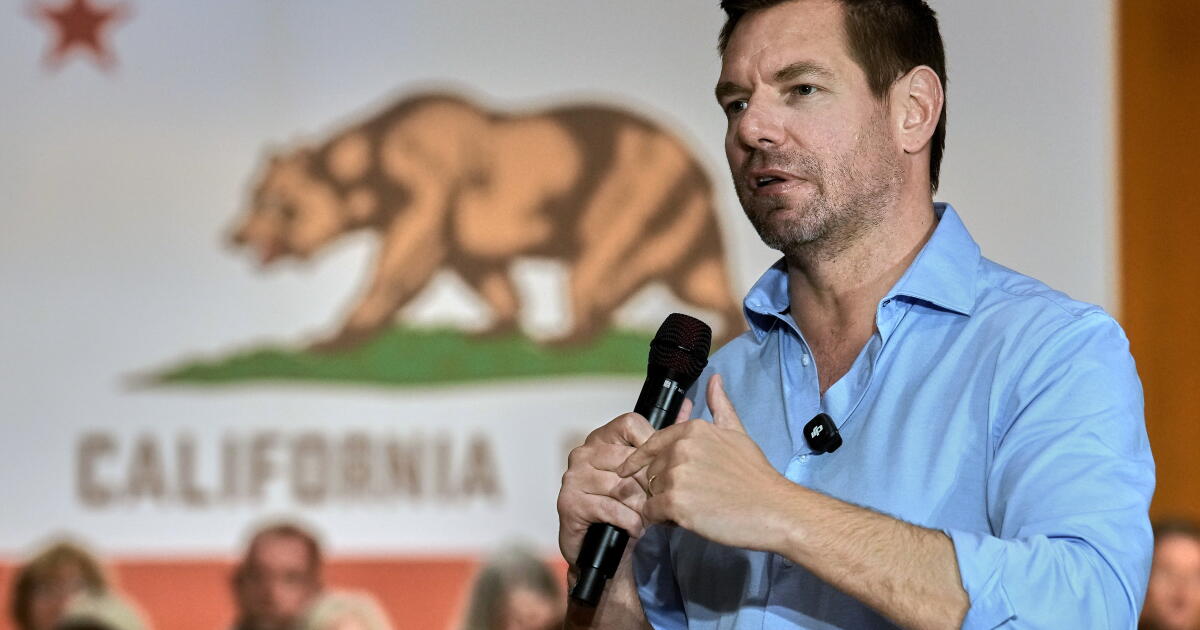
Rep. Eric Swalwell, a leading Democratic candidate for governor of California, has accused President Trump of trying to sway the election following reports that FBI Director Kash Patel may release documents from a decade-old investigation into the congressman’s ties to a suspected Chinese spy.

According to a report by the Washington Post, Patel has directed agents in the bureau’s San Francisco office to redact the case files for public release. According to the outlet, it’s highly unusual for the FBI to release case files tied to a probe that did not result in criminal charges.

The investigation centered on Swalwell’s ties to a suspected intelligence operative, Christine Fang, or Fang Fang, who worked as a volunteer raising money for his congressional campaign. Swalwell cut off ties to Fang in 2015, after intelligence officials briefed him and other members of Congress about Chinese efforts to infiltrate the legislative body.

Swalwell was not accused of impropriety.

The FBI did not immediately respond to a request for comment.

“Through great reporting, we now know the outrageous ends the White House will go to target political opponents,” Swalwell said in a prepared statement Saturday, calling the decade-old story “nonsense.”

“Donald Trump is targeting me. He’s trying to influence the election,” Swalwell said in a post on X. “There is only one reason why: he’s scared.”

Swalwell accused Trump of “desperately trying” to stop him, because he’s now the favored candidate for California governor.

“What Trump wants the most is to have a Western White House. An enabler on the opposite coast,” he said. “A lot of people have bent the knee to this administration. But I will not. And neither will the people of California.”

It’s not the first time Swalwell has accused the administration of targeting Trump’s political opponents.

Last year, Swalwell sued Federal Housing Finance Agency Director Bill Pulte, accusing him of criminally misusing government databases to target Trump’s political opponents. Pulte had accused Swalwell of mortgage fraud and referred him to the Justice Department for a potential federal criminal probe. Swalwell dropped that suit this month.

Swalwell, a former prosecutor who ran for president in 2020, announced his bid for California governor in November. Swalwell said his decision was driven by the serious problems facing California and the threats posed to the state and nation with Trump in the White House.

U.S. Sen. Adam Schiff (D-Calif.), who has endorsed Swalwell for governor, shared the Post story on X Saturday, saying, “This abuse of the FBI is as dangerous as it is unlawful.” Schiff served with Swalwell on the House Intelligence Committee, where they riled Republicans by investigating President Trump during his first term.

Schiff served as the lead manager of Trump’s first impeachment and Swalwell as a manager of Trump’s second impeachment.

“Time and again, the President and his appointees have weaponized the Department of Justice against those who dare stand up to Trump,” Schiff wrote. He added that there was no doubt that Trump and Patel “will stop at nothing to try to tell Californians who their next governor should be.”

The Post story unleashed a flood of critiques from California politicians, including Rep. Jimmy Gomez (D-Los Angeles), who sits on the House Intelligence Committee. On X, Gomez accused Patel of “wasting resources” on a “closed, decade-old case where Swalwell cooperated with the FBI and was found innocent of any wrongdoing.”

“Reopening it now, right as he leads in the polls and ballots are about to drop, is a political hit-job!” Gomez said. “Trump and Kash Patel are weaponizing the FBI against people they deem political enemies.”

Rep. Jamie Raskin of Maryland, the top Democrat on the House Judiciary Committee, released a statement accusing Patel of working at “the behest of the White House” and “wasting the resources of the FBI and perhaps violating the Hatch Act by ordering agents to spend hours preparing a political smear file for a personnel vendetta.”

According to the Associated Press, Fang came into contact with Swalwell’s campaign as he was first running for Congress in 2012. She also participated in fundraising for his 2014 campaign and helped place an intern in his office, the report said. Federal investigators alerted Swalwell to their concerns — and briefed Congress — about Fang in 2015, at which point the California Democrat says he cut off contact with her, the AP reported in 2021.

In 2023, the House Ethics Committee closed a two-year investigation into the allegations of his ties to Fang.

In closing the probe, the ethics committee wrote in a letter to Swalwell that it had “previously reviewed allegations of improper influence by foreign agents and in doing so, cautioned that Members should be conscious of the possibility that foreign governments may attempt to secure improper influence through gifts and other interactions.”

Times staff writer Kevin Rector contributed to this report.

Source link

Rep. Swalwell, candidate for California governor, has an AI side gig

During the Los Angeles writers’ strike in 2023, Democratic Rep. Eric Swalwell wanted to reach out to his donors in Hollywood and ask what he could do to help them. But he didn’t have an easy way to find the screenwriters who backed his many campaigns.

So Swalwell and his congressional chief of staff launched an AI technology company that sifts and analyzes campaign fundraising data.

The company has since been used by dozens of political campaigns, including by Sen. Adam Schiff (D-Calif.) and Rep. Jimmy Gomez (D-Los Angeles). Even Swalwell’s current campaign for California governor hired the artificial intelligence company, called Findraiser.

But some details of Swalwell’s private venture remain unclear, including the company’s investors.

Craig Holman, a governmental ethics expert with the nonprofit consumer advocacy organization Public Citizen, said it’s common and legal for candidates to use their own businesses to promote their campaigns or the campaigns of others, as long as all business interactions are charged at market value.

He said Swalwell can talk about his business privately but cannot do so in relation to his role in Congress, to avoid running afoul of ethics rules barring using one’s position for personal monetary gain.

Holman called it “odd and politically unwise” that Swalwell’s business will not publicly disclose all of its investors.

Swalwell, who has represented Northern California in Congress since 2013, is among the top Democrats in the governor’s race, according to a recent poll, but thus far none of the candidates has a breakaway lead.

Findraiser is close to profitability, his onetime chief of staff, current campaign manager and Findraiser CEO Yardena Wolf said in a podcast interview that aired in October.

The company received more than $67,400 from congressional campaigns in the 2025-26 cycle, according to filings with the federal government.

Members of Congress are not barred from owning outside companies or accepting a small outside salary, with exceptions. Swalwell makes no income from the company, according to filings he has made with the state of California, though he could benefit if the company was ever sold.

“Findraiser is a platform like hundreds of other tools in the market that helps Democratic campaigns communicate more efficiently,” a Swalwell spokesperson said. “Congressman Swalwell and the Findraiser team consulted the House Committee on Ethics on the conception and implementation of the tool every step of the way.”

Still, it highlights how mixing public service and private business can raise ethics questions.

Wolf told The Times that none of Findraiser’s investors have business before Congress, but she declined to reveal the names of the backers.

The fair market value of Findraiser is between $100,001 and $1 million, according to campaign finance documents filed with the state this month.

Swalwell stated on the documents that he is a part owner. Besides the Congress member and Wolf, the other member of the company listed with the state is Paul Mandell, who runs an event business.

The company’s website boasts that it provides a “straightforward AI-powered chatbot that supercharges your fundraising database searches. This first-of-its-kind tool sits on top of your political fundraising database, allowing you to ask simple, intuitive questions and receive the results you need instantly.”

The website also contains testimonials, including from former Democratic National Committee Chair Jaime Harrison, who says Findraiser provides the AI technology that makes it “easier than ever for campaigns to connect with the right donors and raise what they need to win.”

The amount of money campaigns are paying to use Findraiser is nominal, federal campaign finance records show. During the 2025-26 cycle, Swalwell’s campaign for Congress reported paying Findraiser $6,630. His campaign for governor paid the company $975.

Wolf, in an interview with The Times, declined to provide details about the company’s staff or how much it charges customers.

In her interview with the political podcast “The Great Battlefield,” she recounted that the writers’ strike was the impetus for Findraiser and said Swalwell came up with the name.

She conceded that it is “pretty unusual” for a member of Congress to start a company with his chief of staff. She also said there was “a lot of ethics back and forth — of lawyers and all of that, to make sure that we were aboveboard and that everything is kosher.”

Among other things, Findraiser has helped Swalwell’s campaigns pull in more money, she said. For example, the campaign could identify donors who gave small amounts to Swalwell but larger checks to other politicians, Wolf said.

“We’ve been able to set up meetings with people like that, and they’ve increased their contributions.”

Aside from Wolf, one other staff member who works for both Swalwell’s campaign and his government office is also being paid via a contract to do digital work for Findraiser, Wolf confirmed.

Michael Beckel, director of money in politics reform at Issue One, a bipartisan advocacy group, said that although there is no prohibition on a member of Congress hiring his own company, voters may perceive an issue.

“Voters may see self-dealing as evidence that a candidate is prioritizing personal enrichment over public service, which damages confidence in elections and governmental institutions,” he said.

“If donors give money knowing it will personally benefit the candidate, that undermines the integrity of the political system.”

Swalwell’s campaign declined to respond to Beckel’s statements.

Wolf in her podcast interview last year said the business was “going really well.”

“We have PACs that use it. We have first-time candidates, as well as 20-year incumbents who are using it. We have congressional races and Senate races,” Wolf said.

Around 2024, the company began offering beta testing, she said.

“Obviously, both Eric’s and my network are people who are in the political space and just in our day to day, as we were talking to people, we had people say, ‘Well, I want to use it,’” Wolf said. “And so we had a group of people who ended up beta testing.”

A spokesperson for Swalwell’s campaign said that “Findraiser spread through word of mouth among campaigns across the country. Any decision by a campaign or candidate to utilize the tool is based on their choice and their organization’s strategic prioritization.”

The Times contacted 16 congressional campaigns that reported using Findraiser in recent federal filings. None would tell The Times how they came to hire the company.

Both Schiff and Gomez have endorsed Swalwell in his campaign for governor.

Schiff’s paid about $2,000 for two months of Findraiser services last year. However, Wolf, in her podcast interview, said Findraiser works with Schiff “a lot.”

Ian Mariani, a spokesperson for Schiff’s campaign, said the company “is one of many campaign vendors used by our team, and it helped us engage with several people.”

Source link

Anxiety grows among California Democrats as gubernatorial candidates rebuff calls to drop out

Despite a plea from the head of the California Democratic Party for underperforming candidates to drop out of the governor’s race, all but one of the party’s top hopefuls spurned the request.

Party leaders fear the growing possibility that the crowded field will split the Democratic electorate in the state’s June top-two primary election and result in two Republicans advancing to the November ballot, ensuring a Republican governor being elected for the first time since 2006.

His advice largely unheeded, state party Chairman Rusty Hicks on Thursday said the fate of a Democratic victory now rests squarely on the gubernatorial candidates who flouted him.

“The candidates for Governor now have a chance to showcase a viable path to win,” Hicks said in a statement Thursday.

Eight top Democratic candidates filed the official paperwork to appear on the June ballot after Hicks released a letter on Tuesday urging those “who cannot show meaningful progress towards winning” to drop out. Friday is the deadline to file to appear on the primary election ballot. On March 21, the secretary of state’s office will formally announce who will appear on the June ballot.

“It sounded like someone who has his head in the sand,” former Los Angeles Mayor Antonio Villaraigosa said of Hicks’ open letter. “[Most] of us filed within 24 hours of getting that letter. It created some press but not much else. It didn’t impact [most] of the candidates and it certainly didn’t impact my candidacy.”

Democratic strategist Elizabeth Ashford said it was appropriate for Hicks and other Democratic leaders to make a public plea as opposed to keeping such discussions solely behind closed doors.

But the response showed the limited power of the modern-day party bosses.

“It’s definitely not Tammany Hall,” said Ashford, referring to the storied Democratic political machine that had a grip on New York City politics for nearly a century. “The party and Rusty are influential and they are helpful and that is their role. I don’t think anyone would be comfortable with outright public strong-arming of specific candidates.”

Ashford, who worked for former Govs. Jerry Brown and Arnold Schwarzenegger, along with former Vice President Kamala Harris when she served as state attorney general, added that the minimal power of the state GOP is likely a factor in the dynamics of Democrats’ decision to stay in the race. Democratic registered voters outnumber Republicans by almost a 2-to-1 margin in the state, and Democrats control every statewide elected office and hold supermajorities in both chambers of the California Legislature.

“If there were a strong viable opposition that existed, if the Republican Party was actually relevant in California, I think that would sort of force greater unity amongst Democrats,” she said.

Just one of the nine major Democrats did heed the party chair’s message. Ian Calderon, a former Los Angeles-area Assemblyman who consistently polled near the bottom of the field, withdrew from the race and endorsed Rep. Eric Swalwell (D-Dublin) on Thursday.

Candidates cannot withdraw their name from the ballot once they officially file to run for office, leading to some fears that even if other candidates drop out of the race, a crowded primary ballot could still split California’s liberal votes.

“I’m disappointed most of them will be on the ballot,” said Lorena Gonzalez, the head of the California Federation of Labor Unions, which will announce whether it endorses in the governor’s race on March 16. But “I do still think you can have people drop out of the race or become viable. I think that there are candidates who know viability is a real thing they have to show in coming weeks” before ballots start being mailed to voters.

Jodi Hicks, chief executive and president of Planned Parenthood Affiliates of California, said she is “still worried” about the prospect of two Republicans winning the top two spots in the June primary, shutting Democrats out of any chance of winning the governor’s office in November.

“I didn’t have any specifics of who I wanted to do what,” she said. “I’m just very, very concerned and the stakes are really high right now and seem to be getting worse by the day.”

Republican candidate Steve Hilton, a former Fox News host, said he is “confident that I’ll be in the top two” along with a Democratic candidate. “I find it very difficult to believe that the Democratic Party will just surrender California and allow two Republicans to be in the top two.”

Hilton made the comments Thursday after a gubernatorial forum in Sacramento hosted by the California Assn. of Realtors focused on housing and homeownership. Villaraigosa, former Health and Human Services Secretary Xavier Becerra, San Jose Mayor Matt Mahan and former Rep. Katie Porter also attended. Swalwell, who is currently in Washington, joined the panel virtually.

During the panel, candidates were in broad agreement about the need to reduce barriers and costs in order to build more housing in California, where the median single-family home costs more than $820,000. Many also endorsed proposals to disincentivize private investment firms from buying up homes as well as a $25-billion bond proposed by former Sen. Bob Hertzberg to help first-time homebuyers afford a down payment.

“This really isn’t a debate because we’re agreeing so much with each other,” Hilton said at one point during the event.

That political alignment on one of the most pressing issues facing California may explain why voters are having such a difficult time deciding who to support.

A recent poll of the Public Policy Institute of California found that the five candidates topping the crowded field were within 4 percentage points of one another: Porter, Swalwell, Hilton, Democratic hedge fund founder Tom Steyer and Republican Riverside County Sheriff Chad Bianco. Earlier polls had Hilton and Bianco leading the field, though many voters remained undecided.

Some candidates took issue with Hicks’ push to cull the field, noting that most of the lower-polling candidates he asked to drop out are people of color.

“Our political system is rigged, corrupted by the political elites, the wealthy and well connected,” state Supt. of Public Instruction Tony Thurmond, who is Black and Latino, said in a video posted on social media in response to the open letter. “The California Democratic Party is essentially telling every person of color in the race for Governor to drop out.”

Villaraigosa argued that enough voters remain undecided that it was too early for quality candidates to call it quits.

“Most people don’t even know who’s in the race,” said Villaraigosa. “It’s premature to be thinking about getting out of the race. I certainly am not considering it and I feel no pressure.”

Aside from the opinion polls, other indicators on who may emerge from the pack a candidates are slowly emerging.

Though it wasn’t enough to win the party’s endorsement, Swalwell won support from 24% of delegates at the state Democratic convention last month, the most of any party candidate.

While spending is no guarantee of success, Steyer has donated $47.4 million of his own wealth to his campaign. Mahan, who recently entered the race and is supported by Silicon Valley leaders, has quickly raised millions of dollars, as have two independent expenditures committees backing his bid.

Ashford said part of candidates’ decisions to remain in the race could have been driven by their lengthy political careers, as well as Democrats’ crushing November redistricting victory.

“In several cases, these are people who have won statewide office,” she said. “It’s tough to feel like there may not be a sequel to that.”

Nixon reported from Sacramento and Mehta from Los Angeles.

Source link