LAS VEGAS — Leo Carlsson had a goal and an assist, Lukas Dostal made 27 saves, and the Ducks opened the season by holding off the Vegas Golden Knights 4-3 on Friday night.
The teams met last season in the second round of the playoffs, with Vegas winning in six games and going on to win the Western Conference. The Golden Knights opened Tuesday night at home with a 5-2 victory over Chicago.
Carlson set up Beckett Sennecke’s goal with eight seconds left in the first period, then scored at 7:03 of the second to cap a three-goal burst for a 4-0 lead. Alex Killorn and Jeff Malott also scored.
Shea Theodore, Tomas Hertl and Braeden Bowman scored for Vegas in the third period, with Bowman connecting with 2:50 left. Hertl struck on a power play.
Carter Hart stopped 16 shots for the Golden Knights.
Up next for the Ducks: vs. Florida at Honda Center on Sunday.
WASHINGTON — The Department of Justice filed a complaint Wednesday against federal judges in Minnesota over their remarks to the media related to the Trump administration’s immigration enforcement surge.
The complaint escalates the department’s battle with the federal judiciary, which has halted administration priorities, dismissed high-profile prosecutions and accused government lawyers in some cases of failing to comply with court orders.
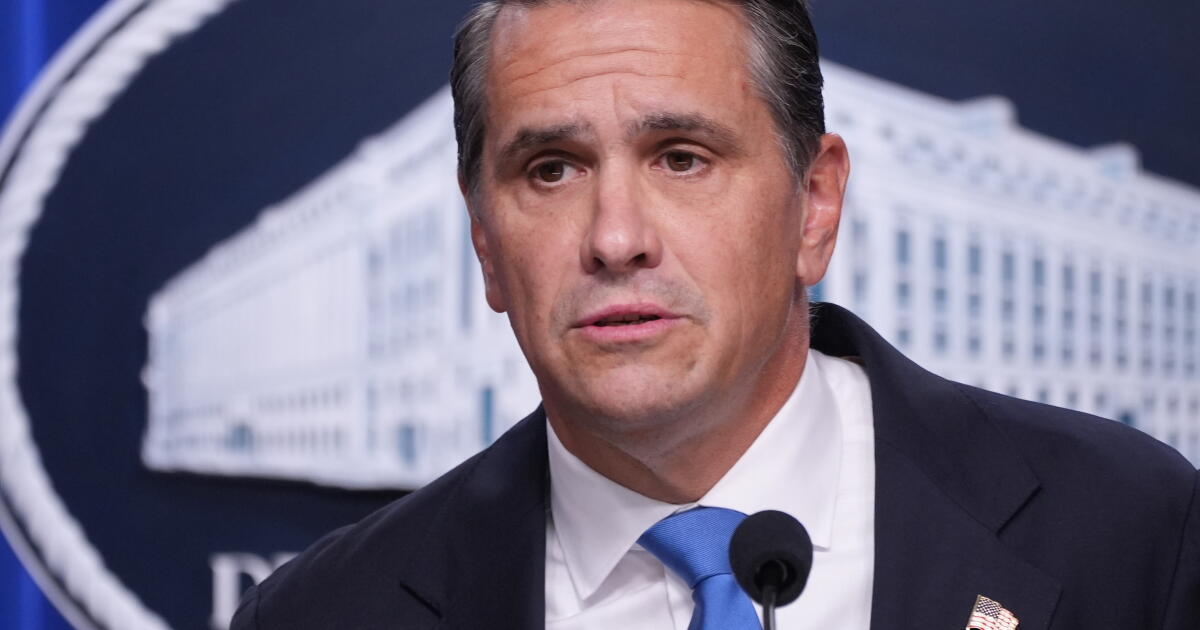
The department is demanding that the judges recuse themselves from all criminal or civil cases involving the Department of Homeland Security, Atty. Gen. Todd Blanche told reporters, because of what he described as “obvious bias they have shown” in recent remarks to the New York Times.
At issue is a September article in which seven federal judges in Minnesota — nominated by Democrats and Republican presidents — spoke on the record about their experience dealing with a flood of cases during last winter’s immigration crackdown that led to thousands of arrests.
The judge at the center of the story, Patrick Schiltz, accused the government in January of failing to comply with nearly 100 court orders. He said in a ruling that U.S. Immigration and Customs Enforcement, a part of Homeland Security, “is not a law unto itself.”
Schiltz, who was nominated by Republican President George W. Bush and served as a law clerk for Supreme Court Justice Antonin Scalia, told the newspaper that what happened in Minnesota’s federal court last winter “created a grave threat to the rule of law.”
In a statement Wednesday, Schiltz said he was “acting well within the ethical rules that apply to federal judges in speaking to The New York Times.”
“Indeed, in February of this year, the Committee on Codes of Conduct issued an advisory opinion to emphasize that federal judges” may speak or write “on core judiciary matters such as advocacy for the rule of law and judicial independence,’” Schiltz said. “That is exactly what I did.”
The complaint was filed with the chief judge of the U.S. 8th Circuit Court of Appeals, which oversees federal judges in Minnesota.
The Republican administration has railed against what it describes as “activist judges” who officials say are intent on thwarting Trump’s agenda. Yet some of the most critical and unfavorable court rulings have come from judges nominated by Trump and other Republican presidents.
Swedish and German forces are conducting what appears to be the first joint rehearsal of their rapid-reinforcement plans for the Baltic island of Gotland. The exercise is another step in Sweden’s defense planning for an island whose position in the middle of the Baltic gives it an outsized strategic importance for controlling access, protecting the Baltic states, and maintaining NATO’s freedom of movement in a region where Russian military activity remains a persistent concern.
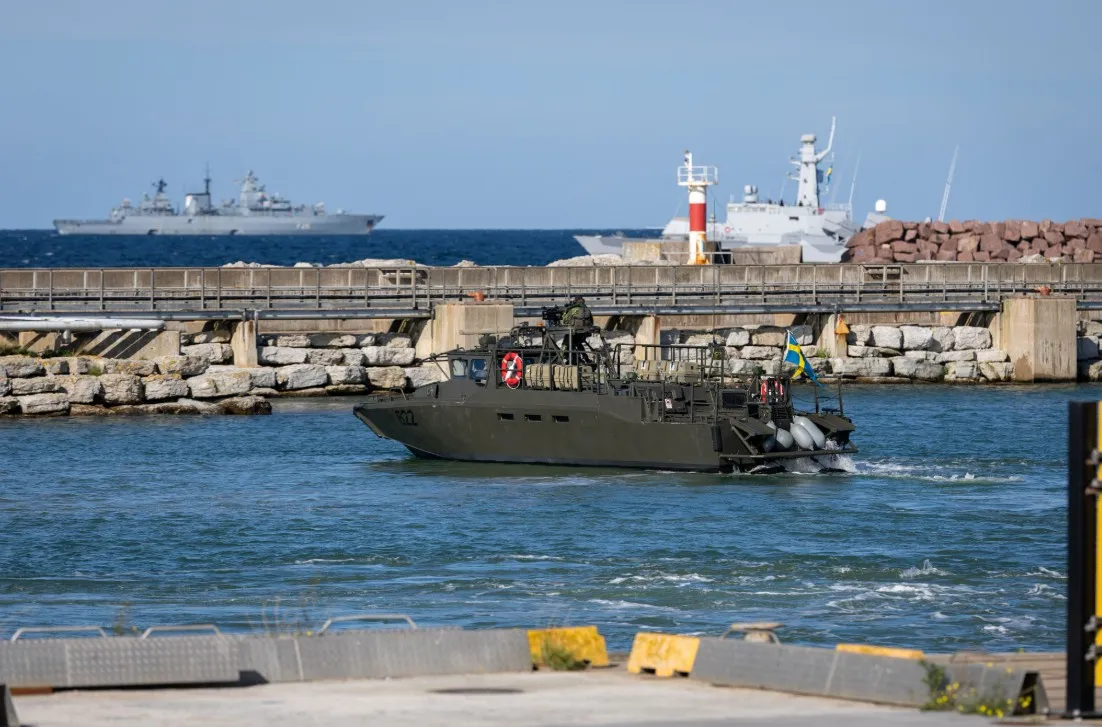
German and Swedish warships stand offshore while a Swedish CB90 fast assault craft operates in the harbor at Visby. Bundeswehr/Marc Tessensohn
The exercise, Silver Wotan 2026, running between September 14-23, brings together Swedish and German forces across the land, maritime, and air domains. The scenario is built around a Swedish request for allied assistance, with German forces moving personnel and equipment across the Baltic before integrating with Swedish units already defending the island. The operation is testing the entire process of getting allied combat power to Gotland, protecting it during the movement to Visby, and rapidly incorporating it into the island’s existing defensive network.
A video shows troops coming ashore on Swedish CB90 fast assault craft, a type that German soldiers are also trained to operate:
A rapid deployment of German and Swedish forces to Gotland island is being carried out today. Units from 🇸🇪 and 🇩🇪 are rehearsing the swift reinforcement of the strategic island in order to ensure the security of the Baltic Sea.#SilverWotan#NATOpic.twitter.com/A0r3LF8XUP
The strategic importance of Gotland has grown considerably following Sweden’s accession to NATO in March 2024, which was a direct response to the full-scale Russian invasion of Ukraine.
Located approximately halfway between mainland Sweden and the Baltic states, the island occupies a central position in the Baltic Sea, close to the maritime approaches to the Gulf of Finland and within reach of the Russian exclave of Kaliningrad. Its location gives forces operating from Gotland a potentially significant position from which to conduct surveillance, air defense, and maritime operations, while also making the island an important part of the wider network connecting NATO’s northern and eastern members.
The location of Gotland within the Baltic region. Google Earth
At the same time, Gotland sits within an extremely complex littoral environment, where shallow waters, islands, narrow maritime approaches, and the proximity of multiple states can make both offensive operations and defensive planning more difficult. The region has also been shaped by longstanding Swedish concerns about Russian clandestine activity, including intelligence gathering and other forms of covert or deniable activity. The complexity of the Baltic operating environment can make such activities harder to detect and attribute, adding another layer of uncertainty alongside the more conventional military challenges facing the region.
The unloading operation in Visby. The vehicles seen here were transported by sea from Karlskrona to the Swedish mainland. Bundeswehr/Marc Tessensohn
Geography has long made Gotland important to Swedish defense planning, but its significance has taken on a broader dimension since Sweden joined the alliance. NATO has described the island as strategically important to its freedom of maneuver in the Baltic, while Swedish officials have highlighted its potential role as a hub for military operations and logistics in the region.
The current exercise is designed around the practical difficulties of reinforcing such a position.
Military equipment is being transported by sea to Visby, Gotland’s principal port, including by commercial ferry. In Visby, Swedish and German personnel are securing the harbor and conducting the reception of the arriving force. Among the equipment being moved are air defense systems, while Swedish forces are also operating coastal defense systems armed with anti-ship missiles.
German Army vehicles roll into Visby during Silver Wotan. Bundeswehr/Marc Tessensohn
Meanwhile, publicly available flight-tracking data showed German Luftwaffe transport aircraft, including at least one Airbus A400M airlifter, apparently involved in the effort. The commercial airport at Visby has long also been used for military activities related to Gotland and the wider Baltic region.
The movement is supported by Swedish and German naval forces and other aircraft, creating a scenario in which the maritime transit, protection of the port, air operations, and subsequent movement of troops and equipment ashore all form part of the same military problem. Once ashore, the arriving forces have to be moved into position and integrated with Swedish units already responsible for defending the island.
The Swedish Gotland Regiment, P 18, provides the core of the island’s permanent military presence. The regiment, Sweden’s youngest and smallest, has been rebuilding its capabilities since Sweden began expanding its military presence on Gotland. Its forces form the basis of the ground-defense structure into which allied reinforcements would be incorporated.
Soldiers of the Gotland Regiment of the Swedish Army camouflage an armoured vehicle during an earlier field exercise near Visby. Photo by Jonathan NACKSTRAND / AFP
Swedish coastal defense capabilities are another important element of the drill. Land-based anti-ship missiles provide the island with a means of threatening hostile surface vessels operating in the surrounding waters, giving the defense of Gotland a direct connection to the wider maritime battle for the Baltic. During Silver Wotan, Swedish and German forces are also conducting anti-surface warfare activities alongside the broader reinforcement operation.
Germany is contributing more than 500 troops to the exercise, part of approximately 2,000 Bundeswehr personnel involved, including elements from the army, navy, and air force. The German Luftwaffe has deployed Panavia Tornado aircraft for surveillance, while German naval forces are participating in the maritime component, and German ground personnel are involved in the reinforcement and security activities on Gotland.
Stock photo of a Luftwaffe Tornado ECR equipped for a reconaissance mission. Bundeswehr
The exercise scenario is particularly relevant against the backdrop of Russia’s continuing military presence in the Baltic region.
Russia maintains major military infrastructure in Kaliningrad, including naval, air, missile, and air defense capabilities, while the Russian Baltic Fleet operates from bases in the region. Kaliningrad’s position between Poland and Lithuania gives Moscow a significant military foothold inside the NATO area, while Russian forces and military infrastructure elsewhere along the Baltic add to the complexity of operating and reinforcing allied territory in the region.
The security environment around the Baltic has also deteriorated considerably since Russia’s full-scale invasion of Ukraine. NATO has increased its surveillance and military activity in the region, including the launch of Baltic Sentry in January 2025 following a series of incidents involving critical undersea infrastructure. The alliance has subsequently expanded efforts to monitor maritime activity and protect infrastructure and sea lines of communication.
A Swedish Navy Helicopter 15 on the flight deck of patrol ship HMS Carlskrona as part of the NATO Baltic Sea patrol mission, Baltic Sentry, aimed to secure critical underwater infrastructure. Photo by Johan NILSSON / TT NEWS AGENCY / AFP
Swedish authorities have stressed that Silver Wotan was planned in advance and is not being conducted in response to a specific imminent Russian threat. The exercise nonetheless reflects the operational environment in which Swedish and NATO planners now have to consider the possibility that maritime and air movements across the Baltic could be monitored, disrupted, or contested.
The exercise also builds on a series of increasingly large Swedish-led activities designed to test the reception of allied forces on Swedish territory. During Aurora 26 earlier this year, more than 18,000 troops from 13 countries participated in operations across Sweden, including the deployment of allied forces to Gotland alongside the Gotland Regiment and Swedish Home Guard. NATO described that activity as an emergency deployment intended to test the reinforcement of the island.
A Dutch AH-64 Apache attack helicopter takes part in Exercise Aurora 26 in southern Sweden on April 29, 2026. Photo by Johan NILSSON / various sources / AFP
Silver Wotan places a more concentrated emphasis on the Swedish-German relationship and on the movement of an allied force into the island’s existing defensive structure.
Germany’s participation is also consistent with its growing military role in the Baltic and along NATO’s northeastern flank. Berlin is already providing forces for NATO’s forward defense in Lithuania and has increasingly emphasized the ability to move German forces rapidly across northern Europe in support of allied operations.
For Sweden, meanwhile, Gotland has become one of the clearest examples of how NATO membership has changed the country’s defense planning. The island remains a Swedish responsibility, but its location means that what happens there has consequences well beyond Sweden’s territorial defense.
German and Swedish troops on a Swedish CB90 fast assault craft. Bundeswehr/Marc Tessensohn
A defended and adequately supplied Gotland provides NATO with a strategically positioned base for surveillance and defensive operations in the Baltic, while the ability to reinforce it demonstrates that the alliance can maintain access to the island even as the surrounding maritime and air environment becomes more contested.
The exercise comes as European allies are being forced to plan for a NATO in which the United States may provide less of the conventional military weight it has supplied for decades. The Pentagon is reviewing the size and posture of U.S. forces in Europe, including the forces and capabilities Washington would make available in a European crisis, while NATO’s top commander has said further U.S. troop withdrawals should be expected as European allies build up their own conventional capabilities.
A German and a Swedish soldier involved in securing Visby during Silver Wotan 2026. Bundeswehr/Marc Tessensohn
At the same time, the alliance now describes Russia as its most significant and direct security threat, citing military activity alongside airspace violations, sabotage, cyber operations, and other forms of hybrid pressure. There are also growing concerns that Russia could try something in the Baltics, while it continues to step up its gray-zone activities regardless. NATO officials have warned that Russia could rebuild enough military capacity to pose a more serious conventional challenge to the alliance before the end of the decade.
There are escalating warnings from Poland that Russia is preparing to widen its war against Ukraine, with “accidental” missile and drone strikes on NATO territory.
Such a move – Russia falsely claiming air strikes that hit NATO allies happened by accident – would be designed to…
For Sweden and Germany, the Silver Wotan exercise is a practical test of how quickly European forces can reinforce and defend one of the Baltic’s most strategically important positions. As the security environment grows more contested and Europe prepares for a future in which U.S. forces may not be as readily available, the ability to move allied combat power across the region and integrate it into existing defenses is becoming an increasingly important part of NATO’s deterrence.
Oil prices are rising to nearly a six-week high amid a wave of strikes between the United States and Iran in the Strait of Hormuz, through which roughly a fifth of the world’s oil supply travels during peacetime.
On Monday, Brent oil futures, the global benchmark, rose to hover around $97 a barrel — up 9 percent over the last five days and 19 percent over the last month. Monday’s market moves are approaching the highest point since July 24th, when prices topped $97.93.
Recommended Stories
list of 4 itemsend of list
US West Texas Intermediate crude similarly rose to $92.27 a barrel, up 79 cents, also a near six-week high.
In recent days, strikes escalated in the Strait of Hormuz. The US hit three Iranian oil tankers on Saturday, while Iran’s Islamic Revolutionary Guard Corps (IRGC) said it had struck three tankers and three US-linked vessels in other areas.
“This is a reflection of continued conflict and exchange of fire. The supply deficits globally are persisting, and there is little end to these shortages,” Rachel Ziemba, an adjunct senior fellow at the Center for a New American Security (CNAS), told Al Jazeera.
On Monday, Saudi Aramco’s Jizan facilities were struck for the second time in the last month, according to reporting from the Financial Times that cited two people familiar with the matter.
“The fact that a Saudi refinery in Jizan was hit, possibly delaying its return to production, didn’t help,” Ziemba added.
Amid increased strikes, there’s less traffic in the Strait of Hormuz, with an average of 10 commodity ships crossing the vital chokepoint each day over the last 10 days, according to Kpler, a data analytics platform.
“Crude went back down to what the pre-war level was in early July. Then it increased again, and then it reduced again, and now it’s increasing again on this weekend’s exchange plus the Aramco attack,” Arif Gasilov, a partner at the Gasilov Group, an energy advisory firm, told Al Jazeera.
“I would say that you might eventually see an inflection point, depending on how long this keeps going on, where a ceasefire doesn’t move the market at all, maybe by just a dollar or two.”
US consumers pinched
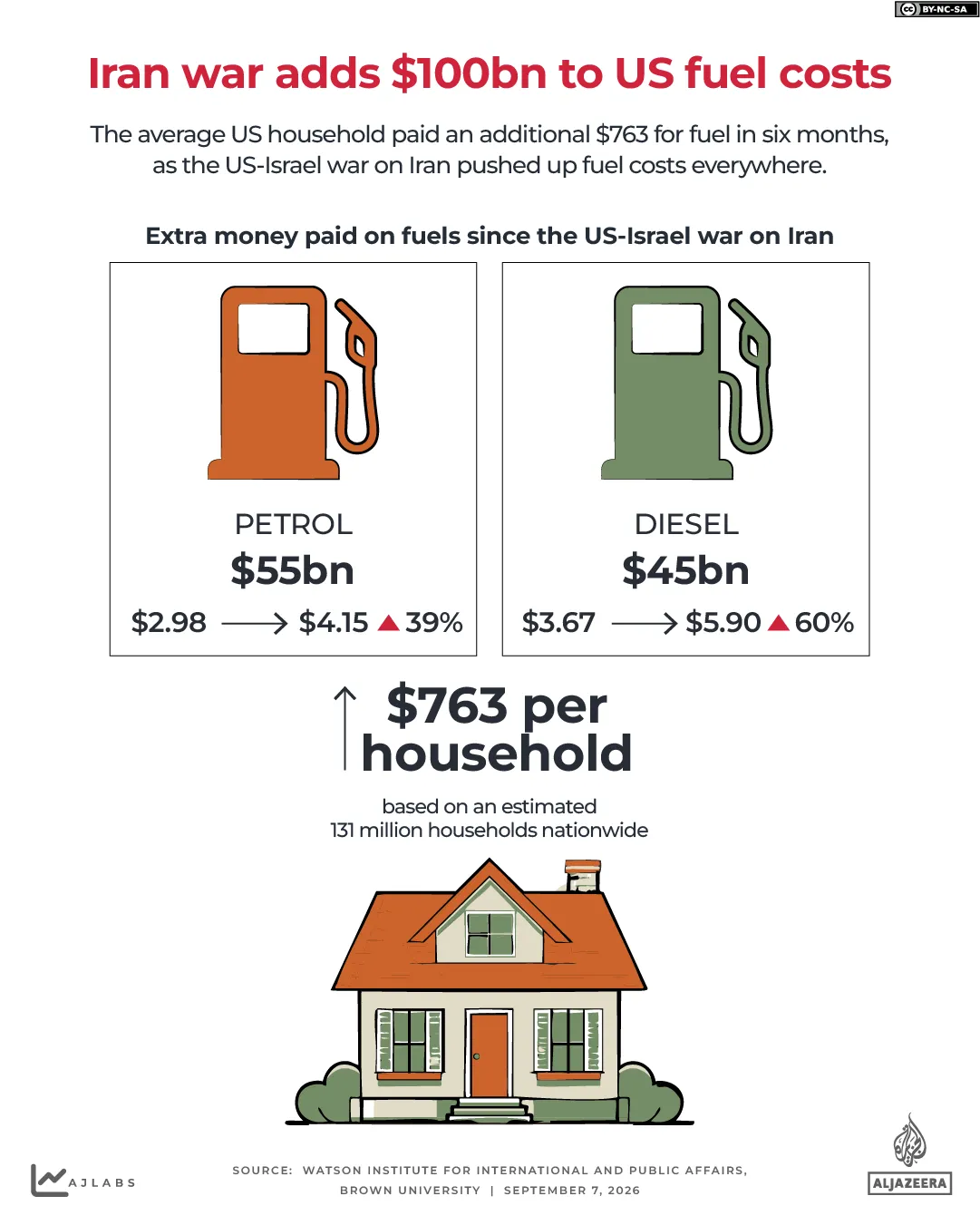
US consumers are feeling the impact of heightened oil prices at the petrol pump. The average price for a gallon (3.78 litres) of petrol has jumped 7 cents over the course of a week, reaching $4.15 nationally on Monday, up from $4.08 this time a week ago, according to the American Automobile Association (AAA), which tracks daily petrol prices.
That’s up from $4.04 this time a month ago and $2.98 from February 28th, when the US and Israel first struck Iran, marking a 39 percent increase since the war began.
“US diesel prices have never been this high, and now the countdown starts for the trickle-down to everything consumers buy… record diesel will start funnelling down into the economy,” Patrick De Haan, head of petroleum analysis at GasBuddy, said in a post on the social media platform X.
Prices have continued to climb since, with average prices on Monday topping $5.90 per gallon.
“Markets are pricing in longer disruptions. It continues to be in product markets where the biggest disruptions lie, though, including diesel,” Ziemba added.
Those price gains are weighing on Americans, who have spent an average of $764.59 per household on fuel since the war began. That’s $418.82 more than usual, according to Brown University’s Watson School of International and Public Affairs.
Ahead of the US’s September 5-7 Labor Day weekend, the unofficial end of summer and a popular time for US travel, AAA forecasts showed a 20 percent increase in flight costs compared to the same weekend last year.
Ahead of the midterm elections, the economy is emerging as a key issue for US voters — and a potential warning sign for Republicans. Polls show voters souring on President Donald Trump’s handling of the economy, with his economic approval rating falling to a new low in a recent Financial Times poll. Just 17 percent of Americans approve of his handling of the economy.
An Economist/YouGov poll similarly found that 39 percent of Americans believe Democrats are doing a better job handling the economy, compared with 32 percent who said Republicans are.
China pressures
Southeast and East Asian markets rely more heavily on imports travelling through the Strait of Hormuz directly than the US, but Beijing has moved to insulate itself from the disruption by turning to domestic sources, including its strategic petroleum reserve (SPR).
“China has been managing this situation successfully since the beginning of the war. We know that China has many domestic resources, despite rising oil prices,” John Gong, an economics professor at the University of International Business and Economics, told Al Jazeera.
“China has been conserving its oil and gas consumption for quite some time now. China was prepared for these challenges,” Gong said.
He also stressed that China’s close relations with Russia give Beijing another source of supply, with Moscow able to provide nearly half of China’s daily oil needs.
China has also begun tapping into its SPR while reducing its reliance on imports, as Beijing accelerates a broader shift towards alternative energy sources and vehicles that require little or no oil to operate.
“We have national strategies focused on transitioning to clean energies like solar and green power,” Gong said. “When we look at the vehicles purchased in China, more than 50 percent of cars sold on the Chinese market are electric.”
RIYADH: Companies listed across the Gulf Cooperation Council posted a record $74.8 billion in net profits in the second quarter of 2026, up 31.3 percent year on year, driven by gains in the energy and banking sectors, according to an analysis.
In its latest report, Kamco Invest said the rise in net profit also reflected higher average crude oil prices amid the regional geopolitical situation, which more than offset a decline in crude oil exports from the region.
Compared with the previous three months, net profit of listed companies in the GCC region increased 10 percent.
The strong figures underscore the resilience of GCC corporates even as geopolitical tensions and regional disruptions continue to weigh on investor sentiment. The gains also highlight the continued importance of energy to Gulf corporate earnings, even as governments pursue economic diversification and non-oil sectors expand.
In its report, Kamco stated: “At the country level, the increase in profits mainly reflected double-digit y-o-y growth in profits for Kuwait, Saudi Arabia, Abu Dhabi and Oman and 4.9 percent growth in profits for companies listed on Dubai Exchange.
It added: “On the other hand, Qatari and Bahraini companies reported decline in quarterly profits by 20 percent and 0.4 percent, respectively.”
Industry observer Tony Hallside, CEO of STP Partners, said the record $74.8 billion profit figure reflected strength beyond the headline number. “Higher oil prices clearly provided a major tailwind, with energy-sector profits rising more than 40 percent, but earnings growth across several other sectors shows that corporate activity remains resilient.”
He added: “For investors, that breadth is arguably more important than the record number itself.”
Aggregate revenues for GCC-listed companies rose 17 percent year on year to $381.6 billion in the second quarter and 8.1 percent quarter on quarter.
Excluding Saudi Aramco, revenue growth for the rest of the region remained in double digits at 11.4 percent.
Saudi Arabia leads growth
Saudi-listed companies accounted for the bulk of the gain in the region, with aggregate net profits rising 36.7 percent to $45.3 billion from $33.2 billion a year earlier.
Energy, banking and materials together made up 92 percent of Saudi earnings in the quarter.
Saudi Aramco’s net profit increased 42 percent year on year to $32.4 billion, supported by a 19 percent rise in total revenue as realized crude prices climbed from $66.7 a barrel in the second quarter of 2025 to $108.1 a barrel in the second quarter of this year.
Saudi Arabia’s banking sector net profits increased 8.3 percent to $6.6 billion from $6.1 billion, supported by strong lending growth and resilient operating income.
Al Rajhi Bank reported $1.9 billion net profit, up from $1.6 billion, driven by a 13.7 percent increase in net income from financing and investments and a 13.3 percent rise in total operating income.
Saudi National Bank recorded a 7.5 percent increase in net profit to $1.8 billion, mainly supported by a 1.6 percent rise in income from financing and investments.
“Saudi Arabia remains the earnings engine of the GCC market. Aramco was clearly a major contributor as higher crude prices lifted energy earnings, but the more interesting figure is that Saudi-listed company revenues still grew around 11 percent excluding Aramco,” said Hallside.
He noted that it points to “broader corporate momentum and gives investors more evidence that the opportunity set in Saudi equities is widening beyond the traditional energy story.”
Wider regional outlook
Kuwaiti companies recorded the largest percentage increase, with net profits almost doubling to $3.1 billion, partly reflecting the absence of large losses from discontinued operations that weighed on Agility in the year-earlier quarter.
Abu Dhabi profits rose 41.8 percent year on year to $14.7 billion. Dubai-listed firms grew 4.9 percent to $6.9 billion.
Qatari companies saw profits fall 20 percent to $2.9 billion, while Bahraini firms declined 0.4 percent to $572 million. Omani companies rose 24.2 percent to $1.4 billion.
In the first half of 2026, aggregate net profits for GCC-listed companies rose 23.1 percent, or $26.8 billion, to $142.81 billion. The increase was led by almost 30 percent growth in Abu Dhabi and Saudi Arabia, followed by a 14.6 percent rise in Oman. Kuwaiti and Dubai-listed companies registered high single-digit growth, while Qatar and Bahrain recorded declines of 11.6 percent and 0.2 percent, respectively.
Sectoral outlook
Sector performance was mixed but broadly positive. Energy profits jumped 41.6 percent year on year to $36.2 billion in the second quarter.
Food, beverage and tobacco more than doubled to $3.9 billion. Real estate, materials, capital goods and transportation also posted higher profits.
Banks reached a record $17.8 billion, up from $16.6 billion, with six of seven country aggregates higher. Telecom recorded modest growth. Utilities, food and staples retailing, and media and entertainment declined.
“What stands out is the divergence within the GCC. Kuwait, Saudi Arabia, Abu Dhabi and Oman all delivered double-digit profit growth, while Qatar and Bahrain saw declines. That tells investors this remains a market where country and sector selection matters,” said Hallside.
He noted that banks and telecoms continued to grow, albeit more moderately, while energy, real estate, materials and transportation were stronger. “The GCC cannot be treated as one homogeneous equity market; earnings drivers are becoming increasingly differentiated,” Hallside added.