supreme court

Federal appeals court strikes down ICE’s mandatory detention policy

An Immigration and Customs Enforcement officer walks back to his vehicle after checking the documentation of a construction worker during a random stop in Minneapolis, Minn., on January 9. File Photo by Craig Lassig/UPI | License Photo

Aug. 28 (UPI) — A federal appeals court on Friday ruled against a policy by the U.S. Immigration and Customs Enforcement that greatly expanded detention for migrants living in the country for years.

Under the Trump administration, ICE has changed its policies to treat people with extensive ties to the United States as still “seeking admission.”

That policy shift allows the agency to subject people who have lived in the country for years to mandatory detention without bond.

On Friday, the 3rd U.S. Circuit Court of Appeals struck down the policy, marking the eighth time ICE has been rejected over this same issue in federal appeals court.

In more than 13,000 cases challenging the policy, judges have ruled against ICE more than 90% of the time, Politico reported.

The federal panel said ICE’s policy is incongruent with the law, which is to be applied differently depending on how recently a specific person entered the country.

“Contrary to the Government’s view, the Illegal Immigration Reform and Immigrant Responsibility Act of 1996 (‘IIRIRA’) retained two tracks for detention even though it overhauled the procedures for removing noncitizens from the United States,” the court wrote in its decision.

“Before IIRIRA, noncitizens arriving in the United States were subject to ‘exclusion’ and those already in the country were subject to ‘deportation’ — the former were held in mandatory detention while the latter were afforded bond.”

The appeals court also ruled that ICE’s policy violates the Constitution’s Due Process Clause.

“The Supreme Court has recognized the Fifth Amendment’s ‘Due Process Clause applies to all ‘persons’ within the United States, including aliens, whether their presence here is lawful, unlawful, temporary, or permanent.'”

The court added: “Because Petitioners here have lived in the United States for decades, they have ‘established connections’ in the country and are entitled to due process rights beyond those provided to noncitizens at the border.”

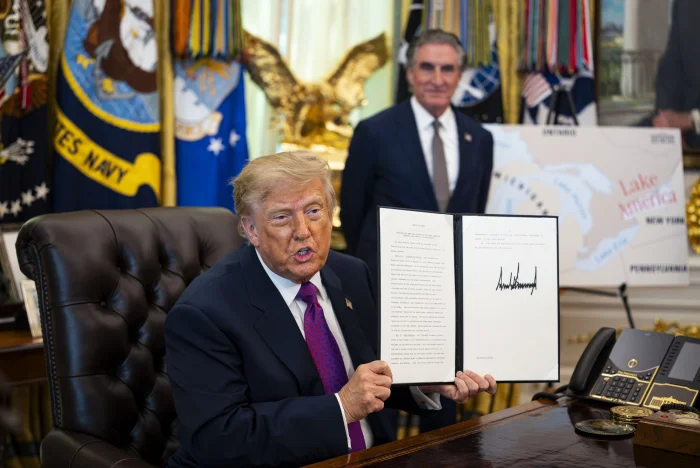
President Donald Trump signs an executive order to rename Lake Ontario as Lake America in the Oval Office of the White House on Thursday. Photo by Al Drago/UPI | License Photo

Source link

Pentagon asks Supreme Court to allow ban on trangender troops

Aug. 28 (UPI) — The Trump administration on Friday asked the Supreme Court to allow the Pentagon to ban transgender individuals from serving in the military.

A federal appeals court ruled in June that the military’s attempts to remove transgender Americans was “both arbitrary and based upon animus.”

On Friday, Solicitor General John D. Sauer appealed to the country’s top court to reverse the ruling.

“The court asserted that the policy likely denies equal protection because it reflects invidious discrimination against trans-identifying people,” Sauer wrote in his petition. “That gravely erroneous holding warrants this Court’s review.”

“The authority of the U.S. military to determine who may serve in the Nation’s armed forces is a matter of exceptional importance,” he added. “Whether the Constitution prohibits the military from exercising that authority by adopting a policy like the one here is a recurring issue, which has arisen before and will likely arise again absent this Court’s review.”

President Donald Trump has targeted transgender service members since the first days of his second administration.

He signed an executive order saying transgender troops’ health needs are “inconsistent” with service in the military.

The National Center for LGBTQ Rights and GLAD Law sued in February, and the federal appeals court in the District of Columbia agreed with the plaintiffs.

Judge Robert Wilkins said the ban on transgender service members “appears driven by the bare desire to harm a politically unpopular group.”

“We are confident the Supreme Court will affirm that the Trump administration cannot base policies on hostility toward a group of people,” said Jennifer Levi, GLAD Law senior director of transgender and queer rights, in a statement.

“As the Trump administration’s own attorneys admitted, these are qualified individuals who are meeting all military standards,” Levi added. “There is no reason to waste millions of taxpayer dollars to kick out thousands of highly trained, skilled, and decorated troops based on nothing but hostility and this administration’s political whims.”

The Supreme Court is on summer recess and will return on Oct. 5.

President Donald Trump signs an executive order to rename Lake Ontario as Lake America in the Oval Office of the White House on Thursday. Photo by Al Drago/UPI | License Photo

Source link

President Trump loses again in bid to erase his hush money conviction

A federal judge on Friday once again spurned President Trump’s effort to erase his hush money conviction, rejecting the president’s bid to move the state court case to federal court and have it dismissed on presidential immunity grounds.

Judge Alvin K. Hellerstein reiterated his earlier finding against Trump, saying that the reasons Trump cited for renewing his request were “neither new nor legally sufficient.”

The judge added: “He has failed to show good cause and diligence.”

It is the third time Hellerstein has blocked Trump from having the U.S. District Court in Manhattan seize control of the case from the New York court where he was tried and convicted.

And, like before, Trump will appeal, according to a spokesperson for his legal team who called Hellerstein’s ruling “baseless and lawless.”

“The Supreme Court’s historic decision on Immunity, the Federal and New York State Constitutions, and other established legal precedent mandate that the Witch Hunt perpetrated by the Manhattan DA be removed to federal court, and immediately overturned and dismissed,” a statement issued on behalf of the legal team said. “President Trump will be filing a powerful appeal, and will continue defeating Democrat weaponization at every turn.”

The guilty verdict, reached in May 2024 while Trump was between terms, made him the first former — and now current — U.S. president to be convicted of a crime. Trump is also challenging his conviction through the state court appellate process, which is pending.

Hellerstein’s decision came after a federal appeals court last year ordered him to reconsider his prior denial. The judge previewed his ruling during oral arguments in February, slamming Trump’s lawyers for legal maneuvers that amounted to taking “two bites at the apple.”

State prosecutors did not immediately respond to a request for comment.

The case centered on a payment to Stormy Daniels

Trump was convicted in May 2024 of 34 felony counts of falsifying business records to conceal a $130,000 hush money payment to adult film actor Stormy Daniels, whose claim of a sexual encounter with Trump a decade earlier had threatened to upend his 2016 presidential campaign.

Trump was sentenced to an unconditional discharge, which left his conviction intact but spared him any punishment. He had long denied Daniels’ claim and said he did nothing wrong. He has sought to get the conviction overturned both by attempting to move the case to federal court and through the appeals process in state court, which is pending.

Hellerstein rejected Trump’s requests to move the case twice before. The first was after Trump’s March 2023 indictment. The second was after Trump’s trial, as his lawyers sought to nix his conviction in the wake of the Supreme Court’s July 2024 ruling that presidents and ex-presidents can’t be prosecuted for official acts and prosecutors can’t use official acts as evidence that unofficial actions were illegal.

Trump appealed Hellerstein’s post-trial ruling and, last November, the U.S. 2nd Circuit Court of Appeals ordered the judge to reconsider his decision, finding that he had failed to consider “important issues relevant” to the president’s request to move the case.

A three-judge appellate panel said it expressed no view on how he should rule but instructed Hellerstein to closely review evidence that Trump claimed was related to official acts and whether Trump could argue those actions were taken as part of his White House duties.

The judges also instructed Hellerstein to determine if Trump had “diligently sought” to have the case moved to federal court and whether the case can even be moved to federal court now that Trump has been convicted and sentenced in state court.

During oral arguments in February, Hellerstein took issue with the Trump legal team’s decision-making after the Supreme Court ruling.

Instead of immediately seeking to move the case to federal court, he noted, Trump’s lawyers first asked the trial judge in state court, Juan Merchan, to throw out the verdict on immunity grounds. Normally, such a request must be made within 30 days of an arraignment, but a federal appeals court in Washington, D.C. has ruled that exceptions can be made if “good cause” is shown.

Trump, a Republican, did not attend the arguments.

Trump lawyer Jeffrey Wall argued that prosecutors rushed to trial instead of waiting for the Supreme Court’s presidential immunity decision and that Trump’s legal team was crunched for time after the high court’s ruling because his sentencing was scheduled for just 10 days later.

Trump’s lawyers did not ask Hellerstein to intervene until nearly two months later, while their request to Merchan was still pending. The judge called that a “strategic decision” and suggested that by going to the state court first, Trump’s lawyers cost him the right to pursue remedies in federal court.

“No, your honor,” Wall replied. “It is what any sensible litigant would do” in that situation.

“Not so,” Hellerstein replied.

“That is a decision on your part,” the judge added. “You didn’t have to do that. You could have come right to the federal court. Just by filing a notice of removal, there would be no sentencing.”

Trump’s lawyers “made a choice,” Hellerstein said, “and you sought two bites at the apple.”

In his written ruling Friday, Hellerstein said Trump was asking for a “‘second bite at the apple,’ a result the law disfavors.”

The judge added that “Trump’s delay in filing for removal constitutes a ‘quintessential strategic decision,’ and the ‘fact that he later came to view that decision as a poor one is not sufficient, by itself, to establish cause.’”

Sisak and Neumeister write for the Associated Press.
Source link

Trump names new head of agency overseeing ballroom construction

Aug. 27 (UPI) — U.S. President Donald Trump on Thursday named a new head of the agency that oversees his ballroom project at the White House and a proposed national arch in Washington, D.C.

Mark Paoletta, the general counsel of the White House Office of Management and Budget, will take charge of the National Capital Planning Commission. He will replace Mark Scharf, who is set to become White House counsel on Monday.

“President Trump has transformed D.C. into a capital worthy of the greatest nation in history,” Mr. Paoletta said in a statement to the news agencies. “I look forward to working with my new colleagues to further the president’s historic restoration and beautification of the National Capital Region, especially in the 250th year of our country’s independence.”

The NCPC is the federal government’s planning agency for projects in and around the capital city. According to its website, it “provides overall planning guidance for federal land and buildings in the region.”

In April, the 12-member panel approved the construction of the ballroom where the East Wing of the White House once stood.

Supreme Court Justice John Roberts last week temporarily blocked a ruling by a lower court stopping the project in a lawsuit filed by the National Trust for Historic Preservation.

In addition to his post at the OMB, Paoletta has been the acting chief of the Consumer Finance Protection Bureau since the start of August. Brian Johnson has been nominated to fill the role at the CFPB permanently.

Paoletta had represented Ginny Thomas, the wife of Supreme Court Justice Clarence Thomas, during the House Select committee’s investigation of the Jan. 6, 2021 attack on the U.S. Capitol.

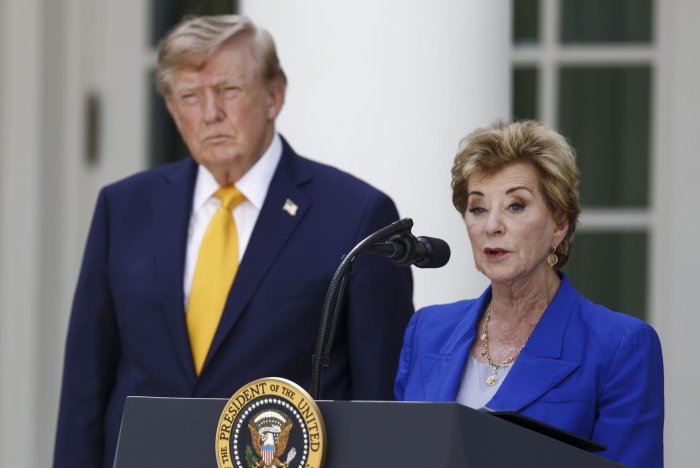
President Donald Trump looks on as Secretary of Education Linda McMahon speaks during a back-to school event in the Rose Garden of the White House on Monday. The event focused on education and the Trump administration’s education policies. Photo by Will Oliver/UPI | License Photo

Source link

Lawmaker outlines plans for Trump inquiry if Democrats win Congress

Where, Robert Garcia must consider, does one begin?

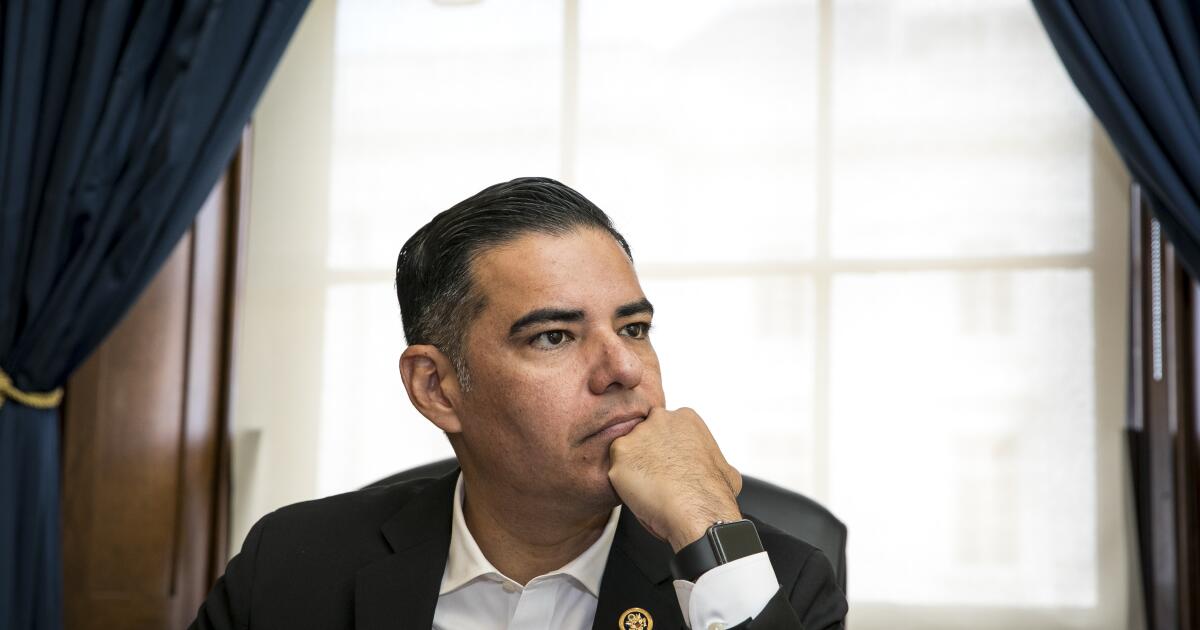
Garcia is a two-term Democratic congressman from Long Beach. He’s the ranking member of the House Oversight Committee, which makes him the top Democrat on the panel charged with patrolling and policing operations of the federal government — a role congressional Republicans have conspicuously abdicated. If, as seems likely, his party wins control of the House in November, Garcia is poised to take over as chairman.

After two years of reckless abandon, the most obvious target for some badly needed congressional oversight is the crooked occupant of the White House. Like a shoreline strewn with seashells or a meadow bursting with mushrooms, President Trump’s brazen corruption and naked self-dealing offer a field that is ripe for the plucking.

So, given the gavel, where to start?

“First we have to ensure that people understand that this president and the administration, what they’re doing, is unprecedented and the most corrupt administration we’ve ever seen,” Garcia said.

To wit: In just his first year back in the Oval Office, Trump reported earning at least $2.2 billion, which is 5,500 times the president’s $400,000 annual salary. (No wonder he gives away his paycheck.) But it’s not just Trump who’s raking it in hand over fist.

“You have Jared Kushner getting billions from the Saudis and other foreign governments,” Garcia said. “You have [Trump’s sons] doing real estate deals across the country, being on boards that are getting contracts from the federal government. You have the selling of pardons. I mean, the list goes on…. It is just like an endless amount of corruption.”

You’re reading the L.A. Times Politics newsletter

George Skelton and other analysts cover the insights, legislation, players and politics you need to know. In your inbox Monday and Thursday mornings.

Before he digs in, however, Garcia has to win reelection in November.

A vote, then a reckoning?

His reconfigured congressional district, which straddles Los Angeles and Orange counties, is somewhat less friendly than it used to be. As part of a redrawing under Proposition 50, the 2025 measure California voters passed to boost Democratic membership in the House, the lines were extended south, to take in the Trump-friendly territory of Huntington Beach and Newport Beach. (The remap gave away a chunk of Garcia’s Democratic voters to bolster other districts.)

Still, the odds are strongly in his favor — especially in a midterm election serving as a referendum on the deeply unpopular incumbent.

Though his district leans left even after modification, Garcia said his pursuit of Trump isn’t some ideological bender. The president’s malfeasance is something constituents raise often, he said. “It’s corruption and it is affordability,” Garcia said this week from his district office in Long Beach. “Those are the two issues I hear constantly about. It’s just nonstop.”

Apart from Trump and his family, Garcia has a long list of administration officials he’d like to hold to account, and an even longer list of questions he’d like answered.

Why, for instance, are “JD Vance and Susie Wiles and Kash Patel having secret meetings in the Situation Room about the Epstein files?” Garcia asked, name-checking, respectively, the vice president, White House chief of staff and FBI director. “Why is [White House Deputy Chief of Staff] Stephen Miller out there essentially creating this huge … loss-of-due-process crisis in this country as it relates to what he’s doing with” Immigration and Customs Enforcement and the Department of Homeland Security?

Also, Garcia said, he wonders what businesses have gotten in return for their generous giving to this most avaricious of administrations.

“If you are cutting secret deals with the Trumps, if you are helping to set up these these crypto schemes, if you are paying for this ballroom that no one knows about and you are gaining some sort of favor from the presidency,” he said, “we need to understand exactly what’s going on.”

Of course, any attempt to investigate and prosecute wrongdoing is sure to run into stonewalling from an obstructionist White House. The “Justice” Department, which has been thoroughly tainted and co-opted by Trump, won’t be any help either.

For that reason, Garcia said, “not only does there have to be efforts made by the Congress and the House … we also have to partner with our state partners and attorneys general and governors and outside organizations…. I think the state court process is going to also be really important for us.”

Impeachment in abeyance

Impeachment, which has a visceral appeal to certain of those deeply aggrieved by this lawless president, is not a first resort, Garcia said. Nor, he suggested, is it necessarily the second or third resort.

“Trump commits an impeachable offense every week,” Garcia said, exaggerating somewhat. But, as he noted, Trump was impeached twice in his first term and still won reelection in 2024. (Throw in a conviction on 34 felony counts and you can see the futility of trying to shame Trump into submission.)

“I don’t think you ever take anything off the table, and that includes impeachment,” Garcia said. “But that’s not our focus on Day One…. It’s time for [Democrats] to work on actually passing a forward-looking agenda and making sure that we are taking on this family and these dealings that are clearly the most threatening we’ve ever seen. To me, that has to be the immediate priority in front of us.”

Garcia and fellow Democrats are mindful of what’s driving unhappy voters who face a vexing mix of inflation and weak economic growth. Affordability is, for good reason, the central issue this election season.

But accountability matters, too. Indeed, in Trump’s debauched Washington, it’s long overdue.

That’s something else voters should consider in November.

What else you should be reading

The must-read: Supreme Court for now allows Trump to plan new mail ballot rules. California to sue again
The deep dive: Will Trump interfere in the midterms? Democrats and their allies are preparing
The L.A. Times Special: Two good ideas from Republicans dead on arrival in Democratic Legislature

Until next time,
mzb

Was this newsletter forwarded to you? Sign up here to get it in your inbox.

Source link

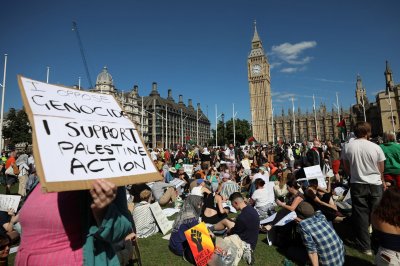
Trump administration names Palestine Action a global terrorist organization

Aug. 26 (UPI) — The U.S. Treasury issued sanctions Wednesday against British-based direct action group Palestine Action and two other organizations it called “violent far-left terrorist networks.”

The treasury declared Palestine Action a “specially designated global terrorist,” meaning that it can freeze the group’s assets, including bank accounts and property. The sanctions also prohibit people from giving funds, goods or services to the organization.

“Far-left extremists, their fronts and their enablers should be on notice: We will bring the full weight of our economic tools to bear,” said Scott Bessent, secretary of the treasury. “Political terrorism has no place in our society, and we will continue to cut the financial lifelines of these groups until they are eliminated.”

In response, Huda Ammori, the co-founder of Palestine Action, said the group’s activities in the United States and other countries “have always been about saving lives by disrupting the Israeli war machine, which is committing a genocide in Gaza with the support of the U.S. government,” The Guardian reported.

“Trump has been at the center of the mass murder of Palestinians, enabling the Zionist regime at every turn,” Ammori said.

Palestine Action was also the first direct action group named under Britain’s Terrorism Act in July 2025. The group is fighting the ban in a legal challenge before the country’s supreme court in November.

“The fact that Trump is now taking inspiration from Britain’s repression of the movement for Palestinian freedom exposes just how dangerous this ban is and should be a wake-up call to anyone who cares about free speech and civil liberties,” Ammori said.

The U.S. Treasury said Palestine Action “has supported numerous acts of terrorism since July 2020, including acts that have physically injured U.K. law enforcement personnel, as well as acts intended to intimidate lawful commercial enterprises and coerce the U.K. government.

“The group’s action include multiple high-profile instances of breaking into defense infrastructure and British military installations and causing millions of dollars’ worth of damage to military equipment,” it said.

In March 2025, Trump’s golf course in Scotland was targeted by Palestine Action supporters who painted graffiti on the clubhouse and damaged the course, spraying “Gaza is not 4 sale.” Trump at the time called those responsible “terrorists.”

Other groups named global terrorist organizations by the United States include Hamas, al-Qaida and the Islamic State.

The groups sanctioned Wednesday also include Autistici Inventati, an Italy-based group “that supplies specialized digital architecture, tools and services for Antifa cells and other violent far-left extremists,” and Masar Badil, “which operates as a front for the Popular Front for the Liberation of Palestine,” the treasury said.

Source link

Judge removes one hurdle for Trump mail voting order as states file new challenge before midterms

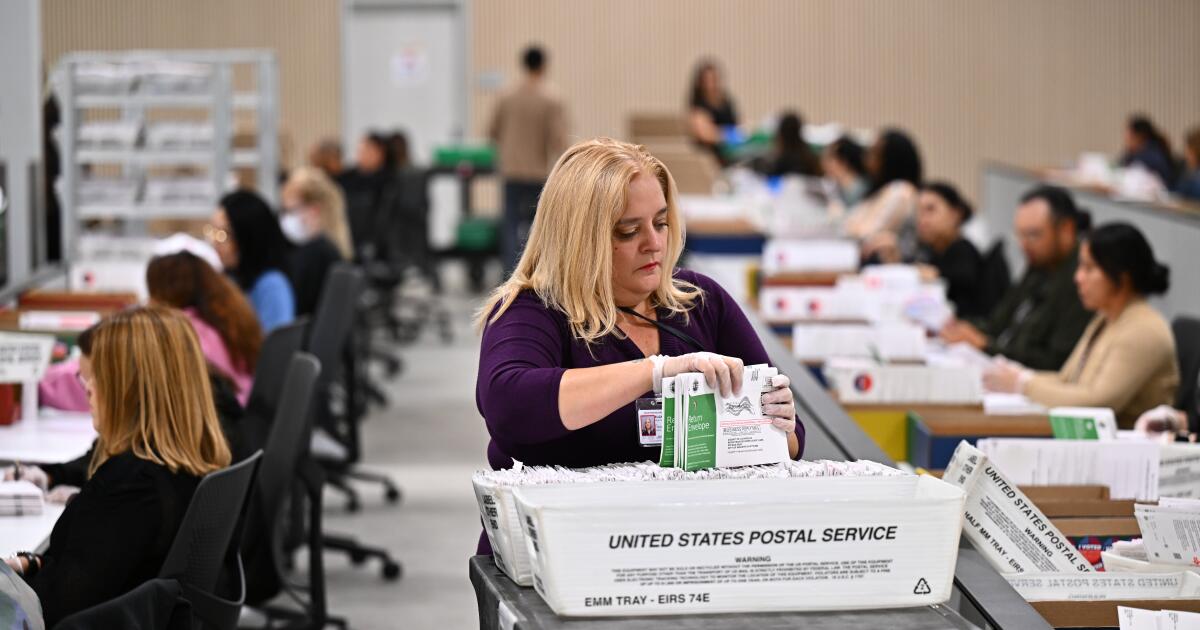
A federal judge on Wednesday lifted a major obstacle to President Trump’s executive order limiting mail voting, even as Democratic state officials filed a new court challenge with the midterm elections fast approaching.

The fresh round of legal wrangling comes just two days after the Supreme Court handed down a procedural ruling in Trump’s favor, and could mean the issue lands before the high court again before the pivotal contests for control of Congress. The first mailed ballots are set to be sent out next week.

U.S. District Judge Indira Talwani in Boston agreed to lift an order prohibiting the U.S. Postal Service from carrying out Trump’s order for November’s elections. She wrote that she was “compelled” to do so after the Supreme Court’s conservative majority ruled that a similar injunction she granted in a separate case was premature.

Talwani nevertheless said the executive order could unleash “chaos” and referred to it as “likely unconstitutional.”

The administration can now move forward and implement a Postal Service rule published late Friday. It would require states to follow a uniform envelope style for mail ballots and to give the Postal Service a list of voters eligible to receive them. Talwani found on Tuesday that the rule’s issuance technically violated her injunction, but she declined to penalize the administration.

The new lawsuit, filed by about two dozen Democratically controlled states against the U.S. Postal Service, marked a new phase in the high-stakes litigation creating confusion around the midterm elections.

It came after the Supreme Court ruled against them in a separate case, but did not say Trump’s order was legal.

The high court majority found the initial Democratic lawsuit was premature, but that was before the Republican administration issued a rule governing Postal Service delivery of mail ballots. Election officials warn it will be impossible to implement before the first wave of mail ballots are sent out next week.

“Across the country, states are already deep into preparations for the 2026 elections. Now, at the last moment, the federal government is attempting to meddle in those preparations and potentially threaten countless Americans’ right to vote,” New York Attorney General Letitia James, one of 25 Democratic attorneys general filing the lawsuit, said in a statement. “USPS has no authority to decide who can and cannot vote by mail.”

The Trump administration plan faces a third lawsuit originally filed in May in the nation’s capital, though judges there have so far declined to block it.

All previous challenges were filed before the administration published its mail ballot rule Friday night.

White House spokesperson Lauren Bis on Wednesday said the Postal Service’s proposals were “commonsense measures that protect the security of mail-in ballots” and that the administration would continue to work to implement them to boost “the safety and security of our elections.”

The Postal Service said it would not comment because of the pending lawsuit.

National Democrats on Tuesday cited the rule in asking the federal judge in the Washington case to block Trump’s order after he declined to do so last spring, saying the administration at the time had not taken concrete action. In Boston, Talwani also found that the administration had violated a separate injunction she had placed on the Postal Service in drafting the new rule, although she did not take any action against the government.

Talwani had issued the injunction against Trump’s executive order in the prior Democratic state case, which is the one the Supreme Court overturned on Monday. She also issued a second injunction Aug. 11 in a case filed by the League of Women Voters and other voting rights groups, while the Supreme Court was considering the administration’s appeal of the judge’s first order.

Trump has long targeted mail voting, which he falsely blames for his 2020 election loss and is disproportionately used by Democrats as a result of Trump’s condemnations. Since returning to power, Trump has tried to claim authority over election rules, saying he thinks Republicans should “take over” vote counting in Democratic areas.

He issued his first election executive order just months after retaking office, attempting to require documentary proof of citizenship to vote, among other changes. He has also been pushing a sweeping election bill that has stalled in the Senate amid opposition from Democrats and even some within his own party.

Riccardi and Whitehurst write for the Associated Press.

Source link

Man accused of forging Supreme Court Justice John Roberts’ signature

Aug. 25 (UPI) — A man is facing federal charges for forging the signature of Supreme Court Chief Justice John Roberts and impersonating a federal agent.

Joshua M. Culver was indicted Friday in the Northern District of Indiana on four counts of falsely impersonating an officer of the United States and one count of forging the signature of a judge and court seal.

He was arrested in Colorado and has been assigned a public defender there.

The indictment alleges that Culver identified himself as a National Security Agency agent on at least two occasions in September 2025. He allegedly did so at the Tippecanoe County Sheriff’s Office trying to get information about the location of a family member. The indictment also alleges that he made phone calls to someone at their employer threatening them and accusing them of breaking the law.

In January 2026, Culver allegedly claimed to be a “Special Master enforcing orders of the United States Supreme Court” to get a Lake County, Ind., judge to dismiss criminal cases and judgments against him.

He’s accused of forging Roberts’ signature and using a counterfeit seal on an order in September that told a Grant County, Ind., court to drop theft charges against him.

President Donald Trump looks on as Secretary of Education Linda McMahon speaks during a back-to school event in the Rose Garden of the White House on Monday. The event focused on education and the Trump administration’s education policies. Photo by Will Oliver/UPI | License Photo

Source link

Supreme Court: Trump can start carrying out order restricting mail-in voting

Aug. 24 (UPI) — The U.S. Supreme Court on Monday ruled that President Donald Trump can begin implementing measures from an executive order intended to restrict mail-in voting in many states and Washington, D.C.

However, legal challenges to that order could still cause issues for that plan before the midterm elections in November.

The ruling Monday means that the Department of Homeland Security can begin moving forward with compiling state-specific lists of people it believes are eligible to vote in the states — all led by Democrats – that had challenged the executive order.

Another part of the executive order required the U.S. Postal Service to require states that want to send ballots through the mail to submit lists of eligible voters with information allowing those ballots to be tracked by the government. A lower court had blocked that policy nationwide in a separate case, meaning that more legal action will be needed before the postal service can continue.

The high court’s ruling did not address the overall legality of the executive order.

“If the Postal Service’s final rule harms the states, theymay challenge that rule,” the ruling said.

The postal service entered an unpublished version of that final rule into the Federal Register late Friday despite the court injunctions against it.

Trump has repeatedly and without evidence claimed that mail-in voting is “inherently corrupt” and full of fraud, although voting experts have criticized the order and say such fraud is exceedingly rare. The president himself has voted by mail as recently as this year, NPR reported.

The high court handed down the ruling in an unsigned order over the dissent of three of its members: Justices Sonia Sotomayor, Elena Kagan and Ketanji Brown Jackson.

In a dissent, Jackson said the ruling “needlessly injects chaos and uncertainty into the upcoming midterm elections,” CNN reported.

She noted that, in the past, the Supreme Court has turned away challenges to election law because they were too close to elections. “Today’s revelation is that such claims can also come too early — never mind that an election is looming and related harms are presently occurring.”

Source link

Supreme Court allows Trump plan to regulate but not block mail ballots

The Supreme Court cleared the way Monday for President Trump to seek new limits on the use of mail ballots, but they are not likely to take effect this year.

Acting by a 6-3 vote, the court’s conservatives granted an emergency appeal from Trump’s lawyers and set aside a judge’s order that blocked new federal regulations on states and their use of mail ballots.

It’s not clear, however, what happens now, since the midterm elections are less than three months away.

About 30% of the nation’s voters — and 80% of Californians — cast their ballots by mail in 2024. Trump, however, has long maintained the voting by mail leads to fraud, including voting by noncitizens.

The court’s order stressed the new regulations do not put new requirements on the states this year.

Trump’s executive order “is internal directive from the President to his subordinates mandating that certain agencies pursue certain policies. It neither requires nor forbids anything of anyone outside the Executive Branch,” the court said.

The Department of Homeland Security will compile state-by-state lists of citizens who are over 18 and eligible to vote.

“States are not required to use the Lists,” the court said, although they could lead to future prosecutions.

The most disputed provision could have authorized the Postal Service to restrict mail ballots to those who are on the Homeland Security lists, but that is a future proposal, not a rule that will take effect this year.

The unsigned order spoke for the six Republican appointees. The three liberals, all Democratic appointees, dissented into two separate opinions.

Justice Ketanji Brown Jackson said Trump’s order was unlawful and should have been struck down. “It needlessly injects chaos and uncertainty into the upcoming midterm elections,” she said.

“Today’s decision does not address whether the President’s attempts to interfere with States’ administration of the November 2026 elections are lawful,” Justice Sonia Sotomayor wrote in a dissent joined by Justice Elena Kagan. “Nor does it suggest that the Executive Branch has any constitutional or statutory authority to implement the President’s directives. Instead, today’s decision merely postpones adjudication of those challenges.”

Trump issued his executive order on March 31 with the aim of “ensuring citizenship verification” in federal elections. California and 22 other Democratic-led states sued a few days later and said Trump sought to use the Postal Service to impose new restrictions on voting by mail. They also argued the Constitution gives states and Congress the power to regulate elections, not the president.

A federal judge in Boston and 1st Circuit Court agreed with the challengers and blocked Trump’s executive order from taking effect for the November elections.

The case on appeal was Trump vs. California because California Atty. Gen. Rob Bonta was a leader of the Democratic state attorneys who sued.

Source link

Two good ideas from Republicans dead on arrival in Democratic Legislature

Memo to Democrats and independents: Just because an idea emanates from a Republican, doesn’t mean it necessarily stinks. Here are two examples.

Legislators wearing red jerseys have proposed to:

  • Make the California secretary of state officially nonpartisan. Rip off the seemingly inevitable blue jersey and replace it with a neutral referee’s garb.
  • Similarly, seize the job of writing official ballot proposition titles and summaries from the partisan attorney general and hand it to the nonpartisan, universally trusted Legislative Analyst‘s Office.

Both ideas, of course, were dead on arrival when introduced in the Democratic-dominated state Legislature, which is about to wrap up a two-year session.

But both make good government sense and promote democracy, which the Democratic Party claims it’s fighting for against the President Trump-led GOP.

The secretary of state is the chief overseer of California elections. That office holder, regardless of party, has never favored one side over the other in balloting, although many GOP politicians have been parroting Pied Piper Trump’s nonsense about election rigging.

California Republicans pushing to neutralize the office argue that Democratic incumbent Shirley Weber has taken public policy positions that echo her party’s stands. Shock! This is America. She has a right — a democratic duty — to take any position vocally that she desires.

But it’s logical for the secretary of state to officially operate as a political nonpartisan — as does the state superintendent of public instruction and all county voter registrars, who actually administer the elections and count votes.

“It’s time to take the secretary of state out of the partisan mix,” says former Orange County Assemblyman Don Wagner, who is Weber’s underdog Republican opponent in the November election.

“The secretary should be calling balls and strikes as opposed to being on the red team or a blue team.”

Realistically, no red team member is likely to win any statewide office in California for the foreseeable future, given that Democratic voters outnumber Republicans by nearly 2 to 1 and Trump is widely detested in this state.

“Sometimes Trump does make it harder in California for Republicans,” Wagner acknowledges.

Sign up for the L.A. Times California Politics newsletter

Deeply reported insights into legislation, politics and policy from Sacramento, Washington and beyond. In your inbox twice per week.

The legislation to make the secretary of state nonpartisan was a proposed California constitutional amendment, introduced by Republican Assemblymembers Natasha Johnson of Lake Elsinore and Josh Hoover of Folsom.

But it was submitted so late in the legislative session that there was no chance of it ever receiving a committee hearing. It didn’t really matter anyway. Even if it had been introduced on Jan. 1, Democrats would have instinctively tossed it in the trash.

They’re never going to make it remotely possible for a Republican to win this office any time soon.

The measure’s authors say their proposal would help “restore Californians’ trust in the electoral system.”

Actually, the only Californians who largely distrust the electoral system are Republicans. And the best way to fix that is for Trump to shut up and stop telling lies about stolen elections and hordes of undocumented immigrants voting illegally.

A recent poll by the UC Berkeley Institute of Governmental Studies found that 88% of Democrats and 64% of independents have confidence in California’s election system. But 76% of Republicans do not — a sign of our polarized times.

Of the two Republican proposals, the most significant is the one stripping the attorney general of the power to write titles and summaries of ballot measures.

Often, the only thing many voters know about a proposition is what they’re told in the title. They aren’t inclined to wade through neutral details in the official state Voter Information Guide.

The legislative analyst is a political noncombatant appointed by the Legislature and basically agreed to by both sides. The highly respected policy wonk already writes the proposition analyses included in the voter guide. Why not also the measures’ titles?

Increasingly in recent years under Democrats, including projected next governor Xavier Becerra, the attorney general has been dishing out party propaganda in official proposition titles.

State law requires the attorney general to provide an “impartial statement of the purpose of the measure” in language unlikely “to create prejudice for or against” the proposal.

But often on hotly contested measures, the language reads like talking points for the blue side.

The latest example is Proposition 39, a Republican proposal requiring Californians to show identification when voting. Election officials also would have to verify that registered voters are U.S. citizens.

I’m no fan of that measure. It overreaches, is unnecessary, could suppress voting and is merely a tool to drive up the GOP vote. Democratic legislative leaders and the party are fiercely opposed.

But Proposition 39’s title is unfairly negative and loaded against the measure. It reads: “Prohibits citizens from voting unless they present government-issued identification.” All some voters will focus on are the first four words.

Proponents sued, but judges are historically reluctant to interfere in election campaigns. A Sacramento judge OKd Democratic Atty. Gen. Rob Bonta’s biased wording.

The legislation for nonpartisan labeling of propositions cleared the Senate Elections Committee but later was quietly killed behind closed doors in the Senate Appropriations Committee, a notorious graveyard for measures sentenced to execution by legislative leaders.

“The Democratic leadership doesn’t want it passed,” notes the author, Sen. Roger Niello of Sacramento County, who recently was elected the next Senate minority leader. “If they kill it [in appropriations] nobody has to vote on it and it dies without fingerprints.”

That’s common legislative games-playing: Keep potentially popular but politically undesirable bills off chamber floors so majority party members can avoid shamefully voting “no.”

But these are still excellent Republican ideas.

There are times when politics should be taken out of elections.

What else you should be reading

The must-read: California backtracks on good-government policies in divided Trump era
Law & Order & Politics: Eric Swalwell briefly detained as feds seize his phone at San Francisco airport, source says
The L.A. Times Special: It’s beyond debate. California voters deserve a Becerra-Hilton face-off

Until next week,
George Skelton


Was this newsletter forwarded to you? Sign up here to get it in your inbox.

Source link

Postal Service publishes mail-in voting rule despite court injunctions

Aug. 22 (UPI) — The United States Postal Service has prepared a final rule changing how mail voting is administered under an executive order issued by President Donald Trump despite a pair of court injunctions against it, documents show.

An unpublished version of the rule was entered into the Federal Register late on Friday, indicating the USPS intends to press ahead with implementation of a measure the administration says is necessary to prevent fraud in mail-in voting — a popular method of casting ballots that Trump has called “inherently corrupt.”

But critics contend actual fraud in mail-in voting is exceedingly rare and have denounced the measure as one of the most serious attempts by the administration to federalize control of elections in violation of the U.S. Constitution, which reserves such power for the states.

A federal judge 10 days ago expanded an earlier injunction against Trump’s executive order, under which the USPS would be required to decide who will get mail-in ballots.

The injunction blocked it from implementing Section 3 of the order for this year’s midterm elections, which most polls shows will likely favor Democratic congressional candidates.

Despite the court rulings, USPS promulgated the final rule with Friday’s filing, thus making it available to be officially published in the Federal Register on Wednesday. After that it would theoretically take effect immediately, even though it will be blocked for this year’s midterm elections unless a court decides otherwise.

The current filing is an amended version of the initial proposal which received more than 200,000 comments during its review phase.

Trump signed the order on March 31 directing the Department of Homeland Security to build a list of citizens from federal data, which would then be sent to state election officials.

The USPS would then only send absentee or mail-in ballots to people it has determined are eligible to vote, and the U.S. Attorney General would investigate and prosecute election officials who issue federal ballots to those ineligible to vote.

Twenty-three mostly Democratic-led states sued to block the order and U.S. District Judge Indira Talwani agreed with the plaintiffs.

The administration appealed the decision and failed. It appealed again on July 27 to the Supreme Court, which has yet to make a ruling.

“Yesterday’s new mail-in voting rule is an attempt to weaponize USPS as part of the Trump administration’s efforts to take over elections,” Michael McNulty of the bipartisan political reform group Issue One said in a statement issued Saturday.

“If it holds up in court, it would mean postal workers shift from neutral transporters of a state-led process to a federal gatekeeper of states’ outbound mail ballots — requiring states to provide USPS with voter-level ballot information and giving USPS authority to reject ballots that do not meet the new federal requirements.”

He dismissed Trump’s oft-stated concerns about voter fraud as “tired, debunked conspiracy theories to justify gaining control over secure, verified, and effective methods of voting, including mail-in voting, to tilt the playing field” in favor of Republican candidates.

Source link

Supreme Court allows Trump’s ballroom construction to continue

Aug. 21 (UPI) — The Supreme Court on Friday temporarily allowed construction on President Donald Trump‘s White House ballroom to continue, staying a lower court injunction demanding that it stop.

In a one-page order signed by Chief Justice John Roberts, the high court for now blocked an injunction issued in April by U.S. District Judge Richard Leon ruling that only that security-related, underground components of the $400 million project could move go ahead without congressional approval.

Leon’s ruling found that construction at the White House requires authorization from Congress and ordered the construction to halt while a legal challenge brought by the National Trust for Historic Preservation plays out.

He carved out an exception for the government to continue underground work deemed necessary for the White House’s safety and security.

The administration quickly appealed that order, citing a shooting incident at the White House Correspondents’ Dinner as evidence that the 90,000-square-foot ballroom is a security necessity.

Trump, meanwhile, harshly criticized Leon, calling him an “out of control Trump hating” judge whose ruling “severely jeopardizes the lives and welfare of the people who work, and will be working, at the White House.”

The administration said in Supreme Court filings last week that construction on the ballroom is already 65% complete as a 250-person crew is working on it nearly 24 hours per day.

Leon’s ruling would “halt the ongoing construction of the integrated military complex, including a totally secure ballroom space, at the East Wing of the White House, which is vitally required by national security,” U.S. Solicitor General D. John Sauer argued, while also claiming the group does not have standing to sue.

The National Trust, meanwhile, contended the administration is illegally trying to complete construction as soon as possible in a bid to “outrun judicial review” and push the project “beyond the point of no return.”

But its efforts “to foil judicial review and arrogate Congress’s exclusive powers should not be rewarded with a stay that allows [it] to complete a ballroom [it] lacked any authority to commence in the first place,” the Trust argued.

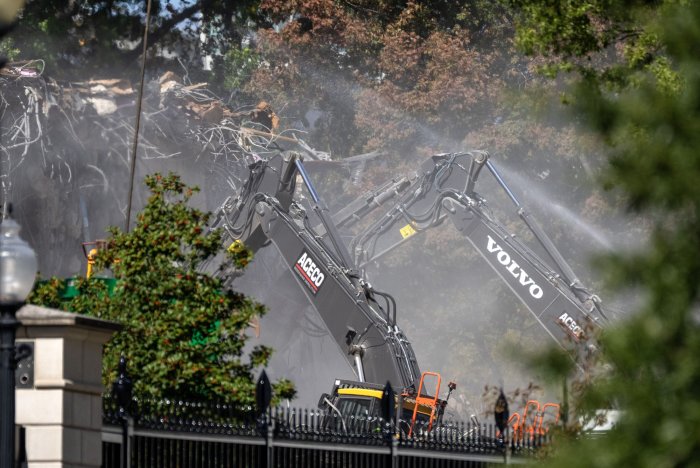
Demolition equipment continues to break up the East Wing of the White House in Washington on October 22, 2025. Photo by Pat Benic/UPI | License Photo

Source link