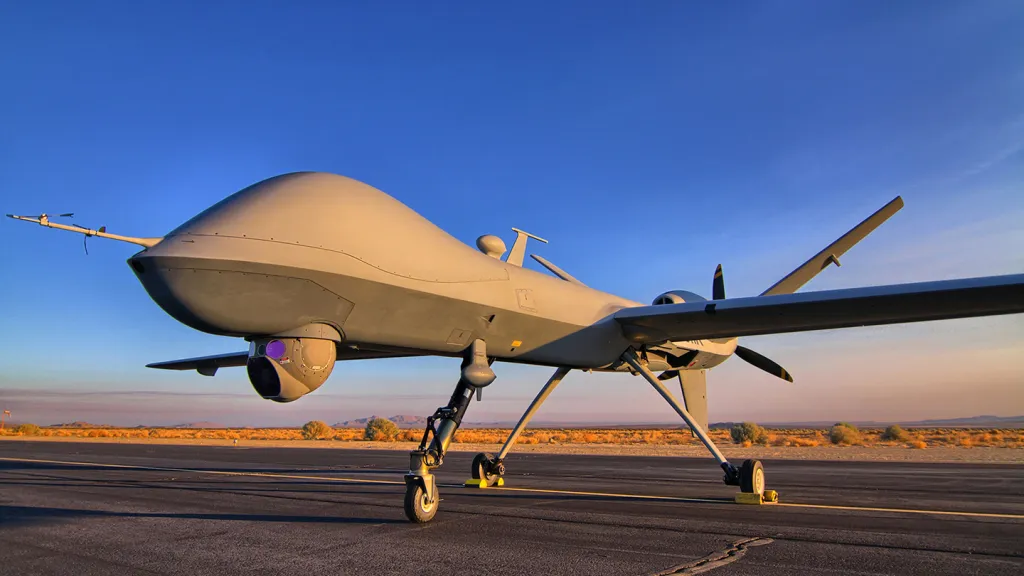
Wildfire Is General Atomics’ Successor To The MQ-9 Reaper
General Atomics (GA) has unveiled plans for what it calls the Wildfire Unmanned Aerial System, a next generation medium-altitude, long-endurance (MALE) drone. The move comes as the Pentagon is seeking an updated, modular, cheaper successor for the MQ-9 Reaper – one that is easier to produce and can be more freely sent into higher-risk environments where losses are likely to occur.
The Reaper, a workhorse for U.S. uncrewed strike and ISR missions for decades, suffered heavy losses during the war with Iran and against the Houthis in Yemen. This has added a new level to already existing concerns about how they would perform against a peer threat like China. It also has decreased the MQ-9 fleet so dramatically that there are real concerns above operational impacts and the force size going forward overall. The MQ-9 is now out of production and cannot be directly replaced.
Aviation Week was the first to report about the Wildfire.

GA spokesman C. Mark Brinkley offered limited details about the Wildfire system, which he claimed is a leap beyond what the Pentagon is currently seeking in a new MALE combat drone. The company, he added, is not yet providing any images.
“General Atomics is looking at it and asking ourselves, ‘What can we really do? No kidding, no BS, actually do,’” Brinkley told us. “Let’s be honest with ourselves first. How do we come out of the box, day one, with a 10,000-nautical-mile ferry range? Can we carry four LRASMs [AGM-158C Long Range Anti-Ship Missiles]? Can we swarm 100 aircraft under semi-autonomous control? Can we fuse all of that data into a highly effective common operating picture? Can we do that at scalable, affordable mass?”
“So that was the assignment, and our engineers sharpened their pencils and got to work,” he added. “What came out the other side was our new Wildfire UAS. That thing is a beast, and no one who actually does this for a living and is honestly concerned about America’s warfighting edge can look at it and not want 100 of them as fast as we can make them.”

Last month, the Pentagon’s Defense Innovation Unit (DIU) announced its plans for what it has dubbed the Massed Modular Aircraft (MMA) program to replace the Reaper. The objective is to bring several companies together to help determine the way forward.
“The math of modern warfare is changing, and our force design must change with it,” DIU stated. “For decades, the Joint Force has relied on low-density, high-value, ‘exquisite’ (>$30M) manned and unmanned aircraft. In a high-end fight, this model is simply unsustainable. To win, we must design for, and accept, inevitable attrition while retaining the advantage.”

“The Joint Force seeks a cost-effective, theater-range, massed, and modular Unmanned Aerial System (UAS) to provide a flexible, operationally-responsive, risk-tolerant option in the air domain,” the DIU explained. “The ability to employ many aircraft at once ensures a persistent overwhelming credible threat despite inevitable attrition.”
Massed Modular Aircraft “are envisioned as in-theater reconfigurable platforms capable of long-range payload delivery,” DIU added. “Crucially, MMA must retain the ability to be outfitted with a variety of payloads, including Full Motion Video (FMV) sensors, to execute missions that the MQ-9A performs today.”
Primarily, DIU wants an aircraft with a munition and sensor payload capacity of at least 2,800 pounds, an unrefueled combat radius of at least 2,300 nautical miles with payload, and able to self-deploy one-way at least 8,000 nautical miles. It must also have a Modular Open Systems Approach (MOSA) to rapidly swap in different payloads and system upgrades.
As for secondary attributes, DIU wants autonomy for control, allowing one pilot to operate several aircraft. In addition, it is seeking “resilient and integrated communications – hybrid SATCOM/mesh network connection” and to be able to conduct “local airfield operations under highly degraded or denied primary C2/SATCOM conditions.”
In addition, the aircraft would have “at least 200 knots true airspeed” and operate from runways with a maximum length of 6,000 feet.

The MQ-9A Reaper has a 3,850-pound payload capacity and can fly for more than 20 hours unarmed, or more than 12 hours with weapons. In the case of the latest MQ-9B version, with an extended wingspan, flight endurance can be increased to more than 40 hours.”
The deadline for submissions on this program ended July 23, but it is unclear when contracts will be awarded. However, proposed solutions “must be capable of full-scale prototype flight testing within 21 months of award, with a targeted Initial Operating Capability in FY2031 (20 mission-ready aircraft delivered to an operational unit, able to be deployed),” DIU noted.
To put the DIU goal into perspective, official budget documents say the Air Force had 165 Reapers in inventory as of the start of Fiscal Year 2026, which began on October 1 of last year. This had already marked a significant year-over-year decrease, down from 231 MQ-9As at the beginning of Fiscal Year 2025. These figures don’t include the Marine Corps and Central Intelligence Agency, which also fly Reapers.

General Atomics is turning the MQ-9 Reaper family of drones into cruise missile ‘trucks’
As noted earlier in this story, the DIU announcement of the MMA program came as Reaper losses in the war against Iran were mounting.
By May, the Air Force’s total MQ-9A fleet had shrunk to 135 aircraft, Air Force Lt. Gen. David Tabor, Deputy Chief of Staff for Plans and Programs, told members of Congress at a hearing.
There was enough concern that the service has scrambled to replace some of those airframes.
“So there’s a bit of a short-term effort to buy back things immediately, in this fiscal year,” Tabor testified.
The picture has only grown bleaker since then.
“The U.S. military has lost at least 45 MQ-9 Reaper drones during the war with Iran, or roughly 25 percent of its fleet,” The Washington Post reported last week, citing three U.S. officials familiar with the matter. The newspaper, citing the Air Force, stated that Reapers can cost between $30 million and $50 million each, depending on the type of sensors and weapons they carry.
“The potential taxpayer cost of recent losses is over $1.3 billion for that weapon system alone,” the publication added.
TWZ cannot independently verify those figures.

The MQ-9 Reaper Keeps Getting Shot Down – And Still Gets Used
The MMA program is not the first effort to replace the MQ-9. The Air Force has tried multiple times to develop a Reaper replacement without success. While GA had long held essentially had a monopoly on the MALE combat drone market in the U.S., the DIU competition has a host of other companies competing.
As we highlighted in a past report on this subject:
“…the U.S. drone landscape has changed considerably in terms of manufacturers. A few years ago, Northrop Grumman, Lockheed Martin, and General Atomics would have been seen as the front-runners for the MQ-9 replacement. Now, there are more contenders, often with a founding focus on rapidly scaling up production at low cost. Still, these firms have much to prove, especially considering the risk in replacing an aircraft as important as the MQ-9. At the same time, in the more advanced drone space, the legacy defense “prime” contractors are also making major progress in leveraging new technologies to reduce production costs and migrating away from exquisite, very expensive drones as their default offerings.”

As for General Atomics, Brinkley pushed back against the notion that the MMA program is actually a Reaper replacement.
“I think it’s really unfortunate that MMA has been branded as a ‘Reaper replacement’ because it misrepresents what America needs now and what we need later,” he suggested. “We need an immediate backfill solution to a critical shortage of unmanned MALE ISR/Strike. We need to get going on that now. MMA isn’t a backfill solution, or even a bridge to a backfill solution. This isn’t that.”
“Some say we need cheaper, disposable aircraft, so that we can use them and throw them away, or lose them and not feel bad about it. No one is talking about actual capability, ready today,” Brinkley told us previously. “No one is talking about all of the hard lessons, already learned, about icing and weather and weapons integration. No one is talking about the multiple survivability upgrades available for the existing platforms and the lack of investment in those.”
“These make-believe weapons that don’t exist have the luxury of being anything you imagine them to be,” Brinkely added. “Unscratched lottery tickets, promising all of the win and none of the lose [sic].
Still, the company did submit a proposal for MMA, Brinkley told us on Wednesday, “but the aircraft [Wildfire] is not dependent on that program.”
“We can deliver Wildfires years earlier than the current schedule, and absolutely no one on Earth wants to see them coming over their horizon,” he stated.
Contact the author: howard@twz.com