China’s Mysterious Submarine-Ship Hybrid Breaks Cover
The Chinese trimaran craft is seen in what is the first widely circulated image of the vessel, but it leaves many questions unanswered. Not least, what is the actual purpose of this vessel? At the same time, details point to this craft being fully or nearly fully submersible, making it something of a hybrid design.
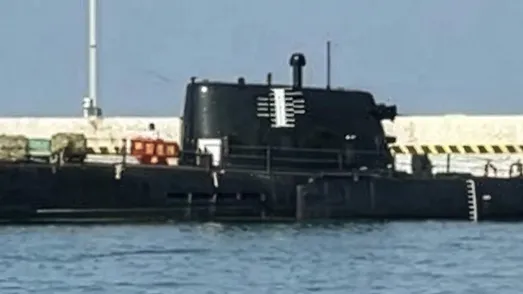
The photo, which began to circulate recently on social media and is republished at the top of this story, provides a profile view of the vessel in the water. While the date of the photo is unknown, the location is likely the Huangpu shipyard in Guangzhou province, where the vessel has reportedly been noted in satellite imagery over the last few months. Our previous understanding of the vessel’s appearance comes apparently exclusively from naval analyst H. I. Sutton, who looked at that imagery, in which the vessel was still covered with tarpaulins.
As had been apparent in the satellite imagery, the black-painted vessel incorporates features of both surface ships and submarines. The vessel’s slender shape had also previously been noted, pointing toward high efficiency. However, seen from this angle, the roughly 210-foot-long vessel doesn’t appear to have been necessarily tailored for high performance, at least not as an overarching priority.
At the same time, in this view, the vessel’s submarine-like attributes are perhaps even more pronounced.
These features may also include a propulsor at the rear, which would point to a pump-jet being fitted, a possible feature noted by Alex Luck, a journalist who closely follows the People’s Liberation Army Navy (PLAN). Pump-jets offer an array of advantages over traditional propellers, above all the ability to reach higher speeds without noisy cavitation — this means they can transit long distances around much more stealthily.
More obvious in this view is the submarine-like sail, which is fitted with a snorkel or possibly an antenna mast.
What’s far from obvious, even now, is whether this vessel is crewed or uncrewed.
Should it fall into the uncrewed category, the trimaran craft may well be some kind of hybrid between an uncrewed surface vessel (USV) and an uncrewed underwater vessel (UUV), essentially a semi-submersible, something H. I. Sutton also posited.
In this new image, however, there are indications that the vessel might be able to operate fully or at least very nearly fully submerged. The overall design, as well as features like the depth marks on the sail and elsewhere on the hull, point to it being a hybrid submersible/surface craft, which would offer the benefits of stealth when submerged and relatively efficient travel while surfaced.


In terms of its purpose, one of the most persistent theories is that it’s an arsenal ship.
For some years now, there have been rumors that China is developing a vessel of this kind. The idea would be to have an uncrewed, hard-to-detect vessel that could emerge to launch its missiles (land attack and/or anti-ship) before disappearing below the waves.
Unofficial renderings showing a potential configuration for a Chinese semi-submersible arsenal ship, with a trimaran hull:
A vessel of this sort could also provide additional magazine depth for more conventional surface combatants, which would likely also provide targeting solutions. In general, arsenal ships, with no crew or a minimal crew, are a concept that is currently gaining greater traction around the world.
So far, however, there is no firm evidence of a VLS on the deck of the trimaran, which would be required for an arsenal ship as outlined.
Another possibility, as put forward by H. I. Sutton, is that the vessel is intended as a ‘mothership’ for drones.
Rather than an arsenal ship packing cruise missiles, its internal space could be given over to aerial drones in an extension of the kind of concept that Ukraine has pioneered, on a much smaller physical scale, in its conflict with Russia. If it is a mothership for aerial drones, then vertical takeoff and landing (VTOL) types would appear to be the most logical. There is no obvious ‘flight deck’ for conventional takeoff and landing drones, although another possibility could be some form of catapult or rail-type launch system. A Shahed-type long-range one-way attack drone, in particular, would lend itself to being launched from a rail using a rocket booster.
As an alternative to drones, it could be that the vessel is intended to carry soldiers. A semi-submersible or fully submersible craft would be especially useful for moving special forces around littoral zones or among islands and reefs. The U.S. Navy, notably, also has its own very low-profile special operations craft, the Sealion, or Combatant Craft Heavy (CCH). Other craft that are more exotic exist for the special operations role.

Less dramatically, the trimaran vessel may simply be a testbed for future technologies, perhaps exploring possible roles for semi- or fully submersible craft with the People’s Liberation Army. The PLAN certainly does have a history of building bespoke vessels ostensibly for research and development, test and evaluation, and training roles.
For now, we simply don’t know what this black-painted trimaran is designed to do, nor any more details about its systems and crew (or lack thereof). However, with more imagery slowly coming to light, the vessel might not be so mysterious for much longer.
Contact the author: thomas@thewarzone.com