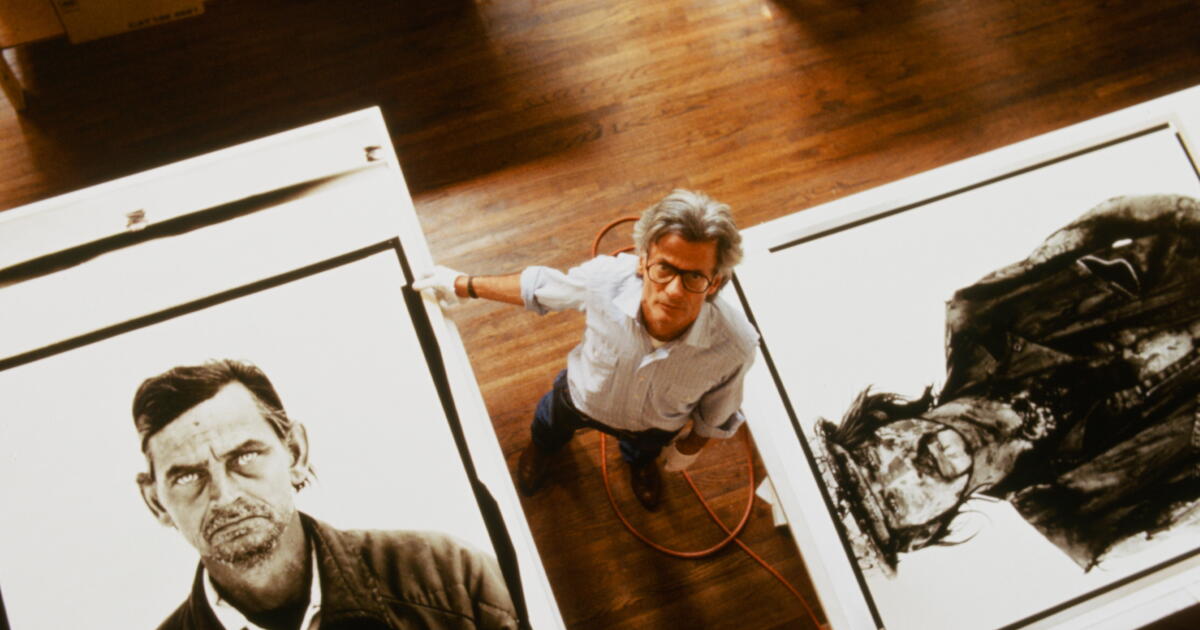
‘Avedon’ review: Ron Howard’s exhilarating look at a photography great
In the 20th century, an age of print, photography was the primary medium through which we understood the world beyond our personal field of vision. Pictures recorded and sometimes changed history.
Once upon a time, mastering the technology of a camera and the chemistry of a darkroom provided proof of seriousness. A person shooting even with a Polaroid or Instamatic had to reckon with the cost of the film, developing and printing, and so you chose your shots; you composed them carefully. It was a commitment, whereas now, anyone with a phone can take endless pictures, with little thought, it’s a reflex. By dint of sheer numbers — Instagram processes some 500 million uploads a day — the practice has been devalued.
That isn’t to say you can’t take a good picture with a phone, or that there aren’t plenty of serious artists working today, in old or new formats. But we have passed the age of the culture-shaping superstar photographer (and the culture-shaping magazines that gave them work). Richard Avedon, who is the subject of an exhilarating new documentary, “Avedon,” directed by Ron Howard and streaming Wednesday on Netflix, was among the greatest of them, with a career stretching from 1947 — when, in his early twenties, he was sent by Harper’s Bazaar to Paris — almost until the day he died in 2004 while working in San Antonio, on a photo essay for the New Yorker titled “Democracy.” (He was the magazine’s first staff photographer; “Dick was a great magazine man,” says Tina Brown, the editor who hired him.) James Martin, executive director of the Richard Avedon Foundation, reckons it amounted to “about 16,000 sittings.”
Even if you don’t know the name Avedon, it’s a good bet you’ve encountered his much reproduced 1955 “Dovima with Elephants” — “I think we sold one for $2 million,” says the gallerist Larry Gagosian — or his psychedelic Beatles portraits. Many of his celebrity portraits, from Samuel Beckett to Buster Keaton to Judy Garland to Nastassja Kinski (naked, wrapped in a snake) to Marian Anderson to Malcolm X, and the enormous murals of Andy Warhol’s Factory gang and the Chicago Seven defendants, will be the images we remember them by. None are pretty; most are striking; many are beautiful; some are disturbing.
“I’ve been called a cruel manipulator, existential hero and to top it off, agent of death,” says the photographer, whose suite of pictures of his dying father is explored here.
Avedon began in fashion photography, which he revolutionized, bringing motion and implied narrative into a previously static form; he moved to portraiture, which he remade by removing any vestige of flattery. As a commercial photographer — with Doon Arbus, daughter of Diane, he also created television commercials for Calvin Klein and Chanel — who would come to insist that he was an artist, he was not always well received, reviewed or understood. But he approached everything with the same democratic curiosity, and many museum shows later, it’s hard to argue against his claim.
Although in earlier years, he shot on location, either for magazine spreads or personal work — he photographed in the psychiatric ward at New York’s Bellevue hospital — he came to be known for placing his subjects against a white background, stripping out everything that would distract from the “geography” of the face, and settling finally on using an 8×10 camera, which would allow him to come out from behind the lens. He took the white paper from the studio out into the field — to Saigon in 1971 and for the controversial project that was displayed and published as “In the American West.”
His goal was to eliminate the distance between the sitter and himself, and he was not interested in merely recording surfaces, though many of the surfaces he recorded were interesting, but of finding a way past the skin to the person inside. (“I had to go within to who I really am and that’s when I saw him come alive,” says model Beverly Johnson.) He viewed a portrait session as an “exchange of energy,” a collaboration with the sitter in which he had the final say. “Photography is the marriage of the imagination and reality of a situation,” he said. “Every photograph is accurate and none of them is the truth.” He was interested in photographing what frightened him, in vulnerability, tension and (a favorite word) contradiction.
Confident and insecure, fun-loving and haunted, he was a contradiction himself: “I’ve lived in a state of anxiety my whole life. [I’m]as addicted to that as I am to coffee.” “His whole life was an existential crisis,” says curator Jane Livingston. “That’s a hard way to live.” Like many successful artists, he prioritized work (“the one thing that doesn’t turn on you”) over family; his studio, instead, was familial. The troubled family he grew up in edited their photo albums to suggest all was well, but his younger sister, Louise, Avedon’s first model and the model for later models, died in an institution. (“Beauty of that kind is isolating.”)
Howard’s interview subjects include Avedon’s son John, photographer Joel Meyerowitz; Isabella Rossellini; models Lauren Hutton, Penelope Tree and Twiggy Lawson; Twyla Tharp; and New Yorker writers Hilton Als, Adam Gopnik and John Lahr, whose father Bert was one of Avedon’s celebrated subjects, seen in a pose of pain (as Estragon from “Waiting for Godot”).
The film is sleek and energetic and looks fantastic, offering a bounty of images, including many of the most famous ones; it has something of the feel of a magazine layout without ever trying to look like a magazine. (Many of the same images, and some of the interview subjects, are present in the 1996 documentary, “Richard Avedon: Darkness and Light,” which makes a great companion piece to “Avedon” and can be found online.) Working with the cooperation of the Richard Avedon Foundation, Howard has had access to a many shots of Avedon at work — he’s a dancing, leaping sprite. Fun was important to him; on a fashion shoot, they might socialize for most of a session “and five minutes before the hour is over we go on to the paper and — bam!”
That Avedon was very good looking, with a great crest of hair he brushes back off his forehead almost as a signature, a cleft chin and bright, piercing eyes, is a visual plus, and possibly contributed to his celebrity, if not to his actual career, which was, after all, all about talent and vision. As the character Dick Avery — Dick was what friends called Avedon — Fred Astaire played an echo of him in the fashion-world musical film “Funny Face”; Avedon’s own screen credit reads “Special visual consultant and main title backgrounds.”
“It’s almost as if I’m writing my autobiography with the faces of people I photograph,” Avedon said, and indeed, his big 1993 monograph is titled “Autobiography.” There’s a copy of it on the shelf behind me.