Switzerland remain unbeaten at the 2026 World Cup and will face either Colombia or Ghana in the next game.
Published On 3 Jul 20263 Jul 2026
Switzerland striker Breel Embolo struck early and winger Dan Ndoye added a second as their side cruised to a 2-0 win over Algeria on Thursday and into the last 16 at the FIFA World Cup, where they will meet Colombia or Ghana back in Vancouver next week.
Murat Yakin’s Swiss side put on a tactical masterclass, shifting formations and laying traps for Algeria before hitting them with two sucker-punch goals that decided a contest short on excitement, but full of intrigue and nuance.
Recommended Stories
list of 3 itemsend of list
Pitted against a familiar foe in Algeria coach Vladimir Petkovic, who had seven years at the helm of Switzerland between 2014 and 2021, Yakin set his team up to absorb early pressure and strike on the break, and that is exactly what they did.
Their opener was as simple as it was effective.
Breel Embolo #7 of Switzerland celebrates scoring his first goal of the tournament [Fran Santiago/Getty Images via AFP]
The Swiss won the ball in their own half and sent 20-year-old Johan Manzambi off down the left on the counter, and he squared for Embolo to steer the ball into the net from close range in the 10th minute.
The lead secured, Switzerland shifted to a five-man midfield out of possession, snuffing out the space and challenging the Algerians to play through them, but Petkovic’s charges struggled to break their opponents down.
Algeria’s best chance came in first-half stoppage time when Ibrahim Maza dragged a snap shot wide of the near post, one of the few efforts on goal they managed in the game.
Switzerland’s Dan Ndoye celebrates scoring their second goal [Lee Smith/Reuters]
The Swiss struck again almost immediately after the break, attacking down the right before a half-hearted clearance from Rafik Belghali ended up at the feet of Ndoye, and the winger placed his shot beyond the dive of goalkeeper Luca Zidane.
Algeria captain Riyad Mahrez could have pulled a goal back moments later, but he fired straight at a defender from a central position, summing up a frustrating evening for the Algerians.
With Granit Xhaka steering Switzerland’s defensive shape, they reverted to their original game plan of ceding possession and launching lightning-fast counterattacks, but the Algerians were wary of committing players forward, lest they concede again.
Despite the sellout crowd at BC Place, the last 15 minutes were played in virtual silence, only broken by cheers and then groans as Swiss substitute Fabian Rieder somehow contrived to miss with the goal at his mercy, scuffing his shot back across goal where a grateful Zidane was able to avert the danger.
Fortunately for Switzerland, it had no bearing on the outcome as they celebrated moving into a last-16 clash on Tuesday.
Algeria’s Riyad Mahrez looks dejected after the second goal scored by Switzerland’s Dan Ndoye [Anne-Marie Sorvin/Imagn Images via Reuters]
England’s Ollie Robinson bowls a triple-wicket maiden in his first Test appearance for two years, as New Zealand fall to 2-3 on the opening day of the first Test at Lord’s.
Arsenal are fresh from Champions League final heartbreak but there is no time to wallow.
Sunday’s Premier League title celebrations in north London may have refocused minds on next season’s missions, when they will aim to stay at the top of the English game and go a step further in Europe.
Defeat by Paris St-Germain in Budapest on Saturday night came only on penalties, but Arsenal‘s limitations against opposition of the highest class were evident before the spot-kicks.
The Gunners had less than 25% of possession, and Kai Havertz’s early opening goal was their only shot on target in 120 minutes of football.
After the game, PSG midfielder Joao Neves said Luis Enrique’s side had been “the only one who wanted to play”.
Former Arsenal defender and Premier League winner Matthew Upson told BBC Sport that Havertz’s early goal killed the game in one sense.
“Had it been 0-0 throughout the first half, I think you might have seen a slight difference in Arsenal, but once you get that goal naturally you just slightly slip into protection mode,” Upson said.
“Every team does it and obviously PSG then dominated the ball, but the possession stats are pretty scary really for a final with two teams who are the best around. To have a 75-25% difference in possession is almost unheard of really in a Champions League final.”
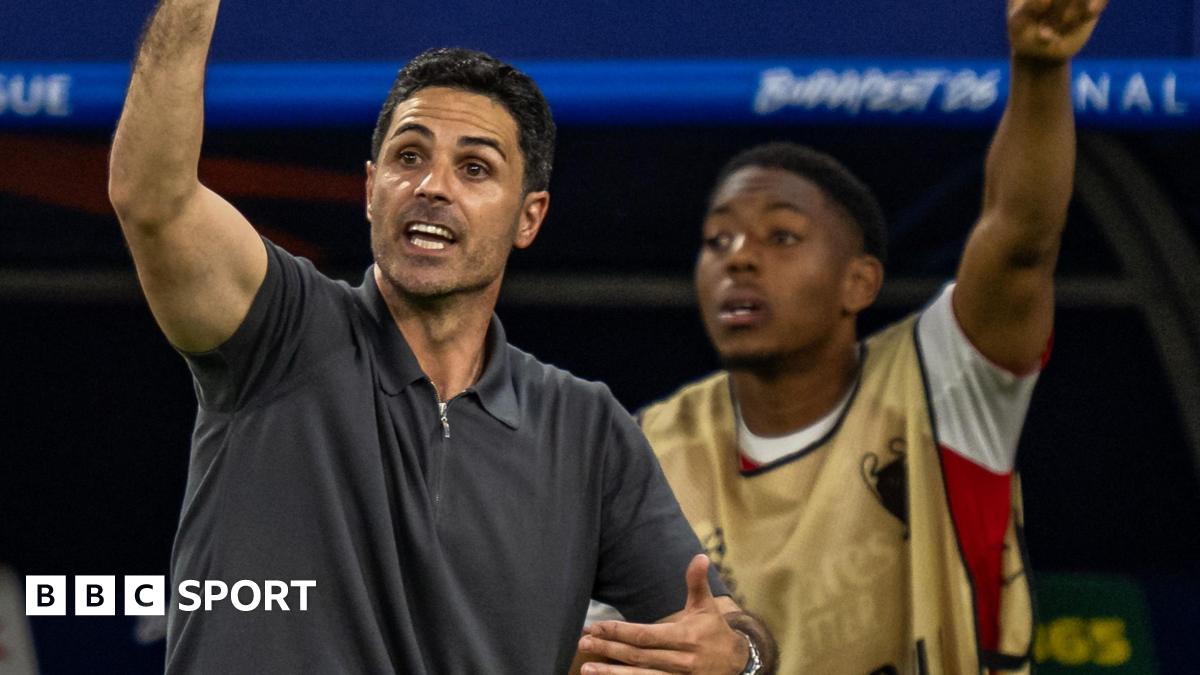
Arsenal manager Mikel Arteta described PSG as “the best team in the world”.
He said it was their prowess that dictated Arsenal‘s style.
He also hinted that his side could look to emulate the French side’s style of play in the future.
“What they are able to do with the ball, with individual actions, I haven’t seen it,” Arteta said.
“It’s not the plan to play in certain areas when you don’t have the ball, but they force you to do that.”
So does the Spaniard need to refine his style for next season to push Arsenal to the next level, build up their possession numbers, and keep challengers at bay?
Or will we see more of the same Premier League title-winning formula from the Gunners?
Thirty-five years after his death, jazz giant Miles Davis, who would have turned 100 years old Tuesday, remains a truly larger-than-life figure in music and well beyond.
Still possessor of the biggest-selling jazz record in history, “Kind of Blue,” Davis casts a huge influence over the whole music world for his uncompromising artistic vision, constant evolution, style and more. Though he came from jazz, he may be the biggest rock star there ever was. Talk to any musician, regardless of genre, and they will tell you Davis defined swagger and cool. He had a vibe unlike that of anyone else.
In honor of Davis’ centennial, The Times spoke to an array of notable artists from all walks of music, some who knew and played with him, some fans of the man, but all agreed, Miles Davis was and is a singular force in music, an artist like no other in his vision, passion and feeling for the music. In short, there was only one Miles Davis.
‘A complete innovator’
Chuck D, rapper: I like Miles Davis and all the exterior aesthetics. I like the Blue Note album covers, Prestige album covers, his style, his way of life.
Cindy Blackman Santana and her husband Carlos Santana in 2019.
(Ethan Miller / Getty Images)
Cindy Blackman Santana, drummer: Stylistically, Miles was a complete innovator. I remember hearing him say that he didn’t play right if he wasn’t dressed right. That is completely something that inspires me as well, because it becomes not only what you’re putting out on your horn or your drums or your guitar or your piano, but it’s your whole being that is expressing this innovative approach to music and to life.
Bilal, singer: If you play the music you’ve got to look the part, and it was almost like he got into a movie role or something like that. But he was always into the clothes … It was almost like every era had a different outfit. But, yeah, I definitely take his style. The clothes make you feel a certain way to play that way. So that’s the vibe. You’ve got to have that character, that attitude.
Emmet Cohen, left, performs with Terence Blanchard at Lincoln Center in 2025.
(Slaven Vlasic / Getty Images for Find Your Light)
Emmet Cohen, pianist and composer: I think when you listen to Miles’ records you can really appreciate them all the way through and there’s something in there for all sides of humanity. Whether it was the Prestige records that he pumped out in a couple of days, or there was “Birth of the Cool,” he just knew how to assemble musicians and let them tell their stories. And the storytelling is really where I think the deepest connections are made. He was a rock star, but he had a story to tell. And that always comes first.
‘Always evolving’
Guitarist Lenny Kaye performs onstage at Carnegie Hall in 2023.
(Noam Galai / Getty Images for Tibet House US)
Lenny Kaye, guitarist: He started in the bebop era, with the immortals of that moment in time. But I always got the sense that he was looking for something else. He didn’t want to participate in the faster-than-light speed changes and virtuosity. So, I really respect the fact that when he moved into “Birth of the Cool,” he pulled it back so he could inject more of his human self into it. And over the years, he kept on doing that, “Sketches of Spain,” “Kind of Blue,” one of the most jazz friendly records of all time.
Flea, bassist: Every time Miles changed it up, he destroyed everything that came before. He is the ultimate artist, always evolving, always coming organically from the depths. His music is the warmest and the wildest.
Flea of the Red Hot Chili Peppers released a solo jazz album in March.
(Allen J. Schaben / Los Angeles Times)
Bilal: I really like his electric era, but I would say I keep discovering and rediscovering stuff from Miles that I’m just like, “Damn, man. It’s like it’s another artist because he went through so many different changes.” … The other day I found his “Sketches of Spain” record. I put it on. I was like, “This is crazy. I forgot he was into this too.”
Wyclef Jean, rapper: When you go through Miles’ whole catalog, you see you can have quiet days. You can have loud days. You can have explosive days. But the key is that consistency. And that discipline.
Kaye: I respect Miles. For me, he’s an artist that transcends the jazz genre. He’s so alert to the shifting moods of the culture, the directions of the music. And what I find fascinating about him is his ability to morph into new styles and to keep challenging himself. One thing about Miles is that he doesn’t repeat who he is.
Musician Ron Carter in 2011.
(Theo Wargo / Getty Images)
Ron Carter, bassist: We always thought that we were honored to have Miles hire us out of other guys who were available to him. The first few gigs, we had a couple of weeks up and down the West Coast, and everybody but Miles was trying to find out what the tunes were, what the changes were. I was just trying to do what I thought was necessary to make this guy think he hired the right guy and make the band sound good. … Whatever his method was, it was successful.
Ibrahim Maalouf, trumpeter:Quincy [Jones] always spoke about Miles not just as a genius, but as someone who knew when to move on. And that’s a lesson I still carry with me every day.
Kaye: In “Bitches Brew” he created the template for what would be jazz fusion and made rock ‘n’ roll an important part of his evolution. Just an artist who never stands still and that is what I personally respect and honor within his work. When he saw what an artist like Jimi Hendrix was doing, he thought, ‘Yeah, I know how to access that and not be Jimi Hendrix. I can be myself.’ He understood the tides of cultural transformation as much or better than most musicians of the 20th century.
Don Was performs onstage at Ryman Auditorium in Nashville in 2022.
(Jason Davis / Getty Images for Americana Music)
Don Was, musician and producer:In life, as exemplified by music, if you don’t change, you stagnate. And the thing about Miles that really stands out, I think, is that he was always willing to risk losing his audience in order to keep moving forward. He was courageous in every era, including eras when maybe courage wasn’t held at a premium.
‘More than that’
Maalouf: For me, as a trumpet player, of course, the musical influence; space, phrasing, silence, we can talk about this for hours. But I think that more than that, there’s an attitude.
Ibrahim Maalouf performs at the Paris 2024 Cultural Olympiad at L’Olympia on July 24, 2024, in Paris France.
(Julien M. Hekimian / Getty Images)
Trombone Shorty, musician: Miles has inspired me because of that attitude, ‘I’m going to do what I want.’ He was playing what he felt in whatever time period or whatever decade he was inspired by. He really embraced that tremendously. And that’s always the thing that I admire about him as a person and as a musician. Whatever the spirit is, he’s going to go with that. That’s what I always got from Miles.
Nas, rapper: With Miles it wasn’t just about the music he made, it was about how he carried himself as an artist and a pioneer. His impact on me personally is as much on a human level as it is on the artist level.
Trombone Shorty performs at the Anaheim Convention Center in 2015.
(Jesse Grant / Getty Images for NAMM)
Trombone Shorty: The swagger, he may have created the swag.
Vince Wilburn Jr., nephew and drummer, who now co-manages Davis’ estate: He liked to catch things, that’s why the tape kept continuously rolling, because he said it was songs inside of songs.
Carlos Santana, guitarist: “I recommend that people who never heard of Miles Davis, I’ll say start with “Kind of Blue,” then move on to “Bitches Brew.” Because the thing about Miles Davis is that he teaches people who have never meditated how to stop and be coherent about absoluteness. In one note, Miles can play absoluteness. One note for Miles, like Billie Holiday, like Cindy says, that’s enough to understand all the whys and all the reasons why it’s sacred to be alive.
Was: He probably changed the face of music more than anybody did, at least four or five times. Maybe more than that. It’s a combination of mastery and an unstoppable spirit of adventure that I think make him unique. Because he was absolutely a master of harmony, rhythm, of creating a vibe. Yet he loved upsetting the cart and I think went out of his way to create friction musically, within the band, to keep things stirred up constantly and make every day an adventure. It requires tremendous courage. But also, supreme excellence to do it on the level that he did with the level of musicians that he surrounded himself with. That’s another thing, too. He wasn’t just the most innovative man on the horn. His genius was also as a curator of human chemistry.”
‘Larger than life’
Musician Wyclef Jean performs in 2023.
(Christian Petersen / Getty Images)
Jean: The main thing that I learned from Miles at a very young age is just the braveness, you can’t be scared to just go. Going doesn’t just mean learning one part of it. It means learning the entire metrics. … When it comes to Miles, he’s just a complete teacher; even on how he sees art, how he sees shapes, and also there’s a whole part of Miles that’s tough love when it comes to it. So, all of that instills character.
Bilal: As an older musician, you could see all of the building blocks are in those records. If you take some of those records out, I don’t know where jazz would be. You can see the essential building blocks.
Izzy Escobar, singer: Miles Davis made jazz feel cinematic to me. When I listen to songs like “It Never Entered My Mind” or “Flamenco Sketches,” there’s mystery, romance, restraint and tension in every note. Nothing feels overdone, yet somehow it says everything. As a songwriter, that’s deeply inspiring because the best music doesn’t just sound good … it creates an entire world you can step into. I think that’s why his influence has lasted a century. His music still feels fearless, elegant and emotionally alive — all of which never go out of style.
Jorma Kaukonen, guitarist: I had always thought of jazz as somewhat of a haughty art form. Probably because at the time many of the time signatures and chordal progressions that Miles used were over the head of a young guitar player still functioning in the blues and folk idioms. … The growing rock and art movement in the Bay Area in that era taught us to eschew boundaries and labels, and it became possible to see similarities and possibilities with jazz music that would have gone previously unnoticed. Our harmonic tendencies were nowhere near as complex, but they were rapidly becoming more sophisticated thanks to our exposure to such great improvisers as Miles! Miles knew no boundaries.
Jean: One thing that I learned from Miles is someone can have the best technique. They could be moving around. But if you can dig and play from your soul, this instrument just becomes a vessel of sound and orbit, bro, it’s over. There’s a connection with the soul. And I wouldn’t be able to do that, bro, if I didn’t have people like Miles to really teach me how to hear.
Theo Croker plays trumpet the Kennedy Center in 2018.
(Paul Morigi / Getty Images for Thelonious Monk)
Theo Croker, trumpeter: He was definitely a larger-than-life figure. And it encourages me to be a larger-than-life figure. Growing up as a kid, we sit in a room all day and play trumpet for hours. You see somebody like Miles Davis and you’re like, “Wow, I can be a rock star.” Because I couldn’t sing, otherwise, you end up being a pop star, Prince, Michael Jackson and Stevie and all that. But Miles was that for the trumpet, of course. So, it’s so much bigger than music.
Musician Mia Doi Todd performing in 2012.
(Paul Redmond)
Mia Doi Todd, musician and singer: Miles Davis was such an outstanding band leader, bringing together a group of musicians and seeking to break the boundaries. That is what I look to him most for as a celestial mentor, being a band leader and creating those sonic landscapes. The records that I love most of his are from that electronic jazz fusion era, which weren’t his most popular at the time. I love “On the Corner.” I’m a person of mixed race, so the records that he was bringing together, all these different musical elements, those are the ones that I really admire … “I wish I could play in that band.”
Maalouf: There’s this idea that music is not about providing something. It’s about searching. It’s about staying alive artistically. I think that strength goes far beyond music, it’s really a message for all the musicians that we are. Never stay where people expect you to stay. Every time the audience thought they understood him, he changed direction. And I think that’s definitely one of the most inspiring parts of his musical life.
Was: I never met him. But he was a heroic figure to me as a teenager, very much in the same way that simultaneously, like Bob Dylan and the Rolling Stones were, or John Lennon was, or Allen Ginsberg was.
Bilal performs in New York City in 2023.
(Roy Rochlin / Getty Images)
Bilal: That [artistic vision] is a major influence that I take from Miles. … I always approach the music in that way where you got to do your own thing. You’ve got to have something to say, and you’ve got to want to evolve and always look for ways to grow and change and with the music. Miles was quintessential at that.
Trombone Shorty: To me, Miles Davis was a real rock star. It just wasn’t the sound. When he walked on stage … he looked the way that the music sounded to him. … And as he grew, he just really embraced everything that was coming to him, and he didn’t run away from it. He wanted to have his influence and also be tremendously influenced by things that were happening. He was just the coolest; when they say cool, Miles Davis has to be next to that word.
‘Playing within the language that he created’
Nas performs in New York City in 2018.
(Bennett Raglin / Getty Images for Jenn-Air)
Nas: I think Miles’ impact on every inch of music after him is the most impressive part. Musicians from every genre speak on his influence. It has no language or cultural barriers.
Jean: I would literally tell everybody to do a deep dive and start with early Miles, start from the bebop and the blues, don’t just go in. I started my daughter with “Birth of the Cool.” Now she’s vibing and slowly working her way up.
Musician Vince Wilburn Jr. in 2011.
(Theo Wargo / Getty Images)
Wilburn Jr.: Style, creativity, forever evolving, ever looking back, unapologetic. Lenny White used to say everybody wanted to live and be like Miles, all the musicians. You have Miles, and then you have everyone else.
Santana: Miles is what I call a sacred rascal, a divine rascal, a genius. When I’ve been in the room with Herbie [Hancock], Wayne [Shorter] and Tony [Williams], and the name Miles comes up, they all stop. It has such an impact on all of them to this day it shows that Miles is Da Vinci, Stravinsky, Picasso. Collect all the geniuses of this planet, and that’s what Miles is in one note. In one note, he reveals more because in one note, he teaches an individual how to hug infinity with emotions.
Kaye: I think of him as a lodestar for someone who wants to continually move music forward into the future because that’s what music is about. When you play music, you’re moving from one note to the next and creating the future of that piece. I just find Miles a fascinating creature of transformation. Miles, for all his artistic innovation, was a pop star.
Maalouf: Miles Davis’ legacy is not only a sound, it’s a mindset. He gave all of us the permission to be many people in one lifetime. It feels to me it’s the secret and he was generous enough to do it himself and show the world and especially the jazz world that is not always easy to please that someone can be many people in one lifetime. It’s not only true for music. It’s true for everything in life.
Cohen: He’s always on the cutting edge of the next thing and the next group of musicians that he finds. The story in that is that there’s constant change, constant evolution, and to find the thread throughout is kind of the meaning of life. And to play his music is the same thing. He created a language. So, when we play his music, we’re playing within the language that he created.
Was: “That’s why he’s that cat. He’s the most rebellious musician of all time, I think. He was the complete package man, no one more innovative or influential.