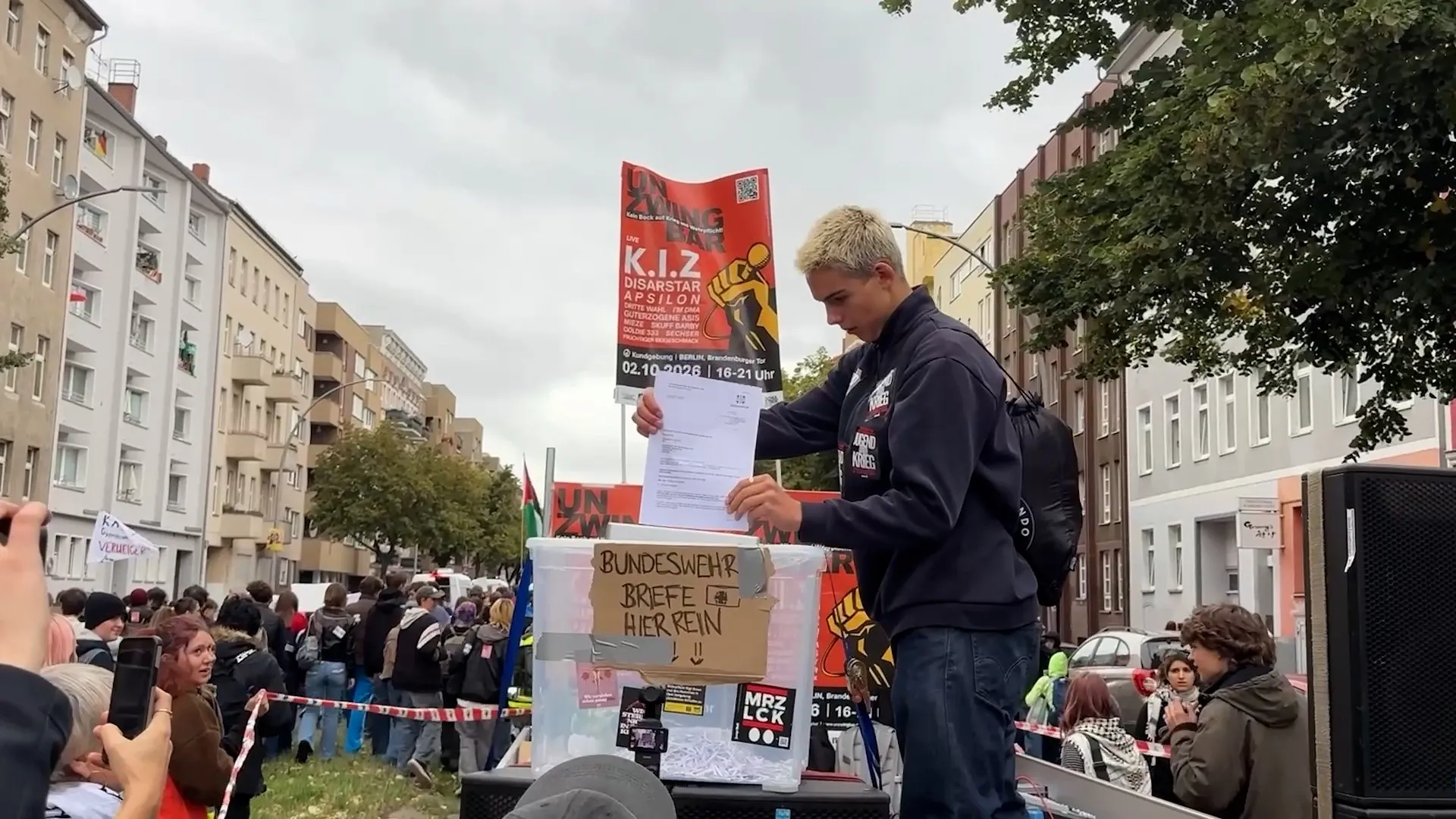
More than 40,000 students have taken to the streets of Berlin, with some shredding conscription surveys in protest of Germany’s proposed military service plans.
Jason Eaton faces up to life in prison after a jury rejected his insanity defence.
Published On 21 Sep 202621 Sep 2026
A jury in the US state of Vermont has convicted a man of attempted murder for shooting three Palestinian college students in 2023, rejecting his defence that he was not guilty by reason of insanity.
Jason Eaton, 51, faces up to life in prison for the attack near the University of Vermont campus in Burlington. It left Hisham Awartani paralysed from the waist down and wounded his friends Tahseen Aliahmad and Kinnan Abdalhamid.
Recommended Stories
list of 4 itemsend of list
The jury deliberated for several hours on Monday before reaching its verdict after a week-long trial that included testimony from the three men and psychiatric experts called by both the defence and prosecution.
Eaton was ordered jailed pending sentencing, which has yet to be scheduled.
Awartani and Aliahmad, who were sitting in the front row of the courtroom, smiled and hugged people around them as the verdict was read.
Eaton did not dispute that he shot the three men in November 2023. Instead, his lawyers argued that he should be found not guilty by reason of insanity.
The defence said Eaton was suffering from a delusional psychotic disorder and believed the CIA and Israel’s Mossad were transmitting messages to him through FM radio.
Joshua O’Hara, the supervising attorney at the Chittenden County Public Defender Office, told jurors that Eaton believed the intelligence agencies had enlisted him to “overwatch duty” to protect a Jewish family living across the street and that God was commanding him to act.
Prosecutors rejected the insanity defence, telling jurors that a state psychiatrist had concluded Eaton did not have a mental disease or defect and that the evidence showed he intended to kill the three men.
‘He pulled out a handgun and started shooting’
Awartani, Aliahmad and Abdalhamid, now 23, grew up together in Ramallah in the occupied West Bank before moving to the US for university.
They were visiting Awartani’s grandmother in Burlington over the Thanksgiving holiday when they went for a walk near the University of Vermont campus after dark.
Awartani testified that the friends were smoking cigarettes and speaking a mix of English and Arabic. Two of them were wearing keffiyehs.
He said Eaton was standing on the porch of the apartment building where he lived before approaching the friends without saying anything.
When Eaton was about five to 10 feet (1.5 to three metres) away, Awartani testified, he pulled out a handgun and began shooting.
Awartani, then a student at Brown University, was shot in the chest and left paralysed from the waist down. Aliahmad, who attended Trinity College, was shot in the collarbone, while Abdalhamid, a Haverford College student, was shot in the right buttock.
The shooting prompted calls for a hate crime investigation, but no hate crime charges were filed.
Police later found three shotguns in Eaton’s apartment as well as a Ruger .380-calibre handgun that crime laboratory testing identified as the weapon used in the shooting.
Deir el-Balah, Gaza – A handful of electronic components, a few wires and a basic programmable circuit board are enough to bring a group of curious children around a table in central Gaza to learn about robotics.
Students at The Next Gen Team: Rising Robotics Engineer Project in Deir el-Balah learn how to integrate sensors into alarm systems, study robotics, understand how motors and drive units work, as well as get firsthand experience with programming.
Recommended Stories
list of 4 itemsend of list
The children’s research could save lives in the future. The robotics and early warning systems they are working on could make way for bigger developments such as early detection of gas leaks and fires or help rescue workers access hard-to-reach areas, such as victims trapped under rubble.
Today’s lesson will also teach students the sciences of the future and help them keep pace with technological advancements happening outside Gaza’s borders.
Before the war, students had access to schools, universities, incubators and training programmes to pursue an interest in technology.
With much of that infrastructure now destroyed or damaged during Israel’s genocidal war on Gaza, there are few places and tools for students to work with.
But their interest in robotics and will to learn are helping them maintain their skills and ambitions for the future, something they hope will be of benefit when the bombs stop falling on Gaza.
Hamza al-Atrash, 16, is a student taking part in the “Next Gen” project and learning how electronic components can be used to develop robots and early-warning systems. To do this, he is using an Arduino controller – a programmable circuit board which connects sensors – and some other electronics.
Students work with what they have, but a shortage of equipment and electricity outages make studying a challenge.
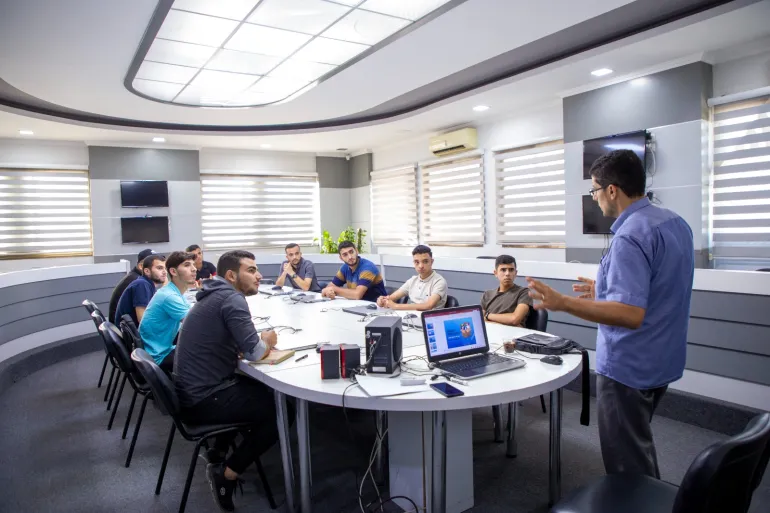
A view of a technology incubator in Gaza before the war, where students received training in technology and innovation [Iyad Al-Qatrawi/Al Jazeera]
“We have capabilities and aspirations that we want to develop, and we try to take advantage of every available opportunity for learning and training,” Hamza tells Al Jazeera.
Hamza hopes the skills that he and his cohort learn in class will benefit his community and provide new opportunities for young people in Gaza.
“The lack of devices and equipment doesn’t mean we’ll stop. It pushes us to look for solutions and make the most of the simple tools we have,” he said.
The challenges facing these students are part of a wider disruption to Gaza’s technology and innovation sector.
Before the war, Gaza had several incubators that supported technology projects and startups. Bahaa al-Masri, head of the training team for the Early Warning Systems and Robotics Project, said it provided a rare bit of hope for children and young adults in the besieged enclave.
“These incubators provided an environment for training and development. They helped innovators and entrepreneurs turn their ideas and projects into prototypes and ventures,” he told Al Jazeera.
The war severely damaged this ecosystem: training spaces were lost, equipment difficult to find, and students and innovators left with limited opportunities to experiment and develop their ideas.
A view of a technology incubator in Gaza prior to the war, which provided an environment for training, incubating tech projects, and supporting students in the fields of technology and innovation [Iyad Al-Qatrawi/Al Jazeera]
Although challenges remain, the trainers are continuing their mission of educating budding tech experts in Gaza.
“We have a generation of students who possess genuine passion and talent in technology and digital systems,” he told Al Jazeera. “They need the environment and tools to develop these abilities and turn their ideas into projects that can serve their community and their future.”
Education pays the price
The near-collapse of Gaza’s technology sector has coincided with the widespread destruction of the education system, with schools, universities and research facilities repeatedly targeted by Israel during the war.
Preliminary estimates from the Government Media Office in Gaza put direct losses to the education sector at approximately $4bn. Seventeen higher education institutions have been completely or partially destroyed since October 2023, preventing about 620,000 high school students and 90,000 university students from continuing their education.
Approximately 20,228 students and 830 teachers and educational staff have also been killed, along with 194 scientists, academics and researchers.
For students seeking to enter technical fields, the loss of such educational facilities and teachers means fewer opportunities to gain practical experience and hone their skills.
Before the war, the IT industry was one of the promising sectors of Gaza’s economy and a rare source of foreign income, said Ahmad Abu Qamar, an economic affairs specialist and board member of the Palestinian Economists Syndicate.
It was also an opportunity for employment for thousands of university graduates entering a job market with high unemployment, with roughly 80 percent of its economic activities directed towards foreign markets.
Abu Qamar estimates that the IT sector now runs at less than 25 percent of pre-war levels, while more than 70 percent of IT companies in Gaza have completely or partially halted operations.
But even if a company’s offices or equipment survived the war on Gaza, damage to digital infrastructure has also made it difficult for companies to continue functioning.
Prices of some technical equipment – including computers, mobile devices, servers, routers, fibre-optic lines, and cabling – used in the industry have increased by more than 600 percent due to the difficulties of importing devices during Israel’s ongoing siege on the enclave.
According to his estimates, about 30,000 IT professionals have lost their jobs since the war began. General unemployment is at nearly 80 percent and poverty at more than 90 percent in the enclave.
UCAS Technology Incubator, one of the most prominent incubators of the University College of Applied Sciences in Gaza, was destroyed during the war, as part of extensive damage to the institutions and structure of the technology and digitisation sector in the Strip [Iyad Al-Qatrawi/Al Jazeera]
Brain drain
A severe shortage of vital IT equipment – such as storage devices, routers, and laptops – has been compounded by the destruction of supporting internet and electricity infrastructure, including primary and secondary networks, according to technology and digital economy expert Abdullah Altahrawi with the UCAS Technology Incubator. This makes the task of rebuilding Gaza’s IT sector an even bigger challenge than before the war, particularly with Israel’s more crippling siege on Gaza.
“The repercussions have extended to dealings with foreign markets, including the purchase of servers and electronic services, the management of digital accounts, the use of cards and e-commerce,” Altahrawi said.
Before the war, Gaza’s five main incubators provided training, mentoring, workspaces and support for tech startups. Perhaps most crucially, it also gave students a place to develop their skills, connect with foreign markets, and find job opportunities.
Just two incubators – the UCAS Technology Incubator, affiliated with the University College of Applied Sciences, and the Ma’an Center for Innovation and Entrepreneurship Incubator, have resumed operations since the October 2025 ceasefire. But their capacity has not managed to exceed 20 percent of pre-2023 levels.
Due to the damage caused by three years of Israeli bombing and a shortage of real estate, just 1 percent of technology companies now have offices, while only 10 percent of business incubators have an operational office space.
Companies looking to rebuild and universities ready to teach a new cohort of tech students have also been hit by a brain drain in the sector, severely hindering development and innovation.
“More than 80 percent of highly skilled and experienced professionals in the technology and digital fields have left the Gaza Strip,” Altahrawi said. “Gaza’s future is inseparable from its ability to restore and develop its technology sector.”
WASHINGTON: Jason Eaton insisted he was acting on orders from the CIA and Mossad when he shot three Palestinian college students who were walking past his home a few days after Thanksgiving. He said the US and Israeli intelligence agencies transmitted the messages to him via FM radio and that God was commanding him to protect his Jewish neighbors.
Eaton’s claims were at the heart of his insanity defens e as he went on trial Monday on attempted murder charges in a case that shook Burlington, Vermont, and reverberated in the West Bank, where the three wounded men grew up and became friends as schoolmates in Ramallah before moving to the US for college.
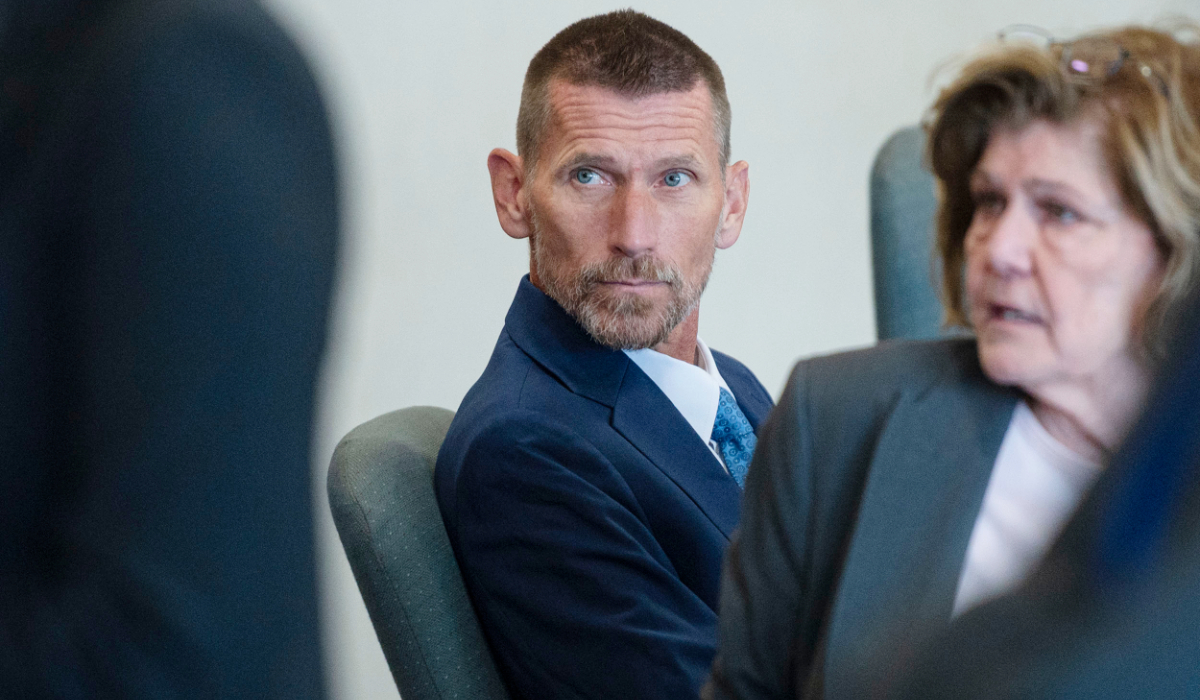
Jason Eaton appears in court during his trial in Burlington, Vt., Monday, Sept. 14, 2026. (AP)
The November 2023 shooting, weeks after the start of the Israel-Hamas war, spawned calls for a hate crime investigation. But no hate crime charges were filed as questions persisted about whether anti-Palestinian animus, an altered mental state or something else had compelled Eaton to open fire on Hisham Awartani, Tahseen Aliahmad and Kinnan Abdalhamid, who were all 20 at the time.
The men testified one after another as Eaton, now 51, watched stoically from the defense table in a Burlington courtroom. He has pleaded not guilty but doesn’t dispute that he was the shooter. If convicted, he faces up to life in prison. If found not guilty by reason of insanity, he could be ordered to undergo mental health treatment.
Defense lawyer Joshua O’Hara, previewing testimony from a defense psychiatrist, told jurors in an opening statement that Eaton was suffering from a delusional, psychotic disorder after losing his job at a credit union two weeks before the shooting.
While listening to a local NPR affiliate, Eaton believed he was hearing messages that he attributed to the CIA, O’Hara said. At first, the messages were encouraging and validating, the lawyer said, but subsequent messages turned dark, insisting that Eaton “has to go out and shoot somebody.”
Prosecutor Sally Adams told jurors that a state psychiatrist who is slated to testify concluded that Eaton did not have a mental disease or defect. Evidence will show he intended to kill the men, was not legally justified in shooting them, and does not meet the test of legal insanity, Adams said.
Authorities found three shotguns in Eaton’s apartment and a Ruger .380-caliber handgun that crime lab testing concluded was the gun used in the shooting, Adams said. Eaton had purchased the gun seven months earlier from a Vermont gun store.
“If the defense tries to focus on the story that Mr. Eaton tells about why he intended to kill these three young men, that story is only part of the whole picture,” said Adams, the chief administrative deputy at the Chittenden County State’s Attorney’s Office.
Awartani, Aliahmad and Abdalhamid, all of whom are now 23, told jurors of their holiday weekend visit to Awartani’s grandmother’s house, a trip to a bowling alley to celebrate his twin cousins’ birthday, and the walk they took near the University of Vermont campus after dusk that ended in bloodshed.
Awartani, who was studying at Brown University in Rhode Island at the time, said they were smoking cigarettes and speaking a mix of English and Arabic. Two of them said they were wearing traditional Palestinian scarves known as keffiyehs. Awartani said he first noticed Eaton standing on a porch as they approached the apartment house where he lived.
Within seconds, Awartani said, Eaton was off the porch and walking toward them. His face was expressionless and he didn’t say anything. As Eaton got to about five to 10 feet (1.5 to 3 meters) away, “he pulled out a handgun and started shooting at us,” said Awartani, who was paralyzed from the waist down in the shooting and now uses a wheelchair.
Jacob Pyne, who lived in a different apartment in the same house as Eaton, testified that he heard four to six gunshots, followed by footsteps going up the stairs of the apartment house. He said he ran outside and heard two men speaking, one of whom was more vocal and yelling, “I’ve been shot, help me.” He then brought the men blankets and called 911.
Abdalhamid, a student at Haverford College near Philadelphia, said he fled and hid behind another home after seeing Aliahmad fall to the ground. He said he only realized later when he sat down that he had also been wounded. Awartani was shot in the chest and the bullet ricocheted off his scapula, causing paraplegia in his spinal cord. Aliahmad, who was a student at Trinity College in Connecticut, was struck in the collarbone, and Abdalhamid was shot in the right buttock.
O’Hara, the supervising attorney at the Chittenden County Public Defender Office, told jurors that Eaton was confused by the messages he said he was receiving, and became convinced that the CIA and Mossad were enlisting him into “overwatch duty” to protect a Jewish family living across the street.
“These were delusions,” O’Hara said. “He believed in the moment that he was doing something that was right. He had been commanded to do this. And that he did not have the ability to appreciate the wrongfulness of his conduct in the moment because he believed he’d been instructed to do this by a government agency or God.”
BRUSSELS, Belgium: Belgium’s top universities condemned on Monday the government’s refusal to help 13 students from war-torn Gaza who received scholarships at Belgian universities reach the country.
Brussels set aside plans to evacuate the Palestinian students last week in a case that has split the coalition government.
The rectors of the European country’s top 10 universities expressed their “dismay” at the move in a letter, accusing the administration of using the students as “bargaining chips” in a “disgraceful political horse-trading.”
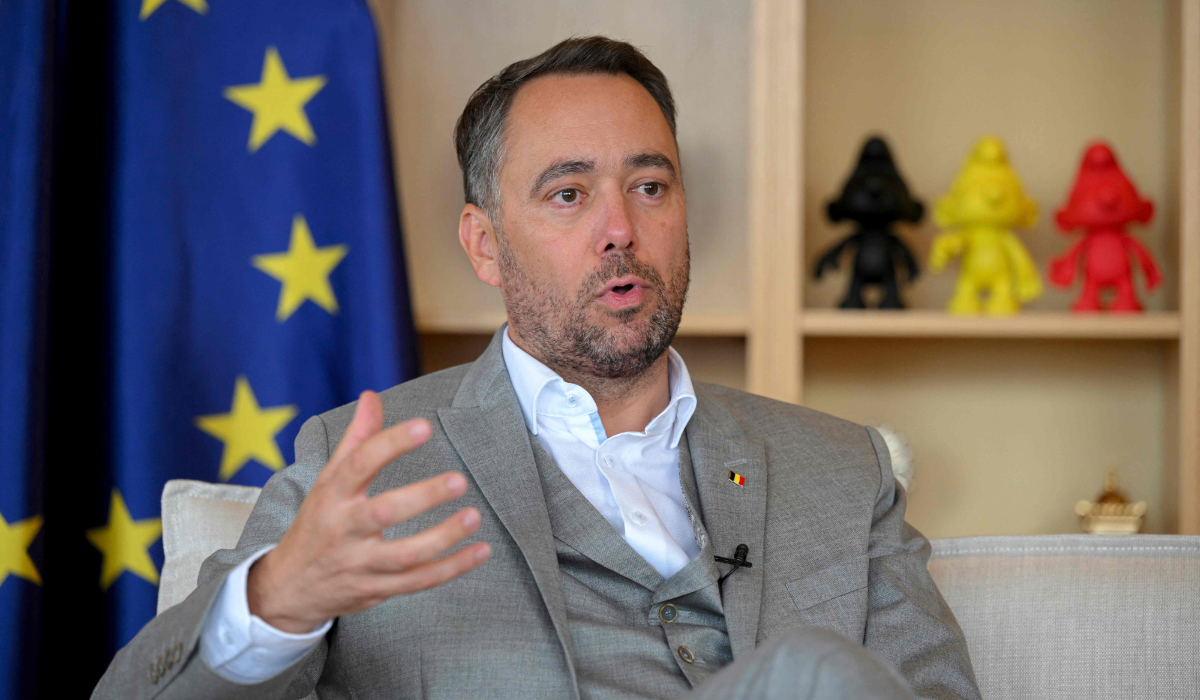
Centrist Foreign Minister Maxime Prevot has advocated in favor of evacuating the students but has faced opposition from the Flemish conservatives party of Prime Minister Bart De Wever, according to a government source.
Prevot said one member of the five-party coalition demanded concessions on migration, including the creation of deportation centers, in return for greenlighting the evacuations.
“They must not be treated as bargaining chips or as variables to be adjusted in political debates on migration,” the rectors wrote of the Gaza students.
“Their cases must be assessed for what they are: those of students and researchers who have been awarded scholarships on the basis of their academic merit and who have all expressed their intention to return to their home countries to contribute to their reconstruction.”
The students are among about 1,500 Palestinians in Gaza currently waiting to reach Belgium, having been granted the right to do so, mainly under family reunification rules, according to several NGOs.
Yet, evacuations from the Palestinian territory at war with Israel are proceeding at a trickle, with activists and now the universities accusing the government of deliberately slowing down the process.
“Discussions in recent weeks also show that the obstacles cited do not stem from insurmountable constraints but rather from a lack of political will,” the university chiefs wrote.
The case is not isolated, with Palestinian students hoping to study in Italy, Turkiye, the Netherlands, Germany also reporting delays in recent months.
Palestinian militant group Hamas launched an attack on Israel on October 7, 2023, which killed 1,221 people, according to official Israeli figures.
Israel’s offensive has since claimed at least 73,470 lives in Gaza, according to the Gaza health ministry, which operates under Hamas.
Aug. 29 (UPI) — A federal judge in California on Friday ruled that the Trump administration violated the Constitution’s First and Fifth Amendments when it sought to deport international students critical of Israel.
Judge Noël Wise, of the Northern District of California, sided with student journalists at the Stanford Daily, which sued because some of its noncitizen writers had been afraid of deportation for expressing opinions critical of the administration’s policies.
“Foundational to America’s enduring democracy are our freedoms of speech and the press embodied in the First Amendment,” Wise wrote in a 90-page ruling. “In the United States, free speech, including the freedom to criticize the government and its leaders, is not a sign of our democracy’s fragility. It is evidence of its strength.”
Wise ruled that it was unconstitutional for State Secretary Marco Rubio to use immigration law to deport students for their opinions.
Last year, Rubio sought the deportations of several student activists in the pro-Palestininan movement, including Columbia University’s Mahmoud Khalil and Tufts University’s Rümeysa Öztürk.
Fearing similar repression, the Stanford Daily sued to stop the government from revoking the visas of other students with views critical of Israel’s war in Gaza.
Wise said the strength of the Constitution “is diminished when members of our society — citizens and noncitizens alike — must self-censor and ‘behave’ or suffer the government’s retaliation.”
“In March 2025, that retaliation was directed at those engaged in pro-Palestine and anti-Israel speech,” the judge continued. “In September 2025, caught in the government’s net were people critical of Charlie Kirk.
“In May 2026, it potentially included ‘weighing in on a peace deal that’s being negotiated’ in Iran regarding the Strait of Hormuz. Tomorrow, or perhaps even today, targets may include anyone in the United States who exercises their freedom of speech to simply express opinions the government does not like.”
Attorney Conor Fitzpatrick, whose Foundation for Individual Rights and Expression sued the government on behalf of the students, said, “Today’s ruling proves that free speech isn’t a privilege, but the inalienable right of every man, woman, and child.”
“In America, free speech doesn’t just belong to the people who say things the government agrees with,” the attorney added in a statement.

![A view of a technology incubator in Gaza before the war, where students received training in technology and innovation [Iyad Al-Qatrawi/Al Jazeera]](https://i0.wp.com/occasionaldigest.com/wp-content/uploads/2026/09/1-1789814125.jpeg?w=640&ssl=1)
![A view of a technology incubator in Gaza prior to the war, which provided an environment for training, incubating tech projects, and supporting students in the fields of technology and innovation [Iyad Al-Qatrawi/ Al Jazeera]](https://i0.wp.com/occasionaldigest.com/wp-content/uploads/2026/09/3-1789814366.jpeg?w=640&ssl=1)
![UCAS Technology Incubator, one of the most prominent incubators of the University College of Applied Sciences in Gaza, after its destruction during the war, as part of extensive damage to the institutions and structure of the technology and digitization sector in the Strip [Iyad Al-Qatrawi/Al Jazeera]](https://i0.wp.com/occasionaldigest.com/wp-content/uploads/2026/09/2-1-1789814285.jpg?w=640&ssl=1)