El-Shenawy was incensed after Al-Ahly’s appeal for a penalty following a handball in stoppage time was denied.
Published On 10 Apr 202610 Apr 2026
Al-Ahly goalkeeper Mohamed El-Shenawy has been handed a four-match ban after striking a referee on the head following a 1-1 draw with Ceramica Cleopatra, the Egyptian Pro League said on Thursday.
The Egypt international, who was on the bench for Tuesday’s game, was incensed after Al-Ahly’s appeal for a penalty following a handball in stoppage time was denied.
Recommended Stories
list of 4 itemsend of list
“He handed a four-match ban and fined 50,000 Egyptian pounds [$942] for assaulting the referee by pushing or pulling,” the league said in a statement.
The ban means El-Shenawy, who is expected to be Egypt’s starting goalkeeper at the World Cup in North America, will be sidelined until the final week of the league playoffs.
Al-Ahly are third on 41 points, five points behind leaders Zamalek.
NICOLE Kidman commandos attention by going undies-free in a sheer-sided dress.
The actress, 58, wore the striking monochrome frock to the premiere of her Apple TV series Margo’s Got Money Troubles.
Sign up for the Showbiz newsletter
Thank you!
Nicole Kidman commandos attention by going undies-free in a sheer-sided dressCredit: AFPNicole cuddled Margo’s Got Money Troubles co-star Elle Fanning in New YorkCredit: GettyElle, meanwhile, blew out candles on a cake for her 28th birthdayCredit: Getty
He plays her husband in Prime Video series Scarpetta in which she is a forensic pathologist investigating a series of murders.
The pair were seen cosying up at a screening of the series earlier this month in New York and stuck together at the after-party.
A source said: “Nicole and Simon’s closeness is definitely the talk of the town right now.
“They’re incredible together on screen and when you see them together in real life, that chemistry clearly wasn’t faked.
“At the after-party they stayed close all night and were deep in conversation.”
Nicole wore the striking monochrome frock to the premiere of her Apple TV series Margo’s Got Money TroublesCredit: GettyNicole is planning a holiday with her teen daughters after her split last year from their country singer dad Keith UrbanCredit: Getty
Neto launched a leadoff shot on Chris Sale’s first pitch, and Soriano (3-0) struck out 10 as the Angels won their third consecutive game. The right-hander gave up one run and three hits without issuing a walk, throwing 69 of his 96 pitches for strikes.
Soriano gave up a solo homer to Drake Baldwin and a single to Matt Olson in the first, then retired 19 straight batters before Mike Yastrzemski led off the eighth with a single.
Mauricio Dubón homered off Angels reliever Chase Silseth in the ninth. Atlanta put two on with two outs before Jordan Romano replaced Silseth and got Yastrzemski to fly out for his fourth save.
The Angels played without star center fielder Mike Trout, who exited Sunday’s game against Seattle after getting hit on the left hand by a 94-mph fastball in the eighth. Trout’s hand swelled so quickly he struggled to remove his batting glove, but X-rays were negative and he is listed as day to day.
Sale (2-1) entered 8-0 with a 1.24 ERA in 11 career games against the Angels, but Neto slammed the left-hander’s first pitch, a 95-mph fastball, for a homer to left field.
Angels star Zach Neto celebrates in the dugout after hitting a home run in the first inning against the Braves on Monday.
(Joe Scarnici / Getty Images)
Sale retired his next nine batters but fell apart during a three-run fourth in which the Angels drew two walks, were twice hit by pitches, had two runners forced out at the plate and hit one ball out of the infield.
Logan O’Hoppe walked and Yoán Moncada was hit by a pitch, both with the bases loaded, to account for two runs. Bryce Teodosio drove in a run with an infield single for a 4-1 lead.
Jorge Soler opened the fifth with a single, and Adell drove a first-pitch fastball 411 feet to left for a two-run homer — his first of the season — and a 6-1 advantage.
Up next: Braves RHP Reynaldo López (1-0, 1.64 ERA) opposes Angels LHP Yusei Kikuchi (0-1, 6.52) on Tuesday night.
Video captured the moment of a direct hit by an Iranian missile on a residential building in Israel’s Haifa. Multiple injuries were reported and some people are feared trapped under the rubble of the partially collapsed structure.
Over the first 10 days of Operation Epic Fury, American forces destroyed 50 Iranian naval vessels “using a combination of artillery, fighters, bombers, and sea-launched missiles,” Chairman of the Joint Chiefs of Staff U.S. Air Force Gen. Dan “Razin” Caine said at a press conference at the Pentagon this morning. U.S. officials have consistently stressed that the neutralization of Iran’s naval capabilities is a core objective of the ongoing campaign against Iran.
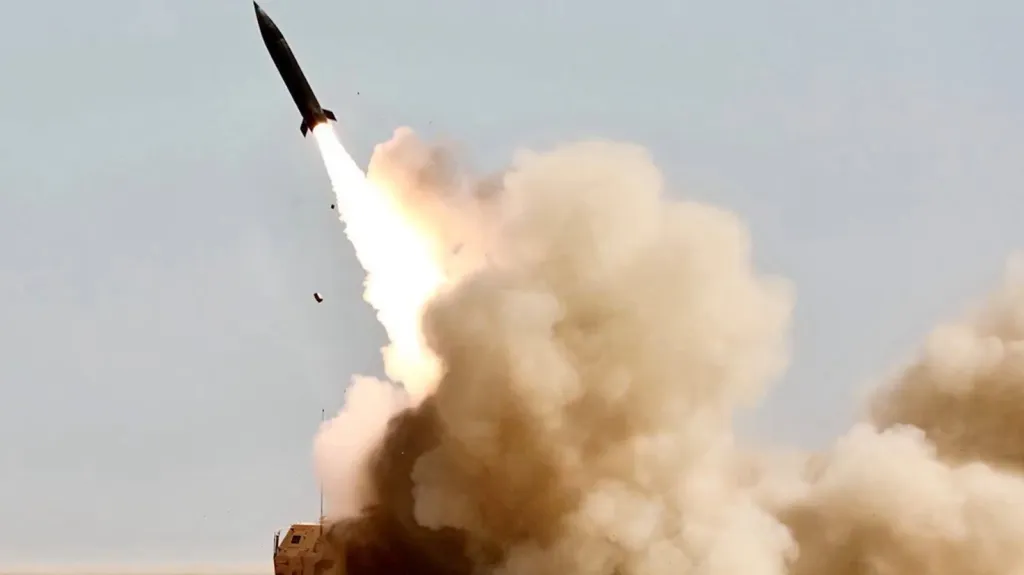
A PrSM missile seen being fired from an M142 HIMARS in support of Operation Epic Fury. CENTCOM
TWZ subsequently reached out for further clarification about what Caine was referring to here when he said “artillery” and for any additional information about the use of those assets against the Iranian Navy. A U.S. official told TWZ that HIMARS were used against Iranian Navy ships, but would not comment on what type of munitions they had fired or which ships were attacked that way.
However, U.S. Central Command (CENTCOM) has released several videos and pictures showing HIMARS operating in support of Operation Epic Fury. As noted, that imagery has only shown them firing ATACMS and PrSM ballistic missiles. CENTCOM has also now explicitly touted the first-ever combat use of PrSM in the current conflict. U.S. officials have yet to confirm where specifically ATACMS or PrSM missiles are being fired from.
In a historic first, long-range Precision Strike Missiles (PrSMs) were used in combat during Operation Epic Fury, providing an unrivaled deep strike capability.
“I just could not be prouder of our men and women in uniform leveraging innovation to create dilemmas for the enemy.”… pic.twitter.com/bydvIv5Tn5
U.S. Army High Mobility Artillery Rocket Systems (HIMARS) provide unrivaled deep-strike capability in combat against the Iranian regime. pic.twitter.com/Onsp1FUrz4
Imagery also began circulating on social media yesterday that is said to show an empty ATACMS ammunition ‘pod’ in Kuwait discovered by locals in the midst of ongoing operations against Iran. Wheeled HIMARS launchers, as well as tracked M270 Multiple Launch Rocket Systems (MLRS), fire ATACMS, PrSM, and 227mm guided artillery from pods with standardized dimensions. ATACMS are loaded one to a pod, while pods for PrSM contain two missiles.
Empty ATACMS missile container found in the deserts of Kuwait, suggesting the U.S. may be launching HIMARS strikes on Iran from Kuwaiti territory.
ATACMS is a U.S. short-range tactical ballistic missile launched from HIMARS, capable of striking targets up to ~300 km. pic.twitter.com/aVJvdAv1w6
A video also emerged online this past weekend showing two HIMARS being employed from a beach in Bahrain. When the footage was captured is unknown. What munitions they see are also unclear.
Geolocation of a U.S. M142 HIMARS launcher seen in the footage confirms it was operating in Bahrain at 26°17′18.48″N, 50°36′40.07″E, from where it was launching strikes against targets in Iran. pic.twitter.com/NjkExpwYkD
No evidence has emerged so far that HIMARS are being used to fire 227mm guided artillery rockets, which come six to a pod, in support of Operation Epic Fury. Even new extended-range variants of these rockets can only fly out to around 93 miles (150 kilometers) away, severely limiting the areas in and around Iran they could reach from available launch points in the region, to begin with. For example, the shortest distance between Bahrain and Iranian soil across the Persian Gulf is around 120 miles. The longest ranged variants of ATACMS can hit targets out to around 186 miles (300 kilometers), with PrSM’s maximum range at least 310 miles (500 kilometers).
It should also be noted that there is no known operational variant of ATACMS capable of engaging moving targets, meaning that it would have to be used against stationary ships. This is very possible, as we’ve seen multiple examples of Iranian ships struck in port or while appearing to be at anchor offshore already.
U.S. forces aren’t holding back on the mission to sink the entire Iranian Navy. Today, an Iranian drone carrier, roughly the size of a WWII aircraft carrier, was struck and is now on fire. pic.twitter.com/WyA4fniZck
There have been indications that the U.S. Army has already begun to field PrSMs that can hit ships on the move, though it is unclear if this represents the full planned Increment 2 capability. In 2024, the service announced it had successfully hit a moving vessel with an unspecified version of PrSM in a test exercise in the Pacific. In a report released in 2025, the Pentagon’s Office of the Director of Test and Evaluation (DOT&E) disclosed that the Army had actually “shot two PrSM EOC [early operational capability] missiles at a maritime target in June 2024.” At that time, the service was only known to have reached early operational capability with the baseline version of PrSM, also known as Increment 1.
The US Army previously released this low-resolution picture of a PrSM being launched during the test in the Pacific in 2024. US Army
It is possible that the Army has begun to field Increment 2 PrSMs, at least on a limited level, as well. The Army announced that it had begun initial flight testing of the new seeker system in 2023. Whether or not Increment 1 missiles can be readily converted into Increment 2 versions is also unknown. Like ATACMS, PrSMs without a moving target capability could still be fired at ships that are stationary, as well.
Regardless, Operation Epic Fury looks to be the first known instance of the U.S. military using ballistic missiles to target ships, at anchor and/or on the move, in real combat.
In general, ballistic missiles are especially well-suited to long-range standoff strikes against time-sensitive and well-defended high-value targets based on the speed at which they fly. They also reach especially high velocity as they come down in the terminal phase of flight. This all, in turn, creates additional challenges for enemy defenders attempting to intercept them compared to other kinds of missiles, including some subsonic air-breathing cruise missiles, and compresses the overall time available to react in any way. That speed also gives ballistic missiles an inherent ability to burrow more deeply into hardened targets. This could be particularly valuable when engaging larger and better-armored warships.
If nothing else, HIMARS has now been used in real combat to target enemy naval vessels, very likely with ballistic missiles. In doing so, experience is gained that could be very relevant beyond the current conflict with Iran.