Stress

Epic Fury Already Stress Testing More Agile Army Acquisition System, General Says

The Army’s revamped system for getting gear and weapons to the fight faster has already been put to work in support of the war the U.S. is waging on Iran, a service leader said Tuesday.

Speaking at the Association of the United States Army’s Global Force Symposium in Huntsville, Ala., Brig. Gen. David Phillips, deputy portfolio acquisition executive for Maneuver Air, revealed the Army was trying to innovate in real time as the conflict approaches the end of its first month.

“As I look back on the past 30 days in Operation Epic Fury, we had some immediate requests from the field in the first week,” Phillips said. “Those immediate requests in the field returned on a requirements document with the [Army Future Capabilities Directorate] and [Army Transformation and Training Command] in about 48 hours, who turned on a contract in about 72 hours. And I can say that we’ve had soldiers out training and testing the capabilities they’re going to deploy with in real time in the past 10 days. So we’ve got industry fully engaged.”

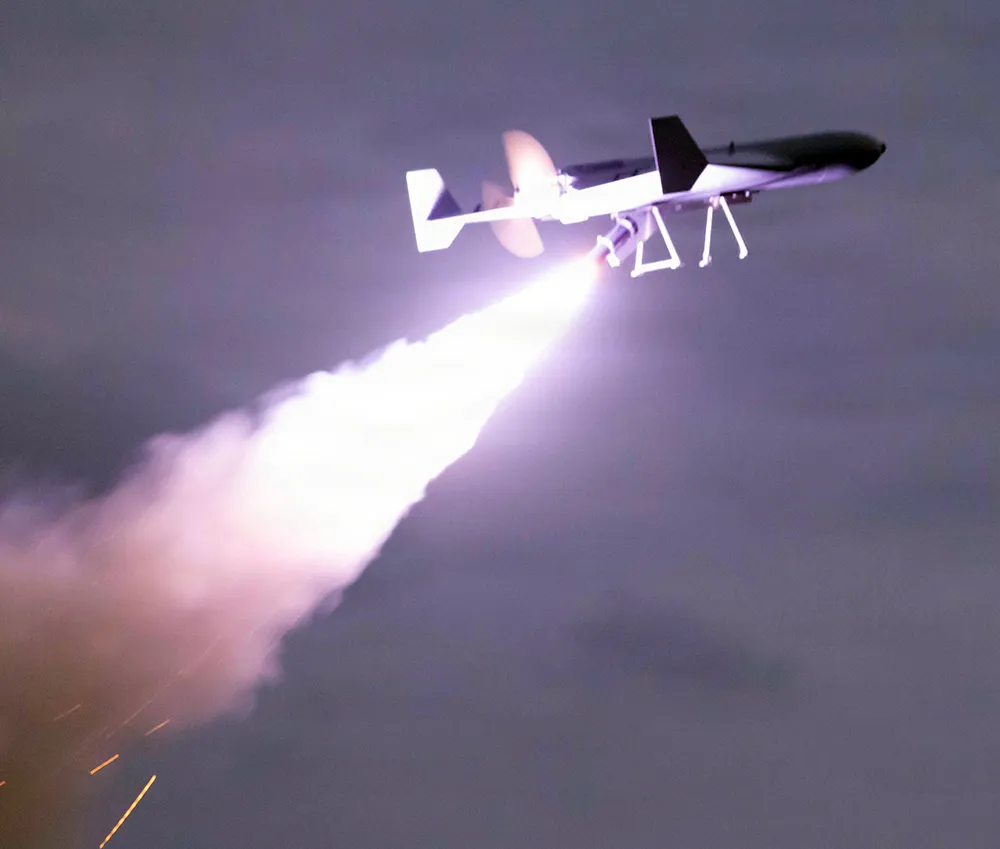
Phillips did not go into detail on what capabilities were sourced or needs identified in that short timeframe. Notably, the Pentagon has shown willingness to deploy new tech to the fight from day one, debuting the Low Cost Uncrewed Combat Attack System (LUCAS), a reverse-engineered American version of the Iranian Shahed-136 kamikaze drone, in the initial barrages.

A Low-cost Unmanned Combat Attack System (LUCAS) launches from the flight deck of the Independence-class littoral combat ship USS Santa Barbara (LCS 32) while operating in the Arabian Gulf, Dec. 16, 2025. Prior to the launch, shipboard weapons integration assessments helped ensure the system could be safely stored, moved, and handled at sea. Task Force 59 operated the LUCAS drone as part of Task Force Scorpion Strike operations. (U.S. Army photo by Spc. Kayla McGuire)
A Low-cost Unmanned Combat Attack System (LUCAS) launches from the flight deck of the Independence-class littoral combat ship USS Santa Barbara (LCS 32) while operating in the Arabian Gulf, Dec. 16, 2025. Prior to the launch, shipboard weapons integration assessments helped ensure the system could be safely stored, moved, and handled at sea. Task Force 59 operated the LUCAS drone as part of Task Force Scorpion Strike operations. (U.S. Army photo by Spc. Kayla McGuire) NAVCENT Public Affairs

On Tuesday, the Army formally announced the creation of an “Unmanned Aircraft Systems Marketplace” in partnership with Amazon Web Services and the Army Enterprise Cloud Management Agency that purports to be a “digital one-stop shop” for procuring drones fast for Army units and their allies.

Phillips urged defense industry members, as well as academics and units currently in the field, to tell leaders what was working in the fight and what needed to change.

“We want your engagements. We want your feedback at PAE Expanded Maneuver Air, and we want to have you as a part of our team. Because we know we don’t bend the metal, we don’t really go out and talk to the sub-tier suppliers as much as you all do, but we need this to be a team sport,” Phillips said. 

In a panel discussion helmed by Phillips, Army leaders who have worked with Ukraine and with mobile brigade combat teams within the 101st Airborne Division did exactly that, discussing needs and vulnerabilities with rare candor. 

U.S. Army Soldiers with the 25th Infantry Division monitor a handheld controller and review sensor data during Joint Pacific Multinational Readiness Center (JPMRC) rotation 26-01, Nov. 6, 2025, at Schofield Barracks, Hawaii. JPMRC integrates U.S. forces, along with military members from France, Malaysia, Maldives, Philippines, Singapore, and Thailand, alongside New Zealand Staff Observers to refine joint capabilities and rehearse tactics, techniques, and procedures required to dominate jungle and archipelagic terrain during large-scale combat operations. The exercise underscores the U.S. Army’s commitment to ensuring regional security and strengthening partnerships in the Indo-Pacific area of responsibility. (U.S. Army photo by Sgt. Taylor Gray)
U.S. Army Soldiers with the 25th Infantry Division monitor a handheld controller and review sensor data during Joint Pacific Multinational Readiness Center (JPMRC) rotation 26-01, Nov. 6, 2025, at Schofield Barracks, Hawaii. JPMRC integrates U.S. forces, along with military members from France, Malaysia, Maldives, Philippines, Singapore, and Thailand, alongside New Zealand Staff Observers to refine joint capabilities and rehearse tactics, techniques, and procedures required to dominate jungle and archipelagic terrain during large-scale combat operations. The exercise underscores the U.S. Army’s commitment to ensuring regional security and strengthening partnerships in the Indo-Pacific area of responsibility. (U.S. Army photo by Sgt. Taylor Gray) Sgt. Taylor Gray

Col. Burr Miller, a former innovation advisor with the Army-led Security Assistance Group-Ukraine, warned that U.S. systems were sometimes not strong enough to sustain attacks on position, navigation and timing (PNT) capabilities. These are technologies that aid in navigation, like GPS, that are absolutely essential to modern warfighting. 

“The PNT environment is incredibly corrosive,” Miller said, adding that he had observed many U.S. systems that “did not survive first contact” with a Russian adversary. “… In the same kind of tenor, we do not test a representative environment in the United States; nowhere can we test what the representative environment is … That’s not only a government responsibility, vendors; that’s your responsibility.”

What Miller did find effective, but said he hadn’t seen much Army action on, was fiber-optic drones, which were largely impervious to electronic warfare defenses and, when moving fast to a target, were hard to bring down with a kinetic kill shot.

“The Russians and the Ukrainians use mass,” he said. “We have forgotten how to fight mass.”

Russian fiber-optic FPV drone strikes a US-made M1A1SA Abrams main battle tank operated by the Armed Forces of Ukraine.

The tank was driving on a road covered by an anti-drone net tunnel, yet the Russian drone managed to snuck into it and hit the vehicle in the rear. pic.twitter.com/QsxlJekDdr

— Status-6 (War & Military News) (@Archer83Able) September 17, 2025

Leaders with the 101st Airborne added concrete numbers to the picture. For a company to attack and defeat an enemy platoon, it had to be able to take down 20 attack drones per day; accordingly, a brigade needed to be able to take out 200, or 1,000 per week, said Col. Ryan Bell, commander of the 101st’s 3rd Mobile Brigade Combat Team. For that reason, he added, the Army was beginning to issue roughly 30 reusable drones to each company training at the Joint Readiness Training Center at Fort Polk, La., allowing them to simulate the mass they’d need to be competitive in a fight.

“We need drones that are good enough to work, but not exquisite,” Bell said. “We have to get them fast. They have to be cheap enough that they compete with artillery and economies of scale; that’s the challenge. I’m shooting 1,000 of these a day. I am looking at these munitions like they are artillery racks, and I have to resupply them like artillery racks, and that is a change in how we’ve been treating them.”

Bell said his units are also working to combine effects – for example, using Starlink-connected ground intelligence, surveillance and reconnaissance robots for all-weather sensing to determine when best to employ AeroVironment Switchblade loitering munitions

A U.S. Army Soldier with the 25th Infantry Division inspects a Switchblade launch tube during Joint Pacific Multinational Readiness Center (JPMRC) rotation 26-01, Nov. 6, 2025, at Schofield Barracks, Hawaii. JPMRC integrates U.S. forces, along with military members from France, Malaysia, Maldives, Philippines, Singapore, and Thailand, alongside New Zealand Staff Observers to refine joint capabilities and rehearse tactics, techniques, and procedures required to dominate jungle and archipelagic terrain during large-scale combat operations. The exercise underscores the U.S. Army’s commitment to ensuring regional security and strengthening partnerships in the Indo-Pacific area of responsibility. (U.S. Army photo by Sgt. Taylor Gray)
A U.S. Army Soldier with the 25th Infantry Division inspects a Switchblade launch tube during Joint Pacific Multinational Readiness Center (JPMRC) rotation 26-01, Nov. 6, 2025, at Schofield Barracks, Hawaii. JPMRC integrates U.S. forces, along with military members from France, Malaysia, Maldives, Philippines, Singapore, and Thailand, alongside New Zealand Staff Observers to refine joint capabilities and rehearse tactics, techniques, and procedures required to dominate jungle and archipelagic terrain during large-scale combat operations. The exercise underscores the U.S. Army’s commitment to ensuring regional security and strengthening partnerships in the Indo-Pacific area of responsibility. (U.S. Army photo by Sgt. Taylor Gray) Sgt. Taylor Gray

A company commander, he said, might have his unit modify Skydio reconnaissance quadcopter drones to execute a breach before sending in ground robots.

“And he can also protect his rifleman, if he has to modify the [drone] to deliver a breaching charge, an aerial breaching charge,” Bell said. “And then using two ground robots as a tertiary mechanism with 28 pounds of C4 to open up the breach before that first rifle squad makes contact.”

Col. Duke Reim, commander of the 101st’s 2nd Mobile Brigade Combat Team, also described innovating in training by pairing the Army’s small medium-range reconnaissance (MRR) drones with loitering munitions in operations to shrink down the time lag between scouting a target and raining steel down on it.

U.S. Army Soldiers assigned to the 1st Battalion, 29th Infantry Regiment, 316th Cavalry Brigade, based at Fort Moore, Ga., use the Hunter WOLF, an unmanned ground vehicle, to retrieve simulated casualties during a military capability demonstration as part of Project Convergence - Capstone 4 at Fort Irwin, Calif., March 17, 2024. The Hunter WOLF is a 6x6 robotic vehicle with a hybrid diesel/electric drivetrain, which can hold two litters on deck and can be rigged to side-carry an additional two litters for prolonged field care. (U.S. Army photo by Spc. Hunter Grice)
U.S. Army Soldiers assigned to the 1st Battalion, 29th Infantry Regiment, 316th Cavalry Brigade, based at Fort Moore, Ga., use the Hunter WOLF, an unmanned ground vehicle, to retrieve simulated casualties during a military capability demonstration as part of Project Convergence – Capstone 4 at Fort Irwin, Calif., March 17, 2024. The Hunter WOLF is a 6×6 robotic vehicle with a hybrid diesel/electric drivetrain, which can hold two litters on deck and can be rigged to side-carry an additional two litters for prolonged field care. (U.S. Army photo by Spc. Hunter Grice) Sgt. Hunter Grice

“The battlefield today doesn’t have time for eventually, and what we’re doing now by pairing these systems is quickening the pace at a rate that we’ve never seen before,” he said. “Our enemy is adapting. They can move quicker, they can hide and, heaven forbid, they can shoot just as fast as we can. So we’ve got to be able to take this initiative and continue to evolutionize it.”

Contact the editor: Tyler@twz.com



Source link

Best restaurants and bars to visit in Palm Springs

I have never managed to score a reservation to Bar Cecil, the restaurant that opened in April 2021 as an homage to Sir Cecil Beaton, the famously flamboyant British photographer, designer, author and all-around Renaissance man who died in 1980. It remains, almost comically after five years in business, the most difficult place to book a table in the Coachella Valley. Long ago I made my peace with lining up before the restaurant opens at 5 p.m. and starting early at the unreserved 12-seat bar, or slipping in between 6:30 p.m. to 7:15 p.m. when the first wave of bar seating turns over. We all show up, whenever we can, for potent drinks and chef and partner Gabriel Woo’s menu, a worldly mix of Continental swagger, global-minded modernism and California realness.

In January, the same team branched out with Beaton’s at Bar Cecil, a posh affair next door that flips the script on the restaurant: more cocktail-centric, mostly snacky food you stretch into a meal. Tufted red velvet cascading from the ceiling drives the louche vibes. The mid-20th-century-era sketches and prints adorning the walls are significant enough that the staff composed a booklet full of descriptions and biographies. (You’ll need a phone light to read through it.) There’s an enclosed terrace where VIPs seeking privacy tend to hang out as the night wears on. Precision-engineered cocktails cover the spectrum of tastes: not-too-sweet Singapore slings, a sharp-tongued Vesper with lemon oil, a retro-chic grasshopper blending Creme de Menthe and pandan for a nightcap. I have always been fascinated that certain Hollywood hangouts serve pigs in a blanket, and here they are, mustardy and easy to down one after another alongside shrimp cocktail, duck-meat bao, oysters, fries and, of course, caviar. Beaton’s also takes reservations but walk-ins, however variable the wait, are welcome. Try your luck. This is absolutely the place to be in Palm Springs right now.

Source link

Oil Shock From Iran War Raises Fears of Financial Stress for Central Banks

The surge in oil prices triggered by the war in Iran is increasingly becoming a major concern for global central banks, which are closely monitoring the potential economic and financial consequences of the shock.

More than a week of conflict in the Middle East has disrupted energy supply routes and pushed crude prices sharply higher, raising fresh fears about inflation. For policymakers already grappling with fragile economic conditions, the oil spike presents a complex policy dilemma.

Historically, oil shocks have posed a difficult challenge for central banks. Rising energy prices can drive inflation higher while simultaneously weakening consumer spending and business activity by raising costs. In such circumstances, policymakers face an uncomfortable choice: tighten policy to control inflation or ease financial conditions to support economic growth and employment.

The current situation could potentially produce both outcomes at once, creating a scenario where inflation rises even as economic demand weakens a combination that complicates monetary policy decisions.

Inflation Versus Economic Growth

Central banks traditionally respond to inflationary pressures by raising interest rates or maintaining tighter monetary policy. Some policymakers argue that responding quickly to inflation triggered by an oil shock can prevent inflation expectations from becoming entrenched and reduce longer-term economic damage.

Others, however, advocate “looking through” temporary energy-driven price spikes, arguing that aggressive tightening could unnecessarily damage economic growth. This approach gained prominence after the pandemic, when many central banks initially viewed inflation as temporary a judgment widely criticised in hindsight.

The decision facing policymakers now depends on several uncertainties, including how long the conflict lasts, how severely energy supplies are disrupted, and whether governments intervene with subsidies or price caps to protect consumers.

Given these unknowns, many central banks may prefer to adopt a cautious approach, waiting to see how markets and economic conditions evolve before making significant policy adjustments.

Financial Stability Risks Enter the Picture

Beyond inflation and growth concerns, central banks must also consider a third responsibility that has gained prominence since the global financial crisis: financial stability.

Senior policymakers worry that the oil shock could expose vulnerabilities that have been building in global financial markets for years. A large macroeconomic disturbance involving energy prices, inflation, interest rates and currency volatility could trigger a broader financial stress event.

Much of the concern centres on the growing role of “shadow banking” institutions, financial intermediaries operating outside traditional banking regulation. These entities have become increasingly important providers of credit to companies and governments.

One major area of focus is the rapid expansion of private credit funds, which now manage more than $3 trillion globally. These funds allow asset managers to lend directly to businesses, often outside the scrutiny of public markets or traditional banking standards.

Regulators worry that during a major shock, investors could rapidly withdraw funds from these vehicles, potentially creating liquidity problems for borrowers and spillover risks for banks that help finance or manage the funds.

Pressure in Bond and Repo Markets

Another major source of concern lies in government bond markets, where highly leveraged hedge funds have become increasingly active. Many of these funds use repurchase agreements, or “repo” markets, to borrow money and finance large trades involving government bonds.

These strategies often rely on exploiting small price differences between cash bonds and futures contracts, but they involve substantial leverage. While such activity can help smooth government financing, it can also create systemic vulnerabilities during periods of market stress.

The Financial Stability Board, which monitors risks to the global financial system for the G20, warned earlier this year that sudden deleveraging in repo markets could disrupt sovereign bond markets.

More than $16 trillion in repo transactions backed by government bonds were outstanding last year, with about 60% concentrated in the United States. A sudden withdrawal of leveraged investors could therefore have significant ripple effects across global financial markets.

New Fragilities: Stablecoins and Technology Stocks

Regulators are also monitoring emerging risks linked to digital finance. Stablecoins cryptocurrencies pegged to traditional currencies such as the U.S. dollar have grown rapidly and are increasingly investing reserves in government bonds.

With the stablecoin market now worth roughly $300 billion and expanding, any loss of confidence in these assets could trigger large-scale sales of the bonds that back them. Such an event could add stress to already volatile financial markets.

At the same time, some investors remain concerned about high valuations and heavy market concentration in the rapidly growing artificial intelligence sector, which could amplify market volatility during periods of economic uncertainty.

Analysis: Oil Shock Could Trigger Wider Financial Stress

The Iran war oil shock illustrates how geopolitical crises can interact with financial vulnerabilities to create broader economic risks.

Higher energy prices directly increase inflation and strain household finances. At the same time, they can force central banks to reconsider interest-rate policies, potentially leading to higher borrowing costs and greater volatility in financial markets.

Such conditions could expose weaknesses in highly leveraged sectors of the financial system, particularly in shadow banking, hedge funds and digital financial markets.

Although previous shocks including the economic turmoil following Russia’s invasion of Ukraine did not ultimately trigger a major financial crisis, policymakers remain cautious. The brief turmoil in the U.S. regional banking sector in 2023 demonstrated how quickly financial stress can emerge when economic conditions shift.

If oil prices remain elevated and central banks are forced to respond aggressively, the resulting tightening of financial conditions could amplify existing vulnerabilities across markets.

For now, the disturbances appear manageable. But the combination of geopolitical conflict, energy market disruption and financial fragility ensures that central banks will continue to watch the situation with increasing concern.

With information from Reuters.

Source link