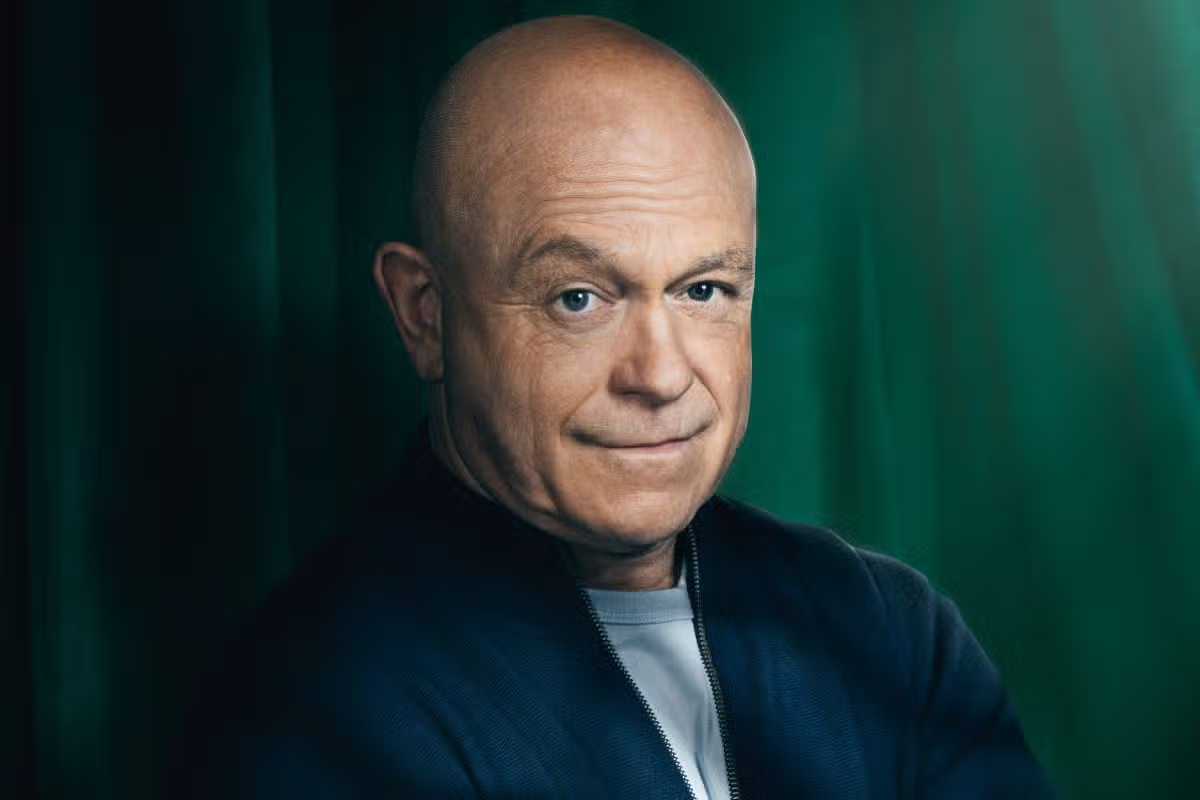
Ross Kemp wants to prove he’s more than just a tough guy while Richard E Grant hopes being ‘geriatric’ will excuse him from the money-making missions

Ross Kemp wants people to know he’s got a sense of humour under that tough exterior(Image: CREDIT LINE:BBC/Studio Lambert/Cody Burridge/BBC Creative)
There’s just three days to go until the new series of Celebrity Traitors hits the screens and some of its biggest stars have revealed what drove them to sign up for the hit BBC1 show.
Former EastEnders star turned documentary maker Ross Kemp says he is a huge fan of the series, and of host Claudia Winkleman, and wants to show people that there’s more to him than just playing, or being, a tough guy.
“I think if I’m able to stay or survive for a period of time, it would give people an opportunity to see that I’m not just Grant Mitchell or a man that goes around the world confronting people with guns,” he says. “I think obviously there will be people that will only know me as Grant, and then people may have seen the documentaries, which are often quite brutal. I think people probably think that I don’t have any kind of sense of humour whatsoever, which hopefully will come out.”
That said, the 62-year-old admits that being a real-life hard man might actually be his biggest asset when it comes to The Traitors. “My strength hopefully would be some of the physical challenges. I’m a qualified HSE diver, so anything with water I should be able to do. I don’t mind heights too much, I don’t mind cold weather, I’ve completed hostile environment training and I don’t mind being uncomfortable, so I should be able to make a good contribution to Missions.”
But ahead of filming, he admitted he did have a few nerves. “There’s an element of: A, I don’t have control over this; B, I don’t want to let the side down; and C, I don’t want to let my family down by making myself look an idiot.”
Unlike Ross, actor Richard E Grant is hoping to pretty much swerve the Missions altogether – using his age as an excuse. The 69-year-old says: “Jerry Hall and I are the geriatrics of the great group. So, I’m rather hoping there will be some leeway about whether we’re expected to bungee jump off the castle’s wall.”
Richard, whose wife Joan Washington died five years ago, openly admits he is desperate to be picked as a Traitor because he feels they hold all the power. “Absolutely! I would love to be a Traitor,” he laughs. “You have no control in real life over anything. Any chance for that would be welcome – and a little bit of mischief is always welcome.”
He feels he’d be good in the role because he is “definitely” better at telling lies than spotting them and believes that a competitive nature is a pre-requisite for actors. “You can’t survive the profession without being so. It’s too brutal.”
But he doesn’t think his award-winning acting skills will actually help him much. “I think it’ll make people more suspicious because they assume that you’re a natural-born liar. I’ve played so many villains that I assume people will think that I’m a bad egg.”
Whatever happens, he’s hoping his positive attitude will help him to thrive at the Round Tables. “My weakness will be trying to hide what I feel about somebody, and my strength is that I’m a glass three-quarters full person.”
Jerry, 70, says she’s “completely obsessed” with the TV game and was thrilled when she learned that pal Richard was also taking part. “Richard was my neighbour for 30 years and we did a movie together called Tooth, where we played Tooth Fairies, and it was ridiculous,” she says. “We had such a laugh, and I went on holiday with him earlier this year, just after Christmas, to Africa with some friends. And we danced all night and had so much fun! Little did we know back then that we’d both be here.”
Unlike Richard, she is embracing the Missions and believes she can contribute to the effort to win the £100,000 prize pot despite being the oldest in the game. “I am quite an active person,” she explains. “I don’t sit down much. I have a lot of animals – two dogs, a cat, three horses, eight chickens. I do a lot of gardening. I’m very, very busy, and then I babysit my three grandchildren a lot.”
And she has revealed certain secret skills that might come in useful. “I was a girls’ leg wrestling champion in my school district growing up which is very popular in Texas. I come from a very athletic family. My sister Cindy was a girls’ champion bull rider and my sister Rosie was a Dallas Cowboys cheerleader. We all used to train horses too and you just get bucked off all the time.”
She says the whole of her immediate family is behind her, including former husband Mick Jagger and their four grown-up kids. “I’m very competitive, as are Mick and our children. My competitive nature will always override any fear. I’m going to try to behave myself on the show. I’m going to try and be a good sport.”
She would like to be a Traitor, even though she thinks she has Faithful-style sleuthing in her genes. “All the men in my family have been law enforcement officers and in the military. My father was General Patton’s staff sergeant on all his campaigns, so I think I get my organisational skills from him. All my uncles, even my nephews, have been policemen.”
Maya Jama was advised to take part by her Masked Singer pal Jonathan Ross – the first Traitor to be outed last year – having decided she wanted to take part in something “where people get to see more of my personality”.
The Love Island host reckons: “I can be warm, but I can also be quite direct when I need to be, so maybe people won’t quite know what to expect.” Laughing that she’s “not massively” competitive, she says her gameplan is to not overthink things, reasoning: “Sometimes you actually do better when you’re relaxed.”
But she also fears her naturally jolly nature might not go down well with those playing the game in earnest. “I’m not naturally very serious, and obviously this is a very serious game. It’ll be interesting to see whether I can keep a straight face.”
Maya, 32, has prepared by watching old episodes to remember deflection techniques if she finds herself accused of being a Traitor. In reality, she’s not actually sure which role she’s aiming for. “At first, I thought I’d rather be a Faithful, but then I started thinking, if I’m doing this experience, why not go all in?”
– The Celebrity Traitors starts on Thursday 1st October at 8pm on BBC One and BBC iPlayer.
Like this story? For more of the latest showbiz news and gossip, follow Mirror Celebs on TikTok, Snapchat, Instagram, Twitter, Facebook, YouTube and Threads.