“No,” he said Saturday, chuckling at the notion. “Nothing’s changed.”
Ah, but everything has changed, the formerly overpaid disappointment having transformed himself into arguably the most important player on baseball’s most important team.
Barely touching 5 feet 10, he looks tiny next to giant countryman Shohei Ohtani, with whom he’ll always be compared because they joined the Dodgers at the same time with equally historic contracts.
Quiet and contemplative, he seems dry next to the charming Ohtani. Employed only as a pitcher, he seems boring next to the goose-bump-inducing Ohtani.
Dodgers pitcher Yoshinobu Yamamoto hoists the MVP trophy as the team celebrates the World Series victory over the Toronto Blue Jays.
(Robert Gauthier / Los Angeles Times)
Struggling at times during his first two regular seasons with the Dodgers while Ohtani was twice voted National League MVP, Yamamoto was originally overshadowed by the greatest player in history.
Until last October, when he became one of the greatest World Series pitchers in history.
It was crazy. It was historic. It was two allowed runs in 17 ⅔ innings with 15 strikeouts and two walks.
Put it another way: It was more compelling than Sandy Koufax’s three-hit shutout on two days rest to win the 1965 World Series over the Minnesota Twins.
It was Yamomania. It was Bulldog 2.0. But if you believe the guy on the mound, it barely made a ripple.
At Camelback Ranch on Saturday, in his first news conference since his World Series heroics, he shrugged and acted like those games were just a walk in the park — except, of course, he barely walked anybody in the park.
Someone asked, how did the World Series change him?
Um, it didn’t.
“I was able to get into the offseason with a great feeling and I was able to go into the offseason with more calmness,” he said through interpreter Yoshihiro Sonoda.
Someone else asked, did he have to alter his legendary workload in the offseason?
Er, no.
“As a matter of fact, the amount of work I did last year has not been affected in terms of preparation,” he said. “In November, I took off and then I began a gradual ramping up. It’s been like a normal offseason.”
Then someone asked, has he watched anything from that World Series?
Actually, yes!
“Of course, that moment of the last out,” he said. “But when I reflect back on that series, there’s so many great plays they made. Also there’s the small play which was very important. So many great scenes.”
One of the best scenes was the one nobody saw, after Yamamoto had thrown 96 pitches in a Game 6 victory.
He was done. He told his personal trainer he was done. Dave Roberts told the media he was done.
But then, in his words, he got “tricked.”
According to a report by then-Times columnist Dylan Hernández, trainer Osamu Yada told Yamamoto, “Let’s see if you can throw in the bullpen tomorrow.”
Dodgers pitcher Yoshinobu Yamamoto throws live batting practice during a workout Friday during spring training at Camelback Ranch.
(Ross D. Franklin / Associated Press)
The trainer figured Yamamoto’s mere presence as a potential reliever would inspire the Dodgers and worry the Blue Jays.
Yamamoto figured he was just going to the bullpen for show.
Oh, he put on a show, all right.
After he pitched 2⅔ scoreless innings to win the game and the World Series championship for the Dodgers, the gamesmanship had been transformed into greatness, and the con man had become a hero.
“For him to have the same stuff that he had the night before is really the greatest accomplishment I’ve ever seen on a baseball field,” said Dodgers baseball boss Andrew Friedman to reporters after the game.
Yamamoto explained afterward, “I didn’t think I would pitch. But I felt good when I practiced and the next thing I knew, I was on the mound in the game.”
And before he knew it, history.
“I really couldn’t believe it,” Yamamoto said. “I was so excited I couldn’t even recall what pitch I threw at the end.”
Now, with the Dodgers chasing a third consecutive championship and Yamamoto involved in a daring race for a Cy Young Award — who will get there first, he or Ohtani? — a different sort of question must be asked.
How on earth can he pitch any better?
“That’s an internal personal question … as far as, can you repeat and continue to get better than what you’ve been,” Roberts said. “Certainly there’s a high bar, but there’s always room for improvement and I can’t find anything right now to be quite honest, but …”
Yamamoto needs to stay healthy. He made his major-league high 30 starts last year after making just 18 the previous year. He needs to do that again to support the other frail Dodgers starters.
Yamamoto also needs to take care of himself while playing for Japan in the upcoming World Baseball Classic. Ohtani is not pitching, but Yamamoto is, and he doesn’t need to wreck his arm.
Finally, he needs to continue acting like the ace that he has become, from his uncomplaining leadership to his dazzling arsenal.
“Every time he takes the ball, he expects to win and we expect to win,” Roberts said.
That is the bottom line on Yoshinobu Yamamoto’s new reality. He was once Ohtani’s sidekick. He is now Ohtani’s partner.
Like it or not, his life has changed. Witness the crowd that screamed for him Saturday at Camelback Ranch like they always scream for Ohtani.
Spain and Portugal are bracing for a new storm, just days after Storm Leonardo’s deadly floods killed at least two people — one in Portugal and one in Spain — and forced more than 11,000 residents to evacuate their homes.
On Saturday, authorities in Portugal mobilised more than 26,500 rescuers as Storm Marta approached, forcing three municipalities to postpone Sunday’s presidential vote until next week due to severe weather.
Recommended Stories
list of 3 itemsend of list
Both countries issued warnings of further flooding after previous heavy rains had submerged roads, disrupted train services, and displaced thousands. Portuguese forecasts warned of heavy rain, strong winds, and rough seas, with alerts active across the country.
In Spain, much of the south, particularly Andalusia, and the northwest were placed on orange alert for heavy rain and violent storms, the national meteorological agency Aemet said.
Other regions, including Castilla‑La Leon, Galicia, Murcia, and the Valencian Community, also received warnings. While rainfall was expected to be less “exceptional” than during Storm Leonardo, authorities cautioned that saturated ground increased the risk of flooding and landslides.
New downpours in Andalusia added to earlier rain that had already caused widespread flooding, landslides, and forced more than 10,000 people from their homes.
Many roads remained closed, and rail services were largely suspended, with officials urging residents to limit travel wherever possible.
Mario Silvestre, commander at Portugal’s civil protection agency, described the forecast as “extremely worrying”.
Juan Manuel Moreno, president of the Andalusia region, wrote on X that the “rivers have hit their limit,” warning of gusts of wind reaching 110 kilometres per hour (68 miles per hour), landslides, and flash floods.
“All the furniture is completely destroyed, the water broke the window, forced the doors open and then burst through the window from the other side,” Francisco Marques, a municipal employee in the central village of Constancia, told the AFP news agency.
After flying over flood-hit areas in southern Spain near Cadiz on Friday, Prime Minister Pedro Sanchez warned that “difficult days” lay ahead for the region as a result of the “very dangerous” weather forecast. Sanchez added he was “bowled over at seeing the endless rain”.
Portuguese Prime Minister Luis Montenegro said the damage exceeded four billion euros ($4.7bn).
Portugal was already reeling from the effects of Storm Kristin, which led to five deaths, hundreds of injuries, and tens of thousands without power, when Leonardo struck earlier this week.
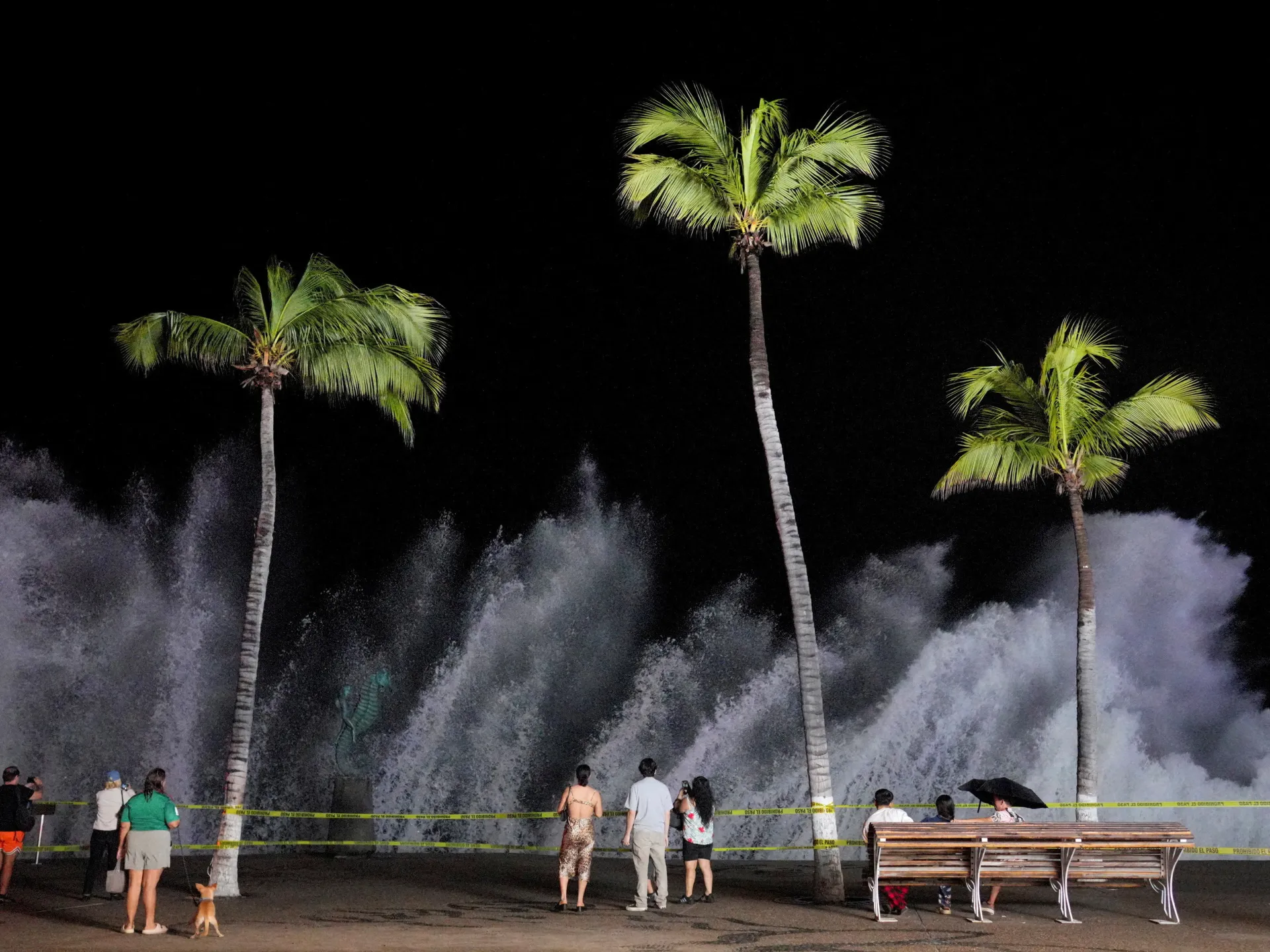
Portugal’s National Meteorological Institute (IPMA) has placed the entire coastline on orange alert due to heavy seas, with waves reaching up to 13 metres (43 feet) high. Eight of the 18 districts on the mainland, mainly in the centre and south, are also on orange alert.
“All river basins remain under severe pressure,” particularly the Tagus River in the Lisbon region and the Sado River further south, a spokesperson for the National Civil Protection Authority told AFP.
One person died during Storm Leonardo in Portugal, and 1,100 people were evacuated across the country. A succession of atmospheric depressions forced Portugal’s dams to release “a volume of water equivalent to the country’s annual consumption” in just three days, Jose Pimenta Machado, president of the Portuguese Environment Agency, said on Friday.
Leonardo is the latest in a series of half a dozen storms to batter the Iberian Peninsula this year.
Published On 5 Feb 20265 Feb 2026
Share
A man has lost his life in Portugal after floodwaters engulfed his car, and in Spain, a girl has been reported missing after being swept away by a river as Storm Leonardo has battered the Iberian Peninsula with torrential rain and gale-force winds.
Leonardo is the latest in a wave of half a dozen storms to sweep across Portugal and Spain this year, causing several fatalities, destroying infrastructure and leaving thousands of homes without power.
Recommended Stories
list of 3 itemsend of list
Portuguese authorities confirmed on Wednesday that a 70-year-old man died in the southern region of Alentejo after floodwaters swept his vehicle off a road near a dam.
In southern Spain’s Malaga province, a girl remains missing after she was dragged away by the Turvilla River in Sayalonga while trying to rescue her dog. The animal reportedly managed to reach safety, and emergency teams resumed the search for the girl at first light on Thursday, according to local and national news reports.
“We spent the whole afternoon and night yesterday searching in the river from the place where the girl fell in until the very end of the river. We found the dog, but not her,” Malaga fire chief Manuel Marmolejo said on Spanish television on Thursday.
Spain’s State Meteorological Agency has warned that Storm Marta, the next front in the ongoing “storm train”, is expected to reach the region this weekend.
Portuguese Economy Minister Manuel Castro Almeida stated that reconstruction efforts after Storm Kristin alone may exceed 4 billion euros ($4.7bn).
In Alcacer do Sal in southern Portugal, residents were forced to wade through waist-deep water after the Sado River breached its banks following a series of storms. Restaurant terraces were submerged, and shopkeepers and homeowners used stacked sandbags in an attempt to protect their properties from the rising floodwaters.
“I’ve never seen anything like this. It’s surreal,” resident Maria Cadacha told the Reuters news agency. “There are a lot of people here, very good people, many shopkeepers, homes with damage. I wouldn’t want to be in their shoes.”
Andalusia’s emergency services reported attending to more than a million incidents by midnight on Wednesday.
Antonio Sanz, head of the regional government’s interior department, confirmed that 14 rivers and 10 dams were at “extreme” risk of overflowing due to the severe conditions.
In Portugal, the National Civil Protection authority registered at least 70 incidents by early Thursday as the region continued to monitor the impact of the storm.
New Delhi, India – The latest release of documents related to the US Justice Department investigation into the crimes of convicted sex offender Jeffrey Epstein has set off political infernos around the globe for featuring the names of world leaders.
The tranche of files, which includes more than three million pages of documents, was released on Friday. This is the largest release since US President Donald Trump’s administration passed a law last year to force the release of the documents.
Epstein was convicted in 2008 of sex offences but avoided federal charges – which could have seen him face life in prison – by doing a deal with prosecutors. Instead, he received an 18-month prison sentence, which allowed him to go on “work release” to his office for 12 hours a day, six days a week. He was released on probation after 13 months.
In 2019, he was arrested again on charges including the sex trafficking of minors. But he died by suicide in a Manhattan jail cell in 2019 before his trial could commence.
With this latest disclosure of documents and emails linked to the cases against him, yet more has been revealed about the disgraced financier’s sexual abuse of young girls and his interactions with wealthy and powerful figures from the United Kingdom, Australia, Norway, Slovakia and India.
Simply being named in Epstein documents or emails does not mean a person is guilty of criminal wrongdoing, and, so far, no charges have been brought against individuals named in connection with the sex offender.
However, the new documents show communications between high-profile figures in the US, including Trump, former President Bill Clinton, and business tycoons such as Bill Gates and Elon Musk.
Here is what we know about some of the powerful men (and one woman) from other countries who have featured in these documents.
Demonstrator Gary Rush holds a sign before a news conference on the Epstein files in front of the US Capitol, November 18, 2025, in Washington, DC, the United States [AP Photo/Mariam Zuhaib]
Narendra Modi, Indian prime minister
Documents released on Friday reveal conversations between Anil Ambani, the billionaire chairman of Reliance Group who is close to Prime Minister Narendra Modi, and Epstein. All the conversations took place in the years following Epstein’s first conviction for sex offences in 2008.
The two emailed each other about a range of issues, from sizing up incoming US ambassadors to India to setting up meetings for Modi with top US officials.
Ambani is the elder brother of India’s richest man, Mukesh Ambani, who is also close to PM Modi.
Anil Ambani, chairman of India’s Reliance Communications, attends a news conference in Mumbai, India, June 2, 2017 [Shailesh Andrade/Reuters]
On March 16, 2017, two months after Trump was sworn in for his first term as president of the US, Ambani sent an iMessage to Epstein, saying “Leadership” was asking for his help to connect with senior figures in Trump’s circle, including Jared Kushner and Steve Bannon.
Ambani also asked for advice from Epstein about a possible visit by Modi to meet Trump “in may (sic)”, before setting up a call in the messages.
In another iMessage exchange two weeks later, on March 29, Epstein wrote to Ambani: “Discussions re israel strategy dominating modi dates (sic).” Two days later, Ambani informed Epstein that Modi would visit Israel in July and asked the disgraced financier: “who do u know fir track 2”.
On June 26, Modi met Trump in Washington on his first visit since Trump became president.
Then, on July 6, 2017, Modi became the first-ever Indian prime minister to visit Israel. He snubbed the Palestinian Authority, prompting condemnation from Palestinian officials.
That year, New Delhi became the largest buyer of Israeli weapons, amounting to $715m worth of purchases. The defence partnership between the two countries has since continued despite Israel’s genocidal war in Gaza.
This marked a sharp change from India’s history of advocating for the Palestinian cause. It only opened up formal diplomatic ties with Israel in 1992. Before that, Indian citizens had been barred by India from travelling to Israel since the country’s creation in 1948.
After Modi’s visit on July 6, Epstein emailed an unidentified individual he referred to as “Jabor Y”, saying: “The Indian Prime minister modi took advice. and danced and sang in israel for the benefit of the US president. they had met a few weeks ago.. IT WORKED. !”
Indian Prime Minister Narendra Modi shakes hands with Israeli Prime Minister Benjamin Netanyahu as they wave to the crowd during a reception for the Indian community in Tel Aviv, July 5, 2017 [Ammar Awad/Reuters]
Ambani Reliance Defence Ltd also entered a joint venture with an Israeli state defence group last year in a deal valued at $10bn over a decade.
Shortly after Modi’s visit to Israel, Larry Summers, former Harvard University president and former secretary of the US Treasury, asked Epstein if he still thought Trump was a better president than rival candidate Hillary Clinton would have been. Epstein responded affirmatively, stating, “yes, defintley India israel. for example great and all his doing (sic).”
In another conversation revealed in the latest document drop, Epstein offered to arrange a meeting between Modi and former White House chief strategist Steve Bannon just hours after Modi had won a thumping majority in the Indian national election in 2019.
In an iMessage to Bannon on May 19, 2019, Epstein wrote, “modi sending someone to see me on thurs,” referring to Ambani.
That Thursday, May 23, Epstein met Ambani in New York and his calendar for that day shows no other meeting scheduled.
After the meeting with Ambani, Epstein wrote to Bannon: “really interesting modi meeting. He won [the 2019 parliamentary elections] with HUGE mandate. His guy said that no one in wash speaks to him however his main enemy is CHINA! And their proxy in the region pakistan. They will host the g20 in 22.. Totally buys into your vision.”
Epstein then messaged Ambani: “I think mr modi might enjoy meeting steve bannon, you all share the china problem.” And Ambani wrote back: “sure.”
Epstein then wrote back to Bannon: “modi on board.”
It is not immediately clear if Ambani was authorised to approve such decisions on behalf of the Indian government. There is no public record either of a meeting between Bannon and Indian officials that summer.
Hardeep Singh Puri, Indian politician
Another major Indian name featured in the Epstein files is Hardeep Singh Puri, who retired from the Indian Foreign Service to join Modi’s Bharatiya Janata Party in 2014.
In the documents are email exchanges between Puri and Epstein that began in June 2014, with the sex offender writing to Puri about Reid Hoffman, co-founder of LinkedIn, and arranging a visit by Hoffman to India.
Following an exchange of emails, Puri wrote a detailed pitch for investment opportunities in India to Epstein and Hoffman, laying out economic plans in India under the newly elected Modi government, and urging Hoffman to visit. Documents also show Puri met Epstein at his Manhattan townhouse on at least three occasions: February 4, 2015; January 6, 2016; and May 19, 2017.
Puri told Indian media on Sunday that his visits and interactions with Epstein were strictly business-related.
In December 2014, Puri wrote to Epstein again by email. “Please let me know when you are back from your exotic island,” he wrote, asking to set up a meeting in which Puri could give Epstein some books to “excite an interest in India”.
US House of Representatives Oversight Committee Democrats/Handout
How has the Indian government responded?
India has dismissed the references to Modi in the Epstein files.
“Beyond the fact of the prime minister’s official visit to Israel in July 2017, the rest of the allusions in the email are little more than trashy ruminations by a convicted criminal, which deserve to be dismissed with the utmost contempt,” External Affairs Ministry Spokesperson Randhir Jaiswal said on Saturday.
However, the opposition, led by the Congress Party, has demanded answers about the latest disclosures – particularly those relating to Israel relations.
The Congress Party’s general secretary in charge of organisation, KC Venugopal, wrote in a post on X: “The reports of the new batch of Epstein Files are a huge wake-up call about the kind of monsters who have access to PM Modi, and how susceptible he is to foreign manipulation. The Congress demands that the Prime Minister personally come clean on these disturbing disclosures that raise serious questions.”
Former Australian Prime Minister Kevin Rudd, left, attends the Munich Security Conference in Munich, Germany, February 16, 2018 [Michaela Rehle/Reuters]
Kevin Rudd, former Australian prime minister
Australian diplomat Kevin Rudd, who served as the country’s prime minister from 2007 to 2010 and again in 2013, has also been named in the Epstein files.
Rudd’s name appeared on Epstein’s daily meeting schedule for June 8, 2014, at 4:30pm. On that day, Epstein flew to New York from his private island, Little Saint James in the US Virgin Islands, for several meetings, including with Rudd.
Rudd, who is currently serving as Australia’s ambassador to the US, claims he did not visit Epstein and denies any friendship with him.
But the newly released files show that two days before the scheduled appointment, Epstein emailed his assistant, Lesley Groff, on June 6, 2014 to ask for non-vegetarian food to be made available at the upcoming Sunday lunch “as now kevin rudd is also coming”. Rudd was not in government at the time.
Just seconds later, Epstein follows up in another email to Groff: “Kevin Rudd might also stop by former prime minister austrailia [sic].”
US President Donald Trump shakes hands with the United Kingdom’s ambassador to the United States, Peter Mandelson, after announcing a trade deal with the UK, in the Oval Office at the White House in Washington, DC, the US, May 8, 2025 [Leah Millis/Reuters]
Peter Mandelson, UK politician
The name of Peter Mandelson, a former UK cabinet minister and life peer, had appeared in tranches of Epstein files previously made public. But he resigned from his membership of the UK’s ruling Labour Party on Sunday after yet more links to Epstein surfaced in the latest dump.
Mandelson was sacked as the UK’s ambassador to the US last year over his connections to Epstein.
The latest documents reveal that Epstein made $75,000 in payments to Mandelson in three separate transactions in 2003 and 2004.
In his resignation letter to Labour’s general secretary, Mandelson wrote: “I have been further linked this weekend to the understandable furore surrounding Jeffrey Epstein and I feel regretful and sorry about this.”
He said he had “no recollection” of the payments, however.
The latest documents also show that Mandelson discussed with Epstein by email a campaign against Rudd’s proposed mining tax, which would have taxed “super profits” reaped by mining companies at 40 percent, while Rudd was still prime minister.
Norway’s Crown Prince Haakon, Princess Ingrid Alexandra, and Crown Princess Mette-Marit attend the Nobel Peace Prize award ceremony in Oslo, Norway, on December 10, 2025 [Ole Berg-Rusten/NTB/via Reuters]
Mette-Marit, Norway’s crown princess
The latest disclosures from the US Justice Department have embroiled Norway’s crown princess, Mette-Marit, in the Epstein scandal, as they reveal her years of extensive contact with the sex offender.
Mette-Marit, who is married to Crown Prince Haakon, the heir apparent to the Norwegian throne, appears nearly 1,000 times in the Epstein files, with scores of emails sent between the two.
In the emails, Mette-Marit told Epstein, “you tickle my brain”, and called him “soft hearted” and “such a sweetheart”. In another, she thanked Epstein for flowers he had sent when she was feeling unwell, signing off with “Love, Mm”.
In 2012, Mette-Marit told Epstein he was “very charming” and asked if it was “inappropriate for a mother to suggest two naked women carrying a surfboard for my 15 yr old sons wallpaper?”
The revelations come at a tricky time for Norway’s royal family, with Mette-Marit’s son, Marius Borg Hoiby – who was born before her marriage to Crown Prince Haakon – set to go on trial for rape later this week. Hoiby has been accused of 38 crimes, including the rapes of four women as well as assault and drug offences.
Jeffrey Epstein and Miroslav Lajcak, a Slovak politician, diplomat, and former president of the United Nations General Assembly, appear together in this undated image from Epstein’s estate released by Democrats on the US House of Representatives Oversight Committee on December 18, 2025 [House Oversight Committee Democrats/Handout via Reuters]
Miroslav Lajcak, Slovakian national security adviser
The new tranche of Espstein files has also prompted the resignation of Slovakia’s national security adviser, Miroslav Lajcak.
Photos and emails released with the documents reveal that he met with Epstein several years after the sex offender was released from jail and exchanged text messages about women in 2018 during his second spell as foreign minister.
On Sunday, Slovakia’s Prime Minister Robert Fico accepted Lajcak’s resignation, and wrote on Facebook that the government was losing “an incredible source of experience and knowledge in foreign policy”, adding that the former minister had “categorically denied and rejected” the allegations made against him.
Jan. 31 (UPI) — A northeasterly storm has created blizzard conditions in the Carolinas and triggered state of emergency declarations in North and South Carolina and Georgia on Saturday.
The intensifying storm system is centered over the Atlantic Ocean and near the Carolinas and Georgia coastline after its central pressure dropped by up to 40 millibars over the past 24 hours.
Hurricane-force wind gusts of between 60 mph and 80 mph are contributing to blizzard conditions along the Outer Banks coastal plains areas, and more than 10,000 flights have been canceled through the weekend.
The Hampton Roads area of Virginia also is getting pummeled with wintry weather from the storm system, and the National Weather Service has issued a winter storm warning through 7 p.m. EST on Sunday for the commonwealth’s coastal areas and parts of North Carolina.
The winter storm is delivering the most snow in two decades to areas that rarely see significant amounts of snowfall.
Icy road conditions caused hundreds of collisions as of Saturday afternoon, and wave action from the storm’s strong winds and a high tide is threatening to damage or destroy homes along the coast.
The National Weather Service is forecasting between 5 and 9 inches of snowfall and sustained winds of between 33 and 41 mph, with gusts up to 50 mph, along the coastal areas of the Carolinas and into neighboring areas in Virginia and northern Georgia.
The snowfall likely will end during the overnight hours, but northwest winds will remain strong, with sustained wind speeds of between 28 and 33 mph and gusts of up to 50 mph into Sunday afternoon.
Although windy, the clouds are predicted to clear during the afternoon hours.
After an enormous storm dumped 3 feet of snow on Mammoth Mountain, rookie ski patroller Claire Murphy and a partner scrambled to help make the resort safe for guests ahead of a very busy — and very lucrative — Presidents Day weekend.
In howling wind and blowing snow, the patrollers labored to clear enormous piles of fresh, unstable powder from a steep, experts-only run, one of a group appropriately named the “Avalanche Chutes.”
Ski patrollers use hand-held explosives, and their own skis, to deliberately trigger small slides in the chutes before the resort opens, to prevent an avalanche from crashing down later in the day on thousands of paying customers gliding happily — and obliviously — along the much gentler slopes below.
Mammoth Mountain ski patrol members Claire Murphy, left, and Cole Murphy (no relation) both died while doing avalanche mitigation on the mountain.
(Courtesy of Lisa Apa; Tracy Murphy)
But something went horribly wrong that day. Instead of remaining safely above the sliding snow, Murphy and her partner got caught in it. He was buried up to his neck but survived. She was trapped beneath the collapsing wall of white and got crushed to death against a towering fir tree. She was 25 years old.
The avalanche that killed the young patroller on Feb. 14, 2025, stunned Mammoth’s tight-knit ski community. Her friends and colleagues were consumed with grief, but most regarded it as a freak accident, something that hadn’t happened before and was unlikely to be repeated.
But then, less than a year later, it happened again.
Share via
In late December — after a “Christmas miracle” storm dumped more than 5 feet of snow on the previously parched resort — 30-year-old ski patroller Cole Murphy (no relation to Claire) and his partner were hurrying to clear the same chutes before the busiest week of the year.
They, too, were caught in a deliberately triggered slide. Cole’s partner suffered a serious leg injury, but he survived.
Signs on top of Lincoln Mountain at Mammoth advise skiers that the runs are for experts only.
Cole was swept away and carried hundreds of feet down the mountain, where he suffocated beneath more than a meter of avalanche debris, according to two sources. Both were involved in the effort to save Cole, but asked not to be identified because they are not authorized to speak to the media.
With the sudden deaths of two young patrollers in such a short span, and in such distressingly similar circumstances — Claire and Cole came to rest within a few hundred yards of each other — questions began to swirl.
Were the resort’s managers pushing too hard to open the mountain after major storms? Had training standards slipped, pushing relatively inexperienced ski patrollers into dangerous situations? Are young ski patrollers afraid to speak up, even when they think they’ve been asked to take unreasonable risks?
Lisa Apa, Claire Murphy’s mother, said she begged mountain officials to take a hard look at their training and safety procedures after her daughter’s death — to figure out what went wrong and make sure it never happened again.
They blew her off, she said.
A small memorial remains at a tree, where an avalanche claimed the life of ski patrol member Claire Murphy.
When she heard about the second death, Apa said she immediately fired off a text to a senior ski patrol manager at Mammoth: “You killed another ski patroller … you’ve learned nothing!”
She told a Times reporter last week, “Claire would be f—ing furious if she knew this happened a second time.”
Mammoth Mountain officials have remained measured in their public response.
In a statement emailed to The Times, Mammoth Mountain President and Chief Operating Officer Eric Clark wrote that, after Claire Murphy’s death, the ski patrol had been empowered to “pursue a slower, phased opening of the mountain on storm days.”
After Cole Murphy’s death 10 months later, Clark wrote that resort managers “immediately instituted” measures to “de-pressurize storm mornings,” giving ski patrol more time to work and more latitude to keep chair lifts closed until the mountain is deemed safe.
In a follow-up interview, Clark insisted the pressure on Mammoth’s managers to open quickly after big storms comes from customers desperate to ski fresh powder, not from corporate executives chasing profits.
Chair 22 takes skiers to the top of Lincoln Mountain at Mammoth, where two ski patrollers have been killed by avalanches in the last year.
“Maybe 10 years ago that was different,” Clark said. But after the most recent accident, the message from the resort’s owners — Alterra Mountain Co., a privately held, multibillion-dollar conglomerate that owns 19 resorts across the U.S. and Canada — was to use caution.
“Make sure you’re taking your time,” Clark said they told him.
Apa, who sobbed talking about her daughter, gasped when she heard that.
Of course senior executives offer reassuring words after a tragedy, she said. But as a former business journalist, who once anchored a show called “Street Smart” on Bloomberg TV, Apa said she spent her career around top corporate officers. Anyone who believes profit motive doesn’t drive such decisions is naive, she said.
“Maybe you’re not getting a phone call, or an email, from the CEO saying, ‘get this mountain open today!’” she said. But any manager who develops a reputation as someone who’s afraid to open after a storm, on the busiest day of the year, “won’t be around very long,” she said.
No doubt, many skiers are desperate to hit the slopes after a storm brings fresh powder.
The sensation of floating down the hill with almost no resistance is dreamlike and addictive. No other conditions compare.
That’s why social media is full of influencers bragging about their epic “pow days,” and why hordes of paying customers start champing at the bit when the mountain is covered in a fresh blanket of white, but the ski patrol won’t let them at it.
A former Mammoth ski patroller recalled years of riding lifts with eager customers complaining that the steepest runs with the deepest powder were still closed for avalanche control.
Mammoth Mountain‘s summit is more than 11,000 feet high and averages nearly 400 inches of annual snowfall.
“I’d point to all of the mountains around Mammoth,” he said. There are dozens of beautiful, towering summits in the surrounding eastern Sierra with absolutely no rules and nobody to stop an adventurous soul from climbing up and skiing down.
But there are no chairlifts, so getting up those mountains is a physically exhausting test of will. And there’s no avalanche control, so you’re on your own when it comes to determining which slopes are safe, which are death traps.
“If you’re such an expert, why aren’t you over there,” the ski patroller said he’d ask, usually ending the conversation.
Within the boundaries of commercial ski resorts, avalanche control takes many forms.
At Mammoth, the steepest slopes near the 11,000-foot-high summit are controlled with a howitzer — an actual cannon. When the resort is closed, crews fire explosive shells across a valley up into the highest, heaviest and most threatening piles of fresh snow. Their aim has to be excellent, since stray shrapnel can do serious damage to ski lifts. But it’s a remarkably efficient way to get enormous quantities of snow sliding down the mountain without putting anyone at risk.
The ski patrol office at the top of Lincoln Mountain.
Another option is called a “Boom Whoosh,” which looks like an industrial chimney and is installed just above spots where dangerous piles of snow frequently accumulate. It works by remote control, igniting a mixture of hydrogen and oxygen — like lighting a gigantic camping stove — to create a shock wave that triggers an avalanche. Mammoth has one at the moment, near the summit above a run called Climax, and officials are hoping to install more.
Then there’s the old-fashioned technique: sending ski patrollers into the steepest, most technical terrain with backpacks full of explosives.
That’s what happens in the Avalanche Chutes — known locally as “the avis” — a handful of natural rock and snow slide paths carved by thousands of years of erosion into the side of a 10,000-foot sub-peak called Lincoln Mountain. Patrollers start early in the morning after a storm and ride a snowcat — like a school bus on tank treads — to a plateau just above the chutes.
Big red signs with black diamonds are everywhere on Lincoln Mountain, indicating its trails are for experts only. The chutes are the steepest trails of all, marked on maps with two black diamonds, the highest rating possible. Casual skiers go weak in the knees at the thought of making a wrong turn onto a vertigo-inducing “double-black.”
After hopping out of the snowcat, patrollers divide into pairs and work their way toward the chutes. Sometimes the wind is so strong it scours nearby boulders free of snow, so they have to take off their skis and climb over the bare rocks in their awkward, plastic boots to get to the edge.
Once in place, one of the patrollers tosses a hand-held explosive — it looks like a cartoon stick of dynamite — down the hill. The patrollers cover their ears, wait for the boom, and hope the explosion has loosened the big stuff and sent it sliding.
Then they ski down in carefully choreographed zigzags, sometimes hopping up as they go, to dislodge any remaining loose slabs beneath their feet.
A view of the Avalanche Chutes at Mammoth, where two ski patrollers have died in the last year.
The key to “ski cutting,” as it’s called, is to make sure your partner is anchored in a secure spot, usually off to the edge of the chute and out of the way of a potential slide, before you start moving.
In normal conditions, it’s just another day at the office. But after a massive “atmospheric river” storm, the risks increase.
This season’s Christmas storm was a monster, and it arrived with the biggest crowds of the year.
To keep the customers happy, Mammoth executives opened the lower part of the mountain on Christmas Day, the portion least exposed to avalanche risk. But there was so much fresh snow, patrollers spent the day digging out people who had simply gotten stuck in huge drifts, even on the relatively flat terrain.
And then, in the early afternoon, Raymond Albert, a 71-year-old regular known to fellow skiers as “every day Ray,” was spotted in a pocket of deep, fresh snow beside a well-traveled run near the bottom of Lincoln Mountain.
He had somehow popped out of his skis, which were behind him, and pitched forward, ending up with his head in the snow and his feet in the air, according to a written report of the incident provided to his family.
Looking down one of the Avalanche Chutes at Mammoth Mountain.
It’s unclear how long he was in that position before bystanders dug him out. When ski patrollers arrived he had no pulse. With so much fresh snow on the ground, the patrollers struggled to find a firm enough surface to lay him on his back and perform CPR. They finally used a bystander’s legs as a makeshift platform, according to the report, but could not revive him.
In a normal week, Albert’s death would have been big news, but it received almost no public attention because early the next morning, Cole Murphy and his colleagues headed up Lincoln Mountain to clear the chutes.
It’s still not publicly known what caused the slide that buried Murphy and his partner, but according to two people involved in the effort to save Murphy’s life, witnesses said that an avalanche triggered by an explosive in a neighboring chute might have “propagated” horizontally to where Murphy and his partner were working — taking them by surprise.
Resort officials declined to answer detailed questions about either Claire or Cole Murphy’s deaths, saying their lawyers advised them not to offer specifics during ongoing investigations by the California Division of Occupational Safety and Health.
As soon as Cole Murphy disappeared in that wall of white, the clock started ticking. More than 90% of avalanche victims survive if they can be freed within 15 minutes, according to the Utah Avalanche Center, but the odds drop “catastrophically” after that.
It took Cole’s desperate colleagues 18 minutes to locate him and dig him out, sources said. When they finally pulled him free, his skin was blue and he wasn’t breathing, the sources said.
He was airlifted to a hospital in Reno and pronounced dead days later.
Tracy Murphy, Cole’s mother, said her son loved Mammoth Lakes and the tight bonds he forged on that “little island” of outdoor enthusiasts, surrounded on all sides by hundreds of miles of mountains and desert.
After Claire’s accident, Tracy Murphy said her son was “shaken to the core.”
Cole’s roommate was the patroller in the chute with Claire that day, she said. Last month, the roommate was among the patrollers frantically trying to dig Cole free.
She’s waiting for OSHA’s report, but for now, Murphy said, “I believe that Mammoth would not have knowingly put any patroller in danger. I feel, in my heart, that this was just an extremely unlucky event.”
Her son had been on the job for a few years before his accident; Claire Murphy had been a ski patroller for only a couple of months before hers.
The wind was howling “like a jet engine” that day, according to accounts Apa received from ski patrollers who were there.
The witnesses told Apa that Claire’s partner triggered the fatal avalanche with his skis, and was quickly swallowed by it. But he survived, at least in part because he was about 6½ feet tall and his head remained above the debris.
It’s still a mystery why Claire was in the path of the slide, but the difficulty of hearing and seeing each other amid the wind and blowing snow probably played a part, Apa said.
Seconds after the slide began, it slammed Claire into the tree. When her colleagues dug her out, she was upright, with her back pinned against the trunk. She was facing uphill, Apa said, looking straight at the wall of snow bearing down on her.
Claire probably had no time to react, Apa said, pausing to steady herself before finishing the thought, but she hoped her daughter didn’t suffer. “It kills me to think of her trapped there, scared,” she said.
After hearing about the accident, Apa raced to Mammoth from the East Coast on a private jet provided by the mountain. She implored doctors to keep Claire’s heart beating until she arrived, she said. “I can’t come to a dead body, you have to keep her alive so I can hold her hand,” she begged.
Lisa Apa, left, with her daughter Claire Murphy.
(Lisa Apa)
Apa arrived in time to spend a few days in a Reno hospital with her unconscious daughter. She washed and braided her hair, read her letters from people wishing her well, and thought about what she wanted to say to the other young women on the ski patrol.
“Don’t get out of the snowcat if you’re scared,” she said she told them at Claire’s memorial service and in private conversations. “Go back down the mountain if you think what they’re doing is wrong. You have to say something, you have to.”
But that’s tough, Apa acknowledged, because there are only so many ski patrol jobs in the country, and most of those women had been dreaming about it since they were little girls.
Becoming persona non grata at either of the two big companies that dominate the U.S. ski industry — Alterra and Vail Resorts — could be a career killer, patrollers fear.
Apa said she is still haunted by the possibility that concern for their jobs prevents patrollers from pushing for safer working conditions, and that what happened to Claire and Cole will soon be forgotten.
On a cold, crisp day last week, beneath an almost impossibly peaceful cobalt sky, a reporter skied the Avalanche Chutes with a group of locals including a former patroller and a professional mountain guide who trains clients on avalanche safety.
There had been no significant fresh snow for weeks, so no one was worried about avalanches. Alone on the broad, steep face, the only sound came from the metal edges of skis biting into the hard surface.
The group pointed their skis toward a stand of tall fir trees hundreds of feet below. Some of them had been snapped in half by previous avalanches, one was still caked on its uphill side with thousands of pounds of snow.
And one, just below it, had a recent boot track around its base. A photographer trained his sharp eye on a faded strand of red cloth, light as gossamer, pinned to the trunk at eye level. Dried rose petals hung around it.
Watch: Stranded cars and rough seas as Storm Chandra hits UK
Parts of the UK are under weather warnings as Storm Chandra brings strong winds and flooding across the country.
Poor weather could impact journeys across England, Scotland and Wales until Friday, National Rail warned, as road closures and rail, ferry, and flight cancellations cause widespread travel disruptions.
As of Tuesday night, there were 97 flood warnings, where flooding was expected, and 260 flood alerts, where it was possible, across England.
A major incident was declared in Somerset where some 50 properties were hit by flooding.
In Wales, there were three flood warnings and 16 flood alerts in place, with eight flood warnings and eight flood alerts in place across Scotland.
Charles McQuillan/Getty Images
Motorists contended with heavy flooding near Belfast International airport
Yellow warnings for wind, rain and snow remain in force across parts of England, Scotland and Wales, while an amber warning for wind is in place in the north and east of Northern Ireland, including Belfast.
Clearer skies and freezing temperatures on Tuesday night also raise the fresh risk of icy patches on sodden roads and pathways, the Met Office warned, with much of the UK placed under yellow warnings for ice hazards on Wednesday morning.
The third named storm of the year comes days after Storm Ingrid caused widespread damage and disruption over the weekend.
Schools closed insome parts of Englandand Northern Ireland, andthousands of properties were without power as winds gusted up to around 80mph.
Rain in parts of south-west England is falling on already saturated ground, making flooding more likely.
Firefighters in Devon and Somerset said they had rescued people from 25 vehicles that were stuck in floodwater on Tuesday morning.
In Somerset, Council leader Bill Revans said heavy rainfall had caused “widespread disruption” and warned people to avoid travelling if possible.
Honiton and Sidmouth MP Richard Foord said there were reports of around 20 flooded properties across Devon and Cornwall – a figure expected to increase as river levels peak.
Oliver Kimber in Lostwithiel, Cornwall, said the lane he lives on was inundated with water.
“There was so much water and it was so fast that it just had nowhere else to go, and it was pushing it back up through the drains,” he told BBC Radio Cornwall.
The heavy rain saw several locations – including Katesbridge in Northern Ireland, Mountbatten in Plymouth and Hurn in Dorset – set new January daily rainfall records.
PA Media/Devon and Somerset Fire and Rescue Service
The town of Axminster was among those in Devon to experience flooding
Asevere flood warning, indicating a danger to life, was issued in Upper Frome, Dorchester, while another severe warning ended earlier on Tuesday in Ottery St Mary, Devon – where the Environment Agency said the River Otter had reached its highest recorded level.
“At the moment, it’s a raging torrent,” Jackie Blackford, whose house overlooks the river, told BBC Radio Devon. “It is horrendous – I’ve never seen anything like it.”
Sections of several roads in Dorset, Somerset and eastern Devon have been closed due to flooding and fallen trees.
Local police have asked people not to travel in Exeter, as well as east and mid-Devon, due to increasing reports of flooding. More than 40 schools have either fully or partially closed across the county.
Watch: Latest weather forecast as Storm Chandra brings rain and wind to UK
The Met Office says further downpours are expected for the south-west on Thursday, which may lead to more flooding and transport disruption.
Some schools in the West Midlands were closeddue to flooding, and flood warnings are also in place for parts of Yorkshire.
Rain is forecast overnight into Wednesday in south-east England, while the Met Office is warning of travel disruption due to rain and snow across a swathe of northern England, as well as in the Pennines and south-western Scotland, where the wind mixed with rain and snow could create blizzard-like conditions.
Up to 5cm of snow is predicted, while as much as 20cm could accumulate on higher ground. A section of the A66 between Bowes in County Durham and Brough in Cumbriahas already been shut because of the snow.
Flooding is expected around the River Monnow at Forge Road, Osbaston, as well as at a number of locations along the Afon Lwyd. Gwent Police earlier said the A40 was flooded between Abergavenny and Raglan.
PA Media
A plough clears snow in Middleton-in-Teesdale, County Durham
PA Media
A fallen tree blocked a lane in Houghton-le-Spring, Sunderland
Strong winds are still a hazard for several areas, particularly south-western parts of Scotland, England and Wales.
In Northern Ireland, more than 10,000 properties were without power and more than 300 schools were closed on Tuesday. Peak wind gusts reached 80mph at Orlock Head on the Ards Peninsula.
Several domestic flights to and from Belfast Airport were cancelled, while Scottish regional airline Loganair cancelled at least 12 flights on Tuesday.
Ferry services between Belfast and Liverpool were also cancelled, and several scheduled services from Belfast and Larne were disrupted.
Outside the UK, the Electricity Supply Board (ESB) in the Republic of Ireland said around 20,000 homes, farms and businesses were without power.
Storm Chandra is the third major storm to hit the UK in January, arriving shortly after Ingrid and Goretti – the latter of which was described by the Met Office as among the most impactful to hit Cornwall and the Isles of Scilly in 30-35 years.
Additional reporting by Chloe Gibson and Christine Butler
A driving instructor has shared three important rules for staying safe on the roads as Storm Chandra brings amber weather warnings, 290 flood alerts and winds of up to 80mph
Alan Johnson Social News Reporter
11:39, 27 Jan 2026Updated 11:39, 27 Jan 2026
Storm Chandra is set to cause havoc on UK roads (stock)(Image: georgeclerk via Getty Images)
A driving instructor has issued three crucial safety tips motorists must follow this week as Storm Chandra batters the UK. The Met Office has put an amber weather warning in place, with 290 flood alerts active as of Tuesday morning (January 27) and gusts reaching up to 80mph forecasted in certain areas.
A number of major roads and bridges have already closed in both directions due to the treacherous conditions. “In these kind of conditions there’s a lot of spray and surface spray, so it’s a good idea to put your headlights on,” advised instructor Mark Zondo, who shares driving tips as Theory Test Hero on social media.
He added: “With dipped headlights, this way it is going to be easier for other drivers to see you.”
Mark also highlighted that failing to switch on your lights – even during daylight hours – makes it significantly harder for lorry drivers to spot you, especially when they’re switching lanes.
Regarding spacing between vehicles, meanwhile, he recommended keeping a “nice” distance from the motor ahead. “You can’t really see much for one, there’s a lot of spray and also the road is very slippery because of the wet and so you don’t want to be too close in case you have to brake suddenly,” he explained.
Content cannot be displayed without consent
Demonstrating his final piece of advice, Mark eased his foot off the accelerator gradually instead of hitting the brake sharply to decelerate his vehicle safely amid the torrential rain.
The initial weather alerts took effect at midnight on Tuesday and are set to remain active for 17 hours.
Forecasters are predicting rainfall totals of 20-30mm across the impacted regions, with some spots potentially seeing between 40-50mm.
The Met Office has also cautioned that there will be a “sharp increase” in snow accumulation at higher altitudes, with the likelihood of two to five centimetres settling in areas above roughly 300m, five to 10cm above 400m, and 10-20cm above 500m.
In response to Storm Chandra, National Highways has issued its own guidance. “Road users are advised to plan ahead, avoid unnecessary travel where possible, and allow extra time for journeys,” they stated.
“Drivers should be aware that surrounding local roads may also be affected by flooding and should not attempt to drive through floodwater.”
Speaking more widely about the flooding concerns, National Highways revealed that expert crews will be checking carriageway drainage infrastructure, including gullies, culverts and ditches, looking for obstructions from leaves, silt and debris swept along by heavy downpours.
“If drainage systems are overwhelmed or obstructed, water cannot recede naturally, prolonging closure times,” the transport body warned.
The NHL postponed the Columbus Blue Jackets’ home game against the Kings on Monday night because of a major winter storm that created dangerous travel conditions across much of the United States.
Almost a foot of snow fell in Columbus, Ohio, and windchill factors were forecast to be around minus 15 degrees Fahrenheit on Monday night. The game is rescheduled for March 9 in Columbus.
A huge winter storm brought frigid temperatures, snow, and sleet to more than a dozen US states, cancelling at least 19,000 flights and paralysing travel in and out of the country.