stirs

No Time to Cite Source, He Says : Biden Stirs Row by Using Lines From Briton’s Talk

A feud began brewing Saturday between the presidential campaigns of Sen. Joseph R. Biden Jr. (D-Del.) and Rep. Richard A. Gephardt (D-Mo.) after published accounts that Biden had used part of a speech by a prominent British politician without giving him credit.

Biden acknowledged using the Briton’s lines without attribution. He said it had occurred only once, that he had been pressed for time and that “if I’d have thought, I would have attributed it to him.” But Biden said he had done no wrong, was not sorry–and had not even made a mistake.

Nevertheless, Biden said he would not do it again.

Sources in Biden’s campaign, who spoke on the condition of anonymity, said they suspected Gephardt’s organization of pointing out to reporters that Biden had used lines virtually verbatim from a British television commercial containing excerpts from a speech by Labor Party leader Neil Kinnock.

Joseph Trippi, Gephardt’s deputy national campaign manager, said: “It wasn’t us.”

Still, the incident served to further sour relations between the Biden and Gephardt campaigns.

“It is entirely possible,” said Eric Woolson, Biden’s press secretary in Iowa, “that this will only add to whatever less-than-great feelings that exist between the two campaigns right now. It is obvious from our standpoint that one of the other campaigns feels like Joe Biden is gaining on them.”

If Biden’s opponents and media commentators seize on this episode as a case of plagiarism, it would pose a threat to Biden’s candidacy because it would raise the issue of character, the same issue that drove then-front-runner Gary Hart from the Democratic presidential race last May.

The disclosure of Hart’s rendezvous with model Donna Rice focused attention on what his critics regarded as a character defect–womanizing. If the Biden episode is viewed as plagiarism, it would tend to support allegations that his personality is flawed by a lack of verbal discipline.

In his eagerness to get attention for his candidacy, Biden’s critics contend, he indulges in wisecracks, hyperbole and a lack of candor.

For example, as recently as Friday, at a forum for candidates at the University of North Carolina at Chapel Hill, Biden, along with the other Democratic candidates present, opposed tuition tax credits. Biden said he had never voted for them.

However, according to a legislative report card issued by the National Education Assn., Biden voted in 1978 against an amendment that would have deleted tuition tax credits.

Didn’t Recall Vote

After the forum, Biden said he did not remember such a vote.

The dispute Saturday over Biden’s use of part of the Kinnock TV commercial came after newspapers, including the Des Moines Register and the New York Times, published stories pointing out that Biden had taken lines from Kinnock for his closing statement in a debate at the Iowa State Fair on Aug. 23.

The British Labor Party broadcast the Kinnock commercial during its campaign last May against Prime Minister Margaret Thatcher’s Tories. Despite Labor’s loss, the commercial, put together by the director of the movie “Chariots of Fire” and using music written by the composer of the “Chariots of Fire” theme, was credited with boosting Kinnock, the party’s leader, by nearly 20% in the polls.

Videotapes of the commercial, considered a media classic, were given to Biden and a number of other candidates and journalists by William Schneider, political consultant for the Los Angeles Times, who was in London to write about the British election.

Biden ‘Truly Moved’

In a telephone interview with The Times, Biden said the commercial “truly moved me.”

He cited Kinnock’s eloquence with the music as background. Speaking to an audience in his native Wales, the British political leader asked: “Why am I the first Kinnock in a thousand generations to be able to get to university?” Pointing to his wife, he went on: “Why is Glenys the first woman in her family in a thousand generations to be able to get to university? Was it because all our predecessors were thick?”

Then, referring to Welsh coal miners among his ancestors, he asked why they had not prospered. “Did they lack talent? Those people who could sing and play and recite and write poetry? Those people who could make wonderful, beautiful things with their hands? Those people who could dream dreams, see visions? Why didn’t they get it? Was it because they were weak? Those people who could work eight hours underground and then come up and play football? Weak?

“Does anybody really think that they didn’t get what we had because they didn’t have the talent or the strength or the endurance or the commitment? Of course not. It was because there was no platform upon which they could stand.”

A Democratic Platform

Those lines, Biden said, “remind me of what the Democratic Party stands for–that we give people a platform, a place to stand.”

In his closing statement at the Iowa State Fair debate, Biden began:

“I started thinking as I was coming over here, why is it that Joe Biden is the first in his family ever to go to a university?”

Indicating his wife, he added: “Why is it that my wife, who is sitting out there in the audience, is the first in her family to ever go to college? Is it because our fathers and mothers were not bright? Is it because I’m the first Biden in a thousand generations to get a college and a graduate degree that I was smarter than the rest?”

Then, referring to his Irish kin, he said: “Those same people who read poetry and wrote poetry and taught me how to sing verse? Is it because they didn’t work hard? My ancestors, who worked in the coal mines of northeast Pennsylvania and would come up after 12 hours and play football for four hours? No, it’s not because they weren’t as smart. It’s not because they didn’t work as hard. It’s because they didn’t have a platform upon which to stand.”

In his interview with The Times, Biden conceded that he had not given Kinnock credit for the lines during his appearance at the fair.

“It was a two-minute closing,” Biden said. “There wasn’t a single thing wrong with what I did. The only thing that made it happen was time–the absolute two minutes. . . . If I’d have thought, I would have attributed it to him.”

Biden said the parallels between himself and Kinnock are true.

“So what if I didn’t attribute it to Kinnock? I can’t quite understand this. If I was making up who I was, then that’s one thing,” he said. “I’m quite frankly confused by the whole thing. Even if I didn’t (cite Kinnock), I do not understand what the big deal is. I guess I’m beginning to understand.”

In retrospect, Biden said, he would rather that he had credited Kinnock.

He agreed it would have been better to do so. Biden said he would go on using Kinnock’s lines–and to give him credit each time. “At a minimum I’m going say, ‘To paraphrase Neil Kinnock. . . .’

‘It Wasn’t Wrong’

“Am I sorry? No. Why would I be? First, it wasn’t wrong, secondly it wasn’t a mistake. And thirdly, it’s much to do about nothing.”

Biden called the dispute “a cheap shot.”

He said he had used Kinnock’s lines before his Iowa State Fair appearance and has used them in his speeches since–each time with full credit. At the state fair, Biden said, was the only time he had not cited his source.

Biden staffers produced an audio tape of Biden’s crediting Kinnock in Okoboji, Iowa, on Aug. 29. On the slightly garbled tape, Biden can be heard to say: “There was an advertisement in the last election (in Britain) and I was sent a copy of it. This advertisement for Neil Kinnock, the Labor Party candidate, expressed for me the best way to quickly say” what it is like to be a Democrat.

“And I apply it to myself,” Biden says on the tape.

Credit on Videotape

The Biden staffers also planned to produce a videotape of his appearance in Sioux City, Iowa, on Aug. 14, during a reception at the Siouxland Senior Center, where he spoke before a crowd of about 300. The Sooland Cable station filmed his address, in which he also is said to have credited Kinnock.

The Boston Globe on Aug. 30 said Biden acknowledged Kinnock when he used his lines in an address in New Hampshire. “Biden premiered his new theme, with credits to Neil Kinnock, the Labor Party leader,” the Globe story says.

Biden counts using Kinnock’s lines–with credit–about 20 times.

Although the Iowa fair appearance was a much larger gathering–nationally televised by C-SPAN, a cable network, and attended by numerous national reporters–Biden estimated that 20% of those in attendance had already heard him give Kinnock credit just a week earlier at a large Democratic Party event, called the Iowa Corn Boil.

In its story about Biden’s fair appearance, the Des Moines Register said it had been given a videotape by “an aide to one of Biden’s opponents, who spoke on the condition that he would not be named.” The Register called it “a novel use of video technology, to try to discredit a candidate.”

Staff writer Robert Shogan contributed to this story.

Source link

US stock market climbs as US-Iran deal stirs hopes for end to energy chaos | Financial Markets

Benchmark S&P 500 rises 1.7 percent, while tech-heavy Nasdaq jumps 3.1 percent.

US stocks have rallied on hopes that the tentative deal to end the US-Israel war on Iran will restore stability to energy supply chains roiled by months of disruption in the Strait of Hormuz.

The S&P 500 rose 1.7 percent on Monday, taking the benchmark index within touching distance of its all-time high.

Recommended Stories

list of 4 itemsend of list

The tech-focused Nasdaq Composite jumped 3.1 percent, aided by a 19.6 percent gain by SpaceX, which on Friday made the biggest market debut in history and minted the world’s first trillionaire in Elon Musk.

The blue-chip Dow Jones Industrial Average climbed 0.9 percent, closing at a record high.

Brent crude futures, the primary benchmark for global oil prices, fell nearly 5 percent to just above $83 a barrel, the lowest price since the first week of the conflict.

Asian stock markets were largely flat on Monday morning, after surging the previous day on the back of US President Donald Trump’s announcement of his deal with Tehran.

As of 01:30 GMT, Japan’s benchmark Nikkei 225 was 0.01 percent lower, while South Korea’s Kospi, the best-performing major index this year, was down 0.06 percent.

In Taiwan, the TAIEX was up 0.2 percent.

Hong Kong’s Hang Seng Index was down 0.07 percent.

Jay Goldberg, a senior analyst for tech-related equities at the Chicago-based Seaport Research Partners, said the announcement of the US-Iran deal had tilted investors’ risk balancing act towards buying into the market.

“To oversimplify, the debate has been: AI spending is strong, but there’s a war going on,” Goldberg told Al Jazeera.

“The war is over, it seems, so that side of the argument falls away. Investors are now feeling better about taking on more risk,” Goldberg said.

While Washington and Tehran’s framework has raised hopes for a return to stability in global energy markets, it is expected to take months before energy flows fully return to normal, due to the massive backlog of vessels around the Strait of Hormuz and the need to ensure the waterway is safe from Iranian naval mines.

According to the International Shipping Chamber, about 500 ships are still waiting to pass through the strait, which normally carries about one-fifth of global supplies of oil and liquefied natural gas.

Source link

California’s slow vote count stirs frustration, but changes would be hard

Over the last decade, California became a national leader in voter accessibility and security, expanding options for when and how ballots can be cast while also strengthening election safeguards.

But those reforms came at a cost: speed. And in a political climate where unsupported conspiracies about election fraud can run rampant on social media — pushed, at times, by top political leaders — some fear the slow vote count is becoming a liability.

Election outcomes in recent years have become more drawn out in California, most recently taking about a week to determine the gubernatorial and Los Angeles mayoral candidates advancing to November’s runoff after hotly contested primaries. And in prior years, it’s taken even longer to determine tight U.S. House or state Senate seats.

That trade-off — election accessibility and security over quick results — has long been defended as a byproduct of California’s desire to make it as easy as possible to cast a ballot while ensuring accuracy and integrity, something backers say remains vital to a thriving democracy.

But some experts say the increasing backlash over the slow vote count sows distrust.

“We’ve allowed the long count to be normalized, … but that doesn’t mean it’s normal,” said Kim Alexander, president of the nonpartisan California Voter Foundation, who has become an advocate for accelerating the state’s vote count. “There’s no question that voter confidence is eroding.”

A slower vote count does not signal any indication of fraud, despite unfounded claims over the last week by President Trump and others. Election officials and nonpartisan groups make clear that voter fraud remains extremely rare in the U.S., and there’s been no evidence of any such issues in California’s latest primary count.

But studies have found that voter trust slides as results lag, and this primary made clear that disinformation gains more traction the longer contests drag on, especially with lead changes.

That came to pass this primary, particularly as reality TV personality Spencer Pratt slowly lost his initial second-place ranking in the L.A. mayor’s race, before later batches of votes bumped him from the runoff — fueling an onslaught of social media hysteria: claims of so-called corruption and vote dumping, misinformed examples of alleged fraud and right-wing disinformation campaigns.

But making any substantive changes — particularly before November’s general election — would be an uphill battle, especially in deep-blue California, where Democrats tend to resist limits to voter access. And some are urging restraint.

“We should never drive policy based on conspiracy theories and lies,” said David Becker, the executive director of the nonpartisan Center for Election Innovation & Research. “That said, are there things California can do?”

Some suggestions, such as increased funding for county election offices and more education about early voting, would probably make some difference.

But the crux of the slow count comes from a flood of last-minute mail-in ballots — in a state with about one-eighth of the U.S. population. When a large percentage of California’s voters mail or drop off these ballots on or just before election day — as they tend to — it creates what Alexander calls the “pig in the python” effect: a major backlog of labor-intensive ballots to process, in a state that already handles the largest-volume ballot counts.

While verification occurs simultaneously during in-person voting, election officials in California are required to confirm a voter’s registration status, verify each voter’s signature and ensure each person did not vote elsewhere for each vote-by-mail ballot. Becker called it an “intensively human process” that cannot be sped through — but could be spread out by more early voting.

“It is a lot easier to report results out faster when ballots come in sooner,” Becker said.

Altering that process significantly enough to ease that bottleneck would likely come with other trade-offs, experts said, such as earlier deadlines to turn in certain ballots or more time-consuming ballot drop-offs — either of which might dissuade some voters from showing up. Mail-in ballots have overwhelmingly become Californians favorite way to vote, with more than 80% of voters using that method in every election since 2020.

But California didn’t become known for slow ballot counting overnight. Since the turn of the millennium, the state has taken several steps to increase voter access by expanding options for how, when and where voters can cast their ballot, while also strengthening its processes to become what the secretary of state’s office calls “the strongest voting security standards in the country.”

Those changes have included same-day voter registration, more early voting options, replacing neighborhood-specific polling places with vote centers, and most notably, universal vote-by-mail, which in 2021 required that all registered voters be mailed their ballot, which can be mailed back, returned to a secure drop box or vote center or ignored if the voter opts to vote in person.

Many Democratic voters this year waited to turn in their ballots due to the crowded pool of gubernatorial candidates, which probably exacerbated the already-slow process.

Still, that was expected. Election watchdogs and party officials from both parties tried to temper Californians’ expectations about the timing of results from the primary, reminding voters that it would likely take days if not weeks to call close races.

But when that exact process began to play out — particularly in the extremely tight contests for California governor and Los Angeles mayor — it almost immediately brought criticism and concern.

“None of the optics are good,” complained Roxanne Hoge, chair of the Los Angeles County Republican Party. “None of this is designed to inspire confidence.”

As Gov. Gavin Newsom’s office tried to dispel misinformation about California’s ballot tabulation process, the statement also said, “For the record: we wish the votes were counted faster, too.”

Not only would a speedier election count improve voter trust, which can often increase participation, Alexander said, it would also decrease harassment of election workers and help newly elected candidates step into their new roles faster — and eliminate a long limbo period for the losing candidate.

“We can get it right and do it faster, and we should,” Alexander said.

A 2023 law allowed counties to provide voters an opportunity to cast their vote-by-mail ballot as an in-person ballot, by submitting it sans envelope and signing for it at a vote center, which reduces the verification process required by election workers. About half of California counties have adopted some option of this expedited process, according to the California Voter Foundation, some calling it “Sign, scan and go!” or the “naked ballot” option, but more widespread implementation of this could help speed up the count, Alexander said. Los Angeles County, which processes more ballots than many states, has not yet implemented this time-saving option.

California also allows ballots, if postmarked by election day, to be accepted up to a week after polls close — though that policy may soon be forced to change depending how the Supreme Court rules on a case challenging ballots arriving after election day. Still, these late-arriving ballots don’t account for a large share of the delays in California: in 2024, only about 2.5% of all ballots arrived in the mail after election day.

But some election observers point out that even when compared with states with similarly run elections, California still lags behind.

“California simply counts the ballots it has too slowly and its elections offices are underfunded,” election analysts Eli McKown-Dawson and Nate Silver recently wrote in a Substack piece. “If you want people to be confident in your electoral system, a good first step is to build one that works properly.”

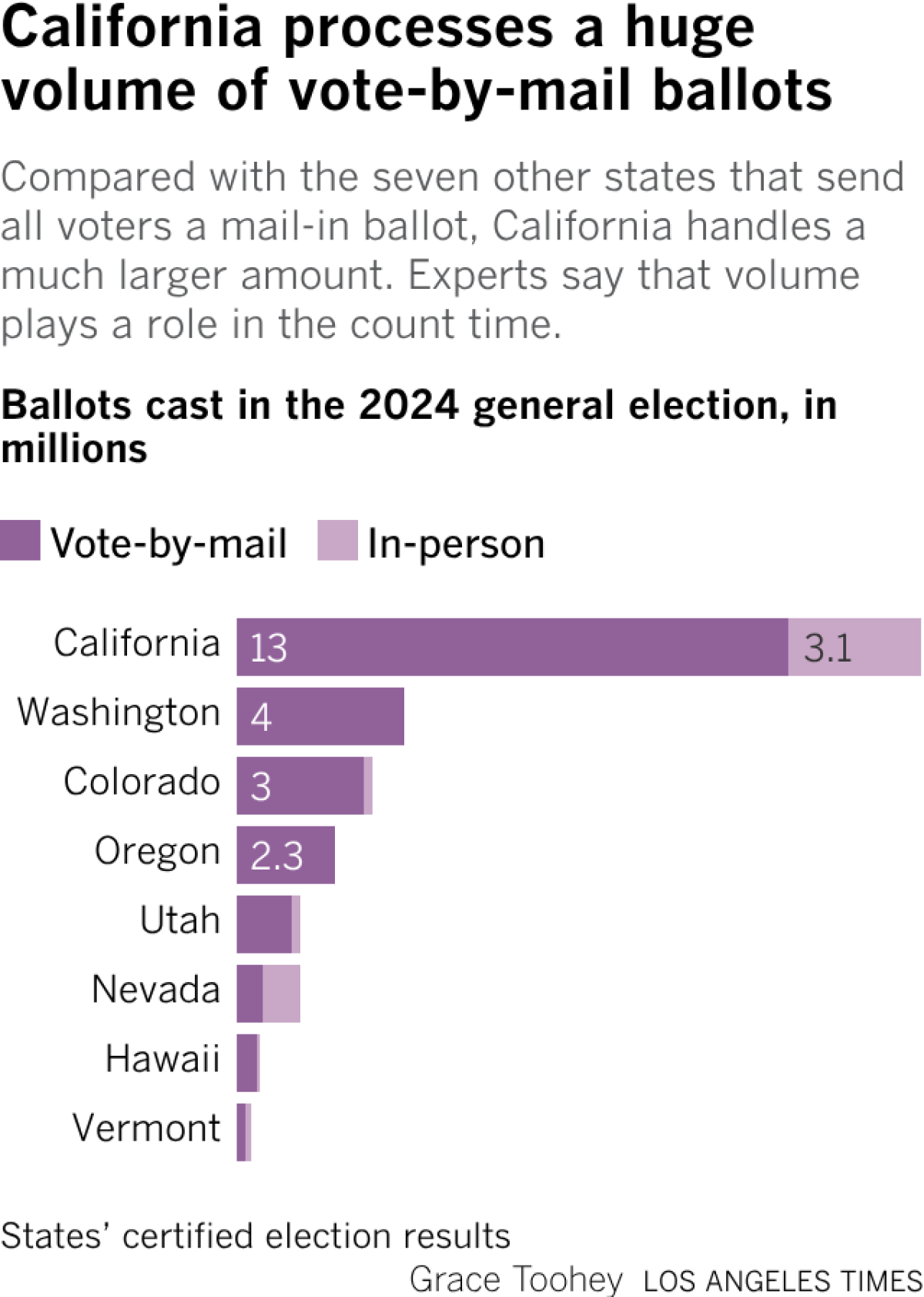
And while seven other states also automatically mail voters ballots, experts say it’s hard to make direct comparisons with California. Some critics often point to Colorado as an example of a state with similarly ubiquitous mail-in voting, yet a much faster count than California. But the scale of states’ elections are so different: In 2024, California processed about 13 million vote-by-mail ballots; not even 3 million were counted in Colorado.

Some have also pointed out that despite all the ways California has worked to expand voter accessibility, turnout hasn’t dramatically changed. California remains relatively in the middle of the pack when it comes to voter turnout across the U.S., and while the state has seen some spikes in turnout during certain election years, there’s been no noticeable uptick over the last 15 years, according to a review of data from 2008 to 2024.

But Becker contended that there are many factors that can influence voter turnout, in particular, California’s strong blue tilt.

“Perceived competitiveness” — or lack thereof — often keeps voters from the polls, as can uninspiring campaigns or even the weather, Becker said, but he was adamant that shouldn’t be a reason to make it harder for people to vote.

“Accessibility is always worth it,” Becker said.

Hoge, the GOP chair, had a different take, highlighting concerns about the voter registration process as well as the slow count — though she has been clear that the latter doesn’t necessarily signal fraud.

She has continued to push a more tempered narrative to many Republican leaders, including from the White House. On X, she shared a post that fact-checked a photo of vote tabulations from L.A. County, which appeared to — erroneously — show reality TV personality Spencer Pratt receiving no new votes in a daily vote count. And she boosted a video that dispelled rumors about Democrats stealing votes and ones about widespread fraud in California’s process.

“It’s a horrible roller coaster,” Hoge said about California’s election results. “It doesn’t make sense, and the fact that you’re just noticing it today doesn’t mean that it’s newly not making sense. … But until we win, we can’t change it.”

No matter what California might change or improve, Becker said he is confident it won’t stop the criticism or campaigns of misinformation. He also said that most elections in California are called relatively quickly — take the state’s pick for president, which is usually confirmed on election night — but it’s a small share of extremely tight races that take longer, because they require a more complete count to call a winner.

“It doesn’t matter how fast California counts its ballots, … we would be seeing similar conspiracy theories, maybe just with a different framing,” Becker said. “California ends up being a very effective bogeyman.”

Staff writer Kevin Rector contributed to this report.


Source link