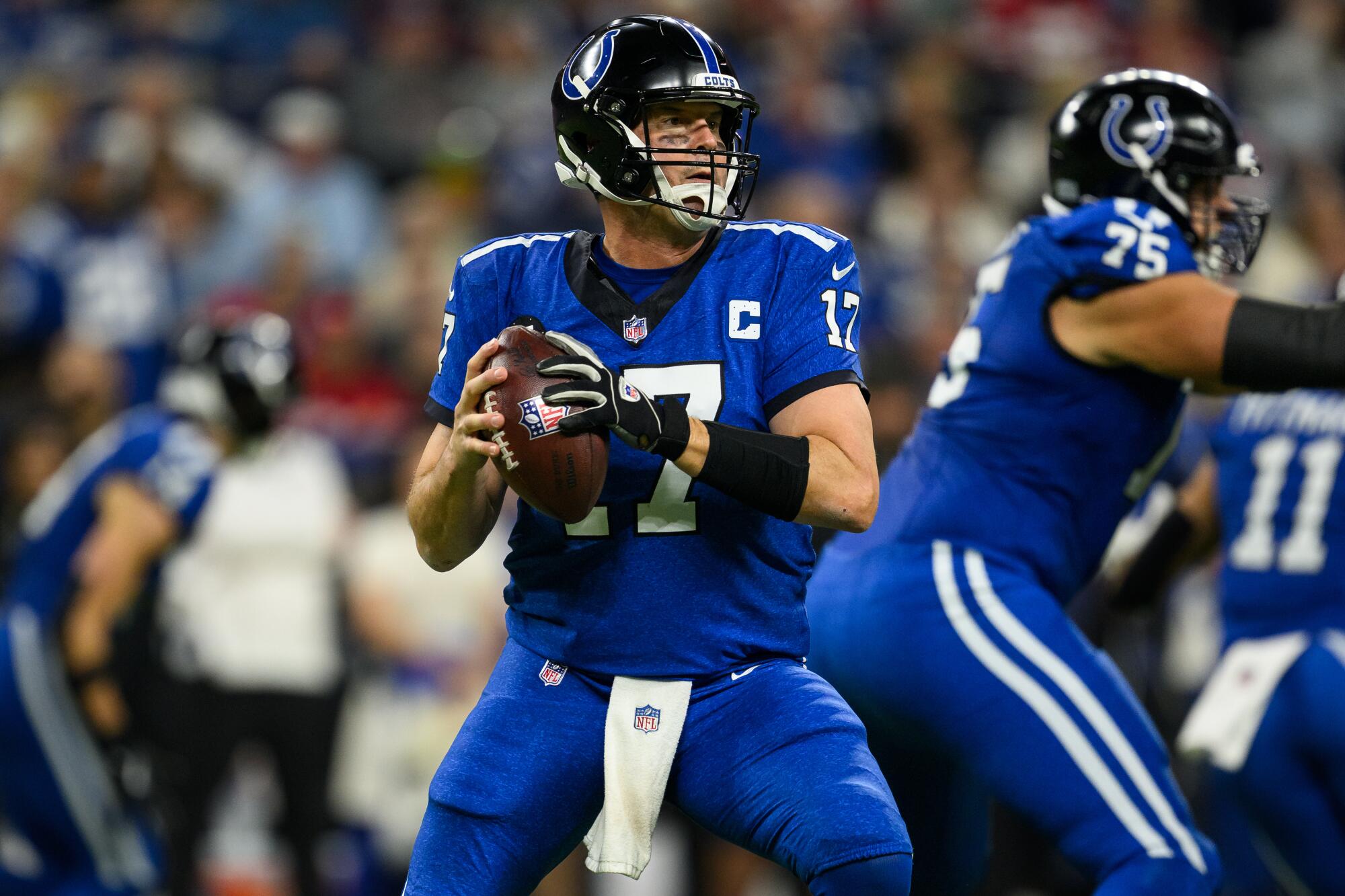
Philip Rivers comeback stirs Hall of Famer Ron Mix’s memories
It was not just a nation of sports fans and media that became entranced when former Chargers great Philip Rivers, like a soldier, answered the call to duty and joined another one of his former teams, the Indianapolis Colts, at age 44, five years after his last game. (Five years after! No misprint). Former players, like me, were curious and envious.
This was a selfless, noble act by Phil. A player is not eligible for the Hall of Fame until five years after his last season. Thus, Phil has delayed his consideration as a candidate by another five years.
The winter is not merely a matter of age; it is long after the time when the pro football player lived a life at full throttle, doing what years of unromantic labor crafted his mind and body to do.
Jim Porter, the president and chief executive officer of the Pro Football Hall of Fame, reported that about 35 million males, from youth leagues to high schools to colleges, have played organized football. Of that total, only about 22,000 have played in a professional game. Shameful pride compels me to say there are only about 300 players in the Hall of Fame.

Colts quarterback Philip Rivers throws the ball during a game against the San Francisco 49ers on Dec. 22 in Indianapolis.
(Zach Bolinger / Associated Press)
Now, at 88 years old, I am in that winter of life; a time long after leaving that locker room, a place that was alive with bravado and bonds with teammates, each knowing the devastating work it took to, not only get there, but to stay there, because each year the team would bring in a fresh group of draftees and players acquired by trade who wanted your spot. As teammates, we had an unspoken contract to do the drills to the extent that the movements become instinct, to do the work, to play injured, to show up.
The memories of teammates stay fresh. I will share a few stories that stick with me about players early Charger fans will recall:
Power of Alworth

San Diego Chargers wide receiver Lance Alworth poses for a photo in 1970.
(Associated Press)
Lance Alworth is in the Pro Football Hall of Fame. Our team in the ‘60s had many players that deserve to be called great; however, we all held Lance in special regard because he encompassed high levels of skill and character. He had speed, elusiveness, and he blocked (something of a dirty word to many wide receivers). The best way to describe how I felt about Lance is to relate an incident that took place when our plane was returning from an East Coast game. The plane hit a long stretch of weather so bad that it caused the plane to rise and drop and shake to such an extent that I knew it was going to crash and kill us all. I truly felt it was all over. Then I remembered that Lance was on board and I relaxed, thinking we are safe because God would not kill Lance. I am still amused that I actually thought that.
A formidable man

Ernie Ladd, seen here in action for the San Diego Chargers, on Oct. 29, 1963.
(Associated Press)
Ernie Ladd was a 6-foot-9, 325-pound defensive tackle who played the position with skill and fury and, for four seasons, before severe knee injuries reduced him from great to good, was as skilled as anyone who ever played the position. And strong. Ernie joined the Chargers in 1961. In 1963, coach Sid Gilman made the Chargers the first team in professional football to employ a strength coach and direct that all players begin a weight-training program. At that time, I was one of only a few players in professional football that lifted year-round because coaches, at all levels of football, discouraged weightlifting, believing it tied up an athlete’s muscles. Ernie had never lifted weights. During our first training session with our strength coach, Alvin Roy, Ernie lifted 300 pounds over his head. I had trained for years and my best lift at that time was a military press of 325 pounds.
He demonstrated strength and restraint when a dispute arose between him and a teammate, who I will refer to as X, a defensive lineman whose play fell far below expectations when he was a high draft choice. Ernie was given to fun-loving razzing of others in the locker room. X took offense and swung his fist at Ernie. Ernie caught the fist in his big right hand, then grabbed X’s forearm and bent the wrist up, forcing X to the ground. Ernie then said, “X, if I let you up, are we done?” X, red with embarrassment, said it was over and Ernie released him.
The reason this stuck with me was because it reminded of an incident in the John Steinbeck novel, “Of Mice and Men,” in which Lennie, a slow-witted worker on a ranch, was being repeatedly struck by the ranch foreman until Lennie caught the foreman’s fist in the air and crushed his hand. The reference is a bit strained because Ernie was extremely bright.
Ernie was the most joyful game participant I had ever seen, bright and quick-witted, laughing before a game, getting energy from the thrill of what was about to take place. Before one of our games, he said to me in a mockingly serious voice, “Ronnie Jack, I hope I don’t kill anyone out there today. If I do, I want you to represent me and plead self-defense.” At the time, I was going to law school at night.
Surprising Wright
Ernie Wright left college early and joined the team at age of 20, the same year I signed up for the Chargers — 1960. He played offensive left tackle, making All-Pro several times. He was extremely bright, great work ethic, and proved it by having a very successful post-football business career.
Different players have different game-day, pre-event routines. I tried to stay calm and collected no matter how big the moment. I believed that if I allowed myself to get charged up by adrenaline rushes before the game started, I would use up energy I needed for the entire game.
My pregame ritual became a curious thing for Ernie. After one of our games, Ernie approached me, and the following conversation took place:
Ernie: I have been watching you before games and seeing your lips moving and I thought you were praying. I finally decided today to get closer so that I could hear what you were praying for. Was it for a team to win, was it to kick butt. You were singing to yourself! You were singing “Fly Me to the Moon.” Is that what you have been doing before all these games?
Me: That’s it. It is my way of staying calm.
Ernie (laughing): And here I thought you were deeply religious, and I have been careful not to swear around you.
A mind for politics

Republican vice presidential candidate Jack Kemp accepts a jersey from football players at Fairfax High in 1996.
(John Hayes / Associated Press)
Jack Kemp was the Chargers’ first quarterback. After an injury in his third year, he played for the Buffalo Bills. After football, he became a congressman in the Buffalo area and, later, presidential candidate Bob Dole’s choice to join his Republican ticket as his vice presidential running mate. Jack and I were training camp roommates during our first year with the Chargers. We became close friends. Jack was constantly thinking about politics and the relationship between government and the public and how power and policy shape everyday life and collective freedom.
Jack’s early political beliefs embraced the John Birch Society, a movement that felt expansive federal power is a threat to individual liberty. Among the Birch beliefs that Jack embraced was that there should not be Social Security, that if it was absent, people would then accept the responsibility of regularly putting away funds for their retirement.
During the week before a game in San Diego, I told Jack that Social Security is earned insurance, not welfare, that it spreads the risks across society, and keeps seniors out of poverty. I gave as an example my mother, who was a first-generation American with only a fifth-grade education who, prior to my retiring her when I signed with the Chargers, held minimum wage jobs that barely covered monthly expenses of her raising my brother and me by herself. I told Jack that her, and likely millions like her, given the choice of setting aside a dollar a month for retirement or spending it to care for her family, would place family first.
The depth of Jack’s constant thinking of politics became clear to me the Sunday of that week. I have forgotten the name of our opponent, but I do remember that it was a brutally contested game on a very hot day and we were ahead by only three points. At halftime, our team was walking toward the locker room when I heard Jack call out to me: “Ron, Ron, wait up.” I thought he was going to ask my opinion on what run plays would be best to call. Nope. Jack said: “I’ve been thinking about what you said about Social Security and people like your mother. I agree with you. Social Security must stay.” Then he was back to football: “OK, then, let’s get ‘em.”
I was surprised. It was a, “Wait … did that just happen?” moment. We were in the middle of a football game!
Being a part of something special
Athletes, as a group, have always been ahead of the country in improving racial and religious relations among the population. I am reminded of my senior year at the University of Southern California in 1959 when Willie Wood and I were elected co-captains of the football team. That was done at a time when 99% of the fraternities at the school barred us from membership because Willie was Black and I was Jewish. That sentiment in America meant nothing to our predominately white Christian teammates who, true to the nature of sports, judged teammates only on their character, work ethic and production.
Missing the demands of the game
And then there were the opponents. How deeply they are missed, those men across the line who made excellence necessary. While it is true that some opponents were less skilled than others, the collisions with all of them were just as real.
Playing against greatness was a measurement of who you were. I had the, yes, the pleasure of playing directly against fellow Hall members such as Deacon Jones, Buck Buchanon, Bobby Bell and Claude Humphrey, and a slew of other notable defensive linemen. They, and others, were equally committed to stopping me from doing my job.
It has now been 54 years since I left the game and I still miss it.
Mix was inducted into the Pro Football Hall of Fame in 1979.

