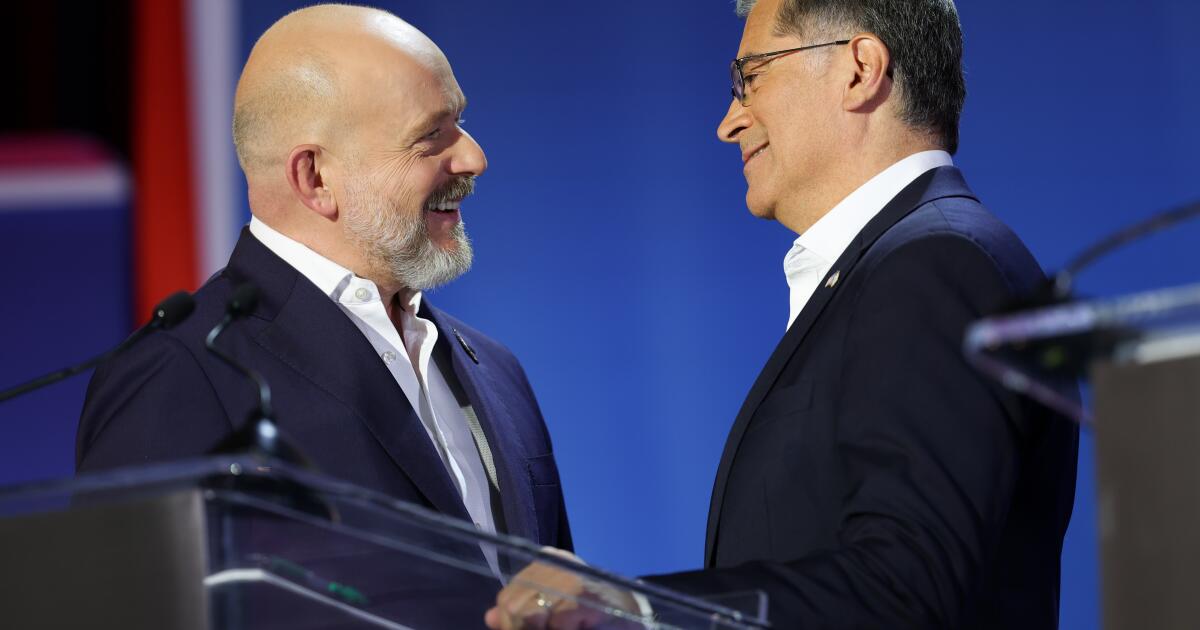
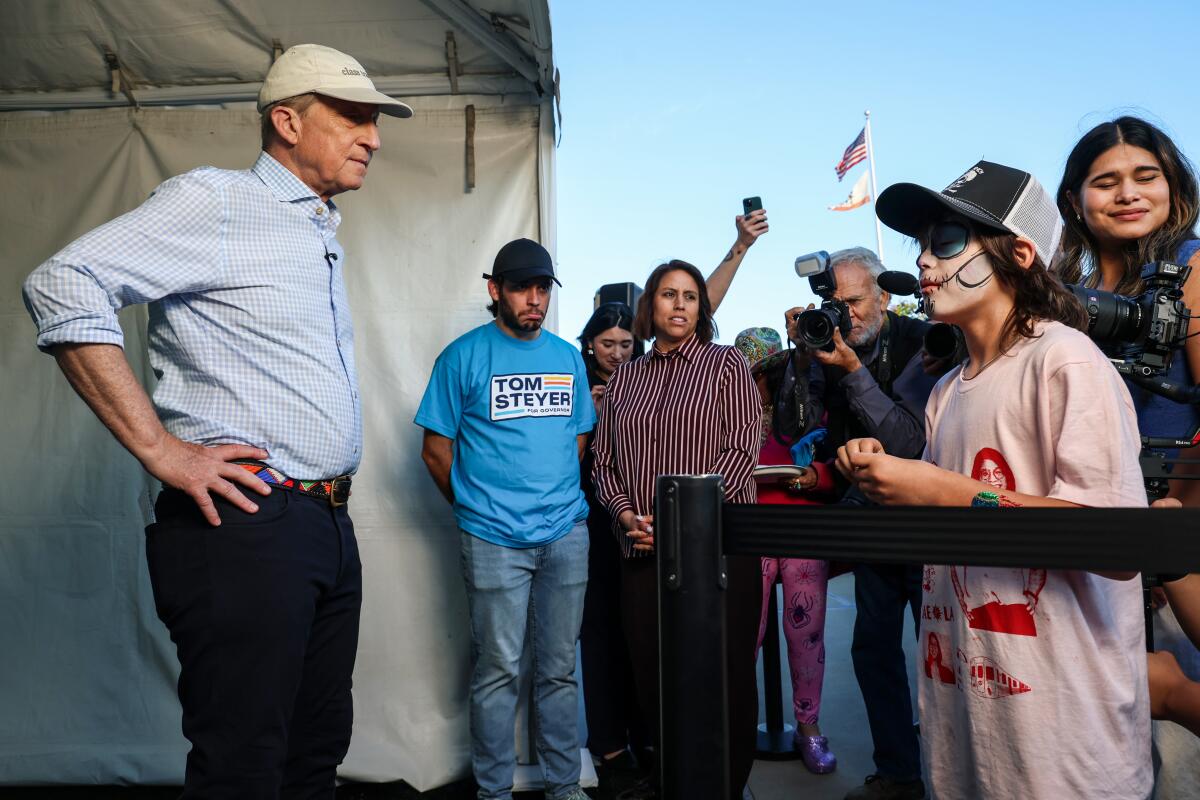
SACRAMENTO — Democrat Xavier Becerra holds a major advantage over Republican Steve Hilton as the race for California governor heads toward the November election, a new poll shows.
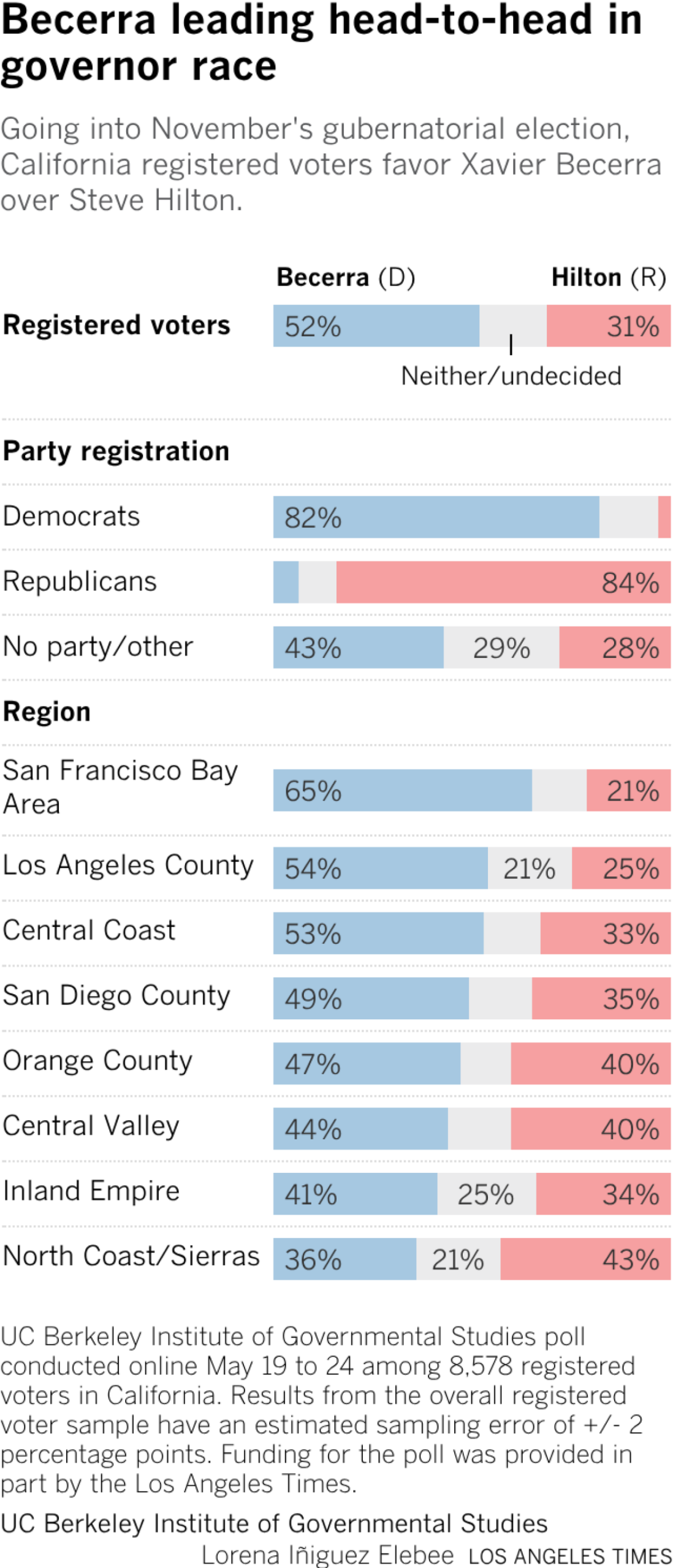
Among registered voters in the state, 52% supported Becerra in a head-to-head matchup against Hilton, who was backed by 31%, according to a UC Berkeley Institute of Governmental Studies poll which was co-sponsored by The Los Angeles Times. The remainder were undecided.
“It looks very much like a traditional, partisan-based general election, with most of the Democrats, over 80%, behind Becerra as the campaign starts,” said IGS Poll Director Mark DiCamillo. “Even though Hilton has over 80% of the Republicans, the Democrats outnumber Republicans by 20 points in the state, and that gives the Democratic candidates a huge advantage, which Becerra is clearly taking advantage of in this election.”
The survey of California voters was conducted before the primary, from May 19-24.
The poll found that Democratic and Republican voters were extremely loyal to their party’s candidate. Among Democrats, 82% said they would support Becerra in the general election, while 84% of Republicans said the same about Hilton.
Becerra also had an edge among voters registered as no party preference or registered with other parties — who make up almost a third of the state electorate. Among those voters, 43% backed Becerra, 28% supported Hilton and 29% were undecided, the poll showed.
Along age, gender, racial and geographic lines, voters preferred Becerra to Hilton nearly across the board. The only geographic region where voters preferred Hilton to Becerra are those in the North Coast/Sierra region, which makes up about 2% of the electorate, DiCamillo said.
More than a third of Republicans, 37%, said Trump’s endorsement made them more likely to support Hilton. But while it helped Hilton consolidate the Republican vote in the primary, helping him finish in second place, it will likely hurt him in the general election, DiCamillo said. Trump remains deeply unpopular in California; the poll released Thursday showed 69% of voters disapprove of the president’s performance while 29% approve.
“A majority of Californians have a very strong negative view of the president, so Hilton’s backing by the president will not be nearly as beneficial to him in the general as it was in the primary,” he said.
A former Biden Cabinet secretary, state attorney general and longtime congressman from Los Angeles, Becerra had been wallowing in the low single-digits in public opinion polls less than three months ago. His fortunes changed when former Rep. Eric Swalwell, one of the Democratic front-runners, dropped out of the governor’s race after he was accused of sexual assault and misconduct, which he denies.
Democratic voters and interest groups quickly coalesced behind Becerra, who was seen as a steady candidate with a long resume in California politics and a record of fighting the Trump administration. In two months, he went from polling at 5% in a March IGS poll to 25% in a late May poll and finishing first in the unofficial primary vote count.
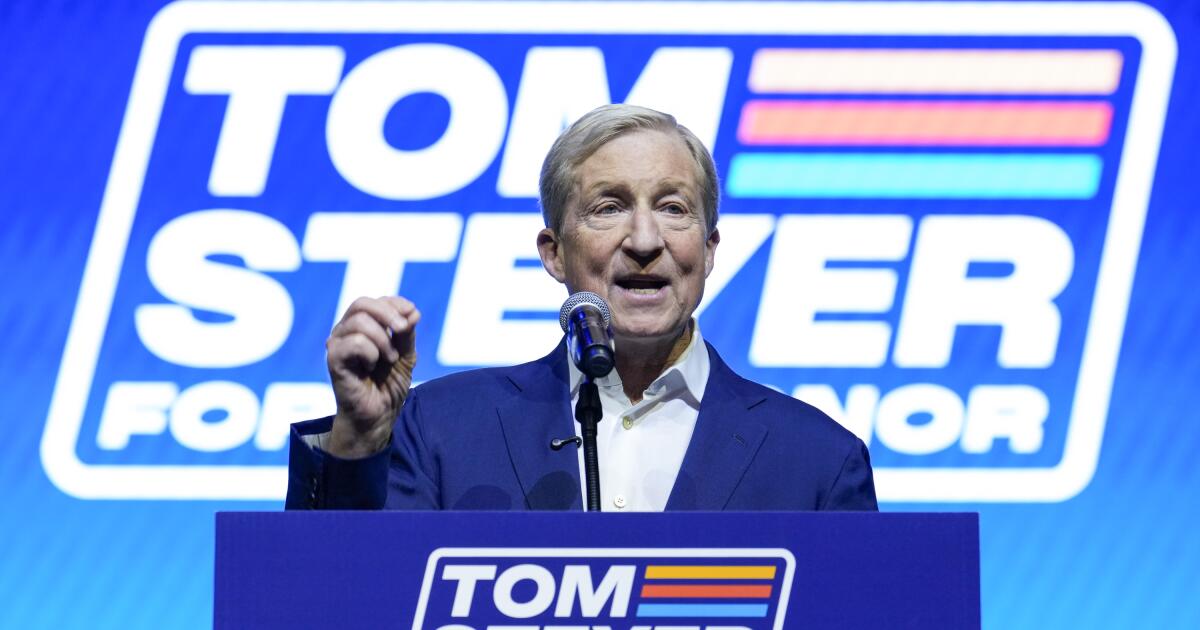
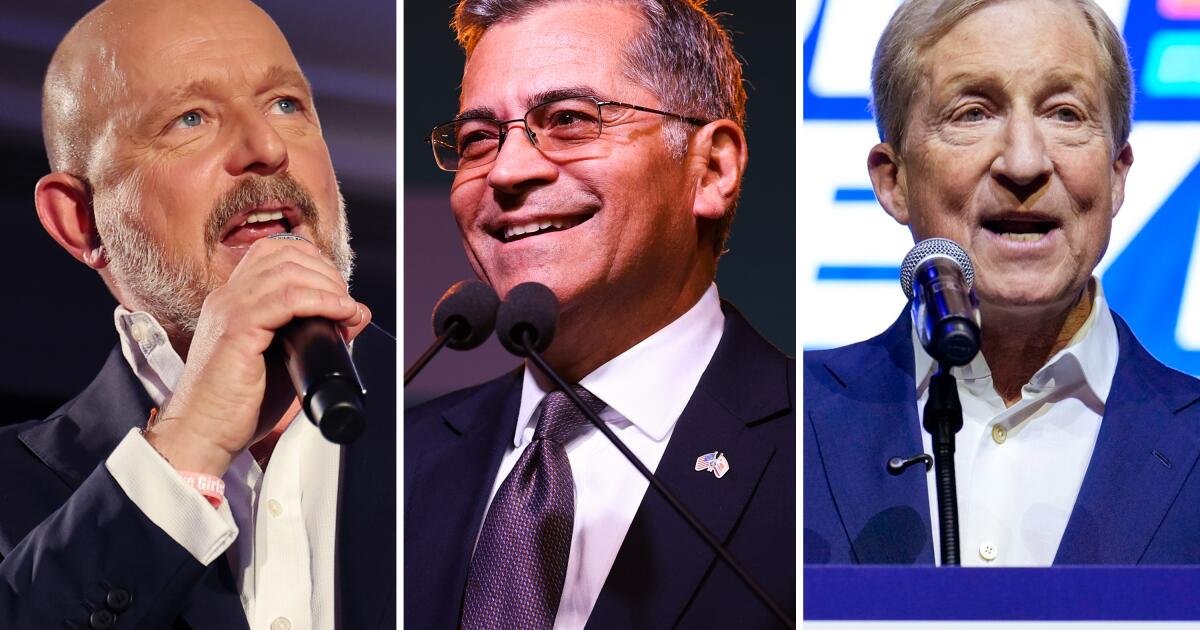
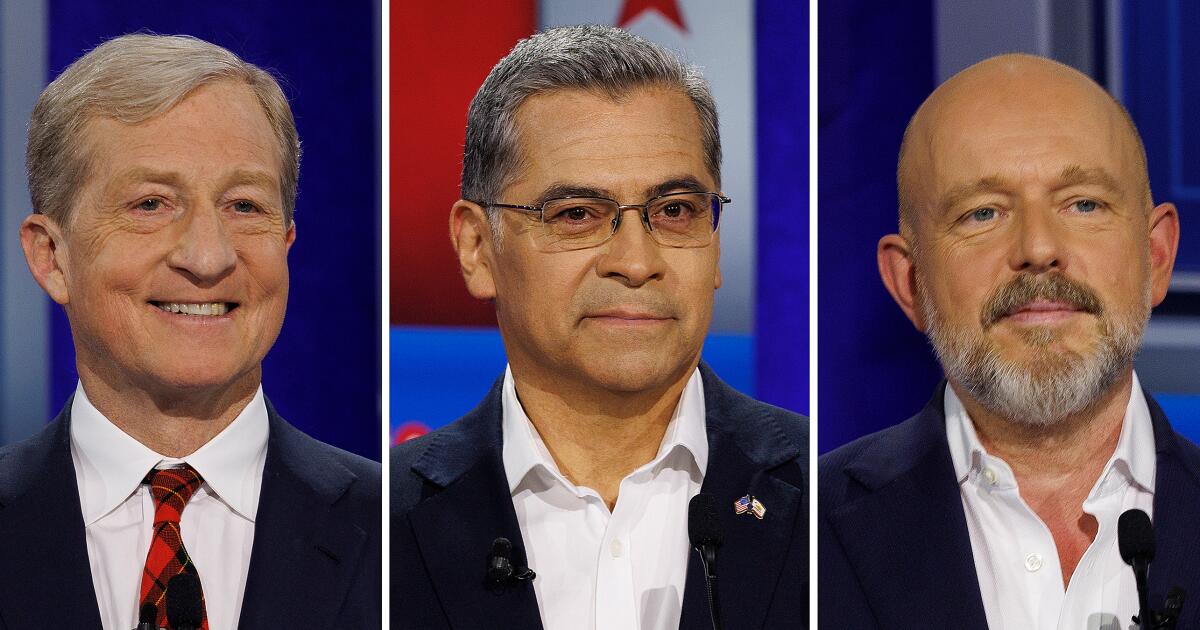
With 91% of ballots tallied as of Wednesday afternoon, Becerra led with 27.9% of the vote compared to 25% for Hilton, according to the Associated Press, which declared Becerra and Hilton the two winners. Billionaire hedge fund founder turned environmentalist Tom Steyer was in third place with 22.5% — knocking the Democrat out of contention for the November election.
DiCamillo said Swalwell’s dropping out of the race “really gave Becerra an opening and he capitalized on it.”
The poll also showed that in the end, “Becerra was the only one of the major candidates who ended the primary race with a favorable image among the overall electorate, even in the face of all the negative ads that Steyer was running” against him, DiCamillo said.
Just before the primary election, 44% of likely primary voters surveyed had a favorable view of Becerra compared to 38% who viewed him unfavorably.
Hilton and Steyer were upside down — 31% had a favorable opinion of Hilton compared to 38% unfavorable, and 39% had a favorable view of Steyer while 43% saw him unfavorably.
Though Steyer had aggressively courted progressive voters and secured the backing of left-wing individuals and groups like Rep. Ro Khanna (D-San Jose) and Our Revolution, a group founded by Sen. Bernie Sanders (I-Vt.), the final IGS poll before the election showed more progressive voters ended up backing Becerra.
Among those who self-identified as progressive, 39% said they would support Becerra while 29% preferred Steyer, according to the late May survey.
“It’s really one of the factors that was responsible for Steyer’s campaign not being successful,” DiCamillo said. Progressive voters were “a target audience for Steyer, but Becerra was able to have an advantage there.”
The poll was conducted online in English and Spanish among 8,578 registered California voters. The survey has a margin of error of 2% in either direction.
Californians couldn’t escape billionaire Tom Steyer’s political ads — during newscasts, sitcoms, or sporting events; on streaming services, YouTube, influencers’ social media feeds, or their mailboxes. Even the Puppy Bowl.
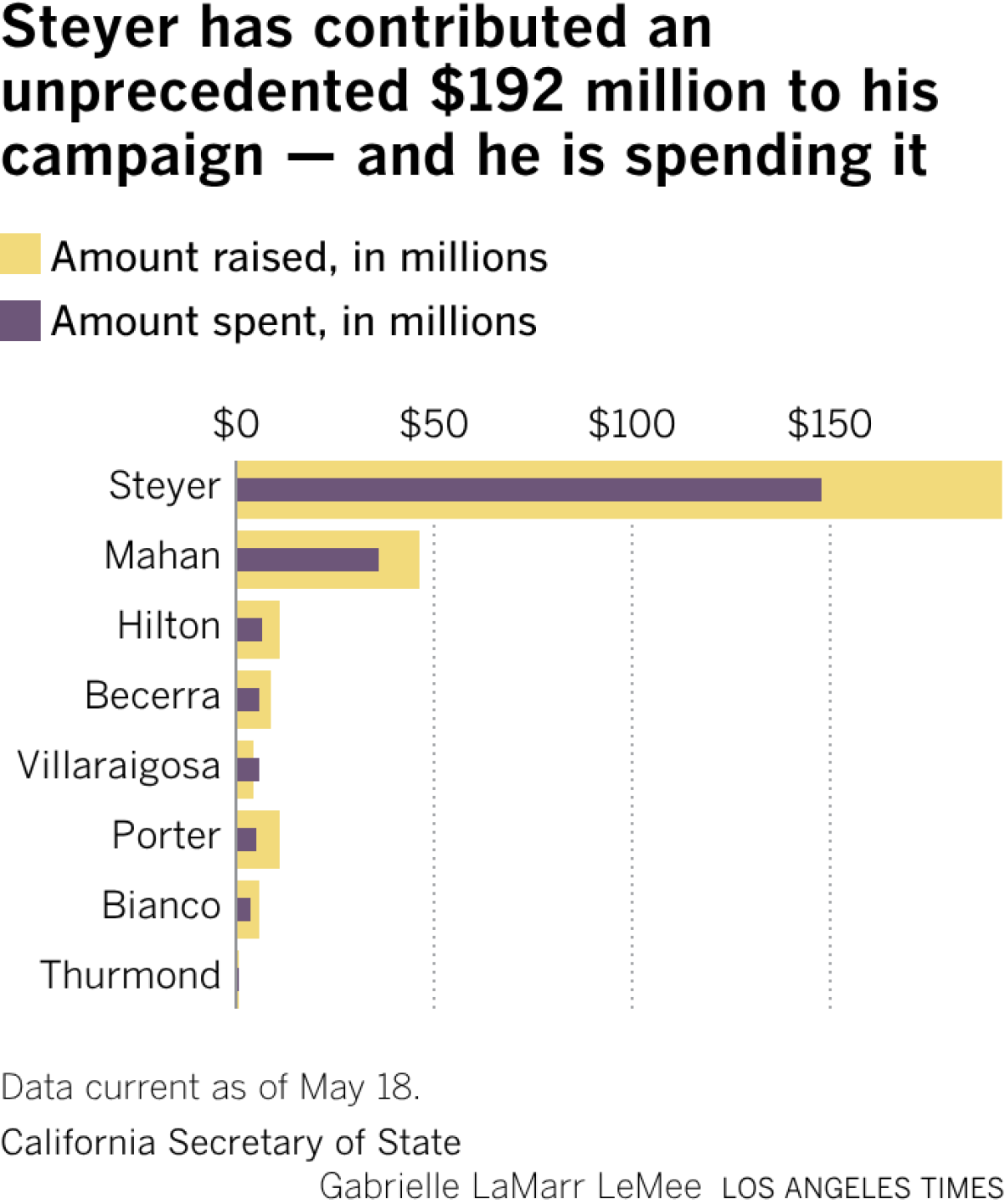
Yet despite spending a record-shattering $216 million of his wealth on his run for governor, the Democrat failed to win enough votes in last week’s primary to advance to the November general election to replace termed-out Gov. Gavin Newsom.
“Money isn’t everything, even though it obviously helps,” said Andrea Godfrey Flynn, a marketing professor at the University of San Diego. “It boosted Steyer way up. … But there are so many other factors at play that it may not have been enough.”
Steyer, a hedge fund co-founder turned environmental warrior, polled at 1% shortly before he entered the governor’s race in November, according to a survey by UC Berkeley’s Institute of Governmental Studies that was co-sponsored by the Los Angeles Times.
He climbed in subsequent polls, hitting 19% in the same poll shortly before the June 2 primary, putting Steyer in contention for winning one of the top two spots in the contest that would allow him to advance to the November election. But then he hit a ceiling, and on Tuesday, it became official that he failed to advance.
Steyer emailed supporters Tuesday expressing gratitude for their efforts backing his campaign, endorsements and votes.
“Together, we fought for a California that belongs to the people who keep it running every day, and we insisted that they do not have to settle for a system that protects corporate profits at the expense of working people,” he wrote. “I’m proud of how we never compromised our values or lowered our sights for what California can and should be.”
He pointed with pride at major corporations such as Chevron and Meta spending heavily to oppose his bid, and said their tens of millions of dollars spent attacking him shows the flaws in the electoral system. And he acknowledged that may be part of the reason some voters were skeptical of voting for a billionaire.
“I’m proud of the enemies we made,” Steyer said. “This campaign proved that business-as-usual depends on politics-as-usual, and there is no going back. We must continue to fight for a system where democracy serves Californians, not corporations — and where you do not have to be a billionaire to run on single-payer, or on breaking up monopolies, or on calling out a corrupt system when you see it. Because people are fed up with a system rigged to benefit billionaires and leave them behind.”
As of Tuesday evening, Steyer had received more than 1.9 million votes of the more than 9 million cast, lagging behind the two candidates who will appear on the November ballot: Republican Steve Hilton, a former Fox News commentator, and Democrat Xavier Becerra, a longtime elected official who most recently served in President Biden’s cabinet. Steyer was trailing Hilton, the second-place finisher, by just over 200,000 votes.
Steyer immediately endorsed Becerra, whom he had relentlessly attacked in the closing weeks of the campaign as beholden to corporations with business in front of the governor.
California has a history of unsuccessful self-funders. Former Northwest Airlines co-chairman Al Checchi spent more than $40 million of his money on an unsuccessful gubernatorial primary campaign in 1998, which broke records at the time.
More than a decade later, former EBay chief Meg Whitman spent $144 million of her wealth on her bid to become California’s governor, setting a new national record for spending on a state election. She won the GOP nomination but lost in the general election.
Sheri Sadler, a veteran Los Angeles-based Democratic media buyer, said Steyer’s 2026 gubernatorial deluge was notable.
“I literally saw his spots ad nauseam,” she said. “They left almost no stone unturned.”
Sadler worked for Steyer in the final weeks of his presidential bid and scheduled $50 million of billionaire Rick Caruso’s money on ads during his unsuccessful 2022 Los Angeles mayoral campaign.
She believes that Steyer hit a ceiling because voters who are bombarded by ads eventually feel that the candidate is trying to purchase their affection.
“It’s one thing to give me a message I can resonate with. If they’re just trying to buy my vote, that feels different to me,” she said, adding that Steyer’s wealth undermined his platform, which included support for raising taxes on billionaires. “That’s my gut. And I feel like that’s what happened to us on Caruso and possibly why he didn’t run” for governor this year.
Steyer, 68, made his fortune founding a hedge fund that included investments in fossil fuels, private prisons and other businesses that are controversial among Democrats. He told voters that he walked away from the firm 14 years ago, leaving an enormous amount of money on the table, because it did not align with his morals. Steyer adds that he and his wife have pledged to give away most of their wealth before they die.
And unlike many wealthy self-funders, Steyer did not leap into a campaign as a political neophyte who assumed their business skills would translate into being an effective elected official.
Steyer and his wife, Kat Taylor, are longtime donors to Democratic candidates, but for well over a decade, they have spent hundreds of millions of dollars on liberal causes such as fighting climate change, mobilizing young voters, urging the impeachment of President Trump, opposing an effort by oil companies to suspend California environmental standards, increasing the state cigarette tax and supporting last year’s redrawing of the state’s congressional districts to counter Trump.
Darry Sragow, a veteran Democratic strategist who advised Checchi, said that Steyer’s focus on such causes had the potential to be meaningful to voters who are often skeptical about the sincerity and motives of rich candidates.
“Tom Steyer has done a good job in that respect, because if you’re going to overcome that skepticism, it’s very helpful for the candidate to show that he or she has actually been involved in the world of public policy and politics for an extended period,” and Steyer has, Sragow said.
Assemblyman Isaac G. Bryan (D-Los Angeles), who endorsed Steyer, argued that he promoted proposals that were against his personal interests, such as the proposed billionaire’s tax that is expected to appear on the November ballot.
“Interestingly enough, Tom Steyer is also the only candidate who’s talked about campaign finance reform and wanting to get money out of politics, including his money, to return power to the people and have publicly financed elections,” Bryan said after a Steyer rally near downtown L.A. on May 31.
Former Orange County Rep. Katie Porter and state Supt. of Public Instruction Tony Thurmond also campaigned on limiting the influence of corporate PAC money in elections, or implementing publicly financed elections in California. Porter often criticized Steyer for running as a “change agent” while spending millions he earned from investments in oil and gas.
“You paid the lowest tax rate on this stage and yet you made the billions that you’re using to fund your campaign off fossil fuels,” she said to Steyer during an April 28 debate in Claremont.
Political experts argue that messages that seem contradictory to a candidate’s background, as well as drowning voters with incessant ads, can be jarring and off-putting to the electorate.
“It can be an overload to voters where they hit that tipping point where they’re no longer interested,” Flynn said.
Despite Steyer’s foundational argument that his wealth meant he was not beholden to anyone, she said voters may be unable to reconcile a billionaire’s ability to understand or empathize about an average Californian’s needs.
“The messaging still is a giant factor,” Flynn said. “I’m curious [about] how believable it came across to voters — can you trust a billionaire to really care about affordability, someone who made money working with business or in business not to care about special interests?”
While Steyer campaigned as a hard-left liberal, he failed to be the top pick for progressives. Steyer had the support of 35% of likely voters who identified as strongly liberal while Becerra was backed by 37%, according to Berkeley’s May poll.
After talking to college Democrats at UCLA on the eve of the primary, Steyer said regardless of what happens in the primary, he will remain politically involved, though he would not run for president in 2028.
“I’m going to keep working on these issues, because I’ve been working full-time on these issues for 14 years,” Steyer said. “There’s no question what I’m going to do. How I do it is a little bit up in the air.”
Times staff writer Dakota Smith contributed to this report.
Despite an uptick in his performance, hopes for third-place finisher Tom Steyer are fading along with the number of uncounted ballots, suggesting Democrat Xavier Becerra and Republican Steve Hilton will face off in November.
Given the overwhelming Democratic advantage — both attitudinally and in registration — the outcome of the governor’s race might seem preordained. But it’s voters who decide elections, not know-it-all columnists.
Barabak: So Anita, now that the election is over how are you feeling? Relieved? Giddy? Depressed?
Chabria: Tired, with five months to go. And while it’s true neither of us can see into the future, it’s not too much of a long shot to predict that in a state where registered Democrats vastly outnumber Republicans, the next governor will likely be blue.
So while the primary was bruising and confusing, the general election will be much more predictable — it’s Becerra’s to lose, and he’d have to try really hard to do that.
But here’s what I’ll be looking for in the lead up to November: How far will Hilton go to capitalize on this moment for personal gain? There are plenty of real issues to be discussed where the Republican-Democrat divide could offer worthy debate. What should we do about gas prices? What is the right balance between environmental regulation and building housing?
That is bad for our state and bad for democracy, and it’s troubling that we will likely be subjected to these lies — and that California could be used to further erode voting rights nationally — for the entire summer leading up to the midterms.
What will you be keeping an eye on?
Barabak: How Becerra spends the next five months.
One presumes he’s smart enough not to take anything for granted. Meaning he won’t spend the time between now and Nov. 3 at some swank beach resort, sipping one of those colorful cocktails with a little paper parasol while musing over his inaugural address.
So it will be interesting to see how Becerra campaigns and whether he uses the next several months to build a mandate and also to prepare California voters for the rough road ahead.
Becerra is smart enough, one would think, not to run as Mr. Sky Is Falling and tell voters, “Boy, oh, boy things are really gonna suck going forward.” But the next governor is going to face some really tough challenges, including a structural budget deficit that’s probably going to require both painful cuts and unpopular tax hikes.
On top of that, there are the inevitable disasters, be they earthquake, fire or flood, the latter quite possibly exacerbated this winter by what may be an epic El Niño. There’s also the continued challenge of dealing with a president who treats California the way a dog regards a fire hydrant.
All of it makes you wonder why anyone would want the job — though Steyer panted after it enough to burn through more than $215 million of his fortune in a bonfire of vanity.
Universal healthcare and standing our climate ground in the face of federal rollbacks were two of Steyer’s big talking points, along with standing up to corporate influence. Becerra now inherits those thorny problems if he wants to form a more cohesive Democratic base.
Becerra hasn’t yet offered up his vision of the Golden State, as you point out. As much as it may benefit Hilton to focus on Trump in coming months, the same could be true for Becerra.
Why get into messy policy when you can run on opposing MAGA in a very blue state? I fear the next few months will be more about Trump than California.
Barabak: That’s a charitable way to look at $teyer’s campaign.
Sure, he had plenty of ideas, though I think the promise of delivering universal healthcare — a political nonstarter — was cheap pandering, not visionary leadership.
There’s no shortage of people with good ideas. The only reason anyone paid attention to Steyer, who’s never served in any elected office, was the obscene amount of money he spent on his luxury-class ego trip. So it pleases me voters didn’t reward his arrogance or buy his billionaire-turned-populist, “Amazing Grace” spiel. (“I once was blind, but now I see.”)
And I’m be gladder still that voters showed — once again — the governor’s office is not for sale.
I do agree, however, that Becerra should to more than just cry MAGA! MAGA! MAGA! for the next five months, as if that incantation is magic and will solve all our problems. That applies, by the way, to Democratic candidates everywhere.
All of that said, we should note the governor’s race has yet to be officially decided and Steyer still has at least a theoretical possibility of slipping into the top two.
Chabria: First, we’ll have to agree to disagree. California is on a healthcare cliff and even middle-class Americans (not just Californians) can’t afford either insurance or care.
Single-payer may be a dream, but it’s my dream — for my kids, for my community and for my state, because healthcare shouldn’t be just for the rich and that is increasingly the direction we are going. So any politician, Steyer included, who fights for inclusion rather than accepting exclusion will get my consideration.
And let’s be real — self-funded or corporate-funded — our elections are, to their detriment, too much about money. My outrage is for the 2010 Citizens United Supreme Court decision, which unleashed the current no-limits mess and created a system in which it requires hundreds of millions from somewhere, anywhere to run for our highest offices.
But back to ballots: Slow is not fraud. Slow is not bad if it’s accurate. Slow allows for greater voter participation by allowing mail-in ballots, and carefully checking all ballots for problems. Slow takes into account the federal mangling of the post office that has, yes, slowed down our mail.
And, slow happens because most of our county elections offices are understaffed and budget-starved. If you want fast, you’ve got to pay for it.
So keep your britches on people and don’t buy Trump’s (or Hilton’s) manufactured hype. Every system can be improved, but there’s far worse problems than slow.
What’s your take on the ballot controversy?
Barabak: Here’s one where we agree.
California goes out of its way to make it easy to vote, which, I believe, is a very good thing. Kim Alexander of the non-partisan California Voter Foundation, who’s spent decades on the matter, has suggested ways we can have both wide access and a faster count, starting with better funding of the state’s over-extended county election offices.
This prolonged count is something Gov. Gavin Newsom and the Democratic-run Legislature could have anticipated. Shame on them for not doing more to address it.
I, too, yearn for that perfect candidate who is firm but flexible, old but youthful in his or her thinking, masculine but also feminine, brilliant but not too smart and larger than life but also totally relatable.
As election officials continued tallying ballots Wednesday, Republican Steve Hilton and Democrat Xavier Becerra continued to lead in the unsettled race to replace termed-out Gov. Gavin Newsom, with billionaire Democrat Tom Steyer hoping for a surge in late-arriving votes to push him into one of the top-two spots to advance to the November general election.
Hilton, a British immigrant and former Fox News commentator, told reporters outside the state Capitol in Sacramento Wednesday morning that he was “very encouraged” by the latest results, though he stopped short of declaring victory.
“It does look as if change is coming to California, and that is good news for everyone, every small business, every working family, everyone who wants to see our state set back on track,” he said.
Becerra and Steyer did not hold public events as of Wednesday afternoon.
Election data analyst Paul Mitchell said it would be nearly mathematically impossible for Steyer to close the gap.
“As we start to get more data, the runway is going to get shorter and shorter,” he said.
He said Steyer, to finish in the top two in the primary, would have to get about 30% of the remaining uncounted votes while Becerra would need to be limited to 15%. The self-funded billionaire has “a very high hill to overcome, and the challenge gets steeper and steeper as we get more data from the counties,” Mitchell said.
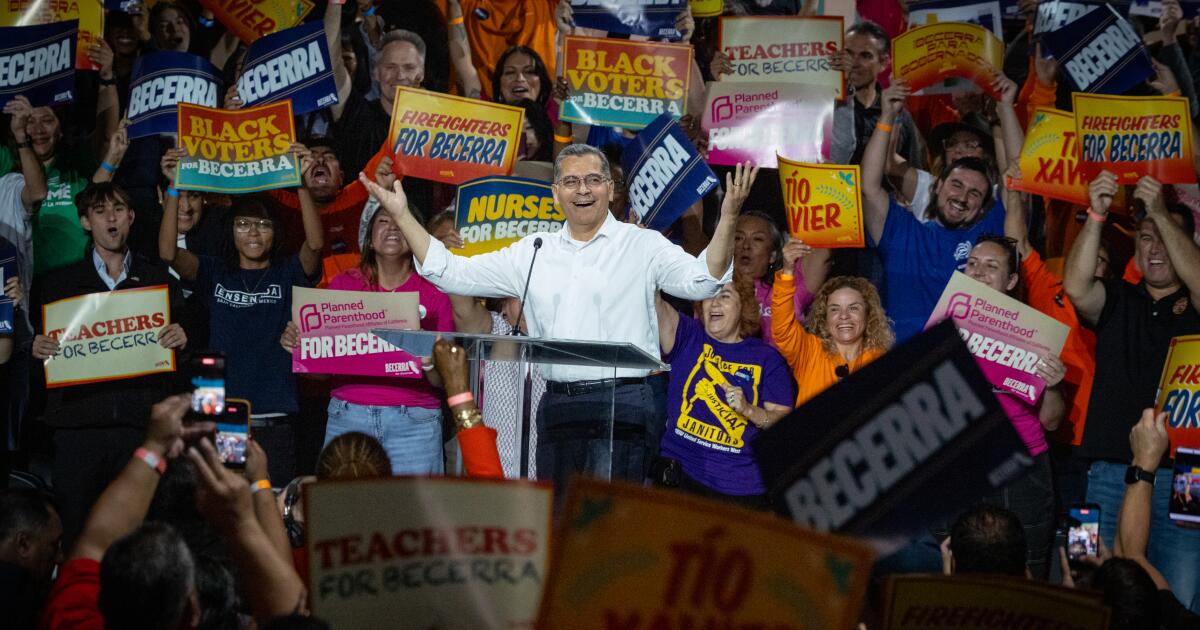
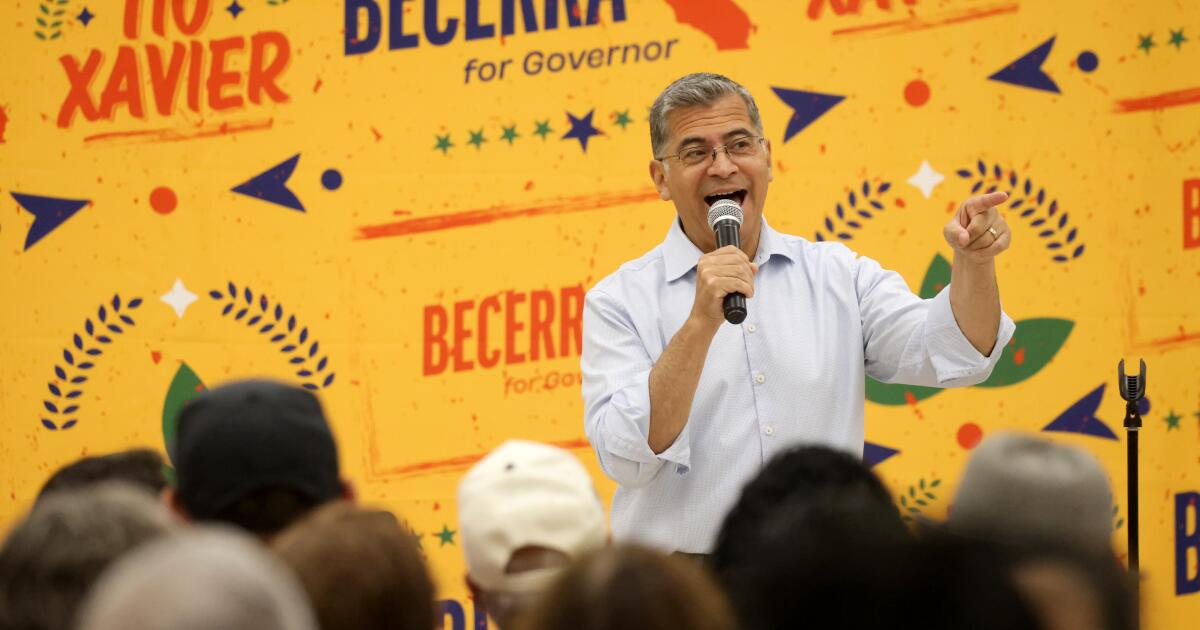
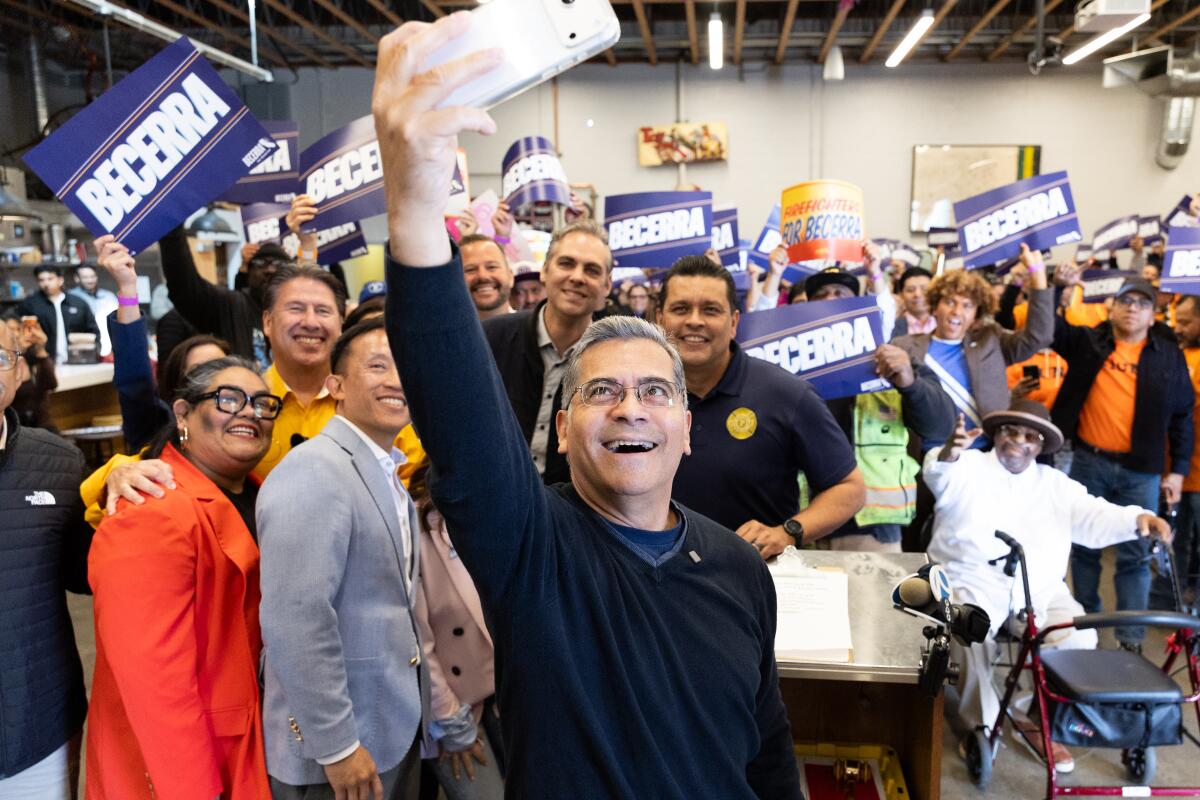
“Here in Hollywood’s hometown, we love a good underdog story,” Becerra told cheering supporters at his election night party at La Plaza de Cultura y Artes in downtown Los Angeles.
Becerra spoke about his Mexican immigrant parents and becoming the first in his family to attend college. Though a longtime California politician, Becerra said that his campaign for governor was outspent and that he faced calls to drop out of the race.
“The underdog stayed in the fight,” he said. “Like my parents, I never gave up. … Never stopped believing in the beacon-light goodness of California and thankfully, neither did you.”
His campaign manager, Heather Hargreaves, wrote in a letter to supporters Wednesday that “we’re going to give democracy time to work. County election officials are still counting ballots and don’t expect to know how many people voted in total until” Thursday, when officials are required to report the estimated number ballots left to process.
Billionaires “do everything they can to hoard their wealth and avoid paying taxes, and we see corporations continue to rig the system for themselves — raising your prices to juice their profits. Screw that,” Steyer said at his election watch party at the Regency Ballroom in San Francisco.
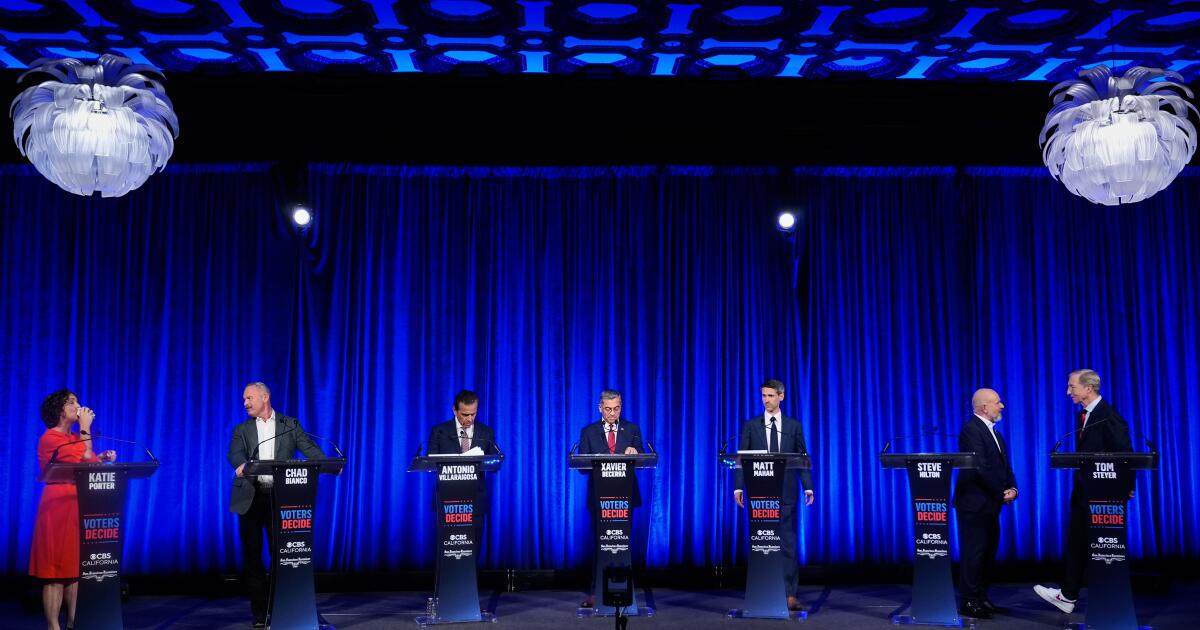
Other candidates in the race included Republican Riverside County Sheriff Chad Bianco and Democrats including former Rep. Katie Porter, San José Mayor Matt Mahan, former Los Angeles Mayor Antonio Villaraigosa and state Supt. of Public Instruction Tony Thurmond.
Villaraigosa, Mahan and Porter conceded the race Tuesday night.
California’s 2026 race for governor started slow but ended with a flourish, including the demise of a scandal-ridden Democratic favorite, the anointing of a Republican by Trump and Becerra’s unexpected rise from the depths of the candidate field.
Unlike gubernatorial elections in the last quarter of a century, this year’s race lacked a clear crowd-pleasing front-runner able to win over voters, such as movie star Arnold Schwarzenegger or Jerry Brown, a sage of the California electorate and scion of a storied political family. But it unfolded at a time when the state’s residents are overwhelmed by high housing costs, steep gas prices and overall unaffordability that threatens the “California dream” that once drew millions of people to the state.
“Normal people are not living and breathing politics on a daily basis,” said Tim Rosales, a strategist who ran Republican John Cox’s unsuccessful 2018 gubernatorial campaign. In today’s information-saturated environment, Rosales said, the race and its roster of “extremely milquetoast candidates” didn’t break through until the Swalwell scandal grabbed voters’ attention.
The 2026 gubernatorial primary has been one of the most unpredictable and expensive in decades and a race that was shaped early on by a number of heavyweight Democrats staying on the sidelines.
Though supporters urged them to run, former Vice President Kamala Harris, Sen. Alex Padilla and Atty. Gen. Rob Bonta passed on the race. It was in a state of limbo for months last year as Harris, one of the state’s most high-profile politicians, weighed whether to jump in.
“I don’t ever recall a playing field that looks like this one. Usually there’s a clear front-runner,” said veteran Democratic strategist Darry Sragow. “It’s easy to say that it reflects a lack of talent [but] that’s absolutely not true. Almost any of the candidates running could make a good governor.”
Still, candidates struggled for months to break through to voters.
In February, polls showed the crowded field of Democrats splitting liberal voters and opening a statistical possibility that the party would be boxed out of November under California’s open, top-two primary, which places all candidates on the same ballot. Only the first- and second-place finishers in the primary advance to the general election, regardless of their party affiliation.
Just when Swalwell appeared on the cusp of becoming the Democratic front-runner the San Francisco Chronicle and CNN published allegations that he sexually assaulted a former staffer and acted inappropriately with other women. Swalwell suspended his campaign.
It was Becerra who benefited the most. In less than two months, he vaulted from polling in the low single digits to the top of the field of candidates, according to surveys conducted by UC Berkeley’s Institute of Governmental Studies that were co-sponsored by the Los Angeles Times.
“Becerra caught lightning in a bottle,” Rosales said. “It could have easily gone to any of the other candidates,” but many had baggage. Videos of Porter losing her temper hurt her image, the source of Steyer’s wealth and his unbridled campaign spending weighed on voters’ minds, and Villaraigosa and Mahan were “more centrist than what most Democrats wanted, and so Xavier Becerra was really the safe choice,” Rosales said.
Before Democratic voters began to narrow down their choices, Trump endorsed Hilton in early April. It helped the former Fox News host break away from Bianco, his main GOP rival.
In the days before the primary election, the race solidified into a three-way contest involving Becerra, Steyer and Hilton.
Steyer stepped up his fight in the remaining days, seeking to squeeze into one of the top two spots by battering Becerra in ads and at campaign rallies as a politician propped up by corporate special interests.
“We cannot afford to have a governor who’s been bought off by Big Oil. Period,” he said at a Sunday rally in Los Angeles.
Corporations, along with labor unions and interest groups including the California Assn. of Realtors, had spent more than $18.7 million to boost Becerra, according to the election spending tracker California Target Book. Many of the same groups also gave money to a committee intended to attack Steyer.
As the election neared, Becerra sharpened his attacks against Steyer, calling the billionaire a “liar” and accusing him of trying to buy the election.
“We are not going to let a billionaire or Trump’s handpicked candidate take over this state,” he said during a Sunday rally in Long Beach.
If Becerra faces off with Hilton in November he’ll have a distinct advantage. Democratic voters outnumber Republicans nearly 2 to 1 in left-leaning California.
Winning the general election would make the 68-year-old Becerra the first elected Latino governor of California. At roughly 40% of the state’s population, Latinos are California’s largest ethnic group but have not been represented in the governor’s mansion since 1875, when then-Lt. Gov. Romualdo Pacheco was elevated to fill a 10-month vacancy.
Times staff writers Iris Kwok, Susanne Rust, Andrew Khouri and Christopher Goffard contributed to this report.
Here are five takeaways from a gubernatorial contest that was sedentary and sleepy until, suddenly, it wasn’t.
Flashback!
Three months ago, Xavier Becerra seemed so irrelevant he — along with a clutch of other weak-polling candidates — was conspicuously excluded from a scheduled debate at USC. Today, the Democrat has seemingly punched his ticket to November.
The obvious parallel is with another massive underdog, Gray Davis, who also came from far behind to win the last time a gubernatorial primary held this level of uncertainty and suspense. That was back in 1998.
Like Davis, Becerra has a political persona that could be marketed as a sleep aid. No one will ever mistake either of them for, say, Arnold Schwarzenegger. But Becerra’s even-keeled demeanor seemed the perfect prescription following the overnight implosion of Eric Swalwell’s scandal-scarred campaign while presenting a welcome contrast with the endless Sturm und Drang emanating from Washington, D.C.
Despite California’s star-struck reputation (perpetuated mainly by outsiders), the state has elected far more governors like Davis and Becerra than Schwarzenegger and Ronald Reagan. In fact, other than Schwarzenegger, who prevailed in an unprecedented recall campaign, every candidate following Reagan has successfully run for statewide office at least once before being chosen governor.
Becerra was elected attorney general before heading to Washington to join the Biden administration; his candidacy offered worn-out voters a safe harbor amid the Trumpian tempest.
Cha-ching!
There are things money can’t buy which, Tom $teyer — er, Steyer — is just the latest to discover.
The hedge fund billionaire turned Democratic activist sank more than $215 million — a record — into his gubernatorial bid, after spending nearly $350 million in a failed 2020 try for president.
With roughly 60% of the vote counted, he was running an unimpressive third and hoping a lopsided surge of still-to-be-counted ballots will push him into the top two.
Half a billion dollars, which makes for a pretty pricey, “Meh.”
California has a long record of rejecting money-bag candidates for governor and the U.S. Senate — a pattern stretching back more than half a century. Given that hostile history, Steyer would enter the runoff as a distinct underdog, notwithstanding the many added millions he is poised to spend.
“These filthy rich people who don’t have to deal with the kind of financial struggles that people have in connection with their daliy lives just don’t feel relatable,” said Garry South, who ran Davis’ successful 1998 campaign against the free-spending Steyer of his day, former airline executive Al Checchi.
Given the relentlessly negative campaign Steyer has waged, besieged voters could count on many more ugly months of brutality on the airwaves, on computer screens and in their mailboxes.
The only happy ones would be TV station managers and political consultants cashing Steyer’s super-sized checks.
A self-fulfilling prophecy
It was never likely. But the mere prospect of Democrats being shut out of the November runoff was enough to guarantee such a scenario would not happen in this reliably blue state.
With a large pack of Democrats running and just two serious Republican contenders, Democratic partisans feared their fractured vote would let the GOP nab both spots in Tuesday’s top-two primary.
Much of the freak-out was fed by polls supposedly showing Republicans Steve Hilton and Chad Bianco atop the field. But no candidate ever had much more than a paltry 20% support; for all the heavy breathing, the race was always pretty much a multi-candidate tie.
Fearing the worst, however, voters who normally couldn’t tell a “jungle primary” from a jungle gym began thinking a lot like gimlet-eyed political strategists. Democrats, in particular, held onto their ballots much longer than usual, waiting to see which candidate appeared strongest at the end.
“The decision matrix on this was not just the political insiders, but all the normies who heard there might be two Republicans,” said Paul Mitchell, a Sacramento political data expert who developed a popular online tool handicapping various election scenarios. “They’re talking to friends and families. It was kind of crazy.”
In the end, the race among Democrats became less a contest than a self-fulfilling prophecy. Becerra was seen as the candidate with the best chance of advancing to November, so many voters flocked his way — ensuring he would advance to November.
Now he waits to see whether his opponent will be Hilton or Steyer.
Sacramento still a boy’s club
More than 30 states have elected female governors. A few have done so multiple times. But come January, California — which perceives itself as oh-so-cutting edge on oh-so-many things — will install the 41st in the state’s unbroken line of male governors.
“There’s expectations that are put on a woman” that are different from those male candidates face, said Mindy Romero, director of the Center for Inclusive Democracy at USC. Toughness in a man can be seen as abrasive or off-putting in a women. Acting with authority can come across — at least to some observers — as overbearing.
“A woman’s version of a leader still has to be at least somewhat feminine,” Romero said. “That’s what our society expects. So you have to be tough, but do it with a smile.”
But in Sacramento, within the governor’s suite, California’s highest glass ceiling remains firmly intact.
Youth won’t be served
Last fall, over a plate of enchiladas in downtown San José, Mayor Matt Mahan emphatically ruled out a run for governor.
“I have a wonderful marriage,” Mahan said at the time. “I have two wonderful kids. I loved working in the private sector. I’ve got a lot of great friends … I genuinely want to make our city better, and I love the job.”
He should have stuck to those words.
Instead, Mahan and his wealthy Silicon Valley backers talked themselves into a rushed and premature campaign that was never remotely competitive. Investors might have thought they were getting in on the ground floor of the next Amazon. Instead, Mahan’s candidacy was more like Pets.com, a famous e-commerce flop that came to embody the heedless froth of the dot.com bubble.
But it would be equally premature to write Mahan off.
Decades ago, another youthful big-city mayor ran an ill-considered campaign for governor, finishing a distant fourth and failing to muster even double-digit support. That, however, didn’t hurt Pete Wilson’s political career. Four years later, he was elected to the U.S. Senate en route to two terms as California governor.
At 43, Mahan has plenty of highway ahead and a good deal of political potential. His time may yet come.
The outcome of the hotly contested race for California governor remained uncertain Tuesday night, but Republican Steve Hilton and Democrat Xavier Becerra held leads in the large field running to replace termed-out Gov. Gavin Newsom.
Hilton, a former conservative commentator, and Becerra, a longtime elected official who served in the Biden administration, were roughly tied in early returns, with Democratic billionaire Tom Steyer in a distant third. Only two of the candidates will advance to the November general election.
In Tuesday night remarks, Becerra cited his upbringing as the child of hardworking immigrant parents. When it came to his run for governor, he said, he was counted out, was outspent by competitors and faced calls to drop out to clear a path for a Democrat to rise to the top of a crowded field.
In the end, Becerra appears to have been that Democrat.
“Like my parents, I never gave up … and thankfully neither did you,” he told supporters Tuesday evening at the Plaza de Cultura y Artes in downtown Los Angeles. “While I take nothing for granted [and] there are lots of ballots left to be counted, it appears that we are on track to advance to November.”
Hilton, a former Fox News commentator who was endorsed by President Trump, took the stage at his party in Huntington Beach just after 10 p.m. as results showed him leading the race. “This is the first stage, but the fight really starts tomorrow,” he told supporters.
Hilton spoke of himself and Spencer Pratt, who had a strong showing in the Los Angeles mayoral race, as “a couple of outsiders who’ve never run for office before” who had taken on a broken system.
Steyer remained hopeful Tuesday night, urging supporters to be patient as the statewide vote is counted. He called out corporations, including Chevron, PG&E and the insurance industry, for rigging the system and making the state unaffordable for working people.
“Never before in all our history have these forces been so united against one candidate,” he said.
Other candidates in the race included Republican Riverside County Sheriff Chad Bianco and Democrats including former Rep. Katie Porter, San José Mayor Matt Mahan, former Los Angeles Mayor Antonio Villaraigosa and state Supt. of Public Instruction Tony Thurmond.
Villaraigosa, Mahan and Porter conceded the race Tuesday night.
Sonia Molina of Hancock Park said she came to Becerra’s election night party to support the Democrat, whom she has known since college. The local dentist described him as an honest, hardworking person who understands the importance of healthcare policy. Still, she was initially surprised at his rise in the polls.
“He’s very low-key and not very pompous — a lot of people [didn’t] really know him,” Molina said. “But I’m glad people are actually paying attention.”
Supporters of Hilton were gathered at the Waterfront Beach Resort in Huntington Beach, where cheers erupted in the ballroom with each wave of incoming results.
“He’s a true conservative,” said Hilton supporter John Merguerian, 52, of Glendale, who works as a security guard. “This is a chance for real change. We have the highest gas prices in the nation. We have the highest sales tax. One-party rule has done all this.”
California’s 2026 race for governor started slow but entered its next phase with a flourish, including the demise of a scandal-plagued Democratic favorite, the anointing of a Republican by Trump and Becerra’s unexpected rise from the depths of the crowded field of candidates.
Unlike gubernatorial elections in the last quarter century, this year’s race lacked a clear crowd-pleasing front-runner able to win over voters like Hollywood movie star Arnold Schwarzenegger or Jerry Brown, a sage of the California electorate and scion of a storied political family. But it unfolded at a crucial time as the state’s residents are overwhelmed by high housing costs, steep gas prices and overall unaffordability that threatens the “California dream” that once drew millions of people to the state.
Many voters appeared exhausted by Trump’s policies that disproportionately affected California, such as immigration raids, and the costly special election in the fall to redraw the state’s congressional districts. They did not tune in to the gubernatorial contest until weeks before Tuesday’s primary.
A fundamental question in recent days was whether the state’s 23.2 million registered voters, who all received mail-in ballots, were waiting to vote or if they would skip the election because of malaise. Low early Democratic voter turnout alarmed party leaders, but it increased in the lead-up to the primary.
Tuesday’s initial results are the culmination of one of the most unpredictable and expensive gubernatorial primaries in decades and a race that was shaped just as much by who opted not to run as by the candidates who did.
Former Vice President Kamala Harris signaled interest in the seat shortly after her bruising 2024 loss to Trump. The race was in effect in limbo as Harris, one of the state’s most high-profile politicians, weighed whether to enter.
She ultimately decided against it, as did Sen. Alex Padilla. If they had run, political strategists said, either would have been favorites to win, with high name recognition and previous experience running for statewide offices.
Others bowed out too, including Atty. Gen. Rob Bonta and billionaire developer Rick Caruso. Candidates who had initially declared for the seat — former state Senate leader Toni Atkins, Lt. Gov. Eleni Kounalakis and billionaire Stephen Cloobeck among them — dropped out or pivoted to other races.
“I don’t ever recall a playing field that looks like this one. Usually there’s a clear front-runner,” said veteran Democratic strategist Darry Sragow. “It’s easy to say that it reflects a lack of talent [but] that’s absolutely not true. Almost any of the candidates running could make a good governor.”
Still, candidates struggled for months to break through to voters.
In February, polls showed the crowded field of Democrats splitting liberal voters and opening a statistical possibility that the party would be boxed out of November under California’s open, top-two primary, which places all candidates on the same ballot. Only the first- and second-place finishers in the primary advance to the general election, regardless of their party affiliation.
Republicans Hilton and Bianco led many polls, prompting Democratic officials and allies to urge their party’s low-polling candidates to drop out of the race.
“Normal people are not living and breathing politics on a daily basis,” said Tim Rosales, a strategist who ran Republican John Cox’s 2018 gubernatorial campaign. In today’s information-saturated environment, Rosales said, the race and its roster of “extremely milquetoast candidates” didn’t break through to voters until scandal erupted.
Just when former Rep. Eric Swalwell appeared on the cusp of becoming the Democratic front-runner — rising in polls and gaining support from influential labor unions — the San Francisco Chronicle and CNN published allegations that he sexually assaulted a former staffer and acted inappropriately with other women.
Swalwell, a top Trump critic in Congress, vehemently denied the allegations as “flat false” and vowed to fight them, but the damage was done. His campaign staff and supporters abandoned him and some donors sought refunds. Two days after the allegations were published, Swalwell suspended his campaign.
In the vacuum created by Swalwell’s collapse, his Democratic rivals frenetically cast about for momentum. Porter saw a new bump in fundraising. Silicon Valley executives poured new millions behind Mahan. Former state Controller Betty Yee — who languished at the bottom of the polls — held on for a few more weeks before calling it quits.
It was Becerra who benefited most, though his critics and supporters alike have a hard time explaining exactly how or why. In less than two months, he vaulted from polling in the low single digits to the top of the field of candidates, according to surveys conducted by UC Berkeley’s Institute of Governmental Studies that were co-sponsored by the Los Angeles Times.
“Becerra caught lightning in a bottle,” Rosales said. “It could have easily gone to any of the other candidates,” but many had baggage. Videos of Porter losing her temper hurt her image, the source of Steyer’s wealth and his unbridled campaign spending weighed on voters’ minds, and Villaraigosa and Mahan were “more centrist than what most Democrats wanted, and so Xavier Becerra was really the safe choice,” Rosales said.
Before Democratic voters began to narrow down their choices, Trump endorsed Hilton in early April. It helped the former Fox News host break away from Bianco but diminished the chances of a Republican primary sweep.
In the days before the primary election, the race solidified into a three-way contest involving Becerra, Steyer and Hilton. Now fearing a scenario with two Democrats on the November ballot, Hilton called on Republicans to unite behind him and ramped up pressure on Bianco to drop out of the race, warning that having Becerra and Steyer on the November ballot would “be a disaster for California.”
“There’s one person who can stop this doomsday scenario, and that is my friend Chad Bianco,” Hilton said in an Instagram video Friday. “Chad, the best time to have dropped out would have been a couple of weeks ago, but the second best time is right now.”
Steyer stepped up his fight in the remaining days, seeking to squeeze into one of the top two spots by relentlessly battering Becerra in ads and at campaign rallies as a politician propped up by corporate special interests.
“We cannot afford to have a governor who’s been bought off by Big Oil. Period,” he said at a Sunday rally in Los Angeles.
Corporations, along with labor unions and interest groups including the California Assn. of Realtors, had spent more than $18.7 million to boost Becerra, according to the election spending tracker California Target Book. Many of the same groups also gave money to a committee intended to attack Steyer.
As the election neared, Becerra sharpened his own attacks against Steyer, calling the billionaire a “liar” and accusing him of trying to buy the election.
“We are not going to let a billionaire or Trump’s handpicked candidate take over this state,” he said during a Sunday rally in Long Beach.
Steyer’s wealth has been a central theme of the race. He has so far dropped more than $216 million into his campaign, shattering records set by other wealthy self-funded candidates before him and prompting attacks from critics who accuse him of trying to buy an election.
“Everybody assumes money is the most important thing, that you can quote-unquote ‘buy an election’ with all that money,” said Jason McDaniel, an associate professor of political science at San Francisco State University. “You still have to have a candidate who is able to be well-liked, and policy stances that are aligned with where voters are in general.”
Times staff writers Susanne Rust, Andrew Khouri and Christopher Goffard contributes to this report.
If the last few weeks have shown us anything, it’s that the gubernatorial primary is an unexpectedly close race among a trio unlikely leaders: MAGA Republican Steve Hilton, and Democrats Xavier Becerra and Tom Steyer.
Though Trump endorsed Hilton, a former Fox News host, a Hilton loss may be just what Trump wants — more fuel to fire up his MAGA base with false claims of rigged elections.
“Whether Hilton finishes first, second, or third, Trump will declare with zero evidence that there is voter fraud.,” Matt Barreto told me. He’s a professor of political science at UCLA and a founder of its Voting Rights Project, meant to promote free and fair elections.
And since California will probably take days or weeks to count all the ballots, a tight race will be fertile ground for those fraudulent fraud claims. President Trump has already started, clearly planning to use our primary to further his push to assert federal control of state-run elections.
California is not, of course, dishonest in its voting, and Trump has whined about elections for so long that this rhetoric might elicit little more than a shrug from most. But California elections matter at this pivotal moment only months before the midterms. Fraud claims here will further erode trust in our electoral system and could provide Trump with ammunition for interference across the country.
Voter fraud claims may also test a new California law meant to protect real election integrity and trust — a law (Senate Bill 73, signed by Gov. Gavin Newsom last week) that has received little notice but one that could provide a model of protection for the rest of the U.S. It stops law enforcement agents, including federal agents, from “providing unauthorized access, disruption, modification, or seizure of voter rolls, voter lists, or certified voting technology,” without a court order.
Call it the Sheriff Chad Bianco Act.
Bianco, another MAGA gubernatorial hopeful, seized hundreds of thousands of ballots from a recent election, claiming he was investigating the kind of wrongdoing Trump constantly alleges without proof. State Sen. Tom Umberg (D-Santa Ana), a former federal prosecutor, said the warrant Bianco obtained from a friendly judge was “woefully deficient.”
So Umberg helped pass the measure to “protect the integrity of California elections” from “rogue law enforcement officials,” he said.
And he’s not just talking about Bianco.
“I am worried about interference in the election by federal authorities,” Umberg said. “I believe Donald Trump when he says, ‘I’m going to interfere in the election.’”
Umberg is so concerned that he has two other bills in the works he hopes will be law by November. One would stop Immigration and Customs Enforcement agents from being present at polling places. The other would make it illegal for anyone running for a third term as president to appear on the California ballot.
The buildup of fraud claims around California elections and the pushback from legislators like Umberg is a background battle that hasn’t received much attention, but one that is real and consequential.
Trump, through demands for voter rolls by the U.S. Department of Justice, the promotion of the SAVE Act, vague threats of ICE or other federal agents at polls, and the placement of election deniers in key federal rolls has gutted safeguards for voting on the national level.
States have been slow to meet the threat, largely waiting for November to see how it plays out. California, to it’s credit, isn’t so complacent.
The strange circumstances of this particular California election may be a test for both sides. Barreto, the UCLA voting expert, said he thinks “Hilton has the highest probability of finishing first on Tuesday with Becerra close by in second, and Steyer in third.”
But that could — and probably would — change as more ballots are counted.
By Thursday, Barreto said, it’s probable (far from certain) that Becerra is in the lead and Hilton is second.
“There will definitely be millions more ballots counted on Wednesday and Thursday and they will be disproportionately Democratic and contribute to both Becerra and Steyer numbers,” he said.
Maybe pushing Steyer into second? Again, a long shot. But possible.
Democrats have been holding on to their ballots until the last minute this year, with a huge number waiting until just the last few days to vote. It’s possible (though unlikely) that by sheer numbers, Democratic voters will propel both Steyer and Becerra toward November.
We do know that Republicans, despite their smaller numbers, have been voting, and trusting the postal service with their ballots this time around at a fairly high rate. That’s despite Trump’s claims that mail-in voting is inherently fraudulent.
So at the same time that we are expecting a big influx of Democratic ballots in coming days, Republicans may be closer to their voting peak, meaning Hilton’s numbers could top out on election night.
If Hilton doesn’t make the top three, after having been in the lead during in-person voting, MAGA will most certainly lose its collective mind.
And Trump will have something just as good as a Republican governor in the Golden State — “proof” we cheated.
Xavier Becerra’s campaign for California governor appeared doomed just two months ago. Every major opinion poll showed the longtime Democratic politician mired near the bottom of the pack, overshadowed by his flashier or wealthier rivals.
Now Becerra tops them all, according to the most recent opinion polls, emerging as a surprise front-runner in a race that has confounded voters and political experts alike.
Both his loyal supporters and well-financed critics have a hard time explaining Becerra’s rapid ascent, with theories ranging from outright luck to a nefarious social media push. Others credit Becerra’s mild temperament, describing him as a steady figure — the Goldilocks candidate in a field of competitors who weren’t just right.
Becerra, when assessing his sudden rise, believes voters wanted experience, not “glitz and sizzle.”
“Folks put their faith in someone who’s done that kind of work and achieved results, someone who’s taken on real crises and been able to pull us out of them,” Becerra said in an interview Friday after a union rally in the Inland Empire. “Now it’s time to get things done. I think they’re looking for someone who could actually do that.”
Becerra’s team also points to the fortuitous timing of their seven-figure political ad campaign that launched shortly before explosive allegations of sexual assault and misconduct against the then-leading Democrat in the race, former Rep. Eric Swalwell. After Swalwell suspended his campaign on April 12, Becerra’s ascent began.
Becerra is backed by 25% of likely California voters, followed by Republican Steve Hilton at 21% and environmental activist Tom Steyer, a fellow Democrat, at 19%, according to a new UC Berkeley Institute for Governmental Studies poll co-sponsored by the Los Angeles Times. Two months ago, before Swalwell dropped out of the race, support for Becerra registered at just 5%.
“It’s almost too good to be true,” said Carrie Webster, a Becerra supporter and Long Beach hairdresser who interviews political candidates on social media using the name “Crowd Source Carrie.”
“He shot through the roof, but it feels like it’s all organic,” said Webster, 49, who said she isn’t paid for her political work.
A Sacramento resident, Becerra, 68, served one term in the state Legislature, more than two decades as a Los Angeles congressman and then as California attorney general, and most recently worked as the secretary of Health and Human Services in the Biden administration.
His only previous statewide race was his 2018 bid for attorney general. In that contest, which he won handily, he had the major advantage of incumbency after being appointed by Gov. Jerry Brown to fill the vacancy caused by then-Atty. Gen. Kamala Harris’ election to the U.S. Senate.
Running for governor has proved to be much more daunting. His top Democratic challengers not only include Steyer, a free-spending billionaire, but also former Los Angeles Mayor Antonio Villaraigosa, current San José Mayor Matt Mahan, former Orange County congresswoman Katie Porter and state Supt. of Public Instruction Tony Thurmond.
In early March, the chair of the California Democratic Party, Rusty Hicks, urged stuggling candidates to drop out of the race. He feared the crowded field of candidates would splinter the party’s voters and lead to a Republican being elected as the next governor of California.
Under the state’s top-two primary system, only the first- and second-place finishers in the primary advance to the November election, regardless of party. While Hicks did not mention Becerra by name, he was certainly among the struggling candidates at the time.
Until now, Becerra’s splashiest moment was in late March, when he launched a public pressure campaign to boycott a gubernatorial debate hosted by USC after he and other candidates of color were excluded from lineup. University officials based the invites on opinion polls and a controversial campaign fundraising formula. The debate was canceled less than 24 hours before it was scheduled to take place.
Then came the allegations against Swalwell, which prompted nationwide interest in the otherwise sleepy California governor’s race. Political data strategist Paul Mitchell compared the moment to a dramatic scene midway into a “Real Housewives” season.
“Finally, somebody flipped a table, threw wine on somebody else, and all the voters started paying attention,” he said.
Alf LaMont worked for Swalwell’s team as a digital communications expert until his firm quit on April 10 following news reports about the allegations against the East Bay Democratic congressman.
LaMont said he was “doomscrolling” that same night when he saw an “organic, random” push for Becerra on Threads and other social media sites. LaMont said he immediately called Becerra’s campaign team and signed up to work for him.
Webster, the Long Beach content creator, also noticed the online buzz about Becerra.
“People were saying, ‘Let’s print out yard signs, T-shirts,’” Webster said. “Or someone would say, ‘I’m going to start Gen X for Becerra,’ or ‘I’m going to start Millennials for Becerra.’”
The push was so noticeable that Steyer’s campaign hired an intelligence agency with ties to a major Israeli firm to study the trend.
The agency’s report found about 3,000 fake accounts that amplified Becerra across social media platforms X, Facebook and Instagram while also criticizing Steyer, according to Steyer’s team. In all, the fake accounts generated 1.3 million views and 42,000 engagements, the report stated.
Steyer spokesperson Kevin Liao alleged a coordinated network from Becerra’s team or his supporters. Becerra’s campaign denied any role and dismissed the influence of the fake accounts.
Earlier opinion polls also offer a possible explanation for Becerra’s rise.
Even as he remained stuck behind other candidates in support among voters, Becerra’s favorability ratings versus his unfavorability ratings were better than rivals, including Porter and Villaraigosa.
Swalwell also had high favorability ratings, and when he dropped out, Becerra was “seen as the least objectionable of the candidates that were remaining,” Mitchell said.
The UC Berkeley Institute poll released Thursday shows more likely voters viewed Becerra favorably (44%) than unfavorably (38%). By contrast, 39% of voters viewed Steyer favorably and 43% unfavorably.
Becerra’s campaign credits part of his April surge to good fortune. His team unleashed a large advertising buy — a major chunk of his remaining campaign funds — placing spots on cable TV and online beginning in late March.
The timing was opportune given the chaos caused by Swalwell.
Becerra’s ads depicted him as calm and experienced. One showed him speaking to a diverse group of young people about his record of challenging President Trump, suing his administration more than 100 times when he served as attorney general, and his plan to bring down the cost of living for “the next generation.”
At the same time, LaMont’s team — which also is behind Gov. Gavin Newsom’s political communications — created a more “earthy” and “grassroots” look to Becerra’s campaign ads and messaging. Words like “Tio” and “carne asada” emphasized the candidate’s Latino heritage.
Polls done in the wake of Swalwell’s exit showed Becerra gaining ground.
Special interest groups, including California Medical Assn., which had supported Swalwell, switched to Becerra. A well-financed, independent political committee campaigning against Steyer — an effort intended to benefit Swalwell — also moved over to Becerra. Major corporations, including Chevron, Meta and McDonald’s, lined up next.
Becerra appeared unprepared for the speed at which voters and others gravitated toward him. He stammered through hastily filmed videos asking for small-dollar donations as his campaign sought to convert the new interest around him into donors.
He appeared stiff during his first post-Swalwell debate appearance; he mistakenly referred to Trump’s “war in Iraq” instead of Iran during his first answer and fended off the first of many attacks to come during an April 22 debate. During a sit-down interview with a KTLA-TV reporter in Los Angeles in early May, Becerra went immediately on the defensive — questioning whether it was a “gotcha piece.”
Still, people flocked to town halls, including one in Oxnard in May, where he leaned into his “bad dad joke” persona. He greeted the large crowd with his corny, familiar line, “Did you think you were coming to a Bad Bunny concert?”
Oxnard audience member Rose Castren, 68, told The Times she liked Becerra’s “calm and reassuring” style. The retired nurse watched the CNN debate in early May, where the candidates piled on Becerra to try to undercut his momentum.
“The other candidates seemed to be coming unglued,” she said. “And he didn’t.”
Times staff writer Seema Mehta contributed to this report.
With former Biden Cabinet secretary Xavier Becerra surging in recent polls, the two candidates battling to win the second spot in this week’s primary and advance to the November election highlighted the strategic reasons why they believe voters ought to support them.
Republican Steve Hilton — a former conservative commentator who rocketed past his main GOP rival, Riverside County Sheriff Chad Bianco, after President Trump endorsed him in April — urged voters to back him to avoid the possibility of two Democrats facing off in November.
“I want us to fight like we are third. We aren’t going to let this slip away,” Hilton told a few hundred people at the Santa Monica Hilton Hotel & Suites on Sunday morning.
Steve Hilton surged ahead of his GOP rival, Riverside County Sheriff Chad Bianco, after receiving an endorsement from the president.
(Kayla Bartkowski/Los Angeles Times)
The former British political strategist once led the polls, but has slipped slightly behind Becerra. Not too far behind Hilton is billionaire hedge fund founder turned climate change activist Tom Steyer, a Democrat.
During his hour and a half appearance, Hilton veered between his oft-repeated criticisms about 16 years of Democrat-led rule in California to jabs at the top Democrats in the race.
Steyer’s nonstop advertising blitz is “one reason alone to defeat him,” while Becerra is the “living embodiment of more of the same.”
“Our secret weapon? The Democrat candidates,” Hilton said to chuckles.
Asked why voters shouldn’t back Bianco, Hilton said it was simple math. Only the first- and second-place finishers in the June 2 primary will advance to the general election, regardless of party affiliation.
“Every vote for Chad Bianco is a vote for two Democrats in the top two,” he said.
If a GOP gubernatorial candidate fails to make the November ballot, it would depress the Republican vote, harming the party’s down-ballot candidates, as well as handicap a Republican-led ballot initiative that would require voters to show government-issued ID to cast ballots.
California gubernatorial candidate Tom Steyer takes a picture with a volunteer during a Get Out the Vote rally at Los Angeles Trade Technical College on Sunday.
(Eric Thayer/Los Angeles Times)
Steyer, who has spent a record-breaking $216 million of his wealth on his gubernatorial bid, argued that he is the only candidate in the race who is not beholden to special interests. He hammered Becerra for the support he has received from corporations including Meta, Airbnb, Uber and Chevron. Steyer argued that Becerra, if elected governor, would be more responsive to special interests than financially strapped Californians.
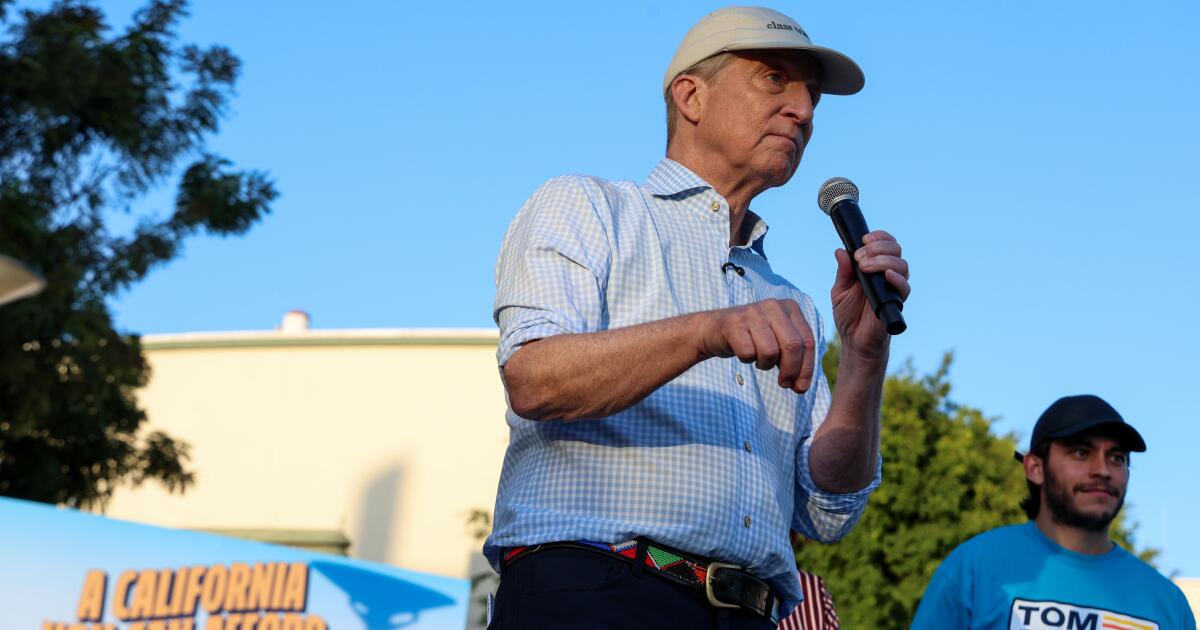
“We’ve seen it in this race. Chevron cuts you a check and you look the other way when they hike prices at the pump. Meta gives you money and your AI plan starts sounding like ChatGPT,” Steyer, sporting a ball cap labeling himself a “class traitor,” told more than 500 supporters at a community college near downtown Los Angeles on Sunday afternoon. “That’s the story of Xavier Becerra.”
Corporations, along with labor unions and interest groups including the California Assn. of Realtors, have spent more than $18.7 million to boost Becerra as of Sunday, according to the election spending tracker California Target Book.
“These companies may be selfish, but they’re not stupid. They don’t give hundreds of thousands of dollars to get someone elected unless they know he’s going to be on their side,” Steyer said.
Though Steyer earned his fortune in part through past investments in private prisons, fossil fuels and private equity, his supporters described him as a reformed billionaire who stepped away from those industries more than a decade ago.
Francesca Fiorentini, a comedian and podcaster, compared Steyer to Charles Dickens’ fictional miser Ebenezer Scrooge.
“At the end of ‘A Christmas Carol,’ nobody turns to Ebenezer and is like, ‘No, I’m not gonna accept your gifts.’ No, they welcome him. They might clown him a little bit, but we need to welcome someone like Tom Steyer,” Fiorentini said. “Tom Steyer is actually listening, he actually cares, he’s actually changing his belief system and he’s acting accordingly.”
Though he mainly went after Becerra, Steyer also made sure to criticize Hilton.
“You are not voting for who’s on the ballot, you’re voting for the California that comes after,” Steyer said. “The California that Steve Hilton is running on sounds exactly like what Trump wants: higher prices, lower wages, and less freedom.”
His campaign underscored his attacks against Becerra by having a handful of supporters dressed as zombies speak outside of Becerra’s Sunday evening rally in Long Beach. Waving signs naming businesses that have supported Becerra, they wore lanyards describing “Big Oil,” “Big Tech” and other corporate sectors as Becerra’s “bestie.”
At a raucous rally, elected officials, labor leaders and reproductive rights advocates were among the speakers who introduced Becerra, who attacked Steyer and Hilton, though not by name.
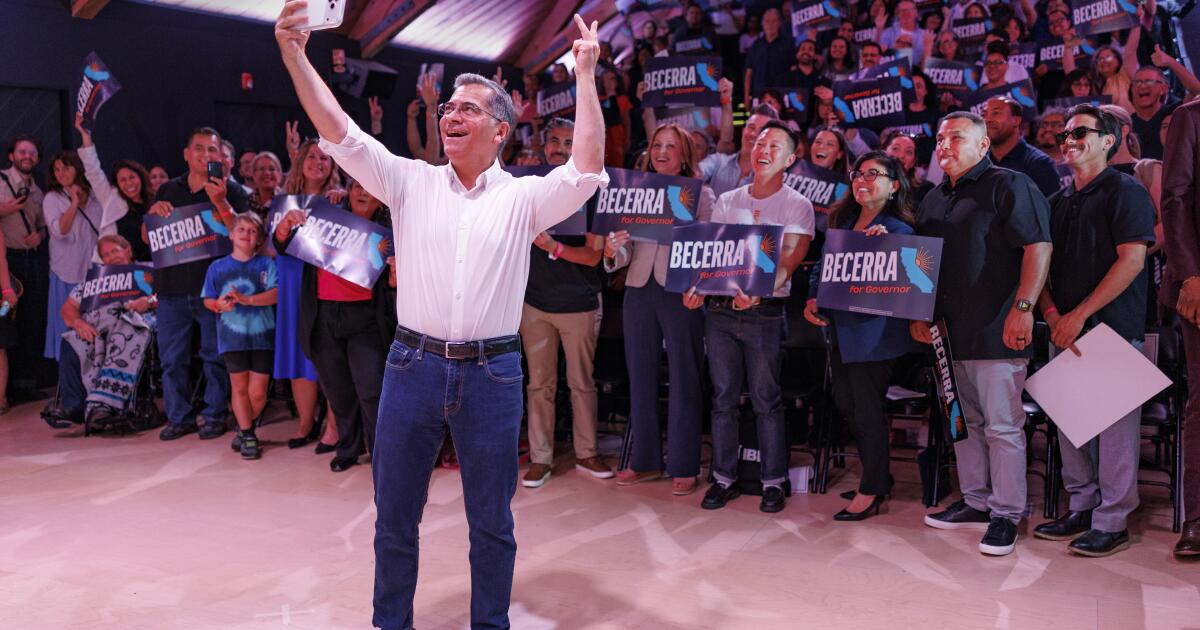
“We are not going to let a billionaire or Trump’s handpicked candidate take over this state,” he told more than 1,000 people at the city’s convention center. “We are not going to let them gut Medicaid while Californians work hard to build a future. We are not going to let them buy an election…. Not here, not in this state, not on our watch.”
Becerra seemed in awe as he stood in front of the packed room.
“Look around this room. One of our opponents has a billion dollars in a checkbook,” he said. “We have something better… We don’t have the money, but we have the movement. We don’t have the money, but we’ve got the momentum. And in this state, if you’ve got the momentum, you run across the finish line, and you win, baby, you win.”
Becerra also released a new video that ostensibly attacks Hilton as “Trump’s favorite” — a thinly veiled effort to prop up Hilton among Republicans to ensure he finished ahead of Steyer in the primary. Given that Democratic voters outnumber Republicans by almost 2 to 1, Becerra would much rather face Hilton than Steyer in the general election.
Newsom’s campaign employed this strategy to boost GOP businessman John Cox in the 2018 gubernatorial election, as did then-Rep. Adam Schiff against Republican Steve Garvey in Schiff’s successful 2024 U.S. Senate race.
Billionaire Tom Steyer has argued that he is the only candidate not beholden to special interests.
(Eric Thayer/Los Angeles Times)
Steyer launched an ad this weekend titled “Risky” that implies Becerra could face criminal charges related to the acts of two former advisors who have plead guilty to federal charges related to stealing campaign funds from a dormant Becerra campaign account.
Becerra’s campaign called the ad defamatory in a cease and desist letter sent to the Steyer campaign on Saturday.
Becerra, Hilton and Steyer, the front-runners in the race, barnstormed the state in the final days before the June 2 primary. They devoted much of their attention to voters in Southern California, which is home to many of the state’s 23.2 million registered voters. Lower-polling candidates also stumped in the Southland — San José Mayor Matt Mahan greeted diners at Grand Central Market in downtown Los Angeles, and former Orange County Rep. Katie Porter kicked off a union canvassing event in Orange on Saturday.
Unlike recent contests to lead the nation’s most populous state, this year’s gubernatorial contest failed to energize the electorate. Despite a crowded field of candidates with notable resumes, as well as record-breaking spending by Steyer and independent-expenditure committees. Californians only recently tuned in.
Political experts of both parties believe voters malaise was due to fatigue about the nation’s political polarization, as well as Trump administration policies such as federal tariffs that drove up prices everywhere and some that disproportionately affected California, such as immigration raids. Southern Californians were also reeling from the devastating wildfires in the Pacific Palisades and Altadena and last year’s special election to redraw the state’s congressional boundaries.
Earlier this year, Democratic leaders worried that their voters would splinter among their candidates, creating a scenario where two Republicans advanced to the general election. They controversially urged their party’s candidates to assess their viability, effectively urging several low-polling candidates to drop out of the race.
Democratic turnout also prompted concerns. As of May 22, mail ballots returned by Democrats were 9.2% lower compared with the 2022 gubernatorial primary, while ballots returned by Republicans were 11.6% higher, according to Political Data Intelligence. But the return rates are shifting — as of Friday, Democrats were 7% behind their 2022 return rate, while Republicans were 6.8% higher.
The most recent polls suggest that the prospect of two Republicans advancing to the general election is nonexistent, and there is now a slim chance that two Democrats win the top two spots in the June 2 primary.
That means there’s no chance of a Republican sweep in this blue state, and suddenly, what has up until now been a pretty dry governor’s primary race has turned into one that has a slim-but-genuine chance at a surprise ending — two Democrats on the November ticket.
“It’s a low probability,” political data guru Paul Mitchell told me, “But there’s always a chance.”
Those of you who have hung on to your ballots like winning lottery tickets, and those who plan on voting in person, will largely decide what happens next: An Xavier Becerra-Steve Hilton top two is a virtual election for Becerra since there just aren’t enough Republican voters in the state to carry a general election. A Becerra-Steyer face-off would force both candidates to define a vision of California beyond generic liberal ideas.
Personally, I wouldn’t mind seeing California have that Dem-on-Dem showdown so that voters of all parties (or none) have the chance to pin these would-be leaders down on the details of their policies. So far, this election has been light on the specifics, but the state faces real problems — from a failing healthcare system to gas prices that literally mystify even lawmakers.
Everything changes when a candidate becomes a winner, so maybe it would be good for democracy to have an old-fashioned war of ideas in this moment when the future of California holds so many unknowns.
Is Steyer just a billionaire dilettante trying to buy an office? Is Becerra beholden to the many corporate interests who have funded his campaign? Those are just the top-line questions many voters still have.
“There’s lots of shades of blue,” pointed out Chad Peace of the Independent Voter Project, on a press call to support open primaries. “When we only look at things as, ‘Oh, there’s red and there’s blue,’ we forget that.”
But voters remain nervous, and the ballot is still packed — along with the top three, former Rep. Katie Porter and San José Mayor Matt Mahan are still campaigning, though with falling support.
Voters, Mitchell said, “are really thinking about the implications” of their vote, and perhaps don’t want to throw it away on a candidate they perceive as having no chance. That’s why the new polls showing Steyer as a contender have the potential of stirring up momentum, especially for voters who originally saw themselves filling in the bubble for one of those candidates on the decline.
Recent polls have put Steyer in a near-dead-heat with Republican front-runner Hilton, both hovering slightly above or below 20%. Becerra, the former California attorney general and a former Biden Cabinet secretary, leads them both by a few points, especially among Latino voters. As my colleague Gustavo Arellano has pointed out, Becerra would be the state’s second Latino governor, after Romualdo Pacheco, who held the office for 10 months in 1875.
“A Dem-Dem race, maybe we’ll get more people involved, because it’s going to be a harder fight, you know?” Diane McClure told me. She’s a board member of the California Nurses Assn., which endorsed Steyer early — in large part because he supports a plan for single-payer health insurance, which that union has long fought for.
McClure, of course, would love to see Steyer take the top spot in that easy-win scenario against Hilton, though that seems doubtful. But a Steyer-Becerra race?
“Maybe it’s a good thing, maybe it’ll wake some people up,” she said.
For his part, Steyer is staying the course. At a Sacramento stop Friday, he bounded around chatting with about four dozen mostly union supporters, wearing trademark Nikes, this time a vintage pair with a tartan plaid swoop.
“Four days,” Steyer said when he finally took the microphone. “I really need you to stand with me. But let me say this: you stand with me, I stand with you.”
Unlike his debate performances, Steyer is passionate, and, though it seems unlikely based on his television appearances, has an amiable charisma dotted with a fair amount of light profanity.
“Make a decent living, buy a house, have a great education for your kids, and retire,” he said. “That’s what we’re trying to build here. We can easily do that. When people say that’s not possible, bull—, that’s bull—.”
It was enough to sway Ricky Carter, one of the few non-union members in the room, who was invited because his wife, Barbara, was on a prayer chain with another invitee. An older Black man originally from South Los Angeles, Carter represents a demographic where Steyer has growing popularity.
“I believe him. He got it right in here,” he said, pounding a fist over his heart. “It ain’t about no color, creed and race. … It’s about the people.”
Indeed, elections are about the people, though it doesn’t always feel like it. But suddenly, this one does.
The top candidates for California governor crisscrossed the state Friday, all venturing to friendly political territory to woo voters and undermine their rivals as the June 2 primary election fast approaches.
The top Republican in the race, former Fox News host Steve Hilton, spent the day railing against transgender athletes before a high school track event in the Central Valley, an event sure to appeal to his base of President Trump supporters.
The front-running Democrats, former Biden administration Cabinet member Xavier Becerra and billionaire environmentalist Tom Steyer, rallied one of their party’s most influential constituencies: union members.
While both stuck with mostly an upbeat message and reiterated promises to lift up Californians struggling to make ends meet, Steyer afterward accused Becerra of being “a corporate Democrat who’s taking money from all these big corporations” who “doesn’t want to change things.”
Steyer’s had good reason to go after Becerra.
A new poll from the UC Berkeley Institute of Governmental Studies and co-sponsored by the Los Angeles Times showed Becerra leading the race with 25% support from likely voters, followed by Hilton at 21% and Steyer within striking distance at 19%. The two candidates who finish in first and second place in the primary will advance to the November general election, leaving the third-place finisher on the sideline.
Though he told reporters Friday morning that “I don’t pay attention to polls,” Steyer was energetic at a Northern California campaign event, where he held a private meeting with leaders of a union representing long-term caregivers. In brief remarks at the offices of SEIU Local 2015, Steyer described the race as a choice between a billionaire champion of working people and the corporate-backed Becerra.
“Does California work for Californians or does California work for corporations? The corporations think it works for them. They want it to continue to work for them and they’re putting up tens of millions of dollars to make sure they continue to make record profits,” he told dozens of home-care workers, teachers, construction workers and nurses at the West Sacramento gathering.
Groups including PG&E, the California Assn. of Realtors and the California Chamber of Commerce have spent more than $34 million opposing Steyer’s candidacy. The former hedge fund manager has pledged to lower energy bills by breaking up large electric utility monopolies.
As a billionaire who has so far poured $216 million of his own money into his gubernatorial campaign, Steyer has faced skepticism from some left-wing and working-class voters. But he is endorsed by progressives, including Rep. Ro Khanna (D-San Jose), and unions including the California Nurses Assn. and both major teachers unions.
“I voted for Tom. I was looking for a change,” said Alvenia Scott, a union board member who works as an in-home caregiver to her disabled sister.
“He really has some good ideas,” she said, adding that she had more qualms about Steyer’s lack of government experience than his wealth. “He made his way in life, more power to him.”
Hundreds of miles south in the Inland Empire, Becerra pledged to be on the side of unions if he is elected governor and urged voters to turn in their ballots in what has so far been a remarkably low-turnout election.
“I am with you. When I become governor and I sit behind that desk, you’ll have a union man sitting at that desk,” Becerra told about 500 people at the United Food and Commercial Workers hall in Bloomington.
He asked the crowd if they had cast their ballots and noted that not everyone raised their hand.
“Less than one in five Californians have actually cast their vote so far. We got to get that number way, way up,” he said, arguing that the election is about “sending a message all across the country that California will be counted, that California cannot be neglected, and that California will not take a knee to anyone in Washington, D.C.”
Only 12% of the state’s registered voters have cast ballots as of Thursday evening, according to the election tracking firm Political Data Inc.
Community college counselor Diego Rodriguez, 32, said he decided to vote for Becerra in recent weeks after seeing the former U.S. Health and Human Services secretary’s momentum in the race and researching his record.
“Also just his story. As someone who works in higher education, and seeing how Xavier, being first-generation, has benefited from higher education, and how he advocates for higher education,” the Rialto resident said. “Additionally, today, him being here at a labor union and advocating for the working class and labor, I think, is very important.”
“I think that people became aware of him more because of that,” Rodriguez said. “There was a lot of conversation online regarding that, but I think it allowed the spotlight to be brought onto him and it made people aware of his record.”
At a campaign stop in Clovis in the central part of the state, Hilton marveled that his campaign had spent only about $2 million in campaign advertising but was still polling above Steyer, according to the latest Berkeley IGS survey.
“We’re feeling confident,” said Hilton, standing in a suburban stretch of the city. Still, he warned that voters need to get out to support him and avoid a “complete disaster for California” of two Democrats advancing to the November election.
Hilton, who was endorsed by Trump in April, joined other politicians and leaders in Clovis in opposing trans athletes from competing at the 2026 CIF State Track & Field Championships.
The group met near where the championship events were scheduled to take place this weekend.
Asked why he was focusing on sports and gender in the final days of the race, Hilton said it’s “one of the main issues” that come up at town halls. If elected, he said he would seek to overturn the state’s 13-year-old law that allows students to participate in school activities and use facilities such as bathrooms based on their gender identity.
Hilton argues the law violates the state Constitution and will “suspend” it while he initiates legal proceedings to overturn it.
He also praised Spencer Pratt, a Republican and former reality TV star who is running for Los Angeles mayor, saying his candidacy has brought “excitement and energy” to the state’s primary election.
“For a long time in California, there’s been this sense that it’s all inevitable — there’s nothing you can do, Democrats run this place, just the way it is,” Hilton said. “I think that that’s changing. I think there’s this sense that something’s happening.”
On the cusp of California’s gubernatorial June 2 primary, voters are closely divided among three candidates vying to succeed Gov. Gavin Newsom at a perilous moment in the state and nation’s history, according to a poll released Thursday.
Among likely California voters, 25% support Xavier Becerra, a Democrat and former Biden Cabinet secretary, according to the survey by UC Berkeley’s Institute of Governmental Studies that was co-sponsored by the Los Angeles Times. Republican Steve Hilton, a former Fox News commentator and British political strategist, has the backing of 21%, while 19% backed billionaire hedge fund founder turned environmental activist Tom Steyer, a Democrat.
California gubernatorial candidate Xavier Becerra takes a selfie at an event while campaigning on May 26, 2026 in San Francisco, California. Becerra is the former United States Secretary of Health and Human Services and is running as a democratic candidate for governor. California’s statewide election is on June 2.
(Benjamin Fanjoy / Getty Images)
The survey provided the clearest indication yet that the three have separated themselves from the rest of the field. Support increased for Becerra, Hilton and Steyer since the last Berkeley IGS poll in March. Becerra leapfrogged everyone. In early March he wallowed near the bottom of the pack at just 5% support among likely voters, and now is the front-runner.
The other candidates floundered. Support for Riverside County Sheriff Chad Bianco, a Republican, dropped 5% and he now finds himself in a distant fourth place. Former Democratic Rep. Katie Porter of Irvine dropped by almost half to 7%. San Jose Mayor Matt Mahan, former Los Angeles Mayor Antonio Villaraigosa and state Supt. of Public Instruction Tony Thurmond — all Democrats — remained mired in the single digits.
Poll director Mark DiCamillo cautioned that it remains unclear which candidates will finish in first and second place in the June 2 primary, a pivotal question since only the top two finishers will advance to the November general election regardless of party affiliation. The low voter turnout thus far makes predicting the outcome especially difficult.
Although every registered voter in California was sent a mail-in ballot, many have not returned them or dropped them off at voting locations — a telltale sign of the uncertain nature of this year’s governor’s race. The survey, which included all 61 of the gubernatorial candidates on the ballot, found that Democratic turnout thus far is noticeably lower compared with past primary elections, DiCamillo said.
Steve Hilton, Republican gubernatorial candidate for California, arrives for a news conference at the San Jose Diridon Station in San Jose, California, US, on Tuesday, May 26, 2026. Republican gubernatorial candidate Steve Hilton is announcing his intention to halt future taxpayer-funded payments for California’s High-Speed Rail project, if elected in November.
(Jason Henry/Bloomberg via Getty Images)
“We’re assuming that … the Democrats will in fact turn out in the final week after we had concluded our poll and begin to make up ground on what looks like an early lead for Hilton, and those voters favor Becerra,” DiCamillo said.
The survey, conducted between May 19 and 24, found that likely Democratic voters favored Becerra over Steyer by 11 percentage points. Voters registered as “no party preference” were evenly divided between Becerra, Steyer and Hilton. Among likely Republican voters, Hilton led Bianco by almost 2 to 1.
Becerra also had a notable edge over Steyer among women and Latino voters, while Steyer had an advantage among Black voters. Hilton was favored over the two Democrats among self-identified libertarians and among voters in Orange County, the Central Valley and northern coast and Sierra region.
The poll found that 7% of voters remained undecided.
For the first time in more than a quarter of a century, the contest to lead the nation’s most populous state and the world’s fourth-largest economy has consistently lacked a front-runner despite a plethora of candidates.
Two of California’s best-known Democrats, former Vice President Kamala Harris and U.S. Sen. Alex Padilla, both toyed with a run for governor before deciding not to run, which contributed to the sluggishness of the race. The 2026 campaign for governor also languished in the shadow of the mayhem stirred up by President Trump, including his immigration raids throughout Southern California, and the devastation wrought by the 2025 Pacific Palisades and Altadena wildfires.
But a whirlwind of recent developments has drawn attention to the race.
Tom Steyer, Democratic gubernatorial candidate for California, during a campaign event in Santa Rosa, California, US, on Wednesday, May 27, 2026. California is holding its primary election on June 2. Photographer: David Paul Morris/Bloomberg via Getty Images
(Bloomberg/Bloomberg via Getty Images)
Additionally, record-breaking amounts of money have flowed into the race. Steyer has smashed state self-funding records by contributing $212 million to his campaign as of Tuesday, according to the California secretary of state’s office. Nearly $85 million has been donated to independent expenditure committees by corporations, labor unions, tech titans, Native American tribes and other special interests, most of which will have policy interests that will be in front of the next governor.
Although the 2026 California governor’s race lacks the allure of recent contests that featured candidates such as global movie star Arnold Schwarzenegger, political scion Jerry Brown and former San Francisco mayor and likely 2028 presidential candidate Gavin Newsom, it is unfolding at a crucial time for Californians.
The state’s most vulnerable residents are facing severe reductions to medical care because of looming federal healthcare funding cuts, and California’s budget, already volatile because of its reliance on the state’s wealthiest residents, may grow more unpredictable. California’s highest-in-the-nation gas prices increased even more because of the U.S.-Iran war, adding to the state’s entrenched affordability crisis, which has driven many residents out of the state.
The cost of living, homelessness and public safety were among the top concerns expressed by voters, according to the poll. Protecting voting rights was also supported by most voters, though their underlying concerns could be starkly different based on their political views.
Democrats have been focused on the disenfranchisement of voters, a fear that has heightened in the aftermath of a recent Supreme Court decision that gutted a section of the Voting Rights Act that forced states to draw voting districts to help elect Black or Latino representatives to Congress. Republicans echo President Trump’s claims of elections being rigged.
Los Angeles, CA – MAY 06, 2026: Chad Bianco is interviewed after the California Gubernatorial debate at Skirball Cultural Center on Wednesday, May 6, 2026 in Los Angeles, CA.
(Jason Armond/Los Angeles Times)
Voters split largely along party lines about issues such as Trump’s policies about climate change, immigration and taxes.
Voters’ uncertainty in the governor’s race is partly driven by California’s unique, voter-approved “jungle” primary system, in which the two candidates who win the most votes in the June 2 primary advance to the November general election, regardless of party affiliation.
Although the state’s voters are largely registered Democrats, the party’s leaders feared earlier this year that they would splinter among the multiple Democrats on the ballot, leading to Hilton and Bianco advancing to the November general election and ensuring that a Republican would be elected governor. Bianco had the backing of 11% in the new Berkeley survey.
The Republicans were once roughly tied in polls, until Trump endorsed Hilton in April. More than one-third of likely Republican voters said Trump’s endorsement of Hilton made them more likely to support him. Among voters who identified with the “Make America Great Again” movement, nearly two-thirds supported Hilton while less than 3 in 10 backed Bianco.
Though Bianco’s followers seem to be more passionate, “Hilton has got the much broader base of support, and then he got Trump’s endorsement,” DiCamillo said.
He added that Hilton’s rise is unusual in California, where statewide candidates typically spend enormous sums of money to raise their visibility among the state’s 23.1 million registered voters.
“What’s interesting about Hilton is that he hasn’t really done much of his campaigning in the traditional way. He hasn’t run huge amounts of television advertising, you don’t see his name out there in the traditional media, other than in free media,” DiCamillo said. “You can see that in the data, because almost a third of voters still have no opinion of Hilton … about what it was back in March, which is startling for a candidate who is among the leaders.”
Democrats’ fear of being locked out of the November general election led party leaders and allies to effectively urge low-polling candidates to drop out of the race in remarkable public statements in March.
The tables have since turned — the prospect of two Republicans winning the top spots in the June primary appear nonexistent, while polling shows a small possibility of two Democrats advancing to the general election.
“I’m not saying it’s likely, but it’s possible that two Democrats could emerge, and that would have huge implications on turnout in the [November] election,” DiCamillo said, pointing to California congressional races that could shape control of the U.S. House of Representatives. “If you don’t have a Republican at the top of the ticket, it would be dismal for the Republicans’ chances.”
The poll of 8,578 registered California voters was conducted online in English and Spanish and has a margin of error of about 2 percentage points in either direction.
SACRAMENTO — The state’s biggest energy utility has made the unusual move to attack candidate Tom Steyer in the California governor’s race.
State campaign filings show that Pacific Gas & Electric has plowed at least $13.5 million into efforts to oppose Steyer. Other major utilities in the state have also donated to another committee backing the anti-Steyer effort.
Steyer, a billionaire and former hedge fund founder who became a high-profile environmental advocate, accuses the big three California utility companies — PG&E, San Diego Gas & Electric Co. and Southern California Edison — of “raking in” record profits at the expense of their customers. He blames the utilities for high consumer bills and causing deadly wildfires with their faulty utility equipment.
Though other candidates in the race are also criticizing the utilities, Steyer is the most aggressive.
“Big energy companies really piss me off,” Steyer said in one of his own campaign ads earlier this year.
In another attack, Steyer called PG&E less of an electric company and more of a “sophisticated Sacramento lobbying and influence operation that also happens to sell electricity. California needs a governor who will stand up to these monopolies, hold them accountable, and break them up.”
Lynsey Paulo, a spokesperson for PG&E, declined to answer questions about the utility’s spending, referring The Times to the committee running anti-Steyer ads.
“Tom Steyer has spent over $200 million trying to buy the Governor’s office,” the committee said in a statement.
Steyer, a Democrat who is relying on his vast fortune in the race, is seeking to advance past the June 2 primary to the November general election. Recent polls put him behind Republican Steve Hilton, a former Fox News commentator, and onetime Health and Human Services Secretary Xavier Becerra.
The utility-funded advertisements against Steyer don’t mention his position on energy policies, focusing instead on his onetime hedge fund’s investments in coal and for-profit detention centers. One ad compares him to President Trump.
“When Steyer sells himself as a different kind of billionaire, tell him where to stick it,” a voiceover says.
Another advertisement from the anti-Steyer group California is Not for Sale highlights its support for Becerra. The California Assn. of Realtors and the California Building Industry Assn. are also supporting the group.
Steyer’s campaign last week embraced the spending from PG&E and others.
“When you’re opposed by the people responsible for devastating wildfires and outrageous rate hikes, you’re doing something right,” Steyer spokesperson Sepi Esfahlani said.
Steyer has used his criticism of the California utilities and the oil industry as a shield against attacks that he made billions of dollars from fossil fuels when he ran his hedge fund, and to elevate himself as an advocate for working-class Californians.
When Democratic rival Katie Porter ripped into Steyer at a recent debate for using his riches to support his gubernatorial campaign, Steyer pointed to the attacks by PG&E and others as evidence that he’ll take on Sacramento’s powerful special interests.
“There is one person that the corporations are going after, including Big Oil, who is spending millions of dollars to stop me,” Steyer responded during the April debate at Pomona College in Claremont.
“The electric monopolies, PG&E, millions of dollars to stop me, because I’m the person on this stage who’s the change agent,” he said. “I’m the person who’s going to drive down costs for the people of California by taking on the special interests.”
PG&E CEO Patti Poppe and Steyer lauded one another in social media posts after appearing together at various conferences last year, the California Post reported.
“Loved sitting down to talk the future of energy with Tom Steyer at the Galvanize Solutions Summit,” Poppe wrote on LinkedIn in December. Steyer co-founded Galvanize, an asset management firm.
The California Chamber of Commerce’s political action committee this year collected at least $2 million each from PG&E, Sempra — the parent company of SoCalGas and San Diego Gas & Electric — and Edison. The chamber’s committee in turn has donated $9.75 million toward the anti-Steyer committee.
John Myers, a representative for the Chamber of Commerce, said the committee’s leadership, not donors, make spending decisions.
California electric rates are the nation’s second highest after Hawaii, contributing to the state’s high cost of living — one of the biggest concerns of voters.
PG&E serves Northern and Central California, while Southern California Edison is available in Central, coastal and Southern California. San Diego Gas & Electric services Southern California.
The California Public Utilities Commission sets the rate of return that the companies can make. Steyer has argued that “perverse” structure allows utilities to disregard cheaper cost-effective solutions in favor of more expensive options, such as undergrounding power lines.
Despite Steyer’s talk of “breaking up” utilities, he doesn’t propose dismantling them. Instead, he vows to put reform-focused appointees on the regulatory agency and reduce utility rates. He also wants more battery storage for renewal energy, as well as additional rooftop and community solar.
The three utilities recently opposed a bill to require that wildfire safety spending by Southern California Edison, PG&E and San Diego Gas & Electric be audited by an independent accounting firm.
The bill by Assemblywoman Tasha Boerner, an Encinitas Democrat, stalled out earlier this month. It would have required the state’s regulatory agency to consider the audits’ findings before agreeing to raise customer rates to cover even more wildfire prevention spending.
Audits of the three companies’ wildfire spending from 2019 to 2020 found that $2.5 billion could not be accounted for.
Matt Abularach-Macias, political director of Environmental Voters, said the utilities probably consider Steyer as a threat to their business. The companies plan infrastructure projects five or 10 years ahead and don’t want disruptions, he said.
Environmental Voters has endorsed Steyer and former Orange County Rep. Katie Porter. The group’s educational arm received a $500,000 donation from a Steyer-backed entity in 2013.
Leah Stokes, associate professor of political science at UC Santa Barbara, called PG&E’s outlay in the governor’s race part of a “corrupt system.”
“These are monopoly companies, you can’t choose to buy from anybody else,” Stokes said. “They take your money, turn it into profits because they are poorly regulated, and then undermine political candidates who would actually hold them accountable.”
Stokes has publicly endorsed Steyer.
A spokesperson for Southern California Edison said the company funds its political contributions from “shareholder dollars.”
“No customer dollars, or any part of the rates paid by Southern California Edison customers, are used to support political candidates,” he said.
Times staff writer Melody Petersen contributed to this report.
Corporations, labor unions, tech titans, Native American tribes and other special interests have donated a record-shattering $79.6 million to independent committees focused on swaying the volatile California governor’s race ahead of the June 2 primary.
Many of the largest backers to these committees will have significant business interests in front of the state’s next governor and state agencies, with hopes of either strengthening a candidate aligned with their political priorities or undercutting those who oppose them.
“This is the first time I’ve ever seen IEs [or independent expenditures] have this kind of an impact on a governor’s race,” said veteran GOP strategist Martin Wilson, who has worked on every California gubernatorial contest since 1978 and worked on an outside effort backing San José Mayor Matt Mahan’s 2026 bid for governor. “It’s totally unprecedented.”
Election laws bar independent expenditure committees from communicating or coordinating with campaigns, allowing candidates to emphasize that they have no control over the money that pours into these outside groups. The wall between the two has long been viewed as performative and penetrable.
The greatest amount of outside spending has been directed at attacking billionaire hedge fund founder turned environmental warrior Tom Steyer, a leading Democrat in the race.
Nearly $32.3 million had been donated to opposing his candidacy as of Monday, according to the California Target Book, a nonpartisan political almanac, which tracks independent expenditure committees. Among the major donors are utility giant PG&E, a political action committee sponsored by the California Chamber of Commerce and the California Assn. of Realtors’ independent expenditure committee, which combined have utility, business, property tax and building issues affected by lawmakers and regulators in the state capital.
Independent expenditures supporting Steyer’s bid for governor have been minimal compared with the record-breaking $212 million Steyer has donated to his own campaign as of Monday, according to the California secretary of state’s office. Still, more than $1.4 million of outside money has been spent supporting his bid, largely by the California Nurses Assn., which shares his goal of creating single-payer healthcare.
Expenditure committees linked to Uber, the California Medical Assn., the kidney dialysis company DaVita and the California Dental Assn. contributed nearly $7.3 million to independent efforts backing former Rep. Eric Swalwell (D-Dublin) before he dropped out of the gubernatorial race in April because of sexual assault and misconduct allegations.
Several of those donors then coalesced behind former Biden Cabinet member Xavier Becerra, who was struggling to connect with California voters before he surged to become a front-runner, recent opininon polls show. More than $13 million has been contributed to outside groups backing the former U.S. Health and Human Services secretary.
The outside money has led to flashpoints in the race. Steyer points to corporations backing Becerra, such as a $500,000 Chevron donation to a group supporting him that was reported to state election officials on Thursday.
“The Becerra campaign was running out of gas until the latest half-million dollar influx from Chevron,” said Steyer spokesman Anthony York.
The message echoes a Steyer theme on the campaign trail — that candidates ought to be judged by who is supporting them and who is opposing them.
Becerra accused Steyer of misleading voters because the $500,000 from Chevron went to an independent expenditure committee supporting him that he has no control over. However, Becerra did receive a direct $39,200 contribution from the oil company to his campaign committee in June 2025.
“For him to say that I took the [$500,000] … that’s just an outright lie,” he said in a television interview this weekend. “It pains me to see that candidates for office believe that they have to descend to telling lies in order to gain favor with voters. If that’s what you do as a candidate, what will you do when you’re in the office?”
Steyer’s campaign, which used the Memorial Day weekend to attack Becerra with billboards highlighting high gas prices in Los Angeles and Fresno, said it was disingenuous for Becerra to feign ignorance of how the political system works.
“Chevron is charging Californians record gas prices on one hand and turning right around to spend $500,000 to elect Xavier Becerra with the other,” said Steyer spokesperson Danni Wang. “Now Becerra is playing semantic gymnastics trying to pretend voters are too stupid to understand how dark money in politics works. Californians aren’t buying it.”
Becerra’s campaign argued that such comments are the height of hypocrisy coming from a billionaire whose campaign is funded by his profits from a hedge fund that made investments that are opposed by many voters. Becerra said he continually took on oil companies when he served as California’s attorney general.
“Tom Steyer made his billions off fossil fuels and private prisons, then decided that qualified him to run California,” said Becerra spokesman Jonathan Underland. “He’s now attacking the only candidate in this race who actually held Big Oil’s feet to the fire and beat [President] Trump 100 times as [state attorney general]. The irony would be funny if Tom’s checkbook weren’t so thick.”
Mahan, a moderate Democrat, has benefited from $21.7 million in spending by outside groups backing him, while $570,000 has been spent by independent committees opposing him, according to the Target Book. The donors who supported his bid are a who’s who of Silicon Valley, including venture capitalists Michael Moritz and L. John Doerr, Stripe Chief Executive Patrick Collinson and Sun Microsystems co-founder Vinod Khosla. Other notable donors include billionaire real estate developer Rick Caruso, who unsuccessfully ran for Los Angeles mayor in 2022, as well as Griff Harsh V, the son of billionaire Meg Whitman, the unsuccessful 2010 GOP gubernatorial nominee turned Democrat who once led EBay.
Despite that generous support, Mahan remains mired in the single digits in the polls. On Wednesday, billionaire Netflix co-founder Reed Hastings received a refund of $1 million he had donated to one of the independent expenditure committees supporting Mahan’s bid.
Hastings said he had not requested the money to be returned to him.
“I’m voting for Matt Mahan. I didn’t ask for any refund and they shouldn’t have done it,” he posted on X on Saturday. “Go Matt.”
Matt Rodriguez, a spokesman for the Back to Basics committee backing Mahan, said that he believes Mahan’s standing in the race is a reflection of a number of factors — an underwhelming contest as well as Mahan’s January entry into it and the fact that he was not well known statewide.
“He got in a little bit late and it was a big climb … with an apathetic electorate,” Rodriguez said. “Politics is all about money and timing — both the amount of time and being there at the right time.”
Mahan’s priorities, such as housing and homelessness improvements he oversaw in San José, had an impact on the campaign, the Democratic strategist said.
“Democrats have to perform, and if we are going to perform, we have to have results,” he said.
The only other candidate who saw seven figures in independent expenditure spending was Republican Steve Hilton, a former Fox News commentator who has been endorsed by Trump and is the leading GOP candidate in the race. More than $1.8 million has been spent opposing Hilton and $13,750 was spent supporting him.
SEIU California donated $250,000 to opposing gubernatorial candidates. Oscar Lopez, the union’s political director, said it has opposed Hilton, Mahan and Republican Riverside County Sheriff Chad Bianco.
“Each of these candidates represents a serious threat to the wages, rights and dignity of California’s working people,” Lopez said.
Hilton said the spending against him represents Democratic recognition of him as a threat.
“They know that they’re vulnerable. The Democratic machine understands they’ve got weak candidates and a terrible record,” he said in an interview. “They see me as outsider and change agent. The only argument they have — if you can call it an argument — is to endlessly repeat the words Trump and MAGA.”
Outside spending has grown exponentially after a voter-approved 2000 California ballot measure limited how much donors can contribute directly to candidates. For the current election, it’s $78,400 for the primary and the general election in the governor’s race.
But donors can contribute unlimited amounts to outside groups, which are formally called independent expenditure committees. Though such donations were already legal in California, they greatly increased in the state and across the nation after the U.S. Supreme Court’s 2010 Citizens United decision that said limits on independent political spending by corporations, unions and other entities violated 1st Amendment free speech protections.
“It has been a steady increase in the amount of money going to outside groups,” said Rick Hasen, a professor of law and political science at UCLA.
In California, independent expenditure groups set a record in 2010 when they spent about $25 million supporting then-gubernatorial candidate Jerry Brown. Largely union money, it was spent in the summer after the primary and was viewed as critical to stalling self-funding Republican billionaire Meg Whitman’s campaign. Brown ultimately won the race by 13 percentage points.
In the 2018 gubernatorial primary, records were once again broken by more than $26 million of outside spending, with former Los Angeles Mayor Antonio Villaraigosa being the biggest beneficiary. Charter school backers spent nearly $16 million on unsuccessful efforts to boost his campaign.
In addition to an enormous financial advantage over campaign committees, outside groups have the ability to trumpet highly provocative adversarial attacks without the candidate they support being blamed for the often controversial messaging.
“IEs are as free to go as negative as they want without that negativity boomeranging back to hurt the candidate,” said Thad Kousser, a political science professor at UC San Diego.
While communication between candidate campaigns and independent committees is forbidden, these rules are commonly circumvented using legal but obvious methods. One called “red boxing,” which Becerra employed earlier this year, literally puts messages inside red-lined boxes on candidate websites that their campaign strategists would like to see outside groups highlight.
“There are technical rules that prevent certain types of communication, but it’s easy enough to communicate in public and be on the same page on messaging,” Hasen said.
Among the major donors in the 2026 campaign are the California Chamber of Commerce, PG&E, the California Assn. of Realtors, the Laborers Pacific Southwest Regional Organizing Coalition PAC, the Pechanga Band of Indians, the California Nurses Assn., and corporations and leaders or founders of companies such as Meta, Google and Uber.
Californians for the People, an outside committee that has spent nearly $32.3 million opposing Steyer, is the most well-funded independent expenditure committee this year. Among it’s largest donors is JOBSPAC, a group sponsored by the California Chamber of Commerce, that has donated nearly $11.8 million to the effort.
“CalChamber is participating in an independent expenditure campaign because voters deserve to know more about Mr. Steyer,” said John Myers, a spokesman for the chamber. “His policy promises will cost billions, driving investment out of California and worsening the state’s affordability crisis.”
The Pechanga Band of Indians has spent $1.5 million on pro-Becerra efforts.
“Secretary Becerra has stood with Indian Country for decades and understands Tribal sovereignty,” said Pechanga Chairman Mark Macarro. “When tribal healthcare was on the line, he was there. This experience comes from a lifetime of public service, not a checkbook.”
WASHINGTON — In the 2024 election, hundreds of social media influencers were credentialed for the first time to attend the Democratic and Republican conventions. They have been invited to holiday parties in the Pennsylvania governor’s mansion, to political rallies in Texas and to events at the White House by both the Biden and Trump administrations.
The role of influencers is surging as candidates and groups across the political spectrum see their social media feeds and personas as a pathway to younger audiences and harder-to-reach groups of voters.
“You have that sense of authenticity, like a friend is talking to you,” said Emma Briant, a professor at Notre Dame University’s Lucy Family Institute for Data & Society who studies propaganda.
That’s exactly what campaigns are hoping to harness when they partner with influencers, she said.
But the nature of that partnership has come into question in California’s hotly contested gubernatorial race after it emerged that a number of content creators — some with millions of followers, others with only a handful — had taken payments from the campaign of Democratic candidate Tom Steyer and not disclosed that they were paid to create those posts.
Some popular content creators have felt the need to explain themselves to their audience. Others have questioned how common such under-the-table payments might be, since there are no disclosure requirements for paid content at the federal level and few jurisdictions have any rules mandating it.
Some campaign finance advocates are concerned that voters could increasingly be influenced by social media posts that they don’t know are sponsored.
“The problem is that it doesn’t look like an ad,” said Saurav Ghosh, a former enforcement attorney at the Federal Election Commission. “It ends up really getting people at a place where they’re not skeptical and not able to tell the difference between what’s voluntary and where the influencer is acting as a paid spokesperson.”
Ghosh is now the director of campaign finance reform at the nonprofit Campaign Legal Center, which has filed a petition asking the FEC to require disclaimers on paid content created by influencers.
Roughly 1 in 5 Americans said they regularly got news from social media influencers in 2024, according to the Pew Research Center, and that number was nearly double for younger adults between the ages of 18 and 29.
Working with social media creators can be an easy way for candidates to try to boost their image, particularly with a younger audience.
“If they don’t have big personalities, maybe partnering with some influencers who seem cool and fun can make you seem cool and fun also through association,” said Link Lauren, a political influencer and podcaster who served as a communications advisor for Robert F. Kennedy Jr.’s presidential campaign in 2024.
California is one of the few places that requires disclosure of sponsored social media posts, but the 2023 law that created those rules hadn’t gotten much of a workout before the issue was raised in this contest through a series of dueling complaints with California’s Fair Political Practices Commission. The commission has yet to weigh in on the various accusations.
Under the law, influencers are required to provide disclosure that a post was sponsored and say who paid for it. Political groups are required to notify paid creators of the requirement.
Even if the commission finds that violations have occurred, the penalties are not especially harsh.
Violation of the law carries no civil, criminal or administrative penalties. The FPPC can take alleged violators to court and ask a judge to force compliance. And violations can be penalized with a fine of up to $5,000 per instance.
Influencers reporting influencers
In the gubernatorial race, the issue of compliance was raised, naturally, by a pair of influencers.
Beatrice Gomberg has built up a following of more than 180,000 followers on TikTok, where she posts under the handle antiplasticlady. Her side gig of creating nonplastic children’s cups and lunch boxes became her main gig after she lost her human resources job at Macy’s during the COVID-19 pandemic.
“I started doing social media because I didn’t want to hire a marketing company,” Gomberg said.
Gomberg’s posts were initially largely focused on research related to plastic, but have become increasingly political over time. When campaigns put out the call for influencers to meet with candidates, Gomberg answered.
She interviewed Katie Porter, she met with Xavier Becerra. And it was at a Becerra event in April when she met Kaitlyn Hennessy, another influencer focused on politics.
They found that the world of online influencers can be isolating. “We stare in front of our phones,” Hennessy said. “You don’t want to see our screen time.”
As they scrolled through social media posts about the governor’s race, they found a cause to unite them.
They kept seeing videos posted by social media accounts espousing similar messages in support of Tom Steyer. Hennessy wondered at first if they were actually created by artificial intelligence.
They found that the posts seemed to be created by a network of women who, in some cases, had created several different profiles to promote a variety of products.
They pored over Steyer’s campaign disclosures and saw that the campaign listed payments to several prominent influencers — including one with the handle Zay Dante, with 1.8 million followers on TikTok — who had not disclosed creating paid content for the campaign.
The pair filed a complaint laying out their allegations, which the Steyer campaign has called “baseless.”
In the wake of their complaint, Steyer defended his campaign’s use of paid influencers, writing on Substack that his campaign believed content creators should be paid for their work and that the campaign had been transparent about disclosing those payments.
In a separate post, influencer Carlos Eduardo Espina said he had been paid $400,000 for work he has done for the Steyer campaign. Espina, who has more than 14 million followers on TikTok, is an advisor to the campaign, which was publicly announced.
“You will never see anything on my channels that I don’t believe in, or that I think goes against the best interest of my community. No one buys my opinion. But I also think it’s fair to be compensated for my work,” he wrote on Substack.
Not everyone is ready to accept payment for posts.
Lauren, the influencer who advised Kennedy’s campaign, said that while he doesn’t begrudge other influencers accepting sponsorship, he chooses not to.
“A passive viewer might think you really believe this,” he said. “I have a strong connection with my audience. I really consider them my family.”
Lauren said he favors disclosure requirements.
Briant, the propaganda researcher, said she is concerned about the possibility of foreign actors trying to influence Americans through paid posts.
In 2024, for example, federal prosecutors filed an indictment alleging that Russian state media employees had paid nearly $10 million to a Tennessee company that paid popular right-wing social media influencers to unwittingly produce pro-Russia content.
Briant said she believes that the only way to counteract increased manipulation through social media influencers is to impose harsh penalties when paid content is not disclosed.
“Ultimately, it’s a wild west at the moment if there are no repercussions for not doing it,” she said.
WASHINGTON — A political influencer has filed a complaint against Tom Steyer’s campaign for governor, saying the committee failed to notify her of disclosure requirements, as required by law, when she was paid to meet with Steyer in March and later produced social media content from the meeting.
What’s more, she said the Steyer campaign falsely accused her of posting paid content in support of Steyer’s chief Democratic rival, Xavier Becerra, and failing to disclose it in a complaint filed by the billionaire’s campaign this week.
Maggie Reed, who regularly posts satirical takes on politics to roughly half a million followers on Instagram and TiKTok under the username mermaidmamamaggie, said she was actually paid by Steyer’s campaign and signed an agreement that barred her from disclosing the payment.
She posted, and later deleted, a video from her meeting with Steyer in March.
“In plain terms: the Committee paid for political content, structured it to look like an ordinary creator’s organic opinion, and used a non-disclosure agreement to keep the public from learning the truth,” says the complaint, filed Thursday with California’s Fair Political Practices Commission.
Steyer’s campaign disclosed in a campaign filing that it had paid the agency that represents Reed $5,000 for digital advertising, but didn’t indicate that the payment was connected to Reed’s meeting with Steyer or her production of content.
The Steyer campaign said that while it did pay to meet with Reed, it left the decision of whether to create content entirely up to her.
Since then, Reed has produced several videos expressing support for Becerra, the former California congressman and U.S. Secretary of Health and Human Services, but she said that she was not paid to produce those videos and that they reflected her genuine support for Becerra’s campaign.
Becerra has been the top Democrat in recent polling in the race, maintaining a narrow edge over Steyer and a firm grip on one of the top two spots in the June 2 primary that would send him to the general election in November.
Reed’s complaint is the latest volley in a back and forth involving the use of paid influencers in the gubernatorial race.
Two influencers who support Becerra — but were not paid by his campaign — filed a complaint last week saying that a number of influencers had created paid content in support of Steyer, but failed to disclose so in their posts.
Steyer’s campaign then filed a complaint earlier this week in which it leveled accusations against Reed and another influencer named Jay Gonzalez, who is now a paid staffer on the Becerra campaign. The complaint alleges that Gonzalez made several pro-Becerra posts after joining the campaign and belatedly amended them to include disclosure that they were sponsored.
The Becerra campaign has maintained that it does not otherwise pay influencers to produce content on its behalf.
Steyer’s complaint included screenshots of an email sent to Reed’s talent agency by a gubernatorial campaign gauging her interest in producing paid content.
While the screenshots produced in Steyer’s complaint did not disclose who had sent the inquiry, Reed said in her complaint that the request had come from a staffer for the gubernatorial campaign of former Los Angeles Mayor and California State Assembly Speaker Antonio Villaraigosa.
Disclosure of paid political content by social media creators is required in California thanks to a law passed in 2023.
Influencers themselves are required to disclose that a post they created was sponsored, but campaigns are required to notify them of the requirement.
Violation of the law doesn’t trigger civil, criminal or administrative penalties, but the FPPC has the right to take violators to court and request that a judge force compliance with the law.
The agreement Reed signed with Steyer’s campaign, which was attached to her complaint, indicated that she needed to follow all applicable state, federal and local laws, but made no specific mention of her requirement to disclose that content she produced was sponsored.
The agreement did specify that Steyer’s campaign might need to disclose the payment.
WASHINGTON — In the latest escalation of a fight over the use of paid social media creators, Tom Steyer’s campaign for governor filed a complaint Tuesday accusing influencers who posted content supportive of Xavier Becerra’s campaign of failing to disclose that they had been paid, which is required by California law.
The complaint, filed with California’s Fair Political Practices Commission, accuses Jay Gonzalez of producing at least 14 pro-Becerra posts on Instagram and Facebook in late April and early May, after he was hired by the campaign, and only belatedly editing the posts to acknowledge they had been sponsored by the campaign.
The complaint also said that a social media creator named Maggie Reed, who posts under the username mermaidmamamaggie, created four pro-Becerra posts on Instagram and had previously offered to create paid posts for another gubernatorial campaign, though the complaint doesn’t specify how the campaign knows Reed was paid.
Reed and a talent agency that represents her did not immediately respond to requests for comment.
The Becerra campaign maintained that it has not paid influencers who have created posts in support of the campaign.
“All of the content you see online is entirely and purely organic,” said Becerra spokesman Jonathan Underland.
Becerra and Steyer have been the top two Democratic candidates in recent polling for the governor’s race, with Becerra consistently maintaining a slight edge in those polls.
The complaint by Steyer’s campaign comes after two influencers who support Becerra filed a complaint last week accusing social media creators hired by the Steyer campaign of failing to disclose that they had been paid to produce their posts.
The campaign of the billionaire candidate for governor had previously disclosed payments to some influencers with large audiences, including one creator with the user name zayydante, who has 1.8 million followers on TikTok, and another with the user name littleyeg, who has nearly 350,000 followers on TikTok. The complaint filed last week said that both of these influencers failed to disclose that they had been paid by the campaign to produce content.
The complaint also highlighted several accounts created by user who don’t appear to live in California who created posts promoting Steyer and, in at least one case, posted elsewhere that they had been paid by the campaign.
The influencers who filed the original complaint said they saw the newly filed complaint as an attempt by Steyer’s campaign to deflect criticism.
“All he’s done is attack his opponent instead of taking accountability for violating the law,” said Kaitlyn Hennessy, one of the two influencers who filed the complaint against Steyer’s campaign. Hennessy and the other influencer who filed the complaint both said they have not been paid by the Becerra campaign.
In a post on Substack, Steyer defended his campaign’s use of paid social media influencers and said that it had been transparent about their use.
“Every creator we compensate has been and will be publicly disclosed as required by law,” he wrote.
Under a California law passed in 2023, social media creators who create paid content on behalf of a political campaign are required to disclose in their post that the material was sponsored and who paid for it.
The onus is on creators to provide the disclosure, but campaigns are required to notify influencers they hire of the requirement.
Violation of the rules doesn’t trigger criminal, civil or administrative penalties but the FPPC can take alleged offenders to court and ask a judge to force compliance with the law.
Former Biden Cabinet member Xavier Becerra remains the top Democrat in the California governor’s race despite being targeted by a barrage of negative political ads and enduring sharp attacks from his rival candidates during recent debates, according to a new poll released Tuesday by the state Democratic Party.
Billionaire Tom Steyer, a Democrat who is shattering self-funding records for statewide office, has been flooding the television airwaves, internet and social media with ads ripping Becerra’s long record in public office, as well as for accepting campaign donations from oil giant Chevron. But, thus far, that has not been enough for Steyer to overtake Becerra.
The survey found that 21% of likely voters backed Becerra, who also served in Congress and as California’s attorney general, while 15% backed Steyer. Among the other top Democrats: Former Orange County congresswoman Katie Porter received 7%; San José Mayor Matt Mahan came in at 4%; and state Supt. of Public Instruction Tony Thurmond and former Los Angeles Mayor Antonio Villaraigosa registered at 1%.
Becerra on Tuesday said he believes he has climbed in the polls because voters are now paying attention to the race.
“They’re really looking closely at who’s out there, and I think I’ve been one of the beneficiaries of folks looking for a place that they can feel comfortable, where they can trust,” Becerra told reporters after a campaign event in South Los Angeles. “I think more and more as people look at the candidates, they’re going to start to crystallize behind somebody who won’t need training wheels, as I say, when they get into the governor’s office and can hit the ground running, day one.”
He said he thinks Steyer’s attacks aren’t working because Californians are skeptical of the billionaire.
“He’s spending like no one before, and he’s hitting like no one before, and so far, it hasn’t made a difference,” Becerra said. “We continue to surge, even after weeks of his barrage of lies and attacks…. California voters are not anxious to have someone who wants to buy the office.”
Leading all candidates in the race was Republican Steve Hilton, a former Fox News host, who was supported by 22% of likely voters. His top GOP challenger, Riverside County Sheriff Chad Bianco, was backed by 10%, the poll showed.
While Hilton and Becerra right now appear to be the likeliest candidates to finish in the top two in California’s June 2 primary, which is required to advance to the November general election, there still remains plenty of time for political fortunes and voter support to rise or fall. Ballots were mailed to the state’s 23.1 million registered voters and early voting sites opened earlier this month, but most Californians have not sent them in thus far.
For Becerra, the strong poll results indicate an astounding turnaround for a campaign that appeared all but dead just weeks ago. In early April, the California Democratic Party tracking poll showed Becerra with support from just 4% of likely voters. That changed after then-Northern California Rep. Eric Swalwell, who had been the front-running Democrat in the race, withdrew from the campaign and resigned from Congress after he was accused of sexual assault and misconduct.
The California Democratic Party launched a series of tracking polls in March after leaders and allies grew increasingly concerned that Republicans would win the top two spots in the primary, shutting the party out of the November general election. This prospect, while statistically possible given the crowded field of candidates running for governor, has grown increasingly less likely as California voters finally focused on the contest to lead the nation’s most populous state and the world’s fourth-largest economy.
Under California’s top-two primary system, only the candidates who finish in first and second place in the primary advance to the general election, regardless of their political party or affiliation.
The poll of 1,200 likely voters took place between May 14 and 16 and has a margin of error of 2.83% in either direction.
Billionaire Tom Steyer, a leading Democratic candidate for California governor, as of Monday has donated a record-shattering $192.4 million of his personal wealth to his campaign in the lead-up to the June 2 primary.
The cash infusion dwarfs the money raised by all his Democratic and Republican challengers combined, and has fueled a torrent of political ads and a campaign infrastructure that’s kept him near the top of the opinion polls.
But Californians have dismissed rich candidates in the past, especially those who use their own fortunes to appeal to a largely middle- and working-class electorate struggling with day-to-day expenses in the notoriously costly state.
Steyer hopes to avoid the fate of former EBay CEO Meg Whitman, former Hewlett-Packard chief Carly Fiorina, banking and oil heir Michael Huffington and former Northwest Airlines co-chairman Al Checchi, none of whom were able to turn their riches into successful gubernatorial or senate campaigns in California over the last three decades.
Darry Sragow, a veteran Democratic strategist who managed Checchi’s unsuccessful 1998 bid for governor that set a self-funding record, said voters have long been skeptical of the motivation of rich people who run for office.
“Their basic reaction is, this person is incredibly successful, has made obscene amounts of money, could do anything they want to do in the world. Why would they want to run for office? Why would they want to represent me? What’s in it for them?” Sragow said. “And voters just go, ‘You’re just doing this for sport.’ … because they’re bored and they have big egos and they want something to do. That is the fundamental challenge for a self-funding candidate.”
Sragow said Steyer could benefit from his sustained involvement and financial support of climate change policy and other Democratic priorities, in addition to his immense spending in a race that lacks a clear front-runner less than three weeks before the primary.
Steyer said his and his wife’s decades-long work and funding of progressive causes sets him apart from previous wealthy self-funding candidates.
“I’m completely different from those people,” Steyer said in an interview on Friday. “I’ve been working full time on behalf of Californians for 14 years, and I was involved before that. You know, those people … never did anything but the private sector.”
He pointed to his and wife Kat Taylor’s work on ballot measures that took on the tobacco and oil industries, protected environmental laws and taxed out-of-state corporations to fund schools. They also backed successful efforts providing free breakfast and lunch for every California schoolchild, registering 1.2 million voters in the state, and supporting the state’s largest provider of services for immigrants, Steyer said.
“We didn’t just fall off the turnip truck. We didn’t just decide in our boardroom [that] we’re smarter than everybody else, they should listen to us.,” Steyer said. “We have been working within this system as private citizens for really a long time, and that’s the truth.”
Steyer said his background is completely different from the people who thought they would bring a business accounting method to state government, a belief he called “super juvenile.”
The hedge-fund founder turned environmental warrior has spent nearly $1 billion on his political pursuits. In addition to the $192.4 million Steyer has spent to date on his gubernatorial bid, he spent nearly $342 million on his unsuccessful 2020 presidential bid, $325 million on national Democratic candidates and causes, $67.4 million on state efforts and nearly $13.5 million backing a successful California gerrymandering ballot measure last year that was widely viewed as a precursor to his gubernatorial bid, according to state and federal fundraising disclosures and Open Secrets, a nonpartisan group that tracks electoral finances.
Californians watching television cannot escape his ads during local newscasts, sitcoms and niche programming such as the Puppy Bowl (the Animal Planet show that airs on Super Bowl Sunday).
Voters are being inundated with glossy multi-page mailers touting Steyer’s environmental record, his work taking on corporations and President Trump, and his campaign promises to build 1 million new affordable homes in four years, cut electric bills by 25% and enact single-payer healthcare.
Steyer bought advertising time on television stations across the entire state
His television ad buys have totaled nearly $59.5 million. In some areas around San Francisco, his spending at all stations combined totaled more than $22 million. He has also paid nearly $20.7 million to a media company that focuses on digital ad buys.
Amount spent, in millions
Data current as of May 18.
California Secretary of State, Federal Communications Commission
Gabrielle LaMarr LeMeeLOS ANGELES TIMES
Recently placing second in Real Clear Politics’ average of recent polls, Steyer is now third behind Republican Steve Hilton, a former conservative commentator and political strategist, and Democrat Xavier Becerra, a longtime elected official who most recently served as President Biden’s Health and Human Services secretary.
Steyer’s Democratic rivals argue that he is trying to buy the election with money his hedge fund made investing in fossil fuels, private prisons currently housing ICE detainees and other industries that are anathema to liberal voters. Only after making money from those ventures did he come out and oppose them, his challengers say.
Steyer “is a billionaire who got rich off polluters and ICE prisons and is now using that money to fund this election,” former Orange County Rep. Katie Porter said during an April debate.
Steyer responded that corporations such as Chevron and PG&E are spending heavily to defeat him because he is the sole candidate who would not be beholden to them.
“‘I’m the only person in this race that the corporate special interests are spending money against, and they’re spending tens of millions of dollars. And the reason that’s true is because I said I will only put the interest of working Californians first,” he told reporters last month in Sacramento. “They’re worried that I mean it, and I do.”
Steyer said the idea that the money funding his campaign is from controversial investments is “absurd.”
“That is such a bunch of bull, that that’s where my money comes from,” he said in the interview. “My money came from long-term investing over 27 years. It did not come from a couple of investments out of thousands that were there for a very short time and were, in terms of the actual money, irrelevant.”
Additionally, endorsements by influential left-leaning organizations — including actor/climate change activist Jane Fonda’s political action committee, the California Nurses Assn. and the Natural Resources Defense Council’s Action Fund — could assure voters who may be skeptical of his past.
He has donated millions to environmental groups and individuals who have endorsed him. Their goals align with Steyer’s long-term commitment to environmental causes. But he was accused of trying to use his money to win endorsements in Iowa and South Carolina during his 2020 presidential bid. He has also recently come under fire that social media influencers who were touting his gubernatorial candidacy did not disclose that Steyer was paying them.
In the 2010 governor’s race, Whitman spent $144 million of her wealth on an unsuccessful campaign, which set a record for statewide campaign spending in the nation until Democrat J.B. Pritzker broke it in 2018 by donating roughly $171.5 million of his fortune to his successful bid to be elected governor of Illinois.
Adjusted for inflation, Whitman’s spending would be nearly $220 million today. But she spent the money in a lengthy primary and general election, while Steyer is still weeks away from the primary and will almost certainly contribute more money before the June 2 primary and if he advances to the November election. Steyer declined to say how much he plans to spend on his bid.
Steyer’s outsized spending in a state that is home to many of the nation’s most expensive media markets could break the unsuccessful streak of wealthy Californians trying to win the state’s top offices, according to political experts.
“Steyer is outspending his opponents by far more than any other self-funded candidate in California,” said Dan Schnur, a longtime politics professor at USC, UC Berkeley and Pepperdine University. “It’s not a question of his message but rather the magnitude of his spending.”
However, Schnur added that the unsettled nature of the race reflects Democratic voters’ “built-in” resistance to supporting a billionaire who became wealthy because of investments that contradict their morals.
Veteran GOP strategist Rob Stutzman, a top adviser to Whitman during her 2010 campaign, said he didn’t think voters’ primary concern would be Steyer’s self-funding, but the money could make a difference.
“It’s not just that Steyer has self-funded to this amazing number,” Stutzman said. “There’s really nobody [else] that’s even spending enough money, arguably, to be successful.”
Steyer’s net worth is estimated at $2.4 billion by Forbes.
In 1986, Steyer founded Farallon Capital, once one of the largest hedge funds in the world. He sold his stake in it in 2012, saying he didn’t want to be associated with investments that did not align with his values.
“There’s a reason I walked away from that business and walked away from a ton of money, because I felt like that is not the life I want,” Steyer told San Francisco voters in March.
Though Steyer has repeatedly expressed regret about Farallon’s investments, his Democratic rivals argue that this is a convenient stance while Steyer benefits from the largess that Farallon created for him. He is using his money to not only tout his record and build a robust campaign operation, but to slash at competitors who present a threat to his candidacy.
Steyer has unleashed a blistering attack ad campaign against Becerra, who was once mired in the single digits and surged in the polls after former Rep. Eric Swalwell (D-Dublin) dropped out of the race in April after being accused of sexual misconduct and assault.
Ads on television and social media accuse Becerra of being inconsistent about his position on single-payer healthcare and about what he knew about a federal corruption scandal that ensnared a former top campaign strategist for stealing funds from a dormant Becerra campaign account.
Steyer recently sent voters a mailer that castigates Becerra for taking campaign contributions from oil, tobacco and utility companies, and his handling of unaccompanied migrant children when he was HHS secretary.
“Xavier Becerra was supposed to keep immigrant kids safe, but thousands were lost, trafficked, or exploited,” the mailer says. “Becerra failed to protect children and they paid the price. What price will California pay when he fails us?”
On April 27 on the social media platform X, Steyer also called on Becerra to return a $39,200 contribution from Chevron.
Becerra responded with an ad that highlighted California’s natural beauty, from the coastline to the desert to the redwoods, as a respite from the deluge of Steyer ads.
“Take a break from all those Tom Steyer ads. Enjoy,” reads the introduction to the ad.
When Swalwell was still in the race, and topping the field of Democratic candidates, Steyer questioned the then-congressman’s eligibility to run for governor because of residency concerns, as well as his attendance record in Congress. Steyer ran ads saying that Swalwell skipped more than two-thirds of congressional votes while in office.
Rich politicians have won prominent elected offices, including financial executive Jon Corzine, who spent more than $100 million of his money on campaigns for New Jersey senator and governor. In California, self-funders have won lower offices, including Lt. Gov. Eleni Kounalakis, who dropped out of the 2026 gubernatorial race and is now running for state treasurer; Richard Riordan in his 1993 Los Angeles mayoral bid; and Rep. Gil Cisneros, Rep. Sara Jacobs and former Rep. Jane Harman in their congressional races.
Steyer has never been elected to public office. The two times he has jumped into a race, there was a familiar pattern.
In last year’s state campaign about redrawing California’s congressional districts to counter Trump’s efforts to do so in GOP-led states, Steyer spent significantly in support of the effort led by Gov. Gavin Newsom. However, he did not donate to the official campaign backing Proposition 50. Instead, he spent his money featuring himself in ads that were widely viewed as a way to raise his visibility among voters before a gubernatorial bid.
In 2019, Steyer spent $8.5 million airing nearly 19,000 ads calling for Trump’s impeachment, according to the Wesleyan Media Project. That was on top of several million dollars he spent on ads that featured himself, leading Trump to call him “unhinged” and a “wacko” in 2017.
That year, when asked by The Times whether his financial support for Trump’s impeachment was laying the groundwork for a future political bid, Steyer demurred.
“One of the things that is now true in American politics — it is reflected in that question — is there is no sense that people might try and do something for its own purpose,” he said. “Throughout American history, people have chosen to do the right thing ’cause they felt like it was important.”
A year and a half later, Steyer launched his presidential campaign. Facing similar questions about the source of his wealth and poor showings in early Democratic primaries, he dropped out in February of 2020.
Times staff writer Nicole Nixon in Sacramento contributed to this report.
WASHINGTON — In recent weeks, several social media influencers have popped up in online feeds touting the California gubernatorial campaign of billionaire Democrat Tom Steyer.
Some complain about the price of gasoline. Others mention environmental concerns. One cites her newfound sobriety as evidence that people can change — a nod to Steyer’s self-proclaimed metamorphosis from hedge fund titan to scourge of big corporations.
“I did not expect the most progressive governor candidate to be a billionaire, but look at the policies you guys,” said one content creator on TikTok with the user name Jaz R. “Hear me out. I know Tom Steyer is a billionaire, but he also is for the people.”
The posts include direct-to-the-camera appeals, with personal details interwoven into messages of support for Steyer. An influencer goes for a stroll as onscreen text touts Steyer’s policies. Some seek to convey authenticity, if occasionally ham-fistedly; one influencer mispronounces Steyer’s last name.
What they do not include is a disclosure that their creators were paid by the Steyer campaign to produce the videos, according to a complaint filed this week with California’s Fair Political Practices Commission and a Times review of the posts.
The complaint alleges that the Steyer campaign failed to notify the influencers it hired of their obligation to inform their audience when their posts have been sponsored by the campaign.
California passed a law in 2023 requiring that influencers disclose if they have been paid to create promotional content for or against a candidate or ballot measure, one of the few jurisdictions in the country with such a requirement. There is no such requirement at the federal level.
“Every time there’s a new technology, you have to create legislation that requires them to disclose,” said state Sen. Tom Umberg (D-Orange), who sponsored the bill.
Violating the law doesn’t carry criminal, civil or administrative penalties, but the FPPC can take influencers who break the law to court and ask a judge to force them to comply.
The complaint was filed by two California women — political influencers themselves — who said they noticed a number of new accounts that suddenly started posting similar-sounding videos promoting Steyer earlier this month.
“They had the exact same language, they had the same talking points,” said Beatrice Gomberg, who worked with Kaitlyn Hennessy in their digital sleuthing efforts.
The FPPC did not comment on the complaint.
Steyer’s campaign appears to have relied on paid influencers more than any candidate for governor, according to the most recent campaign finance filings.
That spending represents only a small fraction of the massive campaign war chest Steyer has seeded with nearly $180 million of his own money. But the complaint highlights the growing degree to which political candidates have come to seek out the authenticity that social media influencers seem to offer.
Steyer campaign spokesperson Kevin Liao said the campaign had properly followed the rules in hiring influencers and that the campaign is “confident” that Gomberg and Hennessy’s complaint is “baseless.”
“Creators make their living generating content. The campaign believes in compensating people for their time and work product and has paid creators to generate content,” Liao said in a statement. “Payments for creator content are disclosed in campaign finance reports, and we notify creators we directly work with of their disclosure requirements.”
While many of the new Steyer influencers have few followers, Steyer’s campaign disclosed in its most recent campaign finance report that it had paid thousands of dollars to numerous social media influencers with massive audiences, the Sacramento Bee reported.
Several of the videos produced by these popular social media personalities also failed to disclose that they had been paid by the campaign, according to the complaint and The Times’ review of the content.
But even accounts with few followers can still have a big impact if they are producing a steady stream of content supporting Steyer, said veteran California political strategist Mike Madrid.
“What they’re trying to do is trip the algorithm,” he said. “It looks like it has a bigger audience than it really does. It’s taking the concept of astroturfing into the digital age.”
Gomberg and Hennessy said they became friends after meeting at an April campaign event for Xavier Becerra, Steyer’s chief Democratic rival in the race, who holds a narrow advantage over Steyer in several recent political polls.
The pair have been prolific social media supporters of Becerra’s campaign ever since, though they insist they are not being paid for their efforts.
They said they discovered that many of the new pro-Steyer accounts seemed to be run by influencers — mostly women — who had previously created different social media accounts to hawk other products.
One of the pro-Steyer influencers had an online portfolio listing numerous clients, including the Steyer campaign and a gummy designed to boost arousal, according to the complaint and the Times review of the publicly accessible website.
The pair said they stumbled on an advertisement placed by a vendor for the campaign on a platform used by creators to find work. The advertisement indicated that creators would be paid $10 for each post, with bonuses for posts that amassed large viewership.
The vendor who posted the ad did not respond to a request for comment.
The advertisement has since been updated to say that it pays $1,000 per month and that creators will have to disclose that it is paid content.
As Gomberg and Hennessy dug deeper, they determined that some of the influencers promoting a candidate for governor weren’t even based in California.
A TikTok account using the handle jess.votes, for example, appears to be connected to a woman registered to vote in Florida. Other accounts were connected to women who indicated elsewhere that they were based in Pennsylvania, Missouri and Michigan.
Several influencers who created seemingly paid content promoting Steyer did not respond to multiple requests for comment from The Times.
The brouhaha over paid social media content is just the latest instance of the growing political impact of online creators.
Eric Swalwell’s campaign for governor — and congressional career — came to an end after multiple women accused him of sexual assault. A pair of influencers had publicly raised concerns about Swalwell’s behavior and helped connect victims with journalists who produced highly detailed reports of the allegations.
The California law requires influencers to disclose in a political post’s audio or text that it was sponsored and who paid for it.
The onus is on the creators to make the disclosure, but campaigns are required to tell them that they must do so. Despite passage of the law, the issue has so far remained largely under the radar.
“I have dozens of candidates and campaigns and I have not heard this issue come up one time,” said a campaign finance lawyer who requested anonymity because they represent numerous candidates with active campaigns.
Gomberg and Hennessy said that they were driven to call attention to potential violations of the disclosure requirements because of their concern about the corrosive influence such paid content could have if left unchecked.
“You have people who have trust in these creators,” Hennessy said. “You have a responsibility to your audience.”
For the sixth and final time before votes are counted, the leading contenders for California governor gathered Thursday night for a televised debate, this one a 90-minute session in San Francisco.
Times columnists Gustavo Arellano, Mark Z. Barabak and Anita Chabria absorbed the rhetorical blows, followed the heated back-and-forths and took in each and every one of the candidates’ myriad policy prescriptions. Here’s their assessment:
Arellano: Near the end of the debate, co-moderator and San Francisco Examiner editor-in-chief Schuyler Hudak Prionas groaned as candidates talked over each other while trying to answer a question that was supposed to elicit a yes or no response.
That’s pretty much how California voters have reacted to this primary.
In an era where politics are far too often about choosing the least worst option, voters in this election are left with the political version of the Angels baseball team.
No candidate has polled higher than 20-some percent — a testament to how many are in the running, but also an indication that none of them has truly captured the zeitgeist of today’s California.
This year’s debates have done little to catapult anyone to the top, and tonight was more of the same. I still don’t know who I’m going to vote for, and no one inspired me to side with them. No one offered a clear vision of how they would pull Californians out of a spiritual malaise that has so many of us leaving the state, or thinking about leaving.
Instead, what I heard too many of the candidates evoke was the glories of the past — their past.
Antonio Villaraigosa’s closing remarks made a mantra out of “Dream with me,” a slogan he used back when he was L.A. mayor — that was 13 years ago.
Xavier Becerra bragged about how he stood up to President Trump as California attorney general — that was five years ago.
Katie Porter pulled out a white notebook with something written on it and directly challenged Becerra to answer a question — a callback to her time as a congressmember grilling people on Capitol Hill with a whiteboard and a marker, which she first made famous seven years ago.
The two Republicans, Riverside County Sheriff Chad Bianco and conservative commentator Steve Hilton, spoke of a halcyon California destroyed by feckless Democrats and vowed a return to those days.
The only candidates who didn’t live in the past were San José Mayor Matt Mahan and hedge fund billionaire Tom Steyer — but they seemed particularly out of their league, with Steyer too often looking down at notes instead of speaking off the cuff with his well-rehearsed populist pluck.
The word “nostalgia” first emerged to describe what doctors back then considered a malady, thinking it unwise to long for the past. It’s a concept historically antithetical to California, long boosted as the land of today and tomorrow by everyone from the Mission fathers to orange barons, developers to politicians. Indeed, nostalgia has sometimes been a dangerous factor in California politics, unleashing the Spanish fantasy heritage movement, Prop. 13, Prop. 187 and all sorts of other nonsense.
The two candidates who advance to the general election would be wise to offer Californians a hope for the future that doesn’t call back to our yesterdays. For now, the only real winners are the political consultants, and the only real losers are Californians, because we still don’t know for sure that any of the candidates can make things better.
All we can expect is that they’ll turn things for the worse.
Barabak: A popular expression — which Steyer mentioned — defines insanity as doing the same thing over and over and expecting a different result.
By that measure, was the audience for Thursday night’s throwdown insane? Masochistic? Or a group of high-minded, dutiful, quite-conscientious California voters?
The leading gubernatorial candidates have been at this so long that they’re like actors in a stage troupe, delivering well-rehearsed lines, or an old band getting together to play their greatest hits, though far less melodious.
Among those reprising familiar roles were Steyer as the boastful billionaire; Bianco as the angry white avenger; Hilton as the chipper doomsayer; Mahan as the kid brother insinuating his way into the conversation; Porter as the left-wing tribune promising a progressive Valhalla; and Villaraigosa as the old political war horse.
Once more, Becerra was the focal point of attacks, befitting his newfound status as the candidate to beat. “This is what happens when you take the lead in polls,” he rightly noted.
And so rivals again assailed Becerra’s performance as state attorney general and Health and Human Services secretary in the Biden administration. They accused of him being a shill for Big Oil. They tried, implying guilt-through-association, to rope Becerra into the scandal involving his former aides who embezzled from a dormant campaign account.
(Becerra, crisper and more lively than he’s previously been, noted that prosecutors in the case have described him as a victim and not a perpetrator or co-conspirator.)
It’s hard to see all the jostling and thrown elbows making a huge difference. The promises made and attacks scattered like buckshot on the San Francisco soundstage all seem much less important than the numbers that show up in opinion polls between now and Election Day.
Many Democrats, spooked by the prospect of their party being frozen out in June’s top-two primary, have been clinging to their ballots, intending to vote at the last moment for whichever Democrat appears likeliest to finish first.
In that way, the race seems to be shaping up as less a competition than a self-fulfilling prophecy. And Thursday night’s performance, while not wholly irrelevant, was just another television rerun broadcast to a less-than-mass audience.
Chabria: Here’s what I’ll say about Thursday night: It was a debate. The old-school kind where everybody is mostly well-behaved and polite, and the audience scrolls on their phones to stay awake.
The candidates themselves seemed low-energy, even with their jabs — which were largely directed at Becerra, as Mark said.
But no sparks also means we have more clarity. Barring an Eric Swalwell-style blow-up, the top three — Becerra, Steyer and Hilton — are really the only true contenders.
But I’ll give a shout-out to Porter, who had her best performance to date with answers that were clear and laid out policy with detail. Still, I fear it’s too little, too late.
Becerra, on the other hand, seemed subdued to the point of flat (sorry, Mark, he came off crisp like a week-old apple to me) often relying on the line that he sued Trump more than a hundred times as attorney general of California during Trump’s first term. I’m not sure that’s inspiring, though it did lead to some court victories.
Granted, Becerra has had a hard week, with a gaffe with a reporter that went viral and a plea deal by a former aide in that case of money misappropriated from his dormant campaign account. It’s not clear yet if voters care about either of those glitches — but if they stick in people’s minds, that could open a path for Steyer to scrape up the small margin he needs to get through the primary.
But Thursday night also did little to help Steyer’s cause — or hurt it. He made some clear, forceful points that positioned him as the changemaker progressive, especially around his policies on moving away from fossil fuels. He also had some convoluted answers that didn’t land. He didn’t give undecided voters much to work with.
I’ll end with one answer from Hilton that women should pay attention to: He said that if elected, he would allow California abortion providers to be extradited to states such as Louisiana to face criminal charges for mailing abortion medications.
Women across the U.S. now must rely on states such as California for any access to abortion care. Hilton’s position is not just bad for California but presents a risk to women everywhere.
For me, that answer should disqualify him for the highest office in our pro-choice state.
A briefing memo obtained by The Times appears to support former Rep. Katie Porter’s accusation that a Tom Steyer staffer leaked a video of her yelling at an employee, an outburst that tainted her gubernatorial prospects when the video became public.
The video, which was obtained in October by Politico, showed Porter erupting at a staff member who appeared in the background of a prerecorded Zoom call between the former congresswoman and then-Energy Secretary Jennifer Granholm.
During a nationally televised interview on CNN by Dana Bash on Monday, Porter accused the Steyer campaign of leaking the damaging video.
“I am confident that is the case,” Porter said after Bash asked how she knew Steyer was the source. “I’ve been told by many people it’s a Department of Energy video, it was only held by the Department of Energy, and people can follow the trail to who his campaign staffers are and understand what happened there.”
Following the CNN interview, Steyer’s campaign denied that the candidate was involved with the leak.
Gubernatorial candidate Tom Steyer hosts an “LA Block Party” campaign event Wednesday at East Los Angeles College in Monterey Park. Rocky Mosse, 9, waits his turn for a photo with Steyer.
(Robert Gauthier/Los Angeles Times)
“Tom has nothing to do with that video,” Steyer campaign spokesperson Sepi Esfahlani said after Porter levied the accusation on Monday. “This is an attempt from Katie Porter to deflect from her past mistakes. Katie Porter only has one person to blame for her standing in the race, and it’s herself.”
According to a briefing memo from the meeting obtained by The Times, Steyer spokesman Kevin Liao was listed as an “expected participant” on the video call between Granholm and Porter, which took place on June 21, 2021, and was filmed to promote electric vehicles by the Biden administration. Granholm and Liao were the only participants listed from the Energy Department, according to the document obtained by The Times.
“This is a 20 minute recorded Zoom with Energy Secretary Jennifer Granholm to discuss the importance of investing in electric vehicles,” the document apparently prepared for Porter and her staff states. “Kevin Liao, Granholm’s press secretary, reached out to set this up. His team will edit this video down into a 2-3 minute clip for social media. Secretary Granholm will have a whiteboard, as noted in the script.”
The edited video conversation was posted on the U.S. Department of Energy’s Facebook page in early July 2021. Politico reported that the Porter staff member snapped at by the congresswoman was not the source of the video provided to the news outlet.
The clip from the Porter-Granholm call was the second unflattering video of the candidate to surface last fall. Days earlier, another clip began to circulate, showing Porter threatening to end an interview with CBS California reporter Julie Watts after becoming frustrated by Watts’ questioning.
U.S. Secretary of Energy Jennifer Granholm speaks during the UNFCCC COP29 Climate Conference in Baku, Azerbaijan, in 2024.
Before the videos became public, Porter had a narrow edge in the race, according to a poll by UC Berkeley’s Institute of Governmental Studies, though many voters at the time remained undecided. Though Porter has continued to hover in the upper tier of gubernatorial hopefuls, she currently trails behind two Democrats — Steyer and former Biden cabinet member Xavier Becerra — and one Republican, former Fox News host Steve Hilton.
The UC Irvine law professor has repeatedly said she apologized to the employee, who spent four more years working in Porter’s congressional office. Dozens of former staffers also came to her defense in an open letter last month.
Liao declined to comment when reached Wednesday evening. He is a primary spokesman for Steyer’s campaign and sent the press release announcing the San Francisco billionaire’s campaign for governor in November. Granholm, when reached via text message, denied leaking the video and said she did not know who did.
According to his LinkedIn profile, Liao, a Los Angeles-based political consultant, worked as Granholm’s press secretary from January through October 2021, during the time the Porter video was recorded. In 2024, he founded Frontrunner Strategies, a consulting firm which has been paid more than $45,000 by Steyer’s campaign, according to campaign finance records.
Porter’s campaign declined to comment on the document.
Voting is underway in the primary election to replace Gov. Gavin Newsom, who is term-limited and exploring a 2028 presidential bid.
A Wednesday Emerson College poll showed Democratic former U.S. Health and Human Services Secretary Xavier Becerra leading with 19%, followed by both Republican former Fox News host Steve Hilton and Steyer at 17%. Riverside County Sheriff Chad Bianco, a Republican, had support from 11% of likely voters and Porter had 10%. San José Mayor Matt Mahan, former Los Angeles Mayor Antonio Villaraigosa and state Supt. of Public Instruction Tony Thurmond were in single digits. Twelve percent of voters were undecided, according to the poll.
Top candidates, with the exception of Thurmond, are slated to appear in a Thursday night debate hosted by CBS California and the San Francisco Examiner.