steyer

California Democrats unite against Trump, differ on vision for state’s future

While united against a common political enemy in the White House, the California Democratic Party remains deeply divided over how to address the state’s affordability crisis and who is best suited to lead the state in this turbulent era of President Trump.

Those fractures revealed themselves during the party’s annual convention in California’s liberal epicenter, San Francisco, where a slate of Democrats running to succeed Gov. Gavin Newsom pitched very different visions for the state.

Former Orange County Rep. Katie Porter and wealthy financier Tom Steyer were among the top candidates who swung left, with Porter vowing to enact free childcare and tuition-free college and Steyer backing a proposed new tax on billionaires. Both candidates also support universal healthcare.

San Jose Mayor Matt Mahan, the newest major candidate to enter the race, hewed toward partisan middle ground, chastising leaders in Sacramento for allowing the state budget to balloon without tangible improvements to housing affordability, homelessness and public schools.

Rep. Eric Swalwell (D-Dublin), a vociferous critic and constant target of the Trump administration, emerged from the convention with the greatest momentum after receiving the most votes for the California Democratic Party’s endorsement, with 24% of delegates backing him.

“The next governor has two jobs: one, to keep Donald Trump and ICE out of our streets and out of our lives, and two, to lower your costs on healthcare, on housing, on utilities,” Swalwell said. “Californians need a fighter and protector, and for the last 10 years, I’ve gone on offense against the worst president ever.”

Still, none of the top Democrats running for governor received the 60% vote needed to capture the endorsement, indicating just how uncertain the race remains just months away from the June primary.

Betty Yee, a former state controller and party vice chair, placed second in the endorsement vote with 17%; former U.S. Health and Human Services Sec. Xavier Becerra had 14%; and Steyer had 13%. The remaining candidates had single-digit levels of support from among the more than 2,300 delegates who cast endorsement votes.

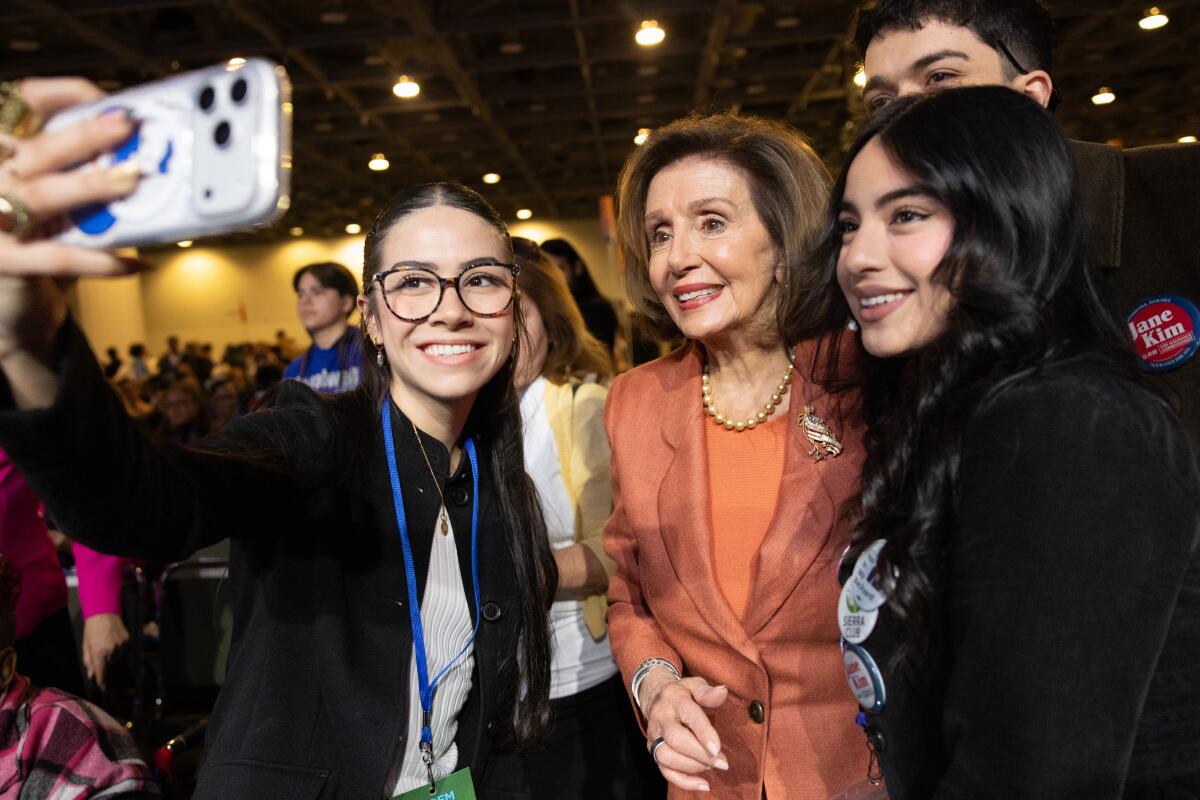
Speaker Emerita Nancy Pelosi (D-CA) takes a selfie with supporters.

Speaker Emerita Nancy Pelosi (D-San Francisco) takes a selfie with supporters during the California Democratic Party’s annual convention at the Moscone Center in San Francisco on Saturday.

(Christina House / Los Angeles Times)

Despite anxiety and infighting over the governor’s race, many in the party agreed that the most effective way to fight Trump is to win back control of the House in November’s midterm elections.

“We’re going to win the House. There’s absolutely no question we will win the House,” said former House Speaker Nancy Pelosi (D-San Francisco) at a Young Dems event on Friday evening. “We’re going to protect the election, we’re going to win the election, and we’re going to tell people the difference that we will make.”

Thousands of delegates, party allies and guests attended the weekend California Democratic Party convention at Moscone Center in the South of Market neighborhood. The gathering included a tribute to Pelosi as she serves her final term.

Party leaders did coalesce behind one of the Democrats running to replace Pelosi, Scott Wiener, a liberal state senator who is vying be the first openly gay person to represent San Francisco in Congress.

The convention comes as party members and leaders continue to soul search after Trump’s second election. California remains a stronghold of opposition to the president, but its next governor will also have to face a growing cost-of-living crisis in a state where utility costs keep climbing and the median single-family home price is more than double what it is nationally.

Under growing pressure, the candidates for governor went on the offensive at the party gathering. Candidates sniped at each other — though rarely by name — for being too rich, too beholden to special interests or for voting in the past in support of ICE and border wall funding.

While largely panned by delegates who tend to lean further left than the typical California Democratic voter, Mahan has jolted the race by quickly raising millions from tech industry leaders and targeting moderate voters with a message of getting the state “back to basics.”

“We are at risk of losing the trust of the people of California if we don’t hold ourselves accountable for delivering better results on public education, home building, public safety,” Mahan said. “We’re not getting the outcomes we need for the dollars we’re spending.”

Mahan has raised more than $7.3 million since entering the contest in late January, according to campaign finance disclosures of large contributions. Many of the donors are tied to the tech industry, such as Y Combinator, Doordash, Amazon and Thumbtack. Billionaire Los Angeles developer Rick Caruso has also contributed the maximum allowed to Mahan’s campaign.

Technology businessman Dennis Bress, from Newport Beach, wears a pin supporting Planned Parenthood

Technology businessman Dennis Bress, from Newport Beach, wears a pin supporting Planned Parenthood and a Yes on Proposition 50 shirt at the California Democratic Party convention at the Moscone Center on Friday in San Francisco.

(Christina House / Los Angeles Times)

Other candidates have raised concerns about the cash infusion, particularly Steyer, who has already dropped more than $37 million into his self-funded campaign and is pitching himself as a “billionaire who will take on the billionaires.”

“Here’s the thing about big donors: If you take their money, you have to take their calls,” Steyer said during his floor speech.

Delegates and party leaders said California’s next governor will have to continue leading the state’s aggressive opposition to Trump while dealing with the issues at home.

“I think people want a fighter,” said Rep. Dave Min (D-Irvine), who represents Porter’s former congressional district and has endorsed her in the governor’s race. “They want someone who’s going to stand up to Donald Trump but also fight to help average people who feel like they’re getting a raw deal in today’s America.”

Several of the candidates made the case that they could do both.

During her speech, Porter held up a whiteboard — her signature prop when grilling CEOs and Trump administration officials while she served in Congress — with “F— Trump” written on it.

“I’ll stand up to Trump and his cronies just like I did in Congress,” she said. “But this election for governor is about far more than defeating Trump.”

Porter, a law professor at UC Irvine, called on Democrats to “send a message about democracy by rejecting billionaires and corporate-backed candidates.” She also rolled out a long list of “true affordability measures” including free child care, free tuition at public universities, and single-payer healthcare, though she did not specify how she would pay for them.

Fighting back against Trump is “the floor,” said 29-year-old Gregory Hutchins, an academic labor researcher from Riverside. “We need to go higher than the floor — what can you do for the people of California? We all recognize that this is a beautiful and wonderful state, but it is very difficult to afford living here.”

Even some delegates — often the most politically active members of a party — have yet to make up their minds in the governor’s race. Nearly 9% opted not to endorse a particular candidate at the convention.

“You want that perfect candidate. You want that like, yes, this is the person,” said Sean Frame, a school labor organizer from Sacramento who is running for state Senate. “And I don’t feel like there is one candidate for me that fits all that.”

For all the focus on affordability, there were undertones of growing frustration from even reliable Democratic allies over a lack of tangible results in a state where the median home price is more than $823,000. SEIU California president David Huerta said workers have “been deferring our power to elected leadership” for too long.

“I think we need to be the ones who set the agenda and hold them accountable to that agenda,” Huerta said. “And they need to be leading from the direction of working people.”

It’s a constant battle with Democrats at state and local levels to get fair pay, said Mary Grace Barrios, who left a career in insurance to take care of her disabled adult daughter.

Barrios makes $19 an hour as an in-home caregiver to other clients in Los Angeles County. When Newsom signed a law to raise wages for most healthcare workers to $25 an hour by 2030, in-home support staff like Barrios were not included.

“It’s so important that we be given the respect and pay we need to live because we can’t live on that amount,” she said, adding that it feels like a “constant attack by people in our own party that we supported, that forgot us.”

“As citizens, you get what you vote for, right? So we have to do it. We have to make the change.”

Source link

Tax billionaires, cut rents and other takeaways from California’s first gubernatorial debate

Gov. Gavin Newsom, barred from running for reelection, still took heat Tuesday during the first debate in California’s 2026 race for governor.

Six Democrats and one Republican on the stage in Newsom’s hometown of San Francisco took direct aim at the governor’s record on homelessness, efforts to ban the sale of new gas-powered cars and opposition to an anti-crime ballot measure that Californians overwhelmingly passed two years ago.

Former Los Angeles Mayor Antonio Villaraigosa, who unsuccessfully ran against Newsom for governor in 2018, pointed to state spending on homelessness as an example of ineptitude.

“We spent $24 billion at the state, along with billions more from the counties and the cities throughout the state, and homelessness went on,” he said. “We cannot be afraid to look in the mirror.”

The televised debate revealed the schism between the moderate and progressive Democrats hoping to replace Newsom, as well as efforts by Steve Hilton, the sole Republican who took part, to coalesce the conservative vote.

Hilton, a former Fox New commentator and British political strategist, called on his top GOP rival, Riverside County Sheriff Chad Bianco, to drop out of the race.

“My Republican colleague Chad Bianco is not here tonight to face these Democrats or his record in 2020, during the Black Lives Matter riots,” Hilton said at the event, which was co-sponsored by the nonprofit Black Action Alliance, which was founded to give Black voters a greater voice in the Bay Area.

Bianco “took a knee when told to by BLM, now he says he was praying,” Hilton said. “Chad Bianco has got more baggage than LAX.”

Bianco was invited to the debate but said he was unable to attend because of a scheduling conflict. His campaign did not respond to requests for comment about Hilton’s attacks.

The, at times, feisty debate came amid a gubernatorial race that thus far has lacked sizzle or a candidate on either side of the aisle who has excited Californians. Public opinion polls show that most voters remain undecided.

Seven of the dozen prominent candidates running to replace Newsom participated in the gathering at the Ruth Williams Opera House in front of a live audience of about 200 people. Rep. Eric Swalwell (D-Dublin) was scheduled to participate but canceled, citing the need to go back to Washington, D.C., for congressional votes. Former Rep. Katie Porter (D-Irvine) also did not attend the debate.

The two-hour clash, at times plagued by audio issues, was hosted by two local Fox News affiliates and moderated by KTVU political reporter Greg Lee and anchor André Senior, as well as KTTV’s Marla Tellez.

Five takeaways from the debate:

Making California affordable again

When grilled about how they planned to tackle the high cost of living in the state — gas prices, rent, utility bills and other day-to-day financial challenges — most of the candidates prefaced their answers by talking about growing up in struggling households, often with immigrant parents who worked blue-collar jobs.

Former U.S. Health and Human Services Secretary Xavier Becerra said he would stabilize rents and freeze utility and home insurance costs “until we find out why they’re increasing.” California Supt. of Public Instruction Tony Thurmond said he would raise taxes on billionaires and create tax credits to help families afford the high cost of living.

Villaraigosa and Hilton said they would lower gas prices by cutting regulations on California’s oil refineries.

Hilton blamed the state’s high cost of living squarely on Democratic policies. “They’ve been in power for 16 years,” he said. “Who else is there to blame?”

Billionaire hedge fund founder turned climate activist Tom Steyer said he favors rent control. Steyer and former state Controller Betty Yee said they would prioritize zoning and permitting reform to build more housing, particularly near public transit. Both Steyer, a progressive, and San Jose Mayor Matt Mahan, a moderate, spoke about using new technology such as pre-fabricated homes to build more affordable housing.

Protecting immigrants

In the wake of the Trump administration’s chaotic immigration raids that started in Los Angeles in June and have spread across the nation — recently resulting in the shooting deaths of two people by federal agents in Minneapolis — the Democrats on stage unanimously voiced support for immigrants who live in California. Some pledged that, if elected, they would use the governor’s office to aggressively push back on President Trump’s immigration policies.

“We’ve got to say no to ICE, and we’ve got to take on Trump wherever he raises his ugly head,” Villaraigosa said.

Steyer, whose hedge fund invested in a company that runs migrant detention centers on the U.S.-Mexico border, and Thurmond both said they support abolishing Immigration and Customs Enforcement, and Thurmond and Mahan said they support a pathway to citizenship for undocumented immigrants.

Politicians politicking

Antonio Villaraigosa, left, talks to Betty Yee

Antonio Villaraigosa, left, talks to Betty Yee during the California gubernatorial candidate debate Tuesday in San Francisco.

(Laure Andrillon / Associated Press)

Amid the debate’s dodging, weaving, yammering and spicy back-and-forth, there were a few moments when the candidates rose above the din.

Villaraigosa, the former two-term mayor of Los Angeles and a former speaker of the California Assembly, insisted that the moderators call him “Antonio” instead of Mayor Villaraigosa.

“It’s my name, everybody. I’m just a regular guy,” he said, prompting a laugh.

Mahan, on the other hand, tried mightily to portray himself as being above the dirty business of politics.

“The truth is that our politics has been oversimplified,” he said. “It’s become this blood sport between populists on both sides, and you deserve real answers, not the easy answers.”

Yee, who has been running on her background as controller and a member of the California Board of Equalization, cast herself as the financial savior the state needs in trying economic times of budget deficits and federal cuts.

“We have not been accountable or transparent with our dollars for a long time,” she said. “Why are we right now and [in successive] years spending more than we’re bringing in? This is where we are. So accountability has to be a tone set from the top.”

The rich guy and the new guy

Steyer, who paints himself as a repentant billionaire devoted to giving away his riches to make California a better place for all, did not directly answer a question about his position on a controversial proposed ballot measure for a new tax on billionaires to fund healthcare. But he said he supported increasing taxes on the wealthy and boasted of having the political backing of bus drivers, nurses and cafeteria workers because he was the rich guy willing to “take on the billionaires for working families.”

Mahan, the latest major candidate to enter the race, wasn’t impressed.

“Tom, I’ve got about 3 billion reasons not to trust your answer on that,” he said, an apparent reference to Steyer’s net worth.

Although he supports closing tax loopholes for the wealthy, Mahan said he opposes the billionaire tax because “it will send good, high-paying jobs out of our state, and hard-working families, in the long run, will all pay more taxes for it.”

Money also spoke Tuesday

Although the battle over campaign fundraising didn’t overtly arise during Tuesday’s debate aside from Mahan’s comment about Steyer, it still was getting a lot of attention. Campaign fundraising disclosures became public Monday and Tuesday.

Unsurprisingly, Steyer led the pack with $28.9 million in contributions in 2025, nearly all of it donations that the billionaire spent on his campaign. Other top fundraisers were Porter, who raised $6.1 million; Hilton, who collected $5.7 million; Becerra, who banked $5.2 million; Bianco, who received $3.7 million in contributions; Swalwell’s $3.1 million since entering the race late last year; and Villaraigosa’s $3.2 million, according to documents filed with the California secretary of state’s office.

Mahan, who recently entered the race, wasn’t required to file a campaign fundraising disclosure, though he is expected to have notable support from wealthy Silicon Valley tech honchos. Former state Controller Betty Yee and state schools chief Tony Thurmond were among the candidates who raised the least, which spurs questions about their viability in a state of more than 23 million registered voters with some of the most expensive media markets in the nation.

Yee defended her candidacy by pointing to her experience.

“All the polls show that this race is wide open. You know, I think voters have had enough. I’ve been around the state. I’ve spoken to thousands of them,” she said. “Enough of the lies, the broken campaign promises, billionaires trying to run the world. You know, look, I’m the adult in the room. No gimmicks, no nonsense, straight shooter, the woman who gets things done. And we certainly can’t afford a leader who thinks grandstanding is actually governing.”

Mehta reported from Los Angeles and Nixon reported from San Francisco. Data and graphics journalists Gabrielle LaMarr LeMee and Hailey Wang contributed to this report.

Source link