steven spielberg

‘Phenomenal’ action film hailed as ‘pure adrenaline’ now streaming on Netflix

One of the best action blockbusters of the past few years has just been added to Netflix just in time for an adrenaline-fuelled weekend viewing

Netflix has just added an exhilarating action film starring two of Hollywood’s greatest stars that you won’t want to miss.

Both leads are featuring in some of the most highly anticipated films of 2026, while the director is one of the most prominent action filmmakers in recent years.

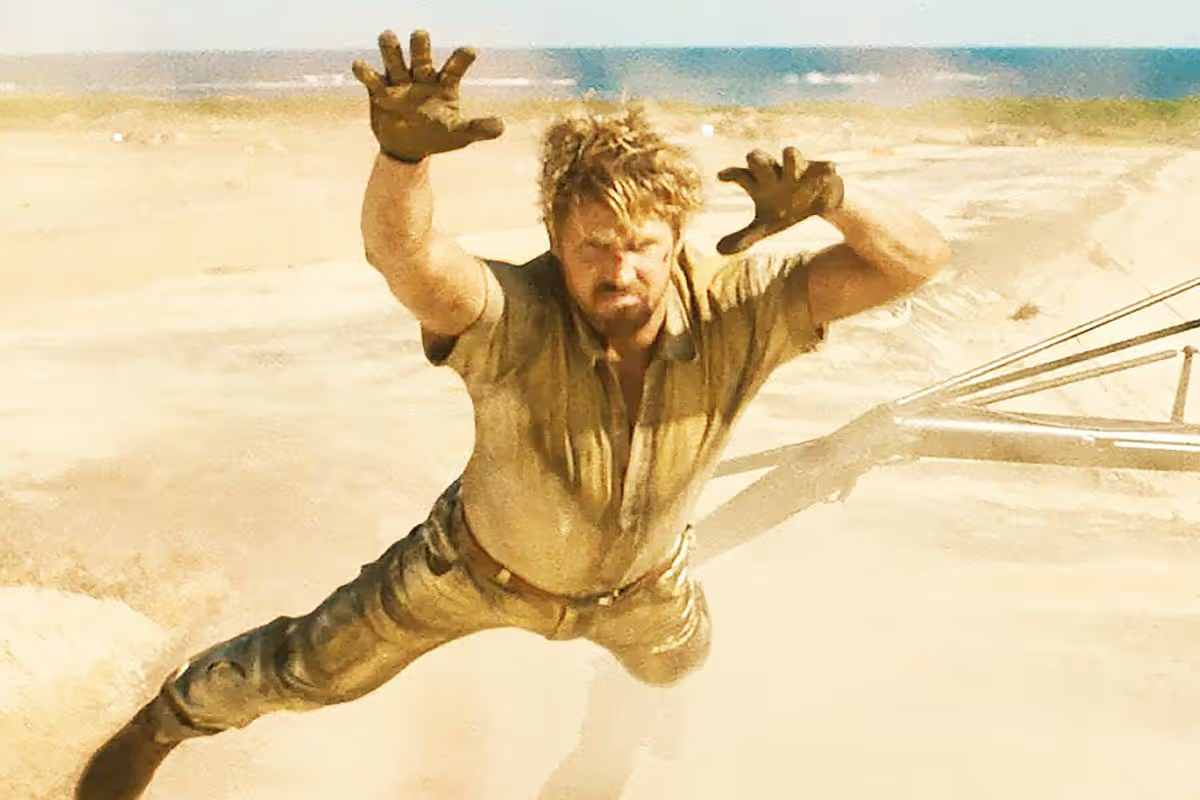
The Fall Guy stars Ryan Gosling as stunt performer Colt Seavers, who reluctantly agrees to a comeback after a life-threatening injury when his ex-girlfriend Jody Moreno (played by Emily Blunt) lands her first gig as the director of a major studio film.

However, the pair soon find themselves wrapped up in a complex conspiracy when the movie’s lead actor, Tom Ryder (Aaron Taylor-Johnson), goes missing.

When Colt is covertly hired to go after the people the producers suspect are responsible for his disappearance, he leaps at the chance to win back his ex by saving her debut. But he quickly realises he’s in over his head.

Both megastars are poised to rule the box office over the coming months. Gosling is about to return to the big screen for the bombastic space opera Project Hail Mary, while Blunt is also tackling extraterrestrial threats in Steven Spielberg’s new sci-fi thriller Disclosure Day.

She is also returning to one of her most iconic roles in The Devil Wears Prada 2, along with Meryl Streep and Anne Hathaway. With The Fall Guy available to stream on Netflix, now is the perfect time to revisit one of their best films ahead of their must-see cinematic experiences.

Fans have been raving about the film since its release, and it received an impressive 82 percent Rotten Tomatoes score from critics, with 84 percent from audiences.

One five-star review from an RT user gushed: “A truly phenomenal film! It’s fun, but locks in when seriousness is needed. I love it so much!”

Someone else described it as “Pure adrenaline popcorn perfection that delivers unfiltered chaos candy!”

The stellar reviews continued on IMDb, where one viewer called The Fall Guy “Pure entertainment” and said: “While watching this movie, I found myself smiling nearly the entire time. If you are looking for pure, unfettered fun (in the form of romcom action of course), then this is the movie for you.

“The plot was fun, the acting was solid, the situations that the characters found themselves in were hysterical, the action was on point, the cinematography was nice, and the romance was entertaining.”

And a final fan wrote: “The Fall Guy is insanely fun, with incredibly cool action scenes, romantically charming elements, and a captivating world of stuntmen.

Get Netflix free with Sky for Bridgerton Season 4

This article contains affiliate links, we will receive a commission on any sales we generate from it. Learn more
The season 4 Bridgerton premiere was held in Paris last night

from £15

Sky

Get the deal here

‘Dearest gentle reader’, as the fourth season of Bridgerton follows second son Benedict love story, there’s a way to watch this fairytale-like season for less.

Sky is giving away a free Netflix subscription with its new Sky Stream TV bundles, including the £15 Essential TV plan. This lets customers watch live and on-demand TV content without a satellite dish or aerial and includes the new season of Bridgerton.

“It’s full-on entertainment, especially for film enthusiasts, with meticulously crafted action sequences in both real and fake movies that look fantastic, grand, and impressively complete.

“Both Ryan Gosling and Emily Blunt have impeccable chemistry, and the portrayal of the stuntman profession is sharp. The film cleverly satirizes the Hollywood industry with excellence.

“Watching this movie in theaters is an absolutely delightful experience. Director David Leitch nails every aspect of the film, truly delivering on the action-packed excitement.”

The Fall Guy is available to stream on Netflix.

For the latest showbiz, TV, movie and streaming news, go to the new **Everything Gossip** website.

Source link

From ‘Bonnie and Clyde’ to ‘Star Wars’: The real history of New Hollywood

Book Review

If you buy books linked on our site, The Times may earn a commission from Bookshop.org, whose fees support independent bookstores.

“That’s my pot dealer!” exclaimed Michelle Phillips in a crowded movie theater in 1977. Months earlier, the Mamas & the Papas singer had only known Harrison Ford as a stoner-carpenter with a few bit parts to his credit. Now he was Han Solo in “Star Wars,” directed by a young upstart, George Lucas. Clearly the world was changing.

How much, though? Conventional wisdom about the Hollywood renaissance of the ‘60s and ‘70s suggests that starting with “Bonnie and Clyde” and “Easy Rider,” a batch of emerging auteurs shook the studios out of a rut and transformed American film. There’s plenty of truth to that: Francis Ford Coppola’s shift in 10 years from a director-for-hire on an old-hat musical, “Finian’s Rainbow,” to the auteur behind “Apocalypse Now” is just one of the era’s most remarkable achievements.

A pair of new books, though, suggest that the overall shift was only so modest, ultimately shoring up not just the old-school studio system but the social norms the interlopers were supposed to be upending.

"The Last Kings of Hollywood: Coppola, Lucas, Spielberg and the Battle for the Soul of American Cinema" book cover

Paul Fischer’s lively history of the new wave of California directors, “The Last Kings of Hollywood,” concentrates on Lucas, Coppola and Steven Spielberg. (New York contemporaries like Martin Scorsese and Brian De Palma are present but relatively off-screen.) Fischer has a gift for highlighting the ways that moments that we now accept as inevitable were often the product of dumb luck, pyrrhic victories and tough decisions. Coppola made “The Godfather” out of financial desperation, averse to adapting a mob novel; Spielberg’s “Jaws” was beset with mishaps, from a foolhardy attempt to train a real shark to its malfunctioning mechanical one; only when Lucas learned that the rights to Flash Gordon were unavailable did he pursue a space-opera concept all his own.

Their brashness and can-do spirit were worth cheering for: As the trio delivered films that broke box office records — ”The Godfather,” “American Graffiti,” “Jaws” and more — there were reasons to believe that big-budget films could operate outside the studio system. Lucas in particular was driven as much by resentment of the old as passion for the new. He never forgot how Warner Bros. manhandled his debut feature, “THX 1138” and was driven to muscle “Graffiti” into existence to spite the suits who said he couldn’t. In 1969, Coppola and Lucas launched their own studio, American Zoetrope, in San Francisco, with a passel of scripts in progress (including “Apocalypse Now” and “The Conversation”) and a $300,000 investment from Warner Bros. But Coppola wasn’t much of a businessman, and he had an easier time putting the office’s fancy espresso machine to work than the suite of state-of-the-art editing bays: “He ran his business like he ran a film set — on vibes,” Fischer writes.

A decade later, both Coppola and Zoetrope would declare bankruptcy, and he would split with Lucas, who’d used the success of “Star Wars” to cut his own path as a Hollywood kingmaker via his own production company, Lucasfilm. It allowed him to indulge his love of classic cliffhanger serials, and he tapped Spielberg to direct “Raiders of the Lost Ark.” But Fischer frames Lucas’ career arc as a disappointment, despite all those dollar figures — Lucas wanted to return to artsier “THX”-style fare, but needed cash flow. “If George was ever going to be independent from Hollywood, he thought he wouldn’t get there by making abstract mood poems,” Fischer writes. By the ‘80s, with two “Star Wars” sequels done, Lucas was out of the mood-poem business entirely.

"They Kill People: Bonnie and Clyde, a Hollywood Revolution, and America's Obsession with Guns and Outlaws" book cover

While “Last Kings” focuses exclusively on directors’ relationship to movie economics, Kirk Ellis’ “They Kill People” considers “Bonnie and Clyde” and the New Hollywood from a variety of angles — filmmaking, the social turmoil of the ‘60s, America’s complex relationship with outlaws in general and guns in particular. It’s a meaty yet accessible book that captures the lightning-in-a-bottle nature of the generation’s ur-text, capturing the unlikely nature of its creation and the somewhat dodgy nature of its legacy.

“Bonnie” was such a provocation — nakedly, almost giddily violent — that its studio, Warner Bros, all but willed it not to exist. It was given a shoestring budget, was mocked by studio chief Jack Warner (who sarcastically referred to director Arthur Penn and producer-star Warren Beatty as “the geniuses”), and initially released largely in Southern drive-ins. “They figured the redneck kids would like the guns,” Penn said.

Everybody liked the guns. A few scolding critics lamented the film’s violence, especially its then-shocking bloody finale, but Beatty and co-star Faye Dunaway were deeply seductive onscreen. (Ellis notes that the two are always the best-dressed characters in the film.) And its outlaw sensibility resonated with young audiences in the late‘60s. Moreover, writes Ellis (a historical-drama screenwriter best known for “John Adams”), it represented the culmination of decades of American culture that equated American gun culture with freedom — a notion that would’ve baffled the founding fathers, who dwelled little on gun-rights matters in the Federalist Papers and other constitutional drafting documents, but gained traction thanks to gun manufacturers. “In the printed legend of American history, guns and freedom have become synonymous,” Ellis writes, but it was a new legend — stoked in part by “Bonnie and Clyde” — not America’s origin story.

It’d be a mistake to reduce the New Hollywood to the filmmakers highlighted by these two books — though, focused as they are on white men, they echo the way women and people of color were largely shut out of the system, or relegated to more marginal blaxploitation work. Artists looking to operate outside the system have plenty of inspiration to draw from in the ‘70s. Yet the books also expose how commerce does what it always does — take provocations and sand the edges off of them, then look for ways to make them profitable. In the early ‘80s, a decade after Coppola and company stormed the barricades, Paramount chief Michael Eisner shared a fresh and contradictory vision, such as it was: “We have no obligation to make history. We have no obligation to make art. We have no obligation to make a statement. To make money is our only objective.”

It would take another decade — and auteurs on the East Coast — to launch another attack on that sensibility, via films like “Do the Right Thing” and “sex, lies, and videotape.” They would help usher in the Miramax era — but that’s another story, with its own problematic twists.

Athitakis is a writer in Phoenix and author of “The New Midwest.”

Source link

Dawson’s favorite director gives to James Van Der Beek fund

Support for James Van Der Beek’s family continues to pour in. The GoFundMe created to support them following the “Dawson’s Creek” star’s death approached $2.3 million in donations Friday morning.

Steven Spielberg and his wife Kate Capshaw are among the celebrity donors who have contributed to the fundraiser organized by the late actor’s friends. The couple’s donation is listed as $25,000. Those familiar with Van Der Beek’s breakout role on the millennial teen drama know that Spielberg is Dawson Leery’s favorite director.

Originally airing from 1998 to 2003, “Dawson’s Creek” was a seminal teen drama that followed four friends growing up in a small coastal town as they navigated their dreams, relationships and various coming-of-age milestones. Van Der Beek’s Dawson was an aspiring filmmaker whose dreams were bigger than his small hometown. Along with friends Joey (Katie Holmes), Pacey (Joshua Jackson) and Jen (Michelle Williams), Dawson grappled with very relatable teen dilemmas including heartbreak, betrayal and bad decisions.

The fundraiser, which had more than 44,000 donors as of Friday morning, was organized to help support Van Der Beek’s wife and children, who “are facing an uncertain future” due to the financial strain of the late actor’s medical costs. The late actor died following a battle with colorectal cancer. Funds will be used to “help cover essential living expenses, pay bills, and support the children’s education,” the organizers wrote.

Van Der Beek revealed in 2012 that he had been paid “almost nothing” for his work on “Dawson’s Creek” and had not received any residuals from the hit show.

“There was no residual money,” he told “Today.” “I was 20. It was a bad contract. I saw almost nothing from that.”

Before his death, Van Der Beek auctioned off personal memorabilia and sold collectibles to help pay for his cancer treatments. In September, his “Dawson’s Creek” co-stars helped organize and stage a reunion fundraiser to support Van Der Beek and his family — a reunion the actor had to miss because of a virus. “Black Bird” actor Paul Walter Hauser had also been raising funds through Cameo videos and auctions to help the late actor prior to his death.

Besides Spielberg, celebrity donors to Van Der Beek’s GoFundMe also reportedly include Zoe Saldaña, Jon M. Chu, Derek Hough, Busy Philipps, Jenna Dewan and others.

Van Der Beek’s “Dawson’s Creek” colleagues have also been among the many who have shared tributes to the late actor.

“Several times today, from my heart, I’ve tried to form the words to express the beautiful brilliance of James and what his presence has meant to my life,” “Dawson’s” creator Kevin Williamson wrote Thursday in a post shared on Instagram. “But I am truly at a loss for words. I will have to trust that one day those words will come… But today, all I can think about is Kimberly and the entire Van Der Beek family.”

Holmes, meanwhile, shared a handwritten note addressed to Van Der Beek on Instagram Wednesday. She was the first of “Dawson’s Creek’s” surviving core quartet to publicly acknowledge Van Der Beek’s death.

“Thank you,” Holmes wrote in her note, which was addressed to Van Der Beek. “To share a space with your imagination is sacred — breathing the same air in the land of make believe and trusting that each others’ hearts are safe in their expression.”

In her remembrance, Holmes highlighted their shared “laughter, conversations about life, James Taylor songs” and their “adventures of a unique youth.” She also highlighted Van Der Beek’s “Bravery. Compassion. Selflessness [and] Strength.”

“I mourn this loss with a heart holding the reality of his absence and deep gratitude for his imprint on it,” wrote Holmes, who also sent love to Van Der Beek’s wife and children in her message.

Other members of the extended “Dawson’s Creek” family, including actors Chad Michael Murray, Kerr Smith and Sasha Alexander, have also been among those offering condolences and paying tribute to Van Der Beek and his family online.

“James Van Der Beek was one in a billion and he will be forever missed and i don’t know what else to say,” wrote Busy Philipps in her Instagram tribute. “He was my friend and i loved him and i’m so grateful for our friendship all these years.”


Source link