MAYA Jama oozed glam in a gothic purple gown with a matching choker as she stepped out at the British Museum Ball.
The Celebrity Traitors star – who is one of BBC host Claudia Winkleman‘s chosen Traitors – flashed a sultry look in her floor length purple frock.
Maya Jama looked sensational in a gothic gown with ruffle detail and a matching chokerCredit: PAMaya flashed a sultry pout as she stepped out at The British Museum Ball 2026Credit: Getty
Ruched detail across her torso drew attention to the Love Island anchor’s toned figure while stitched pattern on the skirt added extra style.
Maya stayed her hair into curls and a half-up style, with sections at the front framing her face.
Sign up for the Showbiz newsletter
Thank you!
The presenter kept her make-up fresh, with a slick of black eyeliner and pink lipgloss.
According to britishmuseum.org, the swanky evening was “the defining highlight of London’s cultural and social calendar this autumn”.
She styled her hair into curls and a half-up doCredit: PAMaya has been hailed a style icon on Celeb Traitors due to her ‘Honey Monster’ coatCredit: BBCFans have also suspected a show romance with a co-starCredit: BBCShe is known for her racy Love Island wardrobeCredit: ITV
It stated: “Conceived as a night where art, history, performance and fashion converge, the Ball will offer a truly unforgettable moment at one of the world’s most iconic institutions”.
The theme of this year’s event was Red and also saw the likes of Mick Jagger and Lesley Manville in attendance.
We told how she packed 10 designer jackets, worth a total £15,000, for the iconic show.
She donned a £2,570 Saint Laurent trench coat for the launch show and wore the £600 mustard Mongolian sheepskin bolero coat designed by London-based fashion house Agro Studio.
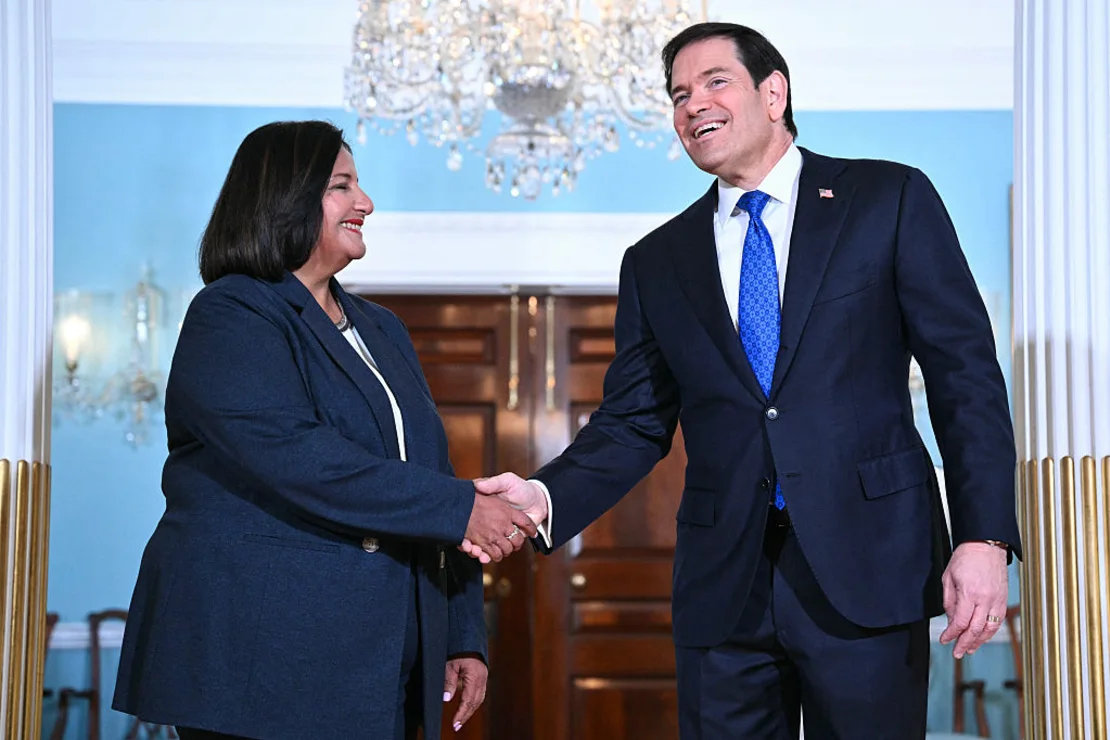
The Trump administration has been heavily involved in the government-opposition talks. (AFP)
Caracas, October 12, 2026 (venezuelanalysis.com) – US Secretary of State Marco Rubio hosted Venezuelan opposition lead negotiator Dinorah Figuera on Friday at the State Department in Washington, DC, to express support for ongoing dialogue with the Venezuelan government.
“This is the best opportunity Venezuela has had in almost a generation,” Rubio told reporters, adding that the talks headed by Figuera are “a difficult process” but enjoy “100 percent support from the highest levels” of Donald Trump’s administration.
Rubio stressed that Washington’s goal goes beyond holding elections. “Our desire is not simply for Venezuela to have an election, but also to have a democracy with the institutions necessary to sustain long-term stability, prosperity, and freedom.” The Trump official has insisted on a three-phase plan culminating in a “political transition.”
For her part, Figuera, the president of the defunct 2015 Venezuelan National Assembly, praised the United States for opening a “path of hope for Venezuela” on January 3, when US forces bombed Caracas and abducted President Nicolás Maduro.
“We are committed to restoring the institutional framework of the public powers, the Supreme Court of Justice (TSJ), and the National Electoral Council (CNE). We want to bring the country toward a process that guarantees political and civil rights and creates space for reunion and reconciliation,” she said.
The opposition leader also thanked Washington for its investments in the oil sector. “The restoration of institutions and the country’s economic progress will be two fundamental pillars for building institutions and democracy,” she added. Despite its term running out in January 2021, the opposition majority parliament elected in 2015 retained US “recognition” as Venezuela’s legitimate authority.
Both officials announced that the next round of talks is scheduled to begin on October 14. Rubio explicitly called for opposition unity: “We ask all elements of the opposition, and all sectors of society, to participate in and support this process.”
Neither Rubio nor Figuera fielded questions from reporters as they left the room, including about opposition leader María Corina Machado, who continues to insist that presidential elections must be held “as soon as possible.”
This was the first time Rubio received Figuera in Washington. Since August, she has led an opposition bloc engaged in dialogue with the acting government headed by Delcy Rodríguez, a process promoted by the United States in which the far-right Machado is not participating.
So far, government and opposition delegations have completed two rounds of negotiations in Caracas. Rubio claimed that the talks thus far have resulted in the release of hundreds of people allegedly detained for political reasons, the unblocking of several pro-opposition news websites, and progress toward amending the 2017 Law Against Hatred. The agenda for this third round includes continuing the process to renew the Supreme Court.
In this regard, opposition delegation member Juan Miguel Matheus said his team is “working to ensure that the members of the Judicial Nominations Committee are appointed and sworn in by October 15.” The committee will be responsible for evaluating candidates for the 32 Supreme Court justice positions.
Following an amendment to the Organic Law of the Supreme Court of Justice negotiated at the dialogue table, it was agreed that the Judicial Nominations Committee would have a majority of 12 civil society representatives, compared with 11 lawmakers. A total of 127 citizens applied to join the body.
Once the committee has been appointed, the process of receiving applications from candidates for the Supreme Court will begin. “We invite the best men and women in Venezuelan law to apply for positions in the TSJ’s six chambers. Venezuela needs independent, competent justices of recognized integrity,” Matheus stressed.
While some opposition sectors are demanding that a date be set for presidential elections, the delegation participating in the negotiations argues that progress in transforming the justice system is a necessary prior step.
In his press statement, Rubio added that future rounds of discussions “will address reform of the National Electoral Council.”
The Venezuelan government’s delegation has not commented on the Trump administration’s express backing for the opposition negotiators.
The two sides agreed to demand the release of 31 tonnes of gold held by the Bank of England since 2019 to address post-earthquake reconstruction needs. The gold, worth more than US $4 billion, will reportedly be moved to the New York Federal Reserve, with its spending subject to US approval and international auditing.
Seoul has urged the North to remove any other mines planted on the southern side of the military demarcation line.
Published On 6 Oct 20266 Oct 2026
South Korea is weighing measures to force an apology from North Korea over a recent landmine blast that wounded three soldiers in the Demilitarized Zone (DMZ) between the two countries, a Defence Ministry spokesperson has said.
A joint South Korean-United Nations investigation concluded on Monday that two landmines that exploded last month in the DMZ were planted by North Korean forces about a year ago, prompting Seoul to demand an official apology.
Recommended Stories
list of 3 itemsend of list
“We are not ruling out any options or prejudging anything when it comes to additional measures,” Defence Ministry spokeswoman Chung Bin-na told reporters on Tuesday when asked if steps were being planned to force an apology from Pyongyang.
Chung did not offer specifics about what actions might be employed.
Seoul has also called on nuclear-armed North Korea to remove any other mines planted on the southern side of the military demarcation line (MDL) that runs through the DMZ, the heavily fortified frontier that has divided the Korean Peninsula since the 1953 Armistice Agreement.
Pyongyang has denied responsibility for the September 21 blast, with Kim Yo Jong, the powerful sister of North Korea’s leader, slamming the call for an apology as “despicable”.
Chung said Seoul is calling on Pyongyang to come to the table to discuss a misalignment of the MDL. Differing views of the border line are one factor contributing to tension in the area, she said.
The comments come a day after South Korea’s military carried out a mine-clearing operation south of the MDL. It pledged to continue with clearing operations in the area if Pyongyang fails to remove the remaining explosives. The United States-led UN Command (UNC) confirmed the mine placement violated the 1953 agreement.
Defence Minister Kang Shin-chul told the Yonhap news agency on Tuesday that the military’s “decisive” response was “unprecedented in history”.
“All responsibility lies with North Korea,” Kang told reporters, adding that armed forces would “respond decisively” to any actions threatening national security.
The escalation comes as Pyongyang rejected diplomatic overtures from Seoul. Unification Minister Chung Dong-young proposed on October 2 that both sides jointly resurvey the MDL, noting that only about 200 of 1,292 original boundary markers remain intact and that Seoul and the UNC differ on roughly 60 percent of border coordinates.
Kim Yo Jong rejected the proposal as a “wild dream”, declaring Pyongyang would define its sovereign boundary “by the use of force, not by means of negotiation”.
The 37-year-old is the longest-serving cricket captain, among both men and women, to have captained in more than 150 T20I games.
Published On 6 Oct 20266 Oct 2026
India’s long-serving captain of the women’s cricket team, Harmanpreet Kaur, has stepped down from the role across all formats, bringing down the curtain on a successful stint as she led the South Asian team to their first ICC Women’s World Cup title at home in 2025.
Kaur announced her decision in a social media post on Tuesday, two weeks after leading India to a successful defence of their gold medal at the Asian Games.
Recommended Stories
list of 4 itemsend of list
“Today, I step down as captain of the Indian Women’s Cricket Team across all formats,” she wrote in an Instagram post.
“This is not an easy decision. It carries years of memories, emotions, sacrifices, and moments that will stay with me for the rest of my life.”
The 37-year-old was the Twenty20 captain for more than a decade after assuming the role in 2016, followed by ODI and Test captaincy in 2022.
Kaur, who made her T20I and ODI debuts for India in 2009, has had an illustrious career as skipper.
Indian media reports said Kaur’s decision came a day after she met Devajit Saikia, secretary of the Board of Control for Cricket in India (BCCI), to discuss the future of the women’s team.
Opening batter Smriti Mandhana, who has been Kaur’s deputy since 2022, is the favourite to take over the captain’s role.
Most recently, she led India to title defence at the Asian Games, thrashing Sri Lanka, just after lifting the Women’s Asia Cup trophy earlier in September.
The top-order batter helped India reach the semifinals of the 2018 and 2023 Women’s T20 World Cups, as well as finish runners-up in the 2020 edition.
Kaur has captained India in five Tests, 51 ODIs and 155 T20Is, and is also the first cricketer — male or female — to captain her side in international cricket in more than 150 T20I games.
“I leave the captaincy today with a heart full of emotions, but also with peace … because I genuinely believe my team is in a good place,” she said in her Instagram post. “I feel I have done my duty.
“Captaincy may end today, but my love for Indian cricket never will.
“Now, I’m ready to play for the love of the game again. Captaincy ends. The journey continues.”
THE actress sister of a Hollywood star looked super stylish as she stepped out at Paris Fashion Week – but can you guess her famous relative?
This New York-born actress, 34, played the lead in HBO Max comedy-drama The Sex Lives of College Girls.
This actress looked very stylish at Paris Fashion Week – but can you guess her famous sibling?Credit: Shutterstock EditorialThe star attended the Zimmermann Womenswear Spring/Summer 2027 showCredit: Shutterstock Editorial
She has appeared in films including The King of Staten Island and The Devil Wears Prada 2 – but does she look familiar?
It’s Pauline Chalamet, whose younger brother is Golden Globe-winning actor Timothée Chalamet.
Sign up for the Showbiz newsletter
Thank you!
Pauline attended the Zimmermann Womenswear Spring/Summer 2027 show, held in the French capital.
Pauline’s younger brother is Golden Globe winner Timothee ChalametCredit: GettyTimothee has been dating Kylie Jenner since 2023Credit: Getty
Pauline had seemingly taken not-so subtle social media digs at Kylie in the past, slamming billionaires, extreme wealth and private jets.
Two well-placed insiders close to the siblings told The U.S. Sun that their relationship was at an “all-time low” due to Pauline’s disapproval of Kylie.
The first source said “something is broken” between the pair, claiming Pauline believed Kylie “doesn’t share the same values and morals as he does,” and that she will “leave him when she gets fed up.”
“Pauline thinks that Kylie is with her brother because it looks cool and it’s nice to be in a relationship with one of Hollywood’s most exciting young stars,” said the first source. “She thinks she’s with him to keep the spotlight on her.”
Different sources told The U.S. Sun there were serious family concerns about the relationship, suggesting it would be “a terrible mistake” for the couple to get married.
A family member, speaking anonymously, questioned how “two complete opposites” could make a marriage work.
Meanwhile, superstars Timothée and Kylie first began their relationship back in 2023.
Kylie, 29, has two children with her ex-boyfriend, rapper and record producer Travis Scott.
History was made this week on Capitol Hill when a female senator womansplained sports to a male senator, and surprisingly, the gender-shaming reversal did not cause the universe to collapse on itself.
During a Judiciary Committee hearing Tuesday, MAGA’s manhood cloak was breached when Sen. Amy Klobuchar (D-Minnesota) revealed that Sen. Eric Schmitt (R-Missouri) had mixed up the names of basketball teams in an unsuccessful attempt to perjure former Special Counsel Jack Smith.
Smith was testifying before the committee because he had led the investigations into Donald Trump’s efforts to overturn the 2020 election and retain classified documents. Several Republican lawmakers have said that Smith overstepped his duties and launched a “witch hunt” against Trump and his allies.
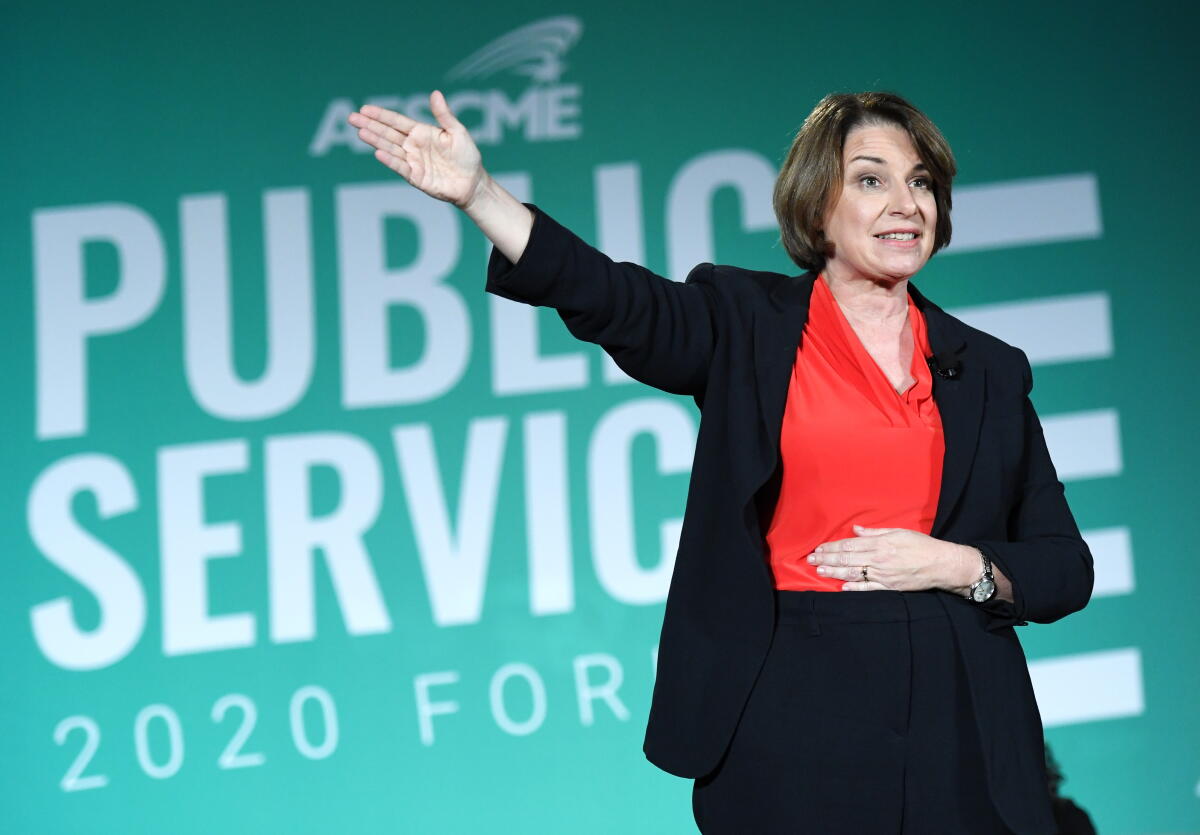
Sen. Amy Klobuchar (D-Minn.) speaks during a 2020 event in Las Vegas.
(Ethan Miller / Getty Images)
Schmitt was trying to suggest Tuesday that Smith improperly colluded with Fulton County Dist. Atty. Fani Willis on their separate criminal cases against Trump by placing the former special counsel on Willis’ home turf of Atlanta in 2024.
But a watershed Watergate moment this was not. If Schmitt’s effort to ensnare Smith was set to a musical score, it would have been far more “Curb Your Enthusiasm” than “Mission Impossible.”
His gotcha moment became a schooling by Klobuchar on basketball, turning the tables on the age-old art of mansplaining. For those who need a quick definition, it’s when a man explains something to a woman in a patronizing way, with sports usually at the top of that talk-down-to-her list. He assumes she knows less than he does, even if she’s versed on the subject.
Klobuchar is an avowed sports fan and the daughter of respected Minneapolis sportswriter Jim Klobuchar and a former prosecutor known for her sharp questioning. The combination proved unfortunate for Schmitt during the hearing when he tried to catch Smith in a lie.
The Republican senator asked Smith, “Did you go to an NBA game between the Golden State Warriors and the Atlanta Hawks on Feb. 3, 2024?”
Smith, whose normally commanding presence has launched countless memes, appeared genuinely perplexed. “What city would that be in?” he asked.
“Atlanta,” replied Schmitt.
Smith denied he was there.
“So your testimony today is that you did not go to a Hawks game on Feb. 3, 2024. Is that correct?” Schmitt said.
“I have no recollection of that,” a bewildered Smith said.
As evidence, Schmitt introduced text messages from Smith’s security detail about seating arrangements for a game, displayed on a poster board that was taken down so quickly that Smith and various senators said they didn’t have time to read it.
“I think you’ve already perjured yourself,” said Schmitt, a former Missouri attorney general who then used the rest of his time to condemn Smith for subpoenaing the communications of Republican lawmakers while investigating Trump.
“You have weaponized the Department of Justice against political enemies to an extent that has never happened in the history of this country,” Schmitt proclaimed. “You will go down as a total dirtbag.”
Klobuchar, who was up next to question Smith, asked if the poster board could be produced again.
“I’m a former prosecutor too, and I have never seen anyone just say, ‘What do you think of this?’ and put it down,” she said.
Schmitt’s evidentiary board was produced again, and this time for more than a few seconds. There was no mention of Atlanta in the text messages.
One could almost hear the sound of Schmitt’s perjury trap crumbling under Klobuchar’s heel.
“Could it then be that it was the University of Iowa, [which] is the ‘Hawkeyes,’ could that be it?” she asked Smith. “That might be the confusion over the names of the team.”
Then she addressed Schmitt: “Perhaps you should have looked at it more carefully. I think people should have their facts straight before they accuse people of being a ‘dirtbag,’ and not get the teams wrong.”
Leave it to a man to confuse the Atlanta Hawks, an NBA team, with the Iowa Hawkeyes of women’s college basketball. Perhaps his emotions got in the way.
Smith said he attended the game in Maryland to see the Hawkeyes’ supremely talented star, Caitlin Clark. Regardless of his whereabouts, Republicans contend that Smith was on a political witch hunt after then-Atty. Gen. Merrick Garland appointed him to oversee the twin investigations into Trump. Smith’s team scrutinized the retention of national defense information and classified documents at Trump’s Mar-a-Lago estate, as well as the president and his allies’ efforts to overturn the results of the 2020 election and impede the peaceful transfer of power.
When Trump won the presidency a second time, Smith moved to dismiss both cases because Department of Justice policy prohibits the criminal prosecution of a sitting president.
Now, it’s game time for Judiciary Committee members who’d like to put Smith on the ropes. There’s just one new rule: Don’t talk sports around the ladies. They deliver a knockout punch.
KATHERINE Ryan has been spotted out and about for the first time since issuing an apology to Victoria Beckham.
The star used the C-word when talking about Posh Spice last year during an episode of Have I Got News For You, and recently apologised for it online after facing backlash.
Katherine Ryan has been spotted for the first time since apologising to Victoria BeckhamCredit: GettyShe dazzled in a green dress for a Wicked eventCredit: Getty
Katherine got dolled up in a stunning green sparkly dress to embrace her inner Elphaba on the green carpet for Wicked’s West End 20th Anniversary Gala Performance.
The dress featured sequins all over as well as dangling tassels across the shoulders.
Sign up for the Showbiz newsletter
Thank you!
The comedian held her hands in front of her and smiled for the camera while a buzzing crowd was forming behind her for the event.
Speaking in an episode that aired on November 7, Katherine made reference to a 2013 private email sent byDavid Beckham, where he allegedly used the word ‘c****’.
Katherine apologised for using the C-word when talking about Victoria last yearCredit: Instagram/kathbumKatherine also claimed she has always loved the starCredit: Getty
She said on the show: “I don’t know that we are allowed to broadcast the C-word, but you did referenceVictoria Beckhamearlier and we’ll allow that.”
TheBBC‘s Executive Complaints Unit (ECU) have issued it’s ruling on the matter and have revealed there was no justification for Victoria being labelled with the offensive word.
In a reel chatting to the camera, she began: “Hi I’m comedian Katherine Ryan and today the BBC announced their decision to uphold a complaint made by two very influential viewers about a joke that I tried to make on an episode of Have I Got News For You eleven months ago.
“At that time, though there is no defence, I was suffering from a condition called matrescence.
“I was in that building with a 10-day old baby. Should I have left the house?
“This is gonna be a tough one for the feminists because I was a woman going to work but I did call another woman a c***.
“[…] “The trouble is now that section’s been taken off iPlayer so the incident only exists in printed media, online media and then you lost the context because on the day, if you watched it, it was clearly a joke and the whole audience went ‘huhhhh’ and I said ‘whoaaaa’.”
An edited version of the episode has replaced the original on the BBC’s streaming service.
JENNIFER Lopez swapped her trademark super sexy red carpet glamour for a look straight out of The Gentlemen as she stepped out at fashion week.
The singer looked almost unrecognisable in a black velvet three-piece suit, complete with a crisp white shirt and tie, and a flat cap.
Jennifer Lopez looked almost unrecognisable in a black velvet suit and flat capCredit: GettyThe singer paired her three-piece suit with a crisp white shirt, tie and knee-high bootsCredit: Getty
The 57 year old finished the look with knee-high leather boots and dark lipstick, giving a nod to the country house style worn by Maya Jama in the Netflix drama.
Maya, who plays Aisha in series two, is regularly seen wearing a flat cap and tweed in the hit series.
Sign up for the Showbiz newsletter
Thank you!
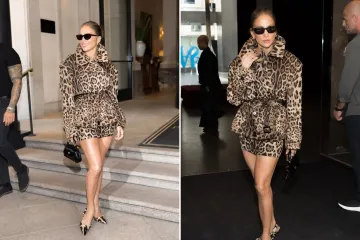
Earlier in the week, JLo rocked an altogether different look in Italy’s fashion capital, stepping out in head-to-toe leopard print.
She showed off her legs in a matching coat and skirt as she left her Milan hotel, finishing the outfit with dark sunglasses, heels and a black handbag.
Maya cuts a chic figure in a flat cap in the new series of The GentlemanJennifer Lopez was a vision in leopard print as she stepped out at Milan Fashion WeekCredit: Getty
A flurry of A-listers and models have descended on the Italian city for the various fashion shows, parties and events taking over for the next few days.
The star has been spending time in Italy with her family over the past few weeks before getting back to work with her latest fashionable appearance at Fashion Week.
But ahead of Milan, she managed to enjoy some sun with a summer spent in various places across Europe.